Winter Jasmine for Early Season Color: A Complete Growing Guide
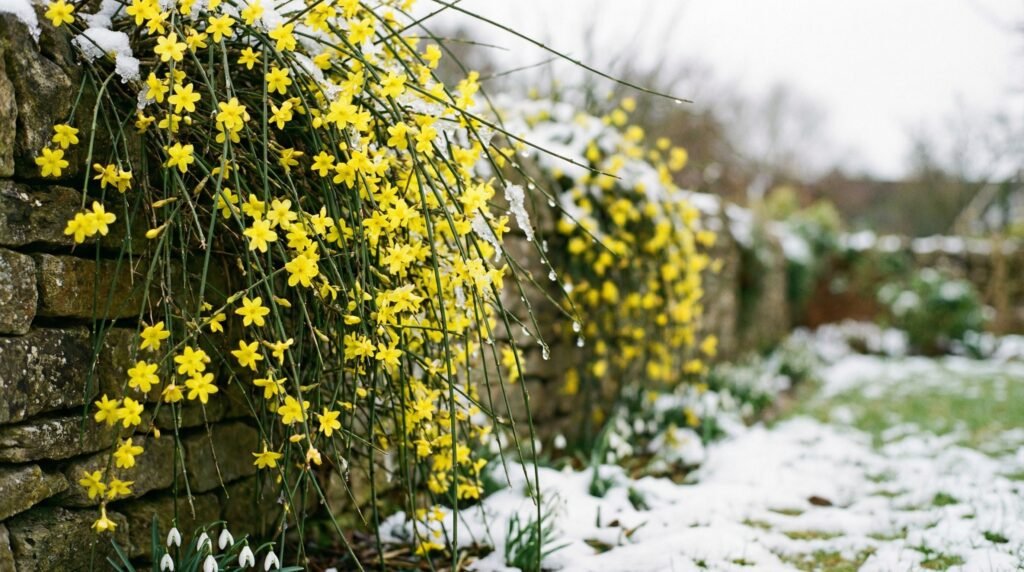
There is a short window in the gardening year when almost nothing is in flower. The last autumn leaves have gone. Spring bulbs are still underground. And the garden looks like it has given up entirely. Winter jasmine does not care about any of that. It opens its small yellow flowers on bare green stems right in the middle of this dead stretch, sometimes as early as December, and keeps going into March.
Jasminum nudiflorum is not what most people picture when they hear “jasmine.” It has no scent. It is deciduous, not evergreen. It does not twine on its own. But it does something almost no other hardy shrub can do: it produces a reliable, generous show of color during the months when gardeners are starved for it.
Why winter jasmine blooms when nothing else does
Most plants flower on the current season’s growth. Winter jasmine is different. It sets its flower buds during summer on stems that matured the previous year. By autumn, those buds are already formed and dormant, waiting. When temperatures stay above roughly minus 5 degrees Celsius for a few days, the buds break open. A mild spell in January can trigger a flush of bloom. A cold snap will pause things, but the remaining buds just wait for the next warm window.
This is why winter jasmine blooms in waves rather than all at once. You might see a scattering of flowers in late December, a heavier flush in February, and a final push in early March. Each individual flower lasts about two weeks, but the succession keeps the display going for two or three months.
The plant itself is tough. It is hardy to USDA zone 6, roughly minus 23 degrees Celsius. The flowers can handle light frost, though a hard freeze will brown the open petals. New buds behind them will open as soon as things warm again.
One reason winter jasmine succeeds where other plants stall is that it does not need pollinators to look good. The flowers are produced for show and seed, yes, but the plant spreads readily by layering (stems that touch the ground root on their own). It does not depend on bees or butterflies that are absent in January. This is a plant built to endure, not to attract.
Where to plant winter jasmine in your yard
Winter jasmine wants a spot against a wall or fence, ideally south or west facing. This gives it reflected warmth in winter, which brings the flowers out earlier and protects them from the worst freezes. A south-facing house wall in a sheltered spot can push blooming back into December in milder climates. A north-facing wall will still work, but expect flowers closer to late February or March.
The plant is not a true climber. It has no tendrils, no twining habit, no aerial roots. Left on its own, it grows as a sprawling, arching shrub that mounds up to about 3 meters wide and tall. The stems are long, flexible, and angular. If you want it growing upward on a wall, you need to tie it in or weave the stems through trellis panels. More on that in the pruning section.
Winter jasmine also works well at the top of a retaining wall or bank, where the stems can cascade downward. This is one of its best uses. The arching green stems drape over the wall face, and when the yellow flowers open in midwinter, the effect is striking against stone or brick.
Avoid planting it in the middle of a border where it has nothing to lean against. Without support or a slope to tumble down, it becomes a messy mound that swallows its neighbors. Give it a job: cover a wall, drape over a ledge, fill a gap between a fence and a path. It performs best with a clear role.
Spacing depends on your goal. For a wall covering, plant one every 2 to 2.5 meters. The stems grow quickly and will fill the gaps within two or three years. For a bank or slope, space them at 1.5 meters for faster coverage.
Sun or partial shade both work fine. Full shade will reduce flowering, but the plant will survive. In hot summer climates (zone 8 and above), some afternoon shade actually helps prevent the stems from looking scorched and tired by autumn.
Soil, watering, and feeding through the seasons
Winter jasmine is not fussy about soil. Clay, loam, chalk, sand: it grows in all of them. It tolerates poor, thin soils that would starve a rose. It handles alkaline conditions without complaint. The one thing it genuinely dislikes is waterlogged ground. If water sits around the roots for weeks at a time, the stems die back from the base.
At planting time, dig a hole about twice the width of the pot and the same depth. If you are planting against a house wall, position the root ball at least 30 centimeters out from the foundation, where rain can actually reach the roots. Wall footings create a dry rain shadow, and a new plant tucked right up against the brickwork will struggle to establish.
Water thoroughly after planting and keep the soil moist through the first summer. Once established (usually after one full growing season), winter jasmine is remarkably drought tolerant. You will rarely need to water a mature plant in the ground except during prolonged dry spells in summer.
Feeding is simple. A single application of general-purpose granular fertilizer in April, after flowering finishes and before the new growth starts, is enough. Scatter a handful around the base and let rain wash it in. If your soil is very poor, a second feed in midsummer helps the plant build strong stems that will carry next winter’s flowers. Do not feed after August. Late feeding pushes soft new growth that is vulnerable to frost.
Mulch the base with compost or bark chips in spring. This conserves moisture, suppresses weeds, and slowly improves the soil. Keep the mulch a few centimeters away from the main stems to avoid stem rot.
Pruning and training on walls or trellises
Pruning winter jasmine is straightforward once you understand the timing. The plant flowers on stems that grew the previous summer. So you prune immediately after flowering finishes, usually in March or early April. This gives the plant the entire growing season to produce new stems that will carry next year’s flowers.
If you prune in summer or autumn, you are cutting off the stems that hold next winter’s flower buds. You will get a tidy plant and no blooms. This is the single most common mistake people make with winter jasmine.
How to prune
After the last flowers fade, cut back all the stems that have just flowered to a strong pair of buds or a strong side shoot. On a wall-trained plant, this usually means cutting the flowered stems back to the main framework of older branches that are tied to the wall. On a free-standing shrub, cut the flowered stems back by about one-third of their length.
Every three or four years, do a harder renovation. Remove one in three of the oldest, woodiest stems right down to the base. This keeps the plant young and productive. A winter jasmine that is never renewed from the base becomes a tangled mass of old wood with flowers only at the tips, well out of sight.
Training on a wall
Fix horizontal wires to the wall at 30 to 45 centimeter intervals, using vine eyes and galvanized wire. As the stems grow, fan them out and tie them to the wires with soft twine or plant ties. Aim for an even spread across the wall face. Remove any stems that grow straight out from the wall at right angles, since these spoil the flat shape and catch wind.
The key is to create a framework of permanent main stems that are tied to the wires, with younger flowering stems growing from them. After flowering, you cut the young stems back to the framework, and new ones grow during summer to replace them.
Training on a trellis or fence
Trellis panels offer a simpler approach. Weave the flexible young stems through the trellis openings as they grow, and they will hold themselves in place. Check in midsummer and again in autumn, tucking in any wayward stems. With trellis, the pruning technique is the same, but you can be slightly less precise since the stems weave and hold more naturally.
One tip: do not use a trellis that is mounted flush against a wall with no gap behind it. The stems need a little air circulation to stay healthy. Spacer blocks behind the trellis, creating a 3 to 5 centimeter gap, make a real difference.
Pairing winter jasmine with other early bloomers
Winter jasmine looks its best when it has company. A wall covered in yellow jasmine with nothing happening at its feet feels incomplete. Planting early-flowering companions at the base turns a nice feature into a proper seasonal display.
Snowdrops (Galanthus nivalis) are the obvious partner. They flower at the same time, their white nodding bells contrasting with the yellow jasmine above. Plant them in informal drifts along the base of the wall, and they will naturalize over the years.
Winter aconites (Eranthis hyemalis) are another strong match. Their buttercup-yellow flowers sit in a ruff of green leaves right at ground level. They bloom from January to March and echo the yellow of the jasmine without competing with it.
Hellebores, particularly Helleborus orientalis hybrids, give you a different flower shape and a wider color range: white, pink, plum, green, near-black. They bloom from February into April, overlapping with the tail end of the jasmine’s season and carrying the display forward. Plant them 40 to 50 centimeters from the wall so they get enough rain.
For something lower and spreading, try Cyclamen coum. It flowers from January to March in shades of pink, magenta, and white, with rounded leaves that are often patterned with silver. It thrives in the dryish, partly shaded conditions you often find at the base of a wall.
If you want a second wall shrub to take over when the jasmine finishes, consider Chaenomeles (flowering quince). It blooms in March and April in red, pink, orange, or white, and trains flat against a wall in the same way. Plant one a couple of meters along from the jasmine, and you get a seamless handoff of color from midwinter into mid-spring.
For a subtler companion, try Sarcococca confusa (sweet box). It is a small evergreen shrub with tiny white flowers in January and February. The flowers are nearly invisible, but the scent is remarkable: sweet, warm, and strong enough to reach you from two meters away on a still day. Plant it near a door or path at the base of your jasmine wall to add fragrance to the visual show.
Avoid pairing winter jasmine with plants that need rich, moist soil. Conditions at the base of a wall tend to be dry and lean, and the jasmine is well adapted to that. Choose companions that share those preferences, and the whole planting will be easier to maintain.
A mature, well-trained winter jasmine on a sunny wall is one of the most reliable sights in a winter garden. It asks very little. No spraying for pests (it has almost none). No staking. No complicated feeding schedule. Just a spring prune, a bit of tying in, and the patience to let it do what it does best: flower when nothing else will.