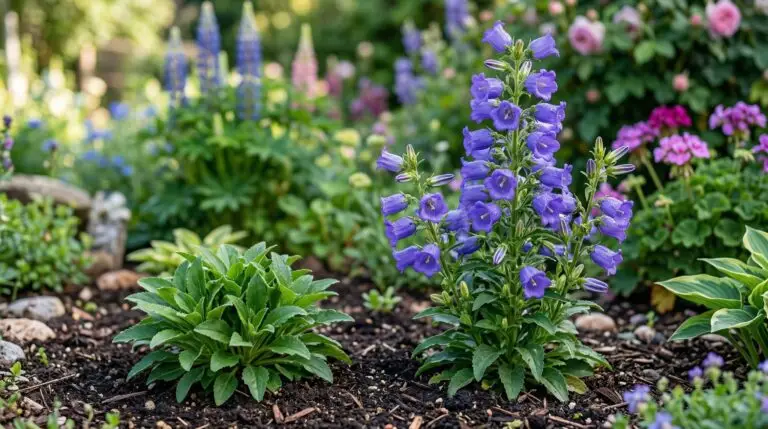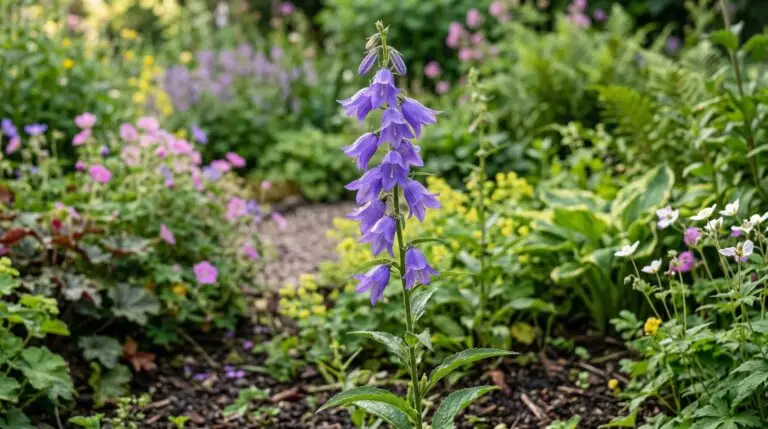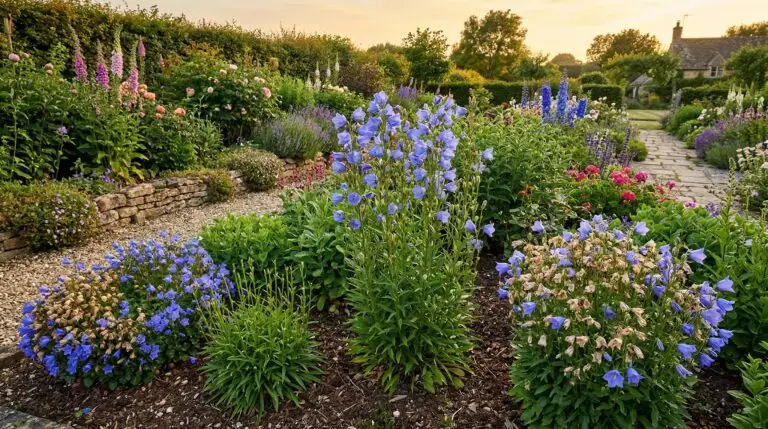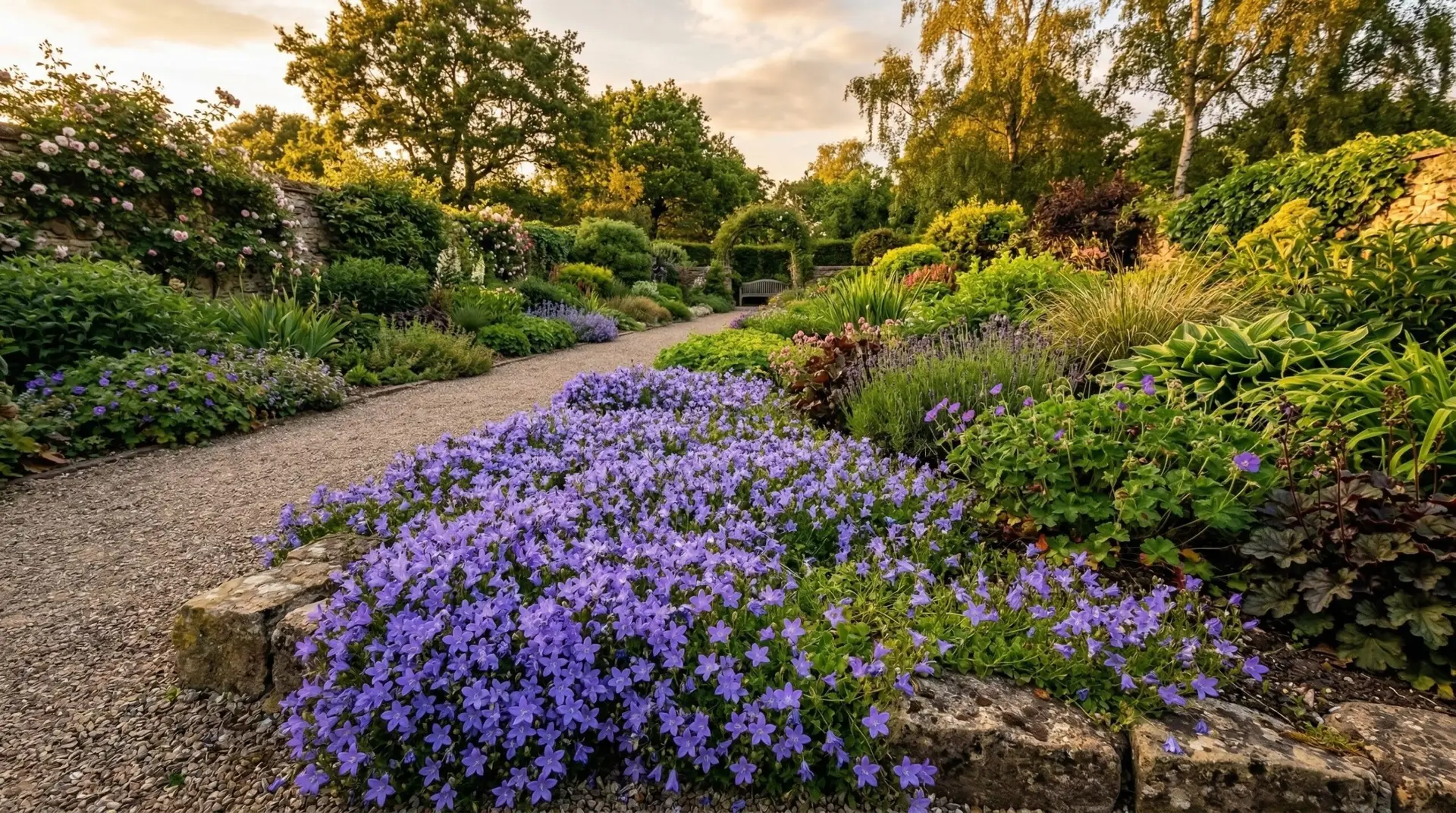
A successful garden composition relies heavily on the transitional spaces between major structural elements and the ground plane. Hardscaping materials like stone, brick, and concrete provide necessary geometry, but they require softening to feel integrated into a living space. Low-growing Campanula species function perfectly as textural mortar in these transitional zones. These creeping bellflowers operate as functional fillers and trailing accents that bridge the gap between rigid architecture and loose organic forms. When you look at a bare retaining wall or a newly laid stone path, the eye catches on the harsh right angles and abrupt edges. Introducing a bellflower ground cover breaks those sightlines, pulling the visual weight downward and grounding the heavier elements in a cool pool of color.
Softening hardscape with creeping forms
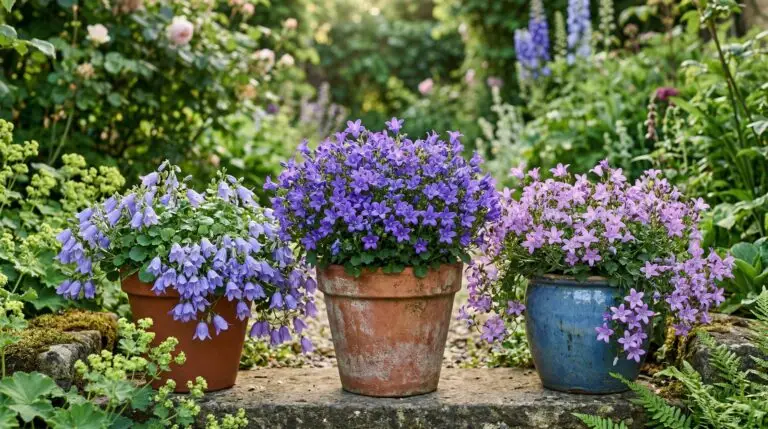
When designing around vertical drops or terraced retaining walls, the trailing habit of Serbian bellflower (Campanula poscharskyana) offers an ideal solution for breaking up large expanses of masonry. This specific species possesses a vigorous, cascading form that actively seeks out crevices and spills elegantly over stone edges. The foliage consists of slightly coarse, heart-shaped leaves that create a dense mat, completely obscuring the soil and suppressing weed competition. As the stems elongate, they create a waterfall effect that draws the eye down the face of the wall, connecting the upper planting tier with the ground below. The star-shaped, lavender-blue flowers emerge in profusion, transforming a static stone barrier into a dynamic, living surface. To maximize this effect, position the plants right at the edge of the coping stones where their stems can drape without obstruction.
Dalmatian bellflower (Campanula portenschlagiana) provides a slightly different structural presence when planted in rock gardens or along raised borders. This species forms a tighter, more mounding silhouette before it begins to trail, making it highly useful as an anchoring plant at the corners of stone steps. The blooms are deeper purple and more distinctly bell-shaped, creating small pockets of intense shadow and color against light-colored limestone or granite. Because it stays relatively compact, you can use it to define edges without worrying that it will consume neighboring, less vigorous alpine plants. The visual contrast between the delicate, cool-toned flowers and the rough, sun-baked surface of natural rock creates a highly satisfying textural tension. Placing these mounding forms at irregular intervals along a wall feels much more natural than spacing them in rigid, predictable lines.
Creating rhythm between stepping stones
Pathways require careful consideration regarding scale and proportion, especially when selecting plants to fill the gaps between stepping stones. Tussock bellflower (Campanula carpatica) answers this specific design need perfectly because it forms neat, restrained mounds that rarely exceed eight inches in height. When you plant between flagstones, the foliage must stay low enough to avoid tripping hazards while remaining robust enough to handle occasional foot traffic at the edges. The fine texture of the leaves contrasts sharply with the flat, heavy planes of the paving stones, adding a layer of intricate detail right at the viewer’s feet. As visitors walk down the path, the repeating clusters of blue or white flowers establish a visual rhythm that guides them forward. You want to avoid planting every single crevice, as leaving some negative space allows the shape of the stones to remain legible.
Color selection along pathways influences how the space feels and how fast a person moves through it. Cool colors like the classic bellflower blue tend to recede visually, making narrow walkways feel slightly wider and more expansive. If you mix the blue varieties with pure white cultivars, you create a dappled effect that mimics sunlight filtering through a tree canopy. This combination works exceptionally well in lightly shaded transition zones where you want to brighten the ground plane without introducing jarring, warm-toned flowers. The white blooms reflect ambient light during the early evening, extending the usability and visual interest of the garden path well past sunset. Keeping the color palette restricted to blues, purples, and whites along a single path maintains a sense of calm continuity.
Color theory and companion plantings
Understanding how creeping bellflower interacts with other low-growing plants allows you to build highly textured, multi-layered ground cover compositions. A classic pairing involves matching the cool purple tones of the bellflower with the bright, clean white of Sweet Alyssum. The alyssum provides a fine, frothy texture that contrasts sharply with the slightly larger, more defined bells of the Campanula. Because both plants share a similar low-growing, spreading habit, they weave together into a continuous carpet that suppresses weeds and covers bare soil completely. This combination feels particularly fresh in spring and early summer, offering a crisp, tailored look that works well in both formal courtyard settings and loose cottage borders. The scent of the alyssum also adds an invisible layer of sensory design to the planting scheme.
For a more dramatic color impact, you can contrast the blue bellflowers with the saturated pinks and magenta tones of creeping Phlox. This pairing relies on analogous colors on the cool side of the color wheel, creating a rich, jewel-toned effect that demands attention. The needle-like foliage of the phlox introduces a distinctly different leaf shape, ensuring the planting remains visually interesting even after the primary flush of spring blooms fades. When designing this combination on a slope or retaining wall, plant the phlox slightly higher up the grade so its stiff, spreading stems intermingle with the softer, trailing stems of the bellflower below. You can also introduce silver-leaved companions like woolly thyme or dwarf artemisia to break up the intense floral display and provide a neutral resting place for the eye. The silver foliage functions as a mediator, making the blues look bluer and the pinks look more deliberate.
Managing spread and seasonal structure
A successful ground cover strategy requires thinking about the garden during the dormant season. Many low-growing bellflowers retain their basal foliage through mild winters, providing a valuable layer of green structure when the rest of the garden has faded. This semi-evergreen habit keeps rock walls and pathway edges looking intentional rather than abandoned during the colder months. The leaves may take on a slight purplish or bronze cast in freezing weather, which adds a subtle, earthy tone to the winter garden. When spring arrives, this existing foliage base allows the plant to flush out quickly and establish its territory before annual weeds have a chance to germinate. You should shear the plants back lightly after their main summer bloom to encourage fresh basal growth and maintain a tight, dense form that carries through the autumn.
Control and maintenance are fundamental components of garden design, especially when working with spreading ground covers. While Serbian and Dalmatian bellflowers are excellent for covering ground quickly, their vigorous nature means they can easily swallow smaller, more delicate alpine specimens if left unchecked. You must plan for this expansion by giving them adequate physical space and using the hardscape itself as a natural boundary. A wide stone border or a deep gravel trench can effectively corral the spreading stems and keep the plants exactly where you want them. If the bellflowers begin to encroach on a pathway, simply using a sharp spade to cut a clean, vertical line along the stone edge restores the geometry of the design immediately. This sharp, manicured edge against the loose, organic form of the plant creates a highly satisfying visual contrast.
The most effective way to use creeping bellflowers is to treat them as a unifying thread that runs through the entire garden composition. Instead of isolating them in a single rock garden, repeat small patches of the same species at major intersection points along your pathways and walls. This repetition trains the eye to recognize the plant as a deliberate design motif, pulling the disparate parts of the yard into a cohesive whole. When you place a cluster of blue flowers at the base of a stone step, and the viewer sees that same blue spilling over a wall twenty feet away, the space feels connected and deeply planned. You can apply this principle immediately by taking a single flat of Campanula portenschlagiana and dividing it into several small plugs, distributing them strategically along the main sightline of your garden. The resulting visual rhythm will transform a collection of individual hardscape elements into a unified, flowing environment.