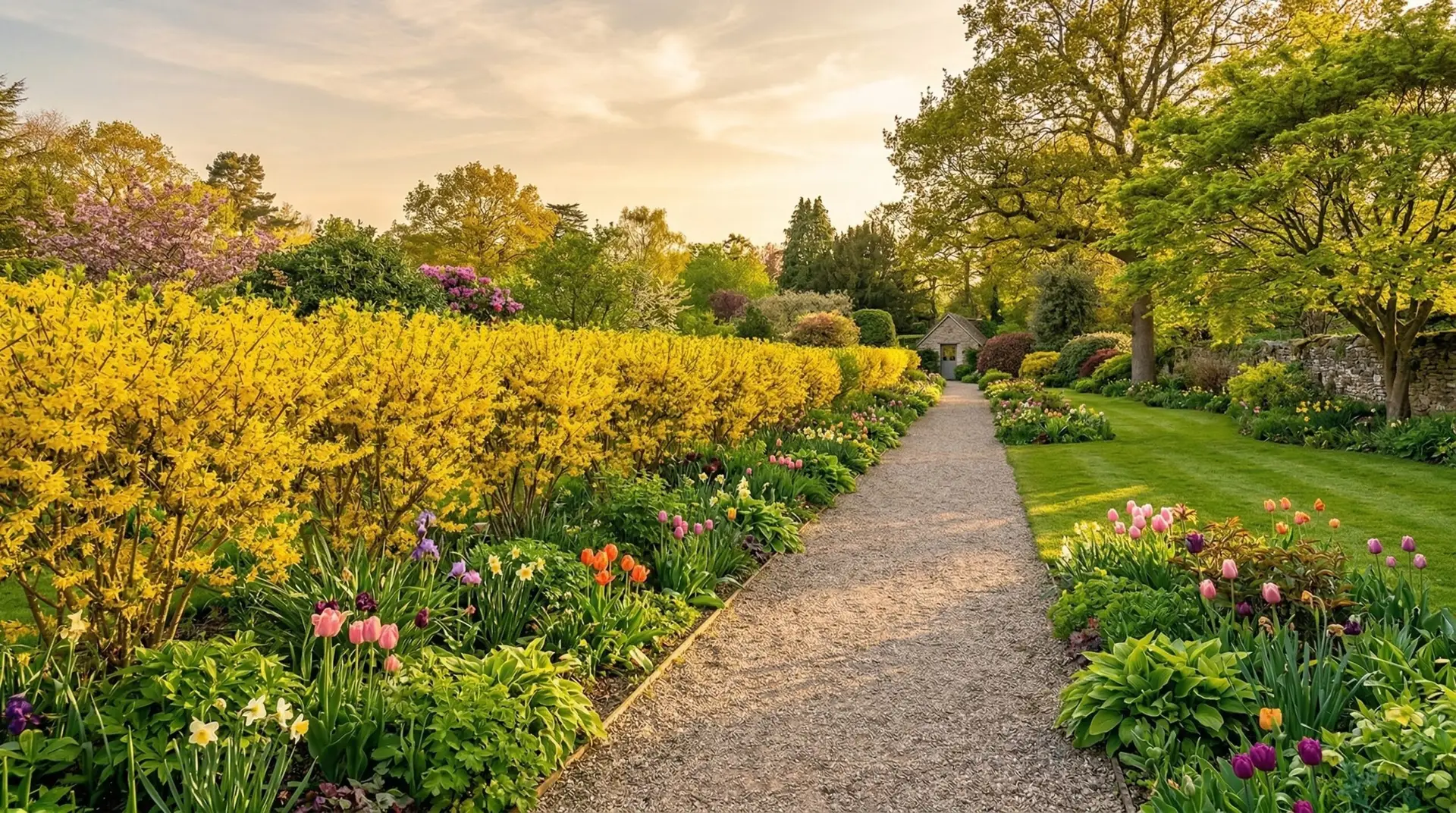
Before you commit to a long row of bright yellow shrubs, you need to evaluate exactly what you want your property line to do. A forsythia privacy screen offers a quick solution for creating boundaries and blocking unwanted views during the growing season. Many homeowners choose this plant specifically because a forsythia fast growing habit quickly fills empty spaces and establishes a mature look within just a few years. You must decide early on whether you want a tightly clipped formal wall of green or a loose, wild boundary that takes up significantly more yard space. Setting up a living fence requires an upfront investment of time to dig a long trench or multiple large holes, plus a commitment to regular watering during the first year. By planning your spacing, budget, and long-term pruning strategy before you buy a single plant, you save yourself the headache of ripping out overgrown shrubs later.
Contents 5 sections
Assessing your site and selecting the right variety
Your first planning step is a realistic evaluation of the physical space where you intend to plant. Forsythia requires at least six hours of direct sunlight each day to produce a dense canopy of leaves and a heavy set of spring flowers. If your planned hedge line runs through a heavily shaded area, the plants will grow leggy and thin, completely defeating the purpose of a privacy screen. You also need to measure the available width along your property line because an unpruned forsythia hedge easily spreads ten feet wide. When calculating your budget, you have to decide between buying small bare-root plants in early spring, which cost less but take longer to provide privacy, or investing in larger potted shrubs for immediate impact. You might also consider mixing your boundary with a lilac to extend the flowering season and add fragrance to the yard once the early yellow blooms fade.
Preparing the ground and planting for a solid screen
Correct spacing determines the long-term success of your hedge, and getting this wrong is the most common mistake impatient gardeners make. For a dense, impenetrable barrier, you should space the individual shrubs three to four feet apart, measuring from the center of one plant to the center of the next. Placing them closer than three feet creates immediate gratification but leads to poor air circulation, fungal diseases, and a tangled mess of dead wood within five years. Before planting, clear a strip of grass at least four feet wide along the entire proposed hedge line to eliminate weed competition during the crucial establishment phase. Digging individual holes is fine for a short run, but renting a small trencher or hiring help to dig a continuous trench makes planting a long row much more efficient. You must commit to deep watering twice a week for the entire first growing season to encourage the deep root systems necessary for drought tolerance in later years.
Managing growth rate expectations and pruning styles
Understanding the timeline of a forsythia fast growing shrub helps you set realistic expectations for your landscape project. In optimal conditions, these plants add up to twenty-four inches of new growth per year, meaning a small starter plant needs about three to four years to become a functional eye-level screen. You have to choose your maintenance style early because an informal hedge requires minimal pruning and retains its natural arching fountain shape, while a formal hedge demands shearing several times a summer to keep strict geometric lines. If you choose the formal sheared route, you will sacrifice most of the spring flowers because constant trimming removes the old wood where the next year’s buds form. For an informal look that maximizes blooms, your maintenance commitment involves spending one weekend every spring immediately after flowering to remove the oldest, thickest branches right at the ground line. This renewal pruning forces fresh green shoots from the base and prevents the hedge from becoming a hollow shell of leaves with bare wooden legs.
Evaluating the year-round structure and maintenance
A practical garden plan accounts for how a plant looks and functions during all twelve months, rather than focusing only on its brief blooming window. After the yellow flowers drop in mid-spring, your forsythia hedge becomes a solid wall of medium green foliage that provides excellent visual blocking through the summer. In autumn, the leaves turn a muted purplish-yellow before dropping, leaving a dense thicket of bare brown branches through the winter months. This winter silhouette still provides a physical barrier and breaks up harsh winds, but it will not give you complete visual privacy from your neighbors. To create a more interesting year-round boundary, you can alternate your planting with other tough shrubs like viburnum for fall berries or mock orange for early summer white flowers. Your long-term maintenance plan must include checking the interior of the hedge each winter to clear out dead leaves and broken branches that accumulate inside the dense twig structure.
Your immediate action plan for a spring hedge
To get started this week, take a measuring tape outside and determine the exact length of your proposed boundary line. Divide that total length in feet by four to calculate exactly how many shrubs you need to purchase for proper spacing. Next, observe the planting line at three different times during the day to verify the area receives the necessary six hours of direct sunlight. Call your local utility company to mark underground lines before you do any digging, especially since a long hedge requires extensive excavation. Finally, research local nurseries to compare the costs of bare-root bundles versus container plants so you can finalize your project budget before the spring planting window opens.
More About Forsythia

Companion plants for forsythia: what to grow, what to avoid
Dwarf forsythia varieties for small gardens that still deliver big spring color
Forcing forsythia branches indoors for early spring sunshine on your kitchen table
Forsythia flower meaning and why this golden shrub signals winter is finally over
How to grow forsythia for an explosion of golden yellow blooms in early spring

Best forsythia varieties from compact Show Off to weeping Arnold Dwarf
When and how to prune forsythia without accidentally cutting off next year’s flowers
Why your forsythia blooms only on the bottom and how to fix bare leggy branches
How to propagate forsythia from cuttings and tip layering for free new plants
Enjoying our flower guides? Add YourFlowersGuide as a preferred source on Google. It helps more readers find us.
Add to Preferred Sources