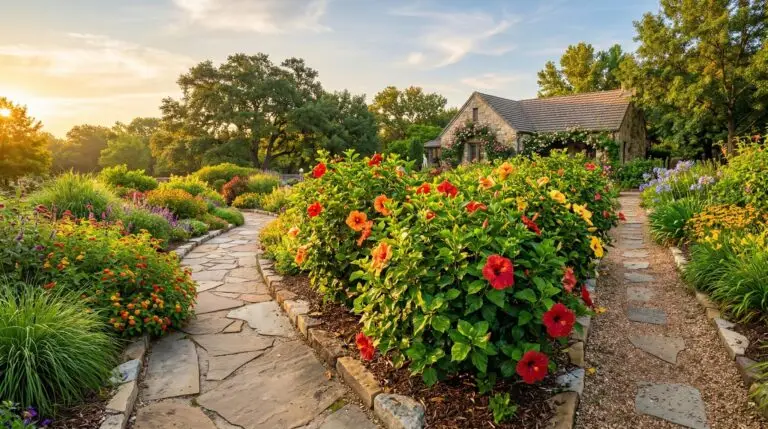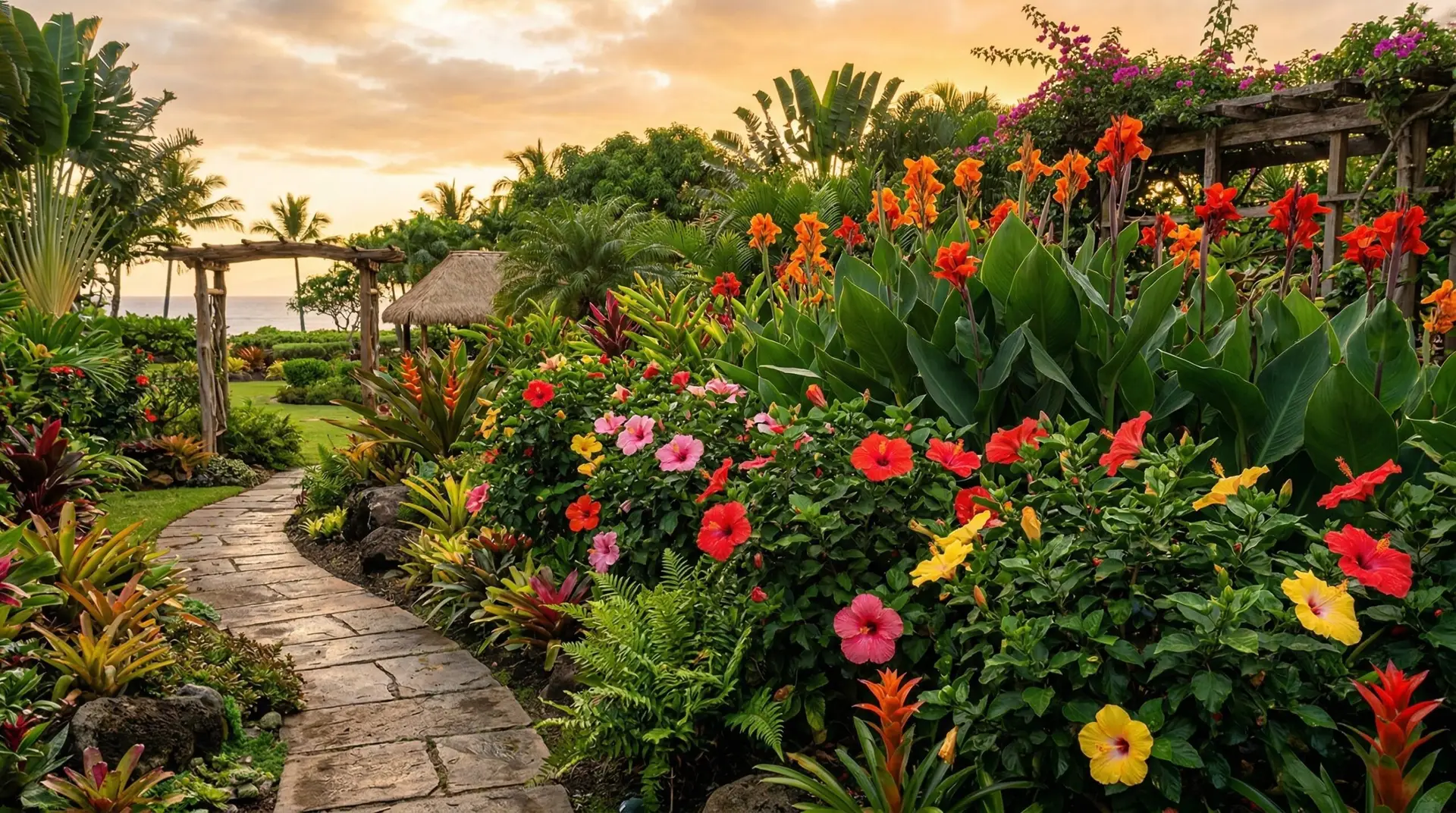
When designing a tropical-themed garden border, hibiscus is a powerful structural anchor. The plant commands attention with its substantial, woody framework and large, disc-shaped flowers that draw the eye immediately. As a medium to large shrub, it holds significant visual weight and dictates the scale of the surrounding composition. Understanding what to plant with hibiscus requires looking past the flowers to analyze the plant’s coarse foliage and upright, slightly spreading habit. You need companions that either contrast sharply with this texture or match its bold scale to create a cohesive tropical garden design. Placing a hibiscus in the middle or back of a border establishes a solid green backdrop that allows you to layer smaller, more delicate plants in the foreground while relying on taller architectural elements behind it.
Color theory plays a central role when selecting hibiscus companion plants for your border. Tropical design relies heavily on analogous color schemes, where warm reds, oranges, and yellows sit side by side to generate visual heat. A red or orange hibiscus pairs naturally with plants bearing similar warm tones, creating a harmonious and unified planting block. Conversely, you can create sharp, intentional drama by placing a yellow hibiscus against deep purple or nearly black foliage. The broad, flat face of the hibiscus flower absorbs light, meaning it benefits from neighboring plants that catch the sun differently, such as glossy leaves or fine, feathery textures. Balancing these bold flower colors with plenty of rich, dark green foliage prevents the border from looking chaotic and gives the eye a place to rest between the bright focal points.
Building structure with architectural foliage
To ground the visual weight of a hibiscus, you need companions with equally assertive, architectural foliage. Elephant ears, including both Alocasia and Colocasia varieties, provide massive, shield-shaped leaves that contrast effectively with the smaller, serrated leaves of the hibiscus. Positioning these giant leaves near the base or slightly behind your hibiscus creates a dense, jungle-like atmosphere that defines tropical garden design. The dark, moody foliage of a black elephant ear creates a heavy backdrop that pushes the bright hibiscus flowers forward in the visual plane. You can also incorporate the strong, upright paddle leaves of a bird of paradise to introduce vertical geometry. The stiff, structural form of the bird of paradise breaks up the rounded, mounding habit of the hibiscus shrub and adds height to the back of the border.
Continuing the theme of bold foliage, you can introduce vertical spikes of color and broad leaves to bridge the middle and back of the border. A canna lily is a highly effective transitional plant because it provides both architectural height and flowers that echo the tropical tones of the hibiscus. Planting a drift of dark-leaved cannas behind a yellow or pink hibiscus creates a layered, dimensional look that draws the viewer’s eye upward. The vertical growth habit of the canna lily prevents the garden bed from looking too bottom-heavy, ensuring the composition feels balanced. Because both plants thrive in full sun and appreciate regular moisture, they form a practical and visually cohesive pairing. Grouping these bold plants in clusters of three or five amplifies their impact and prevents the border from feeling like a disconnected collection of single specimens.
Grounding the composition with trailing and mounding forms
While hibiscus and large-leaved tropicals provide height and mass, the lower level of the border requires careful attention to finish the composition. Hibiscus shrubs often develop bare woody stems at their base as they mature, creating a visual void near the soil line. You can solve this design problem by planting mounding or trailing species that spill forward and soften the hard edge of the garden bed. A spreading lantana is an ideal groundcover in this scenario, creating a dense mat of textured foliage and continuous clusters of small flowers. The tiny, clustered blossoms of lantana provide a distinct textural contrast to the massive, single blooms of the hibiscus. By selecting a lantana variety that repeats one of the colors found in the center throat of the hibiscus flower, you create a subtle color echo that ties the entire vignette together.
Vines and climbing plants offer another layer of design potential when integrated into a tropical border. Mandevilla is a classic tropical vine that can be trained up an obelisk or trellis placed directly behind or beside your hibiscus. The trumpet-shaped flowers of the mandevilla share a similar geometric simplicity with the hibiscus, but the twining, delicate stems provide a completely different growth habit. Allowing a mandevilla to weave through the lower branches of a taller hibiscus shrub creates a wild, integrated look that mimics how these plants grow in their natural environments. This layering technique maximizes the vertical space in your garden and adds floral interest even when the hibiscus is between bloom cycles. You can choose a white mandevilla to cool down a border filled with hot reds and oranges, providing a crisp, clean contrast that sharpens the surrounding colors.
Creating a hardy tropical aesthetic
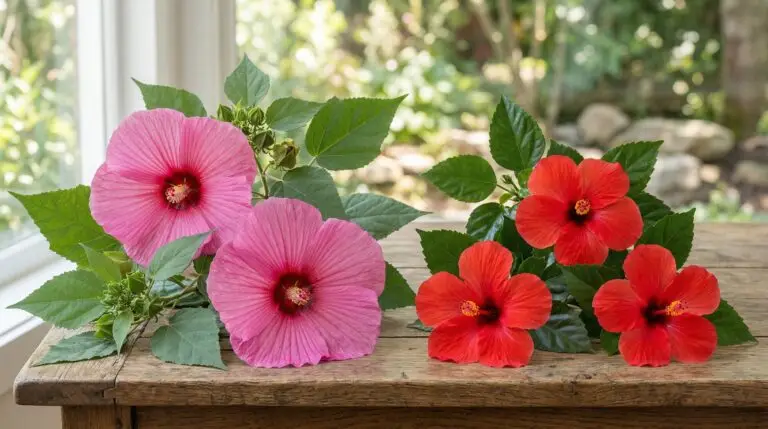
You do not need to live in a frost-free climate to achieve the look of a lush, exotic border. Hardy hibiscus varieties produce some of the largest flowers in the garden and die back to the ground each winter, making them perfect anchors for a cold-hardy tropical design. Because hardy hibiscus emerges quite late in the spring, you must plan the surrounding space carefully to avoid large empty gaps early in the season. Pairing these robust perennials with ornamental grasses is a highly effective design strategy that balances the massive, dinner-plate-sized flowers with fine, kinetic texture. The rigid, upright stems of the hardy hibiscus look entirely different when surrounded by the soft, arching blades of a maiden grass or switchgrass. When the wind blows, the movement of the grasses brings the entire border to life, contrasting with the static, solid presence of the hibiscus.
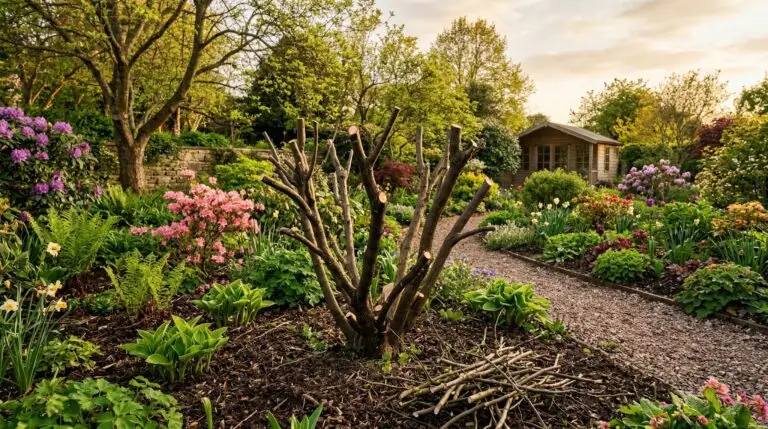
The pairing of hardy hibiscus and ornamental grasses also solves the issue of seasonal interest and winter structure. Once the first hard frost hits, the hibiscus drops its leaves and leaves behind stark, woody seed capsules that hold their shape well into the cold months. Leaving these architectural stems standing alongside the bleached, tan foliage of dormant ornamental grasses creates a distinct, sculptural winter silhouette. During the summer months, the green blades of the grasses act as a neutral filler that separates different colors of hibiscus, preventing the border from becoming visually overwhelming. You can plant a low-growing grass like Japanese forest grass in the shaded foreground cast by the hibiscus canopy to add a splash of chartreuse. This combination of coarse, broad leaves and fine, linear foliage is a fundamental principle of garden design that works in almost any climate.
Designing for seasonal transitions
A successful garden border must rely on more than just peak summer blooms to maintain its structure and appeal. Hibiscus plants often take time to build up their floral display, meaning the early summer garden needs other elements to carry the visual load. Incorporating early-blooming perennials or plants with highly colored foliage ensures the space looks intentional from spring through fall. Coleus or caladiums planted in the dappled shade beneath a mature hibiscus provide immediate color and pattern long before the shrub produces its first bud. When the hibiscus finally reaches its peak in late summer, these foliage plants recede into the role of a colorful, supportive carpet. Thinking about the garden as a sequence of events rather than a single static picture allows you to design a border that evolves gracefully over the months.
The most effective way to elevate your tropical garden design is to practice the principle of massing and repetition. Rather than planting one hibiscus, one grass, and one vine, group your plants in generous drifts to create a rhythm that guides the eye down the border. You might plant three identical hibiscus shrubs in a loose triangle, surrounded by a sweeping curve of low-growing lantana and backed by a dense stand of cannas. This approach transforms a collection of individual plants into a unified, deliberate composition with clear foreground, middle, and background layers. Repetition of color and form creates a sense of calm within the inherently loud and bright palette of tropical plants. By treating your hibiscus as the structural anchor and selecting companions that contrast in texture but harmonize in color, you will build a sophisticated and long-lasting garden space.