Peonies vs Garden Roses Which Is Better for Your Bouquet
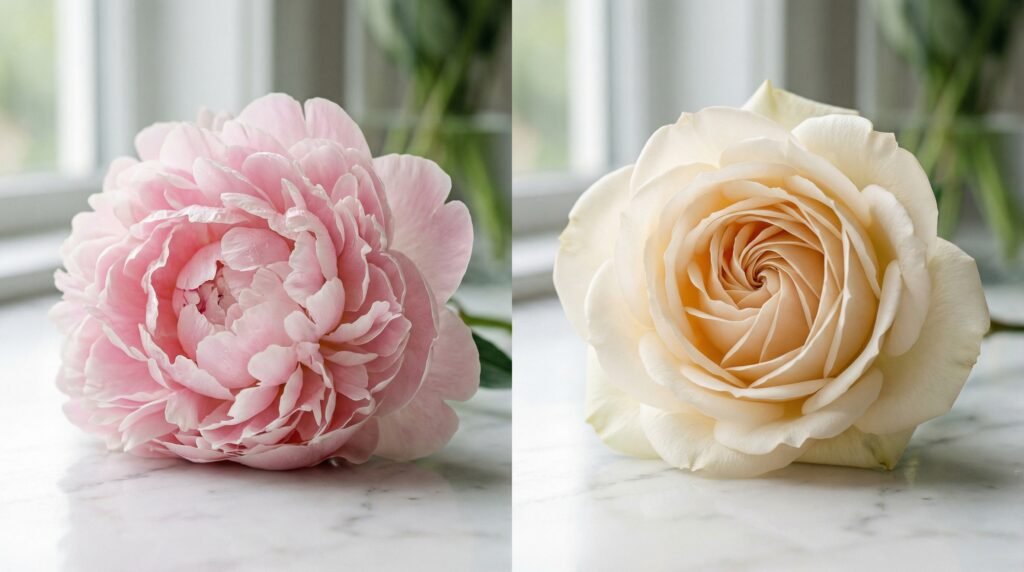
Two flowers that look similar but behave differently
Peonies and garden roses get compared constantly – and it makes sense. Both are lush and full. Both come in soft pinks, creams, and whites. Both photograph the way wedding clients dream about. But once you understand how each flower actually behaves, the choice between them becomes a lot clearer.
This is not about which one is objectively better. It is about which one fits your timeline, your climate, your budget, and the look you are going for.
Visual differences: what you are actually looking at
From across a room, a full-bloom peony and a large garden rose can look nearly identical. Up close, they are quite different.
A peony opens to a wide, almost flat or dome-shaped bloom with layers upon layers of petals that have no real center structure. The petals are soft, almost tissue-like, and they tend to face outward and downward as the flower matures. A fully open Sarah Bernhardt peony can reach 4 to 5 inches across. The overall impression is generous, overflowing, almost slightly undone.
A garden rose (David Austin varieties in particular) has a more defined center – a tight spiral that stays visible even when the bloom is fully open. Petals are slightly firmer and hold their shape better over time. Blooms typically range from 3 to 4.5 inches, slightly smaller than a large peony. The overall impression is more structured and precise.
In a mixed bouquet, this structural difference matters. Peonies tend to be the flower the eye lands on first – they dominate in the best way. Garden roses sit beside them rather than competing.
Fragrance: which one actually smells better
Both can be fragrant, but the experience is different.
Peony fragrance is warm, sweet, and slightly powdery. It carries. People walking past a peony bouquet will notice it. Varieties like Sarah Bernhardt and Festiva Maxima are considered among the most fragrant cut flowers available. That said, not every peony variety is strongly scented – some, particularly red and dark pink varieties, have little to no fragrance.
Garden roses from David Austin – varieties like Juliet, Miranda, and Constance – were specifically bred to have old-rose fragrance. The scent tends to be more complex: myrrh, citrus, tea, honey notes depending on the variety. It is generally softer and closer-range than peony fragrance, noticeable when you hold the bouquet rather than from across a reception room.
If fragrance is a priority for you specifically, check the variety rather than assuming the flower type. A strongly scented peony will outperform a mildly scented garden rose, and vice versa.
Vase life and durability: the real numbers
This is where garden roses generally have an edge.
Garden roses typically last 7 to 10 days in a vase with clean water and proper conditioning. They are available year-round, tolerate temperature fluctuation reasonably well, and hold their form as they age – they close at night and reopen, which extends the visual freshness.
Cut peonies last 5 to 7 days once fully open, sometimes a bit longer if they were cut at the marshmallow stage (firm but showing color) and conditioned properly. They are sensitive to ethylene gas – keep them away from fruit bowls – and they wilt faster in warm or dry environments. Once a peony is fully open, it is beautiful for two to three days and then starts to drop petals.
For a wedding bouquet that needs to survive a 6-hour reception in a warm venue, garden roses offer more reliability. For a bouquet that will be photographed during a morning ceremony and then retired, peonies are perfectly capable.
Price and availability: when each flower makes sense
Peonies are seasonal. In the US, local peonies are available from late April through June, peaking in May. During this window, prices are reasonable – a wholesale stem might cost $3 to $6 depending on grade and variety. Outside of peak season, imported peonies can run $8 to $15 per stem or more, and quality is less consistent.
Garden roses are available year-round from growers in Colombia, Ecuador, and the Netherlands. Prices are more stable: typically $3 to $7 per stem wholesale for David Austin varieties, with smaller variations through the year. For a summer or autumn wedding, garden roses often represent better value.
One practical consideration: stem count per visual dollar. A single large peony head takes up the same visual space as two or three garden roses. If peonies are in season and priced well, they can actually be the cost-efficient choice for volume. If they are out of season, the math flips.
The honest answer for most couples: use peonies as the focal flowers if your wedding falls in May or June, and lean on garden roses to build out the rest of the arrangement. Outside that window, garden roses can carry the whole design without substitution.