Peony Centerpieces for Weddings and Events
Before you order a single stem
Peony centerpieces look generous by nature. One full-bloom stem can fill a vase in a way that takes five roses to match. That is the good news. The challenging part is planning around a flower that has a narrow season, responds badly to heat, and needs specific handling to arrive open on the right day.
Whether you are designing these yourself or briefing a florist, the decisions below will affect how your tables look, how much you spend, and whether the whole thing holds together from ceremony to dessert.
Low vs tall: which design works where
The choice between a low arrangement and a tall one is mostly about the venue and the conversation you want guests to have.
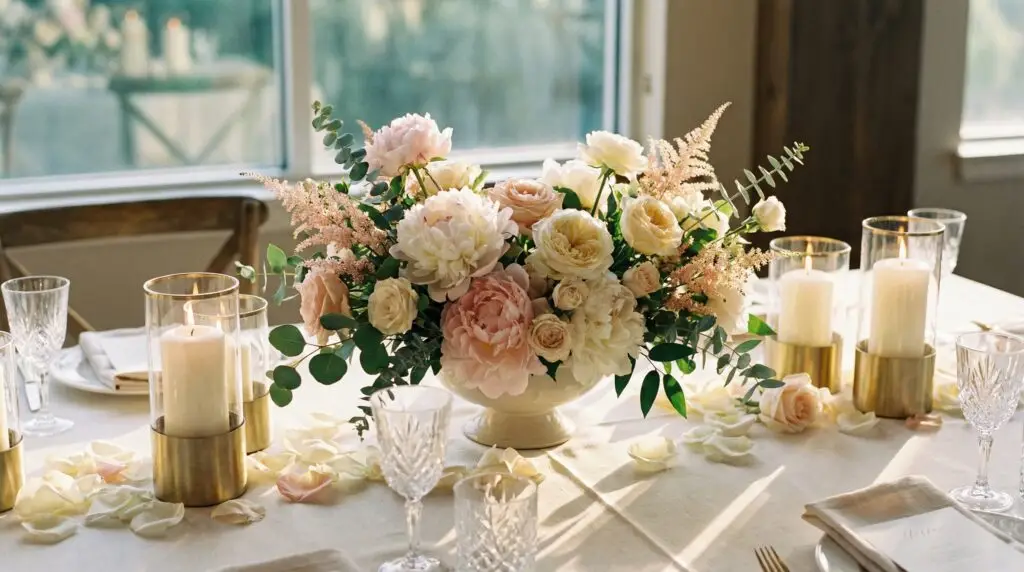
Low centerpieces – typically under 14 inches – sit below eye level when guests are seated. They keep the table feeling open and intimate. People can see each other across the table without craning. This works well in spaces with low ceilings, for smaller round tables, or when you want a relaxed, garden-party feel. A wide, shallow compote vase filled with full-bloom peonies, some scattered astilbe, and a few trailing eucalyptus branches is a classic low arrangement that photographs very well from above.
Tall centerpieces – starting around 24 inches and going up from there – clear eye level entirely, so they do not interrupt sightlines. They make a strong impression in large reception halls, ballrooms, or long rectangular table layouts. The challenge with tall peony arrangements is weight distribution: peony heads are heavy, and a stem placed at the very top of a tall arrangement will droop faster than one sitting in a low vase with proper water access.
A practical middle-ground many florists use: alternate low and tall down long tables, so the visual rhythm changes rather than repeating identically every three feet. This also gives you more design flexibility and can reduce per-table costs.
How many peony stems per centerpiece
There is no single correct number, but there are useful starting points:
For a small bud vase or single-variety low arrangement at a side table or cocktail table: 1 to 3 stems, depending on bloom size. Fully open Sarah Bernhardt heads can be 4 to 5 inches across – one stem in a narrow-necked vase is a complete look.
For a low compote centerpiece (a standard 6 to 8 inch compote on a 60-inch round table): plan for 7 to 12 peony stems. Mix in filler to build volume without spending everything on focal flowers.
For a medium cylinder vase arrangement at 16 to 18 inches tall: 10 to 15 stems work well, with greenery and secondary flowers making up the rest of the volume.
For a tall statement centerpiece in a 28-inch or taller vase: anywhere from 15 to 25 stems, but consider mixing grade A and grade B stems. Grade B heads are slightly smaller but cost noticeably less and look fine once nestled in an arrangement with other flowers.
Mixing peonies with filler flowers
Peonies rarely work alone in a centerpiece – they need support flowers and greenery to create structure and prevent the arrangement from looking top-heavy.
Hydrangea is the most popular pairing. Large hydrangea heads fill space efficiently and cost far less per stem than peonies. A low arrangement that uses 5 peonies and 3 large hydrangea heads looks just as full as one using 10 peonies alone. White, blush, and dusty purple hydrangeas all work depending on your color palette.
Astilbe adds feathery vertical texture that contrasts nicely with the round fullness of peony heads. It comes in blush, white, deep pink, and red. It also hides stems and fills in gaps without adding visual weight.
Baby’s breath has come back strongly in recent years as a filler. Fine-stemmed, airy, and inexpensive – it lightens up an arrangement that might otherwise feel heavy. Works especially well in low compote designs.
For greenery, seeded eucalyptus and Italian ruscus are the workhorses. Both last well in water, have a clean scent, and add a silvery or deep green layer that makes peonies read more clearly by contrast.
Budget-friendly centerpiece ideas
The simplest way to cut centerpiece costs without losing the peony look is to use fewer stems more intentionally.
Buy during peak season. In the US, peonies are cheapest and most available in May and early June. If your event falls then, you are already working with the market. Outside that window, consider supplementing with garden roses or ranunculus, which are available year-round at more stable prices.
Use peonies in bud stage and refrigerate. Florists routinely keep peony buds at 34-36 degrees Fahrenheit to hold them closed, then bring them to room temperature 24-48 hours before the event. This means you can order earlier, store more efficiently, and have full open blooms exactly when you need them.