Peony Companion Planting: What to Grow Next to Peonies
Why companion planting matters for peonies specifically
Peonies bloom for roughly two to three weeks in late spring. That is an exceptionally short window for a permanent garden plant. For the other ten months of the year, what you have is a mound of attractive foliage – green and reasonably lush until midsummer, then increasingly yellow and tired-looking as the season progresses. Without thoughtful companions around them, a peony border goes from beautiful in May to unremarkable by July.
Good companion planting solves this in two ways: it extends the visual interest of the bed across more of the season, and it creates a composition that looks intentional rather than accidental.
Best flowering companions
Alliums
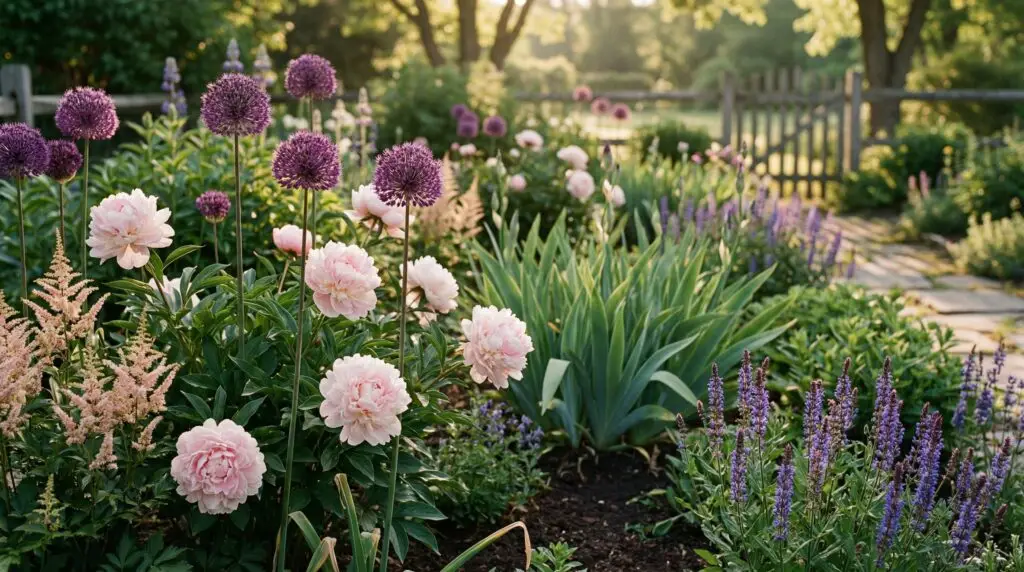
Alliums (ornamental onions) are among the most effective peony companions. They bloom in late May and June on tall, stiff stems topped with spherical purple or white flower heads. The height and the vertical line they create contrast beautifully with the low, round fullness of peony blooms. Plant Allium ‘Purple Sensation’ or the taller ‘Gladiator’ in groups of five or seven behind or between peony clumps. They naturalize over time and come back reliably.
Salvia
Salvia (especially Salvia nemorosa varieties like ‘Caradonna’ or ‘May Night’) flowers in blue-violet around the same time as late peonies and continues into summer. The deep, cool color is an excellent foil for pink and coral peonies, and salvias tolerate the same full-sun, well-drained conditions that peonies prefer. Deadhead them after the first flush and they often rebloom in late summer.
Iris
Bearded iris blooms just before or alongside early peonies, creating a natural succession. The sword-like foliage provides a strong vertical element that complements the softer mound shape of peony plants. Both prefer good drainage and full sun, making them genuinely compatible neighbors.
Baptisia
Baptisia (false indigo) is an underused perennial that blooms in late spring in soft blue or white and develops into a large, architectural shrub-like clump by midsummer – which is exactly when peony foliage starts looking tired. Baptisia is slow to establish but extremely long-lived. It also fixes nitrogen, which is not harmful to peonies and may benefit adjacent plants.
Foliage plants that hide dying peony leaves
By late July, peony foliage typically yellows and begins to look spent. The plants are not dying – they are going dormant – but the effect in a border is not attractive. These foliage plants grown nearby help cover the decline:
Astilbe grows in full mounds of ferny, dark green foliage that fills in beautifully around peony plants as they fade. It blooms in feathery plumes of pink, red, or white in midsummer. Note that astilbe prefers more moisture than peonies, so position it at the edge of the peony’s zone rather than immediately beside the crown.
Hosta is the most reliable gap-filler in partial-shade areas adjacent to a peony border. Large-leaved varieties like ‘Sum and Substance’ or ‘Empress Wu’ expand to fill a lot of space and their foliage stays clean through August. They are not full-sun plants, so use them at the shadier end of your border.
Ferns – particularly ostrich fern or cinnamon fern – provide tall, arching fronds that mask the dying peony foliage from midsummer onward. They work well at the back of a mixed border where they can spread without crowding the peony crowns directly.
Plants to avoid near peonies
Not every garden neighbor is a good one for peonies.
Avoid planting large, spreading perennials with aggressive root systems directly adjacent to peony crowns. Plants like mint, some ornamental grasses, and vigorous geraniums can encroach on the crown and compete for the resources peonies need. Keep a clear circle of at least 12 inches around each peony crown.
Trees and large shrubs planted nearby eventually create too much shade as they mature. A location that gets full sun now may be heavily shaded in five years if there is a fast-growing tree nearby. Plan for what the light will look like in a decade, not just today.
Tall annuals like sunflowers or cosmos planted in front of peonies will shade the lower crown and foliage as the season progresses. If you use annuals as companions, keep them to the sides or behind the peony clumps.
Planning for seasonal succession
The goal is a border that has something interesting happening from April through September, using peonies as the centerpiece of the late spring moment.
A simple succession might work like this: early tulips and bearded iris carry April, peonies with alliums take over in May and early June, salvias and catmint bridge June and July, and rudbeckia or echinacea carry the bed through August and September. The peony foliage sits in the background from July onward – not the star anymore, but not a problem either if it is well-surrounded.
This kind of layered planting takes a few seasons to fully develop, but once it is established, the maintenance is low and the visual return is high every single year.