What to plant with phlox
The pairing · pick a flower
All phlox companions
What not to plant near phlox
The best companions for garden phlox, explained
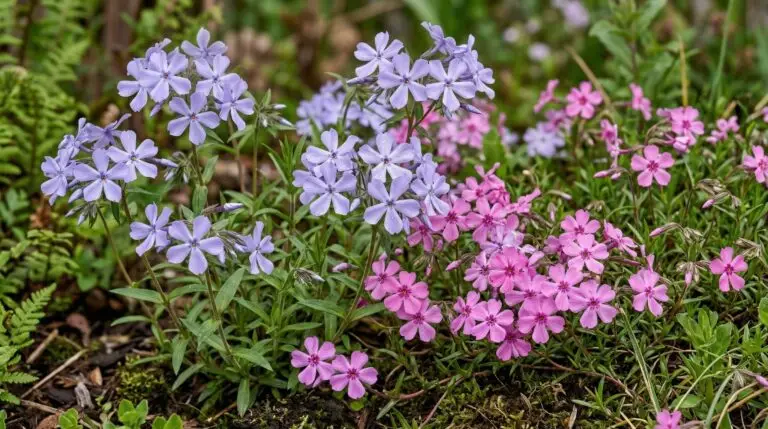
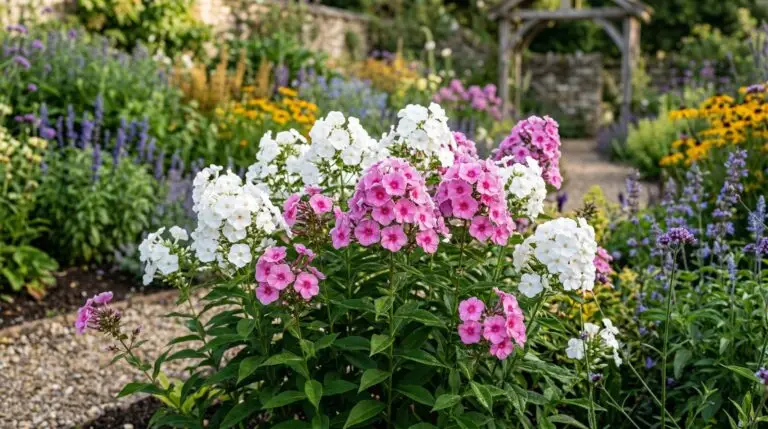
Garden phlox asks for very little in the way of soil chemistry and a great deal in the way of space. Phlox paniculata wants full sun to light shade, average soil that drains well, and consistent moisture, but the trait that actually decides which companions work is its own crowded habit: a mature clump throws up dozens of stems, and any neighbor planted tight against that mass just adds to the shade and stillness gathering at the base. The strongest pairings on this page share phlox’s sun and soil needs and stay low, open, or genuinely distant from the crown, so the airflow that keeps this flower healthy never gets choked off. Catmint does that job about as well as any plant can. Its silvery mounds hide phlox’s bare lower stems, the classic complaint against tall phlox by midsummer, while staying low and loose enough that it never traps still air against the base the way a denser skirt planting would. Coneflower earns its place for a different reason: it shares phlox’s exact full-sun, well-drained profile, and its flat, open daisy form is a real textural break from phlox’s dense, domed clusters rather than another rounded shape competing for the same visual space.
Yarrow and black-eyed Susan round out the front-to-mid layer with plants that ask almost nothing of the gardener once established. Both tolerate the same lean, well-drained soil phlox prefers, both stay low or open enough not to shade the phlox crown, and both are documented pollinator plants in their own right, so a phlox bed built around them is doing ecological work beyond the color show. Daylily takes a slightly different role: its arching, strappy foliage blooms over a long summer season that overlaps phlox’s own show, which means it can screen deteriorating phlox stems from a short distance rather than pressing against them the way a shorter, denser plant would need to. Switchgrass is the strongest textural counterpoint on this list and, worth saying plainly, a genuinely useful pick for the airflow problem specifically. It grows primarily as a clump rather than an aggressive spreader, so it stays open at its own base even as it reaches several feet tall, adding movement and a vertical accent without building the dense, still pocket a solid shrub would. Shasta daisy and baptisia both work at real distance, the former for its upright white bloom against phlox’s cooler pinks and lavenders, the latter as a structural anchor whose blue-purple spires arrive well ahead of phlox and then hold their shape as seed pods through the whole season. Garden roses close the list on a more honest note: the phlox-and-rose combination is a genuine cottage-garden tradition, one repeated often enough in David Austin’s own companion-planting guidance to count as real design consensus, but it is tradition rather than a studied benefit, and it comes with a caveat worth taking seriously, since roses are just as mildew-prone as phlox and the same spacing discipline has to hold for both.
What not to plant near garden phlox
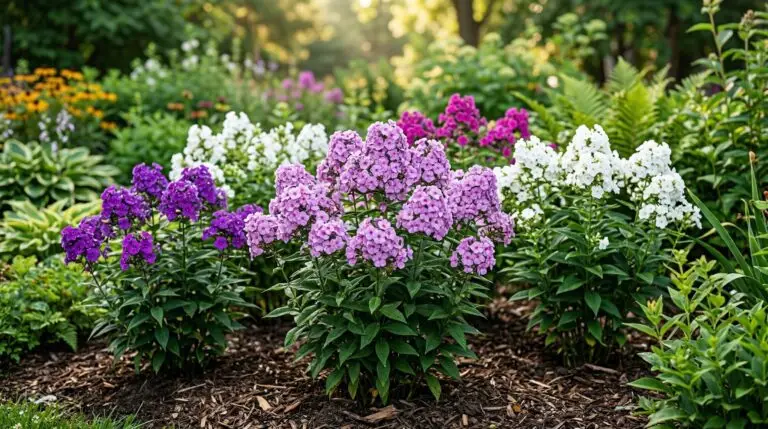
What not to plant near phlox has almost nothing to do with toxicity or competition for nutrients in the usual companion-planting sense, and almost everything to do with space. Four separate extension sources, the University of Minnesota, Iowa State, Purdue, and NC State, independently name the same three conditions behind powdery mildew on phlox: shade, crowded plantings, and poor air circulation, and all three trace back to the same root cause, which is something tall or dense sitting too close to the plant. This reframes the entire avoid question. It is not that a particular species is dangerous to phlox the way juglone is dangerous to a walnut-sensitive plant; it is that any neighbor, regardless of what it is, becomes a problem the moment it blocks light or breeze at the crown. UMN Extension is specific about the mechanism and the fix: space phlox divisions roughly 18 inches apart, thin each clump to five or six vigorous stems every spring, and never plant it flush against a fence or garden wall, since solid structures block air circulation exactly the way an overgrown shrub does.
Two related, more concrete avoids follow directly from that mechanism. UMN Extension states plainly that phlox should not be planted near trees and shrubs that compete for moisture and nutrients, and the same proximity that causes that competition typically also casts shade and blocks airflow, so a backdrop shrub belongs several feet back rather than at the bed’s edge. The inverse mismatch matters just as much and gets far less attention: shade-loving plants like begonia or lungwort tucked in front of phlox expecting to thrive will either struggle in the six-plus hours of direct sun phlox needs to bloom well, or force the gardener to shade the bed for their sake, which then drags phlox’s own bloom quality and disease resistance down together. NC State’s own plant profile notes that overhead watering should be avoided on phlox specifically, since wet foliage speeds mildew the same way shade and crowding do, which means any companion whose care would require regularly spraying the bed from above works against phlox rather than for it. None of this is a list of villains. It is a single pattern, repeated in slightly different forms: give phlox distance and dry leaves, and almost any reasonably sized, sun-loving companion becomes safe.
Do they like the same conditions?
Every companion on this page was tested against phlox’s real growing profile before it earned a spot: full sun to light shade, with NC State noting the plant tolerates six or more hours of direct sun or as little as two to six hours of partial shade, though bloom quantity and quality both drop as shade increases. Soil pH is genuinely forgiving here, since NC State lists Phlox paniculata as tolerant of acid, neutral, and alkaline soil alike, so unlike a true pH-obligate plant, there is no acid-soil puzzle to solve when choosing neighbors. The two conditions that actually matter are drainage and moisture consistency. Phlox wants rich, well-drained soil that never sits wet through winter and never dries out completely through a hot summer, which rules out both true bog plants and the driest xeriscape companions as anything more than a bed-edge accent.
The spacing and airflow rule deserves the same precision as the conditions ruler, because it is easy to treat as a vague suggestion rather than the load-bearing fact it actually is. It is not folklore that crowding causes phlox disease; it is the single most consistently repeated finding across university extension pathology and floriculture guidance for this exact plant. What is worth being precise about is what the rule does and does not claim. No companion plant actively causes powdery mildew, and no companion plant actively prevents it either, the way a resistant cultivar genuinely does. What a well-chosen companion does is stay out of the way, staying low like catmint and yarrow, staying open at the base like switchgrass, or simply staying far enough back like baptisia and a backdrop shrub, so the airflow around phlox’s own crown never gets compromised in the first place. A badly chosen companion, something tall, dense, and planted too close, does the opposite: it does not attack phlox directly, but it recreates the exact shaded, still-air microclimate that lets the fungus already present in most gardens take hold and climb. That distinction, between a plant that causes disease and a plant that simply fails to protect against a site problem, is the honest core of every companion recommendation on this page.
How to plant them together
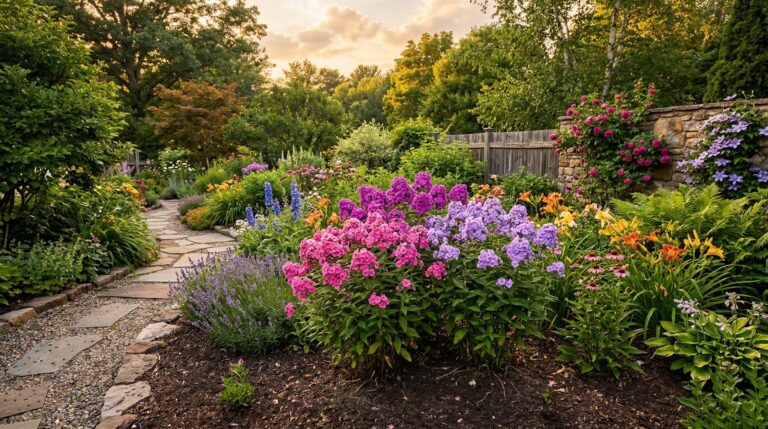
Layer the bed by habit as much as by height. Catmint and yarrow belong at the front edge, twelve to eighteen inches out, low enough that they never shade the phlox crown and loose enough that they never trap air against it, doing the double duty of hiding bare lower stems while staying airflow-neutral. Coneflower, black-eyed Susan, and daylily suit the middle distance, eighteen to twenty-four inches from the phlox base, close enough for the color and bloom-succession payoff to read clearly but far enough that neither plant’s own spreading habit eventually presses into the phlox’s root zone. Switchgrass, baptisia, and any backdrop shrub or rose belong further out still, two feet or more, since all three bring real mature size and, in switchgrass’s case, height that could otherwise cast exactly the kind of shade phlox is trying to avoid.
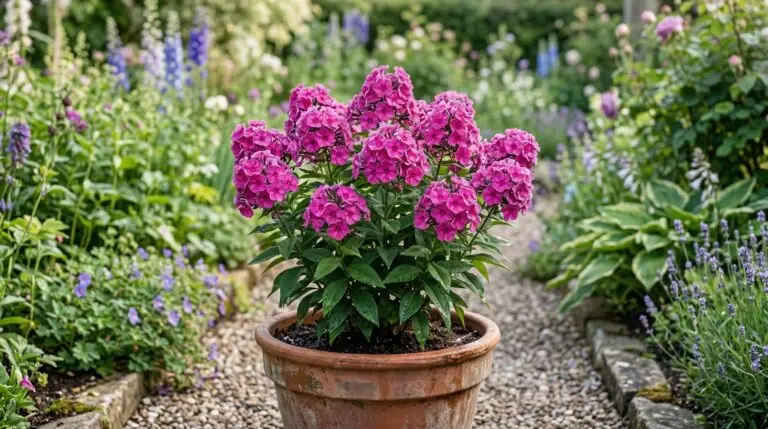
Timing the planting matters almost as much as spacing it. Baptisia and catmint both bloom well ahead of phlox’s midsummer peak, so plant them where the bed will not look empty in June, and let daylily’s arching foliage and long summer bloom season bridge the same gap from a different direction. Water everything at the base rather than overhead wherever the layout allows, since UMN Extension and NC State both single out wet foliage as a mildew accelerant specific to this flower, and a soaker hose or drip line laid before the bed fills in solves that problem for every plant in it at once, not just phlox. Every spring, before growth gets away, thin the phlox clump itself down to five or six of its strongest stems, the same UMN recommendation that governs the initial spacing, since a healthy, open phlox crown does more to prevent mildew than any companion choice ever will. In containers the same logic holds at a smaller scale: pair a single phlox with one low, airy companion like a compact yarrow rather than crowding several plants into one pot, since a container concentrates the same shade-and-crowding risk into much less space.
Does companion planting actually work for garden phlox?
Some of what gets repeated about phlox companions rests on real extension guidance, and some of it is closer to design tradition dressed up as horticultural advice, which is worth separating out honestly rather than blending together. The shared-conditions matches are the strongest claims here: coneflower, yarrow, and black-eyed Susan all genuinely want the same full sun and well-drained soil phlox does, and that overlap is documented directly on each plant’s own NC State Extension profile rather than inferred from a garden blog. The mildew-prevention framing is also real, though it deserves to be stated precisely rather than oversold. Four independent extension sources agree that shade, crowding, and poor air circulation drive powdery mildew on this plant, and University of Minnesota Extension gives the exact fix, roughly eighteen inches of spacing and annual thinning to five or six stems. That is genuinely actionable, evidence-backed guidance, not folklore, and it means the companion choice a gardener makes really does affect phlox’s disease risk, just through spacing and habit rather than through any chemical or biological interaction between two named plants.
Where the evidence thins out is anywhere that implies a specific companion actively wards off disease or pests through some mechanism beyond simply staying out of the way. There is no extension source claiming catmint or switchgrass repels powdery mildew; their value here is purely that their habit does not recreate the shade-and-crowding conditions the fungus needs. The phlox-and-rose pairing sits closer to the folklore end deliberately, since it is a genuinely popular, photographed, repeated cottage-garden tradition rather than a studied functional benefit, and it is labeled that way rather than dressed up as proven. One honest positive worth stating plainly, since most companion content skips it entirely: both woodland and garden phlox are documented juglone-tolerant, useful and specific information for the meaningful number of gardeners working near a black walnut tree, and a case where phlox is doing the tolerating rather than needing to be protected from a neighbor. Match the sun and drainage first, use the spacing and airflow rule as the actual disease-prevention lever, lean on coneflower and yarrow for the genuine shared-conditions and pollinator value, and treat any claim of a companion actively preventing phlox disease, beyond simply not crowding it, as unproven until a real source backs it.
Frequently asked questions
What can I plant in front of phlox to hide its bare stems?
Catmint and daylily both work well at the front edge. Catmint’s low, silvery mounds screen the stems directly without trapping air against them, while daylily’s arching, strappy foliage does the same job from a slightly greater distance and stays substantial through its own long summer bloom season.
What should you not plant near phlox?
The clearest avoid is not a specific species but a pattern: anything tall, dense, or planted too close to the crown, including overgrown shrubs, trees within root-competition range, and fences or walls on the windward side, since all three recreate the shade and poor airflow that four independent extension sources name as the direct cause of powdery mildew on this plant.
Does what I plant near phlox actually affect whether it gets powdery mildew?
Yes, though through spacing rather than any special interaction. A companion cannot cause or cure mildew on its own, but a plant crowded too close blocks the airflow phlox needs, while a low or genuinely distant companion leaves that airflow intact, which is why University of Minnesota Extension frames spacing and thinning as real disease prevention, not just tidiness.
Can phlox be planted near a black walnut tree?
Yes. Garden phlox is documented as tolerant of the juglone toxicity black walnut trees produce, a fact confirmed by NC State’s own plant profile tag and independently by horticulturist Melinda Myers, who names both woodland and garden phlox among the reliable seasonal-color choices for that specific, difficult site.
Do phlox and coneflower actually go well together, or is that just a common pairing?
Both. It is a common pairing because it genuinely works: coneflower shares phlox’s full-sun, well-drained conditions almost exactly, according to NC State’s own growing profile, and its flat, open form is a real textural contrast to phlox’s dense, rounded flower clusters rather than a coincidence of two plants that happen to get photographed together often.
Sources
University of Minnesota Extension, Tall garden phlox · Iowa State University Extension, How can I control powdery mildew on my garden phlox? · NC State Extension Gardener Plant Toolbox, Phlox paniculata · NC State Extension Gardener Plant Toolbox, Nepeta x faassenii · NC State Extension Gardener Plant Toolbox, Echinacea purpurea · NC State Extension Gardener Plant Toolbox, Hemerocallis hybrida · NC State Extension Gardener Plant Toolbox, Achillea millefolium · NC State Extension Gardener Plant Toolbox, Rudbeckia fulgida · NC State Extension Gardener Plant Toolbox, Panicum virgatum · NC State Extension Gardener Plant Toolbox, Leucanthemum x superbum
More About Phlox
Growing phlox in containers for fragrant summer displays on patios and balconies
Dividing tall garden phlox every few years for stronger plants and more flowers
Best phlox varieties from mildew-resistant David to brilliant Starfire
How to grow garden phlox for fragrant flower clusters that dominate the midsummer border
Phlox as a butterfly and hummingbird magnet for fragrant pollinator gardens
Phlox flower meaning and the sweet agreement this bloom represents in the language of flowers

Creeping phlox for spring ground cover that turns slopes into rivers of color
Phlox powdery mildew and how to finally beat this persistent fungal problem