Wedding flowers on a budget: what $500, $1,500 and $3,000 actually buy
Nobody at your wedding will be counting centerpieces.
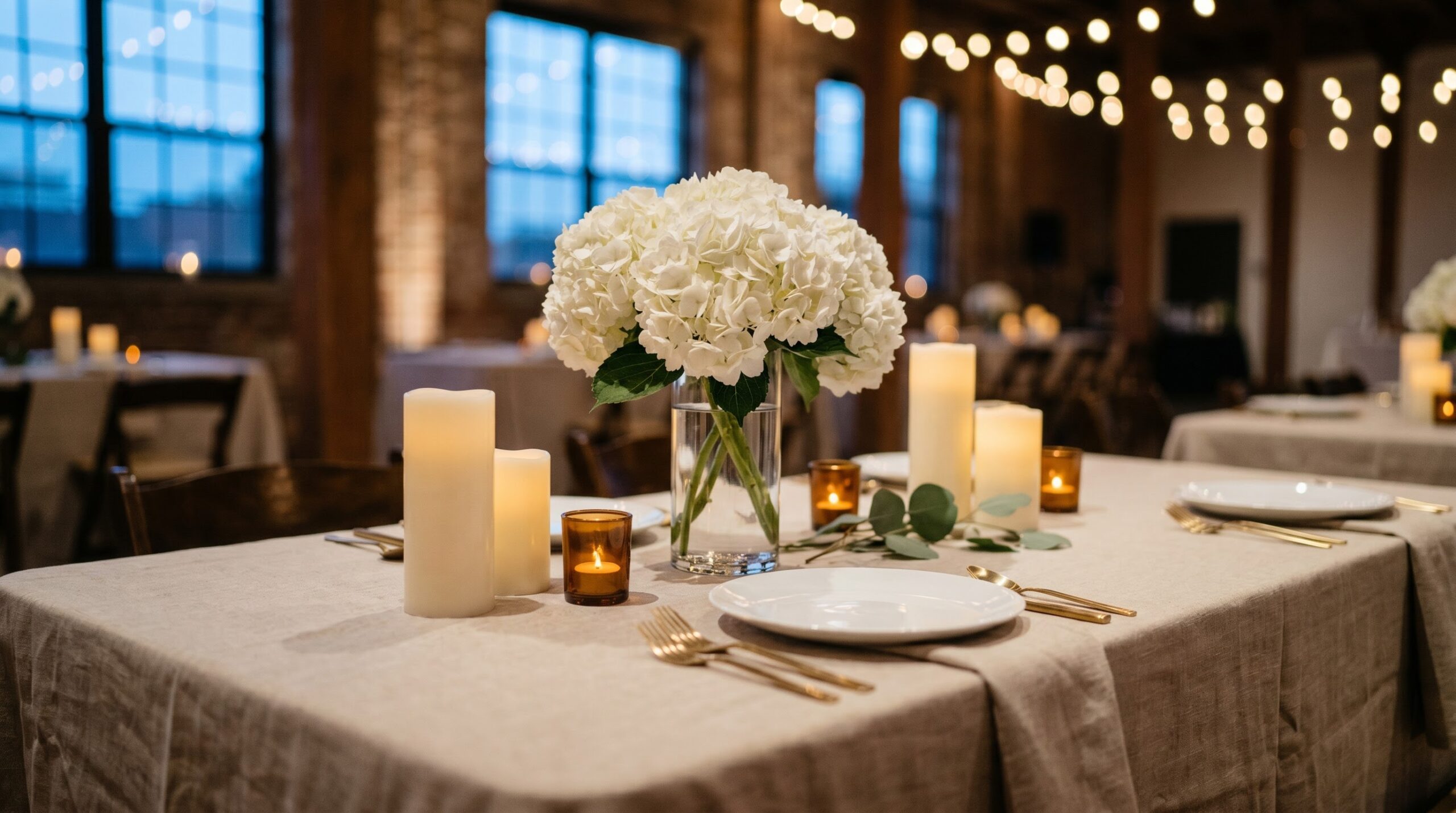
Nobody at your wedding will be counting centerpieces. One wedding DJ put it flatly: in all their years on the job, they had never once heard a guest say, "There weren't enough flowers." Hold onto that sentence, because everything else on this page gets easier once you believe it. You're allowed to spend $500 on wedding flowers. You're allowed to spend almost nothing. A reception dressed in grocery-store hydrangeas and candlelight still reads as a wedding, and the people eating dinner in it will remember the toasts, the food and the dancing, in roughly that order.
The panic that brought you here is real, though. "Even packages for just bouquets are like $600-800 in my city!!" is how one bride put it, and she wasn't exaggerating. The Knot's Real Weddings Study puts the national average for wedding flowers at $2,800, with the lower quarter of couples spending around $900 and the upper quarter around $4,800. Where those averages come from, what hides inside a florist's quote, and who traditionally pays all live in our guide to how much wedding flowers cost. This page starts one step later. The problem isn't that flowers cost too much. It's that nobody tells you what a specific number buys. So below are three complete flower packages, at $500, $1,500 and $3,000, each with the shopping route that makes the number work and a plain list of what it skips on purpose.
And if you catch yourself not caring about any of it, you're in enormous company. One bride confessed that all her mental energy "drains out of my ear" the second she starts thinking about flowers, and diagnosed herself with "a bad case of the Shoulds." If that's you, the section on centerpieces without flowers further down is yours. Candles cost less than any stem, and they photograph beautifully.
What $500, $1,500 and $3,000 actually buy
Two price sheets sit under these builds. Flower Moxie, a wholesale supplier that sells to DIY couples, publishes a florist-versus-wholesale comparison: a bridal bouquet runs $120 to $300 from a florist against $45 to $130 built from wholesale stems, and a simple five or six inch vase centerpiece runs $50 to $85 florist-made against $18 to $35 in raw flowers. FiftyFlowers, a bulk seller with the same incentive to make DIY look good, puts a professional bridal bouquet around $250 against $76 in bulk stems, and professional centerpieces anywhere from $120 to $600 each. Both companies profit when you believe the gap, so treat their numbers as the ceiling on savings. The gap survives the skepticism; it just narrows once your own hours count for something. Each package below also lands inside one of The Knot's real spending bands, so each one sits where actual couples actually spend.
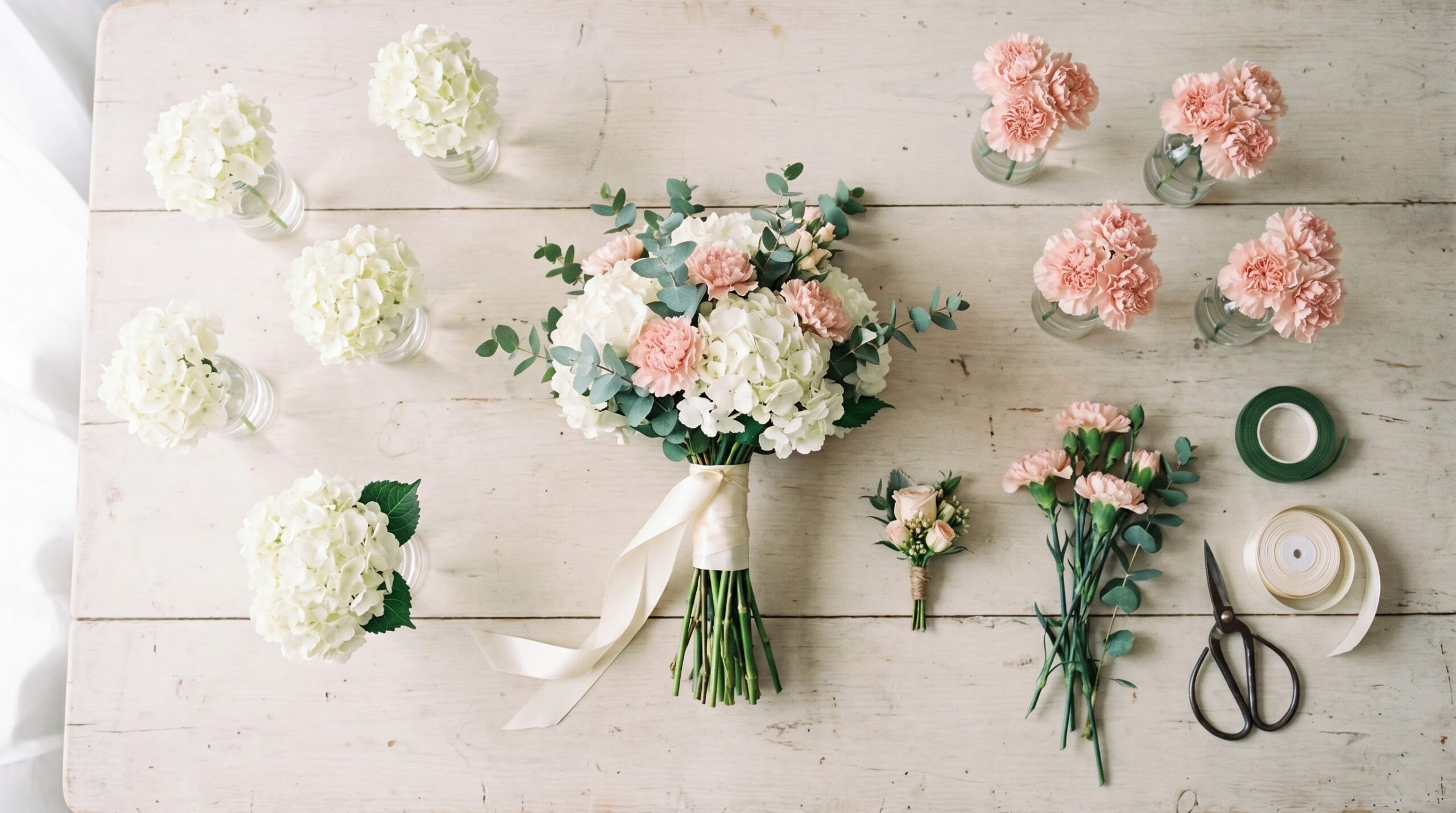
| The $500 build | The $1,500 build | The $3,000 build | |
|---|---|---|---|
| Who carries flowers | Bridal bouquet, one boutonniere | Bridal bouquet, 3 bridesmaid bouquets, 6 boutonnieres | Premium bridal bouquet, 4 bridesmaid bouquets, 8 boutonnieres and corsages |
| On the tables | 10 single-flower arrangements plus candles | 10 low florist-made centerpieces | 12 centerpieces, every third one taller |
| Ceremony flowers | None | None separate (two centerpieces stand at the altar first) | 2 large arrangements, moved to the reception |
| The stems | Hydrangea, carnations, mums, greenery | Carnation and mum base with a few roses | Mass flowers plus garden-rose accents |
| The route | Grocery or wholesale counter, assembled yourself | Small a la carte florist order, delivered | Full-service florist or large a la carte order with setup |
| Skipped on purpose | Bridesmaid flowers, corsages, ceremony florals | Arch, aisle flowers, installations | Floral arch, hanging installations, flower wall |
| Where it lands | Under the $900 lower quartile | Under the $1,900 median | At the $2,800 national average |
Swipe →
The $500 build
This is the wholesale-market and grocery-counter build, and it leaves room to spare. One bride who budgeted $500 total for all her flowers reported that she "struggled to spend $350" at her city's flower market. The package: one bridal bouquet that you or a steady-handed friend assembles from $45 to $55 of wholesale stems, one boutonniere for your partner in a dollar or two of materials, and ten single-flower centerpieces at $18 to $25 apiece, which in practice means one hydrangea head or a tight fist of carnations in a plain glass vase. That's roughly $225 to $310 in flowers, with the balance going to vases, ribbon, floral tape and a bucket in the fridge overnight. Candles do the rest of each table. The stems are chosen for forgiveness as much as price: hydrangea fills a vase in one cut, carnations survive a nervous grip, and mums cost almost nothing while reading as texture in photos. If you're unsure what the bouquet itself needs, our guide to how many stems each arrangement really takes has the counts.
What this build skips on purpose: bridesmaid bouquets, corsages, and any separate ceremony flowers. The labor is real. Plan on an afternoon the day before with cold storage arranged, and resist the urge to promote the plan into seventy bud vases because each one looks cheap on its own. A working florist ran that exact math for one couple: "70 bud vases alone, one rose with stem of foliage is over 1,000." Three bud vases on each of ten tables is charming. Seventy is a florist invoice wearing a minimalist costume.
The $1,500 build
First, the question that sits between these two builds: is $1,000 enough for wedding flowers? Yes. It's the $500 build plus a florist-made bridal bouquet, the one arrangement where professional work visibly shows, and a few more tables covered. It also lands above The Knot's bottom-quartile mark of $900, which means real couples get married on it every weekend.
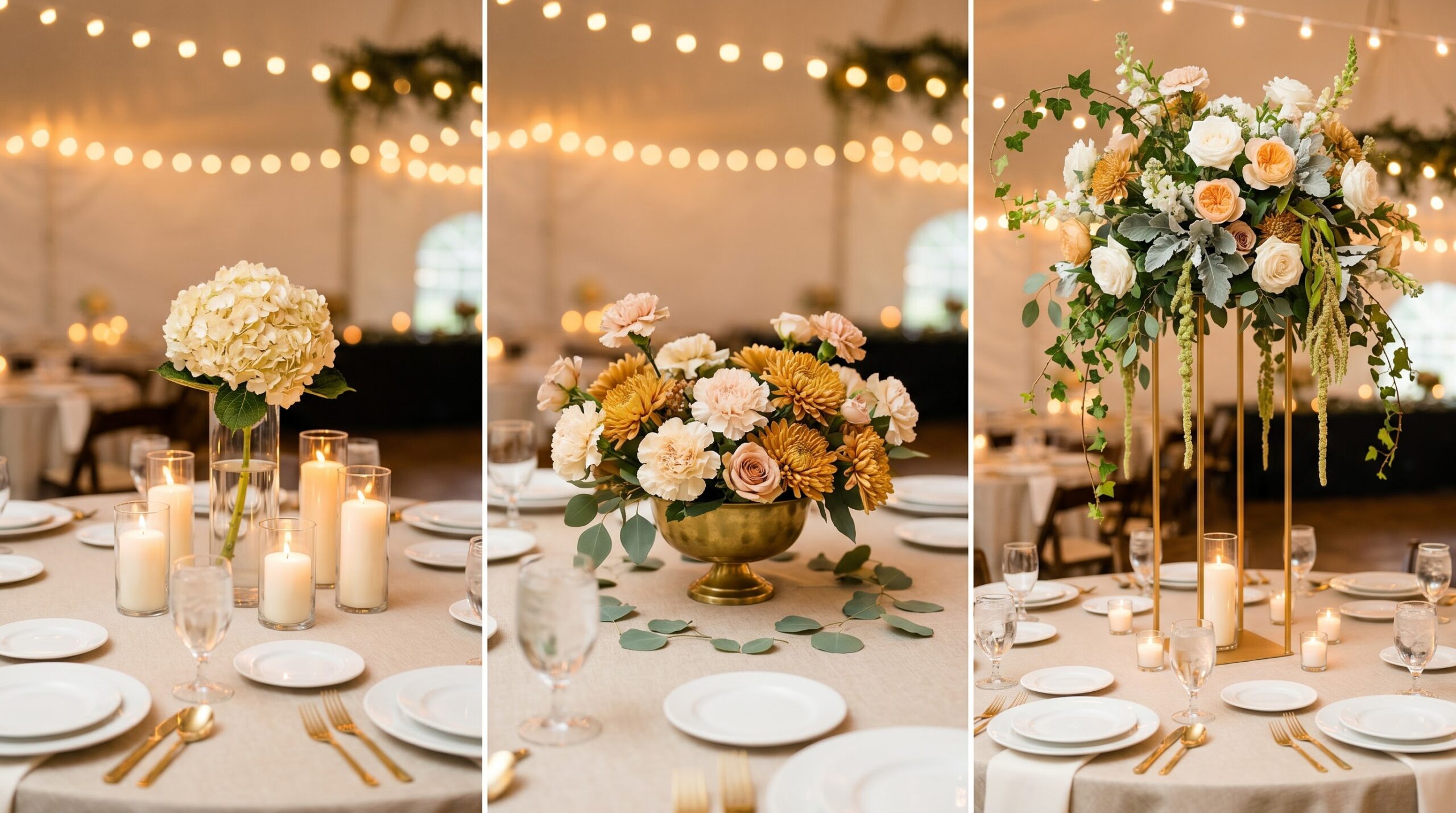
The $1,500 build is the no-labor version: a small a la carte florist order, delivered ready-made. Priced from the florist column, that's a bridal bouquet at $150 to $200, three bridesmaid bouquets at $55 to $75 each, six boutonnieres around $13 apiece, and ten low centerpieces at $70 to $85. It totals roughly $1,100 to $1,350, leaving room for delivery. Everything arrives finished; your only job is approving a proposal. The whole order sits under The Knot's $1,900 median, so half the couples in America spend more than this. And if your guest list is under 50, where the average runs $1,600, this build is simply normal. What it skips: an arch, aisle flowers, and installations of any kind. Two of the centerpieces can stand at the altar during the ceremony and move to tables afterward. One warning about where to shop: full-service studios price around big productions, and many set order minimums this build won't clear. Take the list to a shop or online florist that advertises a la carte wedding work. That's exactly the customer their menu was written for.
The $3,000 build
At $3,000 you're budgeting just above the national average, and the build finally covers everyone. The personal flowers are complete: a premium bridal bouquet at $250 to $300, where garden roses earn their keep as accents (expensive blooms belong where hands and cameras go, with cheaper mass flowers doing the filling), four bridesmaid bouquets at $100 to $125, and eight boutonnieres and corsages covering both families. Twelve centerpieces, every third one taller to give the room depth, mix the $70 to $85 tier with a few pieces from the low end of FiftyFlowers' $120 to $600 professional range. Two substantial ceremony arrangements move to the reception during cocktail hour; The Knot cites a comparable arch or arbor piece starting at a few hundred dollars. Add delivery and setup, and the total settles just under $2,800.
What this build skips is the category that eats budgets whole: the floral arch, which runs $1,500 to $4,000 by FiftyFlowers' numbers, plus hanging installations and flower walls. Any one of those can swallow half the budget in a single line item. This is also the level where a full-service florist starts to make sense, since a $3,000 order clears the $2,000 to $3,500 minimums common at smaller full-service studios, though it still sits below Zola's $5,100 to $7,600 full-service average, and it is complicated enough to be worth handing off.
What to cut first when the quote doesn't fit
There's an order to this. Some cuts save hundreds and change nothing in the photos. Others save little and show. Work down the list and stop when your number fits.
1. Bridal party bouquets go first. Florist-made bridesmaid bouquets run $55 to $125 each, and brides keep arriving at the same verdict: "$50 a bouquet? I love all my girls, but that's just an unnecessary expense." A single ribbon-wrapped stem per bridesmaid reads as intentional. So does nothing at all; hands find drinks and phones by sunset anyway. 2. Corsages beyond the two mothers. If pinning a corsage on your mom matters to her, keep those two and cut the rest of the extended-family list. 3. The separate ceremony order. Whatever stands at the altar can stand at the head table an hour later. Assign one specific person to move it during cocktail hour, because "someone will grab it" means nobody will. 4. Centerpiece count before centerpiece existence. Flowers on every other table, candles everywhere in between, looks deliberate, and deliberate is the whole game.
Cut last, and ideally never: the bridal bouquet. It's in the getting-ready photos, the ceremony, the portraits and half the candids. Of everything on the flower list, it's the only item that appears in nearly every picture you're paying a photographer to take.
Centerpieces that aren't flowers at all
Some couples read everything above and feel only a low hum of obligation. One bride opened a planning thread with "I do not caaaaaaaaaaare," stretched out exactly like that, and more than a hundred replies rushed to agree. In another thread, a comment asking for "centerpiece ideas that aren't flowers" collected likes by the dozen. The demand for this section is enormous; the wedding industry just has nothing to sell it.
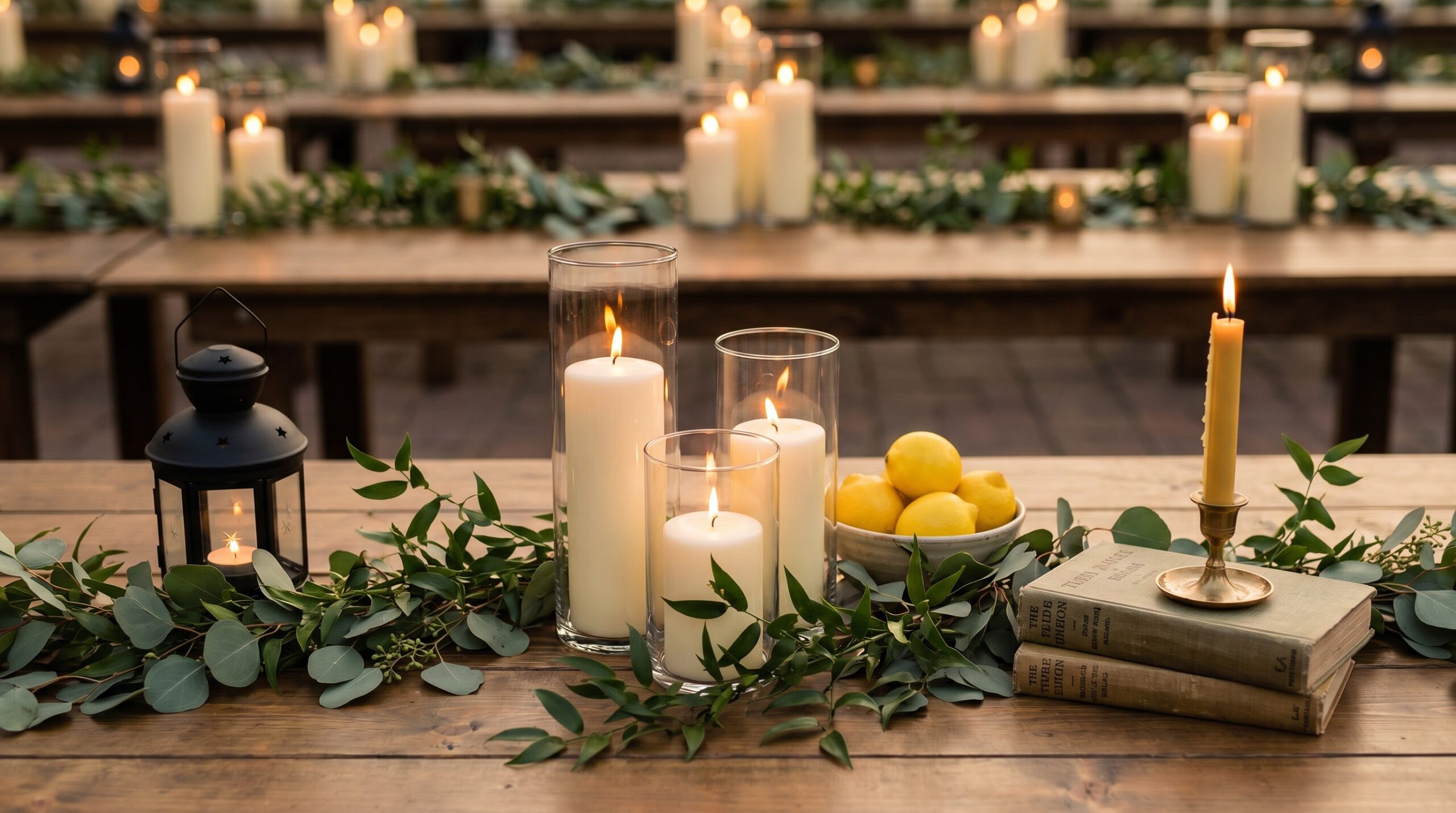
The reliable formula is height, light and repetition, and none of it requires stems. Pillar candles at three heights inside hurricane glass, repeated identically down every table, cost a fraction of florals and photograph like a film scene. Lanterns do the same job with the flame enclosed, which matters because many venues restrict open flames; ask about the policy before you buy anything. A greenery runner of eucalyptus or ruscus laid loose down the table's spine reads lush at filler prices. Stacked vintage books with a taper, bowls of lemons in a tight color story, framed photos of the two of you: all of it works if every table repeats the same recipe.
Two practical notes. Buy candles and vessels in bulk online months out and resell them after; secondhand wedding decor listings are a functioning economy. And if you want one breath of something living, a single bud vase beside the candles gets you there for a dollar or two a table.
Which route fits your number
The builds assume routes, and each route has its own page here. Grocery and warehouse stores are the bottom-dollar path: one bride dressed her whole wedding with about "$500 worth of florals and greenery from our local Trader Joe's," and Costco and Sam's Club both take bulk orders ahead of a date. Timing is the catch, so read up on ordering bulk flowers from Costco, Sam's or Trader Joe's and when to place the order before counting on it. If your city has a wholesale flower market, it beats all of them on price per stem and requires the earliest morning of your life.
Ordering bulk stems online and arranging them yourself powers the $500 build at bigger scale, and prepackaged DIY kits split the difference by matching the stems for you. Whether doing your own wedding flowers actually saves money once your hours and your stress count is a genuine question, and it gets the full treatment on its own page. Just don't plan to arrange thirty pieces alone the night before your wedding.
A la carte florists are the route for money without labor. Write a two-sentence email: the date, the venue, the hard number, and "what would you build for this?" Good shops answer that question happily. It's a normal order, and it's how the $1,500 build gets made.
Then there's the fake question. Artificial flowers look like the obvious hack, and renting or reselling silk arrangements can genuinely work, but decent fakes cost more than people expect, and the economics of fake wedding flowers cut both ways. That question, tackiness included, has its own page.
Do guests actually notice wedding flowers?
The receipts here run in one direction. One woman learned that at her sister's wedding, "her bouquet and our bouquets and the boutonnières were the only flowers she brought," and added: "I say she had to tell me because I genuinely did not notice." Another put it in one line: "We had a total of 0 flowers at our wedding and it was still stunning." And a bride looking back from the far side of her own wedding realized that people "only care if the food is good and if they had fun," and wished she'd moved money out of hair, makeup, dress and flowers and into entertainment.
The pressure comes from a specific place. "Other people have gotten in my head that I NEED flowers and they NEED to be real 'because you can tell when they're fake,'" one bride wrote. Every one of those voices belongs to the industry side of the aisle. Styled shoots are photographed to impress other vendors. Pinterest boards are built from those shoots. Package tiers are written to sell packages. The guest side keeps repeating a different sentence: I didn't notice, and I had a wonderful time. So if the flower line in your spreadsheet is fighting the food or the band, your guests have already voted.
Three questions that keep coming up
Is $2,000 enough for wedding flowers?
Comfortably. The Knot's median is $1,900, so $2,000 clears what half of couples nationwide spend. In practice it buys the $1,500 build plus two ceremony arrangements you repurpose at the reception, or florist centerpieces for several extra tables. For a wedding under 50 guests, where the average runs $1,600, it's generous.
What are the cheapest wedding flowers that still look expensive?
Hydrangea, carnations, chrysanthemums, baby's breath and greenery. One hydrangea head fills a vase by itself. Carnations massed tightly in a single color lose every trace of their gas-station reputation, and baby's breath in dense clouds reads as deliberate style. The trick is mass: lots of one thing, in one or two colors, repeated.
Can you have a wedding with no flowers at all?
Yes, and couples do it without regret. Candle clusters, lanterns, greenery runners and books cover the tables, and the two of you can walk down the aisle holding nothing, a lantern, or a single stem. If family pushback worries you, one bouquet kept for the photos answers most of it.
From here the move is small. Pick the build closest to your number, count your actual tables, and adjust the math: figure $18 to $35 a table if you're assembling, $70 to $85 if a florist is. Then start the route tonight. Walk the grocery or wholesale counter with the $500 list in your phone, or send a florist two sentences with your date, your venue and your hard ceiling, and ask what they'd build for it. And when something still has to give, give up anything before the bouquet. It's in every photo.