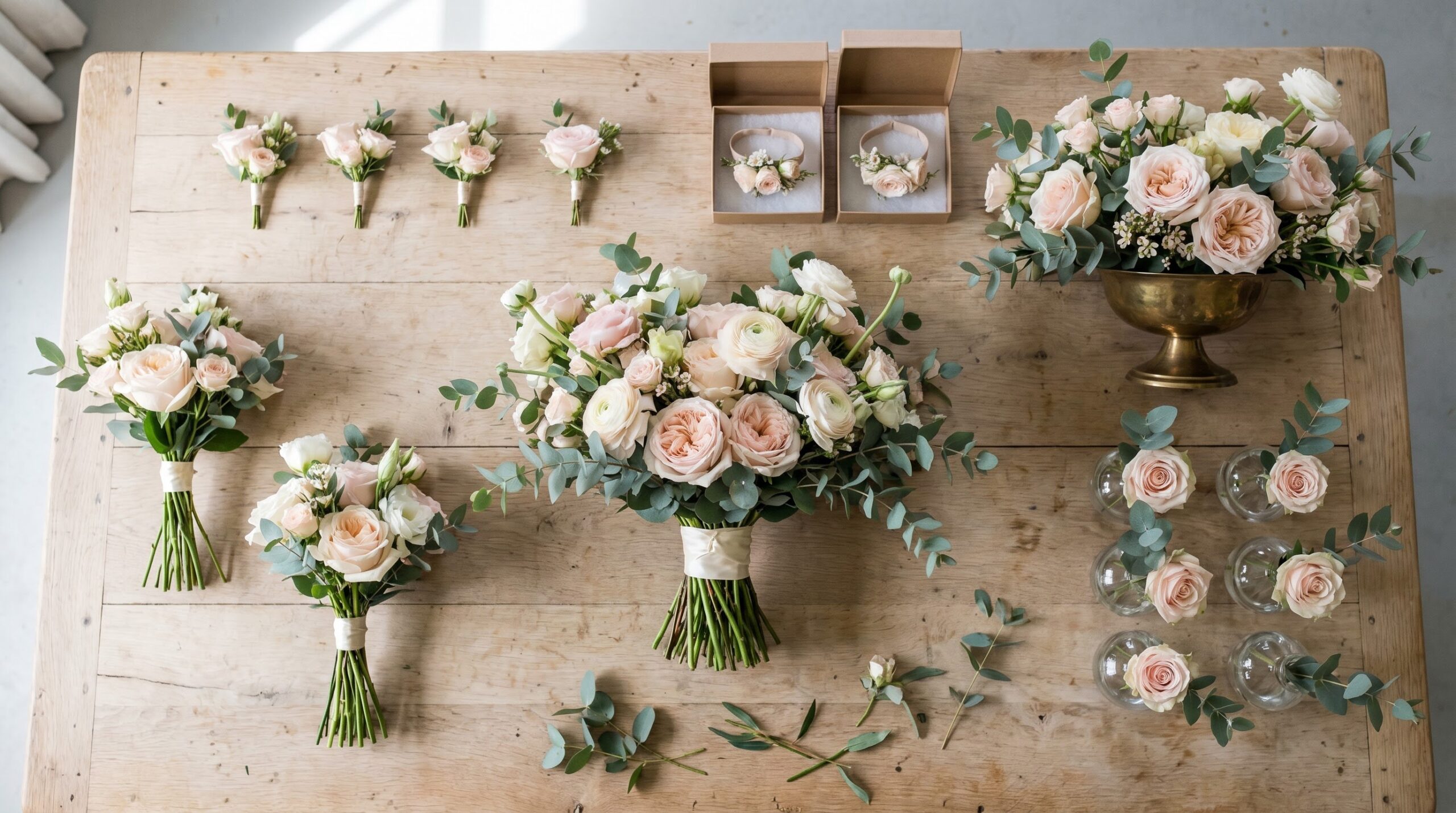
A $3,000 florist quote is normal. The Knot's Real Weddings Study, which gathered numbers from 10,474 couples married in 2025, puts the national average for wedding flowers at $2,800, so a quote near three thousand sits right on that line. In an expensive metro it can even be the friendly bid: couples in San Diego describe $15,000 quotes for full floral service and call a $3,000 offer a steal. So if you just booked a florist, haven't paid yet, and the number feels like a lot, you are inside the range most American couples land in. Florals are the single biggest sticker shock of wedding planning, and the reason has nothing to do with your florist marking you as an easy target.
The shock has a specific cause. A planning guide put $1,500 in your head. Then you told a florist everything you wanted, she came back at $3,000, and your jaw dropped. That gap says less about your florist than about where the internet's numbers come from, because the big wedding sites can't agree with each other either. The Knot says $2,800. Zola says $5,100 to $7,600. WeddingWire says $1,500. All three are published today, all three claim to be the average, and the entire answer to "am I being ripped off?" depends on knowing which one your quote should actually be compared against. That comparison is what this page is for.
What couples actually pay: the honest range
Start with the most detailed public dataset. The Knot's flower-cost survey breaks its $2,800 average into quartiles: the lower quarter of couples spent around $900, the median couple spent $1,900, and the upper quarter spent $4,800 or more. Read that carefully. Half of all surveyed couples spent under $1,900, but "all couples" includes people who carried buckets of grocery-store stems into the venue themselves. The average full-service quote lives in the upper half of that curve.
Guest count moves the number in a predictable way. The same survey found couples with 50 or fewer guests averaged $1,600 on flowers, couples with 51 to 100 guests averaged $2,400, and couples with more than 100 guests averaged $3,300. Region matters almost as much: the West averaged $2,400 while the Mid-Atlantic hit $3,600, with the Northeast close behind at $3,300. Season barely registers, moving the average only about $200 across the whole year.
Then there is the spread you see when real couples compare notes, which is wider than any survey. People planning right now report quotes from $3,000 to $30,000 for what they describe as similar visions, and the $30,000 one was, in the bride's words, an obvious no. A $3,000 bid that feels enormous in one city is the bargain option in another. That's why the useful question is what your $3,000 is actually buying, and what the same list would cost from the shop down the street. The sections below give you the line items to make that comparison.
Why The Knot says $2,800, Zola says $5,100 to $7,600 and WeddingWire says $1,500
Nobody on the first page of Google explains this disagreement, so here is the open accounting. These three numbers describe three different products, and only one of them describes the thing your florist quoted.
| Who publishes it | The number | What it actually measures | Should you judge your quote by it? |
|---|---|---|---|
| The Knot | $2,800 average; quartiles $900 / $1,900 / $4,800 | Every wedding in a 10,474-couple survey, including couples who did DIY, grocery-store and warehouse-club flowers | Only partly. The DIY half drags the middle down; full-service quotes live near and above the $4,800 upper quartile in big metros |
| Zola | $5,100 to $7,600, roughly 13% of the total budget, $6,300 midpoint | What couples pay professional wedding florists for full service: design, flowers, delivery, setup | Yes. This measures the same product your proposal describes |
| WeddingWire | $1,500 average, most couples $700 to $2,500 | A static reference card with no dated survey attached, anchored to older price levels | No. Treat it as a floor for modest, delivery-only orders, and as the source of most sticker shock |
Swipe →
So when your quote lands at double the number in your head, your florist is simply pricing a different product than the one you had in mind. The $1,500-style figures blend in thousands of couples who never hired a florist at all. Zola's $5,100 to $7,600 range is what full service costs; The Knot's quartiles tell you where you sit against everyone, DIY included. A useful shortcut: compare a full-service proposal to Zola's range and to The Knot's upper quartile, and use The Knot's guest-count rows to adjust for your size. If your quote for a 100-guest wedding is $3,500, it is ordinary. If it's $10,000, you're buying a design-heavy wedding, or a coastal metro, or both, and the line items will show which.
Where the money in a quote actually goes
The community that answers "why is this so expensive" most honestly is working florists, and their math is worth more than any editorial average. Garden roses run $15 and up per stem in wedding work. Peonies, the most requested wedding flower there is, sit in the same premium tier, which is why peonies appear in so many inspiration photos and so few $2,000 proposals. Even the modest end adds up fast: florists point out that 70 bud vases with a single rose and a stem of foliage each is already past $1,000, before anyone touches a centerpiece. As one put it flatly, $2,500 goes fast.
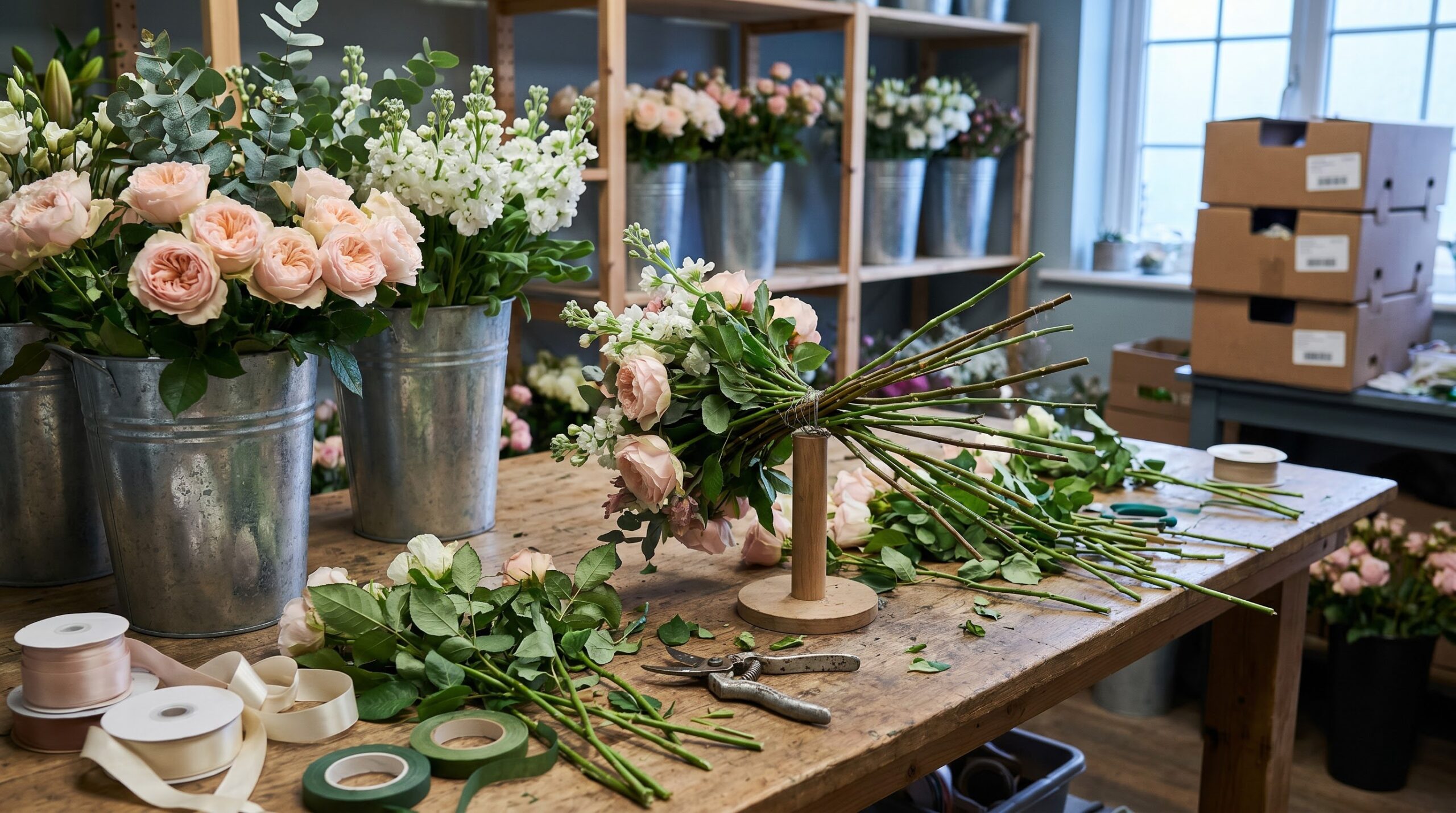
Flowers are only part of the invoice. The rest is the thing couples never see: a florist builds a recipe for every arrangement, orders perishable product to arrive on an exact day, spends hours processing it (stripping, cutting, hydrating), builds everything in a two-day window, then loads a truck, delivers, sets up before your ceremony, and often comes back at midnight to tear down. The rationalization experienced couples pass to panicked ones runs almost word for word: you're paying for the flowers, the florist's time and skill arranging them, transportation and set up. It's that labor and logistics, far more than any markup on the flowers themselves, that make wedding work cost more than a birthday bouquet.
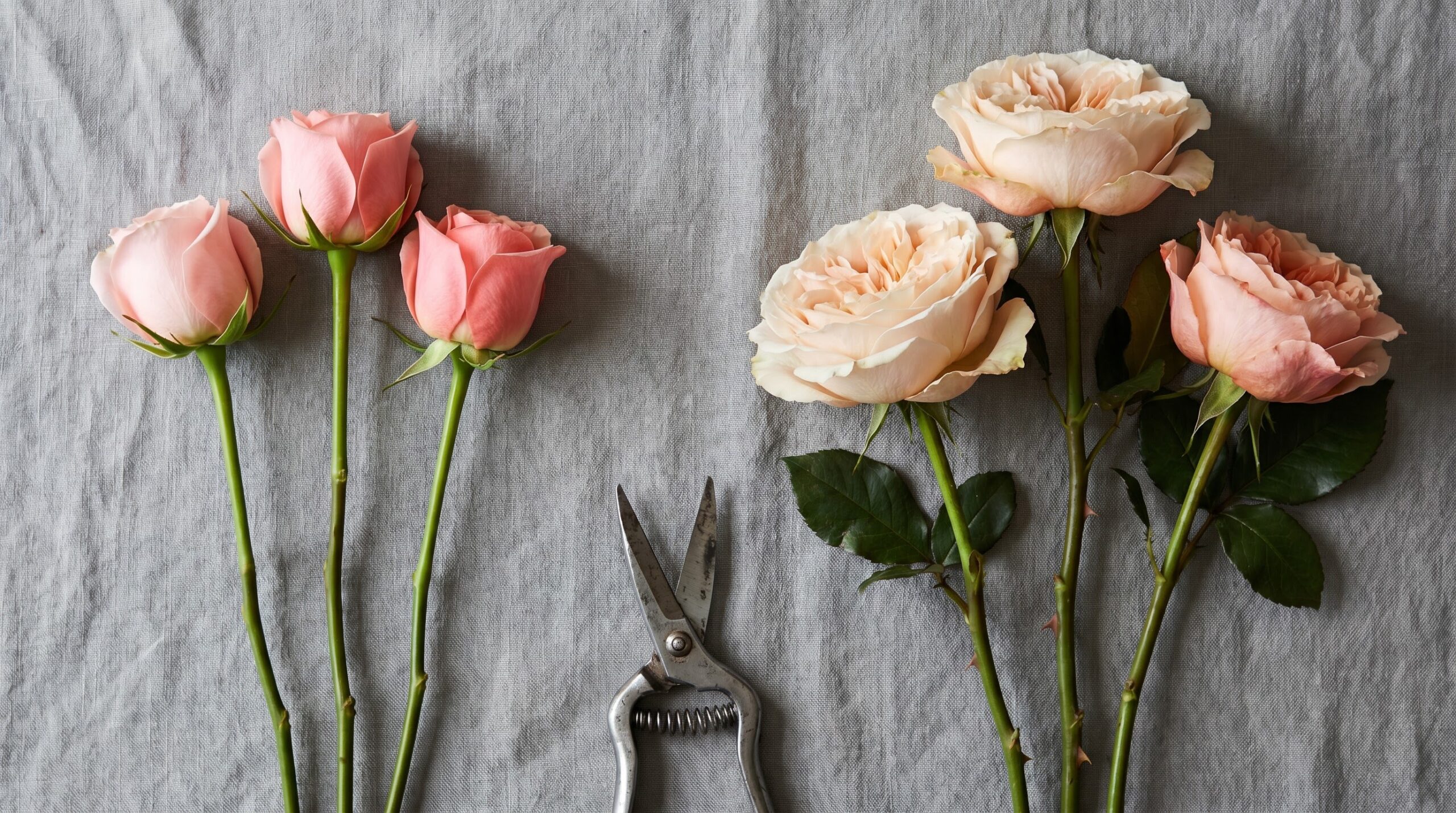
Two structural facts explain the rest of the gap between hope and quote. First, most established shops carry minimums for full-service weddings, commonly $2,000 to $5,000, because a wedding blocks their whole team for a weekend regardless of order size. Second, florists price against your inspiration photos, and those photos are usually the problem. Bringing a Lake Como villa arch or an AI-generated bouquet (nature doesn't grow that way) to a $2,500 budget earns you what florists privately call champagne taste on a beer budget. The quote is simply pricing the photo you brought in.
What each piece costs
The per-item averages you've seen scattered across the internet are below, adjudicated the same way: reference figures first, full-service reality second. Ranges here reflect typical full-service florist pricing unless noted; the low reference numbers ($160 bouquet, $75 bridesmaid bouquet) are WeddingWire's.
| Piece | Full-service range | What moves it |
|---|---|---|
| Bridal bouquet | $250 to $350; $500+ for cascading designs | Stem choice above all: garden roses and peonies vs standard roses |
| Bridesmaid bouquet | $80 to $150 each | Simple multiplication: five bridesmaids at $120 is $600 |
| Boutonniere | $20 to $40 each | Count them; wedding parties hide a dozen |
| Corsage | $30 to $50 each | Mothers, grandmothers, honored guests |
| Low centerpiece | $100 to $250 per table | Table count, which is really guest count |
| Tall centerpiece | $250 to $500+ per table | Height means structure, mechanics and triple the stems |
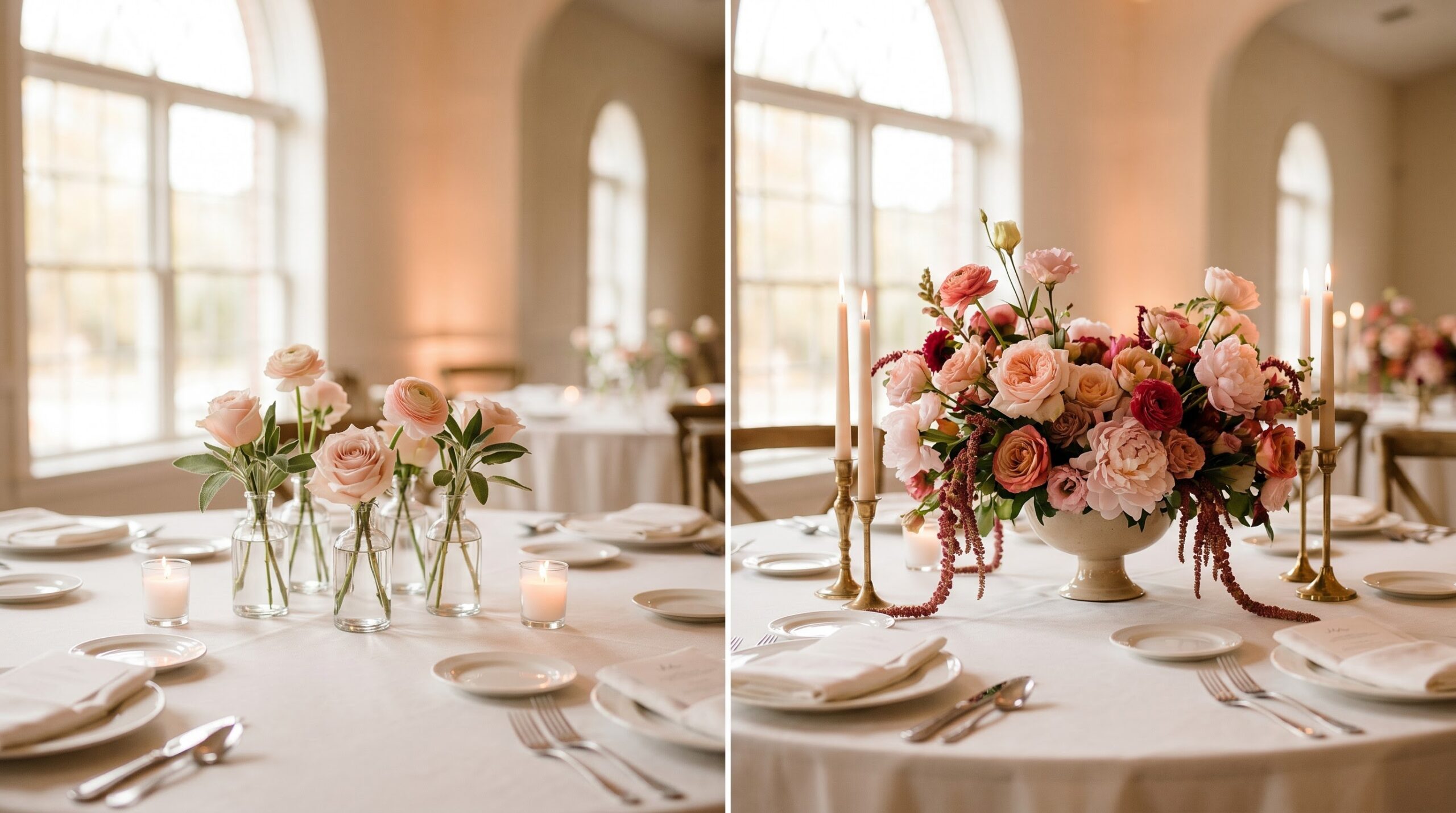
| Bud vase clusters | Florists put 70 vases at $1,000+ in flowers alone | Cheaper per table, but they multiply |
| Ceremony arrangements | $500 simple to $2,000+; full arch installs $1,500 to $4,000 | Labor and structure, not just flowers |
| Cake flowers, aisle markers, extras | $50 to $150 for cake; $20 to $50 per aisle row | The quiet lines that add a few hundred |
Swipe →
The bridal bouquet deserves its own honest paragraph, because it is the piece where the reference numbers mislead hardest. WeddingWire's $160 average describes a standard-rose bouquet from a retail shop. A full-service wedding florist's bridal bouquet starts around $250 to $350, and couples in expensive cities report that even packages for just bouquets run $600 to $800 there, which sounds absurd until you do the stem math. A lush bouquet is dozens of premium stems, and how many stems go into each bouquet and centerpiece is its own question with real numbers behind it (see how many flowers go into a wedding bouquet). Add an hour or more of skilled labor, wiring and taping, and the ribbon finish, and $300 stops looking like a scandal. If you're planning to keep it afterwards, budget separately for that too; preserving a wedding bouquet has its own price list.
Before you price pieces, decide which pieces exist. Couples routinely pay for corsages nobody wears and cocktail arrangements nobody sees. A wedding flower checklist covering what's essential, what's nice, and what's skippable is the cheaper place to fight that battle.
How much should you budget for wedding flowers
The classic advice says 8 to 10% of your total budget, and there are genuinely three camps on whether to believe it. The planning-site camp treats 8 to 10% as the rule of thumb. The working-florist camp says it's outdated: J. Morris Flowers, a Virginia studio, argues flowers deserve 10% and that 15% is the more realistic guide now that floral installations sit at the center of wedding design. And the data camp splits the difference with evidence: Poppy Flowers, which publishes numbers from more than 7,500 weddings, found the percentage isn't stable at all. Flowers eat 12 to 15% of a $15,000 wedding but only 5 to 10% of a $100,000 one, because floral costs don't scale with the rest of the budget. Percentages are a starting guess. They are not a law, and holding a florist to one is arguing with arithmetic.
The better method prices your actual wedding instead of your budget's shadow. It takes three numbers. First, count your floral points: your bouquet, each bridesmaid's, each boutonniere and corsage, one centerpiece per guest table (guest count divided by eight to ten), ceremony arrangements, plus the extras like cake flowers. Second, pick a design tier and convert it to a per-guest rate, where Poppy's data gives clean brackets: $20 to $25 per guest for minimal florals, $25 to $35 for moderate, $35 to $50 for elaborate, $50+ for luxury with installations. Third, multiply by guest count and sanity-check against your floral-point list. A 100-guest wedding at the moderate tier pencils out to $2,500 to $3,500, which is exactly where The Knot's $2,400 average for 51 to 100 guests and the typical real-world quote both sit. A 150-guest wedding with elaborate florals runs $5,250 to $7,500, which is why Zola's full-service range looks the way it does.
One warning the percentage rule hides: small weddings don't scale down proportionally. Your bouquet, the arch and the sweetheart table cost the same whether 40 people or 200 watch. Poppy's data shows weddings under 50 guests still average $2,680 in flowers while 150+ guest weddings average $4,010, a far smaller gap than the guest counts suggest. So is $1,000 or $2,000 enough? Honestly: $2,000 sits below most full-service minimums, and $1,000 buys personals plus a few arrangements at best, but both numbers can produce a beautiful wedding through other routes. What $500, $1,500 and $3,000 of wedding flowers actually buy is its own breakdown, whether doing your own flowers really saves money has a more complicated answer than the seller blogs admit, and the warehouse-store route and when to order is the cheapest legitimate path to bulk stems. The cheapest florist-shop flowers, for the record, are carnations, daisies, standard roses and baby's breath, and the honest economics of silk flowers belong to a separate question entirely. Weigh those before you swear off flowers; almost nobody who threatens to is still flowerless on the day.
Who pays for the wedding flowers
Tradition splits the florist bill in a way almost nobody knows anymore, and since etiquette questions are really budget questions, here it is with dollars attached. By the traditional breakdown, the groom's family pays for the bride's bouquet, the groom's and groomsmen's boutonnieres, and corsages for mothers and grandmothers. At full-service prices that's roughly $350 to $700: one $300 bouquet, a handful of $30 boutonnieres, two or three $40 corsages. The bride's family traditionally covers everything else, meaning bridesmaids' bouquets, the flower girl's flowers, all ceremony decor and every reception arrangement, which is to say the overwhelming majority of the bill. Tradition, in other words, hands the groom's side a symbolic invoice and the bride's side the real one.
Modern practice has mostly dissolved the split. The Knot's 2022 study found couples paid 49% of their own wedding costs, with parents covering the other 51%, and most families now divide the total rather than assigning line items by side. The practical takeaway costs nothing: decide early which side, or which shared account, owns the floral line, because the florist will want a deposit long before the families have had that conversation on their own.
How to read the quote in your other tab
You came here with a proposal open. Run it through this, in order.
1. Benchmark it against the right number. Full service for a typical 100-guest wedding lives between The Knot's $2,400 to $3,300 guest-count band and Zola's $5,100 to $7,600 full-service range. Adjust up for the Northeast and Mid-Atlantic, down for the Midwest and West. A quote inside that corridor is a market price. 2. Check that it's itemized: each piece priced, flower varieties named, and a substitution policy in writing for when a crop fails. A florist who lists labor, delivery and setup as their own lines is showing you a fair quote. A single lump number deserves one polite question before anything else. 3. Count the quiet lines. Boutonnieres, corsages, cake flowers and aisle markers are where a fine quote quietly grows $400. 4. If it's over budget, negotiate with a fixed number instead of a lowball. Tell the florist your true ceiling and ask what their best design at that number looks like. Couples report this works in the plainest terms: asked for a better bid, saved money, kept the florist happy. Cutting piece by piece from their proposal usually saves less than letting them redesign to the number. 5. Remember the booking rule: the date is yours when the deposit clears, and until then the quote is an offer that can expire or get taken by another couple on your date. 6. Walk if the florist refuses to itemize, pressures a same-day signature, or won't put substitutions in writing. Those are the actual red flags; a big number by itself is just the price of the product you asked for.
If the honest corridor is simply out of reach, that's a fork, and both directions are covered by people who took them: rebuild the plan around what a smaller budget genuinely buys, or price the DIY and warehouse routes with clear eyes. Either way, you now know what the number in your other tab is made of.
Enjoying our flower guides? Add YourFlowersGuide as a preferred source on Google. It helps more readers find us.
Add to Preferred Sources