Most common today
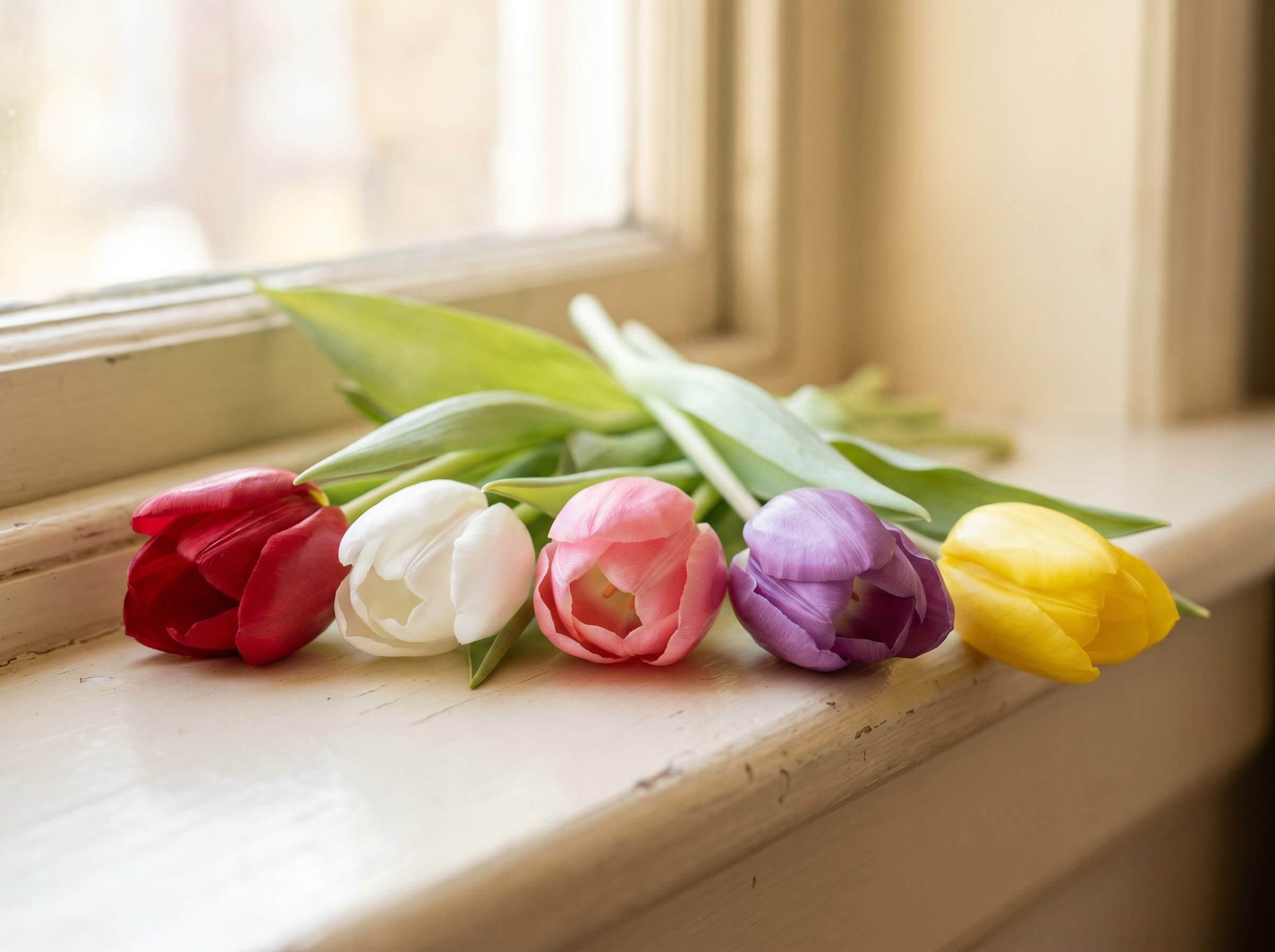
A tulip means love: a deep, perfect, uncomplicated love stated plainly rather than performed, a sincere declaration you can give a partner, parent, or close friend, with the colour naming the kind of love meant.
The Victorian reading
In the Victorian language of flowers the tulip was a declaration of love, and the colour named the kind of love being declared.
The colour spectrum, at a glance
What to write on the card
Match the line to the colour: for white tulips (forgiveness), “Let us start fresh”; for red tulips (love), “It has always been you.”
A tulip means love. Not the dramatic, candlelit kind, but something plainer and warmer: a deep, perfect, uncomplicated love, the sort you can hand to a partner, a parent, or a close friend without it sounding like a marriage proposal. That is the heart of it, and almost every other tulip meaning is a small turn on that one idea, set by the colour you choose. Red tulips say true love. White ones say forgiveness and a fresh start. Yellow, which once meant something sadder, now means sunshine. Below you will find each colour read honestly, the story of how the yellow tulip slowly changed its mind, the Persian legend and the Dutch history behind the flower, and a clear note on which of these meanings are old custom and which are softer modern habit.
As flowers go, the tulip is an easy one to give and a forgiving one to read. Nothing dark is hiding in the bouquet, and even the colours that carry a heavier note carry it kindly, so you rarely have to worry that the message will land wrong. That low risk of being misread is part of why the tulip has stayed such a steady spring gift while showier flowers come and go.
The plain meaning underneath every tulip
Before any colour is chosen, a tulip already carries one thing: a declaration of love, simple and sincere. The modern reading is deep and perfect love, a feeling stated cleanly rather than performed. In the Victorian language of flowers the tulip was a declaration too, and the colour was what named the kind of love being declared. So the flower itself supplies the sentiment, love, devotion, a heart laid open, and then the colour decides whether that love is romantic, grateful, regretful, or just glad.
This is why a tulip reads so well across so many relationships. Hand a bunch to someone and the baseline message is affection and good feeling, with the specifics left to the shade. The flower does not demand that the recipient be a lover. It only insists that they be cared about. If you are after the plant rather than the symbol, how to plant the bulbs, when they bloom, and how to keep them coming back, our guide on how to grow tulips walks through the growing side.
Tulip colour meanings, one by one
Red is the tulip most people reach for first, and the choice makes sense. A red tulip means true love, the clearest romantic message the flower offers and just about as unmistakable as the red rose, but said in a quieter register. Where the rose can feel grand and even a little theatrical, a red tulip makes the same promise more softly, which is exactly why some people prefer it. White tulips point somewhere unexpected and rather lovely. They mean forgiveness and a fresh start, which makes them one of the few flowers with a genuine, specific use as a peace offering. Give white tulips when you want to say sorry, or when two people are starting over, and the message is built right into the colour.
Pink tulips sit in the warm middle of the family. They carry affection and care, a gentle fondness without the full romantic charge of red, which makes them a graceful choice for a friend, a mother, or anyone you love without wanting to declare passion. Purple tulips lean toward royalty and admiration, a flower for someone you hold in high regard, a little stately and flattering at once. Then there is the variegated tulip, the streaked and feathered kind, which the old lists read as “beautiful eyes,” a compliment paid through a flower, charming and very much of its era.
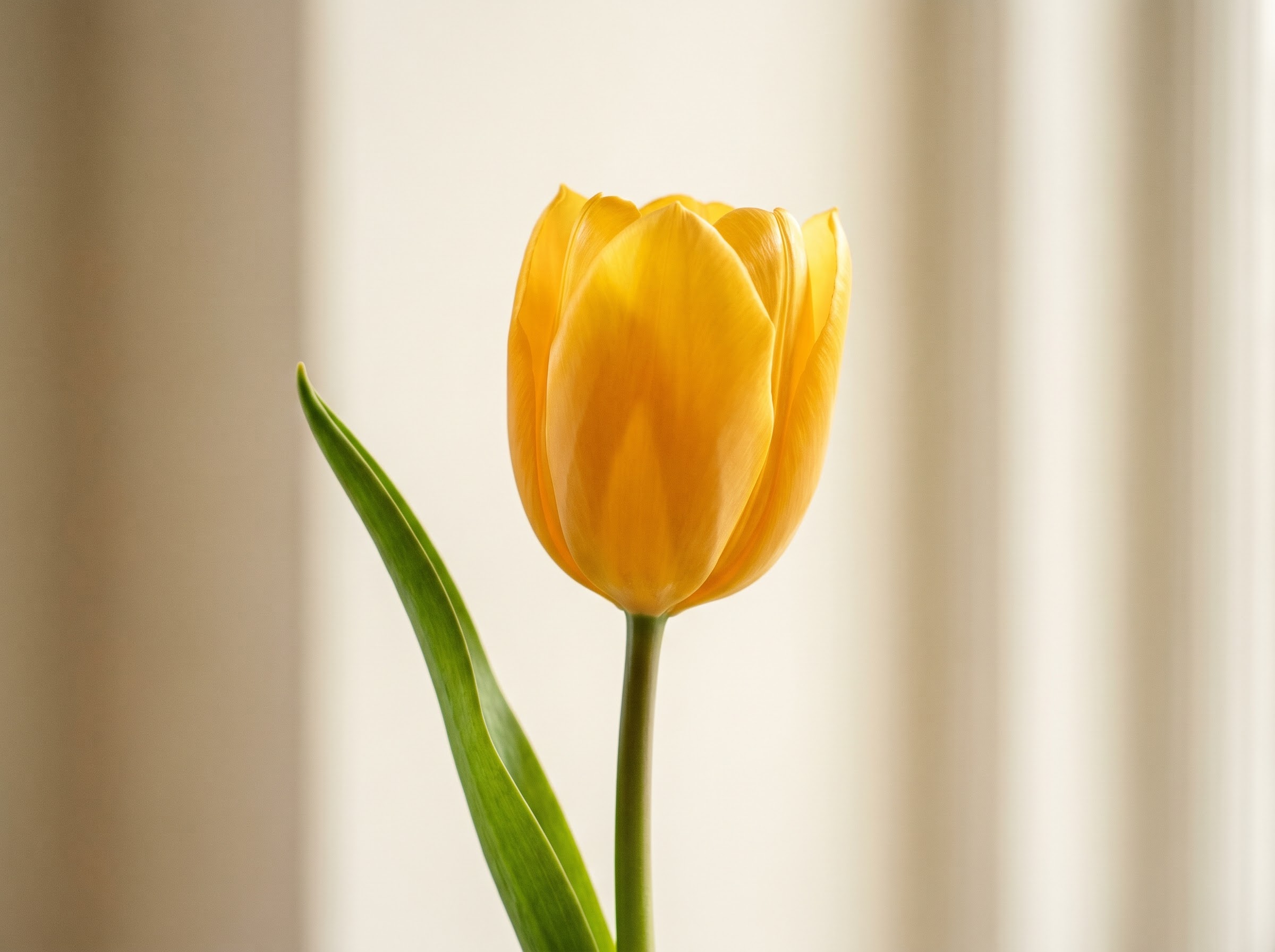
Yellow is the tulip with the most interesting past, and the one worth pausing on. Today a yellow tulip means cheerful thoughts and sunshine, and that is how nearly everyone will read it: bright, friendly, glad to see you. That sunny reading is recent, though, and the older one ran the other way. The full story of that flip gets its own section below, because it is the best small lesson the tulip has to teach about how flower meanings actually work.
The table below collects every tulip colour together, each with the meaning most people use today and a short note on how firm that meaning actually is. Skim the notes before you buy: a couple of these colours are safe to hand over without a second thought, while one or two carry a softer edge or an old double meaning underneath.
| Tulip colour | Common meaning today | Note |
|---|---|---|
| Red | True love | The tulip’s clearest romantic message. Consistent and easy to send. |
| White | Forgiveness and a fresh start | One of the few flowers that genuinely reads as a peace offering. |
| Pink | Affection and care | Warm but not romantic. A safe gift for a friend, mother, or thank-you. |
| Yellow | Cheerful thoughts and sunshine | Modern reading. Victorian lists read it as hopeless love. See below. |
| Purple | Royalty and admiration | Stately and flattering. Good for someone you respect or look up to. |
| Variegated | Beautiful eyes | An old Victorian compliment for the streaked kind. Charming, rarely known today. |
Choosing a tulip for love, for a friend, or to say sorry
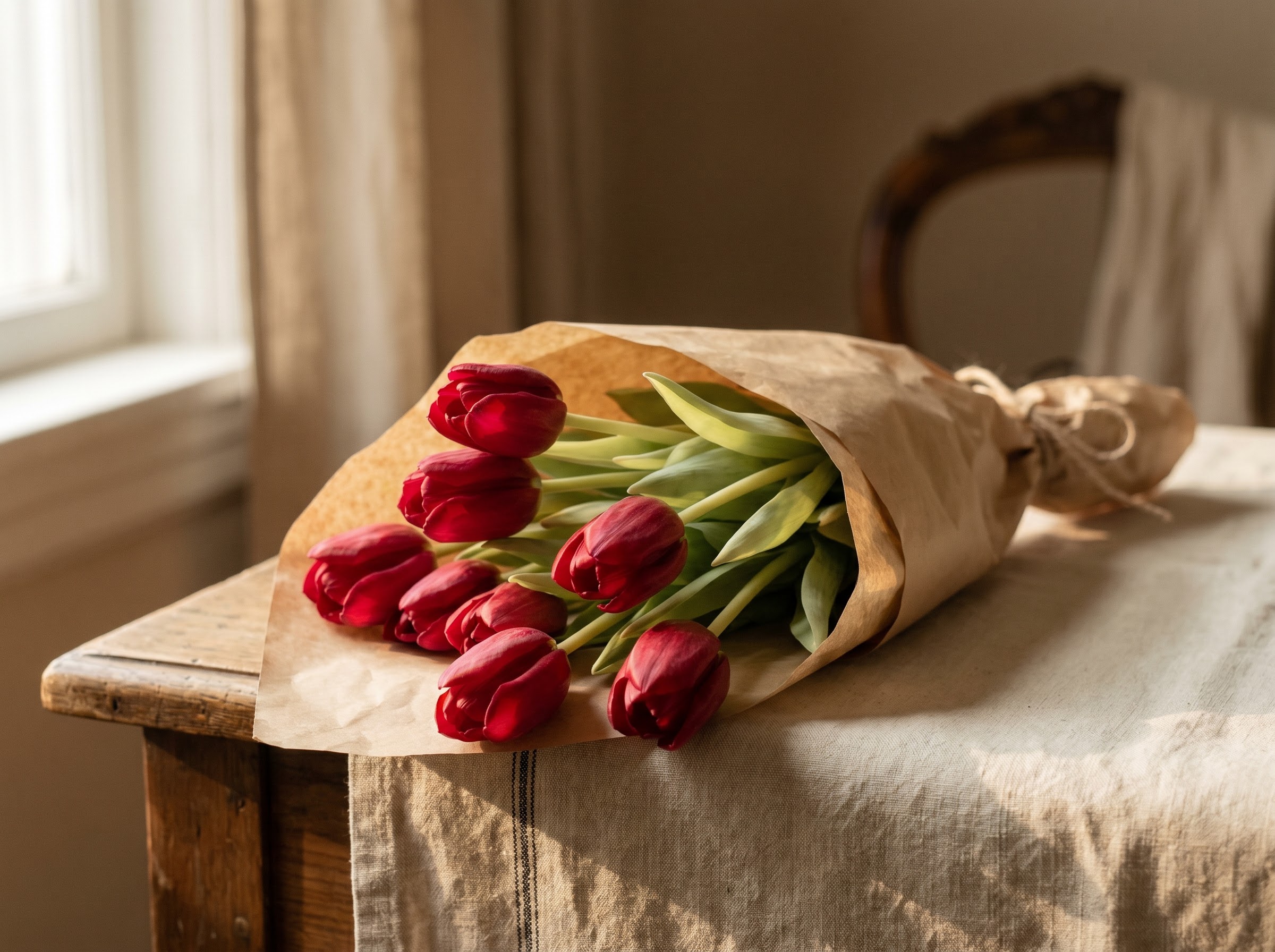
In love, the tulip is one of the most reliable flowers you can pick, precisely because it says love without overstating it. A red tulip declares true love in a way that feels heartfelt rather than showy, which suits a couple past the first dizzy weeks as well as a brand-new spark. For an anniversary, a bunch of red tulips reads as steady, lasting devotion, the love that has settled in and stayed. To a lot of people that quiet warmth feels more fitting for a long partnership than the more obvious romantic flowers.
For friendship and family, the colour does the sorting. Pink tulips say a soft, caring affection that lands gently with a friend or a mother. Yellow tulips, in their modern sense, are pure cheer, the flower to send when you simply want to brighten someone’s week with no romantic subtext at all. And white tulips quietly do a job almost no other flower does well, which is to apologize. When the message is “I am sorry” or “let us start fresh,” white tulips carry it without you having to spell it out, which is why they belong in any honest list of flowers for mending things. To work the other way round and start from the emotion rather than the bloom, our guide to flowers sorted by feeling maps the whole tradition that way.
The legend, the empires, and the Victorian rulebook
The tulip carries one of the most romantic origin stories in the flower world, and it is a story rather than a fact, which is the honest way to tell it. A Persian legend tells of Farhad, a young man who loved a woman named Shirin. When he believed she had died, grief drove him to take his own life, and where his blood touched the ground, the legend says, the first red tulips opened, each bloom a drop of a lover’s heart. That tale is why red tulips have meant perfect, sacrificial love in Persian poetry for centuries, and it gives the colour a depth that the modern florist meaning only hints at.
The flower’s real history is just as striking. In the Ottoman world the tulip became so beloved that an entire period took its name, the Tulip Era, when the flower stood for paradise on earth and for abundance, woven into art, gardens, and court life. From there it travelled to the Netherlands and set off one of the strangest episodes in economic history, the speculative frenzy remembered as tulip mania, when rare bulbs changed hands for astonishing sums before the bubble burst. The Dutch kept their love of the flower long after the fever broke, and the tulip is now a national emblem of the Netherlands. So a flower that means a quiet, perfect love also carries a memory of obsession, paradise, and a market gone mad, depending on how far back you look.
The everyday meanings most of us use, though, come from a much later and more bookish source: the Victorian language of flowers, an elaborate code of sentiments that grew up in the nineteenth century. Cornell University, in its history of floriography, traces the practice of sending messages with flowers back to genuinely ancient roots in the symbolism of China, Egypt, and Assyria, while noting that much of what became the familiar British tradition was actually assembled in France first. The tulip’s tidy colour code is a product of that era of flower dictionaries, not of the Persian legend or the Dutch bulb trade. Knowing that helps explain why the meanings can feel both old and oddly arbitrary at once.
How the yellow tulip changed its mind
The yellow tulip is the clearest example of a flower meaning quietly reversing itself, and it is worth understanding because it shows how the whole tradition moves. In the Victorian lists, a yellow tulip did not mean sunshine at all. It meant hopeless love, the ache of caring for someone who will never care back, a sad little message tucked inside a bright flower. Hand a Victorian a yellow tulip and you were confessing a love you had already given up on.
Today that reading is almost entirely gone. A yellow tulip now means cheerful thoughts and sunshine, a warm, optimistic gift with no sorrow in it whatsoever. The meaning swung from hopeless love to plain happiness as the generations turned over, following the slow drift of yellow itself from a colour the Victorians often distrusted toward the friendly, sunny shade we read it as now. Both meanings were real in their time, and the flower in the vase never moved an inch; what shifted was the mood of the people picking it up, which is the single most useful thing to understand about any flower meaning. So when you give yellow tulips, give them as the cheerful gesture everyone now understands, and let the hopeless-love version stay in the antique books where it belongs.
How firmly to trust any of this
Even a friendly, well-behaved flower like the tulip comes with the same warning that sits under the entire language of flowers. Nobody ever ratified these meanings; they were assembled from old lists, folklore, and florist custom that do not always agree, and there has never been an authority you could appeal to when they clash. Iowa State University Extension, in its own guide to flowers and their meanings, is upfront about exactly this, noting that the information comes from multiple sources and that one flower can end up carrying several meanings at once. The tulip happens to be one of the calmer cases, with its core “love” reading steady across the lists, but the yellow tulip’s full reversal is proof that even here the ground can move.
So trust the colours that have stayed put. Red for true love, white for forgiveness, pink for warm affection are all steady enough to send on instinct, while the rarer readings, like the variegated tulip’s “beautiful eyes,” are best treated as charming old custom rather than a code your recipient will catch. In practice the person opening the bouquet is responding to the colour, the gesture, and the simple fact that you thought of them, and the tulip handles all three gracefully. If you want to see how other shades shift the same way yellow did, our guide to flower colour meanings tracks those swings across the rest of the flower world, and if you would rather step back and ask why any of these meanings exist in the first place, that whole question is what our meaning of flowers hub is for.
The right season and the right note
Tulips are a spring flower, blooming roughly from March through May from bulbs planted the previous fall, which makes them a natural gift for the start of the year, for Easter and Mother’s Day, and for any moment that feels like a new beginning. That seasonal timing pairs neatly with their meanings, since forgiveness, fresh starts, and warm love all suit the season when everything is starting over.
For the message itself, match the line to the colour. With white tulips, when you are mending something or starting fresh, a simple “let us start fresh” says exactly what the flower already says. With red tulips, for a love you mean sincerely, something like “it has always been you” lands the true-love meaning without overreaching. Pink tulips suit a warm, plain note to a friend or a mother, and yellow tulips ask for nothing more than a cheerful line, since their whole modern job is to brighten a day. Match the colour to the message and the tulip does the rest, saying love, or sorry, or simple cheer, in a voice that almost everyone already understands.
Sources
- Cornell University, Written in Petals: The Language of Flowers, on the history of floriography.
- Iowa State University Extension, Flowers and Their Meanings, on why sources disagree.
More flower meanings
 RoseLove in nearly every form, with the precise message set by the colour you choose. A rose on its…
 Cherry blossomThe beauty and brevity of life caught in one breath: a flower that is dazzling and gone in…
 DaffodilNew beginnings, rebirth, and hope. As one of the first flowers to push up after winter, the…
 HyacinthAt its core the hyacinth means playfulness and sincerity, a fresh, fragrant spring flower; the…
More meaning guides
More About The meaning of flowers, honestly
Enjoying our flower guides? Add YourFlowersGuide as a preferred source on Google. It helps more readers find us.
Add to Preferred Sources