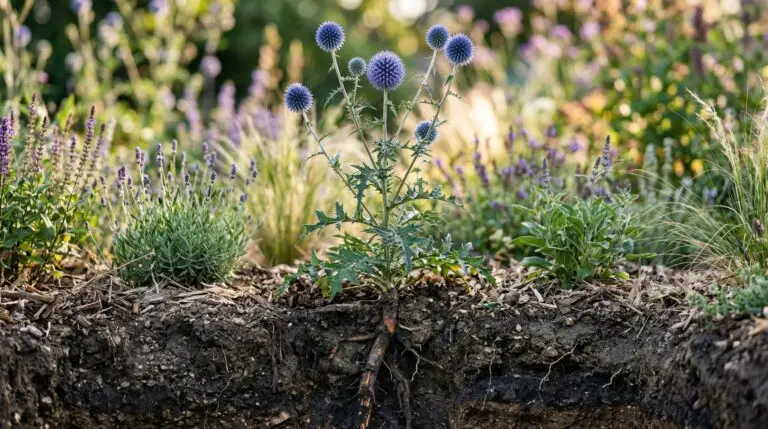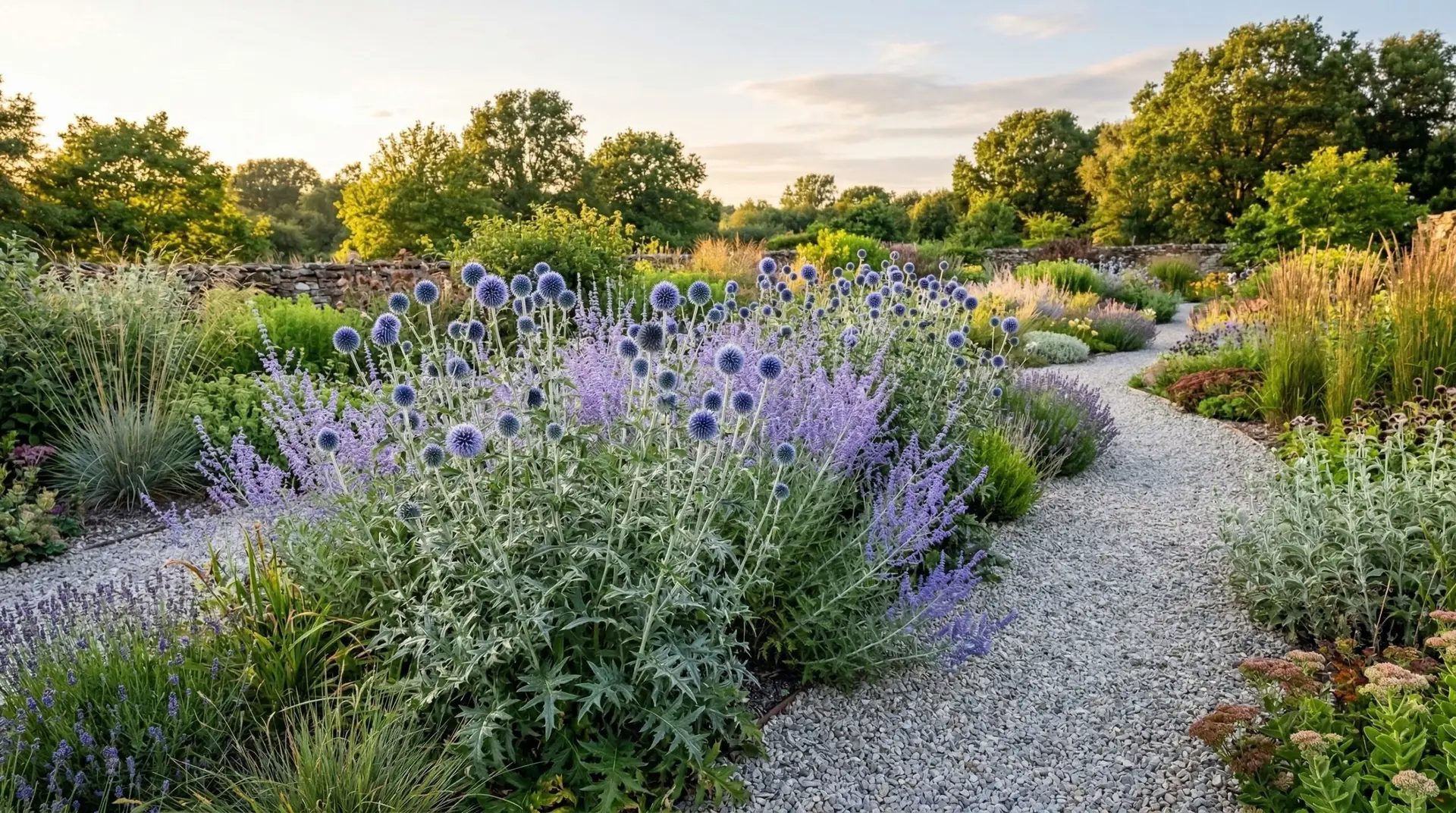
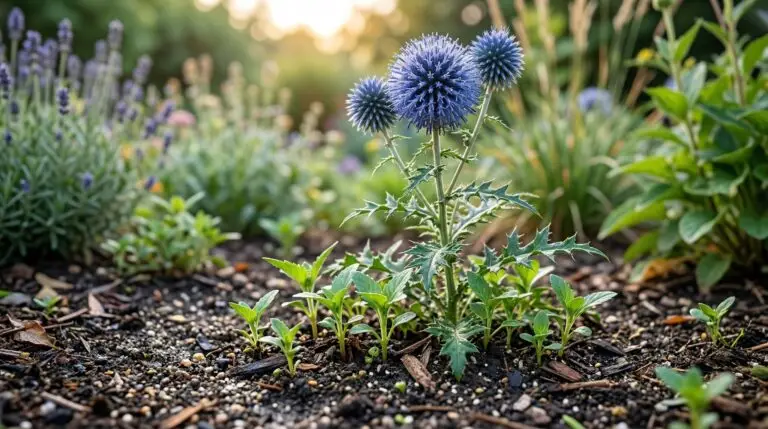
Globe thistle is a definitive architectural accent in the drought-tolerant garden. When you look at a dry border or a gravel garden, the eye naturally searches for structural punctuation marks to break up the low mounds of typical xeric plants. Echinops provides exactly this kind of assertive vertical presence with its stiff stems and perfect spherical flower heads. I treat it as a mid-border anchor that draws attention without overwhelming the surrounding composition. The coarse, jagged foliage creates a strong base that demands space, meaning you should give it room to breathe rather than crowding it with equally heavy plants. In a Mediterranean-inspired planting scheme, globe thistle provides the rigid backbone that allows softer, more forgiving plants to drape and flow around its base.
Color relationships in the dry border
The steely, metallic blue of globe thistle offers a specific coolness that grounds a hot, sun-baked garden space. This particular shade of blue has a silvery undertone that links beautifully with other drought-tolerant plants sharing similar foliage characteristics. For a harmonious, cool-toned composition, you can pair it with lavender, which echoes the silver-green leaves while providing a softer, mounding shape below the rigid thistle stems. To create a more dramatic color contrast, I look to the opposite side of the color wheel. The cool blue spheres pop violently against the flat, mustard-yellow flower heads of yarrow, creating a classic high-contrast pairing that defines late summer borders. You can also introduce the bright, cheerful yellow of coreopsis near the front of the border to pull the eye up toward the blue globes standing behind them. These warm yellow and orange tones make the metallic blue of the thistle appear even colder and more deliberate.
Texture and form combinations
Texture is where globe thistle truly earns its keep in a thoughtful garden composition. The plant presents two distinct textural elements: the prickly, deeply lobed leaves at the base and the smooth, geometric perfection of the round flower heads above. To highlight these spheres, you need companion plants that offer completely different shapes. The airy, violet-blue spires of Russian sage create an excellent backdrop, as their hazy, indistinct form makes the hard edges of the globe thistle stand out sharply. Ornamental grasses are equally effective partners because their fine, arching blades provide movement that contrasts with the static, unyielding posture of the thistle. Mexican feather grass or blue oat grass planted in sweeping drifts around the base of Echinops will soften the overall look while emphasizing the thistle’s rigid architecture. The goal is to surround the heavy, solid globes with plants that catch the wind and blur the lines of the garden bed.
Scale and spatial planning
Because globe thistle typically reaches three to four feet in height, its placement requires careful consideration of sightlines and garden depth. You should position it in the middle or back of a border where its tall stems can rise above lower-growing companions without obscuring them. If you are designing a gravel garden with meandering pathways, placing a clump of globe thistle near a curve creates a natural focal point that encourages the viewer to pause. The plant has a strong vertical thrust, so it looks exceptionally well planted in front of solid structures like stucco walls or large boulders. These solid backgrounds provide a blank canvas that highlights the distinct silhouette of the spherical blooms. When planting, group them in odd numbers, spacing them wide enough apart that each individual globe can be seen clearly against the sky or the backdrop. Crowding them into a dense block ruins their architectural value and turns a striking silhouette into a messy thicket.
Designing for seasonal transitions
A well-designed garden relies on plants that contribute visual interest long after their primary blooming season has ended. Globe thistle excels in this regard, offering a changing display from early spring through the dead of winter. The foliage emerges early with a silvery-white cast that looks fresh alongside spring-blooming bulbs and early perennials. As summer progresses, the tight silver buds form, providing geometric interest weeks before they actually turn blue. Once the blue color fades in late summer, the spheres dry into pale brown, structural seed heads that hold their shape through autumn rain and winter snow. I always advise leaving these dried stems standing until early spring. When surrounded by the tawny, dormant foliage of ornamental grasses and the gray skeletons of Russian sage, the brown globes of the thistle catch the low winter sunlight and provide essential winter architecture.
The most effective way to use globe thistle is to treat it as a repeating rhythm rather than a single specimen. If you plant one group of Echinops, it looks like an isolated event, but if you repeat groupings of three or five along the length of a dry border, you create a cohesive visual language. This repetition pulls the viewer’s eye down the path, establishing a predictable, comforting pattern amid the wilder, looser forms of drought-tolerant companions. You can apply this principle of repeating strong architectural forms to any planting scheme to bring order to a space that might otherwise feel chaotic. By carefully balancing the rigid globes with soft grasses, contrasting colors, and deliberate spacing, you turn a simple collection of dry-climate plants into a highly intentional garden composition.
More About Globe Thistle
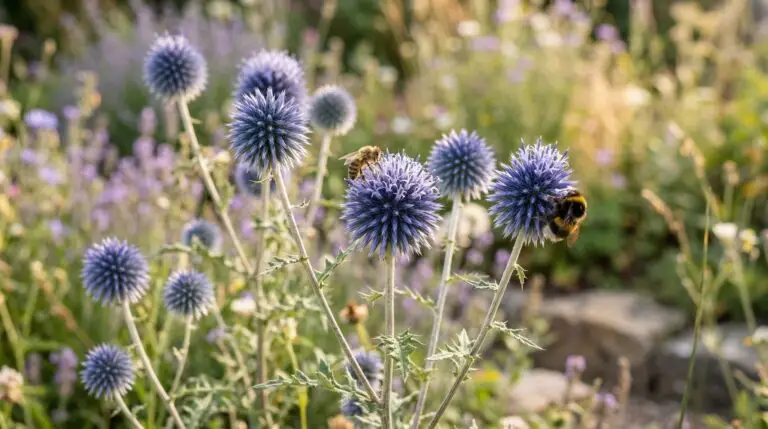
Globe thistle as a pollinator powerhouse attracting more bees than almost any perennial
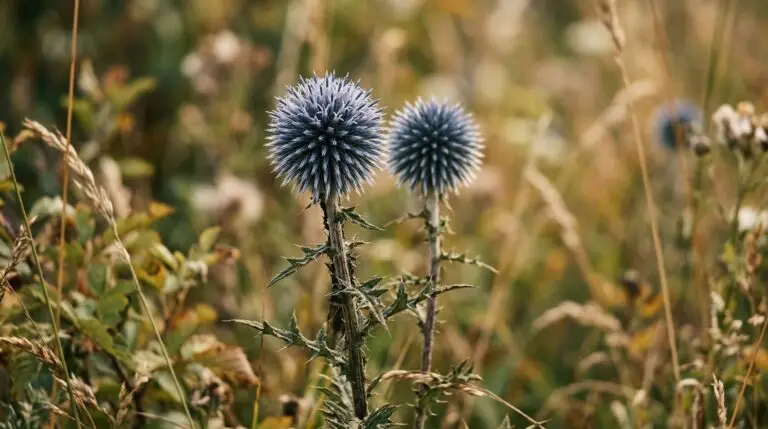
Globe thistle flower meaning and the quiet strength of this spiny blue sphere
Growing globe thistle from seed for the most budget-friendly perennial border