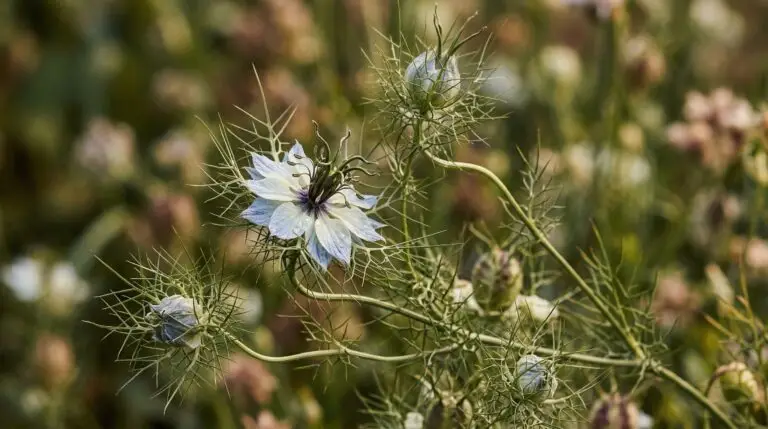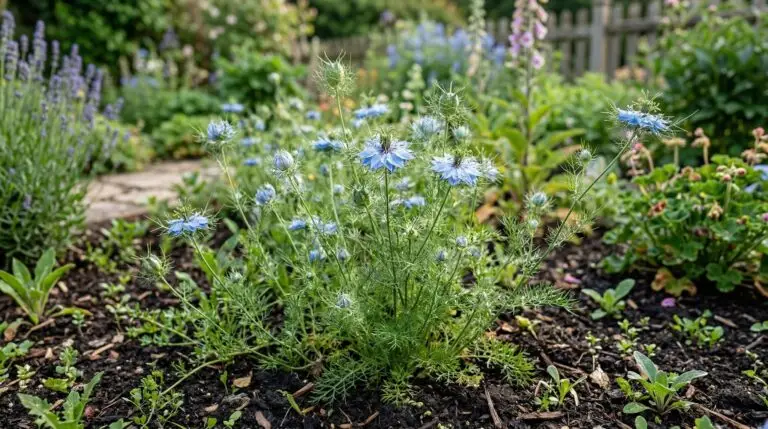
I wish you could stand beside me in the garden just after sunrise, when the heavy dew still clings to the foliage. The love-in-a-mist is blooming along the eastern fence line, catching the pale, slanted morning light in a way that makes the entire patch look like a low-lying cloud. This plant earns its name from the thread-like green bracts that surround each flower, creating a hazy, soft-focus halo around the petals. When you look closely, the flowers themselves are painted in the coolest, most soothing shades of icy blue, chalky white, and a muted, bruised plum. The petals have a papery thinness to them, catching the breeze and shivering on their slender stalks. I often find myself running a hand over the tops of the plants just to feel the feathery resistance of the foliage against my palms. It is a quiet flower, lacking the heavy perfume of a rose, but it carries a faint, sharp scent of fresh green sap and damp earth that rises when the sun finally warms the soil.
Catching the bloom at the bud crack stage
To bring this quiet beauty indoors as a nigella cut flower, you have to watch the plants carefully and catch them at a very specific moment. I walk the rows with my clippers just as the morning chill begins to lift, looking for the buds that are completely swollen and tight. You want to harvest at the bud crack stage, which is the exact hour when the green casing splits just enough to reveal a single sliver of colored petal inside. If you cut them when they are fully open in the garden, the delicate petals will shatter and drop within a day or two, leaving your tabletop dusted in blue and white. Cutting at the bud crack stage ensures the flower will slowly unfold in the vase, stretching its life to nearly a full week. The stems are surprisingly rigid and distinctly ribbed, offering a satisfying, clean crunch when the sharp blades of the snips bite through them. As you gather a handful, the cut ends release a slightly spicy, resinous scent that clings to your fingertips long after you return to the kitchen.
Weaving a wild and airy arrangement
Building a love-in-a-mist bouquet feels less like formal floristry and more like gathering a wild meadow into a glass jar. Because the stems are slender and the foliage is so fine, nigella is a floating element in a vase, creating a halo of green haze that softens the edges of heavier blooms. I like to start by creating a loose lattice of nigella stems in the water, letting their lacy collars spill over the rim of the vessel. Through this airy foundation, you can thread the wide, flat, and papery faces of cosmos, allowing their sturdy stems to rest against the delicate green mist. The contrast between the broad, saturated petals of the cosmos and the fine, thread-like foliage of the nigella creates a visual depth that makes the arrangement feel alive and untamed. It is a forgiving way to arrange flowers, relying on the natural curves and quirks of the stems rather than rigid placement.
To build upon that meadow aesthetic, you can introduce other cottage garden flowers that share a similar wild character. I often weave in a few stems of cornflowers, matching their deep, saturated, almost electric blue tones with the softer, chalkier blues of the nigella. The cornflowers bring a rough, thistle-like texture to the bouquet, which plays beautifully against the smooth, waxy finish of the nigella petals. For vertical interest, the tall, velvet-lipped spires of a snapdragon can rise out of the center of the nigella arrangement, anchoring the floating elements. When you step back and look at the finished vase, the nigella fills every gap with its green haze, making the heavier flowers look as though they are suspended in mid-air. The entire composition shifts and nods with the slightest draft in the room, bringing the movement of the garden directly to your dining table.
The transition from petal to paper lantern
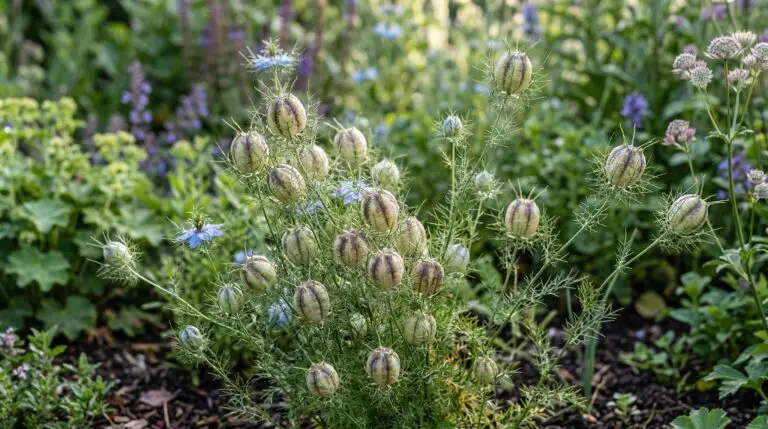
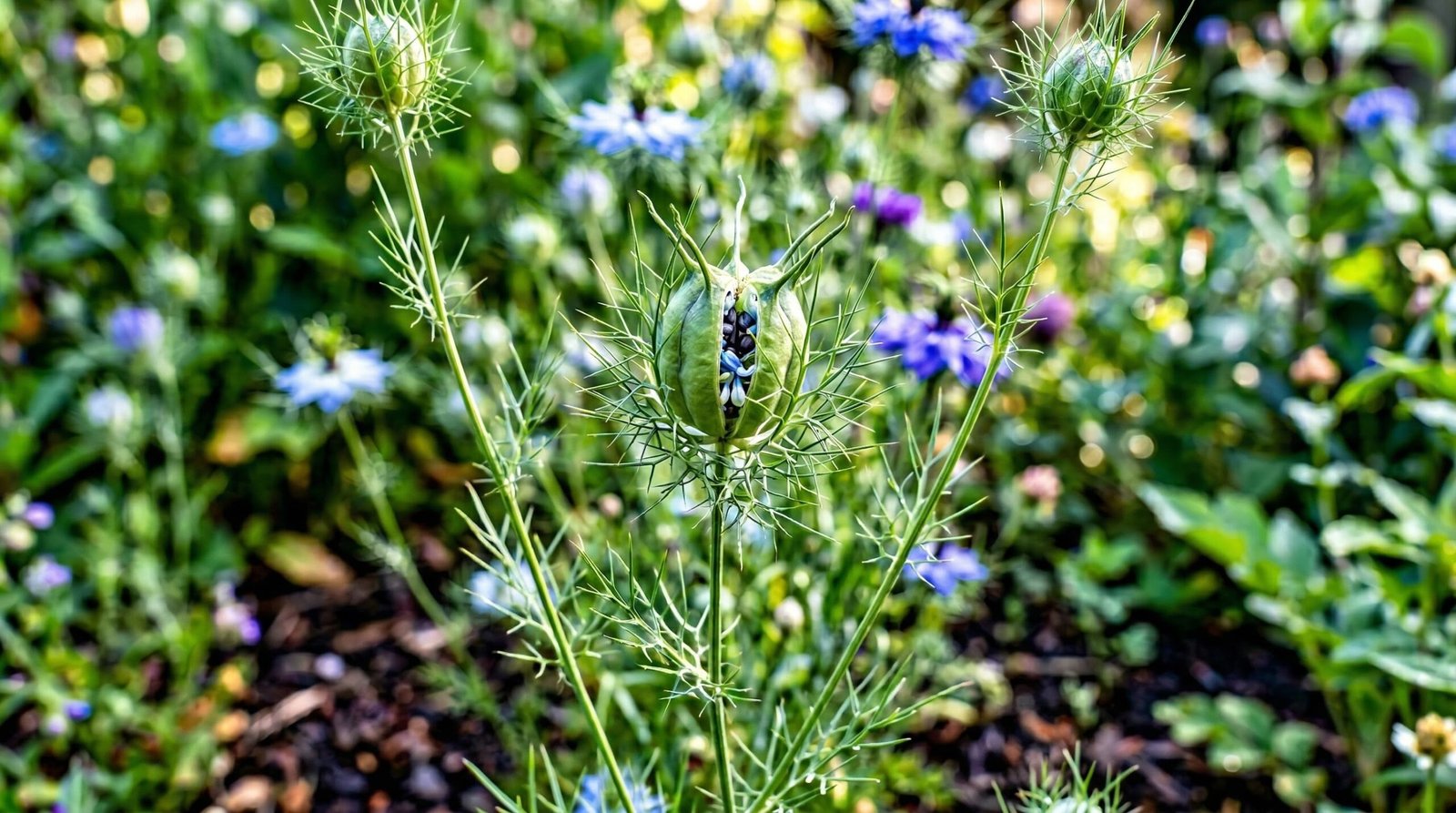
One of the greatest joys of growing this plant is that its beauty does not end when the petals finally drop. After the flowers fade, the center of the bloom swells into a balloon-like seed pod, transforming the plant into an entirely new textural element for cutting. These pods start out as a pale, luminous green, often striped with dark burgundy or deep purple lines that run vertically along their swollen sides. Each pod is crowned with five tiny, curved horns, giving them the appearance of miniature, exotic lanterns hanging in the foliage. You can cut these green pods for fresh arrangements, where they add a firm, structural contrast to soft, ruffled blooms. If you leave them on the plant to dry in the late summer sun, they eventually turn a warm, biscuity tan, their papery walls becoming crisp and fragile to the touch. When you shake a fully dried pod, you can hear the hard black seeds rattling inside like coarse sand, a sound that signals the end of their growing cycle.
Sowing seeds in the cool earth
If you want to fill your vases with this misty foliage next spring, you must start by pressing the seeds into the cool dirt while the air still holds a chill. The seeds themselves are matte black and shaped like tiny, rough-edged teardrops, slipping easily through your fingers as you scatter them over the garden bed. They do not like to be moved once they sprout, so I always sow them directly into the ground, raking a very fine layer of dirt over them to block out the light. You will know the soil moisture is right when you grab a handful of earth and it feels exactly like a wrung-out sponge, damp but not dripping. Within a few weeks, the first sprouts emerge, looking like tiny tufts of bright green dill pushing through the dark, heavy soil. As they grow taller, the foliage becomes denser and more complex, capturing droplets of rain that sit like clear glass beads on the fine green threads until the afternoon sun dries them away.
I often leave a single, simple jar of nigella on the windowsill above the kitchen sink, where I can watch it change throughout the day. In the late afternoon, the sun drops low enough to hit the glass directly, illuminating the water and casting long, fractured shadows across the counter. The light filters through the thread-like green bracts, turning them into a glowing, translucent halo around the fading blue petals. It is in these quiet moments that the plant truly looks like a cloud of mist caught in the glass, holding onto a small piece of the morning garden. Even as the petals begin to curl and drop, falling onto the wood sill one by one, the stem remains beautiful in its slow decay. It is a reminder that a garden is never static, and that capturing a flower in a vase is simply a way to watch it finish its story up close.