
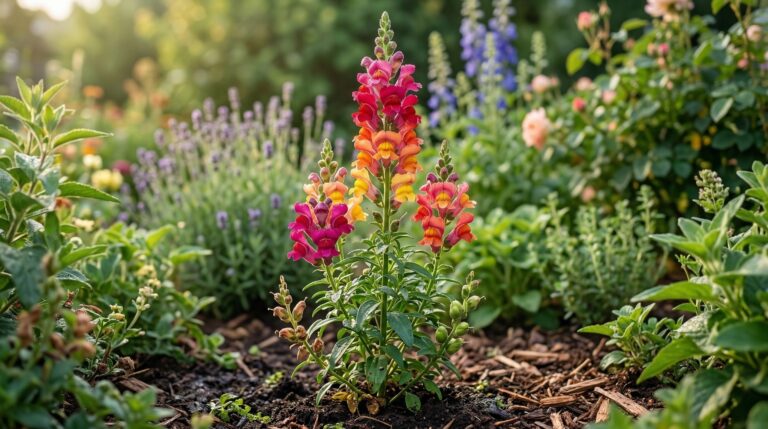
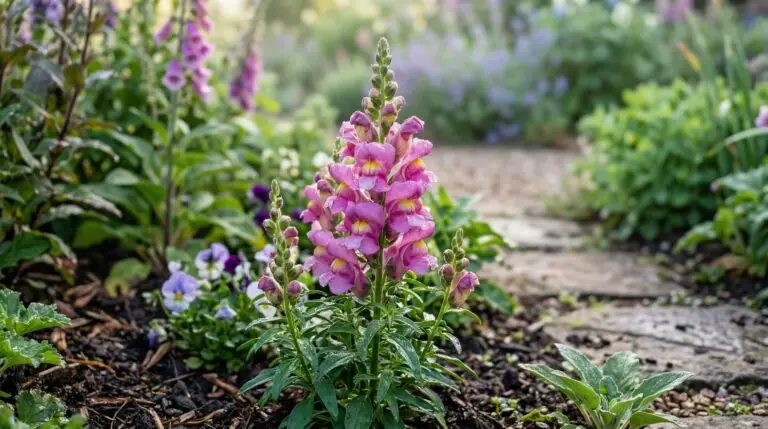
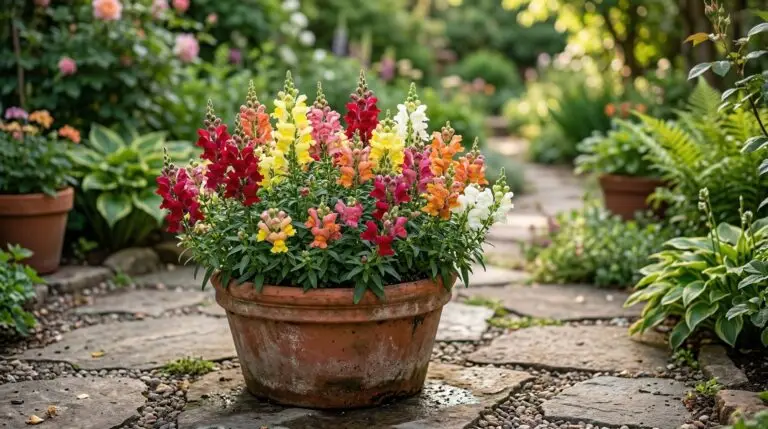
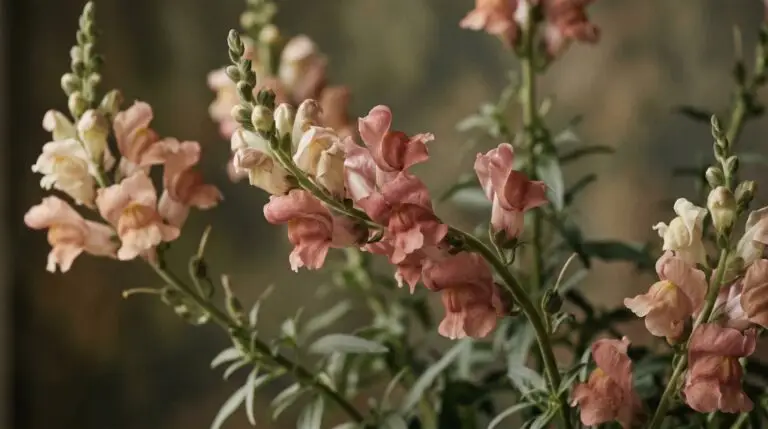

Taxonomy and origin
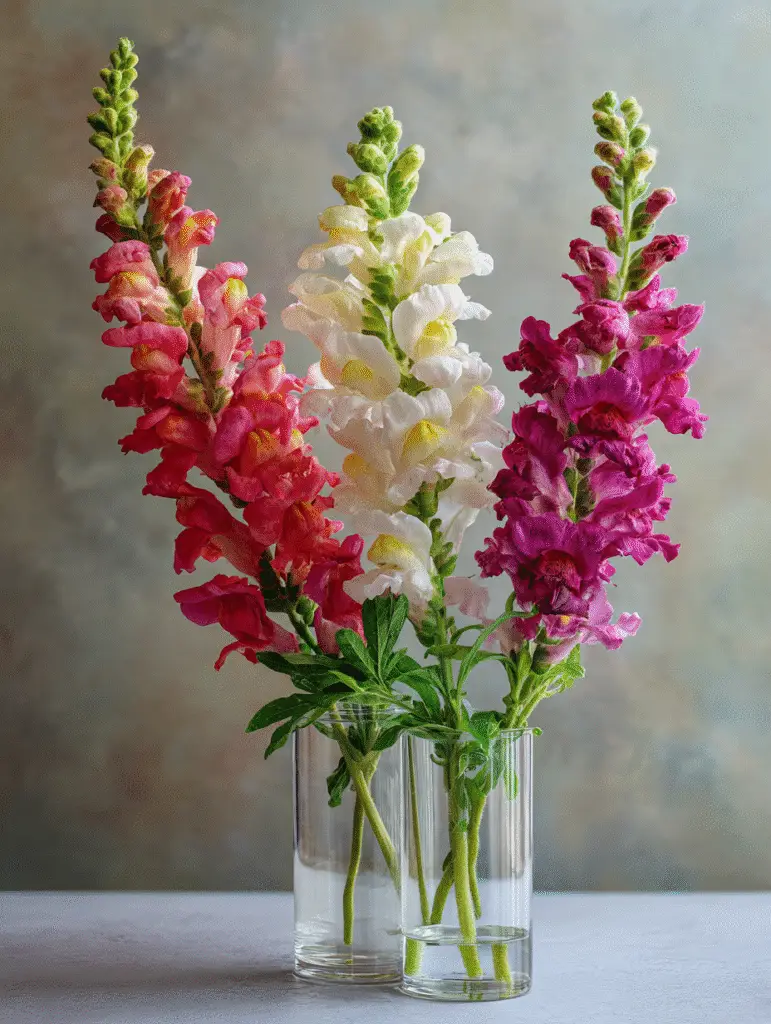
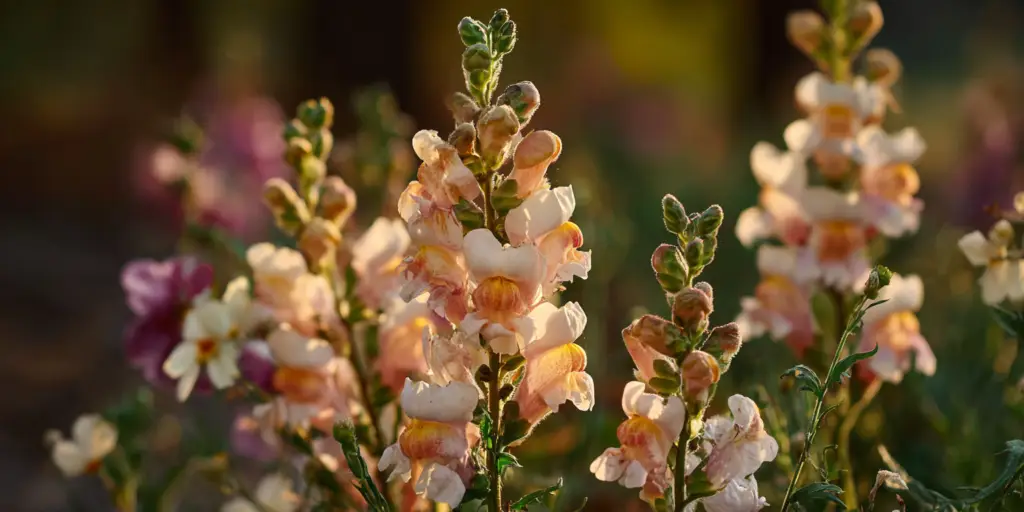
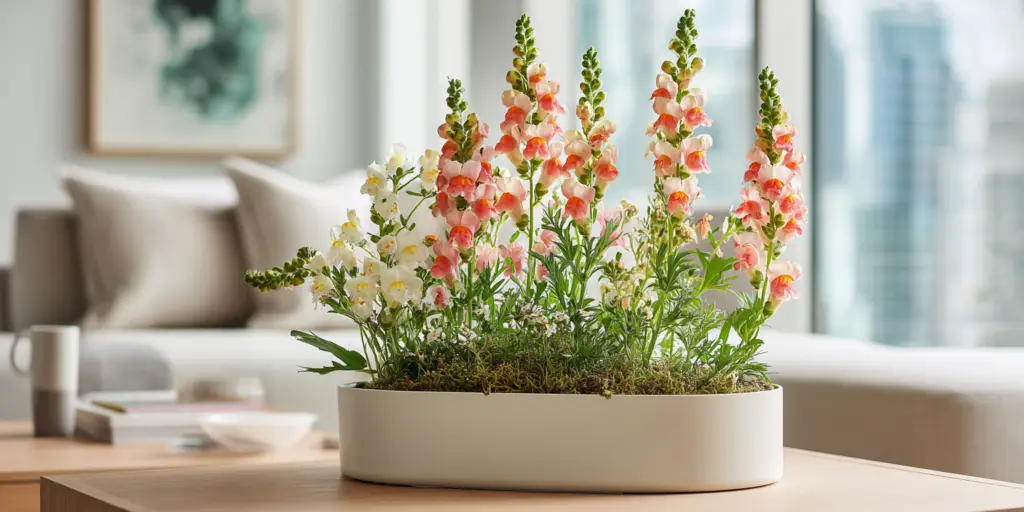
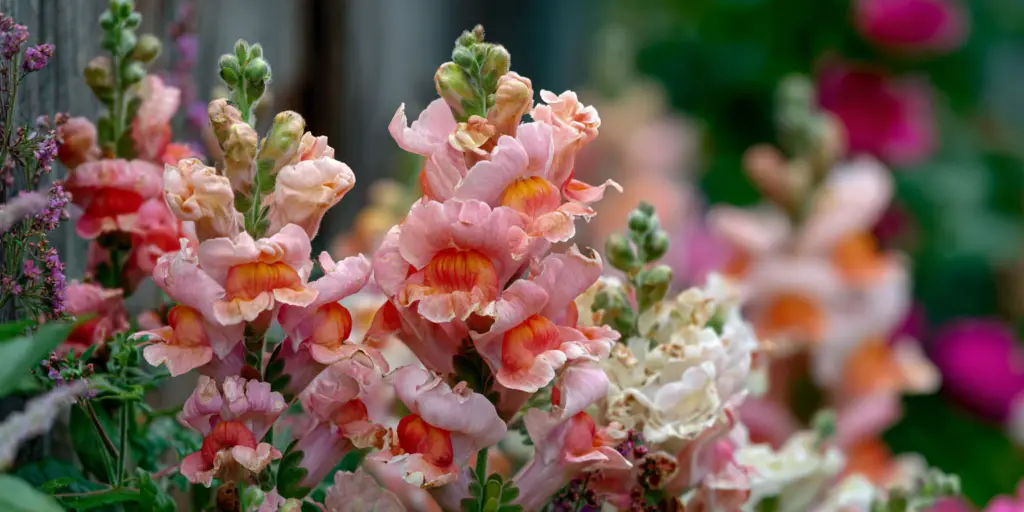
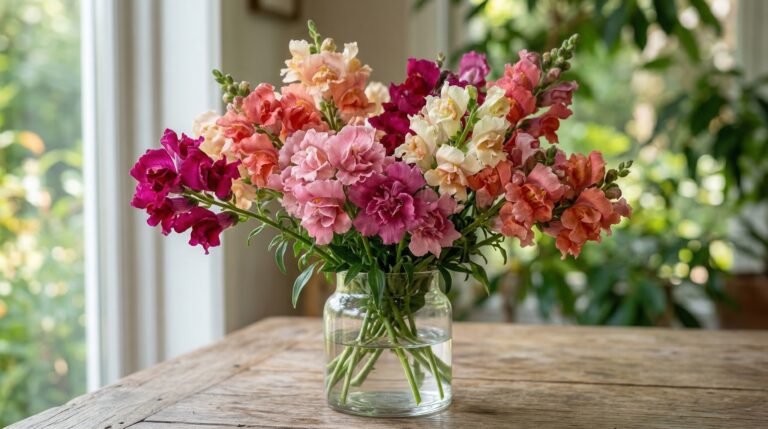
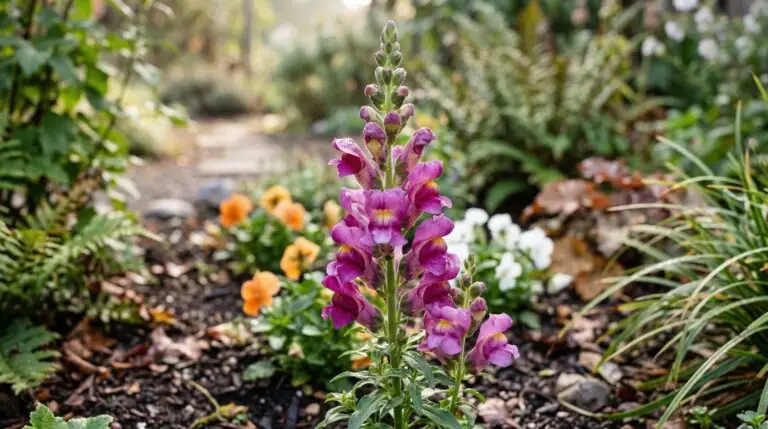
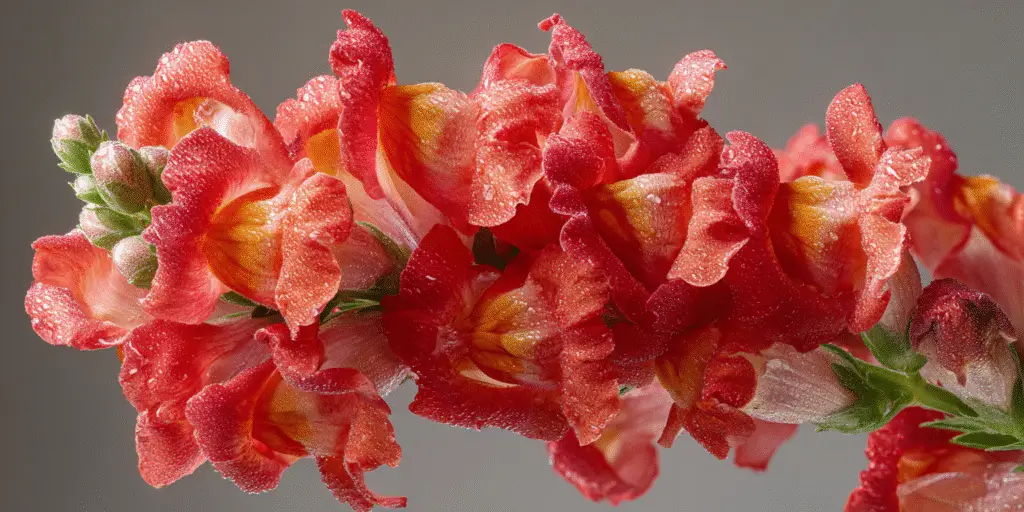
Antirrhinum majus sits in Plantaginaceae, the plantain family, which catches out anyone who learned it as a figwort in Scrophulariaceae; molecular work broke up that grouping and moved the snapdragon alongside veronica, foxglove, and penstemon. The genus name joins the Greek anti, like or resembling, and rhis or rhinos, nose or snout, describing the closed bud rather than the dragon English later read into it. In the wild it grows on rocky slopes, screes, and old walls across the western Mediterranean, centered on the Iberian Peninsula, where populations flower white or purplish magenta; every other shade in a seed rack came out of a breeding program. The flower works like a hinge, a type botanists call personate: a raised cushion on the lower lip, the palate, seals the tube, and only a bee heavy enough to force that lip down gets in. Bumblebees therefore do the real pollinating while honeybees, too light to work the hinge, largely cannot, and squeezing a bloom between finger and thumb reproduces the motion. The species also carries its own active transposable elements, which made mutant hunting possible before modern sequencing; CYCLOIDEA, the gene controlling left-and-right flower symmetry, was identified in snapdragon first.
Bloom time
Snapdragons flower on the cool side of the year: bud set is strongest with days in the 60s and low 70s and nights in the 40s and low 50s, the window University of Georgia horticulturists give as the best time to set plants out. Above the low 80s the plant stops making new buds while keeping every leaf, so the foliage looks fine and nothing opens; above the mid-80s the season is over for the time being. When nights cool again the buds resume, often carrying a second flush into hard frost.
That behavior splits the country into two opposite calendars. In cold and temperate regions, set plants out in early to mid spring as soon as hard freezes are past, since young snapdragons take light frost; they flower from late spring into early summer, stall through the hottest weeks, and return in September and October. In hot regions the schedule inverts: plants go in during fall, hold through winter, flower from late winter through spring, and are pulled when the heat arrives, making it a winter annual across the lower South and the Southwest. A May planting in a hot climate is simply the wrong end of the year, a mismatch that the summer stall and fall comeback covers in more depth.
An individual spike stays presentable for one to two weeks, opening from the bottom upward, and a well-grown plant throws successive spikes for months. The heavier move is the midsummer cutback: once the first flush is spent and heat has shut flowering down, cut the whole plant back by about a third, each stem just above a set of leaves or a side shoot, then water and feed lightly. It comes into fall already branched and budded rather than starting from scratch.
Seed catalogs sort snapdragons into four numbered response groups. The number is a season code, not a quality grade: it describes the day length and night temperature a variety needs before it will flower well.
Cornell trials of tunnel-grown snapdragons found groups 2 and 3 the most productive across both a spring and a fall crop, with group 1 running short-stemmed and group 4 making heads too large to develop under cover. Bedding snapdragons in six-packs carry no group number, which is fine for a border, but between two similar-looking seed packets it is the difference between a two-foot stem and an eight-inch one.
Two paths, worked in order
Both start with the calendar and the packet rather than with a pest, because for this plant the season and the Group number decide most of it.
Height and spread
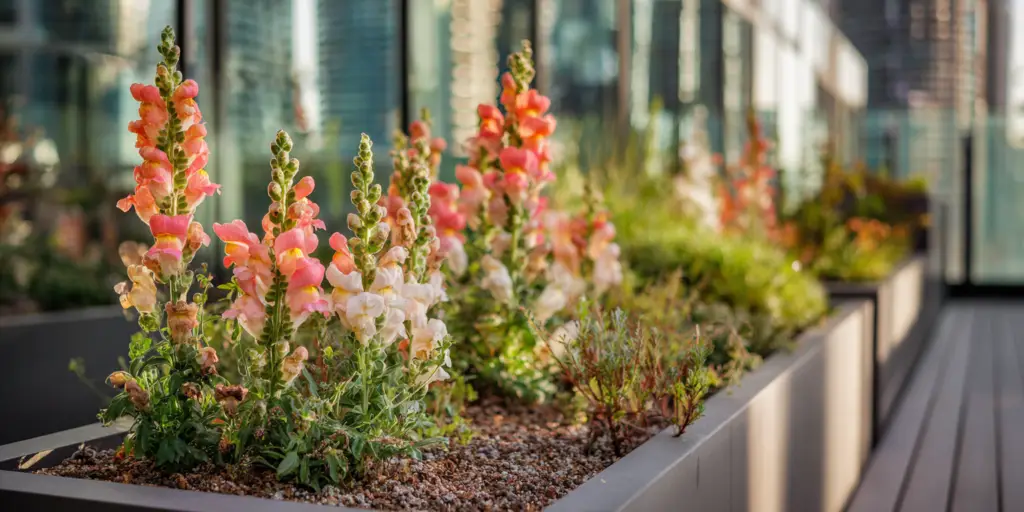
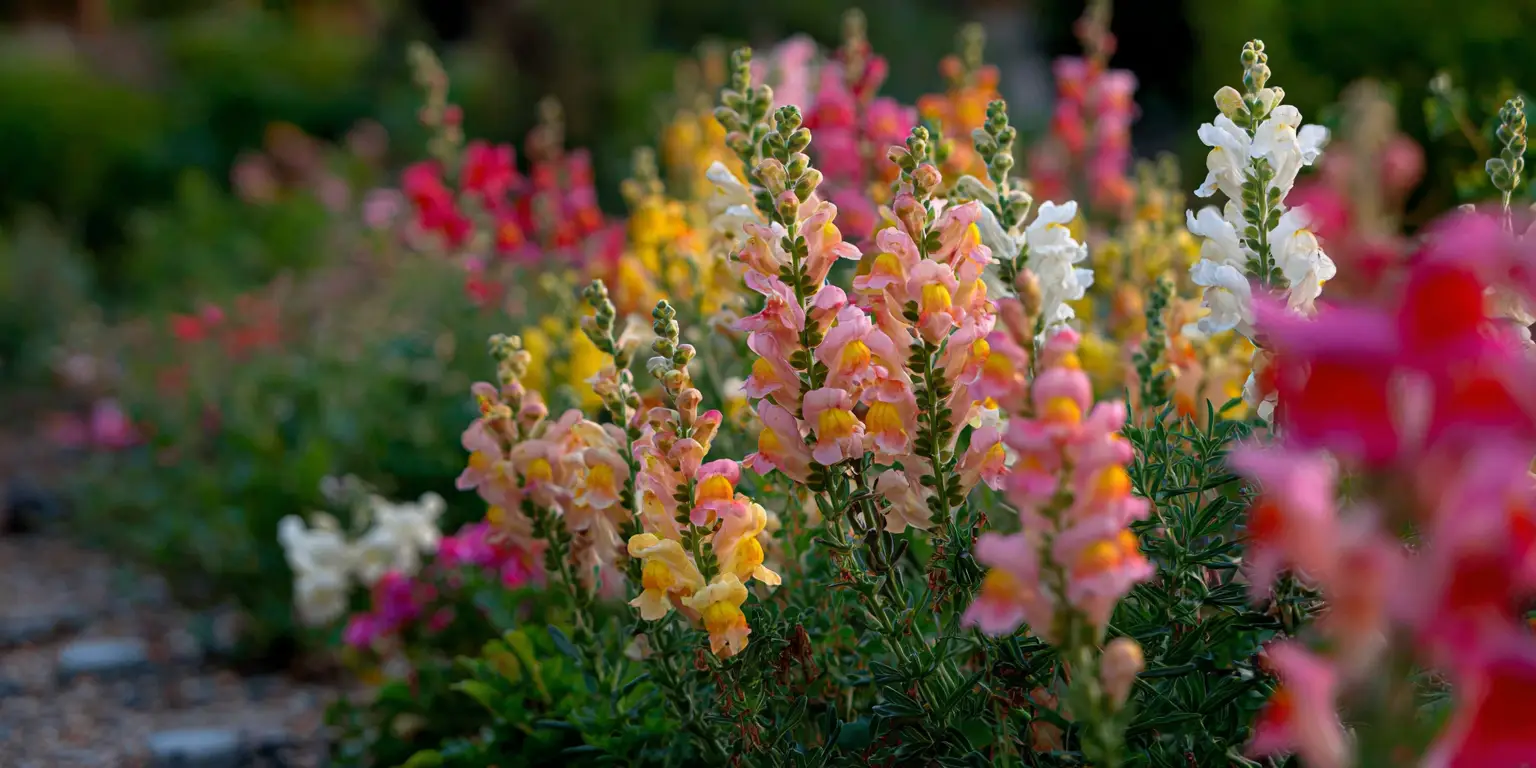
Snapdragons are sold in height classes that behave like different plants. Dwarf and bedding types run about 6 to 12 inches, branch on their own, and hold up in wind and rain. Intermediate types at roughly 12 to 24 inches are the most widely planted, tall enough to read as spikes in a border and short enough to stay standing; the mid-height cut series belong here, including the Liberty series grown for florist work. Tall or rocket types run 24 to 36 inches, pushing toward four feet in a long cool season, and are raised for cutting. Spread stays modest throughout, generally 6 to 12 inches.
Tall types almost always need support, because a spike carrying a full head of open florets is top-heavy and one hard rain will lay a row flat. Cut-flower growers stretch horizontal netting over the bed at planting so the stems grow up through the mesh, which beats staking individual plants; in a border, a fence, a hedge, or sturdier neighbors do much the same job. Spacing follows the goal, not the width of the plant: about four inches apart in a grid produces one long single stem for cutting, nine inches or more a branched plant harvested repeatedly.
The five classes, with what a field trial measured for each
Utah State University trialled eleven cultivars over multiple years in both a high tunnel and an open field, and reported the share of stems that came out marketable. That number, rather than the catalogue photograph, is what separates a cutting class from a bedding class.
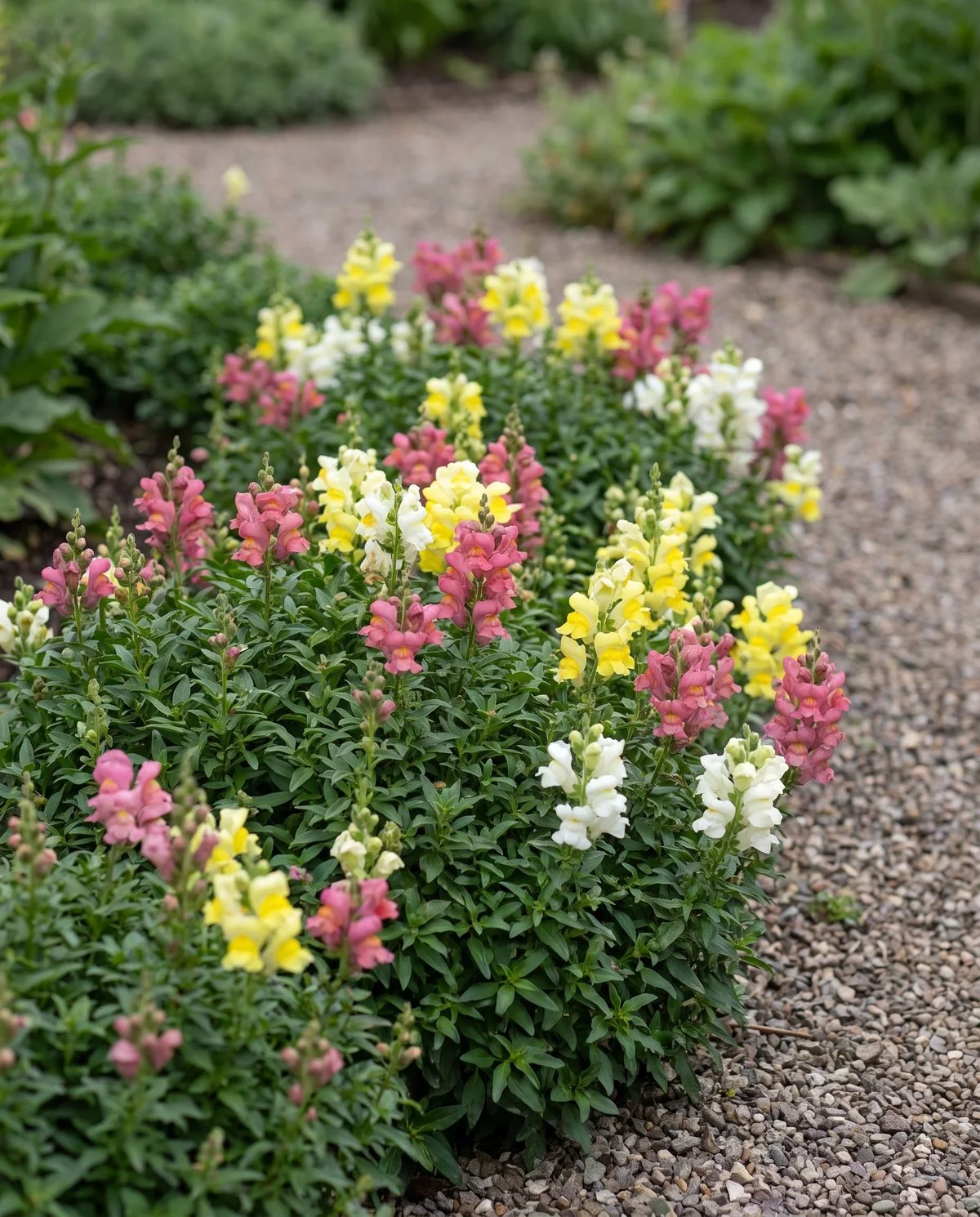
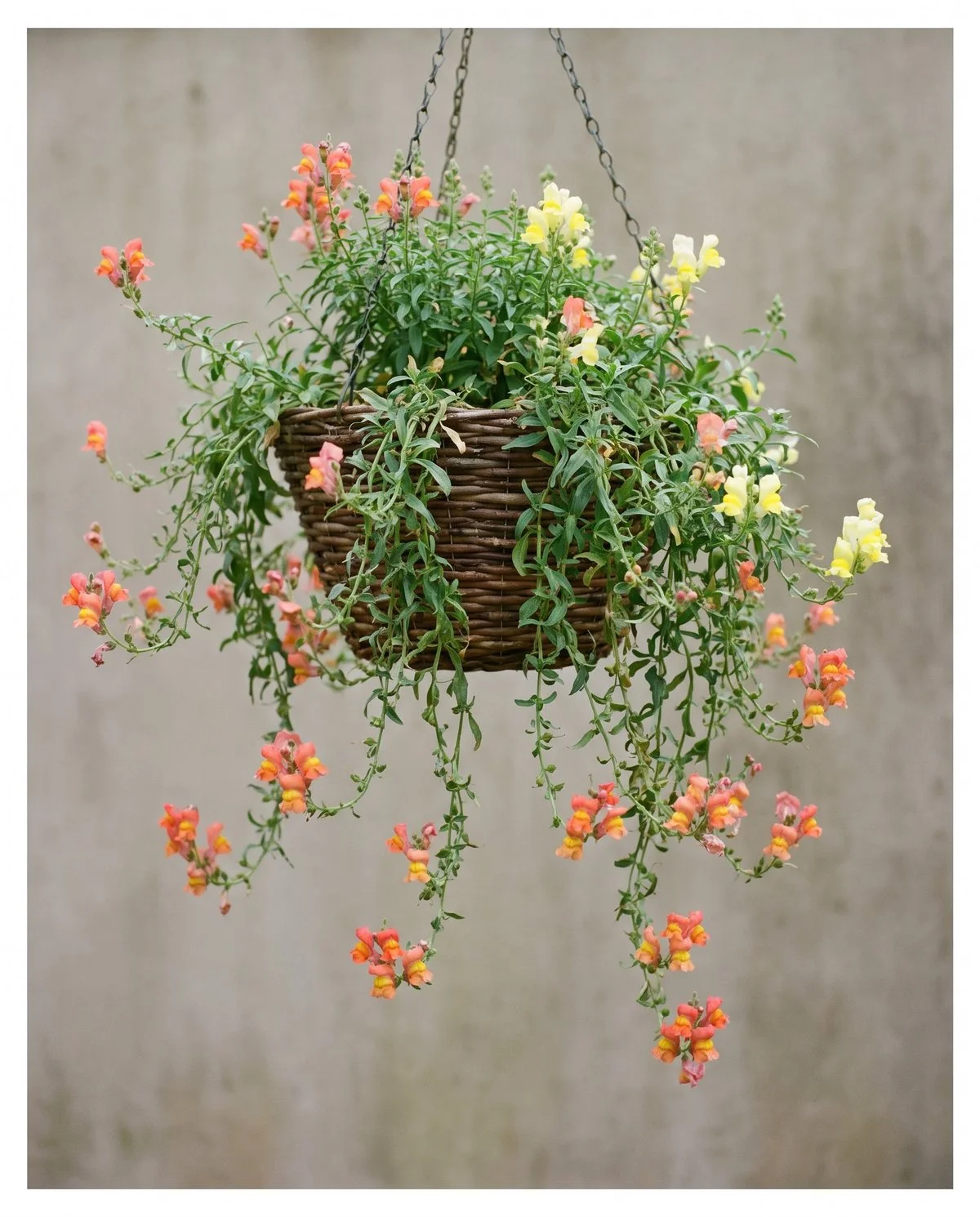
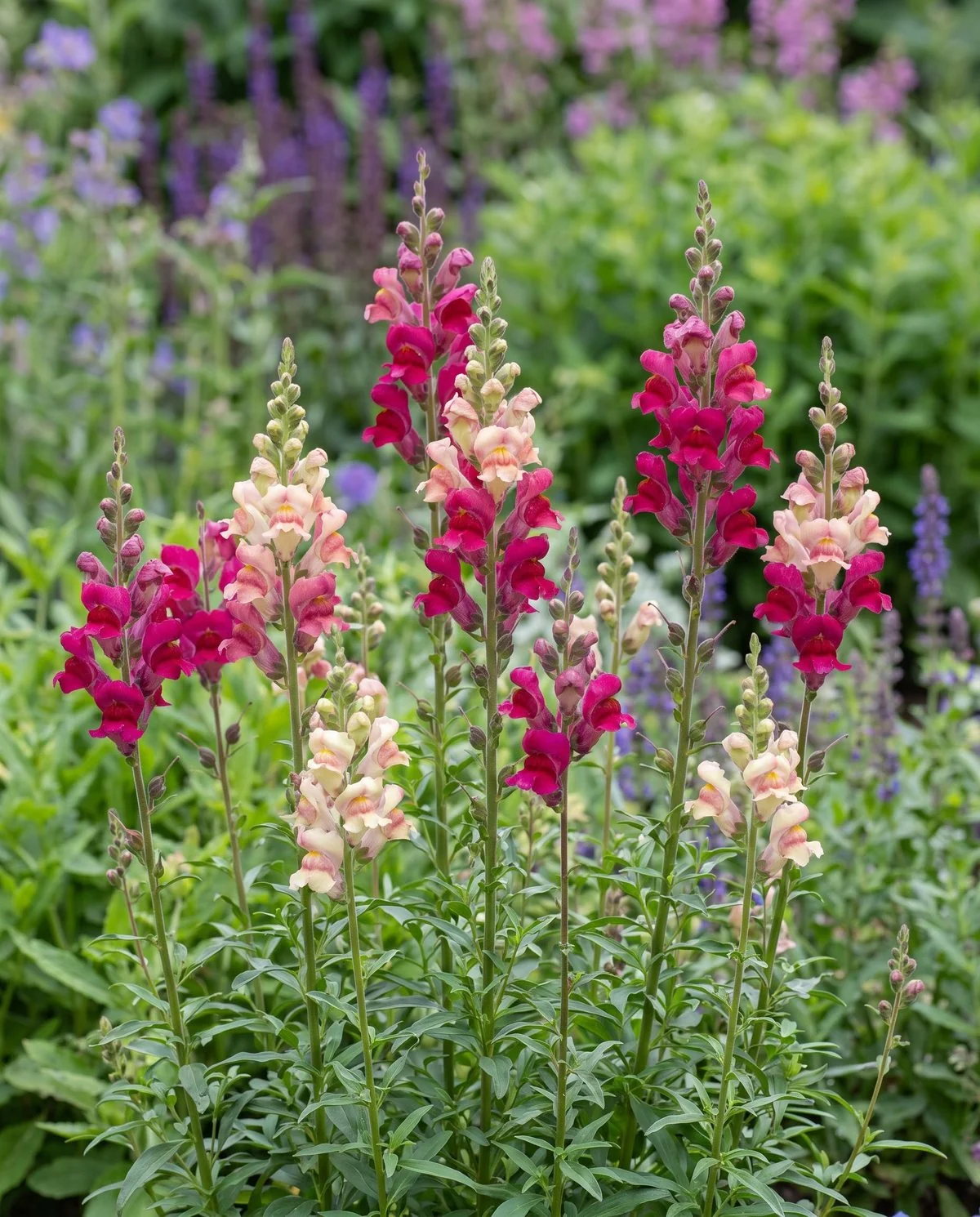
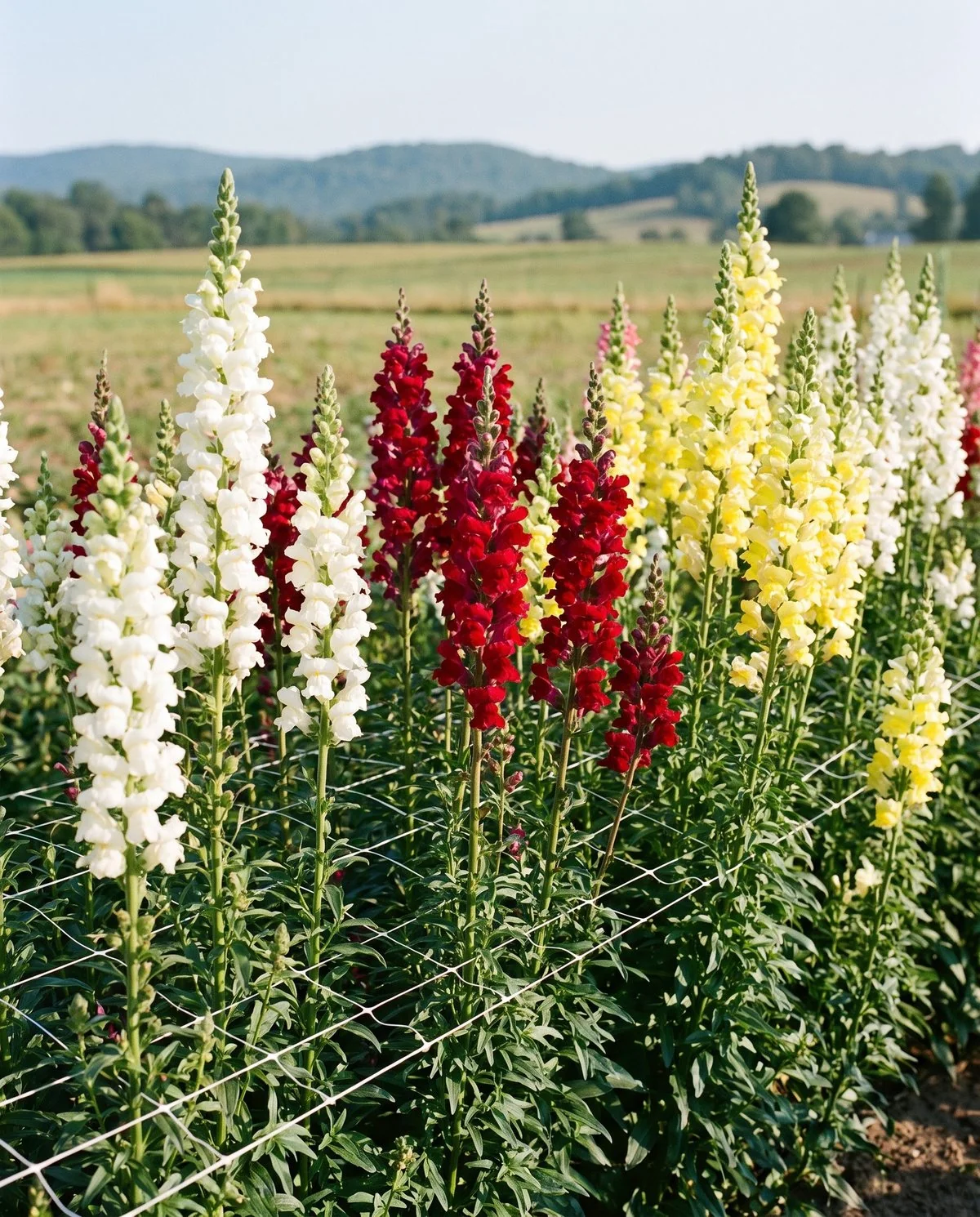
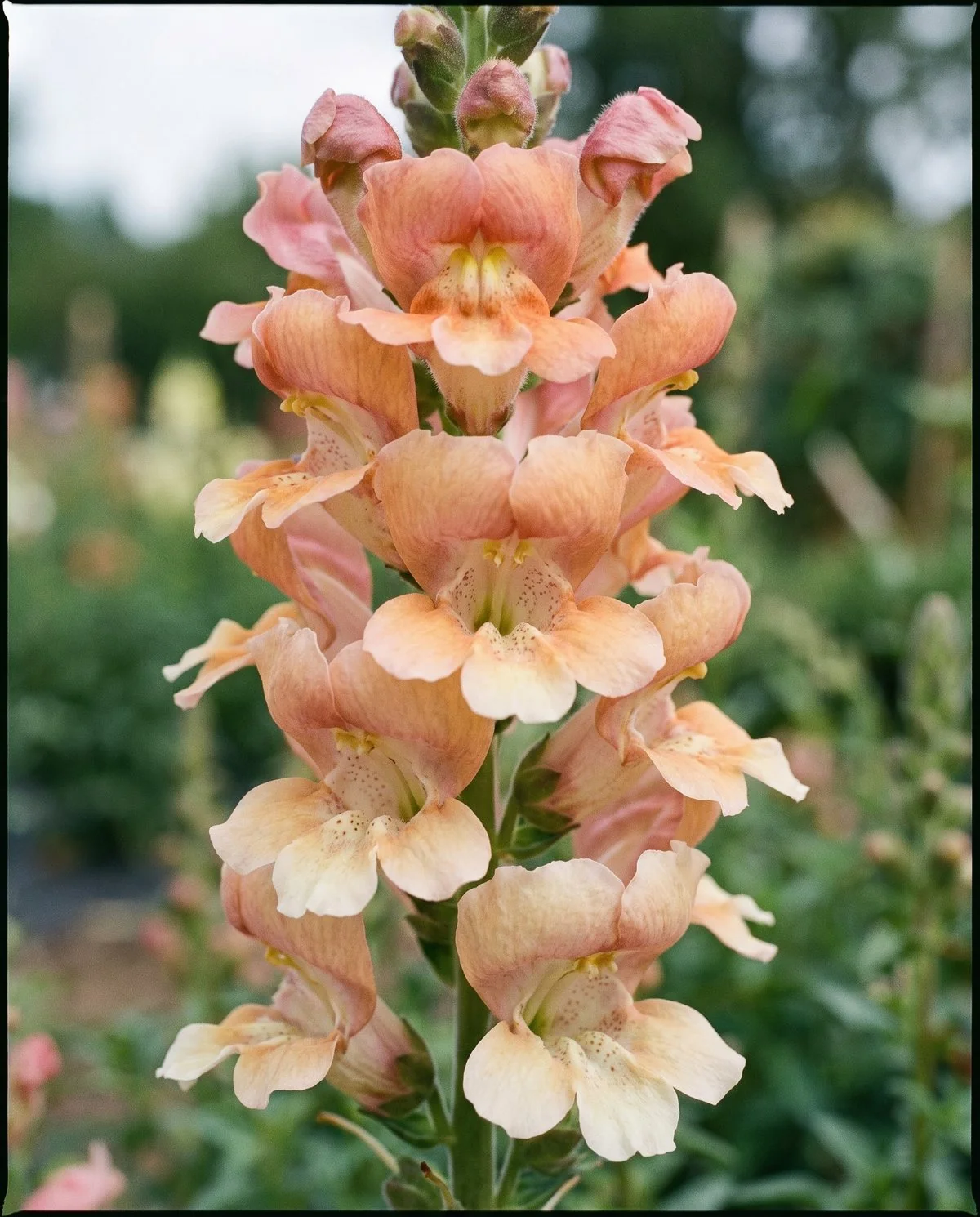
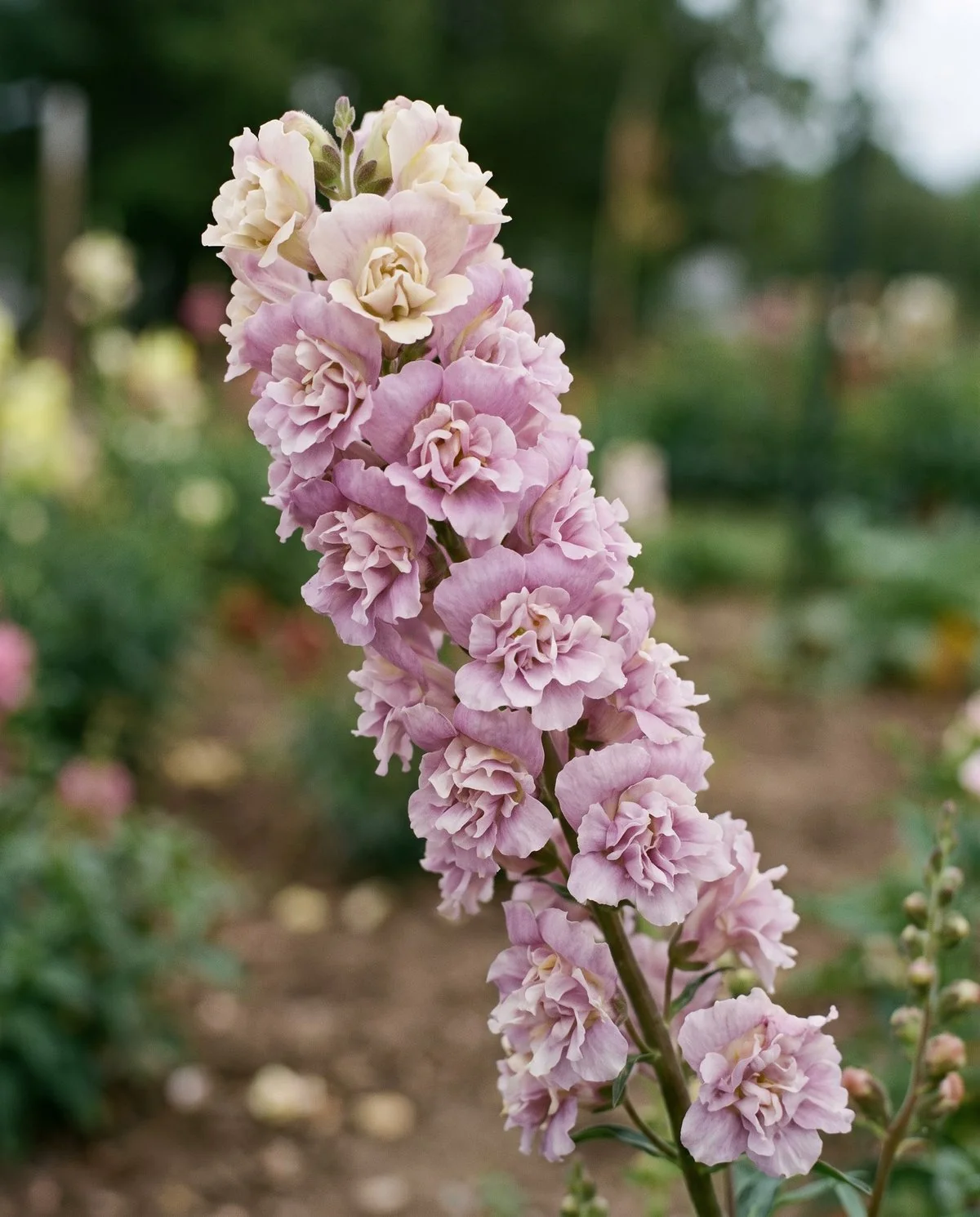
Two axes decide a snapdragon and every named authority uses them together: the temperature and photoperiod bloom Group, printed as a number in seed catalogues, tells you when a variety will flower, and the height class tells you what it will look like in the bed or the vase. Utah State names a third that fewer buyers know exists, floret shape, running open face, double and traditional, where traditional is the classic hinged snap. One measured figure sits under all of it: in the same trial, high-tunnel-grown snapdragons began blooming five weeks earlier than field-grown plants of the same cultivars, had 24 percent greater marketability, and averaged stems nine inches longer.
Light
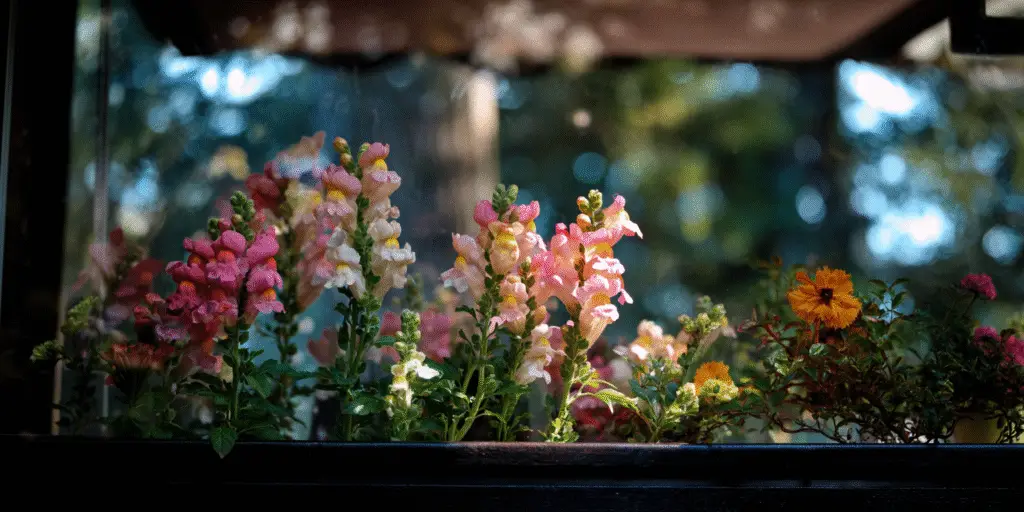
Full sun, meaning at least six hours of direct light, produces the sturdiest plants and the most spikes. In shade it does not simply flower less; it stretches, the stems thin and lean, and the damp air around crowded foliage invites the diseases snapdragons are already prone to. The exception is hot-climate summer, where light afternoon shade lowers leaf temperature enough to stretch the season by a couple of weeks before the plant shuts down anyway. Air movement matters nearly as much as light, so an open position with a breeze counts as part of the disease plan rather than a nicety.
Water
Snapdragons want soil that stays evenly moist and drains freely; they are not drought plants. Water deeply when the top inch has dried, which means once or twice a week in mild weather and daily for a full-grown plant in a small pot in heat or wind. A plant that has gone too dry wilts and then drops the buds it had started, and those buds do not come back. Two inches of mulch steadies soil temperature and cuts watering frequency through a hot spell. Where water lands counts too: wet foliage is the largest controllable disease risk here, so water at the base, use drip or a soaker line where you can, and if overhead watering is the only option, do it early enough that leaves dry before evening. Saturated soil is the worse extreme, since it rots the crown and roots with no recovery, so a container needs a pot that drains freely and a mix that does not stay sodden.
Soil and pH
The ideal is a loose, fertile loam with a good share of organic matter and free drainage, at a garden pH of roughly 6.2 to 7.0. Heavy clay is workable if compost is dug in well ahead of planting, though a raised bed solves drainage more reliably; very sandy ground needs organic matter to hold moisture. Snapdragons in pots want the mix nearer 6.0, because once a soilless mix climbs past about 6.5 the plant cannot take up iron and the new leaves come in pale between dark green veins. A soil test settles it faster than guessing.
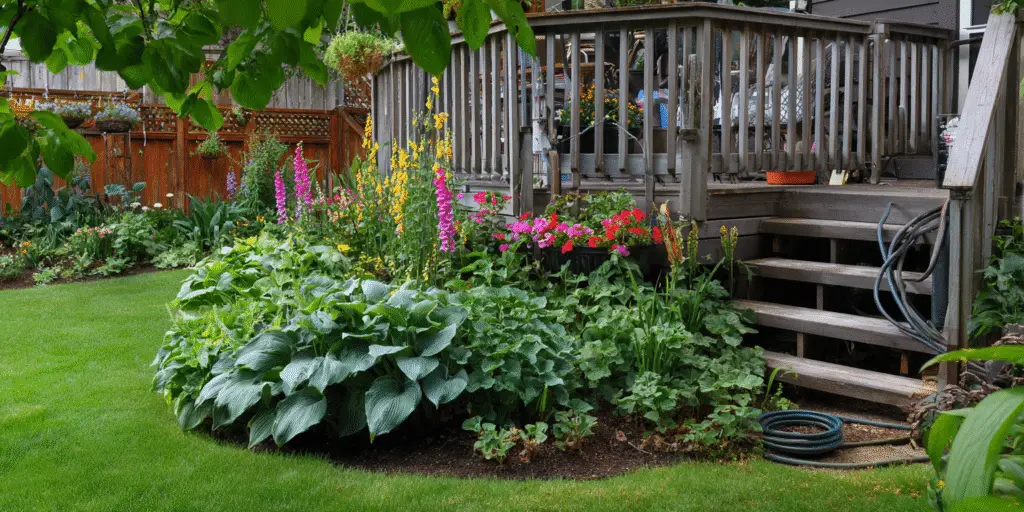
Feeding is where most people overdo it. Work a balanced slow-release fertilizer into the bed at planting, feed lightly during growth, and stop there. Heavy nitrogen produces exactly the wrong plant: tall, soft, dark green growth that leans, breaks, sets fewer spikes, and holds the humid air rust and mildew need. A plant throwing leaves and no spikes is more often overfed and underlit than hungry. Containers run the other way, since frequent watering flushes nutrients out, so a diluted liquid feed every few weeks keeps them producing.
USDA hardiness
Antirrhinum majus is hardy from roughly USDA zone 7a through 10b; outside that range it is grown as an annual. Hardiness means a root-hardy crown rather than a standing plant: hard frost cuts the top growth down, the crown lives, and new shoots rise from the base when the weather turns. Hardened-off plants take sub-freezing nights without damage, and University of Georgia horticulturists note that fall-planted snapdragons in the South come through winter routinely, needing no more than a pine straw mulch in a severe cold snap. Seedlings are far more tender than the same plant three months later, so fall transplanting is done early enough for roots to harden first.
In zone 7 and warmer, fall planting is the standard schedule, and it produces earlier, taller spring flowers than anything set out that same spring. In zone 6 and colder, overwintering works under a low tunnel and gives the earliest and longest stems of the year; without cover, expect to lose the plants. A snapdragon that comes through winter in zone 8 flowers well its second spring and then declines, and by the third year the crown is woody and the spikes short, so most growers pull and replace even where the plant would live.
Planting months by zone, as UF/IFAS publishes them
One extension service does publish planting months by zone band for this plant, which is unusual, and these are its own bands rather than a synthesis. What nobody publishes is a percentage chance of overwintering by zone, so the winter column below is quoted language rather than odds.
Propagation and longevity
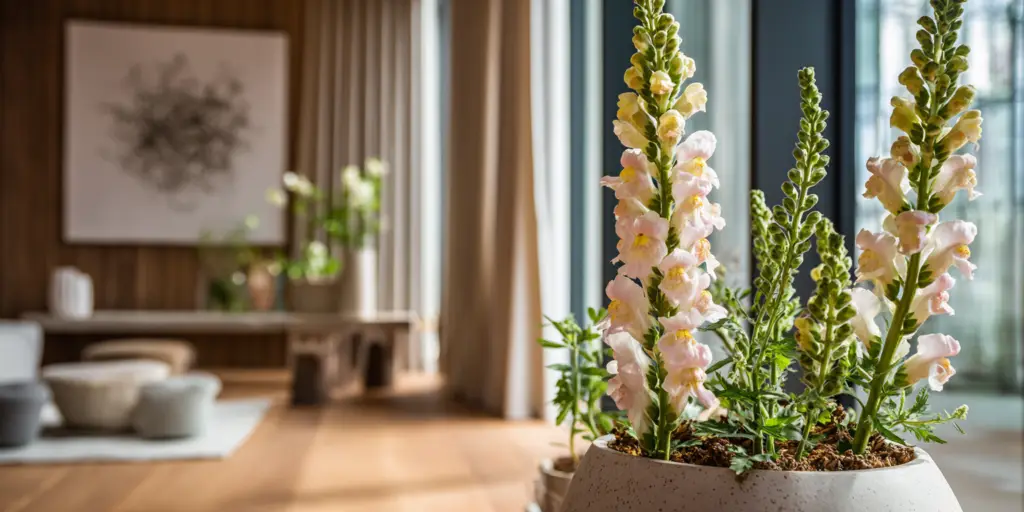
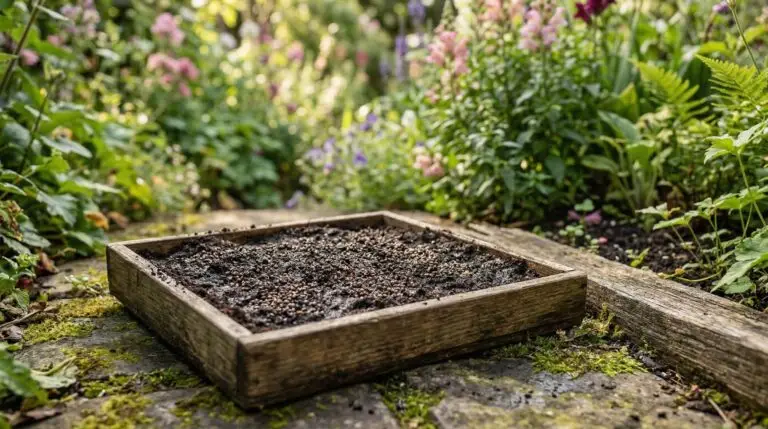
Seed is how snapdragons are normally raised, with one requirement that trips up almost everyone: it needs light to germinate and must not be covered. Sow on the surface of a moist, fine mix, press the seed into contact without burying it, and keep it damp under a dome until sprouting. At around 65 to 75 degrees the seedlings appear in about 10 to 14 days. Start indoors six to eight weeks before the last spring frost in mild regions and eight to ten in cold ones, give strong light at once so they do not stretch, and keep air moving to head off damping off. The full method is set out in starting snapdragons from their dust-fine seed.
Pinching is the highest-return move on a young snapdragon, and it has a trade-off. Mississippi State Extension advises cutting seedlings back to about an inch and a half to two inches once they reach three to four inches tall, which forces side shoots. Cornell's tunnel trials put a number on the payoff: pinching out the growing point once about six leaves have formed raised stem yield by 30 to 50 percent at wide spacing, but pushed the first harvest back two to three weeks. Pinch for more stems over a longer season, skip it for the earliest flower or one long single stem, and leave dwarf and trailing types alone. Cuttings from non-flowering shoots root in a moist mix, worth it only to hold a color you cannot buy as seed.
Longevity is where the annual-or-perennial argument goes wrong, because three different things get called coming back. The first is a genuine return, where a root-hardy crown in zone 7 or warmer resprouts from the base. The second is self-seeding, where pods left to ripen scatter seed that germinates into volunteers a few inches from where the parent stood. Those are not the same plant: most modern snapdragons are F1 hybrids whose seedlings segregate into a scatter of colors and heights, often shorter and plainer than the parent. The third is a fall-planted southern crop still standing in spring, which was never in danger. Telling them apart means checking whether the new growth rises from an old woody crown or a fresh seedling beside it.
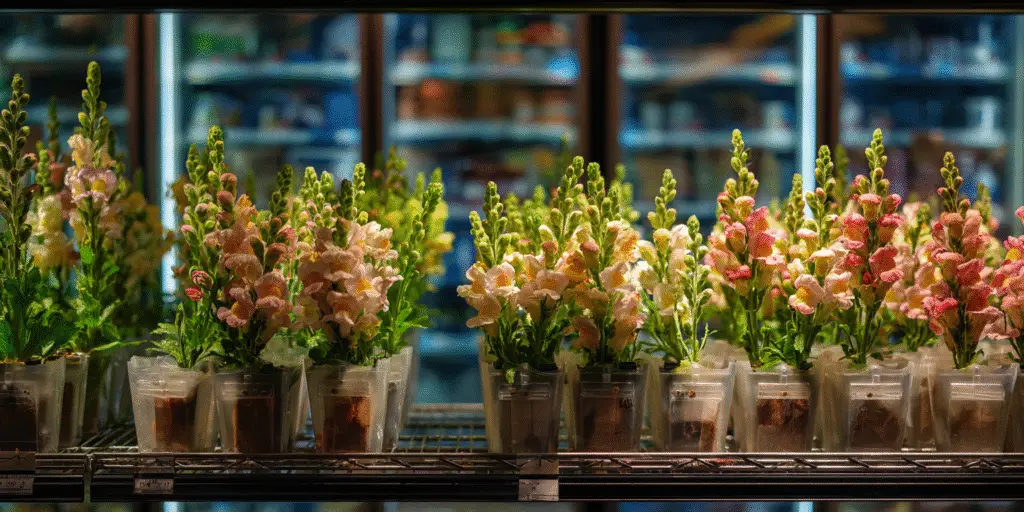
Seed to first stem, with the trial dates attached
Germination takes 7 to 14 days at 70 to 75 F per UF/IFAS and Mississippi State, or 10 to 14 days at Utah State's slightly cooler optimum of 65 to 70 F, and every source requires light, with low light or temperatures below 65 F both lengthening the wait and lowering the rate. Sowing to transplant-ready runs 6 to 10 weeks depending on which authority is followed: Mississippi State says 8 to 10 weeks before the last frost for an outdoor crop, UF/IFAS says 6 to 8 weeks before transplanting, Utah State says 6, and direct outdoor seeding is something Mississippi State rules out in its own words rather than merely discouraging. From transplant, Utah State's field trial recorded flowering beginning eight weeks later, with the Group order confirmed by an actual calendar rather than by the classification alone: in the high tunnel, Group 1 to 2 'Chantilly' began blooming on May 4, Group 3 to 4 'Potomac' on May 23, and Group 4 'Rocket' on June 4. The season after that runs as a sequence rather than as a summer of flowers: a spring flush whose start date is set by the Group, a measured stall in late July, a cutback-triggered second flush in late August and September worth 30 to 66 percent more marketable yield across the season, and continued fall bloom in zones warm enough to carry it. The last step is the one nobody has measured. No published figure exists in any source consulted here for the chance of a snapdragon returning by zone, and the forum evidence, six success stories against one clear failure, is survivorship rather than an answer.
Fragrance
Snapdragons carry a light scent, honeyed and faintly peppery, and it varies enough between cultivars to be worth checking at the nursery. This is a fragrance found with your face in the flower on a warm, still day rather than one that carries across a garden. Older and taller strains are often more scented than compact bedding types selected for uniformity and flower count, so a plant grown for cutting is the better bet if scent matters. What they lack in projection they make up for in nectar, which sits deep in the tube and draws bumblebees all season and hummingbirds to the taller spikes.
Toxicity and pet safety
Snapdragons are non-toxic to cats, dogs, and horses according to the ASPCA, which lists garden, common, lesser, and withered snapdragon alike among its non-toxic plants with no characterized toxic principle. There are no glycosides, alkaloids, or oxalate crystals, no thorns, and no irritant sap, which makes it a relaxed choice for a garden shared with animals and children. A pet that eats a lot of foliage can still get a mild, short-lived stomach upset from the volume alone, and nursery stock treated with a systemic pesticide carries whatever was applied to it. The flowers are edible and turn up as a garnish, though too bitter to eat twice for pleasure. For a fuller picture, see the guide to flowers safe for cats and dogs.
Deer are the other safety question people mean, and the answer is unusually good. Rutgers rates Antirrhinum majus in its top category, rarely damaged, because the bitter foliage is unpalatable to deer, which puts snapdragons among the few showy annuals that survive real deer pressure. Rabbits are less reliably deterred and browse soft new growth, so a wire collar around a young planting is worth it.
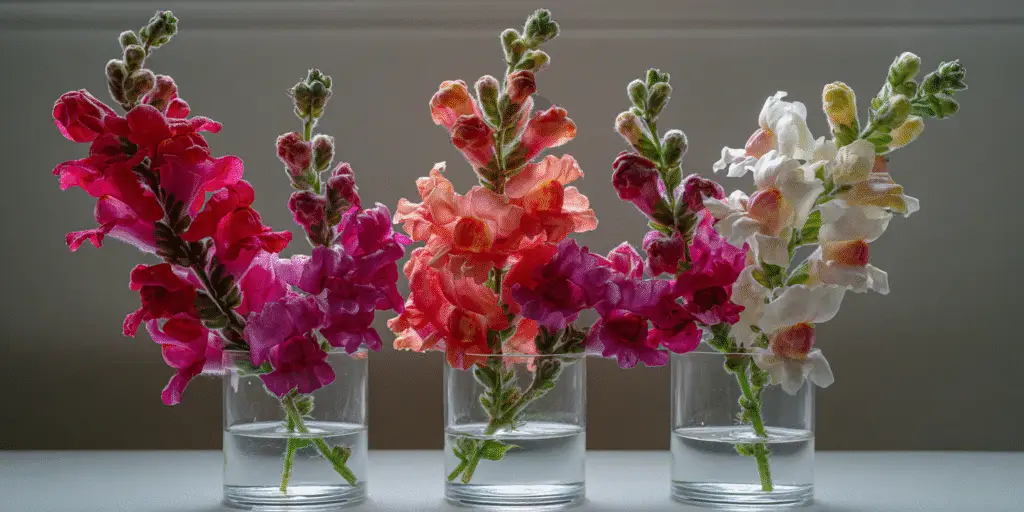
Vase life
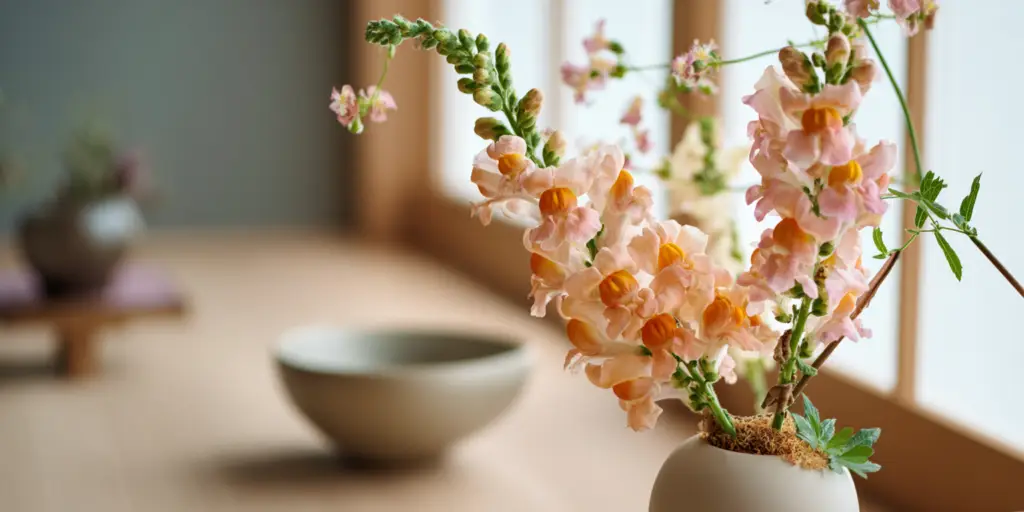
Cut snapdragons hold about 7 to 10 days in a vase, though the color fades before the stem is finished. Cut when the florets on the lower third to half of the spike are open and the upper buds still closed, since the spike keeps opening upward and a stem taken too late drops its bottom florets first. Strip leaves below the waterline, recut the stem, and use clean water with flower food.
Snapdragon spikes are strongly negatively gravitropic, meaning the tip senses gravity and bends away from it, so a stem left on its side twists its top upward within hours into a curve that will not straighten afterward. That is why they are stored and shipped upright at 33 to 35 degrees, wrapped in film to slow moisture loss, and why a bunch carried home flat in a car arrives with hooked tips. The second issue is ethylene, which makes the individual florets abscise and shatter off the spike; commercial growers block it by pretreating with silver thiosulfate or 1-methylcyclopropene, shatter-resistant cultivars have made it much less common, and at home the equivalent is keeping the vase away from the fruit bowl. The spikes bring a vertical line round flowers cannot, which is why they anchor so many cool-season spring bouquets.
The postharvest numbers, from two university programmes
Utah State and Mississippi State both publish handling data for cut snapdragon. Where the two differ, both figures are given rather than averaged into one.
Vase life scales with stem length: about 5 days in a 50 cm stem and 9 days in a 70 cm one.
Excluded rather than repeated. That paired correlation surfaced in this research with no named study attached to it, and it appears nowhere in the Mississippi State, UF/IFAS or Utah State postharvest sections, each of which discusses vase life and stem length separately and never as a pair.
An anti-ethylene treatment will stop the florets shattering off the spike.
Mississippi State attaches its own caveat to its own recommendation: some cultivars are naturally ethylene-resistant, so treatment with 1-MCP or STS is not very effective for those. There is no blanket answer, and which cultivar it is decides whether the treatment does anything.
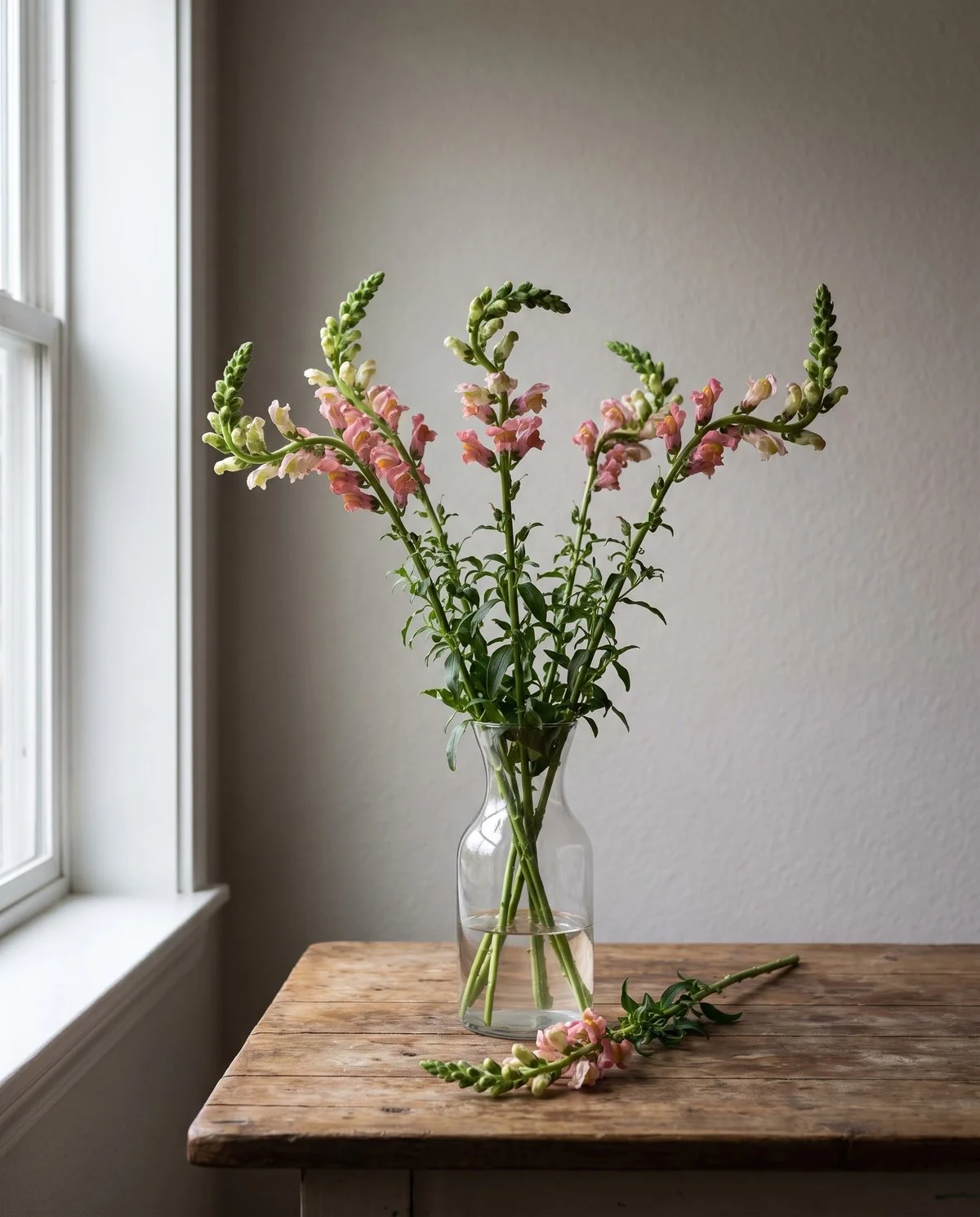
Pests and diseases
Rust is the defining disease here, and its timing makes it manageable. The fungus Puccinia antirrhini needs roughly six to eight hours of continuous leaf wetness to infect and does its best work between about 55 and 70 degrees, slowing sharply once temperatures pass 80, so it arrives during exactly the weeks snapdragons grow best, which makes a cool, damp spring the dangerous season. It shows as small chocolate-brown to reddish pustules on leaf undersides, often with a pale halo above, and a heavily infected plant yellows and stops producing spikes. Management is almost entirely cultural: water at the base early in the day, space plants for air movement, avoid ground that grew snapdragons last year because spores persist on debris, and bin infected material. Rust-resistant cultivars help where rust is an annual event, though new races of the fungus have repeatedly caught up with them.
Downy mildew works a similar but cooler window. Peronospora antirrhini sporulates between roughly 44 and 72 degrees with an optimum near 50, so it is a cool, wet-season problem showing as leaves that curl downward with gray or white fuzz beneath and stunted, distorted growth. Cultivar susceptibility varies enough to plan around: Pacific Northwest disease specialists note that Potomac Rose, Potomac Apple, and Potomac Dark Orange run less susceptible than Rocket White, Potomac Ivory, and Potomac Royal. Powdery mildew adds a white dusting in warm, humid, still air, botrytis grays out flowers and stems in wet weather, anthracnose spots leaves and girdles stems, and root and stem rots follow saturated soil. The same habits address all of them.
Insects are the smaller half of the problem. Aphids cluster on growing tips and distort new spikes, spider mites stipple leaves and spin fine webbing in hot, dry spells, whiteflies rise in clouds when the plant is disturbed, leafminers scribble pale tunnels, and caterpillars chew ragged holes in leaves and buds. A weekly look at leaf undersides catches all of them early, and a strong jet of water, insecticidal soap, or horticultural oil handles most, with hand-picking for caterpillars.
The green bridge: how rust reaches next spring
The debris rule above is real but it is the smaller half of the story. Rust is a biotroph, a fungus that can only live and feed inside living tissue, and the plant pathology sources are blunt about what that means for winter: the fungus survives from one year to the next principally on infected living plants, its occasional resting spores matter little, and it is not carried in seed, because a diseased seedling dies before the parasite can go anywhere. So the bridge that carries rust from one season into the next is not last year's fallen leaves so much as last year's living snapdragons: the overwintered crown this page recommends for the earliest spring stems, and the self-sown volunteers around it, are exactly the tissue the fungus rides through winter.
That turns two pieces of standing advice into a trade to make consciously. Where last season stayed clean, overwintering and volunteers are pure profit. Where rust ran, the surviving plant is the local source of next spring's outbreak, and pulling it costs less than the disease it seeds, so the low tunnel trick is for beds with a clean record. And in zones cold enough that no snapdragon survives outdoors, spring rust does not rise from the soil at all: it arrives on purchased transplants and cuttings raised somewhere warmer. The five second check at the nursery is to turn a few leaves and look at the undersides for the chocolate-brown pustules described above, because the cheapest rust season is the one that never gets carried home.
Photo pairs, and the pairs left unphotographed on purpose
Growth habit, seed anatomy and gravitropic bending are safe to photograph and are here in full. The disease pairs are not: rust pustules, downy mildew sporulation and anthracnose stem lesions are checkable fingerprints, so the normal side is shown and the disease side waits for a real reference photograph.
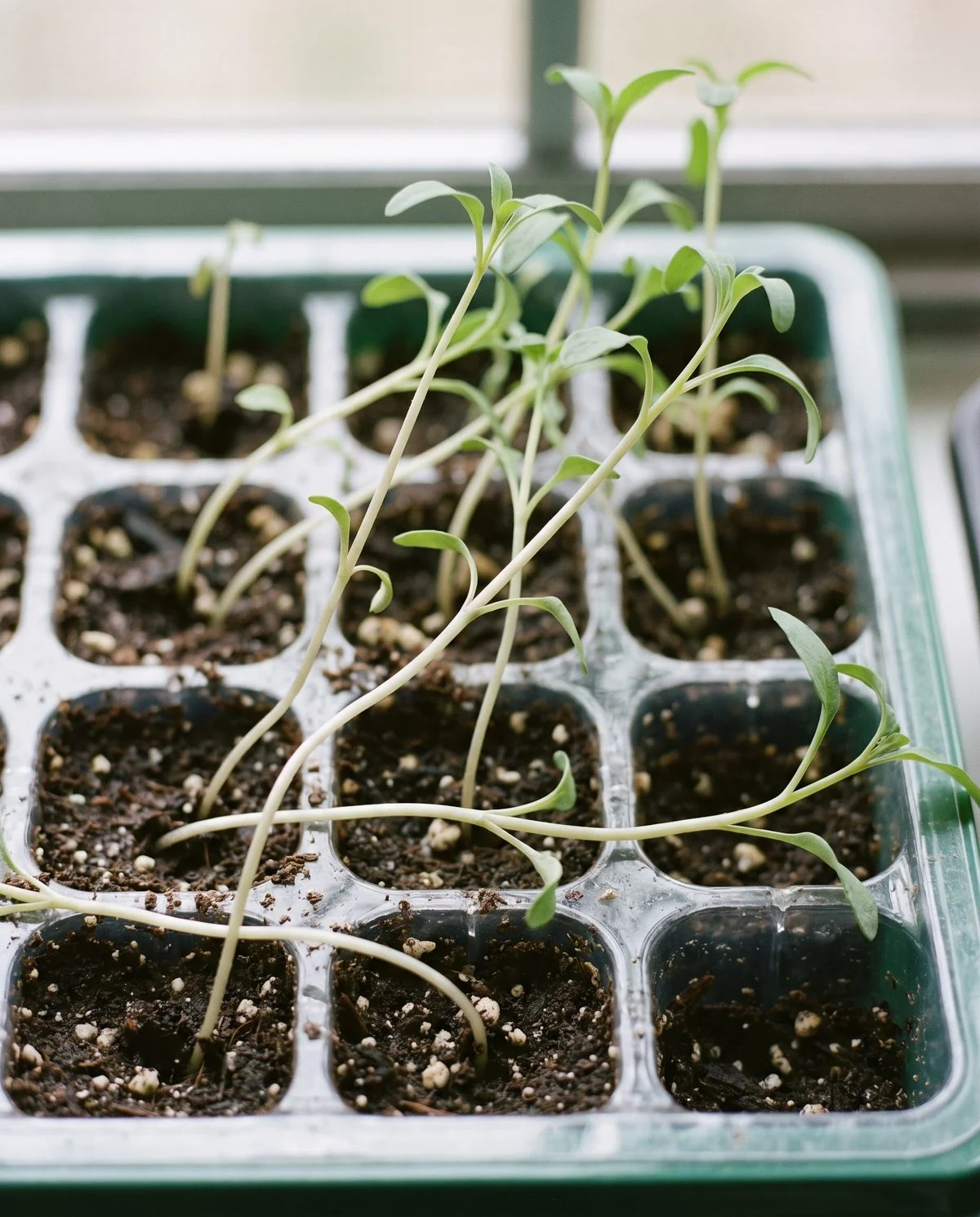
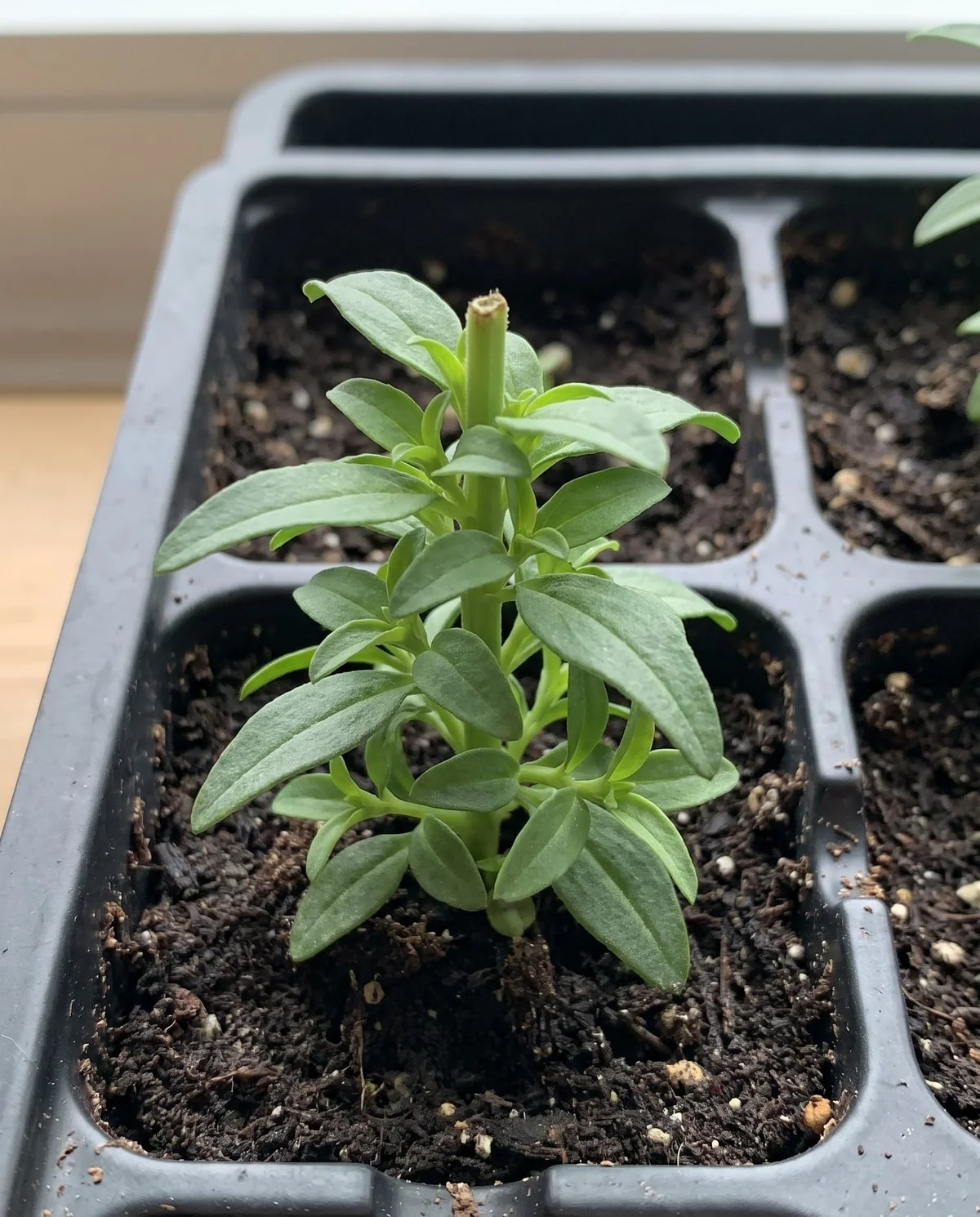
Look at the gaps between the leaf pairs. A leggy seedling has put everything into one thin stem with long bare gaps and topples under its own weight; a pinched one is shorter and carries several stems from low down. Mississippi State cuts at 3 to 4 inches tall, back to an inch and a half to two inches. Cornell measured the payoff at 30 to 50 percent more stems at wide spacing against a 2 to 3 week delay to first harvest, and Utah State recorded 5 to 8 marketable stems per plant at 9-inch spacing against a single stem from an unpinched plant at 4 inches.
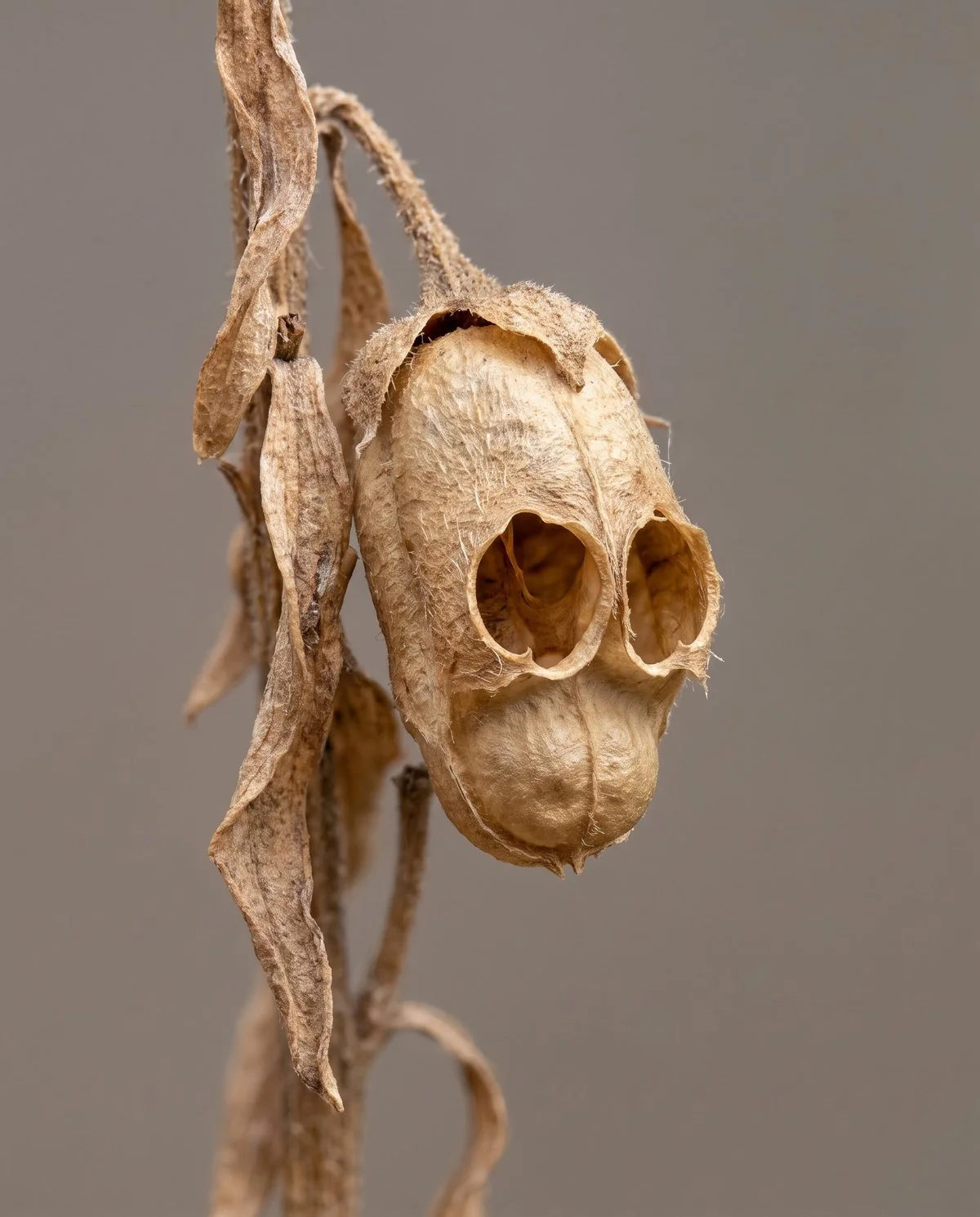
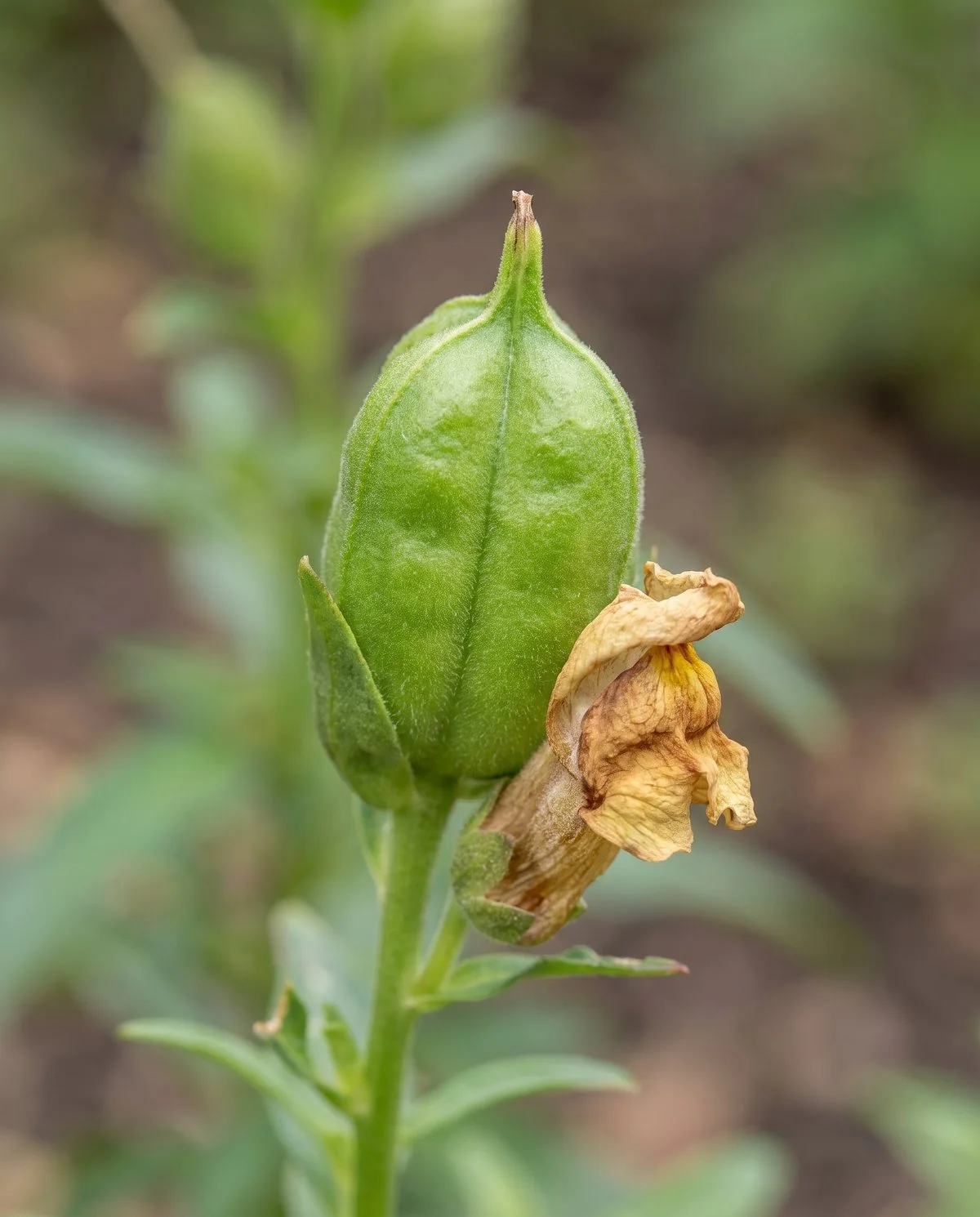
Wait for it to dry, because the face is what drying makes. The fruit is a capsule about 15 mm long with two internal chambers, and it releases seed through pores opening at the tip rather than by splitting down its length, which is what leaves the papery tan capsule with the hollow-eyed pattern people photograph. Green, plump and closed is the same pod before that happens. The botanical structure, poricidal dehiscence, is the sourced part; the skull comparison itself is a popular observation rather than a scientific description.
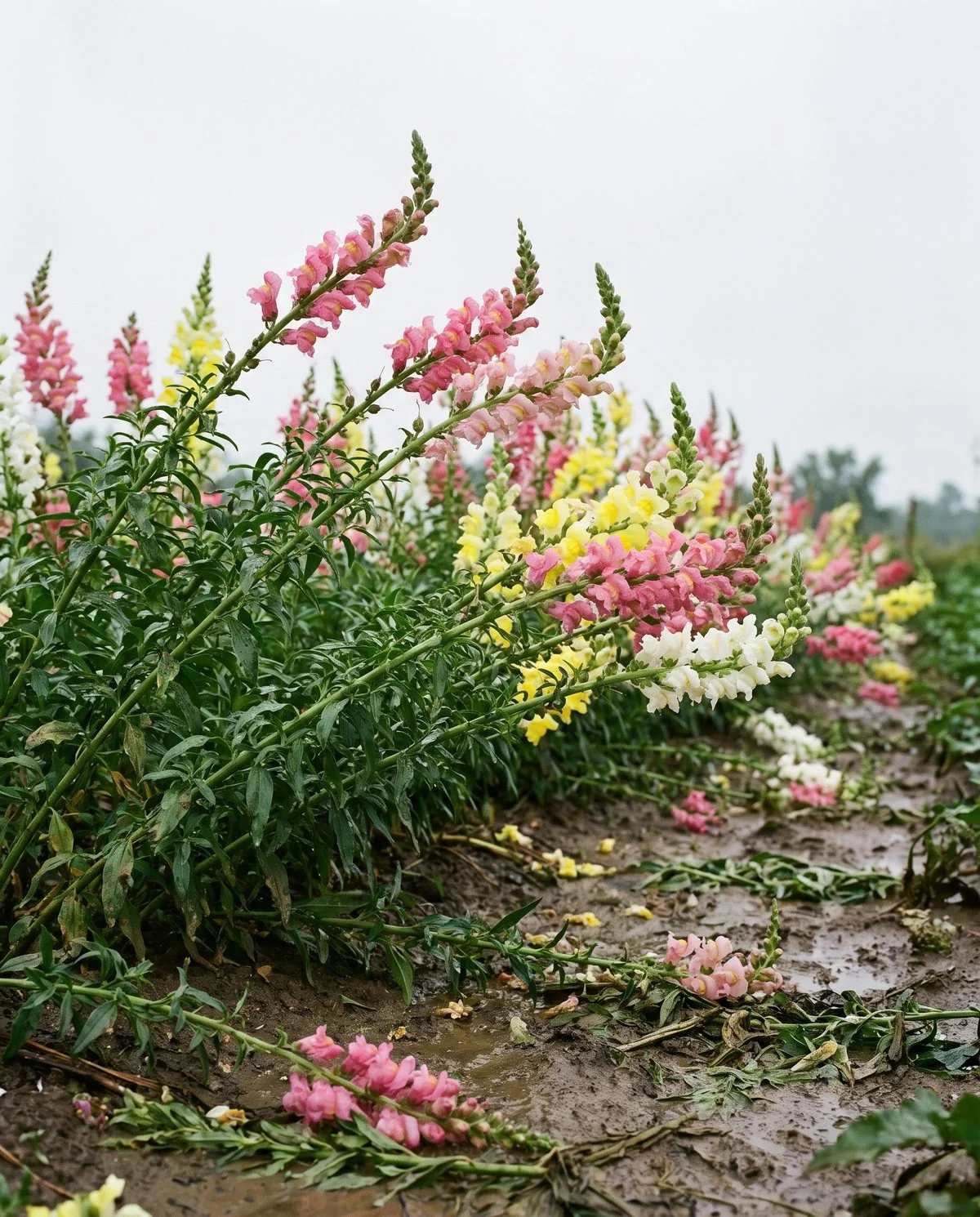
One mechanism in two places. Utah State records that snapdragon stems are highly gravitropic, curving upward as soon as they begin to bend and susceptible to breakage, which is why its field protocol requires a horizontal trellis to produce straight marketable stems. Mississippi State describes the identical behaviour after cutting: stems quickly twist their tips upward when lying on their sides for even a short period, and even leaning them against the side of a half-empty bucket produces a significant bend. Two universities, two professional contexts, one mechanism.
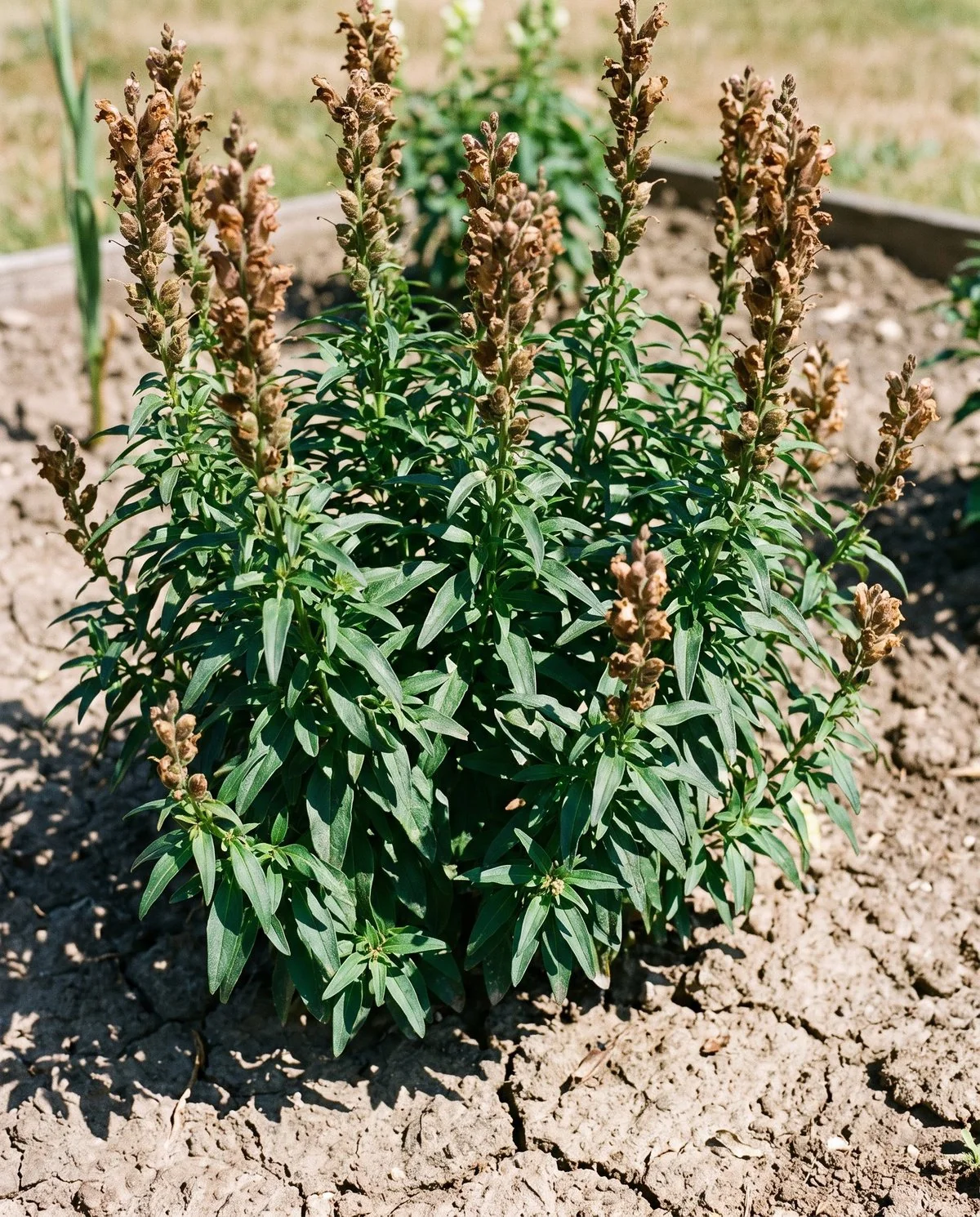
Read the foliage rather than the flowers. In a stall the leaves stay green and full and the plant looks structurally sound, it simply forms no new buds, which Utah State measured happening by late July in every year of its trial and which Mississippi State's Group IV definition describes from the other side, that flowering requires night temperatures above 60 F. A nutrient problem shows in the foliage itself, pale, yellowing or purpling, as well as in the missing flowers. Only the stalled plant is photographed.
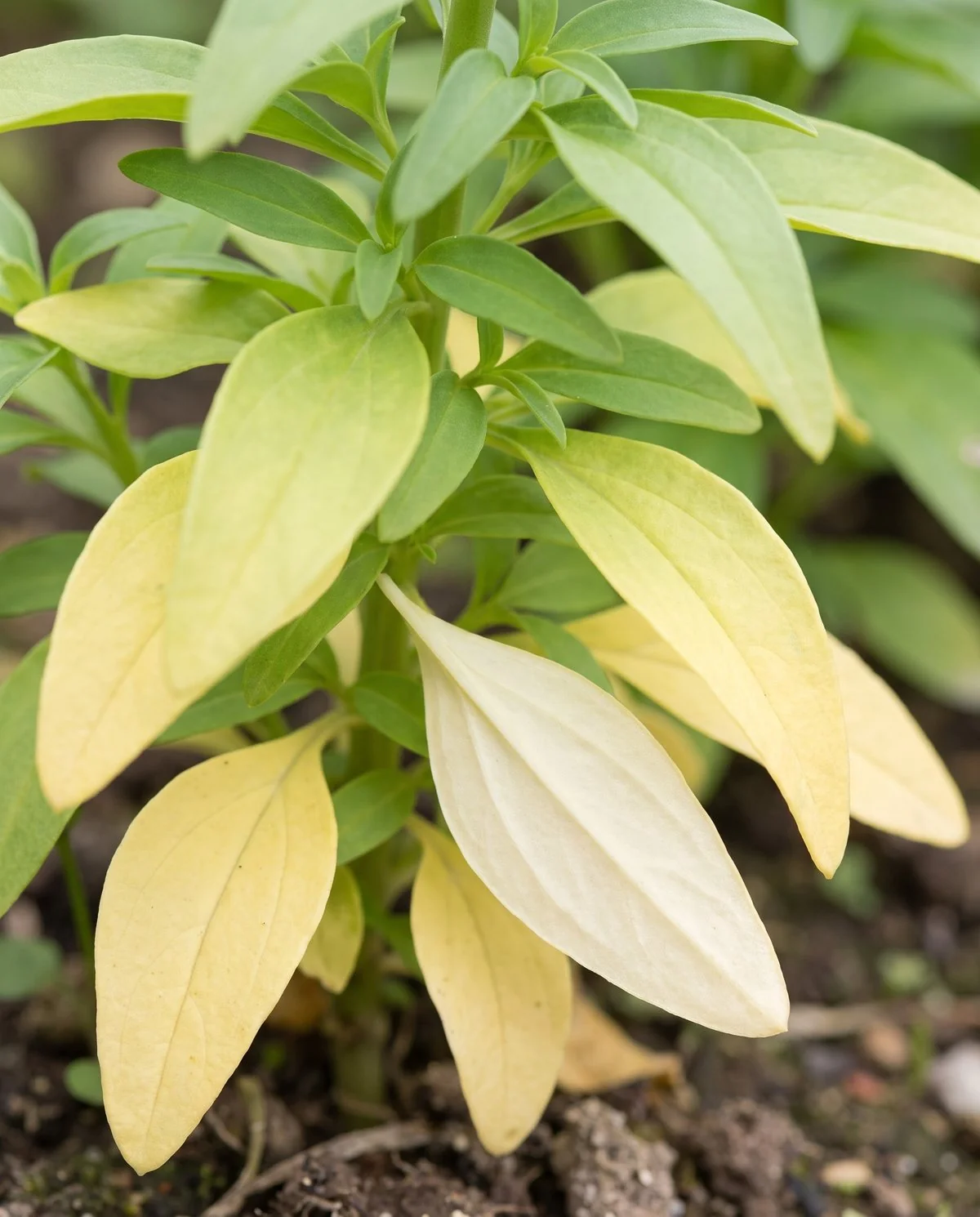
Turn the leaf over and rub it. Ordinary aging is uniform and gradual, begins on the lowest and oldest leaves and moves upward, raises nothing and leaves nothing on a finger. Rust sits specifically on the underside, as raised brown pustules in rings that shed powdery reddish-brown spores onto hands and tools, with only faint discolouration visible from above. Of 28 posts in this research describing spotted or discoloured snapdragon leaves, only four used the word rust at all. Only the normal side is photographed.
Lift one plant and look at the roots, because the two causes of this photograph separate underground. Downy mildew declares itself above ground first: leaves turning pale green to yellow, downy white or grey growth on the undersides, shortened internodes and stunted distorted growth, in cool wet weather. The 1983 University of California trial recorded the alternative directly, a plot that collapsed and died with no foliar downy mildew symptoms at all, where the roots were dark brown and Pythium ultimum was isolated from them, and plants kept collapsing right through the harvest period. Neither side is photographed here.
What snapdragon growers actually ask about, ranked by frequency
269 posts from r/gardening and r/plantclinic, deduplicated by post ID and categorized by reading every title and body rather than by keyword matching. Two caveats belong with the numbers: both r/gardening pulls hit the archive's 100-result cap, so the real population is larger than this sample, and the fifth largest theme is not a problem at all but delight, 15 posts about skull-shaped seed pods, ribbon-flattened fasciated stems and colour mutations on self-sown plants. Themes overlap and do not add to 100.
Light and temperature together, before anything else. The seed needs light to germinate and has to sit on the surface, and Utah State puts the optimum at 65 to 70 F with 16 hours of light a day, noting that both low light and temperatures under 65 F lengthen germination and lower the rate.
The roots, by lifting one plant. This is the theme where one photograph has two causes, and the 1983 University of California trial that separated them had to isolate Pythium ultimum from the roots to do it, because the plot that died carried no foliar symptoms at all.
Which surface it sits on. Only 4 of these 28 posts used the word rust; the rest wrote black dots, brown powder, white spots or stuff on the underside, and University of Minnesota Extension's own diagnostic page groups rust, powdery mildew, gray mold, downy mildew and edema as the five causes of exactly this symptom cluster.
Whether the poster can name it at all. Aphids are the only pest named with any frequency in this sample; the rest are what-is-this-bug requests, which is what a weekly look at leaf undersides answers.
Whether the sample can be trusted, and here it cannot. Six of these eight posts are success or surprise stories and one is a clear failure, which is survivorship rather than a six-to-one survival rate: a snapdragon that quietly failed to return in April leaves nothing to photograph.
Which outcome is wanted, because the trade-off is measured rather than argued: Cornell's high tunnels programme puts pinching at 30 to 50 percent more stems against a 2 to 3 week delay to first harvest.
Whether the variety was ever meant to stand alone. Utah State's own field protocol requires a horizontal trellis for the tall cutting types, because snapdragon stems are highly gravitropic and susceptible to breakage.
The Group number on the packet against the season. Read this row as a floor: a plant with no flowers is a non-event to photograph, while the existence of a formal four-way Group system whose whole purpose is predicting when a cultivar will and will not flower says the question is far bigger than five posts.
The date. Utah State's trial recorded production of marketable stems declining in late July from unfavourably high temperatures in every trial year, a stronger and more universal signal than five posts suggests.
Where the growth rises from: an old woody crown, or fresh soil beside it. That is the difference between the same plant returning and a seedling standing in for it.
The height class and the Group together. A bedding six-pack carries no Group number at all, and the dwarf classes are bred to 6 to 10 inches whatever the rack photograph shows.
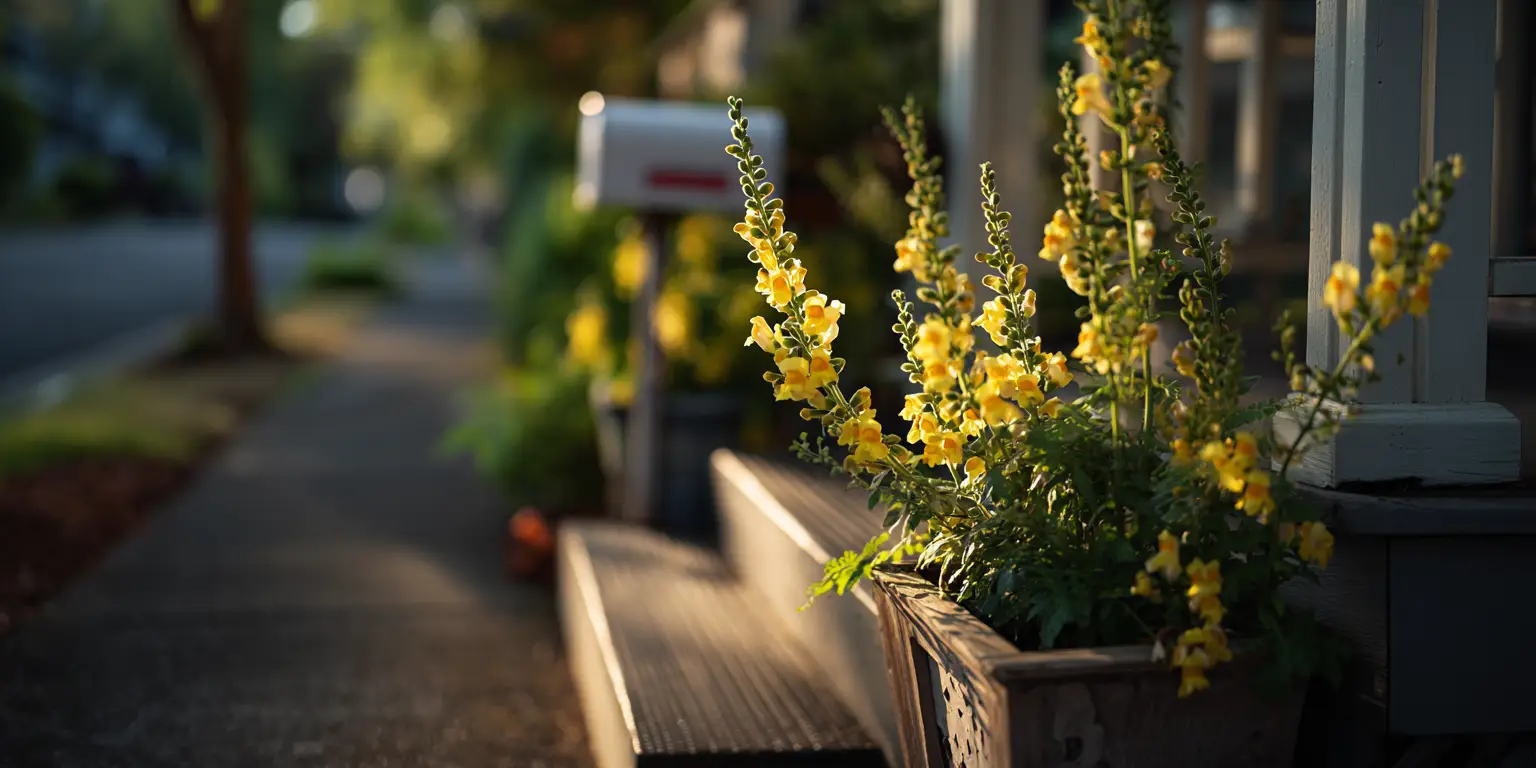
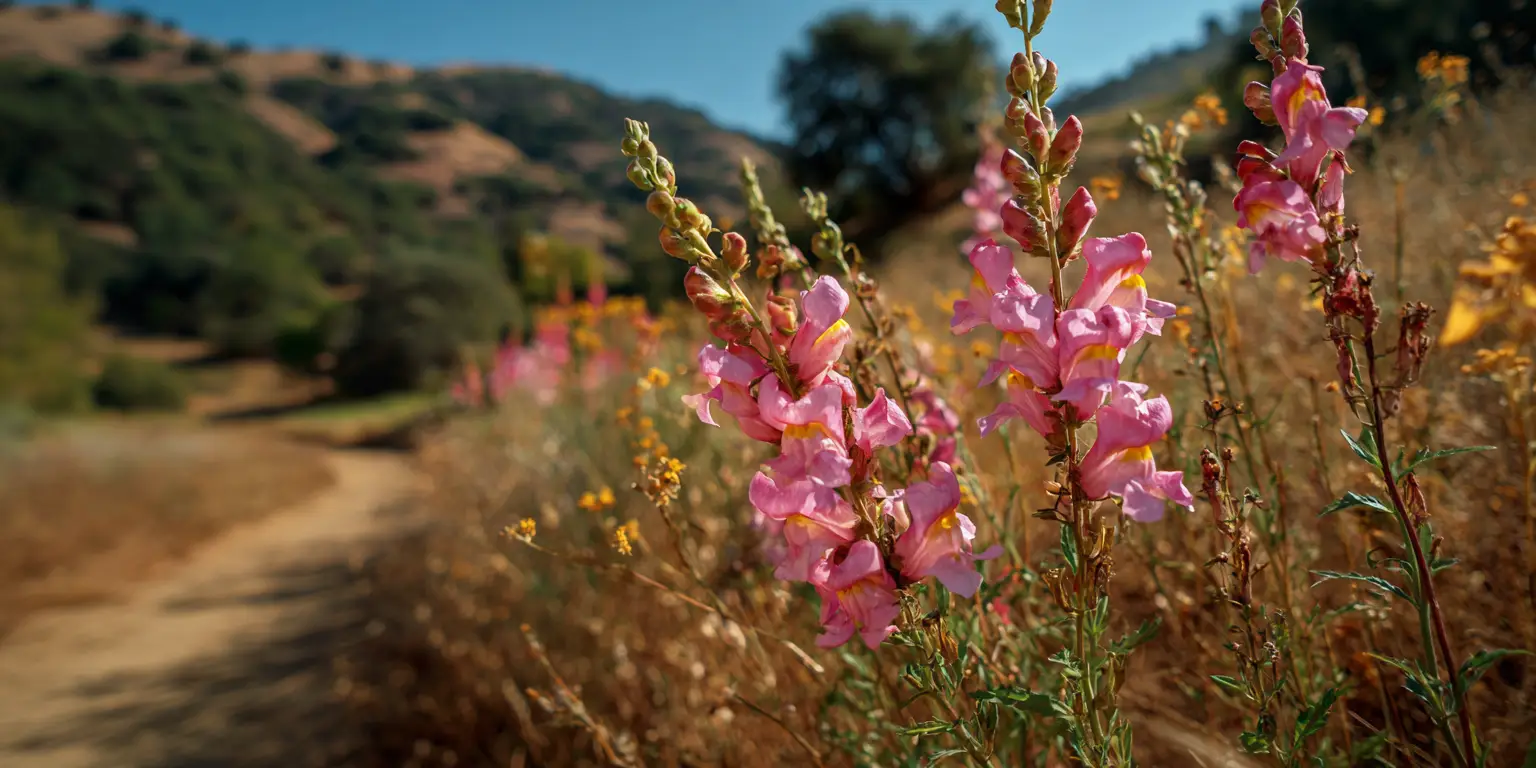
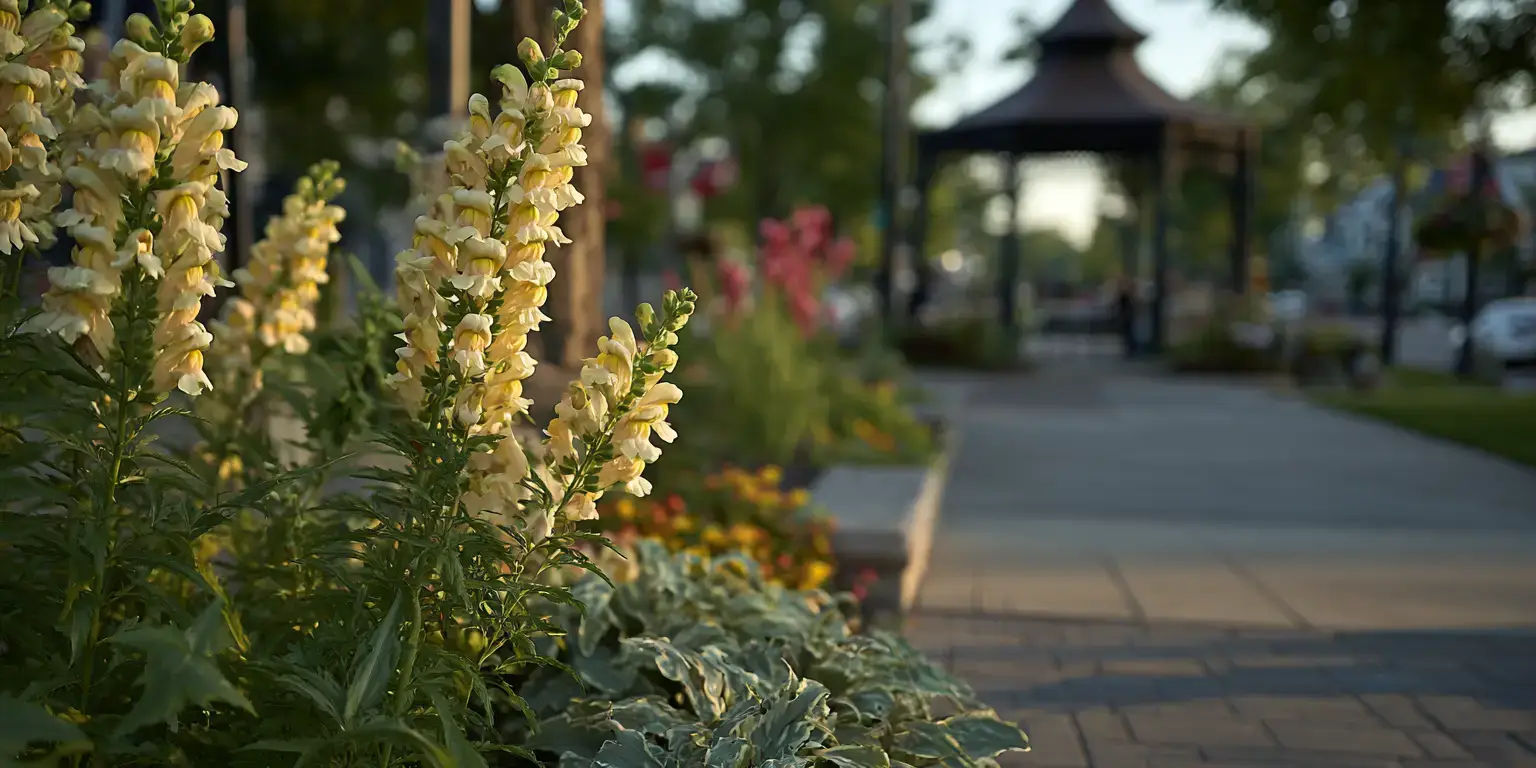
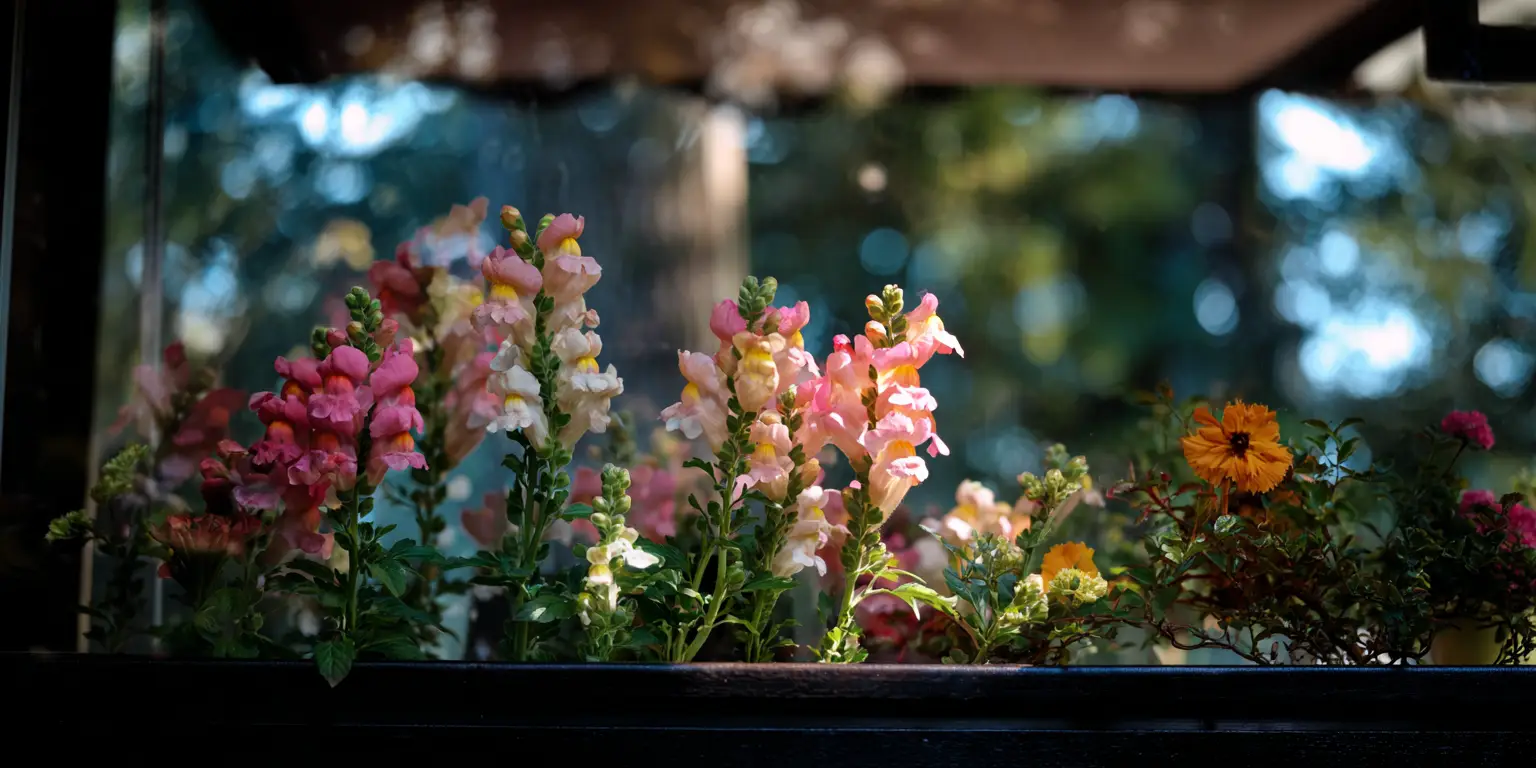
Flower photos
FAQ
Are snapdragons annuals or perennials?
Botanically they are short-lived tender perennials, but only in USDA zones 7 through 10 does the crown survive winter and resprout. Colder than that, the roots do not survive an unprotected winter and the plant is replaced each year; even where it survives it is strongest in its first season and woody by the third.
Do snapdragons come back every year?
Sometimes, and three different situations get that name. In zone 7 and warmer the original crown resprouts, and mulching the base or planting in a sheltered spot makes that far more likely; in colder zones hard frost usually kills the plant outright. Where pods are left to ripen, self-sown volunteers appear near where the parent grew, and since most modern snapdragons are hybrids those come up in mixed colors and shorter. In the South a fall-planted crop simply keeps growing through winter. Growth from an old woody base is the same plant; a seedling a few inches away is a volunteer.
When should I plant snapdragons?
It depends on how hot your summers get. In cold and temperate regions, set plants out in early to mid spring once hard freezes have passed; they flower into early summer and again in fall. In hot regions, plant in fall for bloom from late winter through spring and pull them when the heat arrives.
Why did my snapdragons stop blooming in summer, and will they flower again?
Heat, not neglect. Above the low to mid 80s the plant stops setting new buds while keeping its foliage, and no amount of water or fertilizer overrides that. Most climates get a second flush when nights cool, and a cutback by about a third when the first flush finishes brings the plant into fall already branched.
Should I pinch snapdragons, and when?
Pinch taller and intermediate types when seedlings reach three to four inches, cutting back to about an inch and a half to two inches, or pinch out the growing tip once about six leaves have formed. It raises usable stem count substantially at the cost of delaying first flowers by two to three weeks. Leave dwarf, bedding, and trailing types alone.
Do I need to deadhead them?
Yes, and it is the difference between a few weeks of flowers and a season of them. Cut each spent spike at its base before it sets pods, because a plant ripening seed treats its job as done and stops producing new spikes.
How do I start snapdragons from seed?
Sow on the surface and do not cover it, because snapdragon seed needs light to germinate. Press the dust-fine seed into a moist mix, keep the surface damp under a dome, and hold it near 65 to 75 degrees, where seedlings appear in about 10 to 14 days under strong light.
How long do cut snapdragons last, and why do they bend?
About 7 to 10 days in clean water with flower food, out of direct sun. The bending is unavoidable: the stems sense gravity and curve their tips upward, so a spike left flat for a few hours arrives permanently hooked. Carry and store them upright and away from ripening fruit, whose ethylene makes the individual florets drop off.
Are snapdragons poisonous to cats and dogs?
No. The ASPCA lists snapdragon as non-toxic to cats, dogs, and horses, with no identified toxic principle, and the plant has no thorns and no irritating sap.
When is the best time to plant snapdragons?
Plant snapdragon seedlings in early to mid-spring as soon as the threat of severe frost has passed. They tolerate cool weather well, so they can often go into the garden sooner than warm-season annuals. In mild winter areas, snapdragons are frequently planted in fall or late winter to establish and then bloom in spring. Essentially, you want to give them cool conditions to grow and bloom. Avoid planting during very hot weather. If starting from seed indoors, count backwards about 8 weeks from your ideal planting time to know when to sow seeds.
How long do snapdragons bloom for?
Snapdragons have a long bloom season relative to many other flowers. Individual flower spikes bloom for one to two weeks, but each plant can produce multiple spikes in succession. With deadheading (removing spent blooms), a healthy snapdragon can continue to bloom for several months. Typically, they bloom heavily in spring and early summer. In mild climates they might slow in mid-summer then bloom again in fall. In any case, expect several weeks of color at minimum, and potentially much longer if conditions remain favorable.
Can snapdragons grow in containers or pots?
Absolutely. Snapdragons do well in containers as long as the pot has good drainage and the plants are given proper care. Dwarf and short varieties are particularly well-suited to container gardening since they stay compact. Use a quality potting mix that drains well, and water the containers consistently (they may dry out faster than garden soil). Place potted snapdragons in full sun for best bloom. They make lovely potted displays on porches or patios and can also be combined with other cool-season flowers in mixed planters.
What kind of soil is best for snapdragons?
Snapdragons prefer a loose, rich soil that is well-draining. An ideal soil is a loamy mix amended with organic matter. They like soil that holds some moisture but doesn’t stay soggy. A slightly acidic to neutral pH (around 6.0-7.0) is perfect. Avoid heavy clay that waterlogs, or extremely sandy soil that dries out too quickly (unless you amend it with compost). If your native soil is poor, consider raised beds or adding compost/aged manure to improve fertility and texture. Good soil prep will result in stronger, more floriferous snapdragon plants (i.e., plants that produce lots of flowers).
How often should I water snapdragons?
Water snapdragons whenever the top inch of soil begins to dry. In moderate spring weather, this might be about once or twice a week. In hot or windy conditions, it could be every other day. The key is to keep the soil consistently moist but not waterlogged. Snapdragons do not like drought. If they dry out too much, they will wilt and flowering will slow. At the same time, overwatering can cause root issues. So aim for even moisture. Mulching can reduce how often you need to water by retaining soil moisture. Always adjust your watering frequency based on rainfall and temperature.
Do snapdragons need full sun?
Snapdragons grow and bloom best with plenty of sun. Full sun (at least 6 hours per day) is ideal in most climates. They can tolerate partial shade, especially in the afternoon in hot regions, but too much shade will lead to fewer blooms and lanky growth. If you live where summers are cool, full sun all day is perfect. In hotter climates, try to ensure they get morning sun and some afternoon shade to protect them from intense heat. As a general rule: more sun yields more flowers, provided the plants are not getting overheated.
Why are my snapdragon leaves turning purple?
Honestly unresolved. Purpling came up twice in this research as a real, photographed, recurring symptom, and no source consulted explains it for Antirrhinum majus specifically. In bedding plants generally, purpling is associated with phosphorus deficiency or with cold-stress anthocyanin build-up, and neither was confirmed for this plant, so it is left open rather than answered by analogy to something else.
Is growing them under cover actually worth it?
Measurably, in the one trial that ran both side by side. Utah State's high-tunnel snapdragons began blooming five weeks earlier than field-grown plants of the same cultivars, had 24 percent greater marketability, and averaged stems nine inches longer. The tunnel also changes which cultivars are worth growing: 'Legend' produced 59 percent marketable stems under cover and 15 percent in the open field.
Which types actually produce cuttable stems?
By marketable-stem share in Utah State's eleven-cultivar trial, Potomac was the strongest in the open field at up to 45 percent, the highest field figure recorded there, and Rocket returned 67 percent under a high tunnel and 36 percent in the field with a note that it performs well in mid-summer heat. Chantilly was the earliest to bloom of everything trialled. The named drawbacks are as useful: Madame Butterfly for fragile stems, and 'Legend' as less desirable with thinner stems and smaller florets.
How long from transplanting to the first flower?
About eight weeks for field-grown cut-flower cultivars, per Utah State's own trial, with the Group system's prediction confirmed by real dates rather than by the rule alone: under the high tunnel, Group 1 to 2 'Chantilly' opened on May 4, Group 3 to 4 'Potomac' on May 23, and Group 4 'Rocket' on June 4.
What do open face, double and traditional mean on a label?
They are the three floret shapes the industry uses, an axis of choice independent of height. Traditional is the classic hinged flower that snaps when it is squeezed. Double is fully ruffled and loses the snap mechanism, as in Madame Butterfly. Open face is flat and lipless, which Mississippi State introduces as the open-faced butterfly type without a lip, and Chantilly is the series that made it familiar.
Interesting tips
Leave the last flush of spikes standing at the end of the season and the plant hands you the other reason people remember snapdragons: the pods dry into little three-holed shells that look startlingly like tiny skulls, a resemblance that earned the plant a folk reputation as a charm hung over doorways against ill intent. Cut whole spikes rather than single flowers indoors, since the plant branches from below the cut and pays you back with more stems. And where deer patrol a garden, snapdragons are one of the few showy annuals that come through untouched, which makes them a useful front line around plants deer do want.
- Snap-open blooms: The snapdragon gets its name from the way the flower reacts to touch. If you pinch the sides of a snapdragon blossom, it pops open like the jaws of a dragon, then "snaps" shut when released. This playful feature has made snapdragons a delight for children (and adults) to gently squeeze and make the "dragon" talk!
- Skull-shaped seed pods: After flowering, snapdragons form seed pods that, when dried, have an uncanny appearance: they look like tiny skulls. This curious trait has been noted in folklore and sometimes lends the snapdragon an eerie reputation in autumn when the dried pods persist in the garden.
- Symbolism and folklore: In the language of flowers, snapdragons have carried symbolic meanings of both deception and graciousness. Because the blossoms can appear tightly closed (hiding their interior) then open suddenly, they were seen as symbols of secrecy or deception in Victorian times. Conversely, their bright beauty gave them a positive meaning of grace and strength. In some European folklore, people wore snapdragon blossoms to ward off falsehood or even witchcraft, using them as a charm against evil.
- Historical uses: Snapdragons have been used beyond ornamentation in the past. Traditional herbal medicine employed snapdragon leaves and flowers for their anti-inflammatory properties, treating minor ailments like infections or swelling. And interestingly, in parts of Russia, oil was extracted from snapdragon seeds as a substitute for olive oil. While today we primarily grow them for looks, these historical uses highlight the snapdragon’s longstanding relationship with people.
- Cut flower fame: Snapdragons are among the most popular cut flowers in the floral trade. In the United States, they consistently rank as a top ten cut flower crop by volume and value. Florists love them for their lengthy, striking spikes and the way they add height and elegance to arrangements. Special series of snapdragon cultivars have been developed specifically for cutting, with extra-long, sturdy stems and long-lasting blooms. So the snapdragons you grow in your garden might be similar to the ones seen in lavish wedding centerpieces or bouquets.
- Pollinator dynamics: Bumblebees play a special role in snapdragon pollination. A bumblebee’s weight is enough to pry open the flower’s jaws as it lands on the lip petal, granting it access to nectar deep inside. This ensures that only strong pollinators like bumblebees (and occasionally larger bees) can reach the nectar, making them effective pollinators for the plant. This co-evolved trait means snapdragons essentially "choose" their pollinators by the design of their blooms, a fascinating example of plant-animal interaction.
Related Guides & Flowers
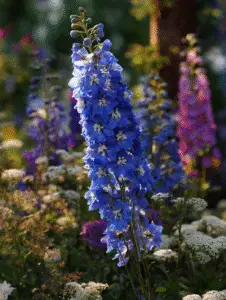
Delphinium Elatum
Tall vertical flower spikes with a similar upright look in borders and cottage style beds.
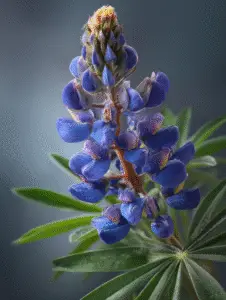
Lupine
Another spired bloomer that pairs well with snapdragons for height and strong color blocks.
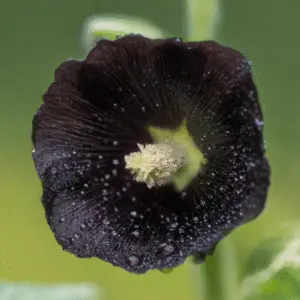
Hollyhock
Classic old garden flower with strong vertical structure for the back of beds.
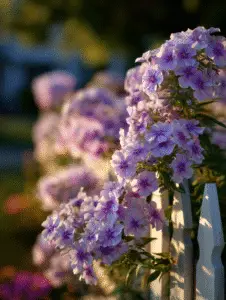
Phlox
Soft rounded clusters that balance snapdragon spikes and help fill gaps in mixed borders.
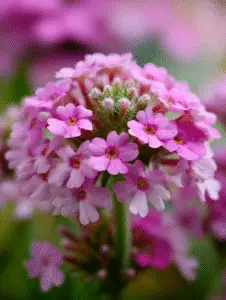
Verbena
Airy blooms that add movement and long color without competing with snapdragon height.
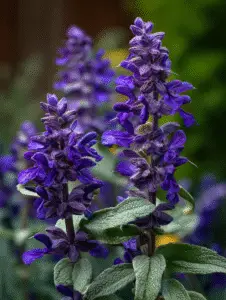
Salvia May Night
Purple spikes with a similar silhouette, great for repeating the vertical theme in a planting.
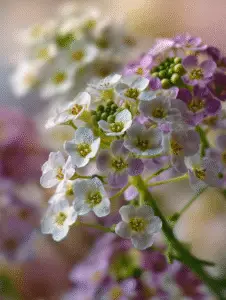
Sweet Alyssum
Low edging flower that works as a soft base layer under taller snapdragons.
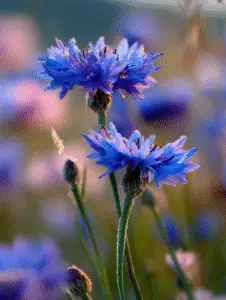
Cornflowers
Meadow style annual that fits the same informal, colorful garden vibe as snapdragons.
References
- North Carolina State University Extension Plant Toolbox, Antirrhinum majusCultural needs, light, soil, and notes about growth habit and heat tolerance.
- University of Florida IFAS EDIS, Antirrhinum majus SnapdragonUse and management, soil preferences, and how to cut back for another flush of blooms.
- University of Illinois Extension, SnapdragonPractical planting and care notes, including rebloom tips and general site preferences.
- ASPCA Animal Poison Control, Common SnapdragonPet safety reference stating non toxic status for dogs, cats, and horses.
Enjoying our flower guides? Add YourFlowersGuide as a preferred source on Google. It helps more readers find us.
Add to Preferred Sources