What to plant with love-in-a-mist
The pairing · pick a flower
All love-in-a-mist companions
What not to plant near love-in-a-mist
The best companions for love-in-a-mist, explained
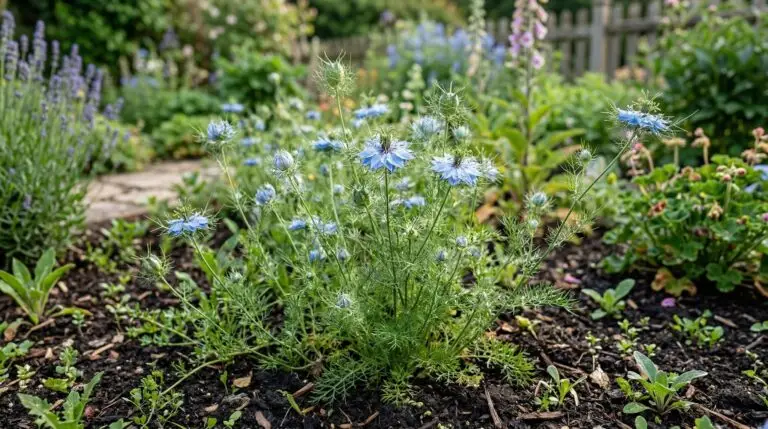
Love-in-a-mist was never built to be the star of a border. Wisconsin Horticulture Extension describes its real job plainly: it is a filler, good for closing gaps and for short-term massed color, not a plant meant to anchor a bed on its own. That single fact reframes the whole companion question. The best partners are not showpieces competing for attention but other lean, sun-loving hardy annuals willing to share the same open, well-drained ground and ask for the same benign neglect. Cornflower is the standout match for exactly that reason. Both are cool-season hardy annuals confirmed by NC State’s own Plant Toolbox to want full sun and average, well-drained soil, both reseed themselves back into the bed year after year, and cornflower’s more saturated blue drifts against nigella’s paler blue-to-white range instead of fighting it for the eye. Shirley poppy runs an even tighter parallel: it shares nigella’s exact taproot habit, the same cool-season direct-sow timing, and the same intolerance for being started as a transplant, so the two can be scattered into the same patch of bare ground on the same afternoon, poppy’s warm red or pink playing the honest counterpoint to nigella’s cool blue.
Larkspur deserves to be called nigella’s closest relative in the garden, even though it rarely makes the standard companion lists. It carries the identical long taproot that forbids transplanting, wants the same full sun and average water, and blooms on almost the same calendar, while its tall upright spires give nigella’s low, misty mounds a genuine vertical partner rather than more of the same shape. Sweet William and California poppy both earn a place through a more ordinary but still honest route: a commercial plant database names each directly as a recommended companion for this species, and in both cases the conditions genuinely back that claim up. Sweet William’s dense, clustered flower heads sit in the same full sun and neutral-to-alkaline soil nigella wants while giving real textural contrast to nigella’s solitary jewel-like blooms. California poppy shares nigella’s own self-sowing habit and full-sun preference, and its warm orange tone does for the palette what Shirley poppy does, just with more drought tolerance and a longer bloom run.
Sweet pea and cosmos round out the list for two different reasons, and it is worth being honest about which is which. Sweet pea is a real cool-season, full-sun companion, and the classic climbing-vs-weaver spatial logic holds up here: a vine needs a low, spreading groundmate at its feet, and nigella’s ferny foliage does that job well, though sweet pea wants slightly more consistent moisture than nigella’s average-water tolerance, so its own root zone needs direct watering rather than relying on ambient bed moisture. Cosmos is not a simultaneous partner at all but a relay. It shares nigella’s fine, ferny foliage for visual continuity, then keeps blooming long after nigella’s brief flush is over, picking up the display exactly where nigella’s short season leaves off. Strawflower, globe amaranth and Bells of Ireland close the list as a named group rather than individual picks: Wisconsin Extension recommends them together specifically for an everlasting garden built around nigella’s own dried seedpods, and each shares the same full-sun, direct-sow annual register that makes the whole planting simple to manage as one unit.
What not to plant near love-in-a-mist
Nigella’s own physiology, not any dramatic conflict, decides most of the avoid list here. The RHS states directly that this plant will not flower freely in shade and will not grow well in very heavy, permanently wet soil, and hosta, astilbe, fern and heuchera, the same acid-soil shade set that suits a hydrangea border, sit on the opposite side of that line: they want morning sun or dappled-to-full shade and consistently moist, often acidic ground. Put the two together and one plant goes leggy and sparse from too little light while the other scorches and dries out from too little water, a straightforward conditions mismatch rather than any active hostility between the plants. The fix is not clever staging, just separation: give nigella the sunniest, most open spot in the border and keep the shade-and-moisture perennials in a bed built for their own needs. The same RHS warning against heavy, waterlogged soil rules out anything that genuinely wants boggy or consistently soggy ground, since keeping that neighbor happy means keeping the bed wetter than nigella tolerates, risking rot in both plants rather than helping either one.
A quieter, more practical avoid follows from nigella’s taproot rather than its light or water needs. Because it must be direct-sown and cannot be moved once it germinates, sowing it into ground already dense with an established perennial’s root mass or a thick groundcover gives the young seedling very little open soil to anchor into, and it frequently fails to establish at all. This is a sowing-technique problem more than a companion-pairing one: the fix is simply to reserve a patch of genuinely open, workable ground for nigella at seed time, in a new bed or a gap actually cleared for it, rather than squeezing seed between crowded, established crowns.
The most honest and distinctive avoid on this page is really about nigella’s relationship with itself. Once established it self-sows so readily, per Wisconsin Extension’s own description of the plant, that left unthinned, those volunteers can crowd out a smaller or slower-establishing neighbor the following season simply through sheer numbers rather than any chemical or competitive trick. Extension guidance is direct on the remedy: thin the seedlings while small if a tidier bed is the goal, or deadhead and remove seedpods early before they shatter, and a companion sown nearby gets a fair share of open ground instead of competing against a carpet of nigella’s own offspring. This is less a warning against a specific plant and more a management note about nigella itself, and it deserves to be said plainly rather than folded quietly into a generic spreader warning: nothing in the literature reviewed for this page shows nigella harming a neighbor chemically, and no meaningful pest-repelling folklore claim exists for it either. Its real reputation is as a well-behaved, chemical-free presence that mostly needs managing, not feared.
Do they like the same conditions?
State the ruler plainly, since it is what makes a pairing honest rather than decorative. Nigella wants full sun, and both the RHS and NC State’s Plant Toolbox confirm this without listing any real shade tolerance; in hot-summer regions from roughly zone 7 up, gardeners commonly give it afternoon shade as a heat concession, since Wisconsin Extension notes it plainly does not perform well in hot weather, but that is a regional workaround, not evidence the plant actually prefers less light. Water needs sit in the middle: NC State lists average, medium moisture with tolerance for occasional wetness, while the RHS is more blunt that permanently heavy, wet soil is a genuine problem, so the safest reading is a well-drained bed that gets watered normally rather than one kept either bone-dry or soggy.
Soil chemistry is where nigella quietly rules out an entire category of popular "cottage romantic" companions. NC State lists a neutral pH range and the RHS calls it alkaline or neutral, and it is broadly adaptable across clay, loam and sand as long as drainage holds. That is the opposite profile from the acid-soil shade shrubs, azalea and hydrangea among them, that share nigella’s cottage-garden reputation but not its actual chemistry, and it is exactly why the shade-and-moisture avoid list above is not a minor footnote but a real, physiologically grounded split. The taproot is the other constraint that actually filters which companions are practical rather than just pretty: nigella must be direct-sown and never transplanted, so its truest partners are other direct-sow hardy annuals, larkspur and Shirley poppy especially, sown into the same open ground at the same time, not potted perennials added later as an afterthought. Bloom timing matters more than it first appears, too. Nigella’s own flowering window runs a short 4 to 8 weeks, so a companion that overlaps it, like cornflower or Sweet William, reads as a true simultaneous pairing, while one that follows it, like cosmos, is better understood as a relay handing off the display rather than a plant growing shoulder to shoulder with nigella at its peak.
How to plant them together
Because nigella cannot be transplanted, the planning happens before anything goes in the ground rather than after. Direct-sow it alongside its taprooted companions, larkspur and Shirley poppy, in the same session, scattering seed across the same patch of open, worked soil in early spring or, in milder climates, in fall for an earlier and fuller spring show. Space nigella itself 8 to 10 inches apart if thinning to a tidy stand, or let it self-sow more loosely for a wilder look, and give companions with a similar habit, cornflower and California poppy, roughly the same 8 to 12 inch spacing, since none of them develop an aggressive root system that would compete underground.
Companions that are better started as young plants rather than seed, Sweet William chief among them, can go in as transplants at the bed’s edge once nigella’s own seedlings are up and thinned, avoiding the crowded-root problem covered above. Give Sweet William and sweet pea 10 to 18 inches of clearance depending on their eventual size, and if sweet pea is climbing a support, keep nigella’s low mounds at its base rather than directly against the trellis, so light still reaches nigella’s own foliage. Layer loosely by height and bloom order rather than a strict formula: larkspur and sweet pea’s vertical forms belong toward the back or on a support, nigella and cornflower hold the middle at their similar heights, and California poppy or a strip of dusty miller can edge the front. Because nigella’s bloom window is brief, plan the handoff on purpose: sow or transplant cosmos a few weeks after nigella so it fills the visual gap as nigella’s flowers give way to its own seedpods, rather than leaving a bare patch mid-season.
In containers, the direct-sow rule still applies, so start nigella from seed in the pot itself rather than transplanting a nursery start into it, and choose potmates that share its lean, well-drained preference, California poppy and dusty miller both work well, rather than a moisture-hungry plant that would need the container kept wetter than nigella wants. A pot at least 10 to 12 inches across gives the taproot room and drains fast enough to avoid the waterlogging the RHS warns against. Whichever setting, keep an eye on volunteers the following spring: thin unwanted nigella seedlings while they are still small so a deliberately planted companion is not shouldered out by nigella’s own return.
Does companion planting actually work for love-in-a-mist?
Some of it rests on genuinely solid ground, and some of it is honest design logic rather than a documented study of two specific plants grown together, and this page tries to keep those two categories visibly separate rather than blending them into one confident-sounding list. The shared-conditions matches, cornflower, Shirley poppy, larkspur, Sweet William and California poppy, are each individually confirmed by extension or RHS sourcing to want the same full sun and well-drained soil nigella does, which earns them a solid Partial tier: the culture match is real and independently sourced, but no source studies the specific pairing as a joint planting with a documented outcome. The everlasting-garden grouping, strawflower, globe amaranth and Bells of Ireland, clears a higher bar, since Wisconsin Extension names that exact combination directly rather than requiring an inference from separate plant profiles, which is why it sits at Proven alongside cornflower’s tightly matched hardy-annual conditions.
The avoid side of the ledger is where the evidence is strongest and most specific to this plant. The RHS does not merely describe hosta’s or astilbe’s preferences in isolation; it states directly, about nigella itself, that the plant will not flower freely in shade and will not grow well in permanently wet soil, which makes the shade-and-moisture avoid a Proven claim anchored to nigella’s own documented limits, not just a companion’s general reputation borrowed and applied by inference. The self-seeding-crowding note earns the same Proven tier for a different reason: extension guidance on thinning and deadheading is direct and specific to this species, describing exactly the mechanism, unthinned volunteers outcompeting a slower neighbor for open ground, rather than a vague spreader warning imported from another plant’s page. What does not survive this test is any claim that nigella actively helps or harms a neighbor through some chemical or pest-control mechanism: no meaningful allelopathy claim and no credible pest-repelling folklore for this species turned up anywhere in the research for this page, which is itself worth stating plainly rather than silently omitting, since the honest answer here is that nigella’s best contribution to a companion planting is simply being an easy, well-mannered neighbor with the same lean requirements as its best partners, not a secret garden weapon.
Frequently asked questions
What can I plant with love-in-a-mist for a cottage or cutting garden?
Cornflower and Shirley poppy are the strongest matches, sharing nigella’s full sun, well-drained soil and cool-season direct-sow timing while adding color contrast. Larkspur runs an almost identical taproot and bloom calendar and makes a genuinely close analog rather than just a look-alike.
What should you not plant near love-in-a-mist?
Keep true shade lovers and moisture-hungry perennials, hosta, astilbe, fern and heuchera among them, in their own bed, since the RHS confirms nigella will not flower well in shade or thrive in heavy, wet soil. Give nigella open ground to sow into rather than crowding it against established, densely rooted perennials.
Is love-in-a-mist invasive, or is it just a weed in disguise?
Neither, honestly. It self-sows readily and produces plenty of seed once established, but it is not classified as invasive and does not aggressively outcompete established plants the way a true invasive species does. The real issue is volume in its own footprint: thin the seedlings or deadhead the spent flowers if a tidier bed matters more than free replanting.
Is love-in-a-mist poisonous to dogs or cats?
The evidence here is genuinely mixed rather than settled. The seeds contain the alkaloid damascenine, and while most consumer sources describe mild, self-resolving stomach upset at worst in dogs, some sources describe a more serious risk to cats specifically. Treat it with the same caution as any unfamiliar garden plant: keep pets from grazing on it and contact a veterinarian if a large quantity is eaten.
Why did my love-in-a-mist stop blooming so quickly?
That is normal, not a sign of a problem. Its flowering window runs only about 4 to 8 weeks per sowing, so a single planting will always look brief. Succession-sow every 2 to 3 weeks through late spring, or pair it with a later bloomer like cosmos, to keep color going after nigella’s own flush ends.
Sources
Love-in-a-Mist, Nigella damascena, Wisconsin Horticulture Extension · Nigella damascena, North Carolina Extension Gardener Plant Toolbox · Nigella damascena, RHS growing guide · Centaurea cyanus, North Carolina Extension Gardener Plant Toolbox · Dianthus barbatus, North Carolina Extension Gardener Plant Toolbox · Eschscholzia californica, North Carolina Extension Gardener Plant Toolbox · Nigella damascena, Gardenia.net plant combinations · Lathyrus odoratus, North Carolina Extension Gardener Plant Toolbox · Cosmos bipinnatus, North Carolina Extension Gardener Plant Toolbox · Corn Poppy, Papaver rhoeas, Johnny’s Selected Seeds growing guide
More About Love in a Mist

Nigella seeds in the spice world and the culinary history of black cumin
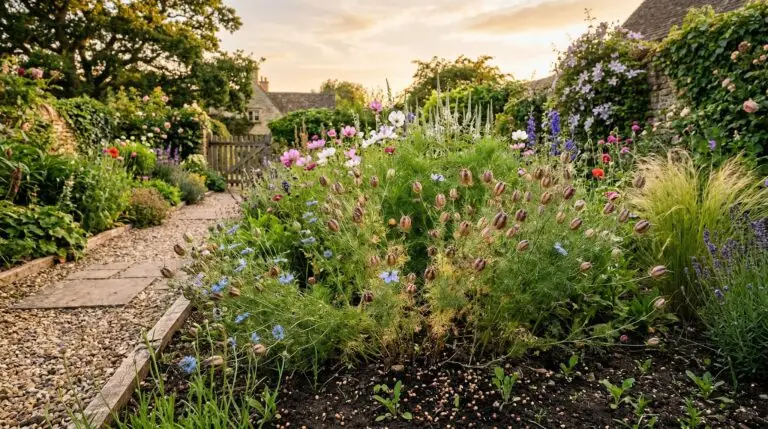
Love-in-a-mist as a self-sowing annual that creates a cottage garden on autopilot

Growing love-in-a-mist from seed with the simple scatter and forget method
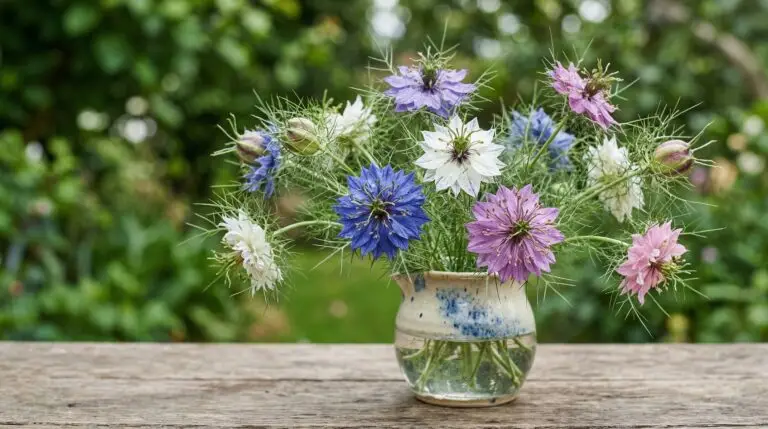
Best love-in-a-mist varieties from classic Persian Jewels to double Albion Green Pod
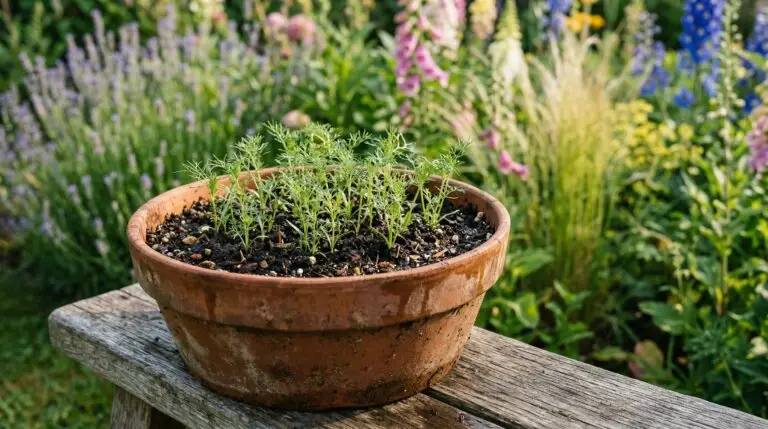
Love-in-a-mist in containers for a feathery cottage feel on balconies and windowsills
Love-in-a-mist flower meaning and the romantic mystery behind this enchanting bloom
Love-in-a-mist as a delicate cut flower for wildflower-style bouquets and arrangements
Love-in-a-mist seed pods that are as beautiful as the flowers and perfect for drying