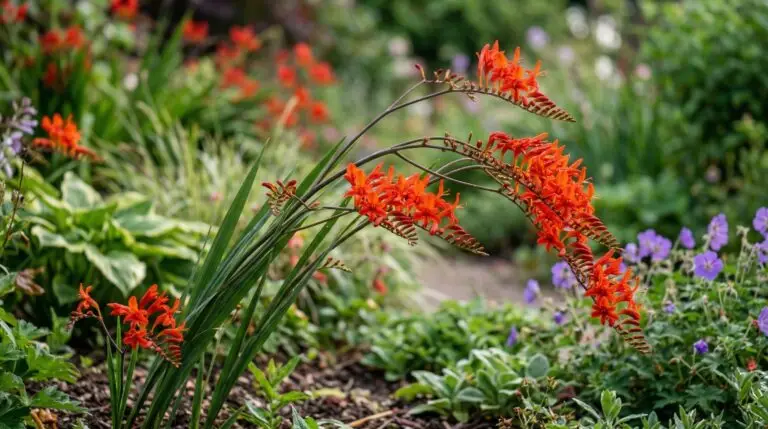
Crocosmia is an architectural punctuation mark in the mid-to-late summer border. Its upright, sword-like leaves provide a strong vertical anchor, while the arching stems of tubular flowers inject movement and energy into the composition. When we design a hot color garden, we rely on plants that can carry the visual weight of intense reds, oranges, and yellows without dissolving into a chaotic mass. Crocosmia excels here because its distinct form prevents it from blending too heavily with its neighbors. It creates a focal point that draws the eye upward and outward, setting the rhythm for the rest of the planting scheme. As a designer, I look for plants that do more than just bloom, and this perennial is a vital structural bridge between low mounding groundcovers and the taller woody shrubs at the back of the bed. A successful hot border needs this kind of structural clarity to balance the visual heat of the flowers. By understanding how to manipulate its sharp lines and saturated hues, you can build a summer border that commands attention through late summer and early autumn.
Building a hot color palette with intention
Hot colors advance toward the viewer, making large spaces feel more intimate and small spaces feel incredibly dynamic. Crocosmia flowers bloom in saturated shades of scarlet, tangerine, and golden yellow, which demand equally strong companions to avoid looking isolated in the garden. To build harmony, pair the fiery red of a tall variety with the deep, smoldering tones of dark-leaved canna lilies. The broad, paddle-shaped foliage of the canna absorbs light, providing a restful backdrop that makes the bright Crocosmia flowers advance even further. For a more dramatic contrast, introduce deep violet or burgundy elements nearby, using dark foliage plants to ground the intense heat of the oranges and yellows. Purple-leaved smoke bush or dark coral bells planted at the base will cool the visual temperature just enough to keep the eye engaged. This approach prevents the hot border from becoming visually exhausting, offering the observer a place to rest between the bursts of saturated color.
Designing with contrasting forms and textures
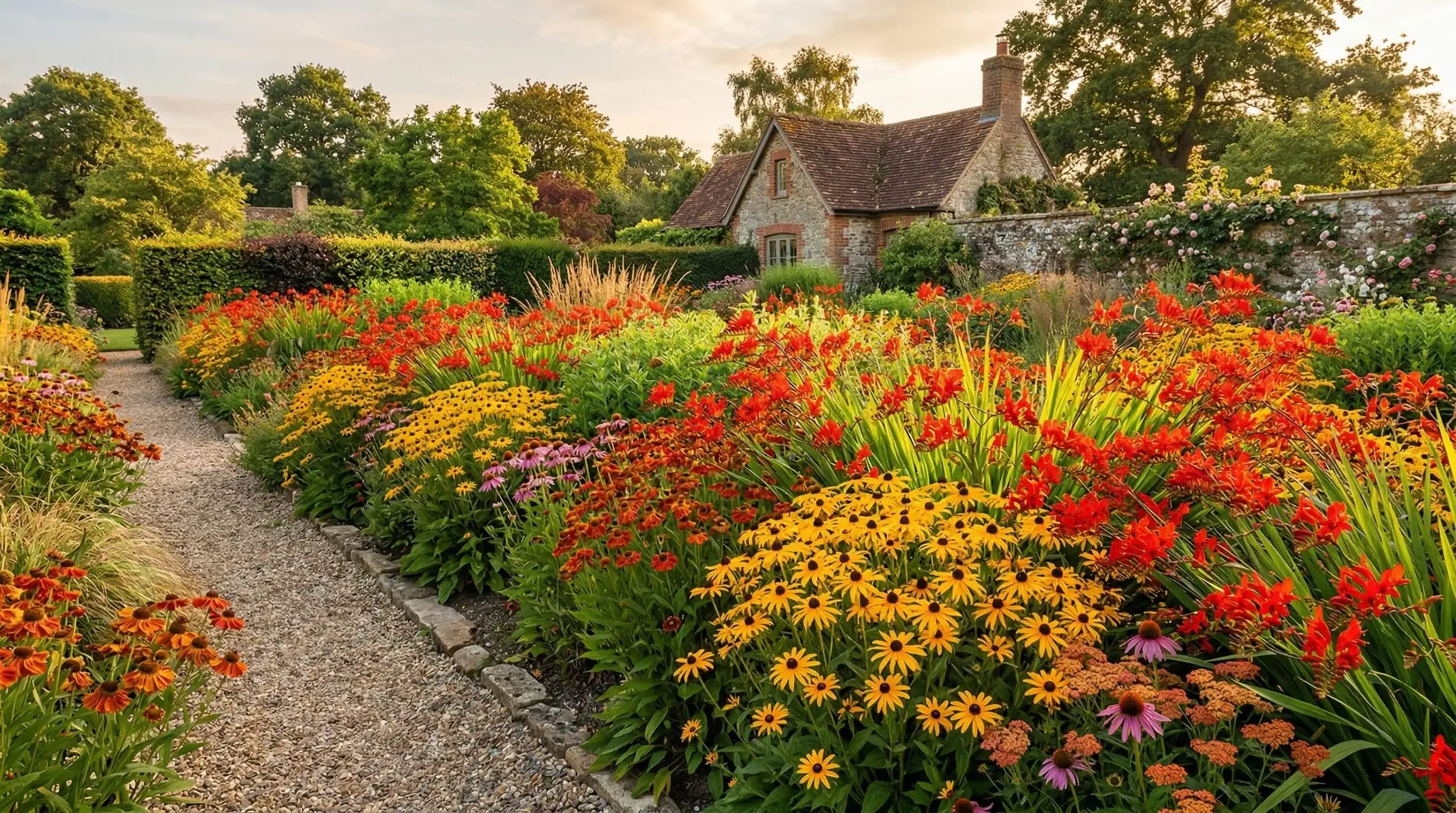
The success of any garden composition relies heavily on contrasting plant forms, and this is where Crocosmia truly proves its value. The stiff, pleated leaves of Crocosmia offer a rigid verticality that slices through the soft, mounding habits of many late-summer perennials. Placing it next to the coarse, heavy blooms of a dahlia creates an immediate tension between the delicate, arching sprays of the Crocosmia and the dense, spherical flower heads of the dahlia. You can further this textural contrast by introducing the flat, daisy-like faces of black eyed Susans into the foreground. The horizontal landing pads of the rudbeckia flowers emphasize the vertical lift of the Crocosmia foliage, giving the border a clear structural hierarchy. Fine-textured grasses can also be woven through these groupings to soften the harsh angles of the broad leaves and sharp swords. This deliberate mixing of swords, spheres, daisies, and plumes ensures the garden remains visually engaging even when viewed in black and white.
Scaling the summer border for visual impact
Proper placement within the garden relies on understanding the mature scale and growth habit of your chosen plants. Tall Crocosmia varieties need placement in the middle or back of the border, where their lower, sometimes messy foliage can be hidden by shorter companions. Planting sturdy, mid-sized perennials like Helenium in front of them creates a stepped effect that guides the viewer’s eye smoothly from the pathway up to the towering red or orange arches. For a highly stylized look, you can plant Crocosmia alongside Kniphofia, commonly known as red hot poker. Both plants share a similar grassy, upright foliage, but the thick, torch-like blooms of the Kniphofia provide a heavier visual weight compared to the delicate, horizontal branching of the Crocosmia flowers. Grouping these structural plants in drifts of three or five creates a continuous rhythm along a sightline, pulling the observer through the garden space. Careful spacing allows each plant to express its natural form without crowding out its neighbors.
Managing spatial relationships and rhythm
Spatial relationships dictate how the eye travels through a garden space, making plant distribution just as vital as plant selection. Instead of planting Crocosmia as a solitary specimen, designers often use it in sweeping drifts that repeat at regular intervals down the length of a border. This repetition establishes a visual rhythm, allowing the intense red or orange flowers to become stepping stones that carry the viewer’s gaze from one end of the garden to the other. To prevent the composition from feeling too rigid, you can interplant these drifts with airy filler plants that blur the harsh edges of the structural perennials. Bronze fennel or tall verbena work beautifully in this role, casting a transparent haze of fine foliage and tiny flowers over the bold, hot-colored blooms. The transparent nature of these fillers means they never obscure the strong lines of the Crocosmia, but rather wrap them in a soft, atmospheric layer. This layering technique builds depth, making a flat garden bed feel like a fully realized, three-dimensional space.
Sustaining interest through seasonal transitions
A well-designed garden must perform beyond its peak blooming window, and Crocosmia contributes lasting structure long after the bright petals drop. The pleated leaves emerge early in the spring, offering clean, architectural green lines that contrast with the softer spring ephemerals. As late summer shifts into autumn, the spent flower stalks develop attractive, bead-like seed pods that persist well into the colder months. Leaving these stalks standing adds a delicate, skeletal texture to the winter garden, especially when coated in frost or light snow. A reliable design principle for any hot-colored border is to anchor your ephemeral, high-color flowers with permanent or semi-permanent structural foliage. By treating the sword-like leaves of Crocosmia as a structural constant rather than just a delivery system for summer color, you create a garden composition that feels intentional and grounded across all seasons.
More About Crocosmia

Overwintering crocosmia corms in cold climates zones 5 and below
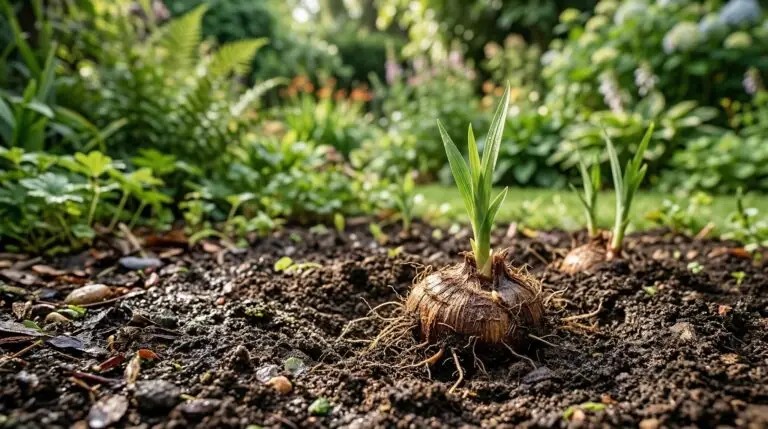
How to grow crocosmia for fiery arching sprays of color in midsummer gardens
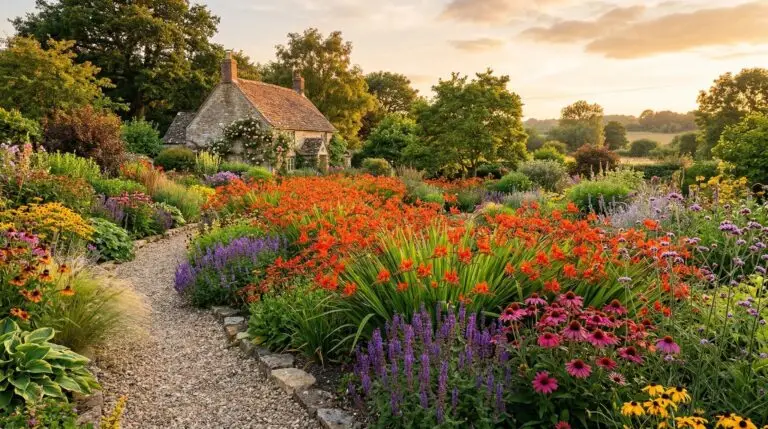
Designing a late summer garden with crocosmia that peaks when spring flowers are gone
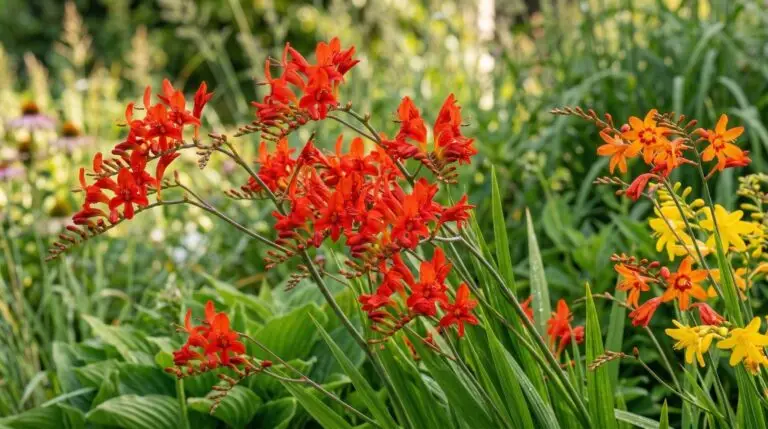
Best crocosmia varieties from fiery Lucifer to golden Emily McKenzie
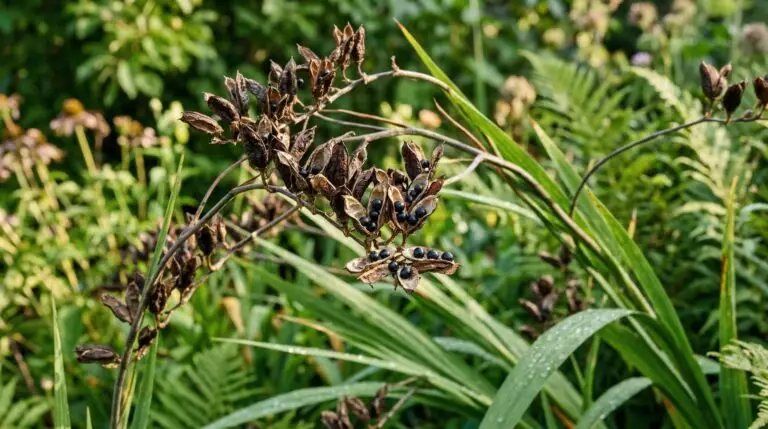
Crocosmia seed pods and how to propagate new plants from seed for unique varieties
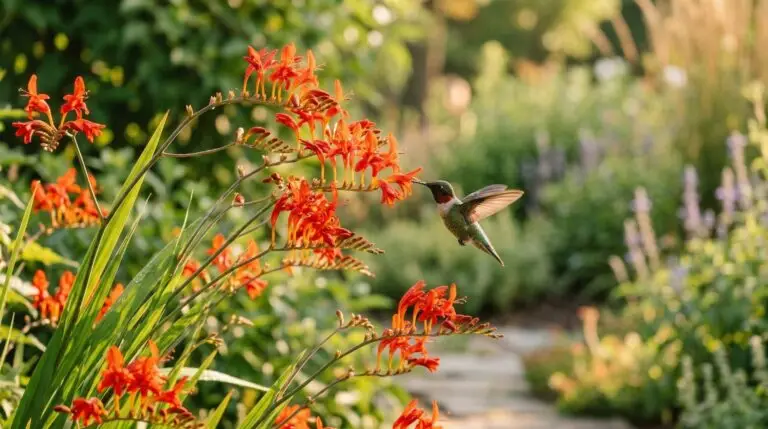
Crocosmia as a hummingbird magnet and why they prefer these tubular flowers
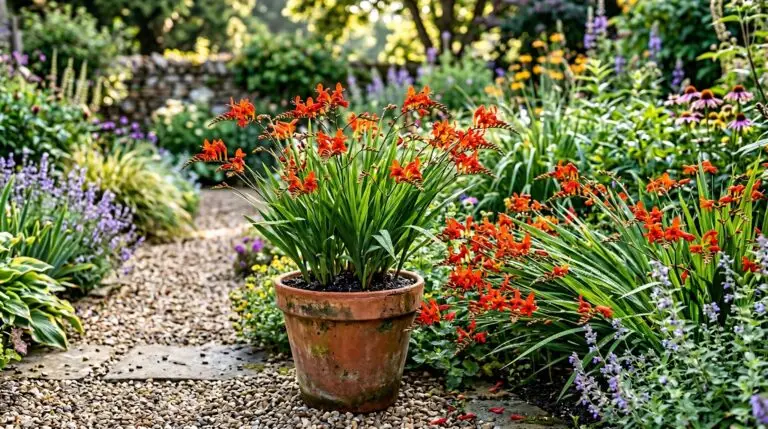
Growing crocosmia in containers for tropical-looking patio displays