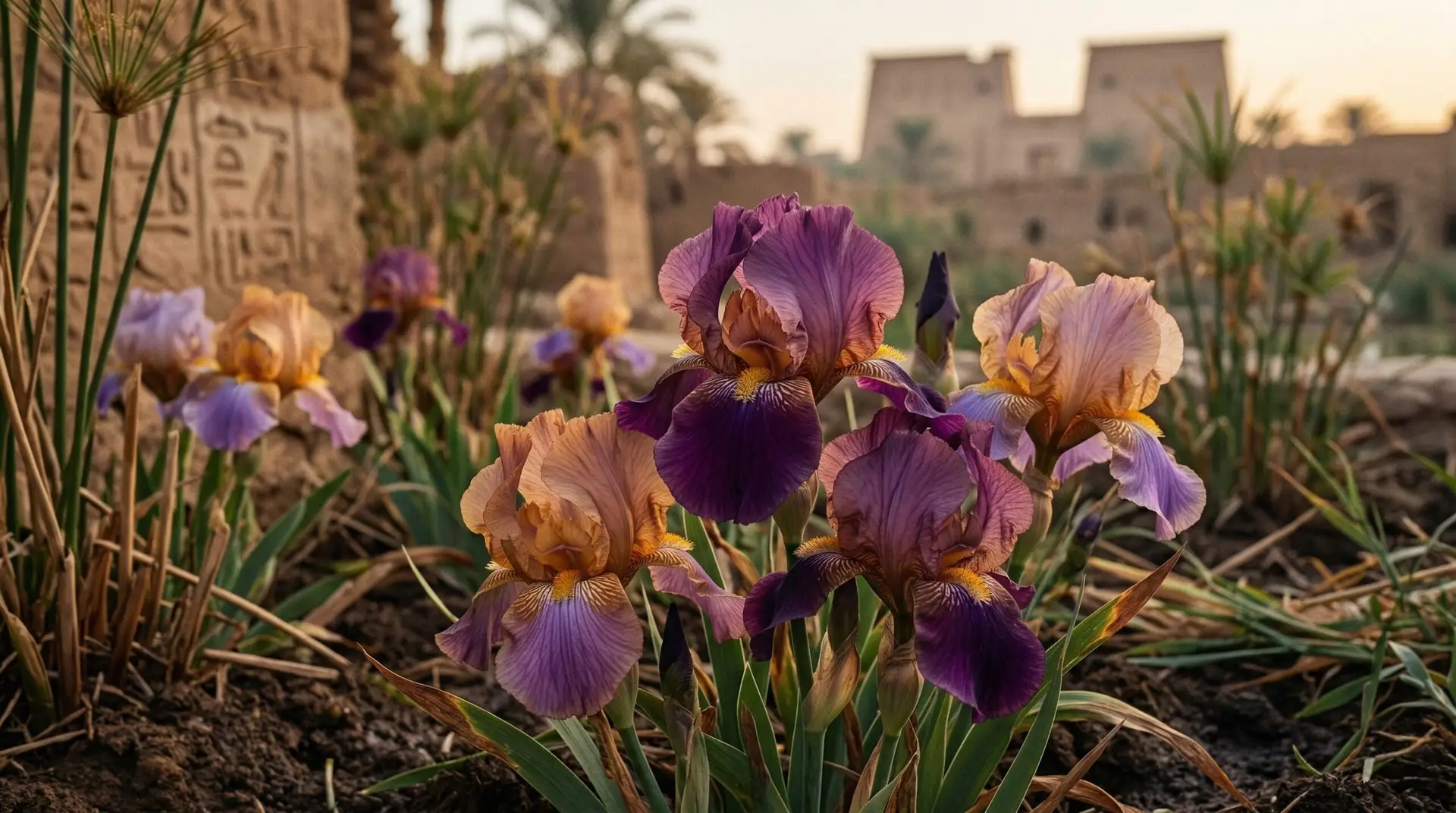
The story of the bearded iris begins long before it found a place in modern garden beds. In Greek mythology, Iris was a messenger of the gods who traveled between heaven and earth on a rainbow. The flower that took her name mirrored that celestial arc, opening petals in shades of deep purple, gold, and white. Ancient Greeks planted these blooms over the graves of women, believing the goddess would guide their souls to the Elysian Fields. Across the Mediterranean, Egyptian pharaohs saw a different kind of power in the upright petals. When Thutmose III conquered Syria, he brought iris rhizomes back to Egypt to cultivate in his palace gardens. The three upright petals came to mean faith, wisdom, and valor in Egyptian culture, qualities a ruler needed to govern a vast empire.
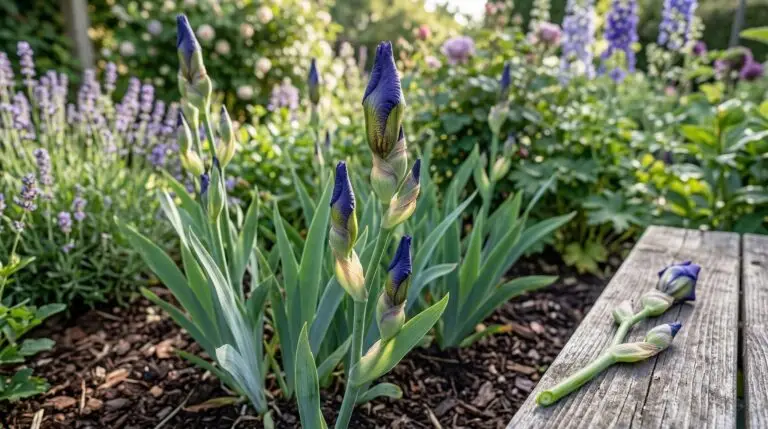
The physical form of the iris has always commanded attention from those who grow it. A bearded iris builds itself architecture first, pushing thick, sword-like leaves through the cold spring soil. By late May, the stalks rise and the buds unfurl into a complex arrangement of three upright petals called standards and three downward-falling petals called falls. Down the center of each fall sits the fuzzy beard that gives the plant its common name, a bristly landing pad designed to guide bees toward the hidden nectar. Early botanists and royal gardeners alike recognized this structural beauty and began moving the plant far beyond its native range. They traded rhizomes across ancient trade routes, allowing the flower to adapt to new climates and soils throughout Europe and Asia.
A royal symbol born in the marshes
The story of the bearded iris took a political turn in the wetlands of early France. According to legend, King Clovis of the Franks was trapped by a river while fleeing an enemy army in the fifth century. He noticed wild yellow irises growing far out in the water, which told him the river was shallow enough to ford safely. After his escape, he adopted the flower as his emblem, replacing the three toads that previously adorned his shield. Centuries later, King Louis VII officially adopted the stylized iris on his shield during the Crusades to signal his divine right to rule. This emblem became known as the fleur-de-lis, translating literally to “flower of the lily” in French. The name caused centuries of botanical confusion, leading many to believe the symbol represented a lily rather than the iris that saved a king.
The fleur-de-lis cemented the bearded iris as a flower of nobility and earthly power. The three stylized petals of the emblem perfectly mirrored the three standards of the living flower. French monarchs used the design on flags, armor, and palace gates to project wealth and heavenly favor to their subjects. The symbol eventually crossed the English Channel when Edward III claimed the French throne, adding the fleur-de-lis to the English coat of arms. Whenever a gardener plants a bearded iris today, they are growing a living piece of heraldry in their own soil. The flower maintains that regal posture in the garden, standing tall on thick stalks while other spring blooms bow entirely to the wind.
Secret messages in Victorian parlors
As the centuries passed, the bearded iris moved from the battlefield to the parlor. During the nineteenth century, the Victorian language of flowers turned garden blooms into a silent vocabulary for expressing hidden emotions. Society rules severely restricted open communication between men and women, so people used small bouquets called tussie-mussies to send messages. While a red rose communicated straightforward romantic love, the bearded iris delivered more nuanced sentiments to the recipient. Giving an iris meant the sender had a message for the recipient, echoing the flower’s ancient namesake, the messenger goddess. A purple iris offered a compliment, a blue one conveyed hope and faith, and a yellow bloom signaled burning passion.
This era of hidden meanings coincided with a surge in iris breeding across Europe. Nurserymen began crossing different species, creating hybrids with ruffled edges and entirely new color combinations. They documented the parentage of each new variety, trading seeds and rhizomes with obsessive care to track the lineage of their creations. The bearded iris proved exceptionally willing to mutate and cross-pollinate, resulting in a sudden explosion of garden varieties. Gardeners no longer had to choose between basic purple or yellow for their spring displays. They could plant irises in shades of copper, pale pink, and deep maroon, greatly expanding the vocabulary of their garden borders.
Taking root in American soil
The bearded iris made its way across the Atlantic Ocean tucked into the trunks of European colonists. These early settlers brought the dormant rhizomes wrapped in cloth, relying on the plant’s ability to survive long periods out of the ground. Once planted in American dirt, the irises multiplied rapidly and established themselves as reliable perennials. They thrived in the distinct seasons of the Northeast and the warm springs of the South. By the early twentieth century, American breeders took up the mantle of creating new varieties, establishing formal societies to register the thousands of new hybrids. The flower became a fixture of the American yard, traded over backyard fences and passed down through generations as cherished passalong plants.
The cultural weight of the bearded iris eventually earned it official recognition in the United States. In 1933, Tennessee named the iris as its state flower, specifically honoring the purple bearded varieties that grew so well in the region’s climate. The flower became a common sight around farmhouses and city lots alike, blooming reliably every spring with minimal intervention from the gardener. A single rhizome planted in autumn will sleep under the winter snow, slowly developing its root system in the cold earth. When the ground warms, it pushes up those familiar green swords, following the exact same biological rhythm it did in the gardens of ancient Egypt.
A garden filled with bearded irises operates as a living historical record. When you divide an overcrowded clump in late summer, snapping the fleshy rhizomes apart to give them room to breathe, you participate in an ancient agricultural practice. You hold the same sturdy root structure that traveled along early trade routes and sailed across oceans in wooden ships. As the sun sets on a late May evening, the light catches the fuzzy beards and translucent petals of the open flowers. The iris stands quietly in the fading light, holding centuries of human history in its brief, seasonal bloom.