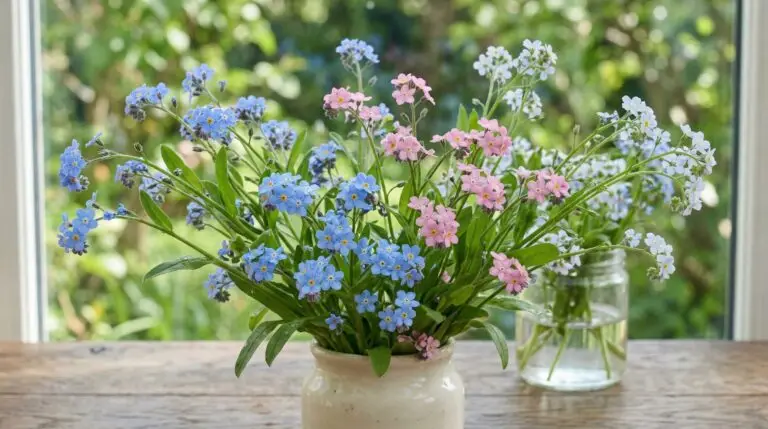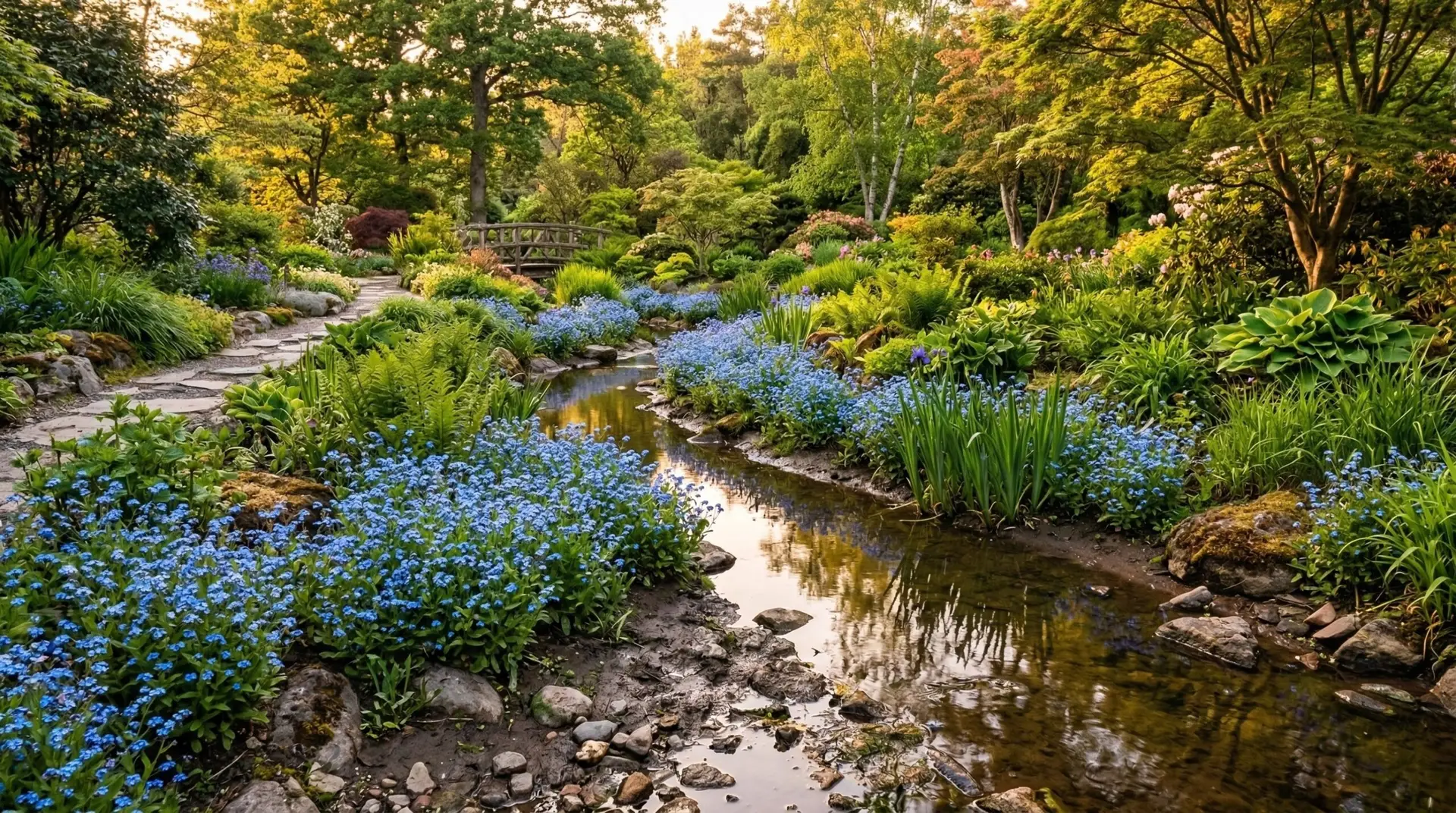
The mist lifting off the dark surface of the pond leaves a heavy dew on the surrounding vegetation. Here at the water’s edge, the boundary between earth and liquid is ambiguous, marked by a thick collar of green stems. Among the rushes, the water forget-me-not opens its small, flat blossoms to the early light. The color is a clear, unclouded blue, punctuated by a bright yellow eye that acts as a beacon for early-foraging hoverflies. Myosotis scorpioides does not demand attention with large, showy blooms, but rather gathers in quiet colonies that mirror the sky. Watching a damselfly rest briefly on a slender stem, I am reminded that a garden is never just a collection of plants. It is a living, breathing community where every petal and leaf plays a role in the daily survival of countless creatures.
The true nature of this plant reveals itself in its preference for saturated soil. While its woodland cousins seek the dappled shade of dry slopes, the water forget-me-not actively reaches for the wetness of a stream bank or a forget-me-not pond. Its stems are slightly angular, covered in fine hairs that trap tiny beads of moisture against the morning chill. They possess a remarkable ability to root wherever they touch the mud, sending down fine white threads into the muck. This creeping habit allows the plant to form dense mats that stabilize loose soil against the gentle erosion of moving water. As the season warms, these mats become a nursery for aquatic life, sheltering froglets and providing a safe harbor for the nymphs of dragonflies. The plant belongs entirely to the transitional zone, thriving where the ground gives way underfoot and the air smells of algae and rich, decomposing matter.
The ecology of the wet edge
To plant at the edge of water requires a shift in how we think about gardening. We are accustomed to digging neat holes in well-drained beds, but the bog garden operates under a different set of rules. Here, oxygen is scarce in the heavy, waterlogged soil, and roots must adapt to constant submersion. Myosotis scorpioides meets this condition with hollow stems that transport air down to its root system, a quiet feat of biological engineering. When you press a piece of the rhizome into the black mud, you are not just placing a flower, but anchoring a piece of the shoreline. The roots weave through the muck, binding the earth together and creating a porous architecture that filters runoff before it reaches the open water. Gardening in this space means accepting the mud on your hands and the unpredictable fluctuations of water levels that dictate where the plants will ultimately settle.
The bloom period begins in late spring and stretches lazily through the summer months. Each flower is tiny, perhaps a quarter of an inch across, but they appear in curling cymes that unfurl slowly like the tail of a scorpion, which gives the plant its botanical name. This continuous unfurling ensures a steady supply of nectar for small bees and butterflies that navigate the humid air above the water. I often sit by the pond edge just to watch the traffic of insects moving from the yellow centers of the forget-me-nots to the taller emergent plants nearby. The blue flowers act as an understory, a cool carpet beneath the vertical thrust of sedges and rushes. They require very little maintenance from the gardener. They ask only that their roots remain submerged or consistently damp, never drying out under the high summer sun.
Companions in the mud
No plant exists in isolation, and the water forget-me-not is most compelling when it grows alongside the other inhabitants of the wetland. In the wild, it frequently mingles with the bright, waxy blooms of marsh marigold. This creates a classic combination of blue and gold that signals the definitive arrival of spring. As the season progresses, the forget-me-nots form a soft skirt around the base of taller, more architectural plants. The sword-like foliage of a water-loving iris provides a striking contrast to the low, sprawling habit of the blue flowers. The stiff, upright leaves of the iris cut through the air, while the forget-me-nots scramble over the wet stones at their feet. This pairing satisfies the eye because it mimics the natural layering found in wild stream edges, where plants occupy distinct vertical niches to share the available light.
Further along the bank, where the water is shallow and still, the smooth, arrow-shaped leaves of a calla lily rise from the muck. The white, funnel-like spathes of the calla offer a cool, sculptural presence that pairs beautifully with the scatter of blue forget-me-nots below. Integrating these different forms requires a degree of restraint from the gardener. We must allow the plants to find their own balance in the shifting mud. Often, the Myosotis scorpioides will weave itself directly into the crowns of its neighbors, its roots tangling with theirs in the saturated earth. Pulling them apart feels entirely unnecessary, as they have formed a functional guild that shades the water and cools the soil. In these damp hollows, we learn to relinquish strict control, watching instead how the plants negotiate their boundaries and establish a self-sustaining community.
The quiet work of naturalizing
Bringing water forget-me-nots into a cultivated space is an exercise in managed wildness. You might start with a few small pots purchased from a local nursery. You tuck them into the muddy margins where the pond liner disappears beneath the soil. Within a single season, the plants will stretch out, sending runners across the wet earth and even floating out over the surface of the shallow water. This vigorous growth is exactly what makes them so valuable for naturalizing a stream edge, but it also requires occasional intervention. Thinning out the densest patches feels like a small act of cruelty, but crowded plants compete for space until the center of the colony begins to rot. I pull handfuls of the shallowly rooted stems from the water, shaking off the mud and the clinging duckweed. This process leaves breathing room for the remaining plants to push forth fresh, healthy growth.
The pulled stems need not be discarded, as they possess a fierce will to live. They root easily and quickly in any permanently wet patch of ground. I often carry a bucket of these thinnings to a lower, poorly drained area of the yard, pressing them into the damp soil with the heel of my boot. There is a deep satisfaction in this simple method of propagation, a participation in the plant’s natural drive to colonize and spread. Over the years, these relocated fragments have formed new patches of blue that light up the dark corners of the property in early summer. The process requires patience, an understanding that a garden is grown over decades rather than installed in a weekend. We are merely facilitators in this environment. We move a piece of the ecosystem from one wet depression to another, trusting the rain and the soil to do the heavy lifting.
As autumn approaches, the blue flowers finally fade, and the foliage of the water forget-me-not begins to break down into the water. The stems turn brown and soft, adding their substance to the rich layer of detritus that fuels the food web of the pond. This decay is not an end, but a necessary preparation for the freezing months ahead. The plant will rest dormant beneath the ice, waiting for the thaw. Standing at the edge of the water in the fading light of November, the mud smells sharp and clean, holding the promise of next year’s growth in its dark depths. The boundary between land and water will shift again with the spring rains. The creeping rhizomes will follow the moisture, tracing the new shoreline in a line of unclouded blue. It is a quiet, enduring cycle, a reminder that life at the water’s edge is always in motion, always reaching for the light, and always remembering the exact place where it belongs.