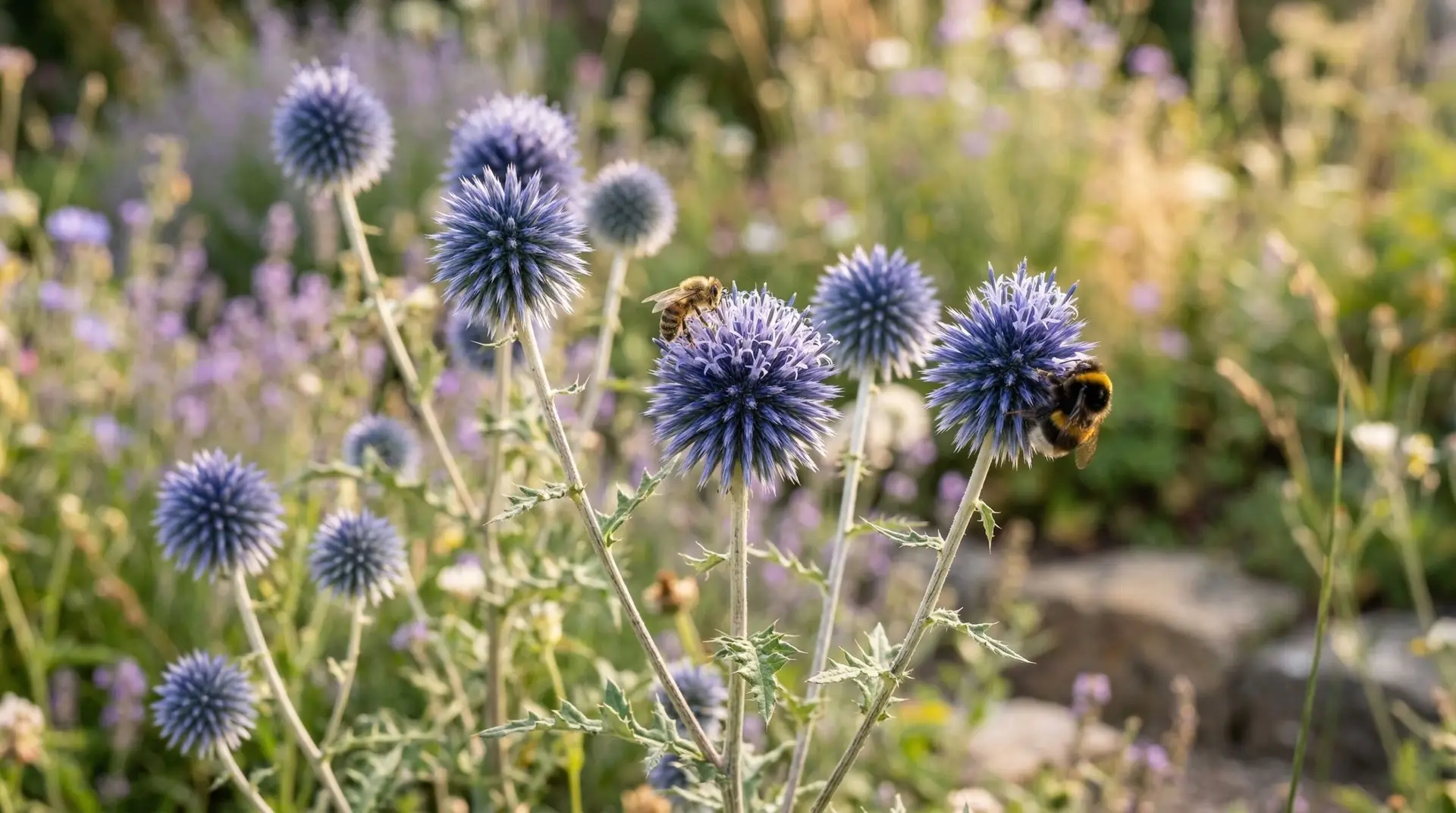
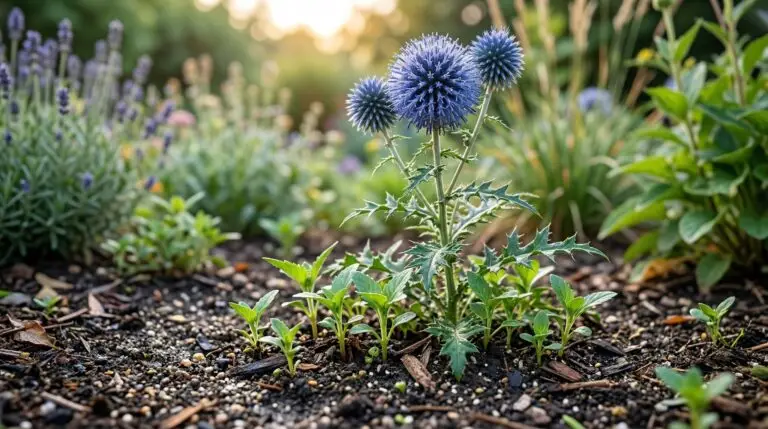
The August sun has barely cleared the eastern ridge when the humming begins. It is a low, continuous vibration that seems to rise from the earth itself, though its source is the tall stand of globe thistle growing at the back of the border. Long before the heavy dew has burned off the silver-green foliage, the workers are already awake and gathering. I stand with my coffee cooling in my hands and watch a single bumblebee navigate the spiky architecture of an unopened bloom. The flower heads are perfect spheres of pale steel blue, suspended on rigid stalks that barely sway in the morning air. This corner of the garden is a busy intersection of ecological commerce. The plant demands attention through an overwhelming offering of sustenance to the waking world.
The architecture of a summer feast
To understand the draw of this plant, you have to look closely at how a globe thistle is built. What appears from a distance as a single round blossom is actually a dense cluster of hundreds of tiny, individual flowers arranged in a tight sphere. Each star-shaped floret opens sequentially, usually beginning at the top of the globe and working its way downward over several days. This staggered opening provides a reliable, steady supply of nectar rather than a brief glut. The sheer volume of sugar produced by these florets makes the plant a necessary resource during the dog days of summer when spring blooms have long faded. I often watch honeybees move methodically around the sphere, probing each open floret with an efficiency born of necessity. For the echinops pollinators that depend on this late-summer bounty, the spherical shape offers a convenient landing pad where they can feed for long stretches without expending energy in flight.
Water, rock, and nectar
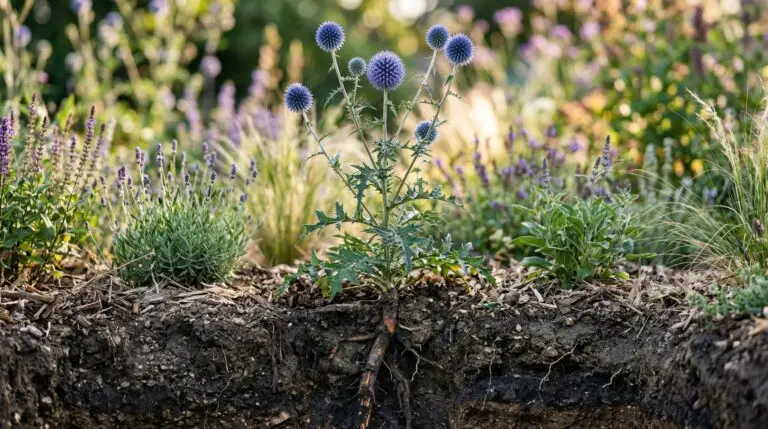
The generosity of the globe thistle is particularly remarkable when you consider the harsh conditions it prefers. These plants belong to the dry, rocky steppes, and they have adapted to thrive in soils that would starve more delicate perennials. Beneath the soil surface, the plant drives a thick, fleshy taproot deep into the earth, searching for moisture trapped far below the baking summer crust. This deep root system is the hidden engine that allows the plant to manufacture such abundant nectar during the driest weeks of the year. While shallow-rooted plants wilt and halt their nectar production to conserve moisture, the globe thistle continues to pump sugar into its florets. Watering these plants too frequently or amending their soil with rich compost often leads to weak, floppy stems that cannot support the heavy flower heads. Gardening with them requires a deliberate withholding of care, a recognition that some plants do their best work when left entirely to their own devices.
Community and competition in the border
A garden is never an isolated collection of specimens, and the globe thistle reveals its true value when observed alongside its neighbors. In my own beds, the rigid, architectural spheres rise behind softer, sprawling mounds of lavender, creating a contrast in both form and insect preference. While the smaller bees and butterflies flit nervously among the lower herbs, the heavy lifting happens up high on the thistles. Planting them near late-season daisies or a patch of sturdy coneflower creates a continuous corridor of food that keeps the local insect population anchored in one place. Gardening asks us to make choices about who we invite into our spaces, and dedicating square footage to such a coarse, prickly plant means prioritizing the needs of the wild over our desire for soft petals. Digging out volunteer seedlings in the spring often yields a sharp prick through my leather gloves, a reminder that the plant possesses its own defenses and will not be managed easily. Yet I let the strongest volunteers remain, knowing the midsummer reward will far outweigh the minor inconvenience of their aggressive roots.
An anchor for the local ecology
The relationship between globe thistle bees and the changing season is a matter of precise timing. By the time August arrives, the early rush of nectar from spring ephemerals and early summer perennials has dried up under the baking sun. The local hives are at their maximum population, and the demand for food is at its peak just as the surrounding fields turn brown and stingy. The globe thistle steps into this gap with an offering so rich that a single plant can hum with dozens of bees at once. I have counted six different species working a single sphere simultaneously, from the massive carpenter bees to tiny sweat bees that look like flecks of green metallic dust. When grown alongside an early bloomer like catmint, the thistle ensures that the garden remains a reliable sanctuary from the first thaw until the autumn frosts. Watching this frantic gathering of resources, one begins to understand the garden as a living map of survival.
The quiet work of going to seed
As the weeks pass and the nights begin to cool, the blue color drains from the spheres, leaving behind pale brown heads that resemble dried parchment. The humming of the globe thistle pollinators finally subsides, replaced by the quiet rustle of goldfinches landing on the stiff stalks. The birds pick apart the globes to extract the seeds, scattering fluff across the soil to ensure the next generation. Leaving these spent stalks standing through the winter requires a certain acceptance of decay, a willingness to let the garden look messy and exhausted after its long labor. The hollow stems will shelter overwintering insects, perhaps the very bees that worked the flowers so diligently in July. Standing in the quiet cold of January, looking at the skeletal remains of the thistles holding small caps of snow, the memory of the summer humming feels distant but secure. The plant has completed its work, feeding the summer insects, sustaining the autumn birds, and holding its ground through the winter until the earth warms enough to begin the cycle again.
More About Globe Thistle
Globe thistle flower meaning and the quiet strength of this spiny blue sphere
Companion plants for globe thistle in a drought-tolerant garden that thrives on neglect
Growing globe thistle from seed for the most budget-friendly perennial border