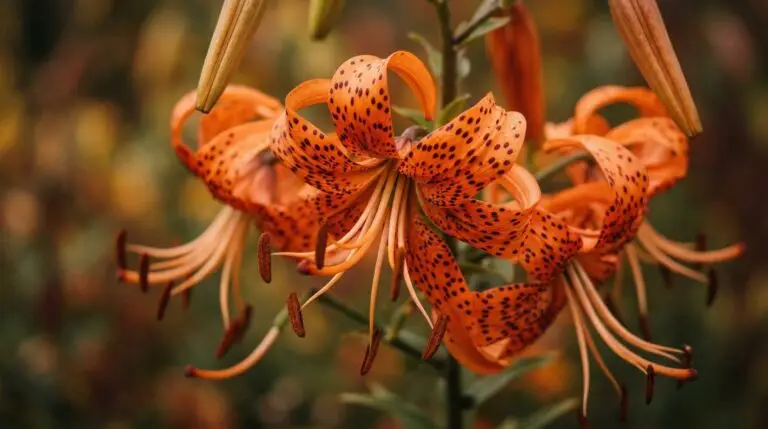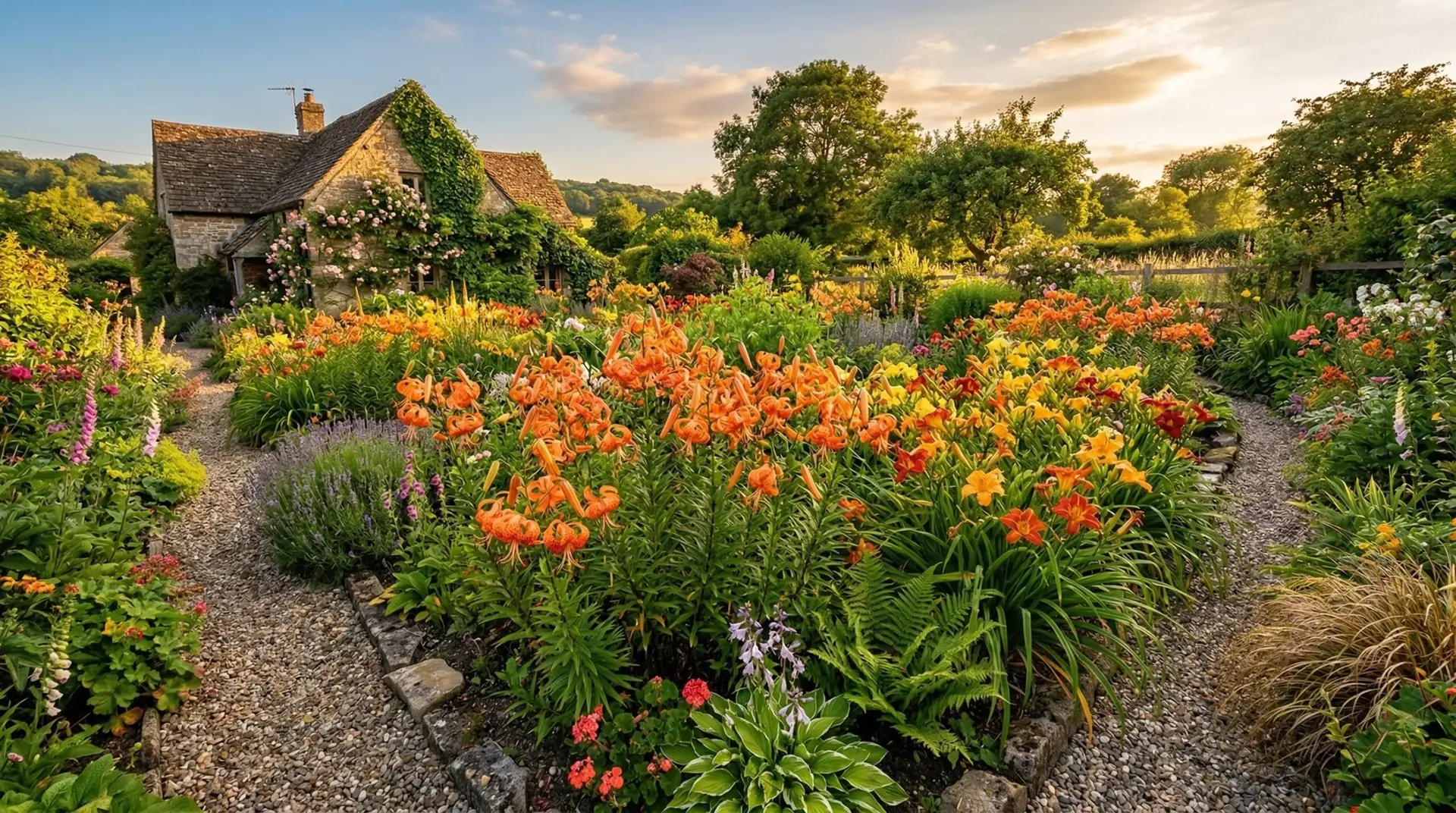
When you approach a garden border in midsummer, tiger lilies immediately draw the eye upward and establish a strong vertical rhythm. These towering perennials are structural accents rather than continuous fillers. Their nodding, freckled orange blooms provide a distinct focal point precisely when early summer perennials begin to fade. As a designer, I look at tiger lilies as the upper canopy of a layered herbaceous border. They require thoughtful placement because their height demands attention while their lower stems often become bare and ungainly by August. Successful tiger lily garden design relies on treating them as the star of the upper tier while carefully selecting companions to support their base. This layered approach creates a cohesive, naturalized look that feels both intentional and wild.
Designing with hot color palettes
Color theory plays a central role when deciding what to plant with tiger lilies. The intense orange petals and dark spots carry significant visual weight in a garden composition. You can build a harmonious hot border by surrounding them with saturated yellows, deep reds, and rich golds. For example, planting black-eyed Susans near the base echoes the dark spotting of the lily petals through their dark central cones. This creates a visual rhythm that ties the upper and lower levels of the garden together. Alternatively, you can use complementary colors to make the orange blooms jump forward visually. Deep violet salvias or cool blue Russian sage planted nearby will cool down the composition and provide a striking contrast that makes both colors appear more intense.
Masking the lower stems with mounding forms
The physical form of the tiger lily dictates much of its placement in a landscape. They produce tall, rigid stems that carry the blooms high above the ground, leaving the lower two or three feet of the plant exposed. As the season progresses, these lower leaves often yellow and drop, creating an awkward gap in the garden border. To solve this structural problem, I always pair them with mounding or bushy perennials that create a dense skirt. A robust daylily is an excellent mechanical partner for this specific purpose. The arching, strappy foliage of the daylily completely obscures the bare lily stems while providing a contrasting texture to the stiff verticality of the lily stalks. This combination ensures the viewer only sees the beautiful upper blooms floating above a lush green base.
Creating a naturalized cottage aesthetic
Achieving a naturalized, cottage-style border requires blending different flower shapes to mimic a wild meadow. Tiger lilies have complex, recurved petals that look best when surrounded by simpler daisy-like forms. Introducing a classic coneflower into the middle tier of the border provides this necessary geometric contrast. The flat, sturdy landing pads of the coneflowers ground the design and give the eye a place to rest beneath the dramatic lily blooms. In a naturalized design, you want plants to weave together rather than sit in isolated blocks. Allowing the coneflowers and lilies to drift into each other’s space creates a relaxed, informal atmosphere. This weaving technique also ensures that the garden maintains strong structural interest even after the lily petals drop, as the dark seed heads of the companion plants persist into autumn.
Managing scale and spatial relationships
Scale and proportion define how a garden feels to the person walking through it. Tiger lilies easily reach four to five feet in height, meaning they belong in the middle to back of a mixed border. If you place them too close to a pathway, they will loom over the viewer and throw the entire scale of the planting out of balance. Set them back at least three feet from the edge, allowing lower-growing perennials to step down gradually toward the lawn or path. This tiered approach gives the garden depth and forces the eye to travel through the space. Group the lilies in odd numbers, like threes or fives, to create substantial visual anchors rather than scattering them thinly across the yard. A solid cluster of orange blooms reads clearly from a distance and holds its own against large background shrubs or fences.
Planning for seasonal succession
A successful garden design must account for the progression of time and the shifting seasons. Tiger lilies have a distinct, relatively short bloom window in midsummer, leaving a green vertical stalk behind for the remainder of the year. To maintain a compelling composition, you must surround them with plants that peak either just before or immediately after the lilies finish. Late-season ornamental grasses are excellent partners because they begin to push their feathery plumes just as the lilies fade. The fine texture of the grass foliage softens the stiff lily stems and introduces movement into the garden as autumn approaches. By thinking of the garden as a sequence of events rather than a static picture, you can ensure the space remains engaging. Always evaluate a plant combination based on how it looks in August and September, not just at the moment of peak summer bloom.