November birth flowers by day: the Korean 365-day tradition
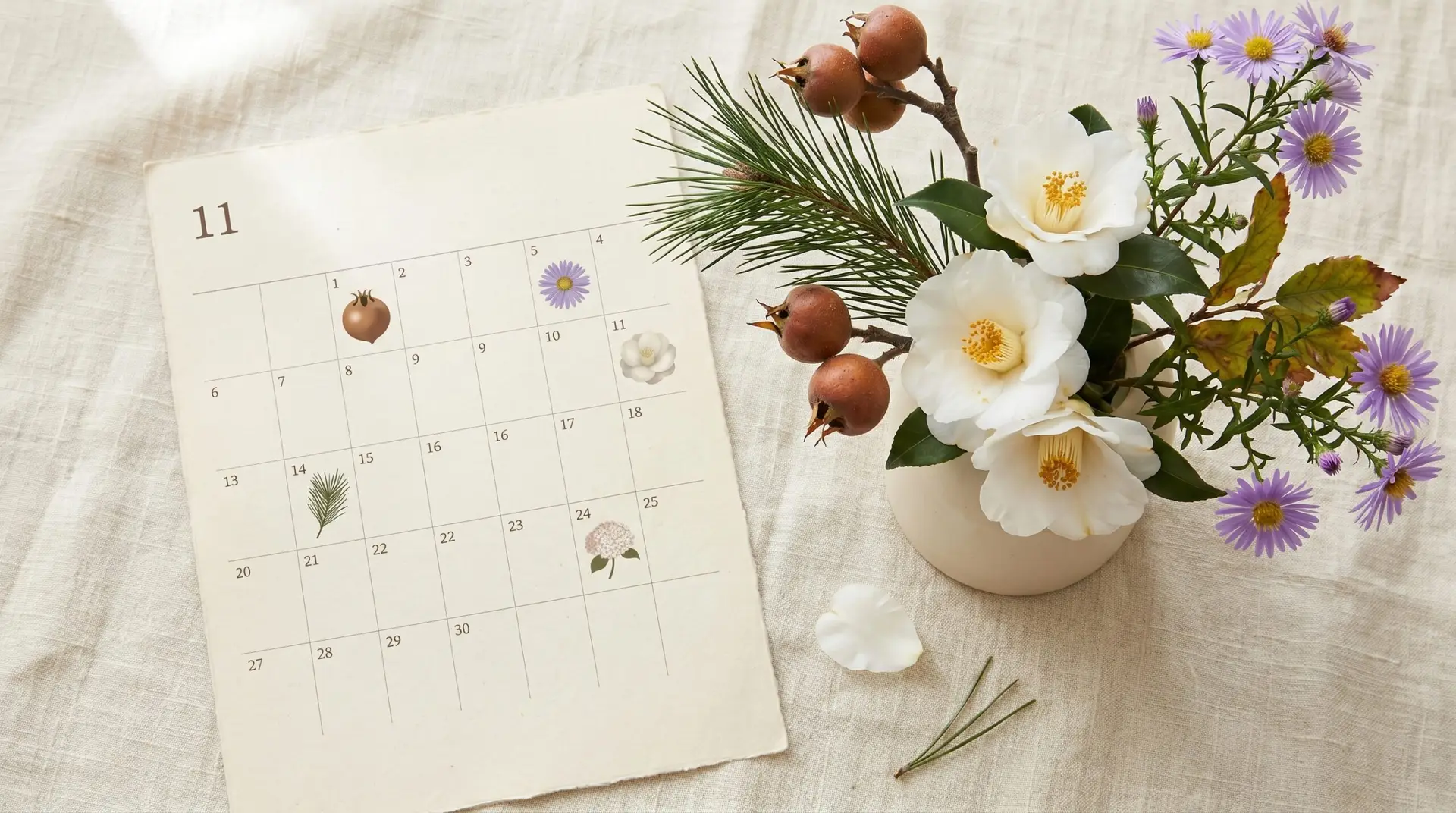
Korean tradition assigns a unique flower to each of November’s 30 days. The system runs parallel to the Western birth flower tradition, which gives all of November to chrysanthemum, and offers a more granular reading that ties specific birthdays to specific blooms.
November in the Korean list moves through the late part of autumn and toward the start of winter. The flowers shift from fruiting trees and field plants in the first week to winter-blooming shrubs and dried grasses by the end of the month. The meanings track that arc, opening on love and a mother’s care, passing through sincerity and trust, and closing on a reed read for the wait until spring. The month carries asters, yarrow, and a late camellia rather than the single chrysanthemum the Western calendar names.
Early November (November 1-10): late autumn
The first ten days of November in the Korean tradition center on love, care, and the close of the harvest season.
| Day | Flower | Korean (한국어) | Meaning |
|---|---|---|---|
| November 1 | Medlar | 서양모과 | Only love |
| November 2 | Lupin | 루피너스 | Mother’s love |
| November 3 | Bryony | 브리오니아 | Rejection |
| November 4 | Hart’s Tongue Fern | 골고사리 Solace in truth | |
| November 5 | Korean Aster | 단양쑥부쟁이 | Merit |
| November 6 | Common Agrimony | 등골나물 | Procrastination, indecision |
| November 7 | Marigold | 메리골드 | Sadness of parting |
| November 8 | Ragged Robin | 가는동자꽃 | Wit |
| November 9 | Myrrh | 몰약의 꽃 | Sincerity |
| November 10 | Confederate Rose | 부용 | Exquisite beauty |
Medlar on November 1 with “only love” opens the month on a fruiting tree. The medlar ripens late in the year and is one of the few fruits picked after the first frosts, which suits its place at the head of a late-autumn list. Lupin on November 2 with “mother’s love” follows, and the same reading attaches to other plants across the Korean year, where it tends to mark steady, protective affection rather than romance.
Korean Aster on November 5 with “merit” brings in one of several asters in the autumn list. Asters flower late and hold their color into cool weather, which is why the genus appears so often through September, October, and November. Marigold on November 7 with “sadness of parting” reads the long-lasting marigold for the ache of leave-taking as the season turns, a meaning the same flower carries elsewhere in the calendar.
Myrrh on November 9 with “sincerity” and Confederate Rose on November 10 with “exquisite beauty” close the early window. The Confederate rose is a hibiscus relative whose blooms change color over a single day, from pale to deep pink, and the Korean reading takes that display as plain beauty. Hart’s Tongue Fern on November 4 carries its label in the data without a separate meaning line.
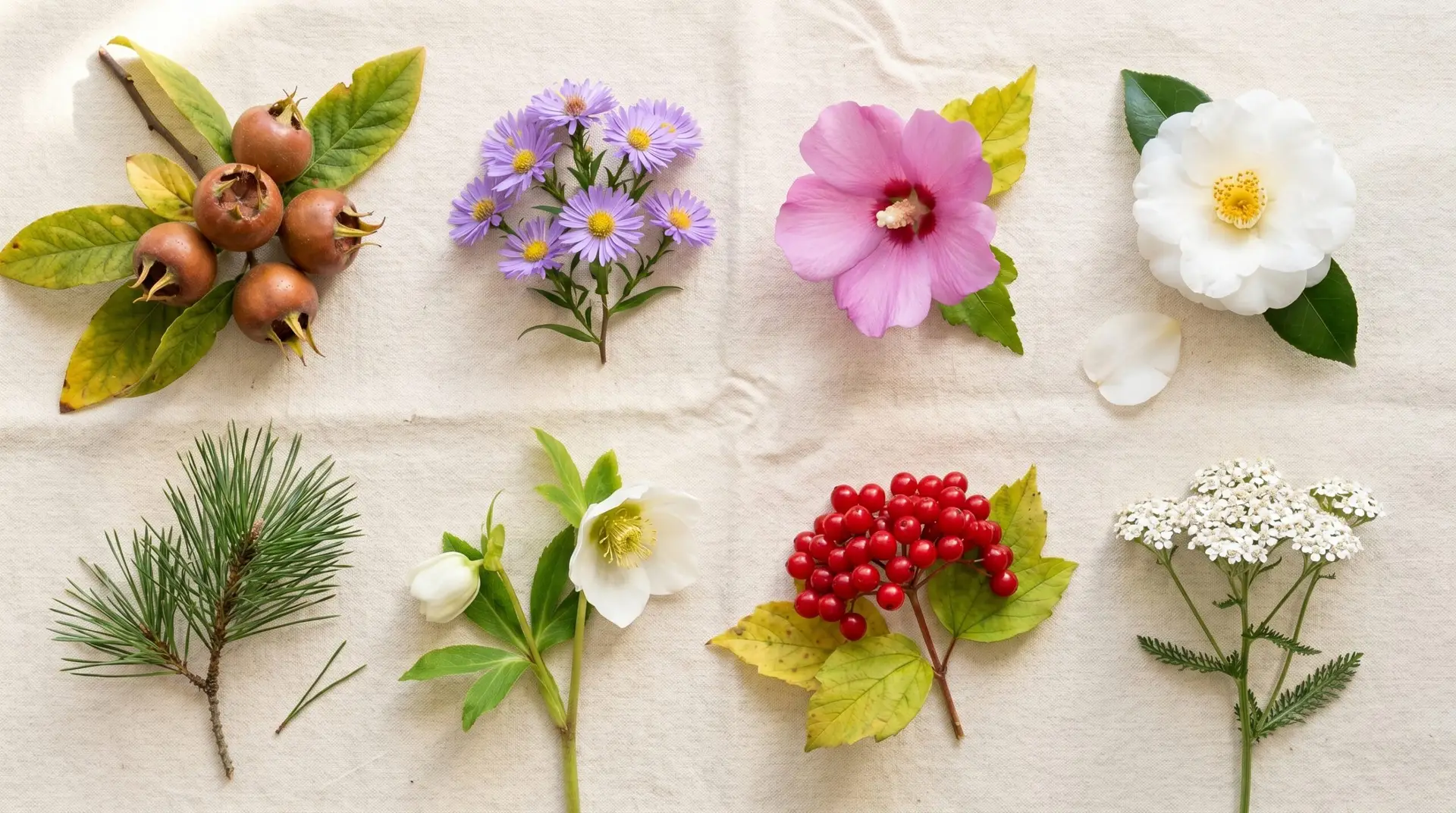
Mid November (November 11-20): quiet feeling
The middle ten days move through sincerity, perseverance, and reserved emotion.
| Day | Flower | Korean (한국어) | Meaning |
|---|---|---|---|
| November 11 | White Camellia | 흰동백 | Secret love |
| November 12 | Lemon | 레몬 | Sincere yearning |
| November 13 | Lemon Verbena | 레몬 버베나 | Perseverance |
| November 14 | Pine | 소나무 Immortality | |
| November 15 | Crown Vetch | 황금싸리 | Humility |
| November 16 | Christmas Rose | 크리스마스 로즈 | Memories |
| November 17 | Butterbur | 머위 | Justice, fairness, equality |
| November 18 | Hill Lily | 산나리 | Magnificence |
| November 19 | Aaron’s Beard | 범의귀 | Secret |
| November 20 | Bugloss | 뷰글라스 | Truthfulness |
White Camellia on November 11 with “secret love” sits at the head of the middle window. Camellia is one of the few shrubs that flowers from late autumn into winter, and the white form here takes a reserved, private reading. The same white camellia returns at the very end of the month, so the flower frames the second half of November.
Lemon on November 12 with “sincere yearning” and Lemon Verbena on November 13 with “perseverance” pair a fruit with a fragrant herb of a different family. Lemon verbena is grown for its strong citrus scent rather than for showy bloom, and the “perseverance” reading suits a tender plant kept through cooler months. Christmas Rose on November 16 with “memories” names a hellebore that opens in the cold of late autumn and winter, well outside the usual flowering season.
Butterbur on November 17 with “justice, fairness, equality” carries one of the longer meaning lines in the month. Hill Lily on November 18 with “magnificence” and Bugloss on November 20 with “truthfulness” close the window. Pine on November 14 appears in the data with its label set alongside the word that stands in for its meaning, kept here as recorded.
Late November (November 21-30): toward winter
The final ten days move toward trust, wisdom, and the threshold of winter.
| Day | Flower | Korean (한국어) | Meaning |
|---|---|---|---|
| November 21 | Lantern Flower | 초롱꽃 | Truthfulness |
| November 22 | Korean Barberry | 매자나무 | Skill |
| November 23 | Fern | 양치 | Trust |
| November 24 | Viburnum | 가막살나무 | Love is stronger than death |
| November 25 | Rhus cotinus | 개옻나무 | Insight, wisdom |
| November 26 | Yarrow | 서양톱풀 | Leadership, inspiring |
| November 27 | Rhus | 붉나무 | Faith |
| November 28 | China Aster | 과꽃 | Abstract |
| November 29 | Baccharis | 바카리스 | Enlightenment |
| November 30 | Reed | 낙엽 마른 풀 | Waiting for a new spring |
Lantern Flower on November 21 with “truthfulness” opens the closing window, and Bugloss the day before carried the same reading, so the two dates run the theme across the month’s seam. Korean Barberry on November 22 with “skill” names a thorny shrub valued for its bright autumn berries that hold on the branch into winter. Fern on November 23 with “trust” returns a plant that appears on several dates through the year with shifting meanings.
Viburnum on November 24 with “love is stronger than death” has the strongest reading of the late window. The same viburnum and the same meaning appear in the early-summer list, so the flower keeps a fixed sense across very different seasons. Rhus cotinus on November 25 with “insight, wisdom” and Rhus on November 27 with “faith” place two sumac relatives close together, both noted for vivid late-autumn foliage rather than for bloom.
Yarrow on November 26 with “leadership, inspiring” brings in a hardy field plant that flowers from summer well into the cool of autumn. China Aster on November 28 with “abstract” gives the month a second aster after the Korean aster on November 5. Reed on November 30 with “waiting for a new spring” closes November on dried winter grass, the meaning pointing past the cold toward the season ahead.
How Korea’s November compares to Western tradition
The Western birth flower for November is chrysanthemum, with no widely agreed second flower for the month. The Korean daily list for November does not assign chrysanthemum to any of its thirty days, so there is no date where the Korean flower and the Western monthly flower are the same plant.
The closest the Korean November comes to the Western chrysanthemum are its asters. Korean Aster falls on November 5 and China Aster on November 28, and asters belong to the same large daisy family as chrysanthemum without being the same genus. These are a botanical neighbor of the Western flower rather than a match, and the meanings the Korean list gives them, “merit” and “abstract,” stand on their own.
The Korean November leans toward woody plants and late-season field growth: medlar, the camellia, the two sumac relatives, barberry, yarrow, and a closing reed. This is the same pattern seen across the Korean year, where the daily assignments favor plants suited to the local season over a single emblem for the whole month.
The two systems read best as complementary rather than competing. A November birthday can take the broad Western chrysanthemum, or the specific Korean flower for the exact date, and in November the two traditions name different plants throughout.
Frequently asked
What is the Korean birth flower for November 1?
Medlar (서양모과), with the meaning “only love.” The medlar is a late-ripening fruit tree, often harvested after the first frosts, which suits its place at the start of the November list.
What is the Korean birth flower for November 24?
Viburnum (가막살나무), with the meaning “love is stronger than death.” The same viburnum and the same meaning appear in the early-summer part of the Korean list.
Does Korean tradition use chrysanthemum for November?
No. Chrysanthemum is the Western flower for November, but the Korean daily list does not assign it to any November date. The Korean November includes asters, which are in the same family as chrysanthemum but a different genus.
Why are there two asters in Korean November?
The Korean list assigns Korean Aster to November 5 (“merit”) and China Aster to November 28 (“abstract”). Asters flower late and hold their color into cool weather, which is why the genus appears often through the autumn dates.
What is the meaning of the November 30 reed?
Reed (낙엽 마른 풀) on November 30 carries “waiting for a new spring.” It closes the month on dried winter grass, with the meaning pointing past the cold toward the coming season.
Which Korean November birth flower is for my birthday?
Find your date in the tables above. The Korean tradition assigns one specific flower to each day from November 1 (medlar) through November 30 (reed), and each daily flower has its own short meaning.
Sources
- Korean birth flower 365-day tradition guide · Creatrip Korean culture portal
About this article. > Written and reviewed by the Your Flowers Guide editorial team. Korean 365-day tradition data from the Creatrip Korean culture portal. Botanical reference cross-verified with RHS and Britannica.