December birth flower: narcissus, holly, and what they mean
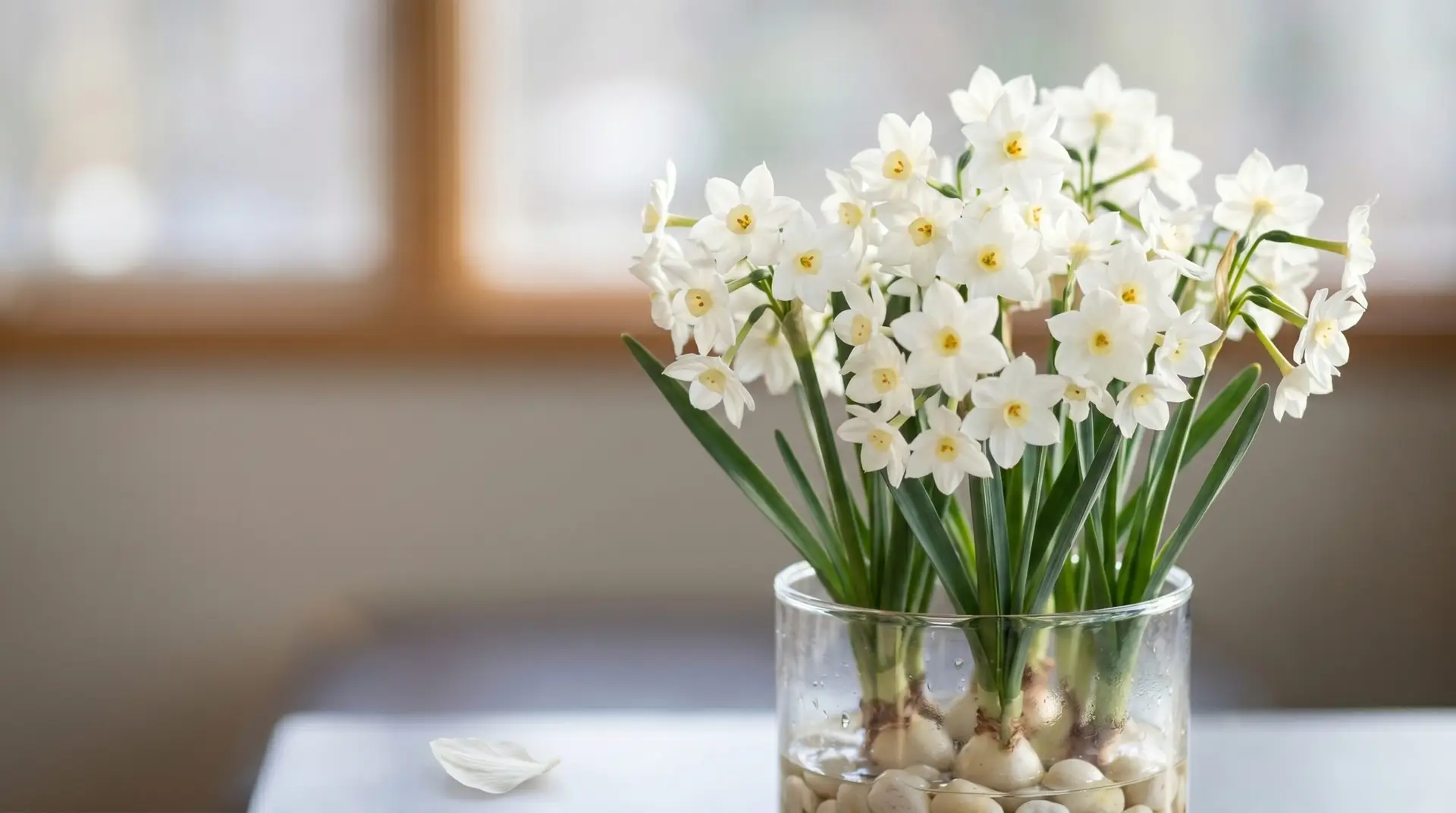
December has two birth flowers in Western tradition: narcissus (specifically the paperwhite narcissus, Narcissus papyraceus and related winter-blooming species) as the primary, and holly (Ilex aquifolium and related species) as the secondary. Narcissus signals new beginnings, rebirth, and self-reflection through its winter bloom timing and Greek mythological heritage. Holly signals protection, foresight, and festive joy through its evergreen winter foliage and central role in Christmas and pre-Christian European winter traditions.
The two flowers share a register of winter resilience and the promise of renewal in the coldest dark season. Paperwhite narcissus blooms in late winter (December through February in temperate climates), producing dramatic clusters of small white flowers with intense fragrance from forced bulbs grown indoors when garden flowers are largely absent. Holly maintains its glossy evergreen foliage and bright red berries throughout winter, providing the iconic Christmas color combination across Western Christmas decorative tradition. The deeper cultural weight of December comes from the Greek Narcissus mythological tradition (the youth Narcissus whose self-love became the species name) and the broader pre-Christian and Christian winter holly tradition that gave the genus its protective and festive symbolic vocabulary.
Narcissus (paperwhite), the main December birth flower
Narcissus belongs to the genus Narcissus in the family Amaryllidaceae. The genus contains approximately 50 species native to Europe, North Africa, and Asia, with extensive cultivar diversity developed through centuries of European breeding. The December birth flower specifically refers to paperwhite narcissus (Narcissus papyraceus) and related winter-blooming tazetta-type narcissus rather than to the broader daffodil group (Narcissus pseudonarcissus and related larger spring-blooming species traditionally associated with March birth flower).
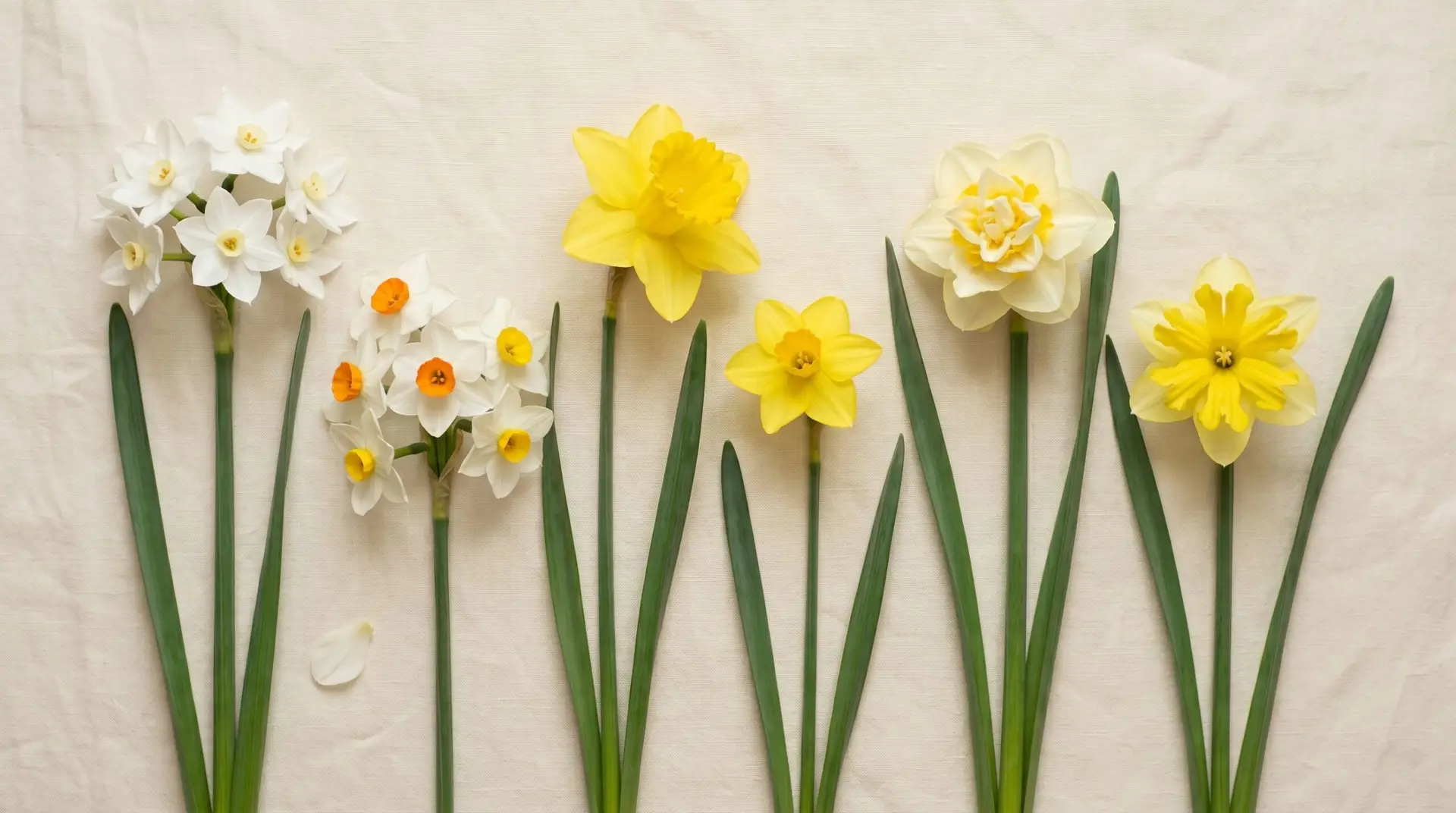
The plants grow from underground bulbs (the characteristic narcissus bulb form), producing the linear narrow leaves and the flowering stems each year in autumn through winter (paperwhite) or spring (most other narcissus). Paperwhite narcissus distinguishes itself from other narcissus through the cluster flowering habit (multiple small flowers per stem, typically 4-12 flowers) rather than the single-flower-per-stem habit of trumpet daffodils and most other narcissus types.
The flowers are small (about 1-1.5 inches across) with the characteristic narcissus structure: six tepal-like flower segments (technically three sepals and three petals appearing identical in narcissus) arranged around a smaller central corona (the trumpet or cup at the center). Paperwhite narcissus shows pure white tepals and a slightly cream-yellow central corona, with the intense distinctive fragrance that makes paperwhites particularly memorable in indoor cultivation.
Modern paperwhite cultivation focuses primarily on indoor forced bulb cultivation for winter holiday season indoor flowering. Bulbs purchased from autumn bulb suppliers can be planted in soil or grown hydroponically (in water with stones or marbles for stability) for indoor flowering 4-6 weeks after planting. The bulbs do not require cold treatment (unlike most other narcissus and daffodils), making paperwhites the easiest narcissus type for indoor winter cultivation.
The Greek “narcissus” name (ναρκισσος) shares etymological root with “narcotic” through Greek “narke” (numbness or stupor), reflecting the mild sedative properties attributed to narcissus flowers in classical Greek tradition (the species’s strong fragrance and potential mild toxicity from the alkaloids in the bulbs probably contributed to this etymological association). The plant species name was given by classical Greek and Roman writers, with the Greek mythological tradition of the youth Narcissus providing the most famous etymological reference.
Holly, the secondary December birth flower
Holly belongs to the genus Ilex in the family Aquifoliaceae. The genus contains approximately 480 species (with hundreds of cultivated varieties), native to temperate and tropical regions across both hemispheres. The species most associated with the Western birth flower tradition and Christmas symbolism is Ilex aquifolium (European holly, English holly), with related important species including Ilex opaca (American holly, native to eastern US), Ilex verticillata (winterberry, the deciduous American holly with bright red berries on leafless stems), and Ilex paraguariensis (yerba mate, the South American holly used for traditional beverage).
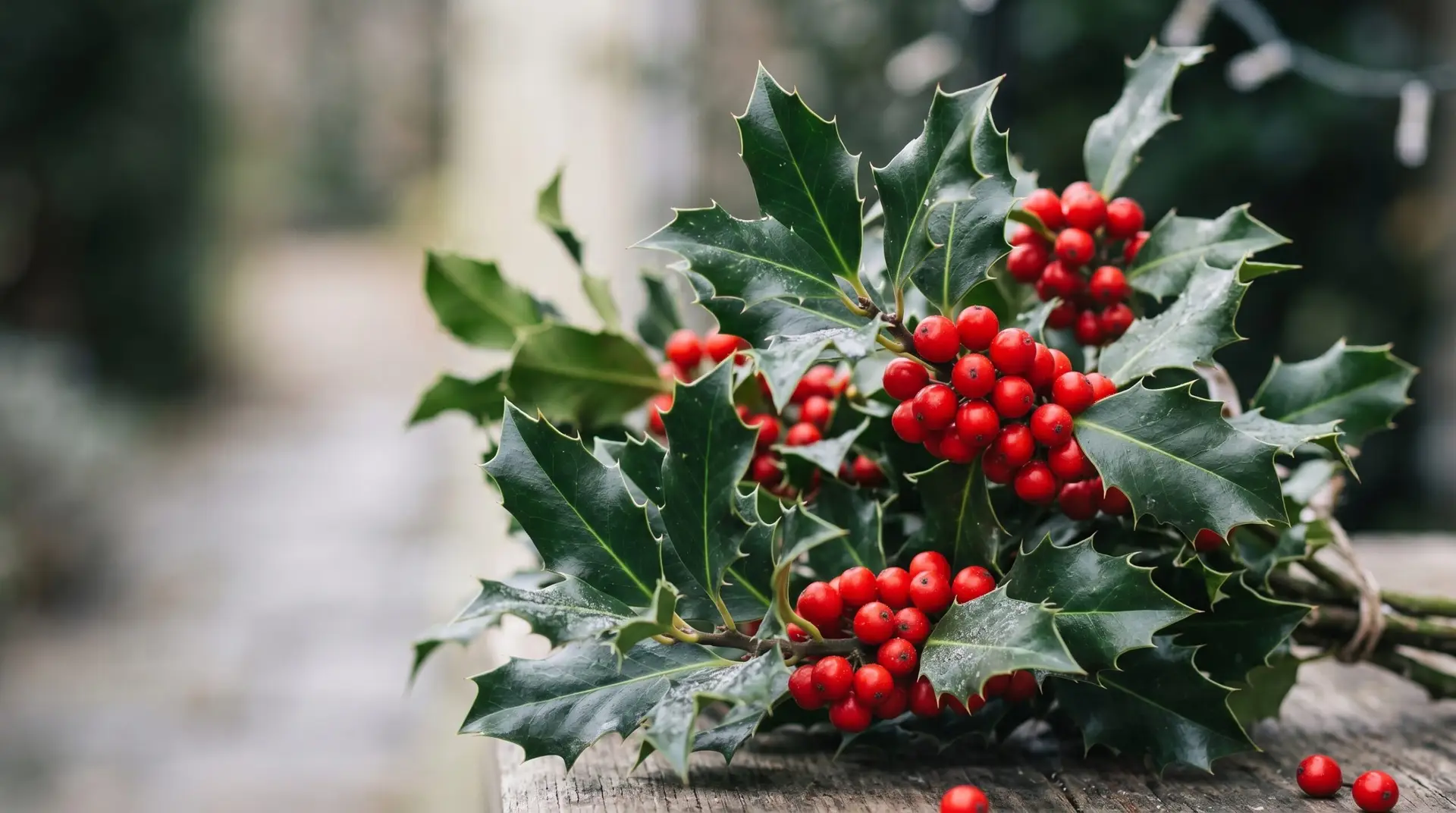
The plants are typically evergreen shrubs or small trees (with the notable exception of winterberry and some other deciduous Ilex species), reaching 10 to 50 feet at maturity depending on species. The distinctive glossy dark green leaves with the characteristic sharp spiny-toothed edges give holly its visual identity, with the leaf shape being so iconic that “holly leaf” has entered Western design vocabulary as a recognized decorative motif independent of specific plant identification.
Holly is typically dioecious (separate male and female plants), with only female plants producing the iconic bright red holly berries. The berries develop in autumn and persist through winter, providing both winter food for birds and the characteristic red-and-green Christmas color combination that anchors Western Christmas decorative tradition. Gardeners wanting holly berries must plant both male and female plants in proximity for the female plants to produce berries.
Bloom timing for holly is in late spring (typically May to June in temperate climates), with small inconspicuous white or greenish flowers that produce the bright red berries persisting through winter. The December birth flower position for holly therefore reflects the berry-bearing season and the cultural Christmas tradition rather than the actual flowering timing.
Holly symbolism in Western tradition includes protection, foresight, defense against evil, festive joy, and immortality (through the evergreen leaves persisting through winter). The Christmas holly tradition synthesizes pre-Christian European protective holly use (Druid winter solstice celebrations included holly as a protective sacred plant) with Christian symbolism (the prickly leaves representing the crown of thorns, the red berries representing the blood of Christ).
For deeper coverage of holly varieties, Druid and Christian winter traditions, color symbolism, growing notes, and the broader Ilex genus diversity, see the holly deep dive article.
The Greek Narcissus myth and ancient heritage
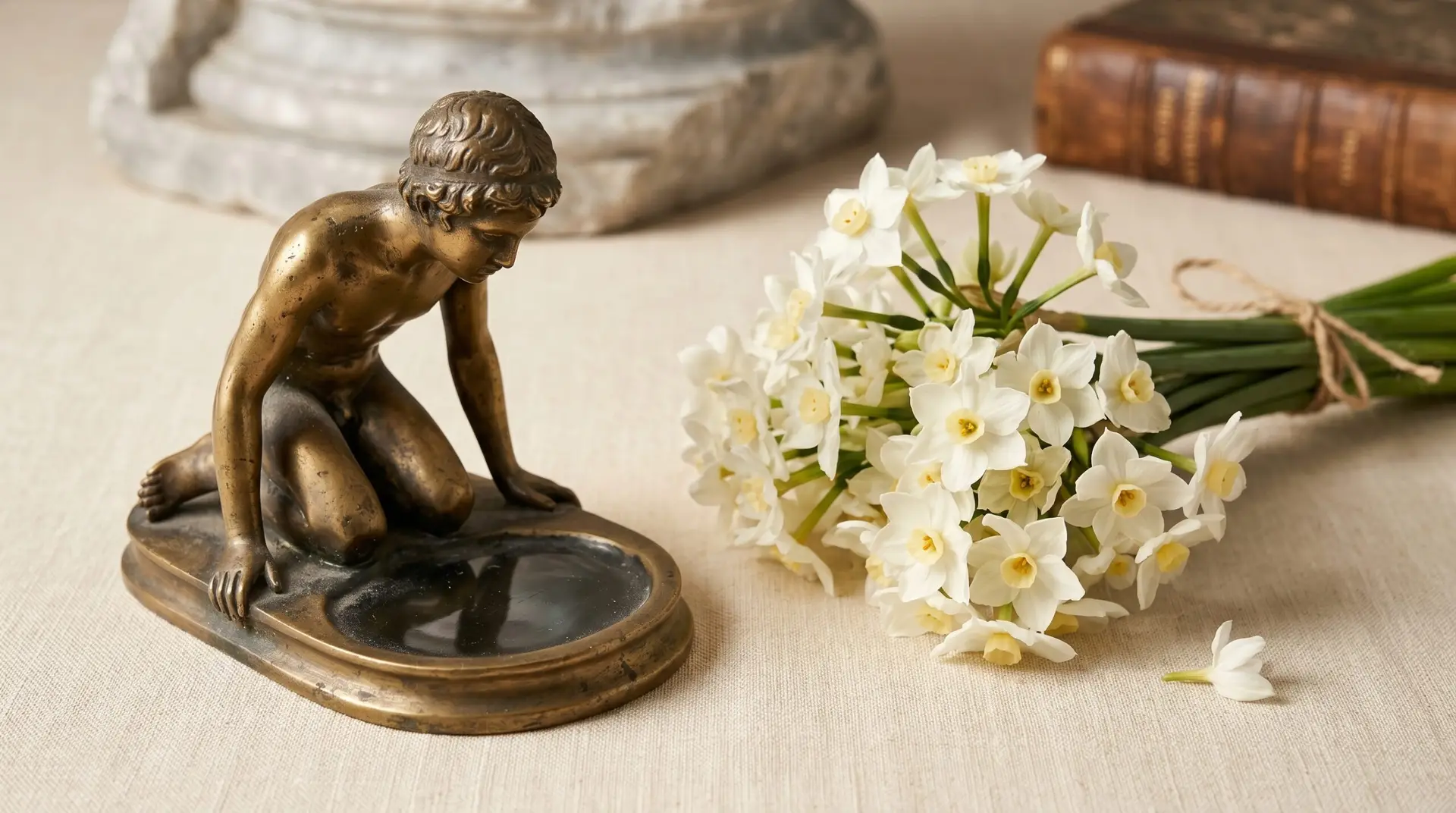
The Greek mythological tradition gives narcissus its strongest classical symbolic anchor through the story of Narcissus, the beautiful youth whose self-love became the foundation of the modern psychological term “narcissism” and whose tragic story has informed Western literature, art, and philosophy for over 2500 years.
The classical Narcissus story has multiple versions across Greek and Roman sources. The most influential version comes from the Roman poet Ovid’s Metamorphoses (Book III, written approximately 8 AD). In Ovid’s version, Narcissus was the son of the river god Cephissus and the nymph Liriope. A prophet predicted at Narcissus’s birth that he would live a long life if he never came to know himself. Narcissus grew into a youth of extraordinary beauty, attracting many admirers including the nymph Echo. When Narcissus rejected Echo’s love, she wasted away from grief until only her voice remained (the origin of the “echo” phenomenon).
Narcissus then encountered his own reflection in a still pool and fell hopelessly in love with the image, unable to recognize that he was seeing himself. He remained at the pool, gazing at his reflection and refusing to leave even to eat or drink, until he eventually died of starvation and exhaustion at the water’s edge. The gods (or the nymphs, depending on version) transformed his body into the narcissus flower, which grows by streams and pools and which bends downward as if looking at its own reflection in the water below.
The earlier Greek versions of the Narcissus story (predating Ovid) include variants with different details: a rejected admirer whose death brings a curse causing Narcissus’s self-love, and various interpretations of the philosophical and ethical implications of Narcissus’s fate. The story was extensively discussed by classical Greek philosophers (particularly the Neoplatonist tradition) as illustrating the dangers of self-absorption and the importance of recognizing reality beyond personal reflection.
The modern psychological term “narcissism” was coined in the late nineteenth century (Havelock Ellis 1898, Paul Näcke 1899, and most famously Sigmund Freud 1914) drawing directly on the Narcissus myth to describe pathological self-love and self-absorption. The psychological concept has been substantially developed in modern personality psychology with narcissistic personality disorder as a recognized diagnostic category. The flower remains the primary cultural symbol associated with the term, providing the visual reference for the psychological concept.
Beyond the psychological framing, the Narcissus myth provides positive symbolic register in flower tradition. The narcissus flower’s habit of growing by water and bending downward as if looking at its reflection connects the species to themes of self-reflection, contemplation, and the importance of looking inward for understanding. The Victorian flower writers who codified the modern Western birth flower system used these positive themes (self-reflection, contemplation, rebirth) rather than the pathological associations of the Narcissus myth.
The narcissus also has significant cultural importance in Persian and broader Middle Eastern tradition through its central role in Nowruz (Persian New Year, March 20-21), where the species symbolizes spring renewal and the rebirth of the year. The “Sabzeh” (sprouts) traditional Nowruz table setting often includes narcissus alongside other symbolic plants. The December birth flower assignment for paperwhite narcissus (rather than the spring daffodil narcissus of Nowruz tradition) reflects the winter blooming variety while the broader Persian narcissus tradition focuses on spring blooming species.
What narcissus colors mean
Narcissus color is relatively limited compared to many other birth flowers, but specific colors carry distinct symbolic readings:
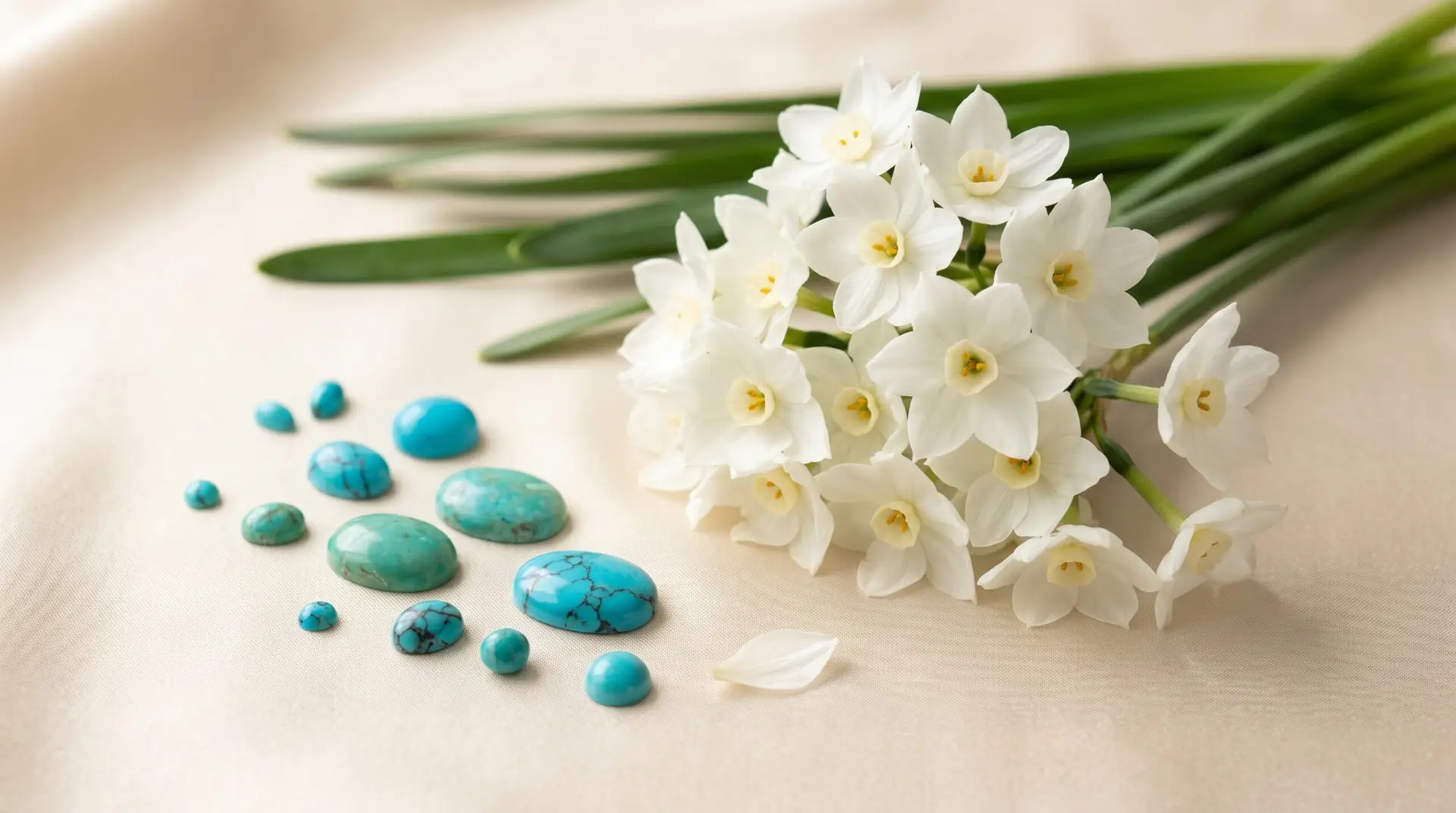
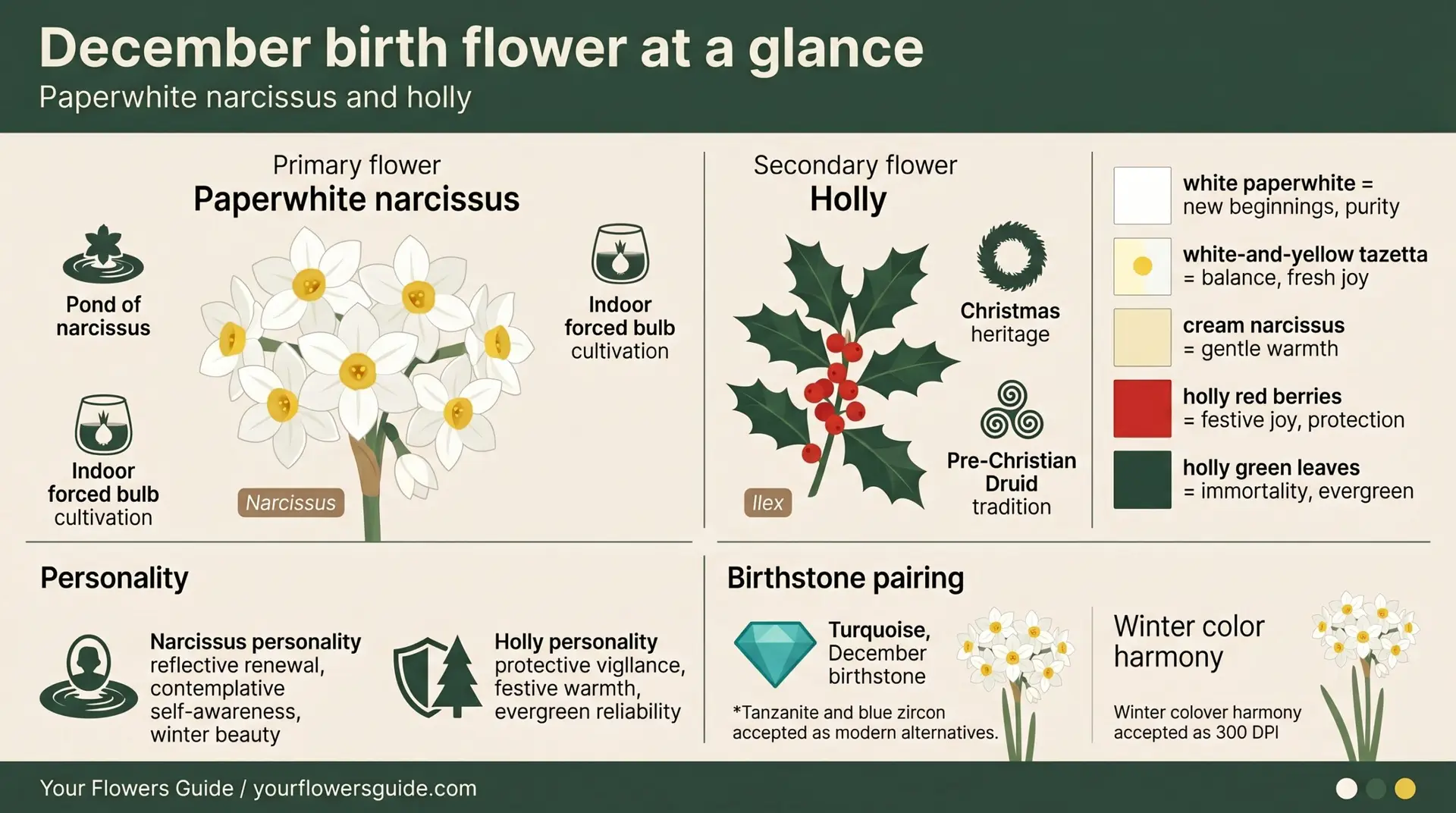
Pure white paperwhite narcissus: the most traditional and most iconic. New beginnings, purity, fresh starts. The classic December paperwhite color and the dominant cultivar in winter forced bulb cultivation.
White-and-yellow tazetta narcissus: balance, fresh joy, the combination of purity (white tepals) with warmth (yellow corona). Common in modern tazetta narcissus cultivars and providing slight visual variation from pure white paperwhites.
Cream and ivory narcissus: gentle warmth, soft renewal, refined elegance. Less common than pure white but available in some specialty cultivars.
Yellow narcissus (most other narcissus species and daffodils): sunshine, rebirth, March birth flower association. Yellow narcissus is more strongly associated with March birth flower tradition than with December; daffodil dominance.
Orange-cup narcissus (daffodils with orange or red coronas): dramatic affection, vibrant renewal. Spring blooming rather than December blooming; daffodil tradition.
Pink-cup narcissus (modern hybrid cultivars): gentle affection, soft renewal. Spring blooming rather than December blooming.
For December specifically, the focus on paperwhite narcissus means the dominant color is pure white with cream-yellow corona accents. The color symbolism for December narcissus therefore centers on the new beginnings and purity themes that match the seasonal transition from late winter dormancy toward the approaching new year.
Florist usage treats paperwhite narcissus as the premier winter holiday indoor forced bulb flower across Western tradition. The dramatic fragrance and the timing of bloom (4-6 weeks after planting in autumn, producing flowers through December and January) make paperwhites particularly suited to December birthday celebrations, holiday gift contexts, and winter holiday seasonal decoration.
December personalities by flower symbolism
Reading personality from a birth flower is closer to a horoscope than to psychology. Take it as a useful lens, not as evidence. The two December flowers offer complementary readings that combine into a distinctive personality profile.
The narcissus side of December reads as reflective renewal and contemplative self-awareness. People in the narcissus profile have the kind of self-knowledge that develops through patient inner observation, the contemplative quality that allows them to learn from each life chapter before moving to the next, and the renewal capacity that enables fresh starts at significant life transitions. The narcissus’s winter bloom timing (flowering in late winter when most plants are dormant) connects to a personality dimension of providing presence and beauty in difficult or quiet seasons: narcissus-profile people often serve as the reflective companions who maintain inner light through challenging external circumstances. The Greek Narcissus mythological heritage adds an awareness dimension: the warning embedded in the myth (excessive self-absorption causes destruction) gives narcissus-profile people natural awareness of the balance between healthy self-reflection and harmful self-absorption.
The holly side reads as protective vigilance and festive warmth. People in the holly profile have the kind of natural protective awareness that maintains the well-being of those around them (the holly’s spiny leaves and protective symbolic register extended into personal sensibility), strong sense of seasonal celebration and shared joy (the Christmas holly tradition extending into personal sociability around milestone celebrations), and the kind of evergreen reliability that maintains presence through long periods rather than appearing only at favorable moments. The combination of protective vigilance and festive warmth suggests a holly-profile person who balances watchful care with joyful presence in their relationships and communities.
The combination describes a December personality that pairs reflective renewal (narcissus) with protective festive warmth (holly). December-born readers who describe themselves as both contemplatively self-aware and reliably present for those around them in important moments will recognize the fit.
Gift ideas for December birthdays
December birthdays fall in deep winter season across most of the northern hemisphere, which makes paperwhite narcissus and holly particularly seasonally available. Gift logic varies by recipient preference and cultural context.
Paperwhite narcissus bulbs for indoor forced cultivation are the iconic December birth flower gift. Specialty bulb suppliers offer paperwhite bulbs from October through December at prices typically running from $1 to $3 per bulb (often sold in bundles of 5-10 bulbs for $10-$25). The recipient plants the bulbs in soil or grows hydroponically for indoor flowering 4-6 weeks after planting. The dramatic fragrance and the timing of bloom (producing flowers through December and January) make paperwhites particularly suited to December birthday celebration.
A complete paperwhite forcing kit (decorative ceramic or glass bowl, pebbles or marbles for hydroponic support, and 5-10 paperwhite bulbs) provides a ready-to-plant gift package. Prices typically run from $25 to $75 for a complete kit. The recipient simply adds water and places the bowl in a sunny window for indoor winter flowering.
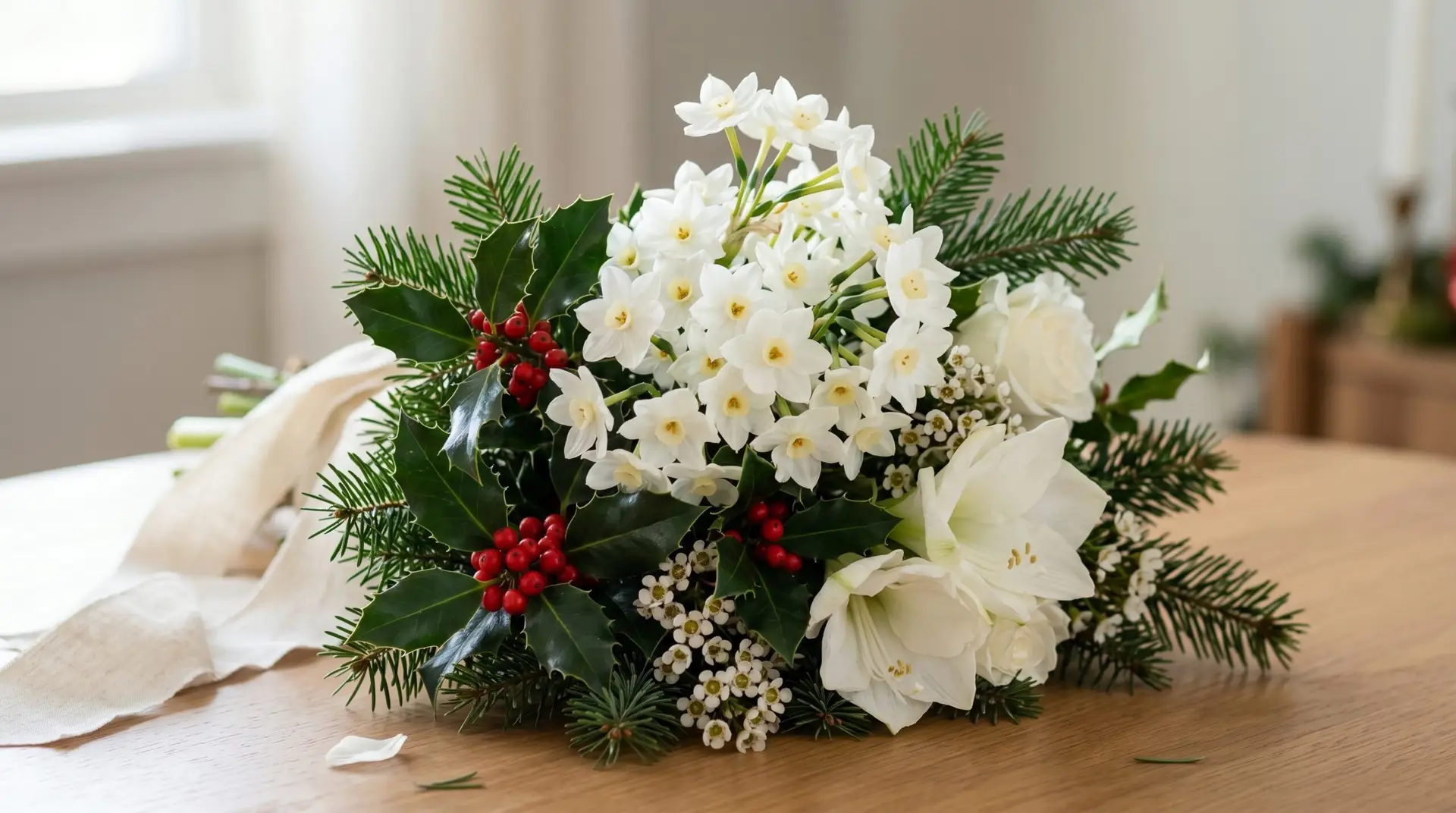
Cut paperwhite narcissus is available from specialty florists during December and January when forced bulbs are flowering. A bouquet of paperwhites makes an elegant winter birthday gift with the dramatic fragrance providing memorable sensory dimension. Florist prices for paperwhite arrangements typically run from $30 to $80.
Holly cuttings and holly wreaths are widely available throughout December as Christmas decorative material. Holly wreaths for door display or table centerpiece use can serve as December birthday gifts, particularly for recipients who maintain seasonal home decor traditions. Wreath prices typically run from $30 to $150 depending on size and complexity.
A living holly plant for the recipient’s garden provides a long-term gift that grows into a substantial evergreen shrub or small tree over decades. Specialty nursery suppliers offer named holly varieties at prices typically running from $30 to $100 per plant. The recipient plants the holly in autumn or early spring; both male and female plants are needed in proximity for berry production on female plants.
For Christmas-season December birthdays (particularly birthdays falling in mid to late December near Christmas), a gift combining paperwhite narcissus, holly, and other Christmas-season floral elements creates seasonally integrated celebration content. The combination acknowledges both the personal birthday significance and the broader seasonal celebration timing.
For recipients with interest in Greek classical culture or psychological themes, a paperwhite gift paired with a small reference book on the Narcissus myth or on classical Greek mythology provides culturally layered gift content. The combination uses the flowers as the primary symbolic element and the educational supplement as the explanatory layer.
A jewelry piece combining narcissus or holly motif work with turquoise (the traditional December birthstone) creates a coherent color and symbolic pairing. Turquoise’s distinctive blue-green color provides natural contrast with both the white paperwhite narcissus and the deep green holly foliage. Price tiers range from about $40 for simple turquoise studs to several thousand dollars for fine pieces with floral motif work. Tanzanite and blue zircon are also accepted as modern alternatives to turquoise for December birthstone purposes.
Frequently asked
What is December’s birth flower?
Narcissus (specifically paperwhite narcissus, Narcissus papyraceus) as the primary, with holly (Ilex aquifolium and related species) as the secondary. Both flowers are associated with December through winter bloom timing (paperwhite narcissus) and berry-bearing season (holly).
Why is narcissus December’s birth flower?
Paperwhite narcissus blooms in late winter (December through February) when forced from autumn-purchased bulbs grown indoors. The winter bloom timing makes paperwhite narcissus the most accessible flower for indoor December enjoyment when most other flowers are unavailable. The Greek mythological heritage of narcissus also provides classical cultural depth that suits December birth flower designation.
What’s the difference between paperwhite narcissus and daffodil?
Both belong to the genus Narcissus. Paperwhite narcissus (Narcissus papyraceus) is a winter-blooming tazetta-type narcissus with cluster flowering habit (multiple small white flowers per stem) and the ability to flower without cold treatment, making it the standard for indoor forced bulb cultivation. Daffodil (Narcissus pseudonarcissus and related species) refers to the larger spring-blooming yellow trumpet narcissus traditionally associated with March birth flower tradition.
What does the narcissus flower symbolize?
New beginnings, rebirth, and self-reflection. The Greek mythological connection to the youth Narcissus (who fell in love with his own reflection) provides the symbolic anchor around self-knowledge and reflection. The Victorian flower writers emphasized the positive themes (self-reflection, contemplation, rebirth) rather than the pathological associations of the Narcissus myth.
What does holly symbolize?
Protection, foresight, defense against evil, festive joy, and immortality (through the evergreen leaves persisting through winter). The Christmas holly tradition synthesizes pre-Christian European protective holly use (Druid winter solstice celebrations) with Christian symbolism (the prickly leaves representing the crown of thorns, the red berries representing the blood of Christ).
Why are holly leaves and red berries the Christmas colors?
The bright red holly berries and the glossy dark green holly leaves provide the iconic red-and-green color combination that anchors Western Christmas decorative tradition. The combination was established through pre-Christian European winter solstice traditions (Druid holly use) and continued through Christian Christmas adoption, becoming codified as the standard Christmas color palette across Western culture.
How do I grow paperwhite narcissus indoors?
Plant paperwhite bulbs in autumn (October-December) in shallow pots with soil OR hydroponically in glass containers with pebbles or marbles for stability. Add water to just below the bulb base (not covering the bulbs, which would cause rot). Place in a sunny window. The bulbs flower 4-6 weeks after planting, producing white flowers with intense fragrance.
What birthstone goes with December’s birth flower?
Turquoise (the traditional December birthstone), with tanzanite and blue zircon accepted as modern alternatives. Turquoise’s distinctive blue-green color provides natural contrast with both the white paperwhite narcissus and the deep green holly foliage. Tanzanite provides a more contemporary luxury option; blue zircon offers a less expensive blue alternative.
Is the Narcissus myth where “narcissism” comes from?
Yes. The modern psychological term “narcissism” was coined in the late nineteenth century (most famously by Sigmund Freud in 1914) drawing directly on the Greek Narcissus myth to describe pathological self-love and self-absorption. The narcissus flower remains the primary cultural symbol associated with the term.
Why are holly berries poisonous?
Holly berries contain saponins and other compounds that can cause stomach upset, vomiting, and diarrhea if consumed in significant quantities. The berries are not typically fatal to humans but should not be eaten and should be kept away from small children and pets. Birds eat holly berries without ill effects through different digestive chemistry.
What is paperwhite narcissus toxicity?
Narcissus bulbs (including paperwhite) contain alkaloids (particularly lycorine) that are toxic if consumed in significant quantities. Symptoms of narcissus bulb poisoning include nausea, vomiting, and abdominal pain. The bulbs are sometimes confused with onions in domestic accidents. Keep narcissus bulbs and all parts away from small children and pets. The flower fragrance is not toxic but can cause headaches in sensitive individuals in unventilated spaces.
Sources
- Narcissus (Narcissus plant) · Encyclopedia Britannica
- Narcissus growing guide · Royal Horticultural Society
- Holly (Ilex) · Encyclopedia Britannica
About this article. > Written and reviewed by the Your Flowers Guide editorial team. Botanical content from Britannica and the Royal Horticultural Society. Greek mythological references via Ovid’s Metamorphoses (about 8 AD). Modern psychological narcissism reference via Sigmund Freud’s 1914 paper and standard psychological literature.