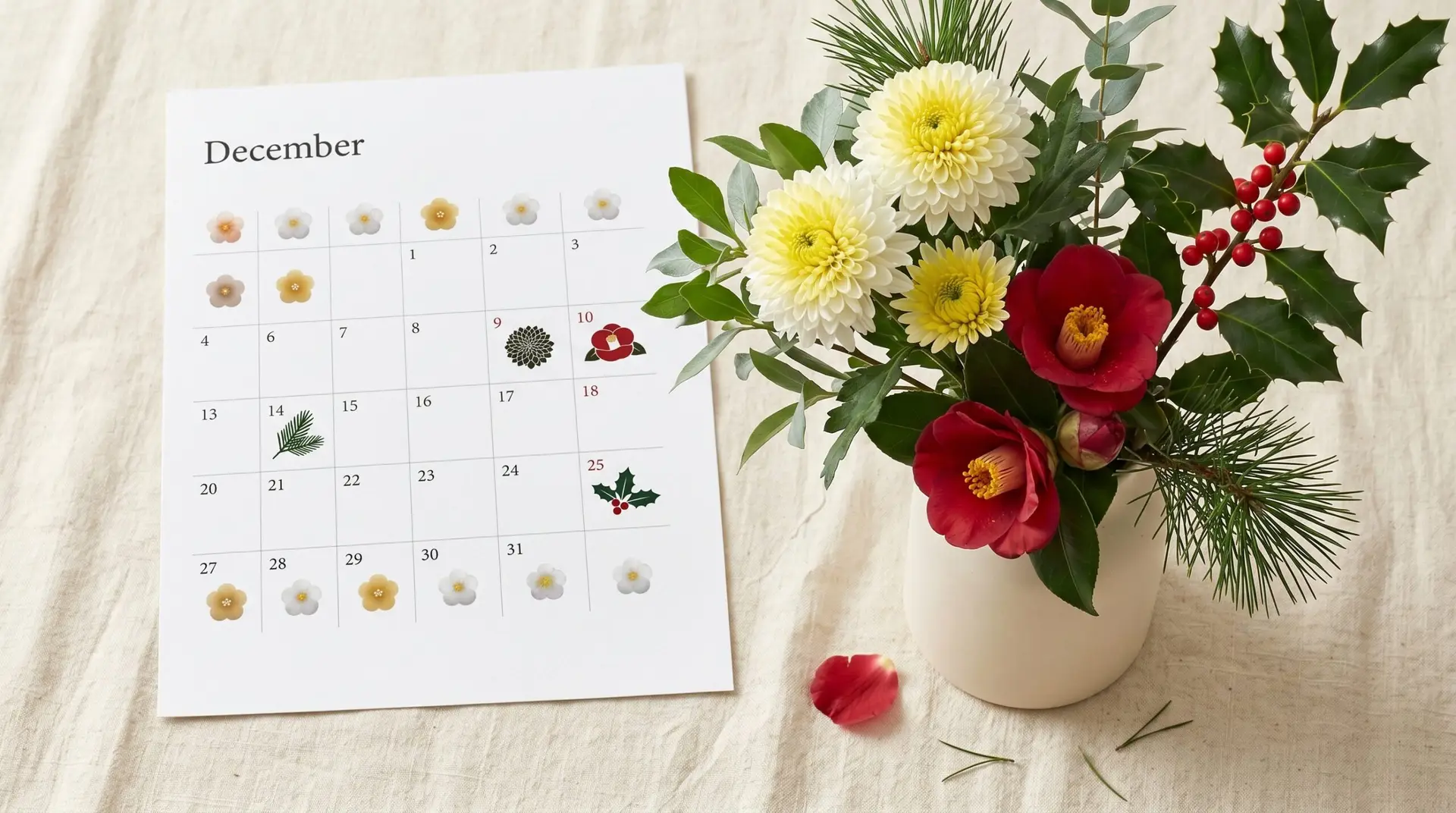
Korean tradition assigns a unique flower to each of December’s 31 days. The system runs parallel to the Western birth flower tradition, which gives all of December to narcissus and holly, and offers a more granular reading that ties specific birthdays to specific blooms.
December in the Korean list leans on winter-hardy plants and evergreens, with several entries that carry over from autumn. The month moves through chrysanthemum, camellia, pine, and other cold-season standards, and it reaches a clear point of overlap with the Western calendar on December 25, where the Korean flower is holly. The meanings range across love, virtue, dignity, and endurance, and the year closes on Chamaecyparis with a reading of eternity and immortality.
In this guide 6 sections
Early December (December 1-10)
The first ten days of December in the Korean tradition gather a mix of winter herbs, mosses, and early cold-season flowers.
| Day | Flower | Korean (한국어) | Meaning |
|---|---|---|---|
| December 1 | Tansy | 쑥국화 | Peaceful |
| December 2 | Moss | 이끼 | Mother’s love |
| December 3 | Lavender | 라벤더 | Expectations and hope |
| December 4 | Rumex | 수영 | Love |
| December 5 | Ambrosia | 앰브로시아 | Happy love |
| December 6 | Saxifraga | 바위취 | Intense love |
| December 7 | Fern | 양치 | Reliability |
| December 8 | Reed | 갈대 | Deep love |
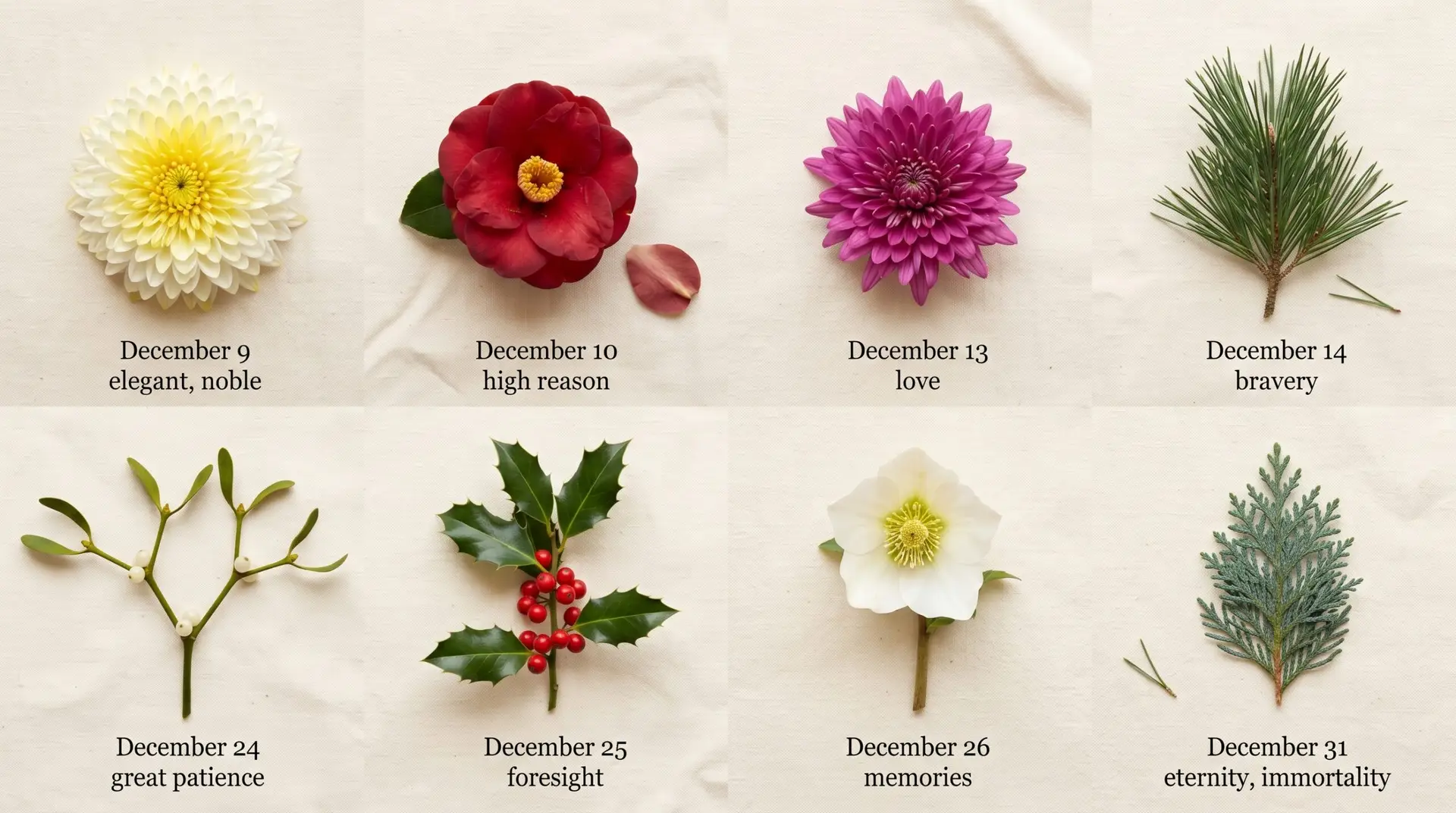
| December 9 | Chrysanthemum | 국화 | Elegant, noble |
| December 10 | Red Camellia | 빨강 동백 | High reason |
Tansy on December 1 with “peaceful” opens the month, and lavender on December 3 with “expectations and hope” follows with a forward-looking reading. Both are aromatic plants whose dried forms hold their scent well into winter, which fits a list built for the cold months. Moss on December 2 with “mother’s love” repeats a flower and meaning that recur across the Korean year, here placed early in the December run.
Rumex on December 4, ambrosia on December 5, and saxifraga on December 6 all carry readings tied to love, ranging from plain “love” through “happy love” to “intense love.” The cluster gives the first week a steady romantic register before the list turns toward sturdier themes. Fern on December 7 with “reliability” and reed on December 8 with “deep love” continue that pairing of feeling and steadiness.
Chrysanthemum on December 9 with “elegant, noble” brings in one of the most familiar autumn-into-winter flowers of East Asian gardens. The species blooms late and tolerates frost, which suits a December placement. Red camellia on December 10 with “high reason” closes the early window with a winter-blooming shrub whose flowers open in the cold, a trait that has long made camellia a cold-season favorite in Korean planting.
Mid December (December 11-20)
The middle ten days move through fiber plants, evergreens, and several entries linked to dignity and virtue.
| Day | Flower | Korean (한국어) | Meaning |
|---|---|---|---|
| December 11 | Fig Marigold | 단양쑥부쟁이 | Patriotism |
| December 12 | Cotton | 목화 | Excellence |
| December 13 | Magenta Chrysanthemum | 자홍색 국화 | Love |
| December 14 | Pine | 소나무 | Bravery |
| December 15 | Winter Daphne | 서향 | Immortality, honor |
| December 16 | Alder Tree | 오리나무 | Dignity, solemnity |
| December 17 | Honey Plant | 벚꽃난 | Empathy |
| December 18 | Sage | 세이지 | Blessings, family virtue |
| December 19 | Snowflake | 스노 플레이크 | Beauty |
| December 20 | Pineapple | 파인애플 | Absolute perfection |
Fig marigold on December 11 with “patriotism” and cotton on December 12 with “excellence” open the middle window. Magenta chrysanthemum on December 13 with “love” gives December its second chrysanthemum entry, after the December 9 date, and shifts the reading from “elegant, noble” to plain “love” with the change in color.
Pine on December 14 with “bravery” places an evergreen conifer at the center of the month. Pine holds its needles through winter, and the reading here points to that resilience. Winter daphne on December 15 with “immortality, honor” follows with another cold-season shrub, one that flowers in late winter and carries a strong scent. Alder tree on December 16 with “dignity, solemnity” adds a third woody plant to the run.
Honey plant on December 17 with “empathy” and sage on December 18 with “blessings, family virtue” turn the middle window toward warmer, more domestic readings. Snowflake on December 19 with “beauty” names a small white bulb flower that blooms in the colder part of the year. Pineapple on December 20 with “absolute perfection” closes the window on the most unexpected entry, a tropical fruit plant read here for completeness rather than for any winter bloom.
Late December (December 21-31)
The final eleven days carry the month to the year’s end, with the only Western overlap falling on December 25.
| Day | Flower | Korean (한국어) | Meaning |
|---|---|---|---|
| December 21 | Mint | 박하 | Virtue |
| December 22 | Zinnia | 백일홍 | Happiness |
| December 23 | Platanus | 플라타너스 | Genius |
| December 24 | Mistletoe | 겨우살이 | Great patience |
| December 25 | Holly | 서양호랑가시나무 | Foresight |
| December 26 | Christmas Rose | 크리스마스 로즈 | Memories |
| December 27 | Chinese Plum | 매화 | Pure heart, clear mind |
| December 28 | Pomegranate | 석류 | Mature beauty |
| December 29 | Winter Cherry | 꽈리 | Natural beauty |
| December 30 | Carolina Allspice | 납매 | Pampering, tender love |
| December 31 | Chamaecyparis | 노송나무 | Eternity, immortality |
Mint on December 21 with “virtue” and zinnia on December 22 with “happiness” open the closing window. Mint repeats its earlier reading of “virtue” from elsewhere in the Korean year, and zinnia, a long-lasting summer flower, appears here read for happiness. Platanus on December 23 with “genius” names the plane tree, a large deciduous shade tree, with one of the more abstract readings in the month.
Holly on December 25 with “foresight” is the point where the Korean and Western calendars meet. Holly is the Western secondary flower for December, and its evergreen leaves and red winter berries make it a recognizable cold-season plant in both traditions. December 25 is Christmas Day on the calendar, which is the date context in which this holly reading sits. Mistletoe on December 24 with “great patience” precedes it, another evergreen plant that keeps its growth through winter.
Christmas rose on December 26 with “memories” follows, a winter-blooming hellebore that opens its flowers in the cold months. Chinese plum on December 27 with “pure heart, clear mind” and pomegranate on December 28 with “mature beauty” continue the run. The list closes with winter cherry on December 29, Carolina allspice on December 30, and Chamaecyparis on December 31 with “eternity, immortality,” an evergreen conifer that ends the Korean year on a reading of permanence.
How Korea’s December compares to Western tradition
December has one direct cross-cultural alignment between the Korean and Western traditions. The Korean December 25 is holly, and holly is the Western secondary flower for December, so both calendars place holly and its evergreen winter character on the same part of the month.
The Western primary flower for December is narcissus, also called paperwhite. The Korean December list does not assign narcissus to any day of the month, so the two traditions do not meet on that flower in December. The omission fits the pattern seen across the Korean year, where the daily assignments lean toward a wide mix of plants rather than tracking the Western monthly pairings.
The Korean December leans heavily on evergreens and winter-hardy woody plants, with pine on December 14, winter daphne on December 15, alder on December 16, and Chamaecyparis on December 31. Western birth flower tradition does not name these conifers and shrubs as monthly flowers, which gives the Korean December a distinctly cold-climate plant list.
The two systems are best read as complementary rather than competing. A December birthday can take the broad Western pairing of narcissus and holly, or the specific Korean flower for the exact date, and the holly on December 25 is the point where both readings meet.
Questions
Frequently asked
What is the Korean birth flower for December 25?
Holly (서양호랑가시나무), with the meaning “foresight.” Holly is also the Western secondary flower for December, so this is the date where the Korean and Western traditions align most closely.
What is the Korean birth flower for December 31?
Chamaecyparis (노송나무), with the meaning “eternity, immortality.” It is an evergreen conifer, and it closes the Korean year on a reading of permanence.
Does Korean tradition use narcissus for December?
No. Narcissus is the Western primary flower for December, but the Korean daily list does not assign it to any day of the month. The Korean and Western calendars meet in December on holly instead.
Why does chrysanthemum appear twice in December?
The Korean December list assigns chrysanthemum to December 9 (“elegant, noble”) and magenta chrysanthemum to December 13 (“love”). Repeated flowers with shifted meanings appear on several dates across the Korean year.
What is the meaning of the December 9 chrysanthemum?
Chrysanthemum (국화) on December 9 carries “elegant, noble.” The flower blooms late and tolerates frost, which suits its December placement in the Korean list.
Which Korean December birth flower is for my birthday?
Find your date in the tables above. The Korean tradition assigns one specific flower to each day from December 1 (tansy) through December 31 (Chamaecyparis), and each daily flower has its own short meaning.
Sources
- Korean birth flower 365-day tradition guide · Creatrip Korean culture portal
Keep reading
December birth flower: narcissus, holly, and what they mean
Holly flower meaning: Christmas tradition, color, and growing
Narcissus tattoo: meaning, designs, and Greek mythology heritage
Birth flower by month: all 12 monthly flowers
Enjoying our flower guides? Add YourFlowersGuide as a preferred source on Google. It helps more readers find us.
Add to Preferred Sources