

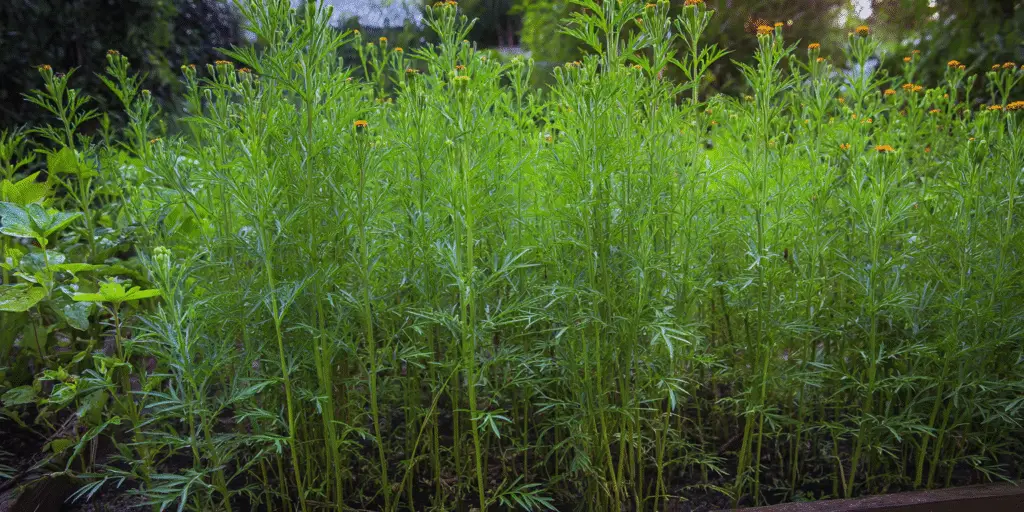
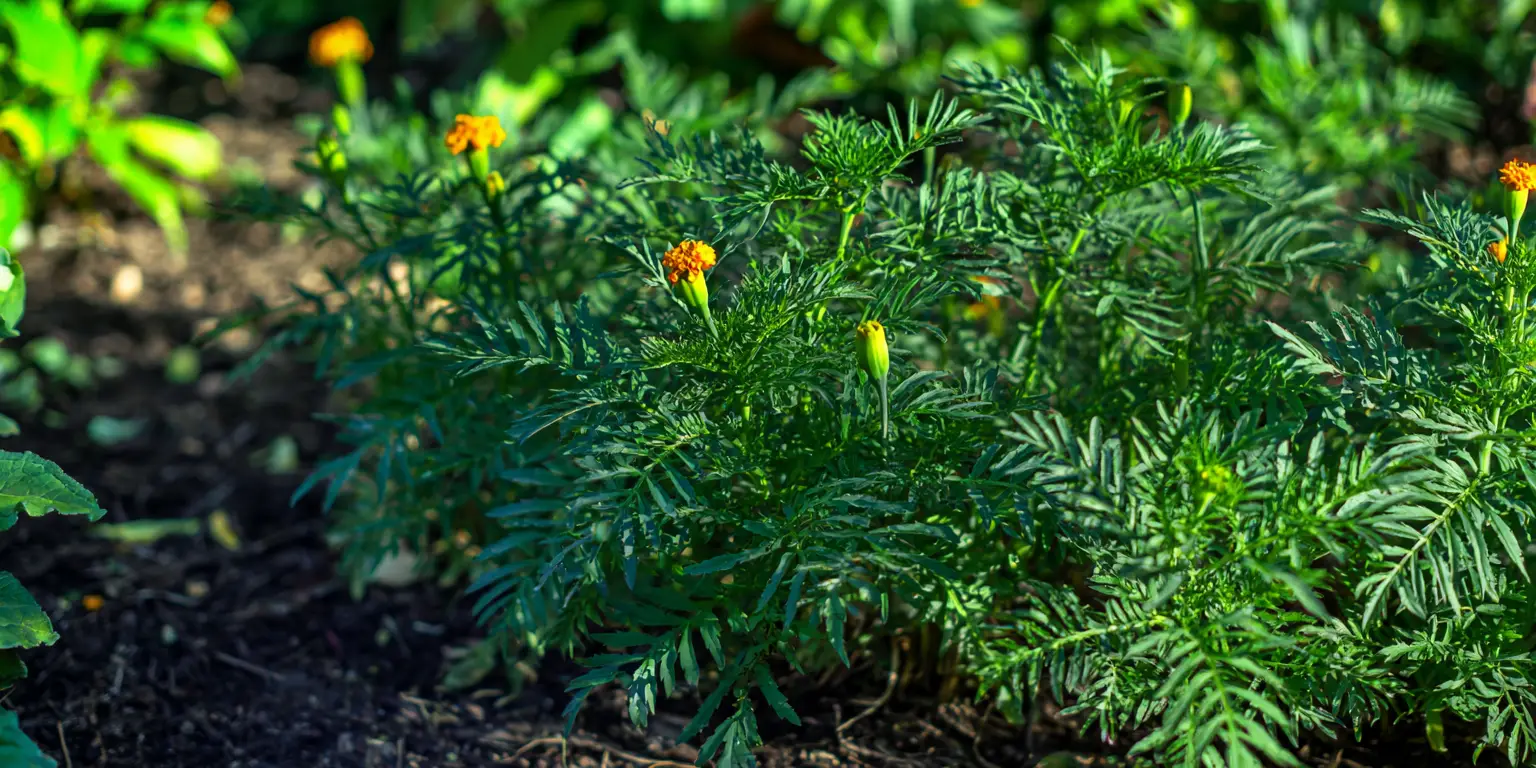

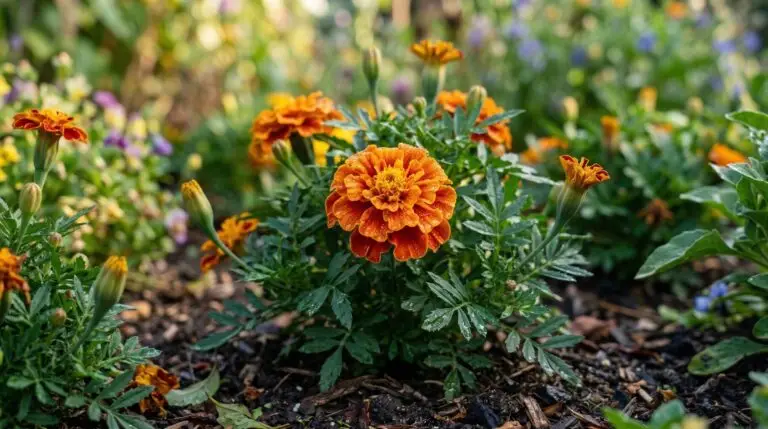

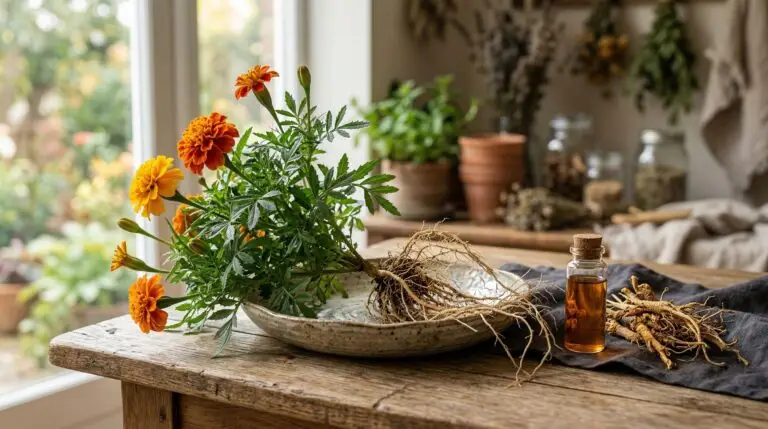
Marigold bloom time across the US
Interactive map
 See the interactive map
Drag the date and the bloom moves north across the country. Every point has its own window, and the map says where it has no records rather than guessing. Free, with nothing to sign up for. Open the marigold map.
City by city
Typical window, earliest first. Cultivars of the same flower can open days or weeks apart.
Taxonomy and origin
Marigolds belong to the genus Tagetes, a group of roughly 50 species in the daisy family Asteraceae, all native to the Americas. The plants sold for gardens come from three species: African marigold (Tagetes erecta), French marigold (Tagetes patula), and the smaller-flowered signet marigold (Tagetes tenuifolia). The common names mislead, because neither the African nor the French marigold is native to those places. Both trace back to Mexico and Central America, where Tagetes erecta, also called American or Aztec marigold, was grown long before it ever reached Europe. Spanish explorers carried marigolds back across the Atlantic in the 1500s, and the plants spread fast because they were so easy to raise from seed. The genus name is often linked to Tages, a figure from Etruscan myth who sprang from plowed earth, a nod to how readily marigolds volunteer in worked soil. The word marigold comes from "Mary's gold" and first referred to Calendula, the pot marigold, but modern gardeners apply it almost universally to Tagetes. The plant keeps deep cultural roots in its homeland: in Mexico the orange Tagetes erecta, known as cempasuchil, is the flower of Day of the Dead, and across India and South Asia marigold garlands are woven for weddings and festivals.
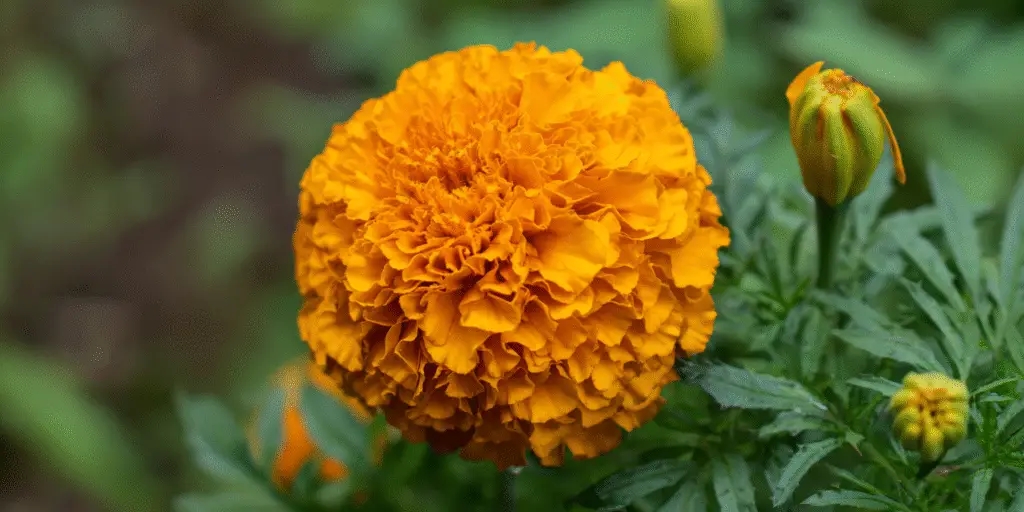
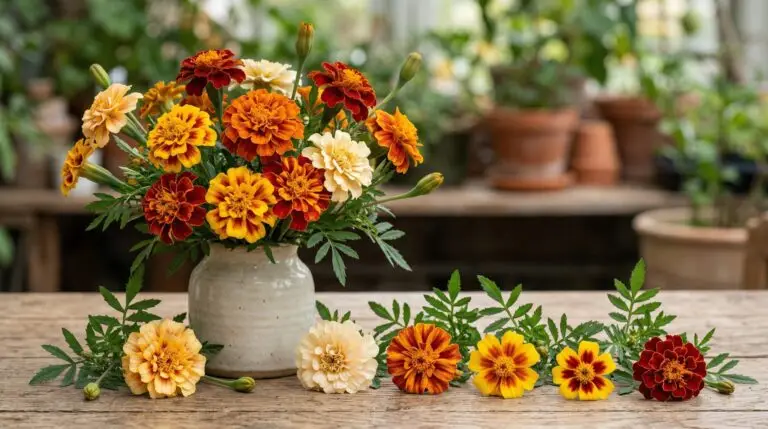
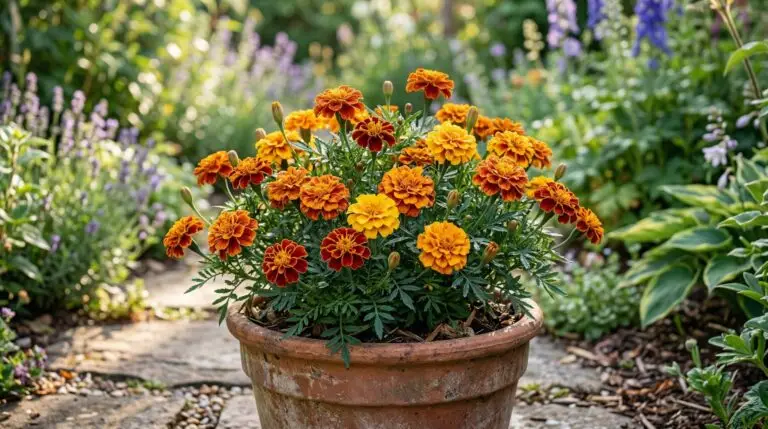
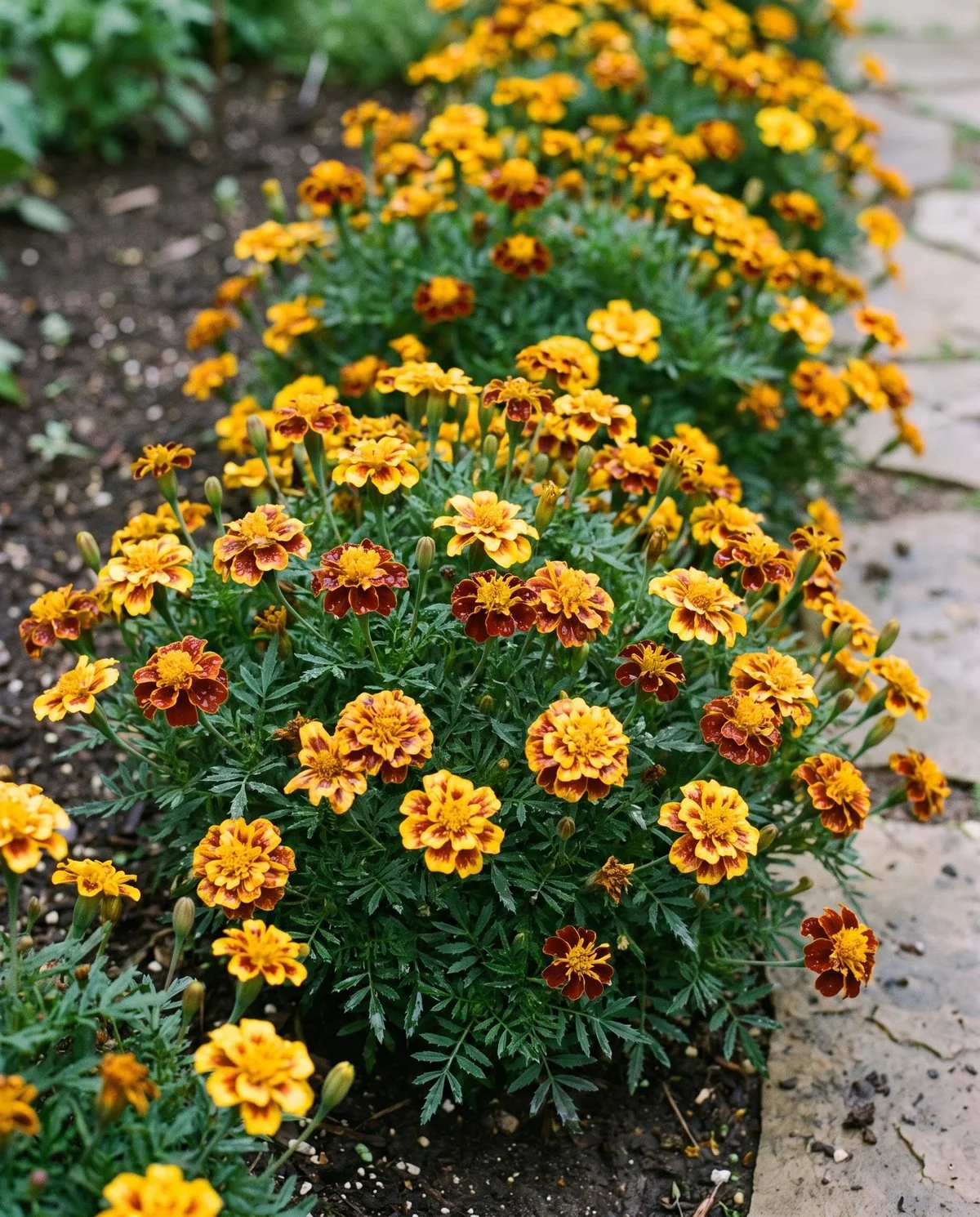
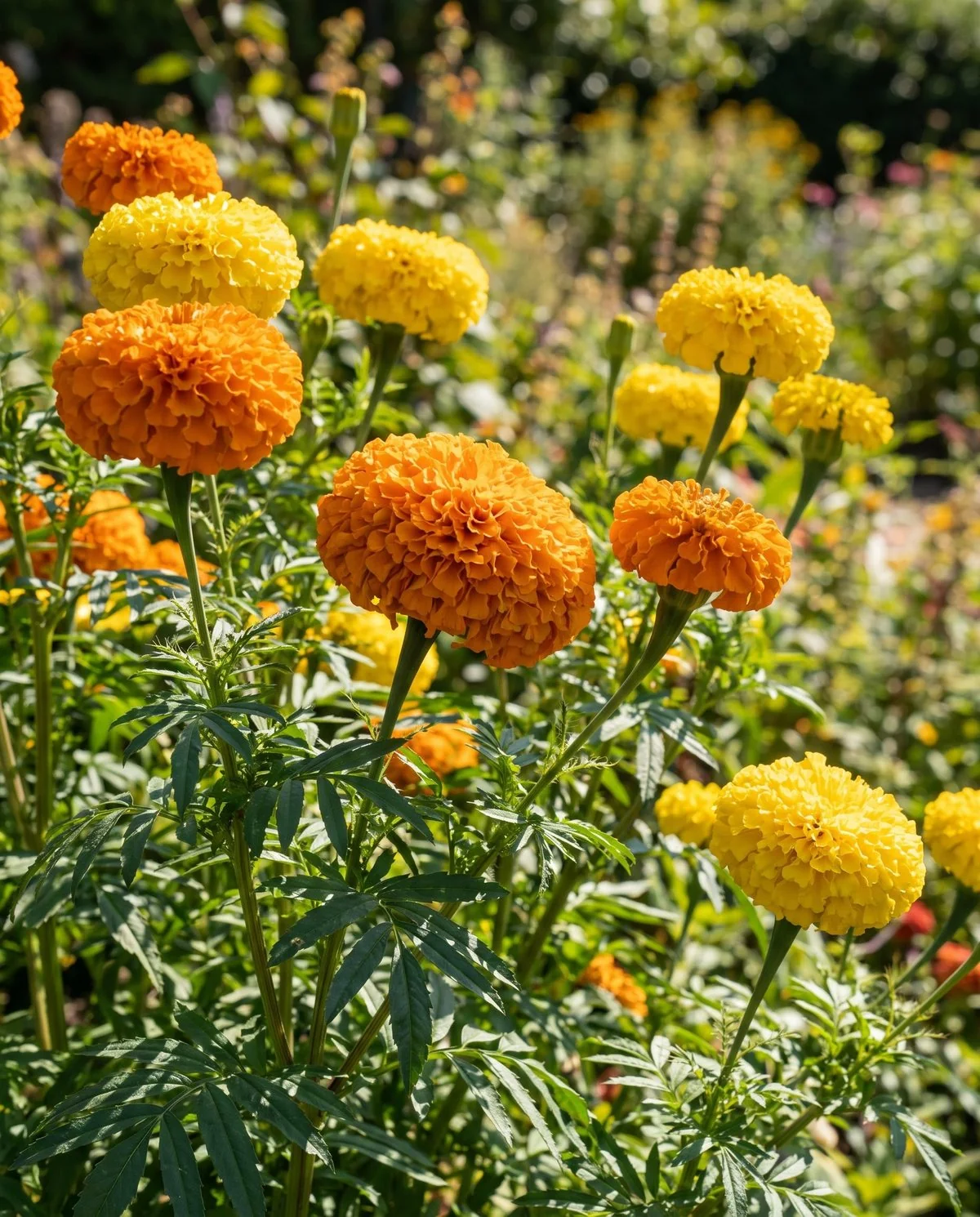
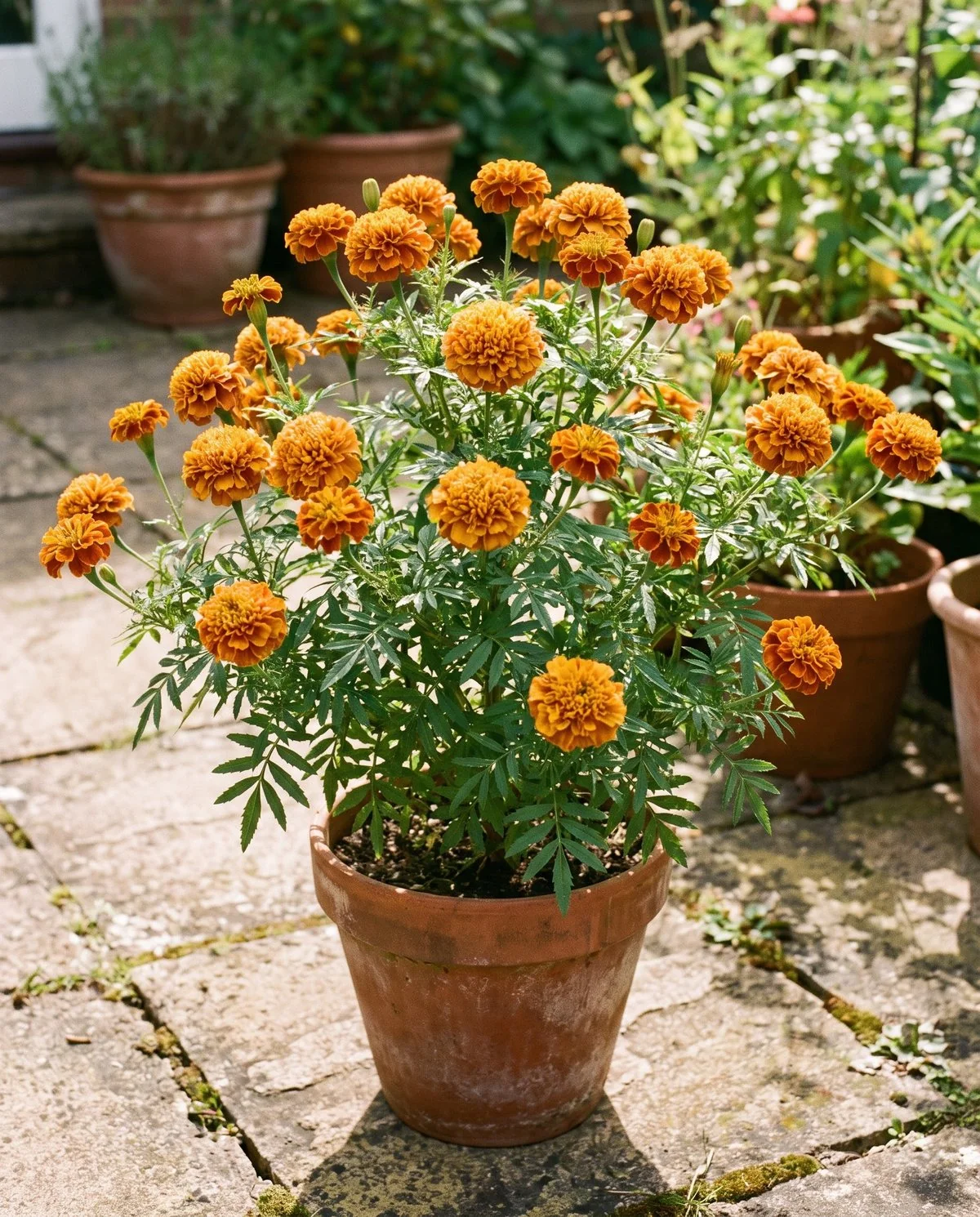
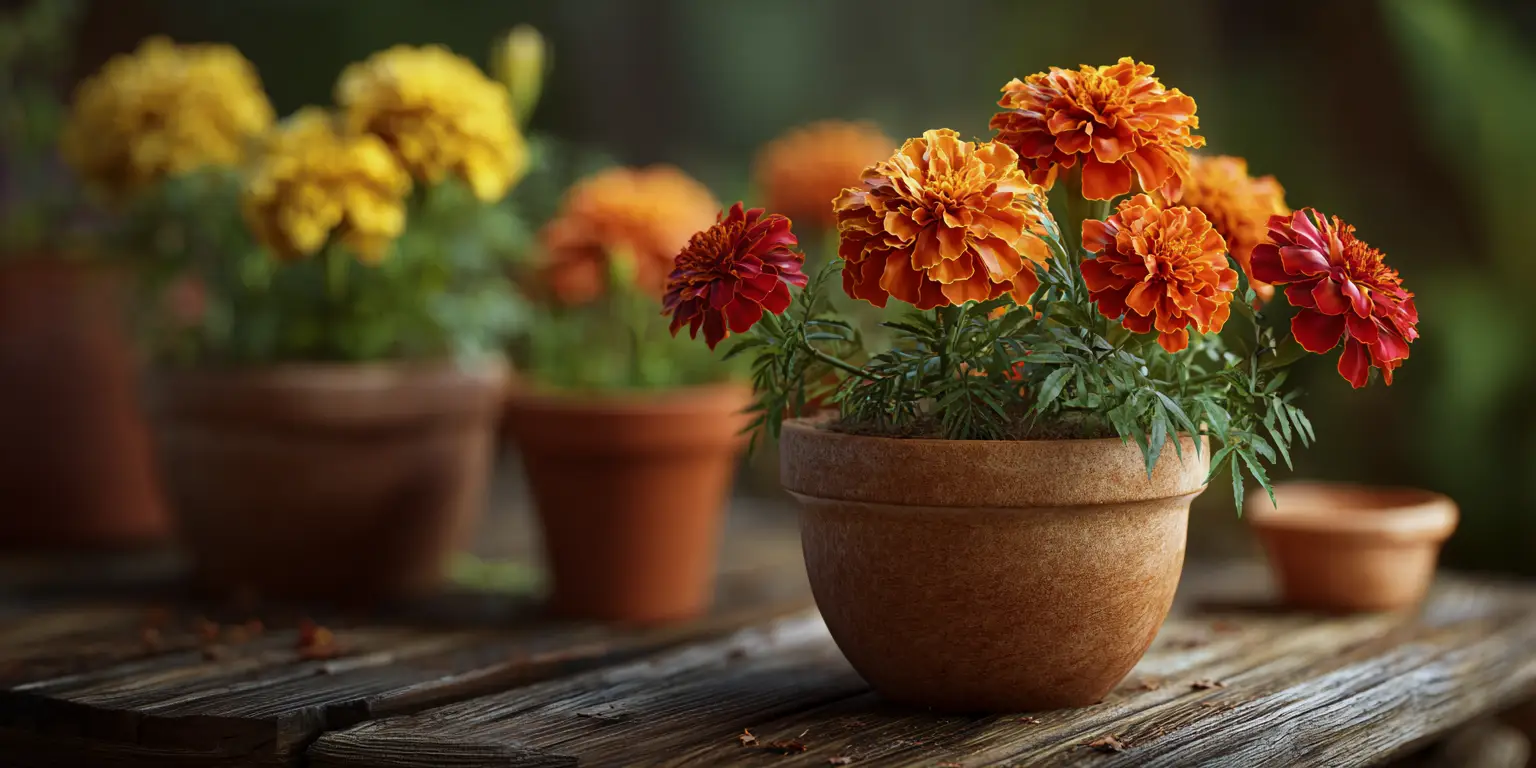
Knowing which of the three types you are buying matters more than the botany, because height, flower size, and heat behavior all follow from it. French marigolds (Tagetes patula) are the short, bushy group, running 6 to 18 inches tall with small single to double blooms that often carry two-tone gold and mahogany markings. For a low front edge, a window box, or a climate with wet summers, they are the pick, since those smaller flowers shed rain and dry fast. African marigolds (Tagetes erecta), sold under the alternative names American and Aztec marigold, are the giants at 1 to 3 feet, carrying large round pompon heads in solid yellow, gold, and orange on stems long and strong enough to cut. Height is the whole point of them, so they belong toward the back of a border where it reads as a feature rather than a gap, and those dense heads are also why they suit a dry summer better than a wet one: a big double bloom holds water where a small French flower has already dried. Between them the two groups cover most of what a garden center stocks in spring, and the decision comes down to height and rainfall more than color, since their yellow-to-orange ranges overlap.
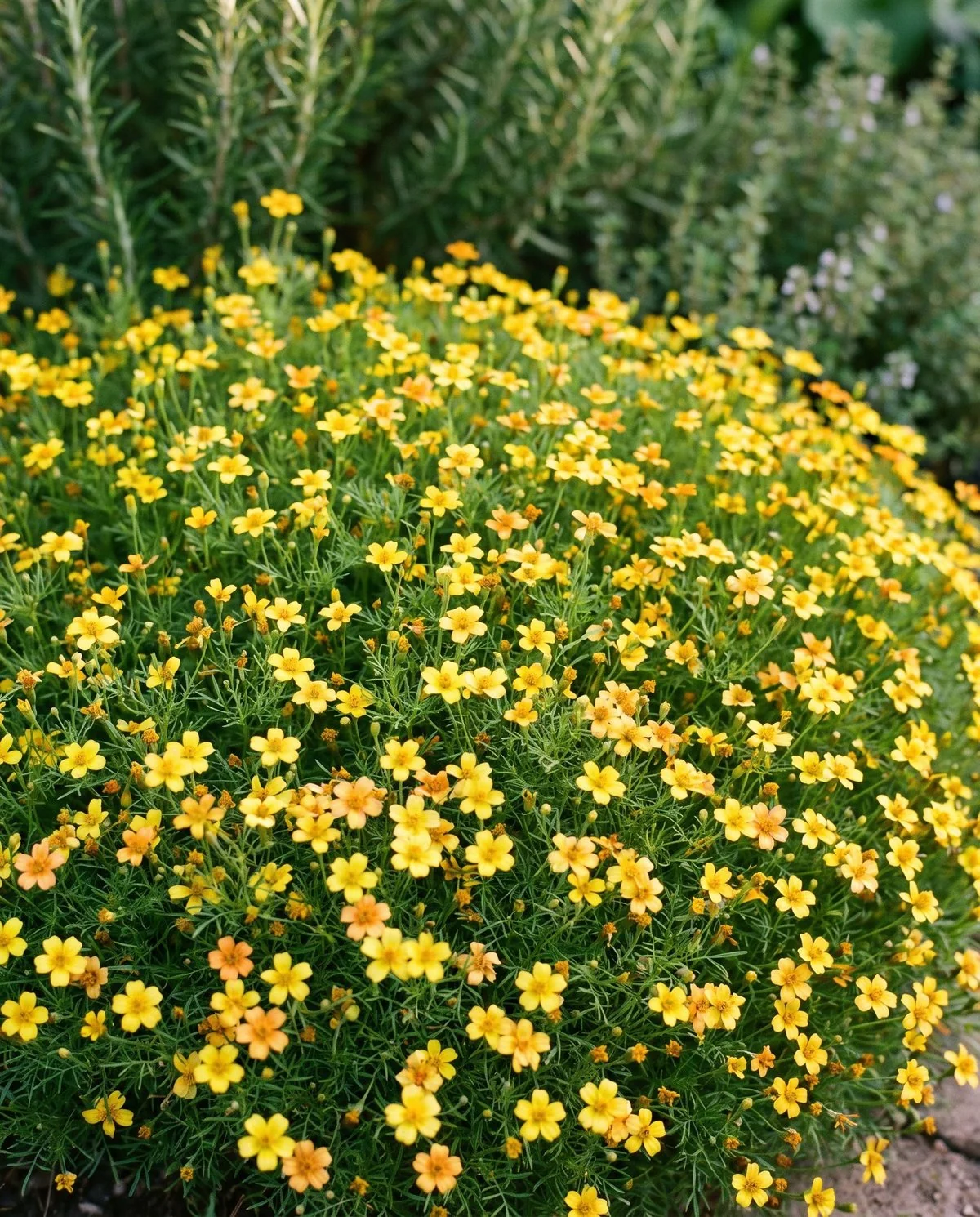
Signet marigolds (Tagetes tenuifolia) are the third and least familiar group, an 8 to 12 inch ferny cushion covered in many tiny single flowers that are citrus-scented and edible, which earns them a place along a path edge, in an herb bed, or scattered fresh over a plate as a garnish. The fourth thing on the rack is not a species at all. Triploid hybrids are a cross between Tagetes erecta and Tagetes patula, landing in the 10 to 16 inch middle ground with mid-size blooms, and because the cross leaves them sterile they never stop to set seed. That is what makes them the steadiest color through high summer, when other plants slow down to ripen the heads they already carry. Heat is where the three groups separate most clearly: the triploids keep flowering nonstop, French types take humidity and rain best, and the tall African plants put on the biggest show in a hot, bright, reasonably dry season. The guide to the best marigold varieties, from tiny French Bonanza to towering African Antigua names specific cultivars within each group.
The four groups on the rack, and what Iowa State says separates them
One extension service published a direct comparison between the marigold species rather than a description of each in isolation, which is unusual, and its judgements are what this grid is built on. The badge answers one question only: whether the plant stops to set seed, because that single trait is what Iowa State names as the mechanism behind the longest bloom season of the four.
Not every marigold has been shown to suppress root-knot nematodes, and the distinction is one most companion-planting folklore skips. Clemson HGIC names the specific cultivars with a documented suppressive effect: the French types 'Tangerine', 'Single Gold' marketed as 'Nema-gone', 'Lemon Drop', 'Bonita Mixed', 'Gypsy Sunshine' and 'Scarlet Sophia', the African types 'Crackerjack' and 'Flor de Muerto', and the French dwarfs 'Petite Gold' and 'Petite Harmony'. Buying a marigold for the nematode effect means buying one of those and growing it the way the schedule below sets out, not buying any marigold at all.
Bloom time
Marigolds open their first flowers in late spring or early summer, once the soil and nights have warmed, and from a spring sowing they reach bloom in about eight to ten weeks. After that they set buds continuously through summer and into fall, stopping only when frost ends the season. Heat rarely shuts them down for good, but a stretch of very hot weather often slows flowering for a week or two, and the plants rebound once temperatures ease and watering stays consistent. That midsummer lull is the most common complaint people have, and it usually traces to heat combined with dry spells or skipped deadheading rather than anything wrong with the plant; the fixes and the reasons behind a stall are covered in the guide to why marigolds stop blooming in midsummer heat. Pinching off spent heads keeps a plant tidy and pushes it toward fresh buds instead of seed, though many modern hybrids are close to self-cleaning and flower well even when a few old blooms are left on.
Two paths, worked in order
Both paths are built from real Ask Extension tickets answered by named extension experts and Master Gardeners, and both start with the soil and the calendar rather than with a pest, because that is where those answers started.
Height and spread
Size depends almost entirely on the type. Dwarf French marigolds stay compact at 6 to 12 inches tall and about as wide, which suits edging and pots, while taller French selections reach 18 inches. African marigolds are the giants of the genus, standing 1 to 3 feet tall with a 1 to 2 foot spread on sturdy, upright stems. Signet marigolds settle at 8 to 12 inches and spread into a soft, ferny mat studded with small flowers, and the many hybrids on the market tend to land in the 12 to 18 inch middle ground. Spacing follows from height, and the point of it is airflow: give French types about 8 to 10 inches between plants and African types 12 to 16 inches, so leaves dry quickly after rain and the fungal troubles that thrive in still, damp air never get a foothold.
Light
Marigolds want full sun, meaning at least 6 to 8 hours of direct light a day. In bright sun the plants stay dense and compact and flower heavily, while in too much shade they stretch, grow leggy, and set far fewer blooms. They will tolerate a little shade, but sun is where they earn their reputation. The one useful exception is a very hot desert climate, where light shade through the fierce afternoon hours takes the edge off heat stress. Good sun does double duty here, since it dries dew and rain off the foliage early in the day, and dry leaves are far less likely to develop the mildews and leaf spots that follow damp, shaded conditions.
Water
Young marigolds want steady moisture while their roots take hold, and established plants shrug off short dry spells with ease. Water deeply right after planting to settle the soil, and keep the top inch from drying out completely for the first couple of weeks. After that, most garden beds are happy with about an inch of water a week from rain or irrigation, more during a heat wave. The habits that matter most are watering at the base of the plant rather than over the top of it, and doing it early in the day so any splashed foliage dries fast, both of which hold fungal disease at bay. Containers and sandy soils dry out quickly and need checking more often through summer. The one thing marigolds will not forgive is soggy soil, which brings on weak growth and root rot, so drainage comes before any watering schedule.
Soil and pH
Marigolds are famously adaptable, but they do best in well-drained, moderately fertile soil, and a loam loosened with a little compost is close to ideal. Heavy clay that stays wet invites root problems, so it pays to open the drainage with organic matter before planting. What marigolds do not want is a rich diet. They are light feeders, and too much nitrogen drives lush green growth at the expense of flowers, which is a frequent reason for a leafy plant with few blooms. A slightly acidic to neutral pH, roughly 6.0 to 7.0, suits them well, and while they tolerate mild swings either way, badly acidic or alkaline soil can dull the leaf color and thin the flowering, so any correction is best made gradually.
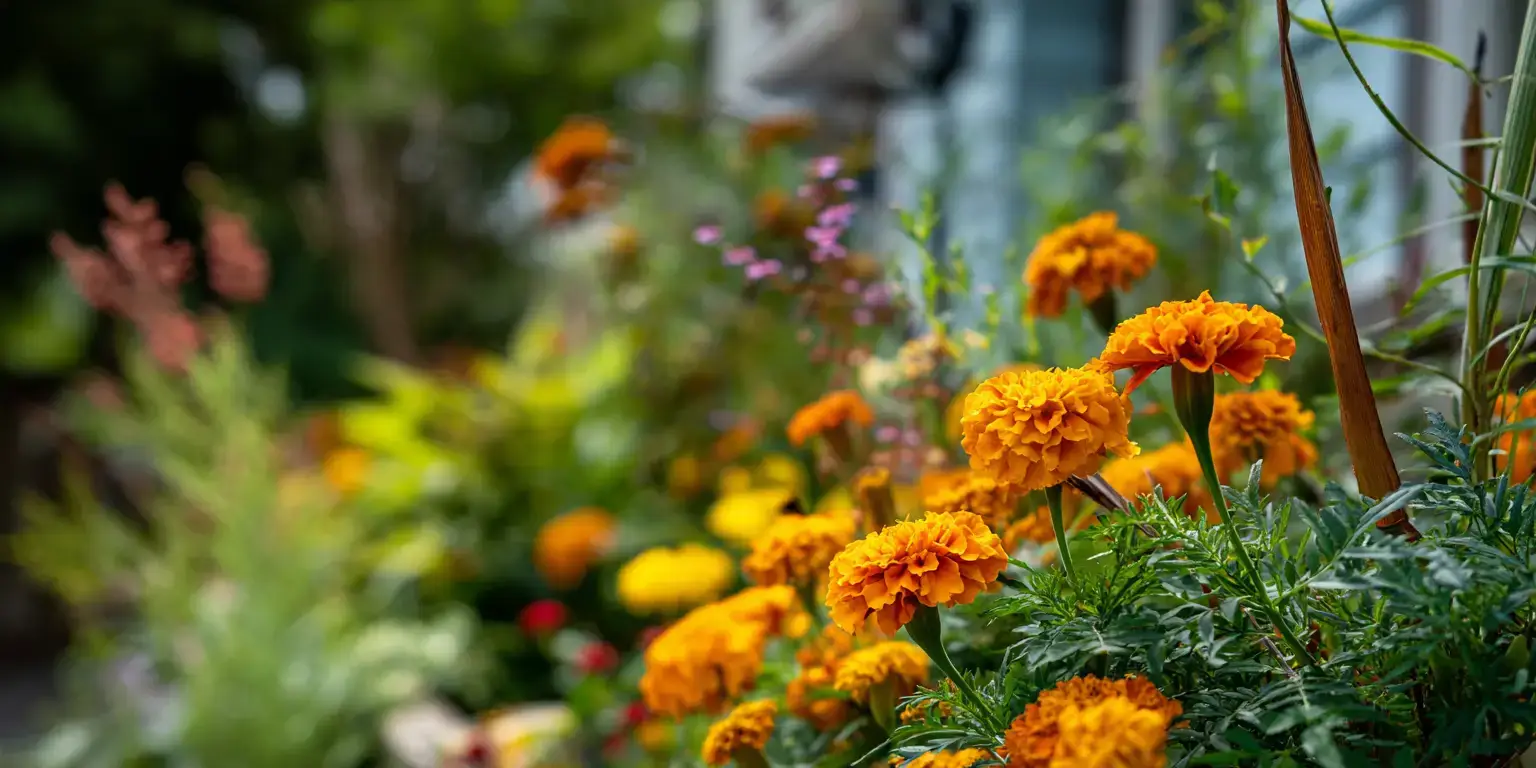
The two claims, and the research that measured them
The pest-repellent question is one of the most active marigold topics in this research, at 38 posts directly and dozens more overlapping in the aphid and scent buckets, while the nematode mechanism that actually has research behind it drew 7 posts. The reason is structural: aphids on a marigold are photographable the same day, and nematode suppression happens underground over two months with nothing to photograph.
The myth: Marigolds repel garden pests just by being planted nearby, against more or less anything.
The reality: Real for specific named pest, crop and compound combinations, and false as a blanket claim. Niall J. A. Conboy and Colin R. Tosh of Newcastle University's School of Natural and Environmental Sciences, with Stockbridge Technology Centre, published a trial in PLoS One in March 2019 in which French marigolds intercropped with tomatoes significantly reduced glasshouse whitefly populations, with the protective effect measurable by day 34 and holding through day 48. They identified the mechanism rather than inferring it: the volatile compound limonene, making up roughly 24 percent of the marigold flowers' volatile output and 21 percent of the leaf tissue's, and they recorded that the effect was much weaker when marigolds were introduced only after a whitefly population was already established. University of Vermont Extension entomologists Cheryl Frank Sullivan, Bruce L. Parker and Margaret Skinner separately found marigolds work as a genuine trap crop for western flower thrips in greenhouses, with the effect varying by crop variety and growth stage and working best early in the crop's vegetative stage, before the crop's own flowers compete for the thrips' attention. The same body of research is equally clear about where the effect stops: marigolds do not reliably deter tobacco hornworm, tomato fruitworm or Colorado potato beetle, and a Rutgers University study found they failed to repel pests on cabbage, carrot or onion at all. That Rutgers finding reached this research through a source citing it rather than from the original publication, and is flagged accordingly.
The myth: Marigolds get rid of nematodes in the garden just by being planted among your vegetables.
The reality: A real effect at a completely different scale and by a completely different method than the folklore describes. Specific marigold cultivars do measurably suppress root-knot nematode populations, and Clemson HGIC's own conditions are what make the difference: a solid, dense planting no more than 7 inches between plants, grown a minimum of two months, then tilled into the soil before a susceptible crop goes into that same ground, with the planting kept free of grass and weeds throughout because nematodes will feed on those other roots instead. A few marigolds scattered decoratively among tomato plants for one season is not the tested method and is not what the supporting research measured. Effectiveness is also cultivar-specific rather than generic: Clemson names 'Tangerine', 'Single Gold' marketed as 'Nema-gone', 'Lemon Drop', 'Bonita Mixed', 'Gypsy Sunshine' and 'Scarlet Sophia' among French types and 'Crackerjack' and 'Flor de Muerto' among African types as the cultivars with a documented suppressive effect, and NC State Extension publishes the same control approach for the home vegetable garden. One question the corpus asked that this research cannot answer is whether the same compounds harm beneficial, non-parasitic nematode populations, since none of the sources consulted addresses it, so it is left open rather than answered by extrapolation.
USDA hardiness
Marigolds are tender plants with no frost tolerance, so across nearly all of the country they are grown as warm-season annuals, planted after the last spring frost and enjoyed until the first frost of autumn ends them. In that annual role they perform through USDA zones 2 to 11, a remarkably wide range, but a hard freeze at either end of the season kills them outright. In the mildest zones, roughly 9 to 11, plants may linger, self-sow, and carry on longer where winters stay frost-free. A handful of Tagetes relatives are genuinely perennial in warm regions, including Tagetes lemmonii, the shrubby Mexican marigold, and Tagetes lucida, grown as Mexican tarragon, both of which return year after year where frost is light. For the ordinary French and African marigolds, though, the plan is to replant each spring or to save seed for the next round.
The numbers, with the gaps left visible
Where a university source publishes a figure for marigold it is named here. Where none does, the row says so rather than borrowing a plausible number from general circulation, and the one genuinely precise multi-step schedule in the whole source set is the nematode cover crop at the bottom.
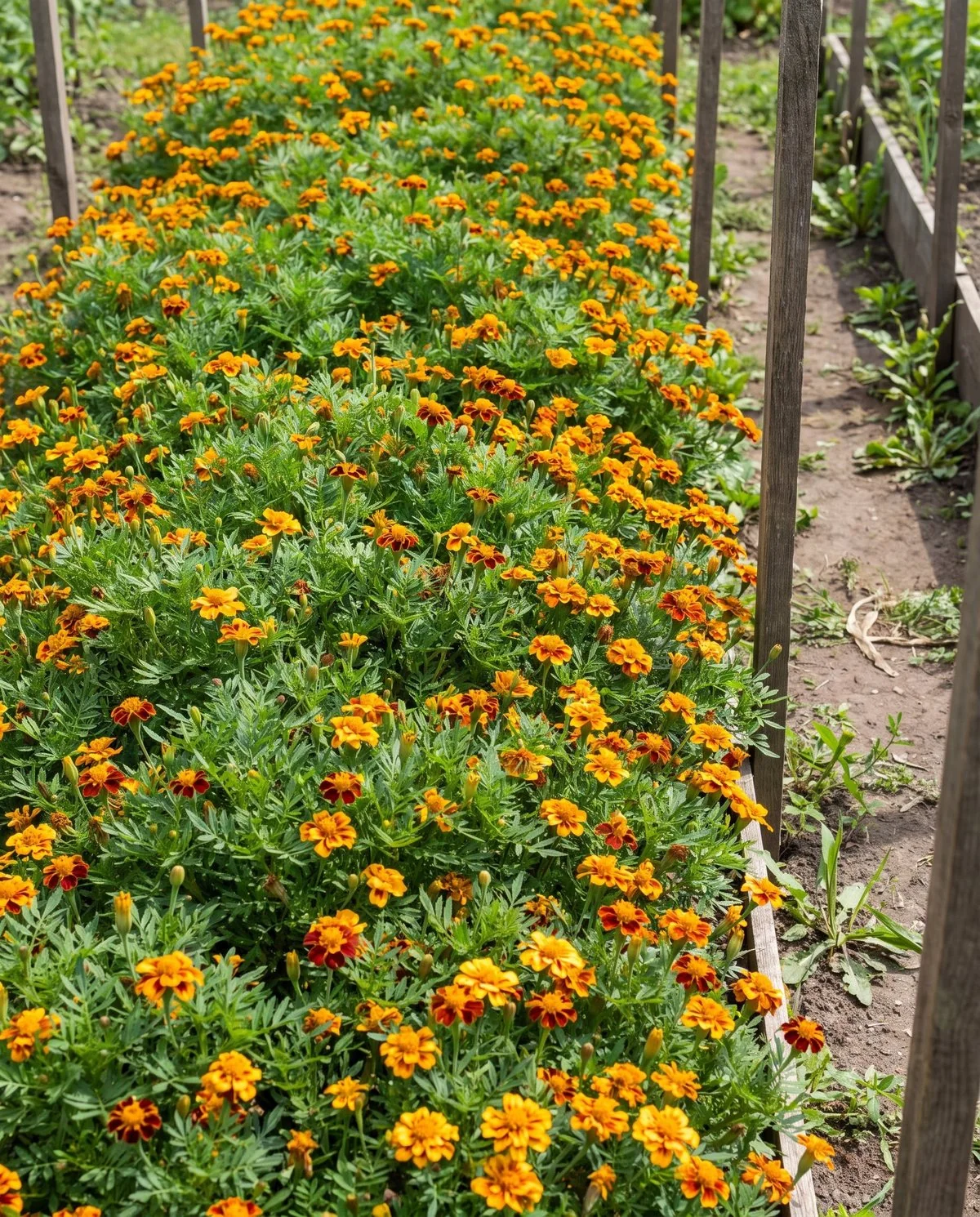
Propagation and longevity
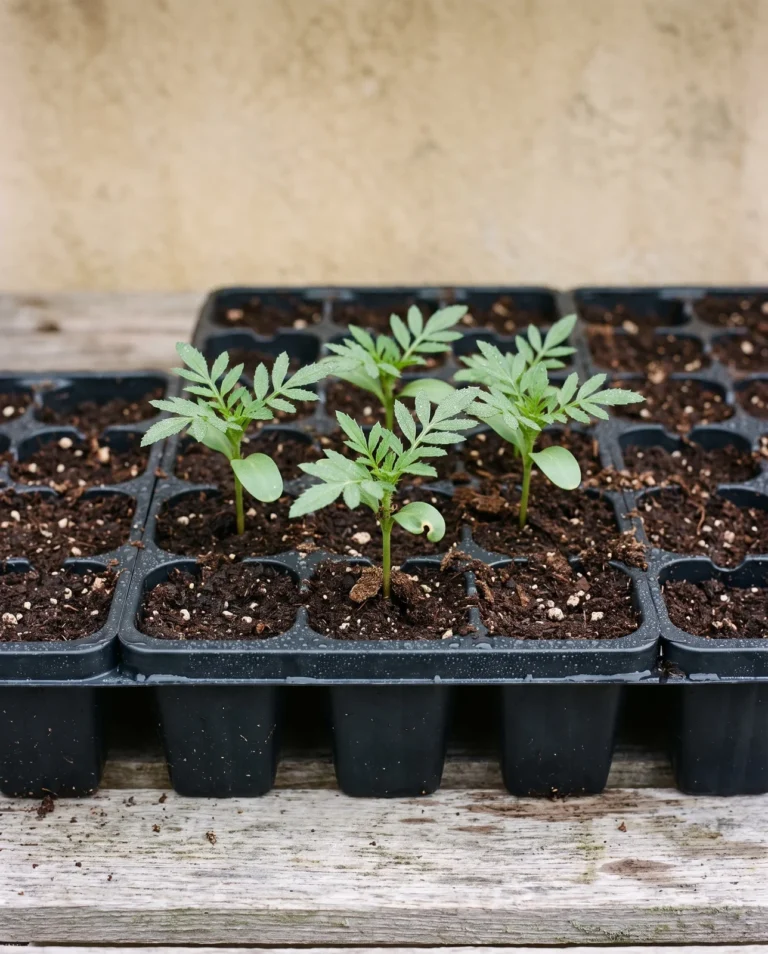
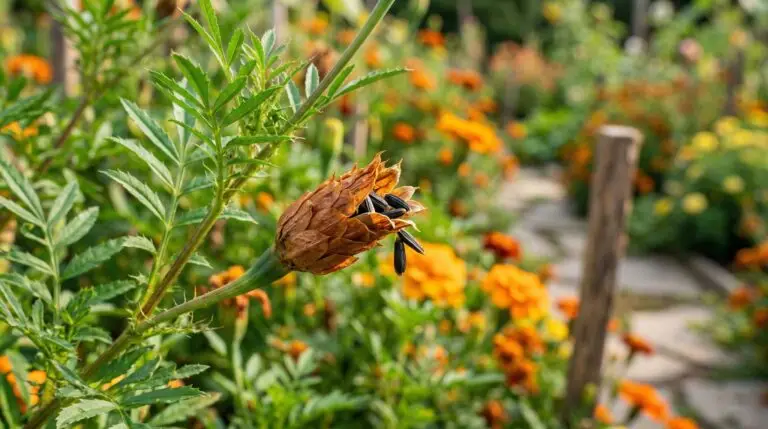
Few flowers are easier to raise from seed, which is much of the marigold's appeal, and the seeds germinate so reliably that they are a standard first project for children. For an early start, sow indoors about four to six weeks before the last expected frost, keep the tray warm at around 70 degrees F and lightly moist, and expect seedlings within a week. Move them outside once frost danger has passed and they carry a couple of sets of true leaves. Just as easily, seeds can go straight into prepared ground after the last frost, sown about a quarter inch deep and thinned as they grow, an approach laid out in the guide to growing marigolds from seed. Either way, most varieties flower roughly eight to ten weeks from sowing. Marigolds live a single season in most gardens, but they readily self-sow when a few spent flowers are left to dry and scatter seed. Saving your own seed works well from open-pollinated varieties, which come true to type: let a few heads brown and dry on the plant, collect the slender dark seeds, and store them somewhere cool and dry until spring. Seed saved from F1 hybrids is the exception, since those seedlings will not match the parent.
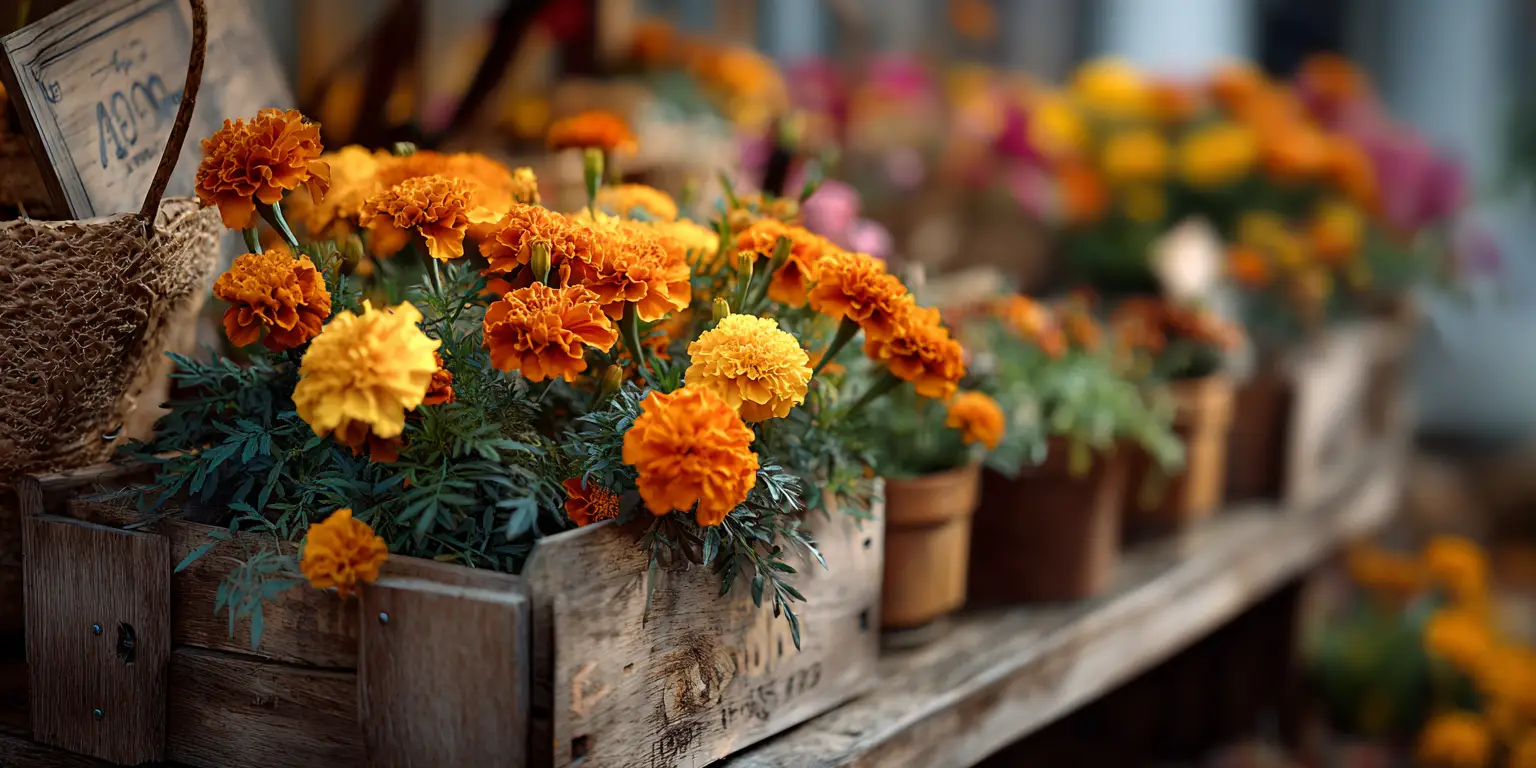
Seed to frost, with the named cases attached
Germination is fast and well sourced: Mississippi State Extension puts direct-sown seed at 4 to 7 days at 75 to 80 F, one of the shorter windows among common bedding annuals, and its transplant schedule starts seed indoors 4 weeks before the last frost date. From there the only hard university figure in this research for time to flower belongs to a named cultivar series rather than to the genus, Mississippi State's African-type Giant Series at 70 to 90 days to maturity, and the figures in circulation for French and signet types are left unstated here because no university source confirmed them. What does apply across all three species is a real complication that Ask Extension's own experts confirmed in live cases: expert Deb Kroon answered a gardener with slow-flowering marigolds by noting that direct-seeded outdoor plants always take longer to bloom than transplants, so the same variety on the same date reaches flower at two different times depending on how it was started. The mid-season stall is where the sourcing gets genuinely specific. Two separate real Ask Extension tickets converged on the same three causes for a marigold that looks lush and refuses to bloom, or buds without opening: too much nitrogen, with Master Gardener Steve Miles recommending simply stopping fertilization and letting the plant deplete the existing soil nutrients rather than adding anything; insufficient direct sun, which one gardener's own follow-up traced to a large volunteer sunflower shading the bed; and heat stress, which another expert addressed with a recommendation for 40 percent UV shade cloth through the worst of summer. Marigolds are commonly described as pausing above roughly 90 F and resuming as temperatures moderate, and no university source in this research gave that number, so it is offered as the pattern rather than the threshold. Deadheading extends the season for a stated reason rather than as folk habit, since removing a spent bloom before it sets seed keeps the plant's energy on new buds, and the proof sits in the group that never needs it: Iowa State records that the sterile triploid hybrids continue to bloom until killed by frost precisely because they cannot divert energy into seed maturation at all. The end is the same in every zone. Frost kills the plant outright, and what returns in zones 9 to 11 is a fall-germinated volunteer from an open-pollinated French or signet parent, capable of overwintering and blooming weeks earlier than a spring sowing, rather than the original plant surviving as a perennial.
Fragrance
The marigold's scent is nothing like a rose or jasmine, and it lives mostly in the leaves and stems rather than the flowers. Brush the foliage and a sharp, pungent, herbal smell rises at once, one that some people find bracing and others associate fondly with a summer garden. The flowers themselves are largely unscented on French and African types. The exception is the signet marigold, whose small blooms carry a light citrus fragrance and whose petals are edible, a combination that makes them a favorite for the kitchen, covered in the piece on signet marigolds and their citrus-scented edible flowers. That same pungent foliage does more than fill the air, since it is the main reason deer and rabbits tend to pass marigolds by, and it may put off a few insects at close range.
Toxicity and pet safety
Marigolds sit at the low-risk end of the garden, and extension references rate the toxicity of Tagetes as low for people, dogs, and cats. The caveats are minor. The pungent essential oils that give the foliage its smell can cause mild stomach upset if a pet eats a large quantity of leaves or flowers, and the sap can irritate sensitive skin, so gloves are worth wearing for anyone who reddens or itches after handling the plants. Serious poisoning is not a realistic concern with true marigolds. One point does cause confusion: the name marigold is also attached to pot marigold, or calendula, a different plant altogether, which is likewise treated as low-risk and is widely grown as an edible flower. As a plain rule, it is sensible to discourage any pet from grazing on garden plants, but marigolds are not among the ornamentals that call for real worry.
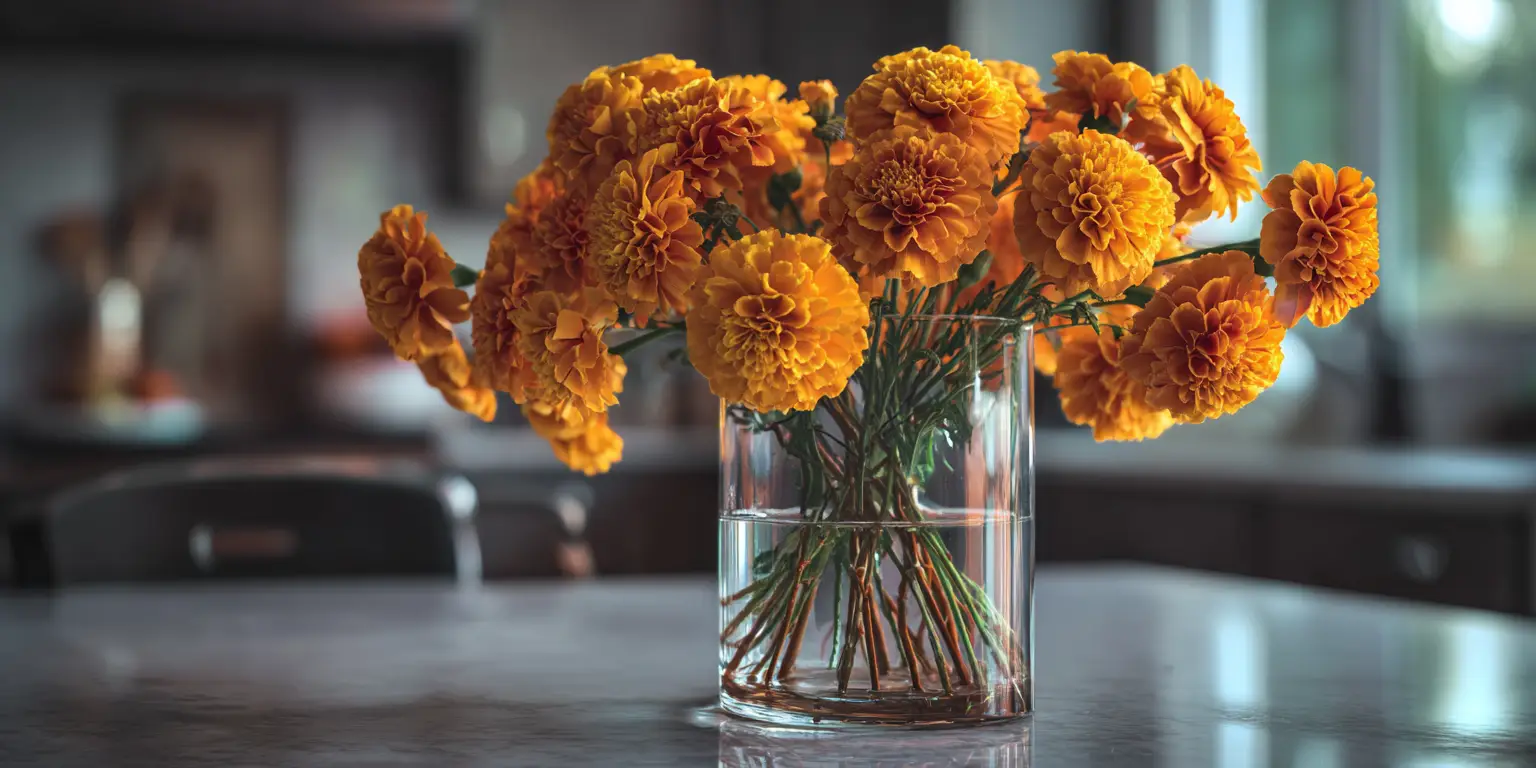
Vase life
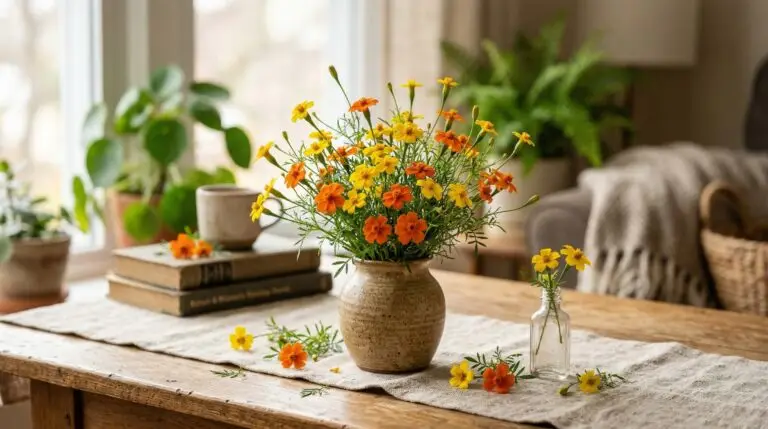
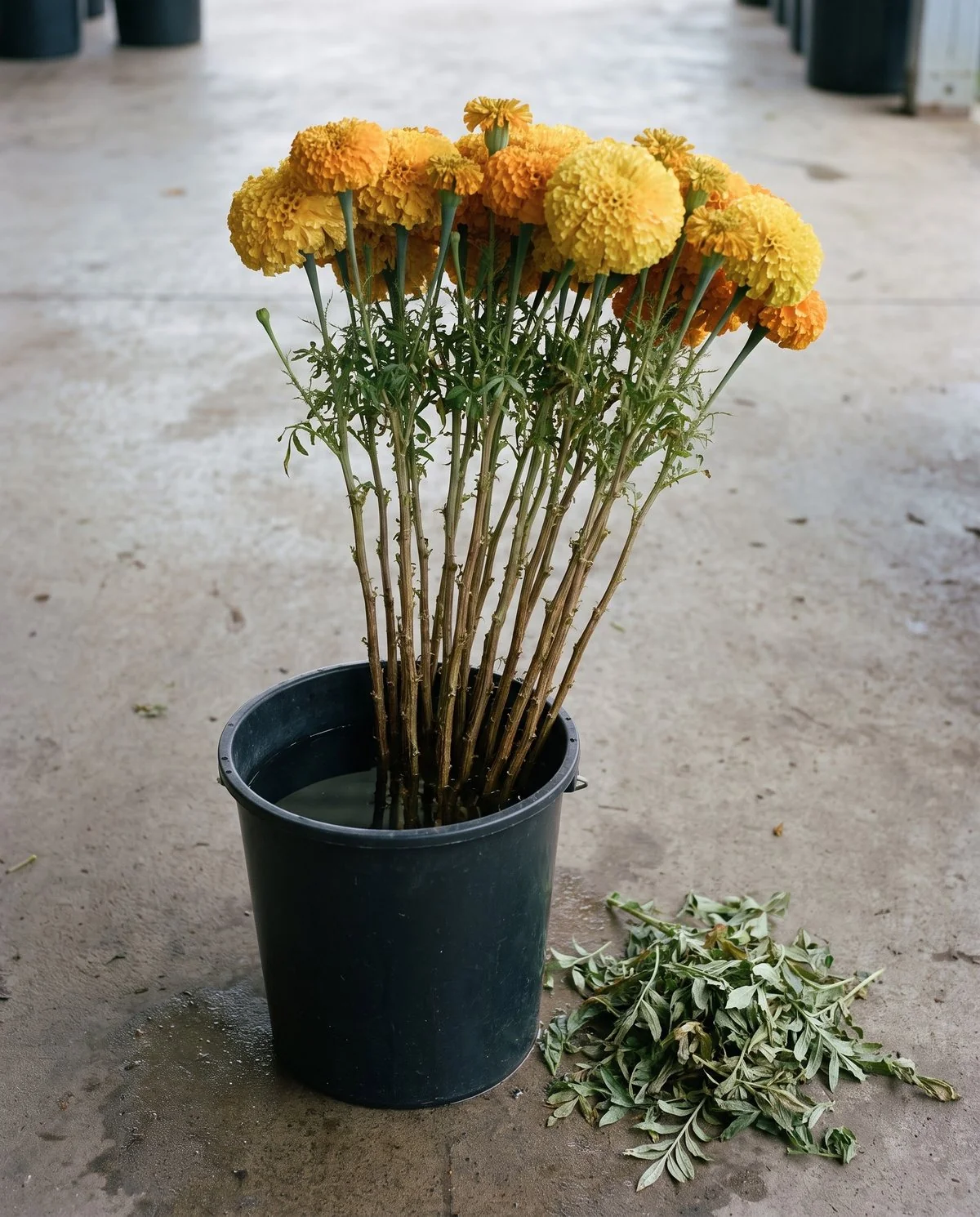
Marigolds make a better cut flower than their bedding-plant image suggests, especially the taller African types with their long, strong stems. Cut at the right stage, they hold for about seven to ten days in a vase. Harvest in the cool of the morning, choosing flowers that are partly rather than fully open, and get the stems into water straightaway. Strip off any leaves that would sit below the waterline, because submerged foliage rots quickly and fouls the water. Marigold stems are prone to clouding the water on their own, so a scrupulously clean vase and frequent water changes make a visible difference to how long the arrangement lasts. The foliage scent that is pleasant outdoors can feel strong in a closed room, so a well-ventilated spot suits a marigold bouquet best.
The postharvest numbers, from a farmer-florist publication
Mississippi State University Extension published a marigold guide written for growers selling stems, by Dr. James DelPrince and Dr. Christine Coker, which is where the exact handling figures below come from. One of its instructions runs against the general rule for cut flowers and is left exactly as stated rather than smoothed over.
A floral preservative always helps, so use one for marigolds too.
Mississippi State Extension's own marigold guidance says no preservative or conditioning is recommended for this flower. It is the same publication that gives the stem lengths and the 36 to 41 F holding range, so the omission is a stated position rather than an oversight.
A penny in the vase water keeps marigolds fresh.
The mechanism behind the folklore has an expiry date. Pre-1982 United States pennies were mostly copper, a mild fungicide; pennies minted after 1982 are 97.5 percent zinc and do not meaningfully help. No marigold-specific university trial of pennies, aspirin or vodka in vase water was located in this research, so the general mechanism is given and no marigold result is claimed.
The bad smell coming off a marigold arrangement is the flowers.
Two separate things compound here and neither is the bloom. Mississippi State attributes the strong resinous scent to the foliage, which is why growers strip it. Separately, any foliage left below the waterline breaks down and accelerates bacterial growth, which is what actually fouls vase water in any cut flower. The fix follows from the mechanism: strip everything that would sit below the water and change the water every couple of days rather than topping it off.
Pests and diseases
Marigolds are resilient rather than bulletproof. The signature pest is the two-spotted spider mite, which flares in hot, dry spells and stipples the leaves with fine pale speckling before webbing the growing tips, and it is the problem most likely to disfigure a marigold in high summer. Aphids gather on soft new growth, whiteflies and thrips move in where plants are crowded, caterpillars chew ragged holes in the leaves, and slugs or snails can shear off young seedlings overnight. Most of these stay minor and yield to hand-picking, a hard jet of water, or insecticidal soap for a heavier aphid or mite outbreak. The diseases are mostly a consequence of damp foliage and stagnant air: powdery mildew and leaf spot show up on crowded plants in humid weather, gray mold rots fading flowers through long wet spells, and root and stem rots set in where the soil stays heavy and wet or the watering is too generous. Seedlings started in cold, wet, unclean conditions can collapse from damping off. Aster yellows and a few viruses, spread by sap-feeding insects, cannot be cured, so any plant that shows their distorted, discolored growth is best pulled and destroyed. The prevention is the same short list every time: full sun, well-drained soil, honest spacing for airflow, water at the base, and a tidy bed cleared of spent flowers and diseased leaves.
The one thing marigolds are most famous for is what they supposedly do to pests and nematodes in the soil around them, and the truth is more specific than the folklore. French marigolds genuinely suppress root-knot nematodes, the microscopic soil worms that knot and stunt the roots of tomatoes and many other crops, but only when they are grown the right way. The effect comes from growing them as a dense, weed-free stand for a full season, about two months, in the same ground where the vulnerable crop will follow, not from tucking a few plants among the vegetables. The roots release a compound called alpha-terthienyl and act as a non-host that starves the nematodes out, and university trials are clear that scattered interplanting does little while a solid cover crop measurably lowers the population. Weeds growing among the marigolds host the nematodes and cancel the benefit, so weed control is part of the method. The wider claims deserve more skepticism, as the table below lays out, and the tradition and its limits are explored further in the piece on marigolds in the vegetable garden and companion planting.
| Claim | Verdict | Why |
|---|---|---|
| French marigolds suppress root-knot nematodes | Proven, with a catch | Only as a dense, weed-free stand grown a full season in the same soil before the crop; the roots release alpha-terthienyl and act as a non-host |
| A few marigolds among tomatoes clear nematodes | Overstated | Scattered interplanting has little measured effect; the soil around each crop root has to be occupied by marigold for a season |
| Marigolds repel most insect pests | Mostly folklore | The foliage scent has at most a mild, local effect, and pests still colonize the marigolds themselves |
| Marigolds repel mosquitoes | Folklore | A growing plant gives no meaningful outdoor mosquito control |
| Marigolds deter deer and rabbits | Real | The pungent foliage makes them one of the plants browsing animals reliably skip |
Seven photo forks, and which sides are deliberately unphotographed
Growth habit, chew damage, seedling collapse and plain colour change are safe to photograph and are here in full. The fungal and phytoplasma sides are not: mite stippling, powdery mildew coating, Botrytis spore masses, aster-yellows deformity and rotted crown tissue are checkable fingerprints, so those sides wait for a real reference photograph.
Turn the leaf over, and check the weather. Mites work on the underside in hot, dry conditions: NC State and University of Maryland Extension describe them as reddish or light green with two dark spots, roughly the size of a period on a page, alongside webbing, eggs and shed skins, and their feeding removes chlorophyll to leave fine white spots or stipples that progress to yellowing, browning and leaf death. Powdery mildew is a white, powdery coating on the leaf surface and is favoured by high humidity and poor air circulation rather than by heat and drought, so the same symptom points opposite ways depending on the fortnight it appeared in. Neither side is photographed here, because a fine stipple and a fungal bloom are exactly the pair a generated image gets wrong.
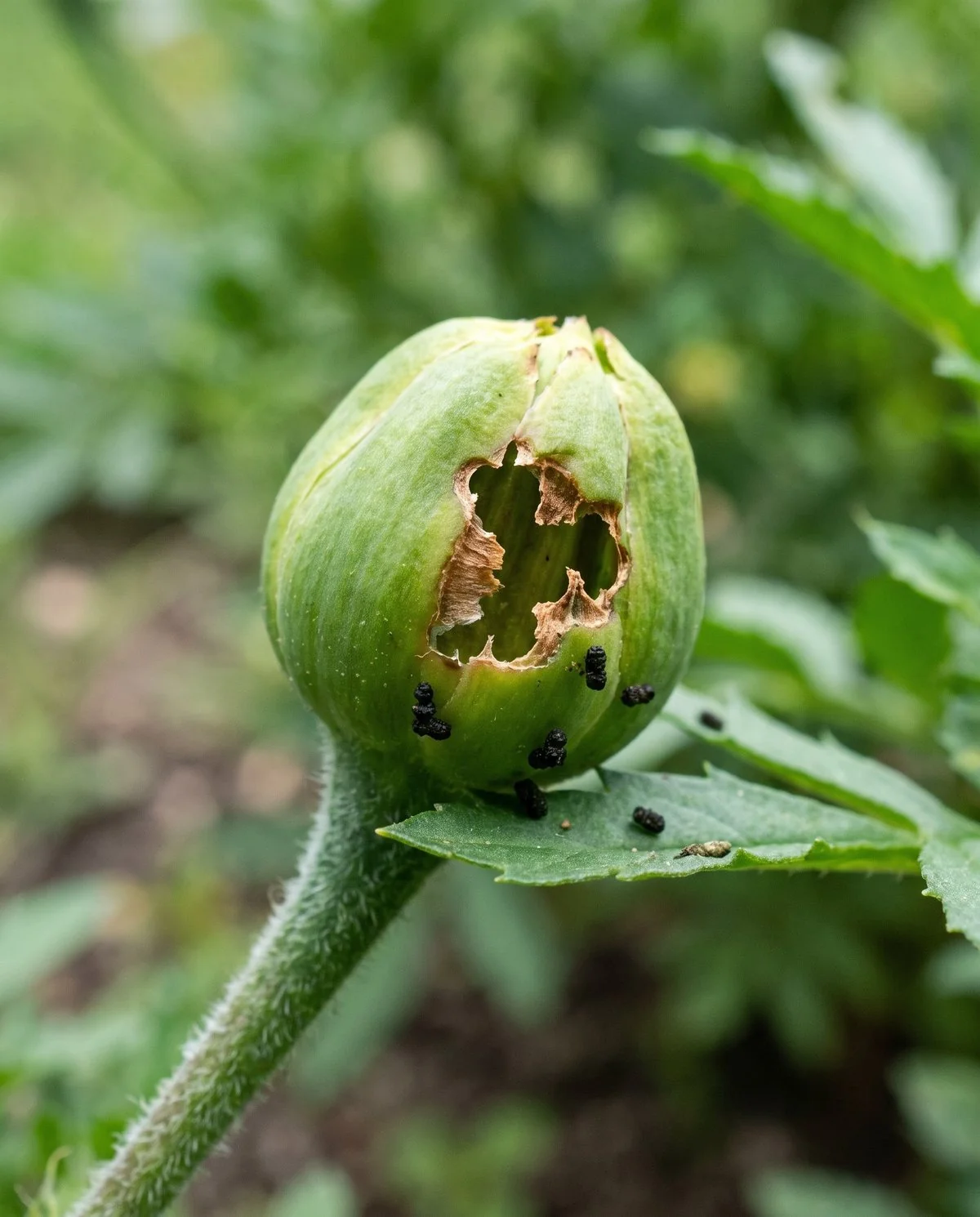
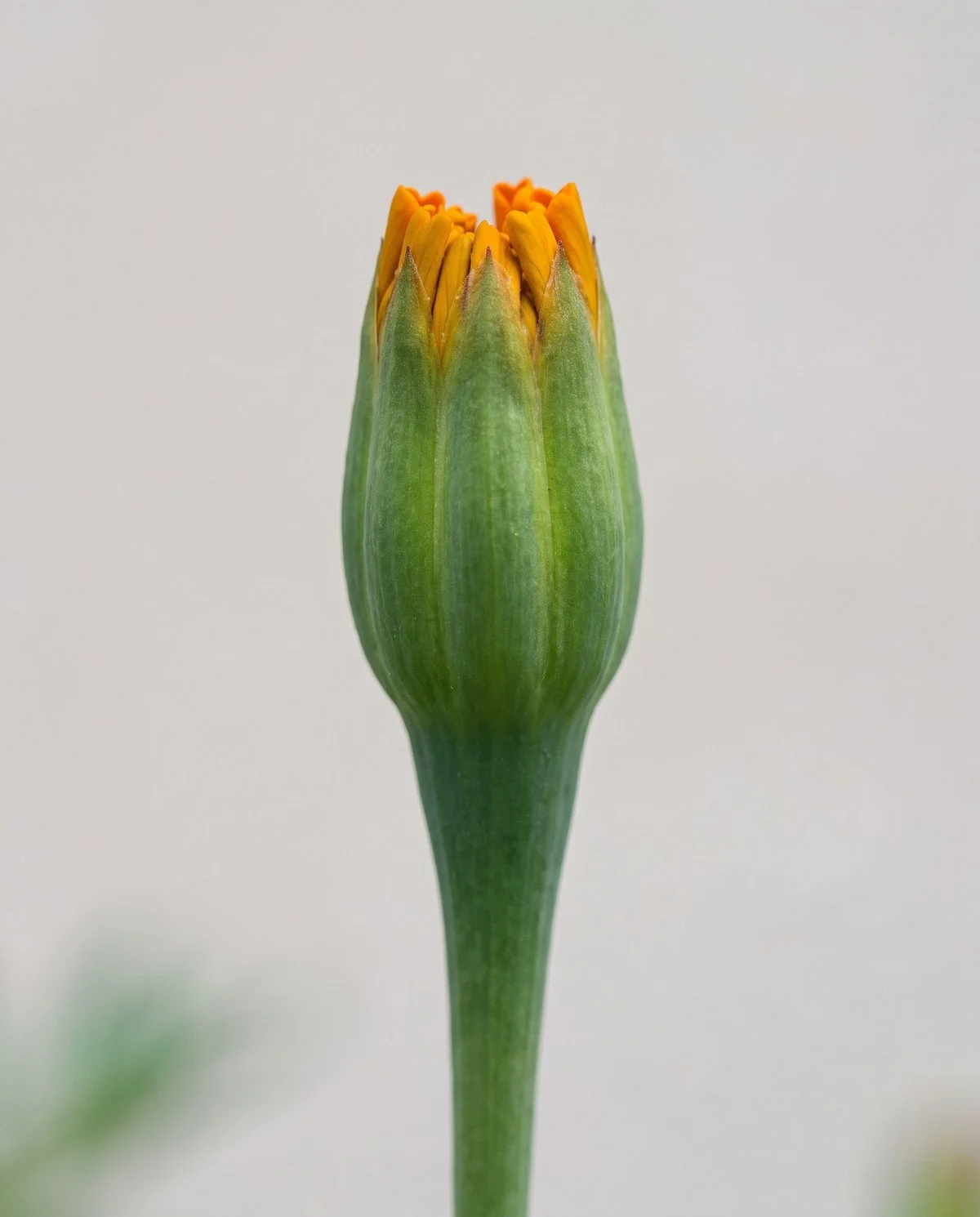
Look for holes and for black specks. NC State, Colorado State and Iowa State all describe tobacco budworm, Heliothis virescens, attacking developing flower buds so that damaged buds do not open, with irregular or round holes in the bud and small black specks of excrement visible on it, and all three name marigold among its favoured hosts alongside geranium and petunia. A bud that is simply not ready has an intact, smooth surface with no holes and no frass on it.
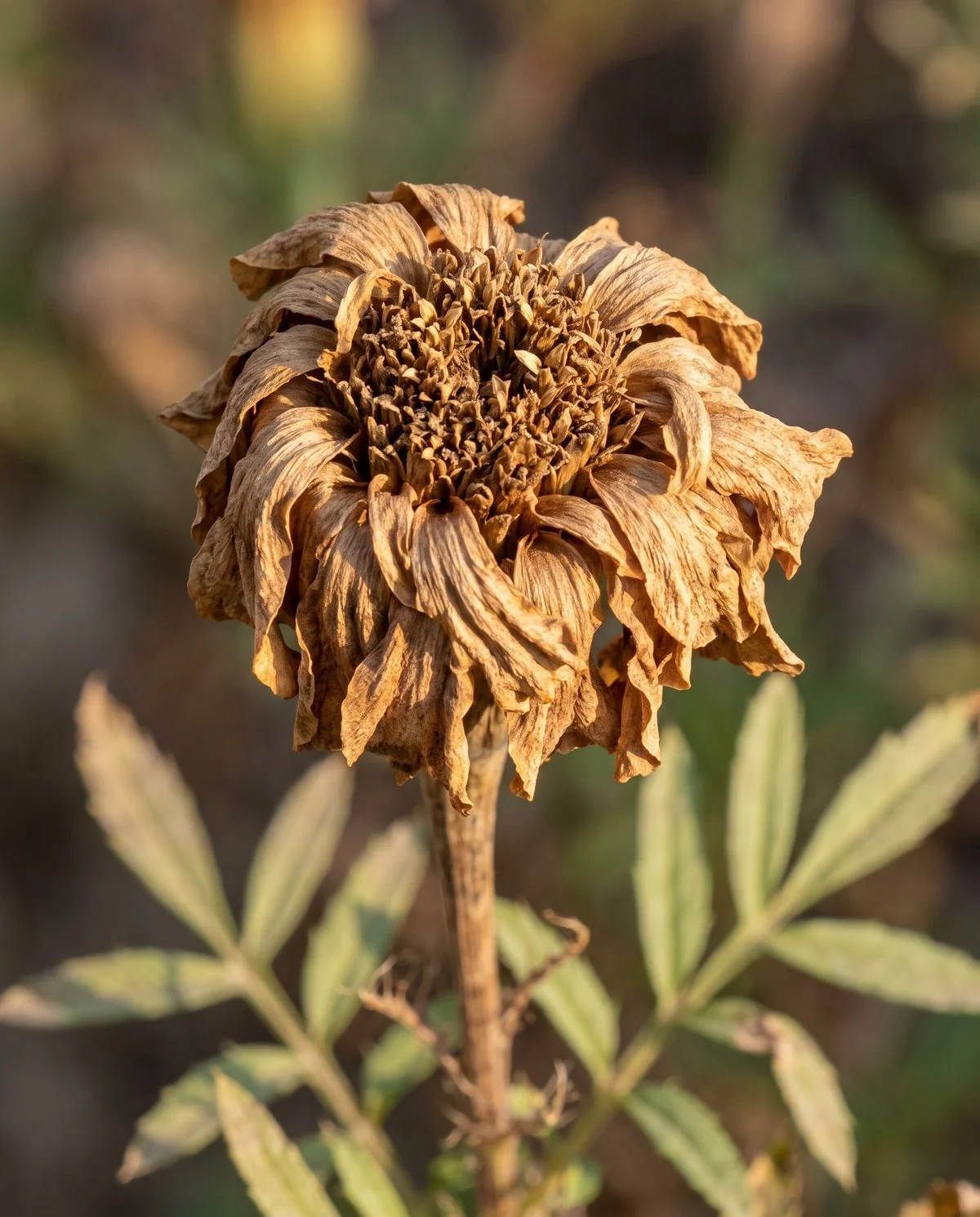
Look for fuzz and for target rings. The Connecticut Agricultural Experiment Station's Plant Pest Handbook describes Botrytis on marigold as flowers turning a papery brown and becoming covered with gray, fuzzy masses, with tan to brown target-like spots on the leaves. University of Illinois Extension adds the environmental fingerprint: infection is favoured by 68 to 76 F with high humidity, needs roughly 20 hours of leaf wetness to establish, and is visibly slowed or stopped by warm, dry weather. A flower past its bloom simply fades, dries and browns with no gray spore mass and no ring-patterned leaf spotting, and only that safe side is photographed.
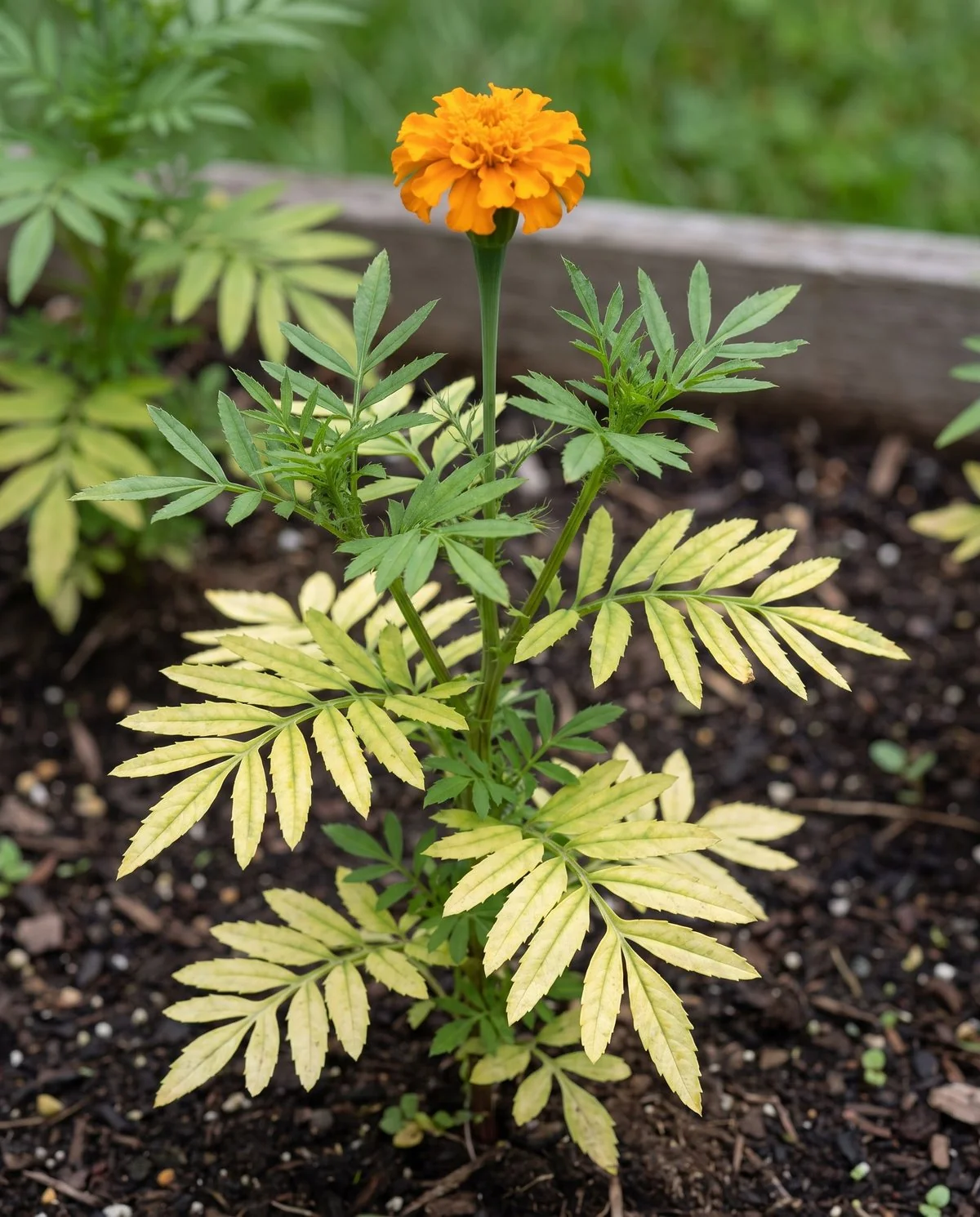
Look for structural deformity, not just colour. The Connecticut Agricultural Experiment Station describes aster yellows as yellowing or clearing of the veins in newly infected leaves, progressing to long axillary breaks that create a yellowish witches' broom, with stunted plants carrying small, distorted flowers that sometimes show green petals instead of colour, and Michigan State University Extension confirms marigold as a susceptible host with leafhoppers as the vector. A nutrient problem is uniform interveinal chlorosis on older leaves with no shoot proliferation, no flower distortion and no greening, which is a colour change rather than a deformity. Only the nutrient side is photographed.
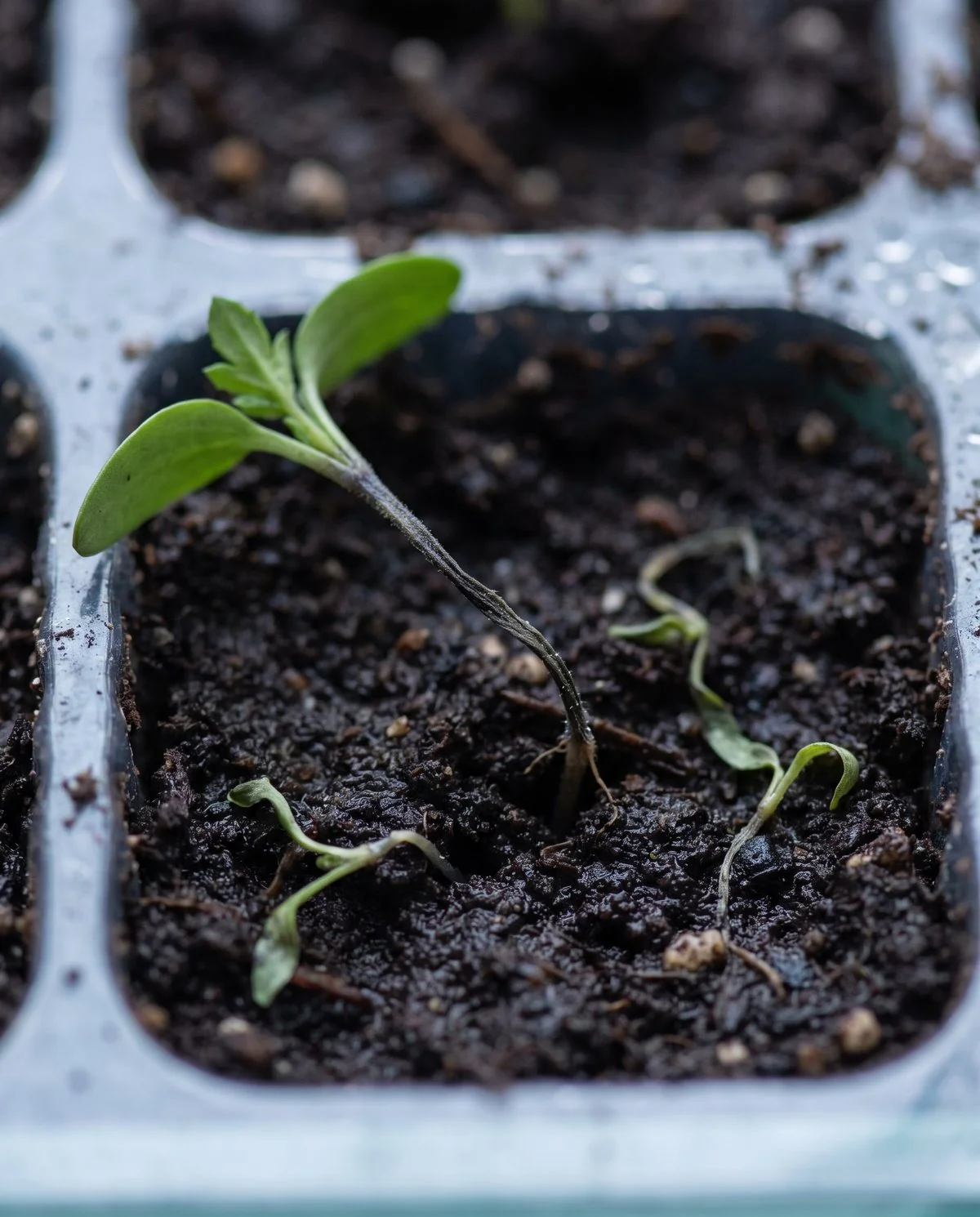
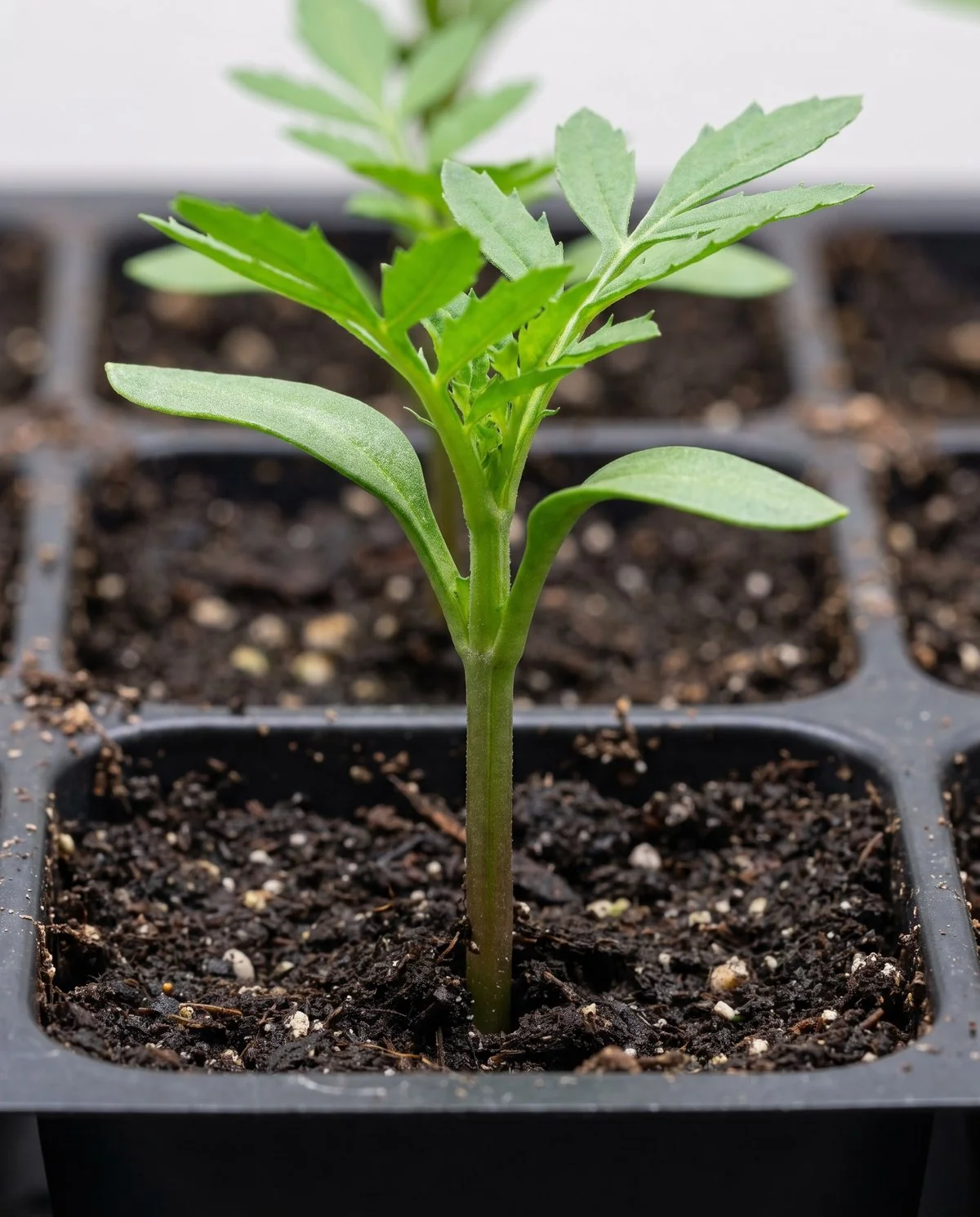
Look at the stem where it meets the soil. University of Minnesota Extension describes a thin, pinched, thread-like stem at the soil line and a toppled, collapsed seedling, notes that large sections or whole trays are often killed, and calls the disease difficult if not impossible to reverse once it starts. The conditions it names are the actionable part: overwatering, and soil temperatures below 68 F before germination or above 77 F after emergence. A healthy seedling of the same age has a sturdy, unpinched stem at that same point.
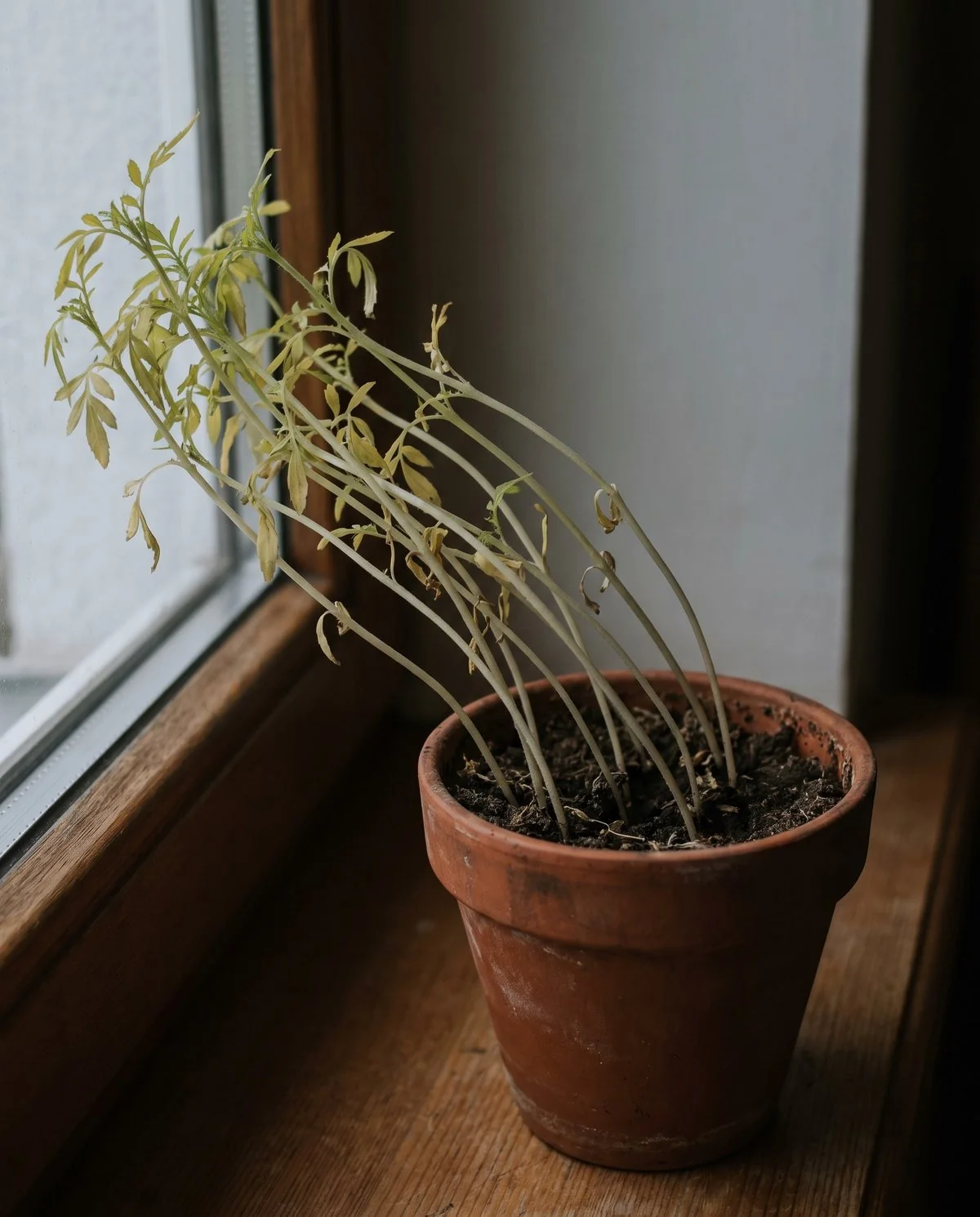
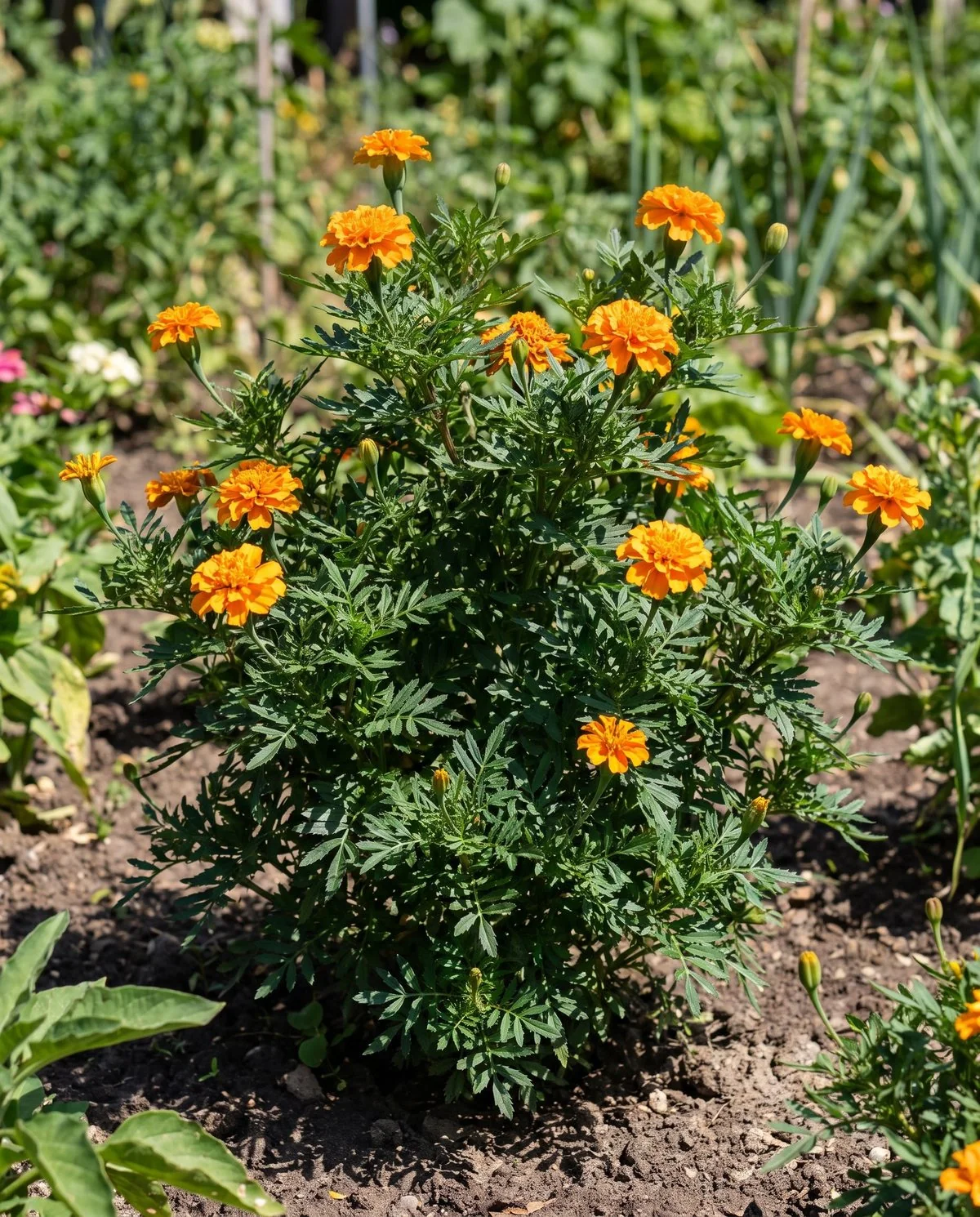
Count the unobstructed hours and then count the neighbours. Etiolated growth stretches toward the light with weaker, more widely spaced buds; a plant in genuinely full sun is dense and well branched with tight internodes. Several posters in this research report the stretching happening even in full sun, which is why both halves matter: competition for light between crowded seedlings produces the same stretching response as too little ambient light, and both Ask Extension experts consulted in real marigold cases named insufficient light as a contributing factor.
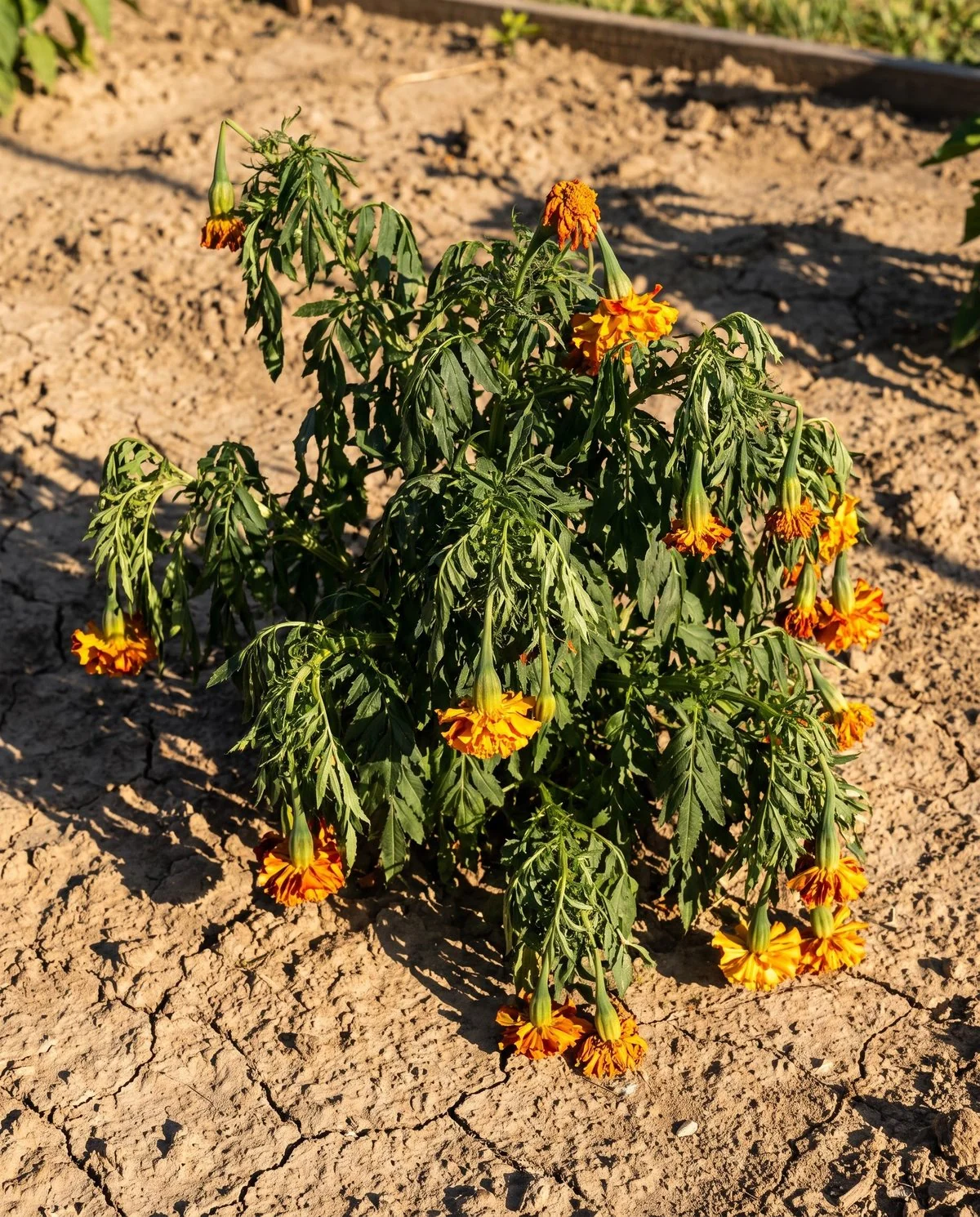
Water it and come back in a few hours. Ordinary drought wilt is a temporary loss of turgor: leaves go limp in the heat of the day and perk back up within a few hours of watering or as the evening cools. The Connecticut Agricultural Experiment Station describes Rhizoctonia solani root rot as general wilting, decline and collapse together with browning and rotting of the roots and the crown, followed by yellowing and death of the outer leaves, which is tissue death rather than thirst and does not reverse. Only the recoverable side is photographed, since rotted crown tissue is a checkable diagnostic detail.
What marigold growers actually ask about, ranked by frequency
650 unique posts from r/gardening and r/plantclinic, 420 and 230 respectively, deduplicated by permalink and categorised by a keyword pass over the full title and body text that was then spot-checked by hand against the posts themselves. Three caveats belong with the numbers. Themes overlap and do not add to 100. One templated reference post that lists many keywords at once was caught inflating several buckets and is flagged rather than left in silently. And the happiest theme in the whole corpus is not a problem at all: 9 posts on deadheading and 9 on seed saving are mostly gardeners sharing a trick, one of them at 347 upvotes, which is a different tone from everything below.
Whether this is a problem at all. This bucket is regex-broad and hand inspection shows it mixes genuine establishment failures with ordinary proud seedling narration, so it is presented as the largest raw count in the sample and not as the largest real problem.
Whether it comes back on its own. Frost damage, transplant flop, overwatering and simple heat-of-the-day wilting all arrive under this one word, and the fork that matters is the one in the photo pairs below: ordinary drought wilt recovers within a few hours of watering or as the evening cools, while the Rhizoctonia root and crown rot the Connecticut Agricultural Experiment Station describes does not.
Whether anything is structurally deformed as well as discoloured. Several posters name aster yellows themselves and then second-guess it in the same sentence, and the Connecticut Agricultural Experiment Station's own description separates them: the phytoplasma produces witches'-broom shoot proliferation and distorted, sometimes greened flower parts, not a plain colour change.
Which pest and which crop, because the answer is specific rather than general. This is one of the most active themes in the whole corpus and it is easy to see why: a gardener plants marigolds to stop aphids and photographs the aphids the same afternoon. The measured effect exists for named combinations and does not generalise, which the myths block sets out with its source.
Whether the expectation was ever founded. Multiple posters frame the aphid photo explicitly as I thought marigolds were supposed to repel this, and the research is clear that aphids are not among the pests marigolds have been shown to affect.
The leaf underside, for webbing, eggs and shed skins. NC State and University of Maryland Extension describe the mites as reddish or light green with two dark spots, roughly the size of a period on a page, feeding in hot dry weather and removing chlorophyll to leave fine white spots or stipples.
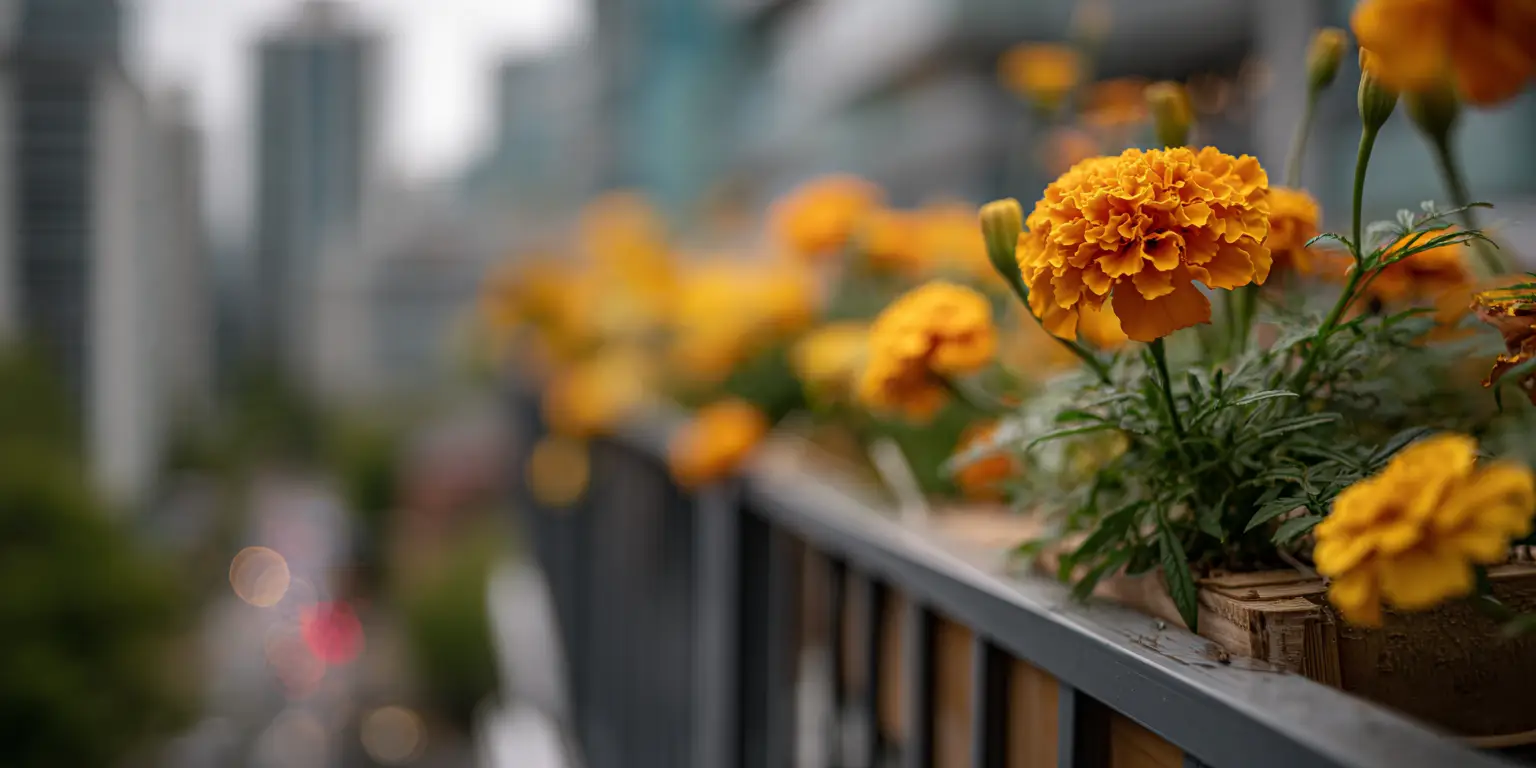
Whether the plant is in a container on a balcony. This is a recurring container-specific pattern in the sample, with several posts naming conditions above 90 F, and one Ask Extension expert answered a real case with a recommendation for 40 percent UV shade cloth through the worst of summer.
Whether it wipes off or sits under the leaf. This is a genuine fork between a powdery fungal coating on the leaf surface, favoured by high humidity and poor air circulation, and spider-mite stippling on the underside in hot dry weather, and at a glance both read as something pale on the leaf.
Whether a sibling plant from the same seed packet in the same bed is blooming. Posters consistently report exactly that, which rules out a blanket cause and points at something plant-specific, and two real Ask Extension tickets converged on the same three answers: too much nitrogen, insufficient direct sun, and heat.
The crown and the roots, by lifting one plant. The Connecticut Agricultural Experiment Station describes Rhizoctonia solani root rot as general wilting, decline and collapse together with browning and rotting of the roots and the crown, followed by yellowing and death of the outer leaves, which is a whole-plant endpoint rather than a recoverable wilt.
The bud surface, for holes and black specks. NC State, Colorado State and Iowa State all describe tobacco budworm caterpillars attacking developing flower buds so that damaged buds do not open, with irregular or round holes and small black specks of excrement on the bud, and all three name marigold as a favoured host.
Whether full sun is actually unobstructed, and whether the seedlings are crowded. Several posters report the stretching happening even in full sun, which is why the standard add-more-light answer is not enough on its own: crowding produces the same response as low ambient light.
Whether the damage happened overnight and at seedling stage. Marigold seedlings are singled out as a favoured slug target in multiple posts alongside hostas and dahlias, including one gardener whose marigolds had been planted specifically to guard basil and were eaten down to the stems before they leafed out.
Whether the growth is the same plant or a volunteer seedling beside it. No marigold survives winter as a true perennial in any zone; what happens in zones 9 to 11 is that fall-germinated volunteers from open-pollinated types overwinter and bloom earlier the following year.
Read this row as a floor rather than a measurement. It is the genuinely under-counted half of the repellent question above, and for a structural reason: aphids on a marigold are photographable the same day, while nematode suppression happens invisibly, underground, across a two-month cover-crop cycle with no single moment to photograph. One post in this sample asks how to blend marigolds into a plant tea to skip the tilling step, which is a gardener who already knows the real method well enough to find it inconvenient.
The stem at the soil line. University of Minnesota Extension describes a thin, pinched, thread-like stem and a toppled seedling, calls the disease difficult if not impossible to reverse, and names overwatering and soil temperatures below 68 F before germination or above 77 F after emergence as the conditions that favour it.
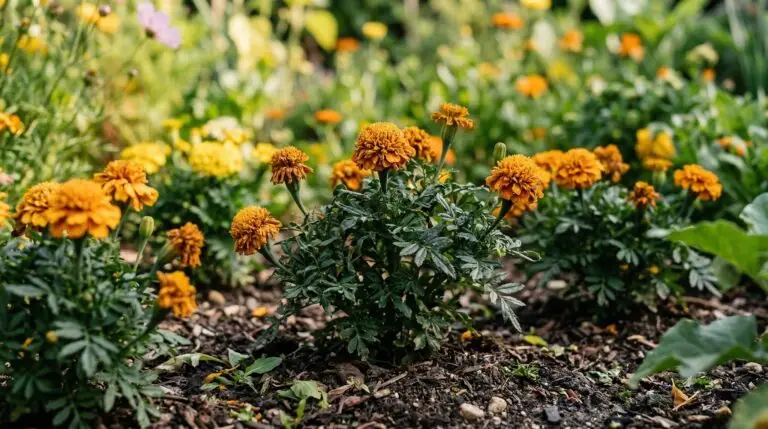
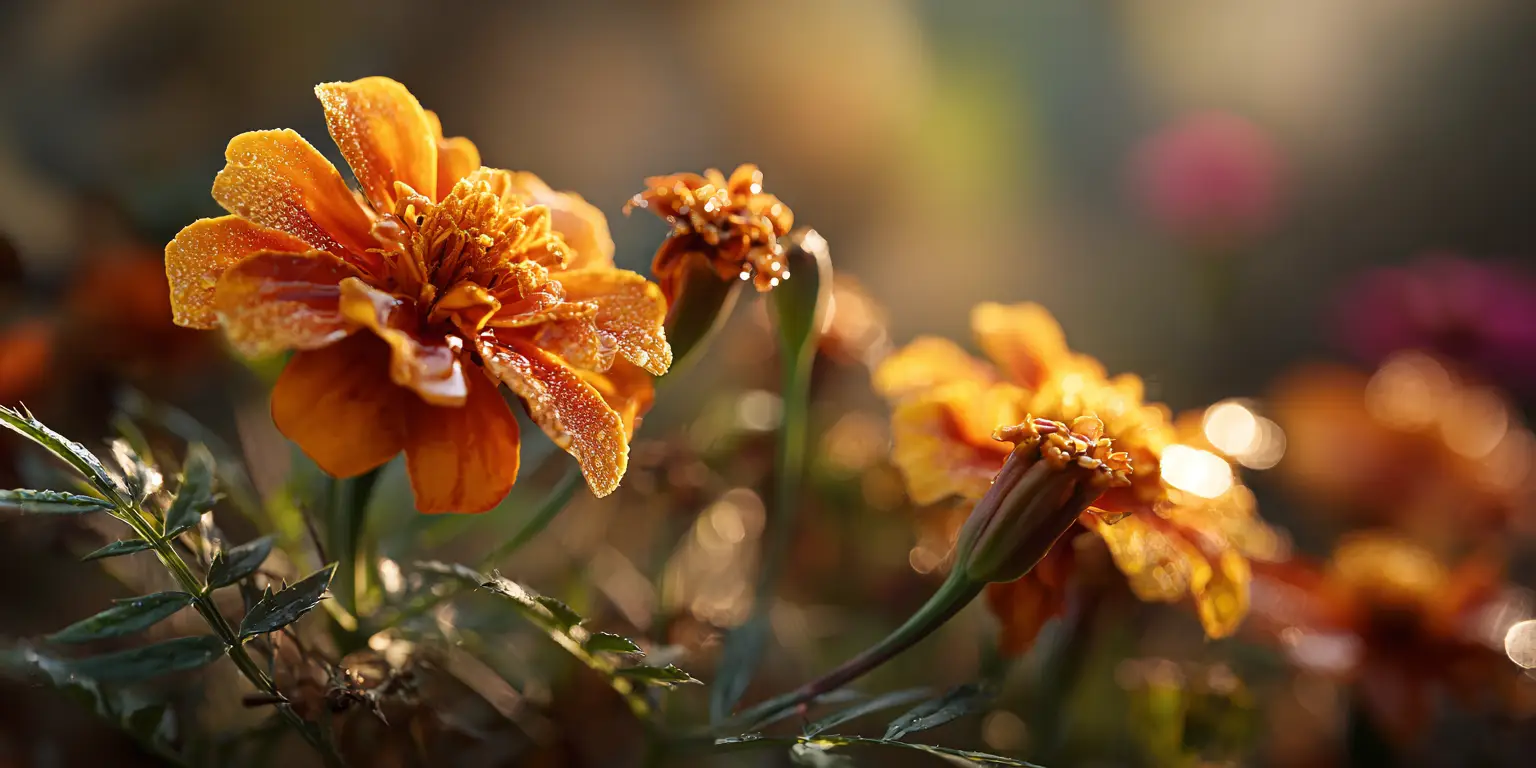
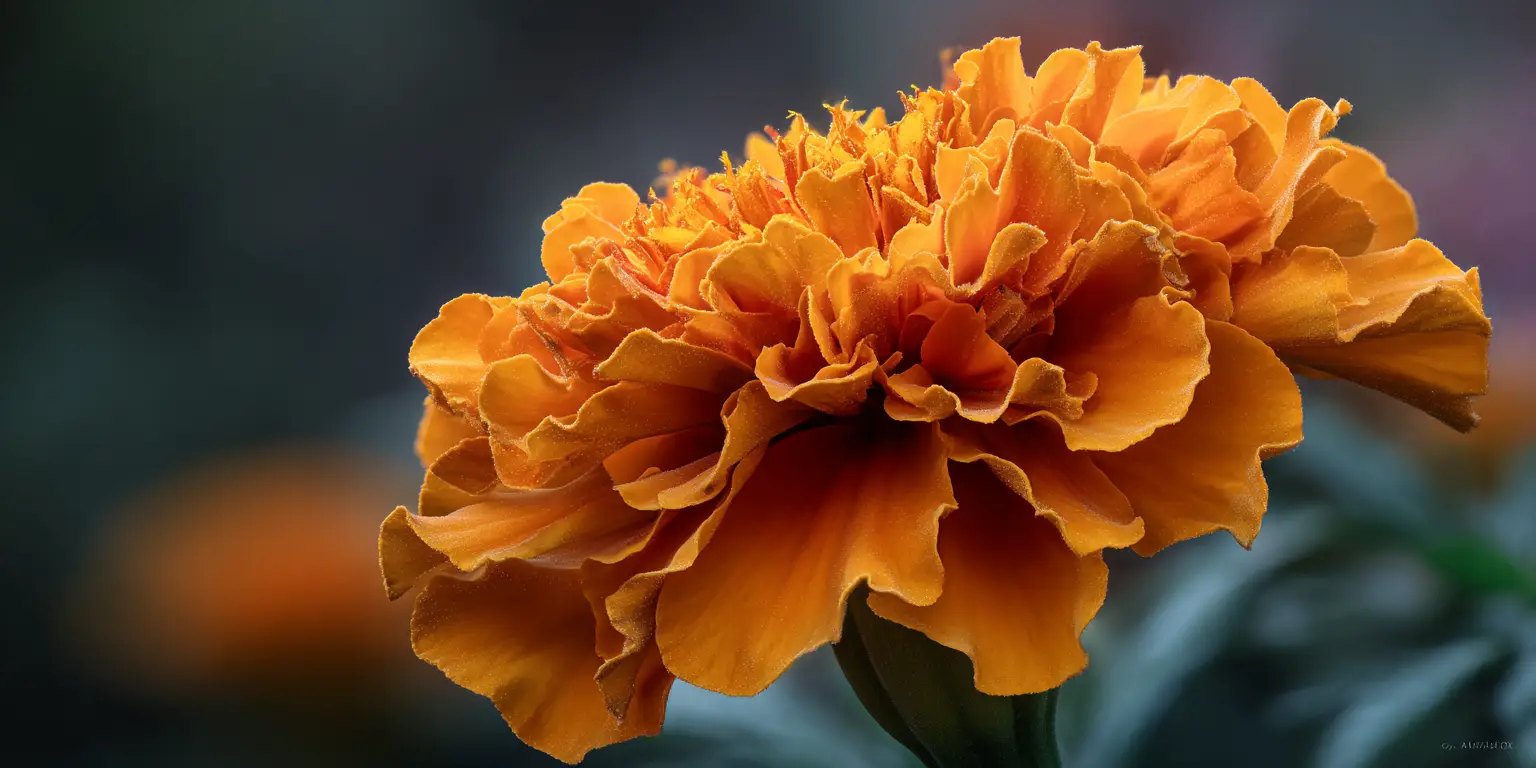
Flower photos
FAQ
What is the difference between African and French marigolds?
African marigolds (Tagetes erecta) are the tall type, reaching 1 to 3 feet with big, full, round flower heads in yellow, gold, and orange, best at the back of a bed or for cutting. French marigolds (Tagetes patula) stay shorter and bushier at 6 to 18 inches, with smaller blooms that often show two-tone gold and mahogany coloring. French types also handle rain and humidity a little better, since their small flowers dry faster, which is why they are the usual choice for edging and containers.
Do marigolds really repel pests, nematodes, and mosquitoes?
Partly, and only in one case strongly. French marigolds grown as a dense cover crop for a full season do suppress root-knot nematodes in that soil, but a few plants scattered among vegetables accomplish little. The claim that marigolds repel most insects or mosquitoes is largely folklore, since the scent has at most a mild, local effect and pests still settle on the plants. The one dependable benefit is that deer and rabbits usually leave marigolds alone.
Why did my marigolds stop blooming in midsummer?
A midsummer stall is usually heat combined with inconsistent watering, and the plants normally rebound as the weather eases and moisture stays steady. Skipped deadheading and overly rich, high-nitrogen soil are the other common causes, the first because seed set slows new buds and the second because it drives leaves instead of flowers. Keep them watered, pinch off spent heads, and hold back on fertilizer.
Are marigolds annuals or perennials?
Most marigolds are grown as annuals and complete their life in one season, dying back at the first frost and needing replanting each spring. In frost-free areas, roughly USDA zones 9 to 11, they can linger and self-sow like short-lived perennials. A few relatives, such as Tagetes lemmonii, the Mexican marigold, are truly perennial in mild climates, but for ordinary French and African marigolds it is safest to plan on planting fresh each year.
Are marigolds safe for pets and people?
They are low-risk. Extension references rate marigolds low in toxicity, with the mild caveats that eating a large amount can cause stomach upset and that the sap may irritate sensitive skin. It is always worth discouraging a pet from chewing garden plants, but marigolds are not grouped with the genuinely toxic ornamentals.
Can I grow marigolds in pots or start them indoors?
Marigolds thrive in containers, as long as the pot has drainage holes, holds a quality potting mix, and sits somewhere with full sun; just check the moisture more often, since pots dry faster than open ground. Starting seeds indoors on a bright windowsill four to six weeks before the last frost works well, but growing marigolds to flower fully indoors is hard, because they need strong direct light and usually disappoint without a grow light.
How do I collect and save marigold seeds?
Toward the end of the season, let a few healthy flowers dry on the plant instead of deadheading them. When the heads turn brown and papery, pull them off and break them apart over a tray or paper towel. You will find long, slender seeds that are dark on one end and pale on the other. Let the seeds finish drying for a day or two if needed, then store them in a labeled paper envelope in a cool, dry place. Saved seed usually stays usable for a couple of years. If the parent plant was a hybrid, seedlings may not match exactly. Open-pollinated varieties are more consistent from seed.
Why are they so tall? And why aren't they blooming?
Most likely too much nitrogen in the soil, not enough direct sun, or the ordinary slower timeline of a direct-sown plant against a transplant. The real case this question came from is instructive: the marigolds had been planted where pansies and a magnolia grew before, and Ask Extension's Master Gardener answer was to stop fertilizing and let the plant deplete the existing soil nutrients for the rest of the season rather than add anything.
How do I deal with root-knot nematode in my soil? I tried to grow marigold but I cannot find any nursery selling it.
Buying nursery plants would not have been the method anyway. Clemson HGIC's tested approach is a solid, dense planting no more than 7 inches apart, grown a minimum of two months and then tilled into the soil before the vegetable crop goes into that same ground, with the planting kept free of grass and weeds throughout because nematodes will feed on those roots instead. Cultivar matters too: Clemson names specific French and African cultivars with a documented effect rather than treating all marigolds as equivalent.
Seeing white spots on my marigold plant leaves. Thought it could be spider mites, but I do not see any.
Check the undersides specifically, and check the weather. Spider mites sit on the leaf underside with fine webbing, eggs and shed skins, and NC State and University of Maryland Extension describe them as reddish or light green with two dark spots and roughly the size of a period on a page, active in hot dry conditions. If the coating is on the leaf surface and reads as powdery rather than as fine stipple, and the weather has been humid with poor air movement, powdery mildew is the likelier answer.
I know aster yellows can cause this, but I do not feel like that is it.
A fair instinct, and there is a way to check it. The Connecticut Agricultural Experiment Station describes aster yellows as producing long axillary breaks that create a yellowish witches' broom, with stunted plants and small, distorted flowers that sometimes show green petals instead of colour. Plain uniform yellowing without that structural deformity is much more likely a nutrient or watering problem. Michigan State University Extension confirms marigold as a susceptible host and names leafhoppers as the vector, so the disease is real, it just looks like more than a colour change.
They start to get really tall and leggy and will not stand upright. I have read it is because of light, but I always place them in full sun.
Worth a second look rather than the standard answer. Check whether full sun is genuinely unobstructed for six or more hours, since a few hours of shade from a nearby structure produces stretching identical to a low-light problem, and check whether the seedlings are crowded, because competition for light between crowded seedlings causes the same response as too little ambient light. Both Ask Extension experts consulted on real marigold cases in this research named insufficient light as a contributing factor.
Do marigolds kill beneficial nematodes?
Genuinely unresolved here. None of the nematode-suppression sources consulted in this research, Clemson HGIC or NC State Extension included, addresses whether the same marigold compounds affect beneficial, non-parasitic nematode populations. It is a sophisticated question that a real gardener asked, and it is left open rather than answered by extrapolating from the pest-nematode research.
Interesting tips
The simplest way to keep marigolds flowering is to deadhead them, snipping spent blooms back to a pair of leaves so the plant pours its energy into new buds rather than seed. Their real value in the vegetable garden is narrower than the tradition suggests: a solid, weed-free block of French marigolds grown for a season genuinely knocks back root-knot nematodes in that soil, while a handful dotted among the tomatoes is mostly decoration, welcome as it is. Where deer and rabbits are a nuisance, a border of marigolds is one of the more reliable plants to reach for, since browsers dislike the pungent foliage. The petals earn their keep in other ways too, with the citrus-flavored blooms of signet types like 'Tangerine Gem' and 'Lemon Gem' scattered over salads, and marigold pigment long used as a natural dye and added to poultry feed to deepen the color of egg yolks. And the flower carries meaning as much as utility, standing at the center of Day of the Dead altars in Mexico and strung into celebratory garlands across India and South Asia.
- Deadhead regularly. Remove faded flowers to keep the plant looking neat and to encourage more buds. Pinch or snip off spent blooms so the plant puts its energy into new growth.
- Good for companion planting. Marigolds are often planted near vegetables, and French marigolds are sometimes used to help reduce certain soil nematodes over time. They also add quick color around beds and paths.
- Often deer and rabbit resistant. Many gardeners find that deer and rabbits avoid marigolds because of the strong foliage scent. They can be useful along borders where browsing is a regular problem.
- Edible and useful blooms. The petals of some marigolds are edible, especially signet marigolds such as "Tangerine Gem" and "Lemon Gem." They can add color to salads and garnishes. Marigold petals have also been used as a natural dye, and extracts are used in food and feed coloring.
- Cultural significance. In Mexico and parts of Central America, marigolds (especially Tagetes erecta) are used during Day of the Dead observances. In India and South Asia, marigold garlands are common for weddings and festivals.
Related Guides & Flowers
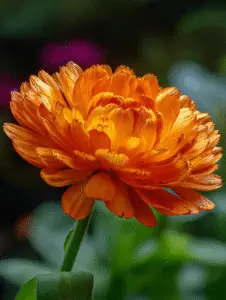
Calendula
Warm season annual with daisy like orange and yellow blooms, often called pot marigold. Works well near marigolds as a bright edging plant and in herb or cottage style beds.
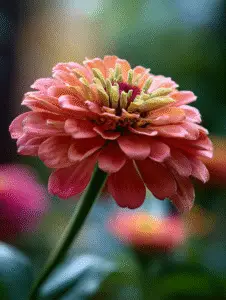
Zinnias
Sun loving annuals with bold colors from yellow and orange to red and magenta. They flower for a long season and combine well with marigolds in hot, dry borders and cutting gardens.

Coreopsis
Cheerful yellow daisy like flowers on airy stems, usually more drought tolerant than marigolds. Good partner for informal pollinator beds and naturalistic borders.
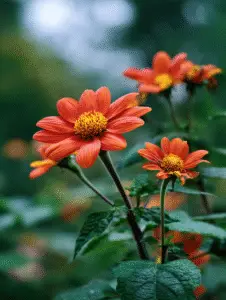
Mexican sunflower
Tall annual with big orange daisy flowers that attract butterflies and bees. Plant behind marigolds to build a hot color theme from low to high layers in sunny beds.

Butterfly weed
Perennial milkweed with strong orange flower clusters and very high value for pollinators and monarch caterpillars. Works well with marigolds in dry, sunny, low maintenance borders.
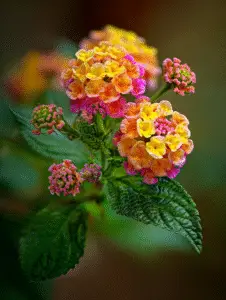
Lantana
Heat and drought tolerant flowering plant with clusters of yellow, orange, red, or mixed colors. Ideal with marigolds in containers and front yard beds in hot climates.
Goldenrod
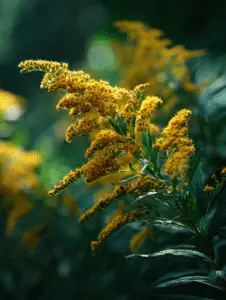
Late summer and fall spikes of golden yellow blooms that feed many pollinators. A good companion if you want to extend the warm color theme after marigolds begin to fade.
References
- Marigolds – University of Minnesota ExtensionCovers French, African, and signet marigolds with details on light, soil, spacing, bloom time, deadheading, and common problems, plus tips for containers and bedding displays.
- Marigolds – Wisconsin Horticulture Division of ExtensionExplains main Tagetes species, plant sizes, flower forms, colors, cultural needs, and typical insect and disease issues, with clear guidance for home gardeners.
- Marigold Common but Reliable – University of Missouri Integrated Pest ManagementArticle on marigold history, origin in the Americas, use by the Aztec people, movement through Europe, plus discussion of heat tolerance, low maintenance habit, and use for nematode and pest suppression in companion planting.
- Tagetes erecta African Marigold – NC State Extension Gardener Plant ToolboxDetailed plant profile with height and spread range, soil pH range, light preferences, bloom season, fragrance, wildlife value, and notes on low severity poison characteristics and possible skin irritation from sap.
- Common Plants Whats Poisonous and Whats Not – University of Wisconsin ExtensionToxicity list for common garden and house plants, including an entry for marigold listed as non toxic, useful for your toxicity and pet safety paragraph.
Enjoying our flower guides? Add YourFlowersGuide as a preferred source on Google. It helps more readers find us.
Add to Preferred Sources