Graduation flowers: the right pick by school level, color and how long it has to last
A high school graduate wants something bright and a little loud, flowers that show up well in every cap-toss photo: sunflowers, gerbera daisies, or a

The right graduation flowers, by school level
A high school graduate wants something bright and a little loud, flowers that show up well in every cap-toss photo: sunflowers, gerbera daisies, or a mixed bouquet in cheerful, saturated color. It reads as fun because it's supposed to. A college graduate usually calls for something a step more composed. Garden roses, whose color meanings shift from romance to friendship depending on the shade, or lisianthus and calla lilies, read as more finished and more "adult," the kind of arrangement that looks intentional next to a cap and gown instead of grabbed off a grocery shelf on the way out the door. For a masters, nursing, or military graduate, quieter is often the better instinct. A small posy or a single boutonniere can say more than another cut-flower bouquet, especially if this isn't the first ceremony they've sat through this year. As one commenter put it about giving flowers to a nursing-program graduate, it's "always a nice surprise," and that's really the standard worth aiming for at any level: something that fits the person and the day, not just the biggest bunch in the cooler.
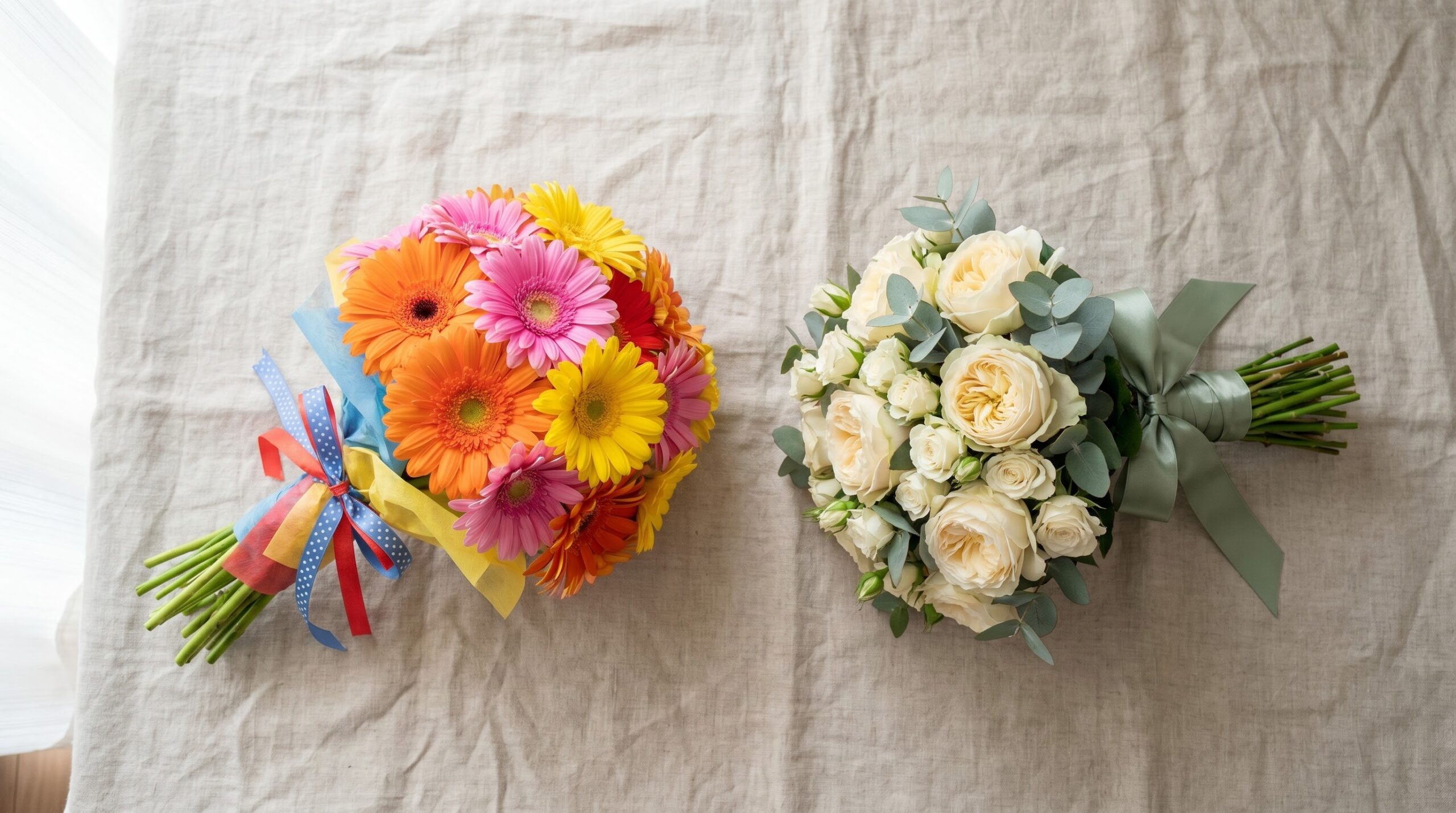
None of this is a requirement, and it's worth saying plainly. "Flowers are not a requirement," one graduate wrote online, adding that a lot of people mostly get them for the photos. That's honest, and it's fine. It's also common enough for graduates to buy flowers for themselves, a small, deliberate kindness rather than a gift from someone else. "I bought myself some flowers for graduation," one wrote. "Trying to be kind to myself." The tradition has real footing beyond retail marketing: the Emily Post Institute lists a corsage, boutonniere, or bouquet among the fitting ways to mark the day. What sunflowers mean and why gerbera daisies read as cheerful both come down to the same simple logic: bright, open-faced flowers photograph as joy, and that happens to be exactly what a high school ceremony calls for.
Matching the color to school colors or a cap and gown
If you know the school's colors, use them. That's the one piece of color logic real people actually reach for. One relative picked red roses for a teenage cousin's graduation "cause the colors of his school is red and white," and it's the kind of small, specific gesture that reads as thoughtful rather than random. A florist trend that has spread on TikTok takes this further, matching bouquet color to the gown itself rather than just the school's palette, choosing wraps and ribbon that complement the fabric underneath instead of fighting it. It's a good instinct, and it costs nothing extra to ask for at the counter.
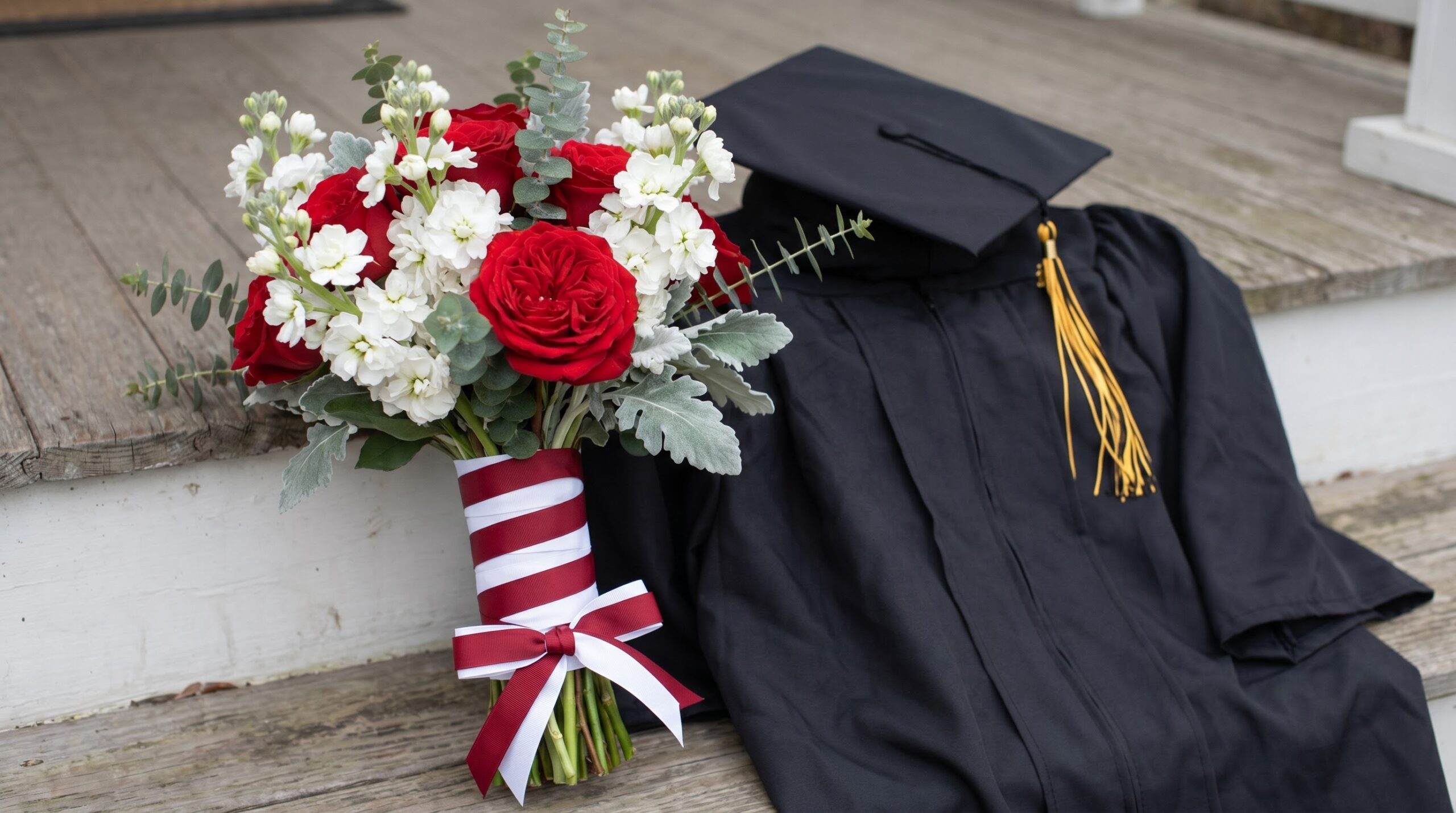
But don't force it if you don't know the colors, or if the school's palette is something like maroon and gold that doesn't translate cleanly into flowers. A safe, classic choice, white and green, soft pastels, or a single strong color like yellow, works everywhere and offends no one. One caution worth carrying, briefly: in some East Asian traditions, all-white flowers and white or yellow chrysanthemums specifically are associated with funerals and mourning rather than celebration, so an all-white arrangement isn't automatically the safe, neutral default it might look like on a flower-shop shelf. A single stem or an accent color sidesteps the issue entirely. If you're choosing for someone whose traditions you don't know well, the fuller picture of what different flower colors say at a celebration is worth the extra read.
Building a bouquet that survives a three-hour ceremony
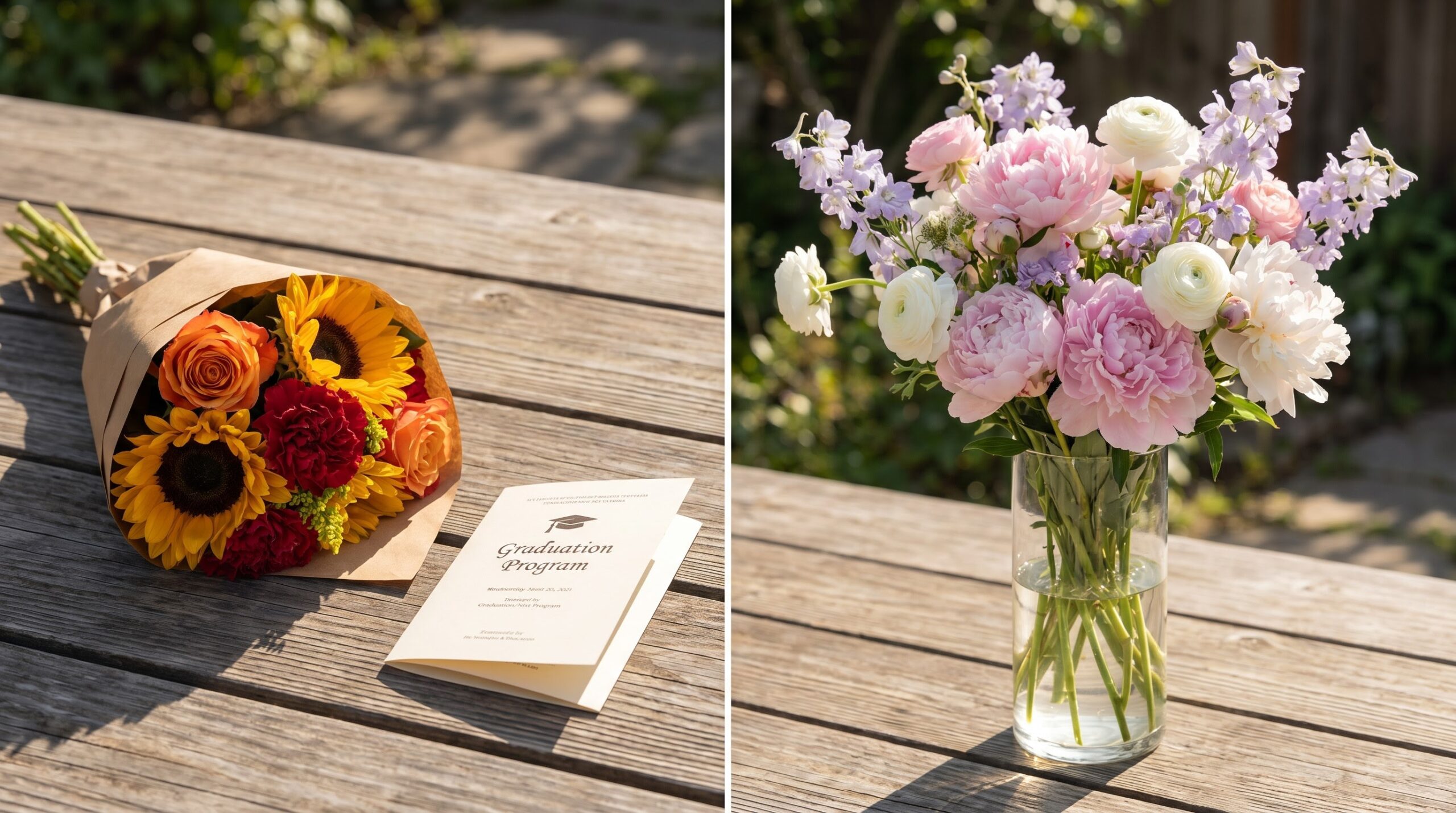
Here's the part almost nobody talks about honestly: a graduation ceremony runs long, often outdoors, often in May or June heat, and the graduate will be holding, hugging, and getting photographed with whatever you hand them for hours before it ever reaches water. A tall vase arrangement is the wrong shape for that job. It has to sit somewhere, it tips in a lap, and it turns "here, congratulations" into a logistics problem for someone already juggling a cap, a folder of documents, and everyone else's gifts. The fix is simple: go compact and hand-tied, wrapped in paper or twine rather than set in floral foam, with sturdy stems that hold up in direct sun for hours. Fresh Sends, one of the graduation-flower delivery brands, gets at this in a single line, noting that smaller, well-structured bouquets are easier to carry. That's really the whole rule. Roses, carnations, sunflowers, and gerbera daisies all survive an afternoon outside without much fuss. Ranunculus, peonies, and anything with delicate, papery petals do not. They bruise and droop within an hour of full sun, a bad trade for a flower that usually costs more to begin with.
| Milestone | What reads right | Solid picks | Color call | Format built for the day |
|---|---|---|---|---|
| High school | Bright, playful, photo-ready | Sunflowers, gerbera daisies, bright dahlias | School colors welcome and expected | Compact hand-tied bouquet, no vase |
| College | A step more composed, more "adult" | Garden roses, lisianthus, calla lilies | School colors as an accent, not the whole bouquet | Structured hand-tied bouquet, sturdy wrap |
| Masters, nursing, or military | Quieter, more restrained | Cream or white roses, eucalyptus-forward, or skip the bouquet | Neutral tones; avoid loud color-blocking | Boutonniere or small posy, carried one-handed |
Swipe →
What to give when they already have four vases of flowers
This is the fear underneath the whole question, and it's a real one. "My daughter got 4 vases full of flowers for graduation," one parent wrote. "They were dead for days and all I could think was what a hassle it was going to be to dump them all, wash and dry the vases, put them back in storage and then clean up the pollen and dead flowers left behind." If the graduate has already sat through a class party, a family dinner, and a formal ceremony this season, a sixth identical bouquet isn't really a gift at that point, it's another vase to wash and find room for. A few options solve this without giving up on flowers as an idea entirely.
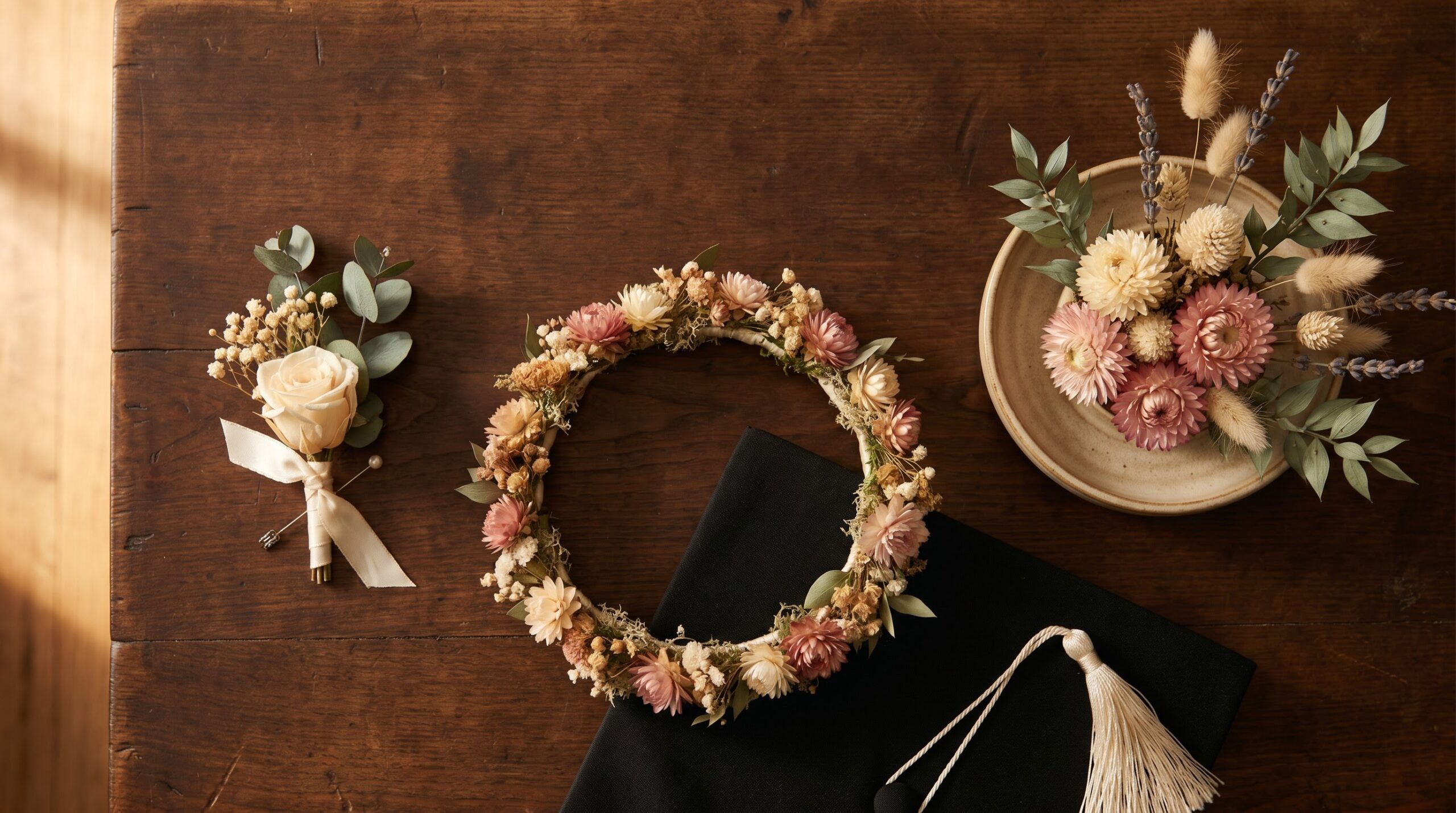
A fake or dried arrangement is one real choice, and more than one family has picked it on purpose. "For each of my graduations, my mom had a professional bouquet of fake flowers made for me," one graduate recalled, and it lasted the whole season instead of three days. A boutonniere or corsage instead of a full bouquet works too, small enough to pin on and forget, with none of the vase problem at all. A flower crown for the cap turns the gift into something worn rather than something carried and eventually thrown out. And splitting the cost of one shared bouquet solves the multiplication problem directly: "Get everyone to chip in $5 to $10 and buy one nice bouquet," as one graduate suggested, or have the friend group order matching bouquets together so nobody ends up with a redundant sixth vase. Any of these still counts as a real, thoughtful gift. It just respects that a graduate's apartment, dorm room, or childhood bedroom isn't an infinite vase factory.
Money bouquets, leis, and whether to DIY or just buy
A simple hand-tied bouquet from a grocery store or florist runs somewhere around $45 for something presentable, a useful number to have in mind before you walk in and get talked into something bigger. That price also explains why so many people skip the florist counter and build something themselves instead: a money bouquet folded from cash into fan shapes and wired onto stems, or a graduation lei, a tradition rooted in Hawaiian and Pacific Islander culture that has spread well beyond the West Coast, made from real flowers, ribbon, or folded bills. Both live almost entirely on YouTube and Pinterest right now, which is its own signal: this is a craft people genuinely enjoy making, judging by how much of it gets filmed and shared. If that's more your speed than a straightforward bouquet, the lei and money-bouquet traditions that turn graduation flowers into a craft project deserve their own explanation, including which venues restrict them and how to wear one respectfully, rather than a rushed paragraph here.
One thing worth knowing before you commit: this is a project that rewards lead time. Florists who make custom flower leis need real lead time to build one properly, so a same-day request is often impossible. If the ceremony is this weekend and you're only discovering the lei idea today, a straightforward bouquet is the better call for this year. Save the DIY route for a graduate you know well in advance is walking a stage.
Graduation flowers, quick answers
Can you give a guy flowers for graduation?
Yes, and it lands better than most people expect. It's a question that deserves a real answer rather than a one-liner, so the full case for giving a son, boyfriend, or friend flowers for graduation gets its own page.
When should you actually hand over the bouquet?
Timing matters more than people expect, and so does the venue: some arenas and stadiums won't let you carry flowers through the door at all. Getting that right before the ceremony rather than during it is covered in full in its own guide.
What are graduation leis and money bouquets?
They're a real, growing DIY tradition rooted mostly in Hawaiian and Pacific Islander culture, covered briefly above and in more depth in its own guide, including venue rules and how to wear one respectfully.
What is the 3-5-8 rule for flowers?
It's a simple ratio florists use when building a bouquet by hand: three focal flowers as the main attraction, five stems of greenery for structure, and eight smaller filler flowers to fill the gaps. Most florists treat it as a loose starting point rather than a fixed formula.
What is a traditional college graduation gift?
There isn't one single answer. Cash, gift cards, and practical items for post-grad life like luggage or professional clothing are the most common defaults, with flowers and a card as the accompanying gesture alongside the main gift.
Whichever level, color, and carry format you land on, decide those three things before you reach the counter. That's the real difference between a graduation bouquet that becomes vase number five and one that actually gets remembered.