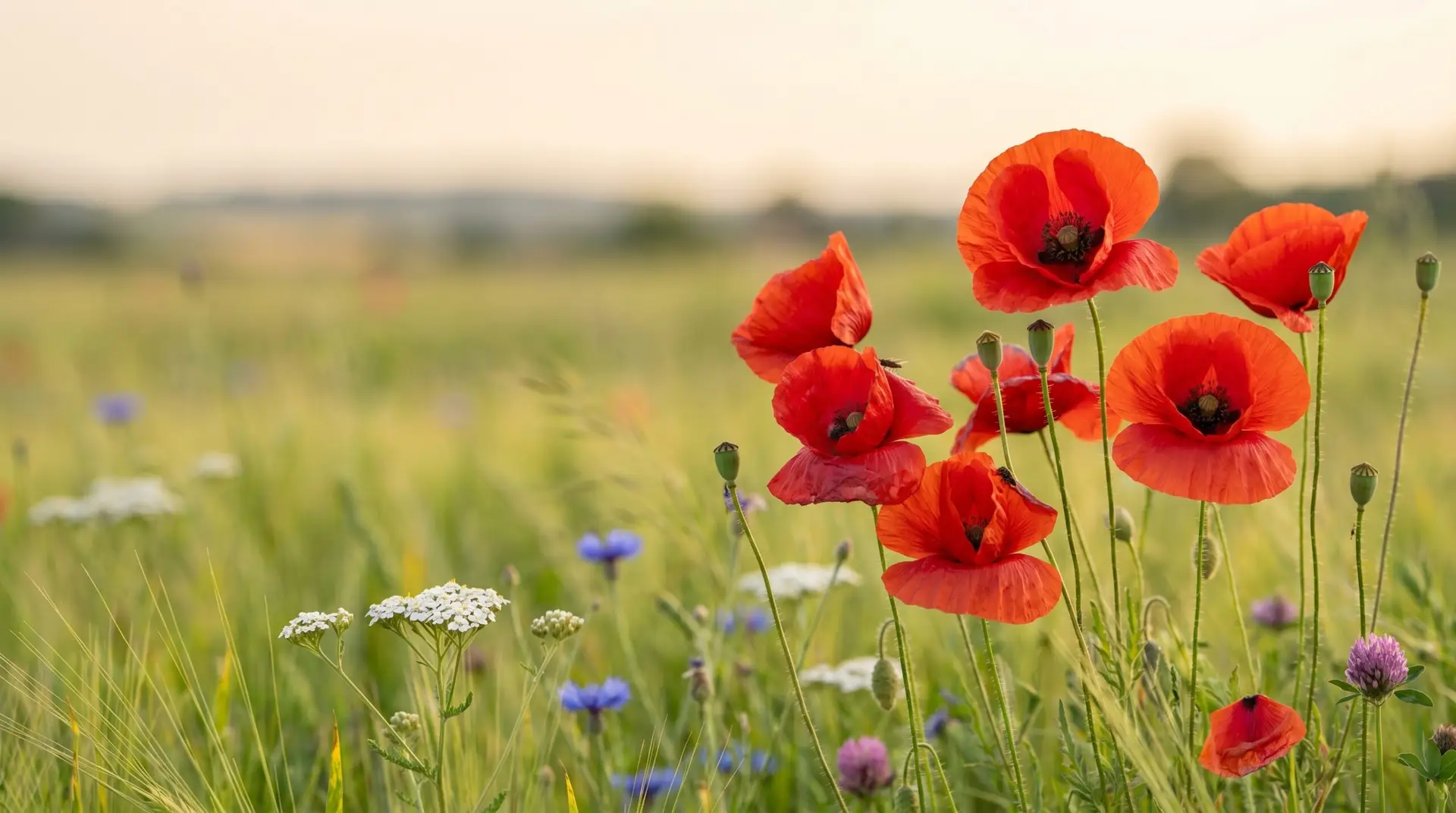
Poppy is August’s secondary birth flower in Western tradition. Where gladiolus signals strength and Roman heritage, poppy signals consolation, peaceful sleep, and active remembrance through its modern military memorial associations. The flower refers primarily to the genus Papaver in the family Papaveraceae, with several other related genera (Eschscholzia, Meconopsis, Romneya) sometimes included under the broader “poppy” common name.
The poppy holds an unusually dual cultural register in modern times. The Victorian floriographic tradition assigned consolation, peaceful sleep, and imagination to the flower (the latter from the opium poppy’s pharmacological associations). The twentieth-century remembrance tradition, fixed by World War One commemoration, gave the red field poppy (Papaver rhoeas) the universal symbolism of military commemoration that now dominates the flower’s cultural reading across English-speaking traditions. The flower’s combined gentle-and-grave register makes poppy particularly appropriate for occasions that combine warmth with reflective depth.
In this guide 7 sections
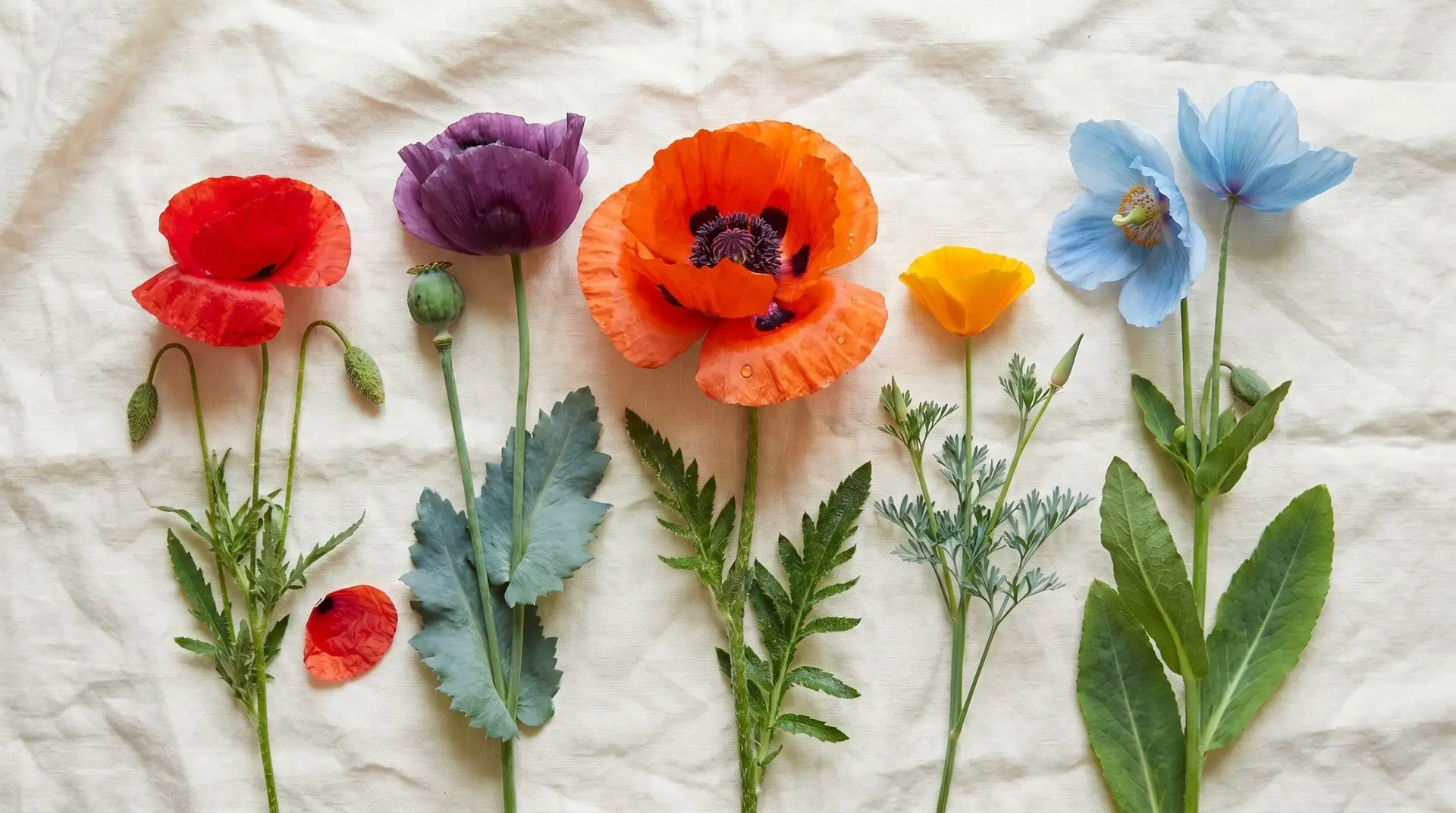
Poppy botany: Papaver species and relatives
The genus Papaver contains approximately 70 species native to temperate Europe, Asia, and North Africa. The most culturally and horticulturally significant species are the following.
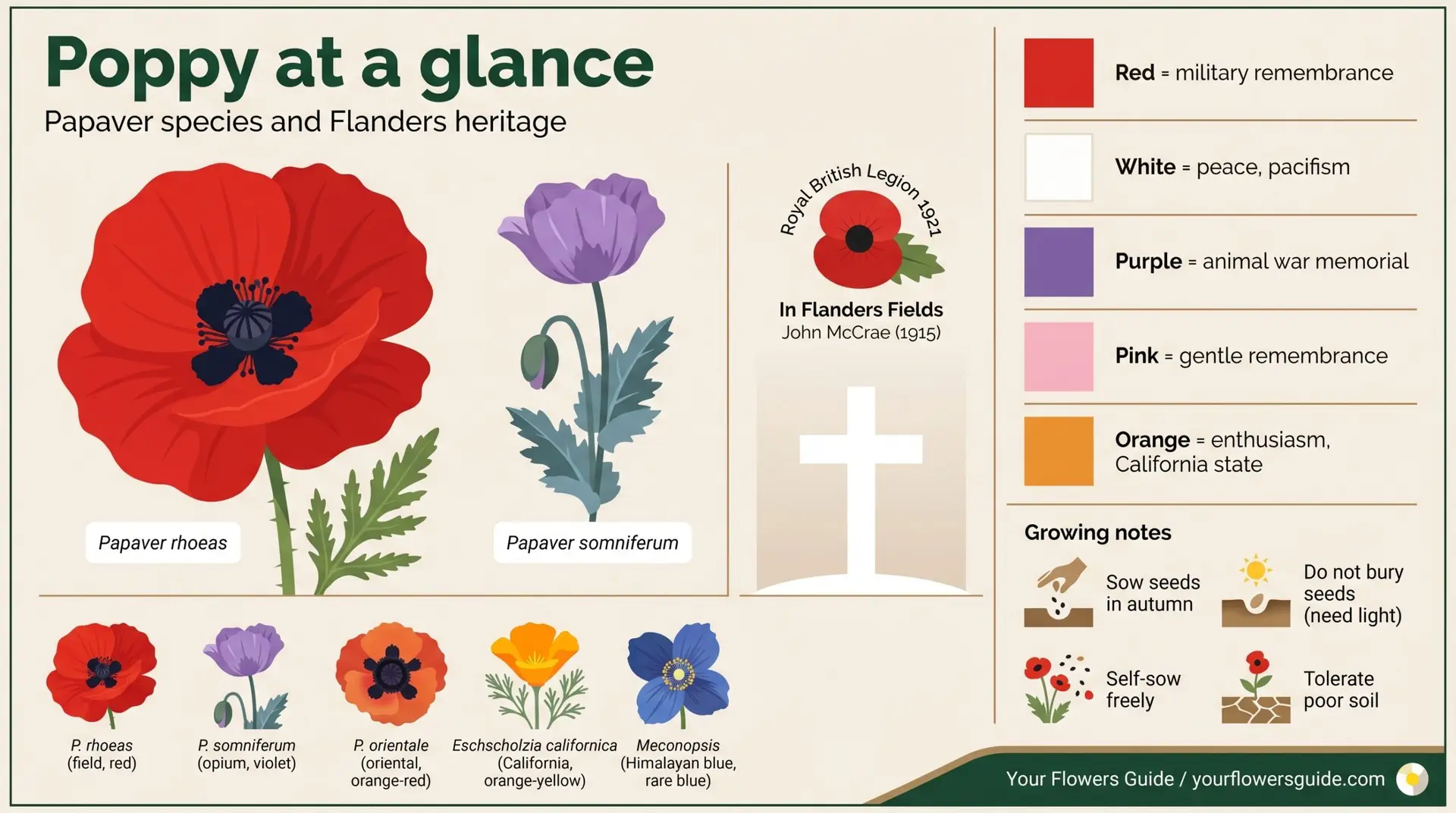
Papaver rhoeas (common field poppy, Flanders poppy, corn poppy). The bright red annual poppy of European agricultural fields and the species fixed in twentieth-century English-speaking culture as the universal symbol of military commemoration. The plant grows 12 to 24 inches tall with delicate four-petal red flowers (occasionally pink or white in cultivated varieties such as the Shirley series) showing characteristic dark central blotches at the petal bases. Self-sows freely in disturbed soil, producing the distinctive bright red color across cornfields and battlefield landscapes.
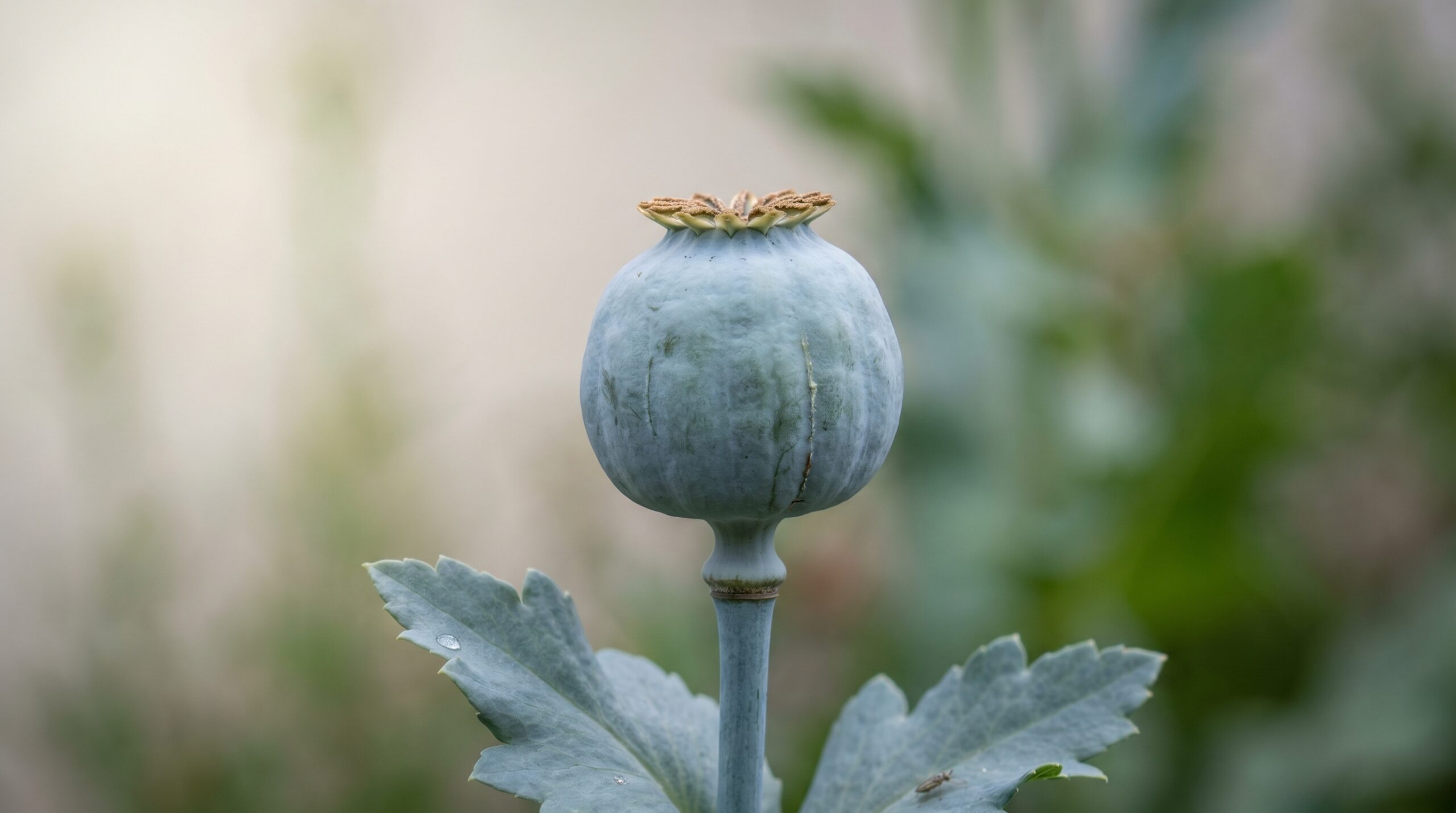
Papaver somniferum (opium poppy, breadseed poppy). The cultivated poppy historically grown for opium production, with attractive violet, pink, or white flowers and the distinctive blue-grey foliage that distinguishes the species visually. The seed capsules contain the dried sap that produces opium and the derived alkaloids morphine, codeine, thebaine, and papaverine. Ornamental cultivation is permitted in most jurisdictions; commercial cultivation for opium production is heavily regulated. The seeds used in baking (poppy seed bread, bagels, cakes) come from this species; the seeds themselves contain minimal alkaloids despite their origin.
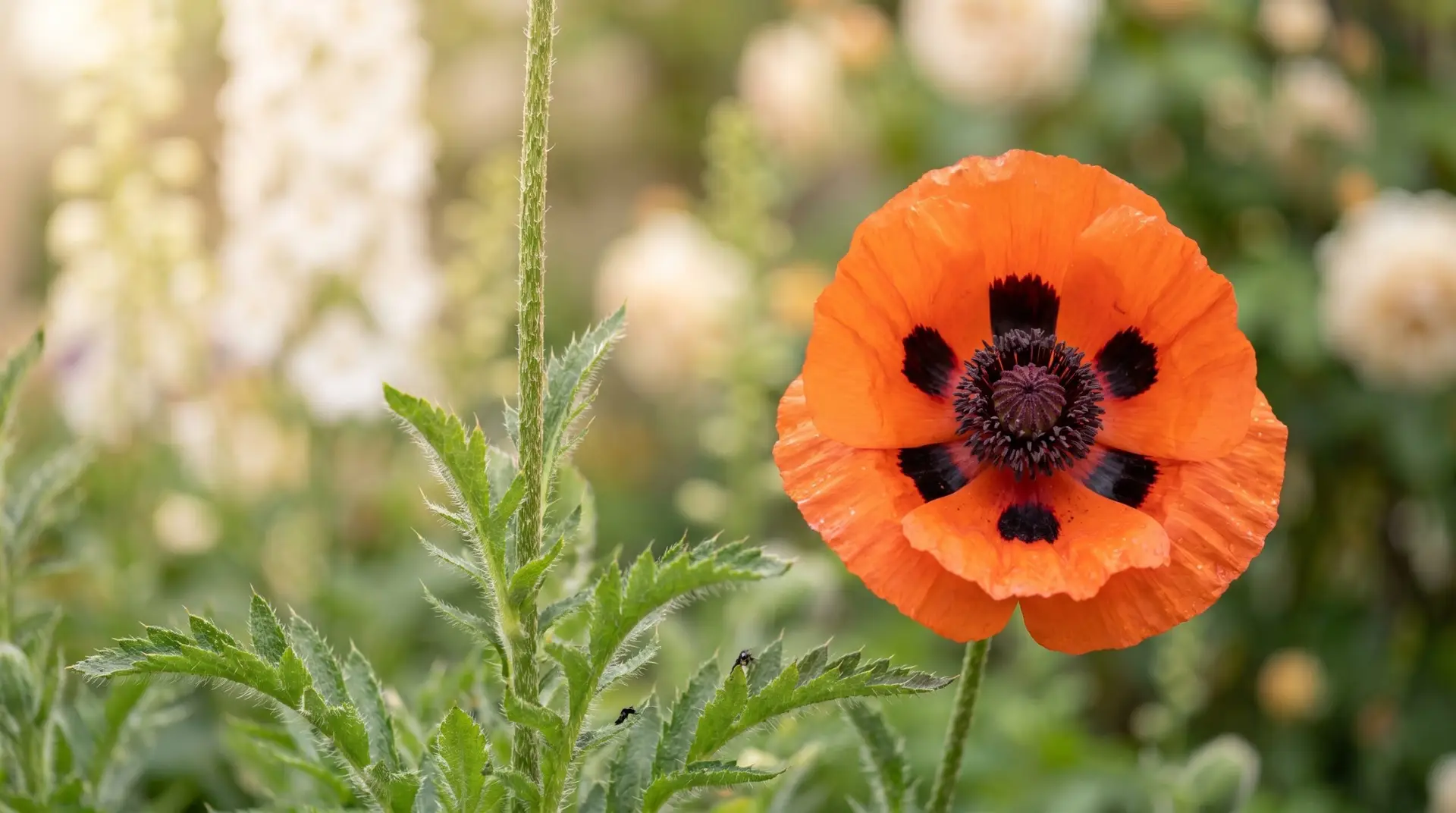
Papaver orientale (oriental poppy). The large perennial poppy with brilliant orange-red, salmon, or scarlet flowers reaching 4 to 6 inches across, growing 24 to 36 inches tall. Native to Caucasus and Turkey; widely cultivated in temperate gardens for its dramatic spring-to-early-summer bloom. The plant dies back to dormancy after flowering, with foliage reappearing in autumn before winter dormancy and bloom returning the following spring.
Eschscholzia californica (California poppy, golden poppy). Not a true Papaver but commonly called “poppy.” The official state flower of California. Native to western North America with bright orange-yellow flowers and fine deeply divided blue-green foliage. Annual or short-lived perennial depending on climate; self-sows reliably.
Meconopsis (Himalayan blue poppy, Welsh poppy, and related). Specialty poppies including the rare and difficult-to-cultivate true blue Himalayan poppy (Meconopsis betonicifolia and related species). These are gardener’s challenge plants requiring specific cool moist conditions.
Papaver alpinum (Alpine poppy). Smaller compact poppy growing in alpine and rock garden settings, with yellow or orange flowers.
The visual distinction across all Papaver species centers on the characteristic crumpled paper-like petal texture that gives the genus its visual character. The petals open from tightly furled buds in just a few hours, often showing wrinkles on the freshly opened bloom that smooth out over the brief flower life. The dark central seed capsule develops after the petals fall, providing the distinctive cup-shaped or rounded form that persists as a dried decorative element long after the flower itself has finished.
The Flanders Fields tradition
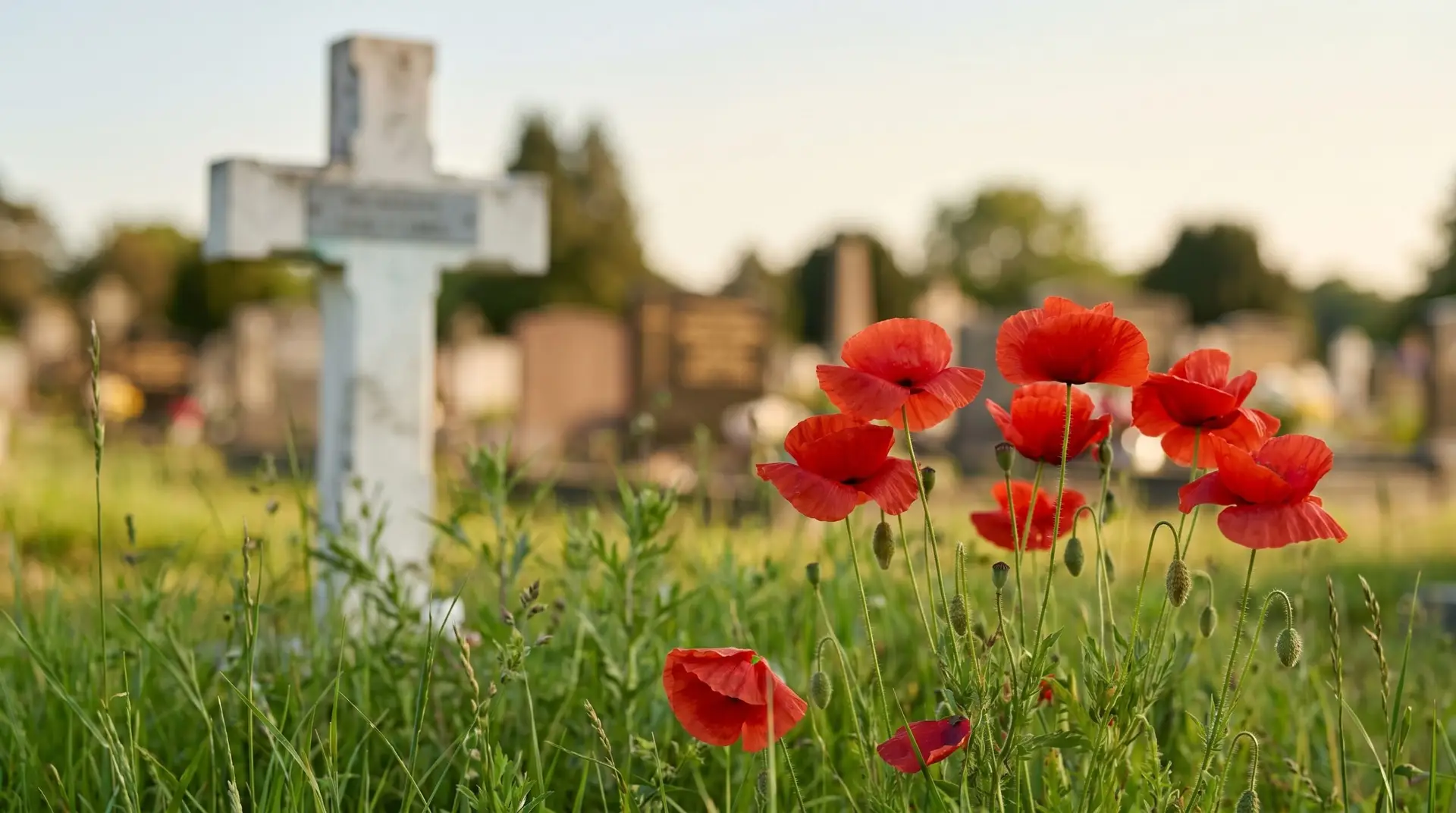
The dominant modern symbolic reading of poppy comes from World War One commemoration tradition fixed by the John McCrae poem “In Flanders Fields” (1915). The poem and the associated red poppy tradition transformed Papaver rhoeas from an ordinary European wildflower into the universal symbol of military commemoration across English-speaking countries.
The botanical and historical background: red field poppies grew naturally in the disturbed earth across Flanders battlefields in northern France and Belgium after major World War One battles. The dormant poppy seeds present throughout the agricultural soil germinated readily in the freshly turned and shell-disturbed earth, producing dense bloom across battlefield areas in the spring and early summer following each major engagement. The visual association between the bright red flowers and the recent war casualties provided the natural symbolic basis.
John McCrae was a Canadian military physician serving with the Canadian Expeditionary Force at the Second Battle of Ypres (April-May 1915). After the death of a close friend in the battle, McCrae wrote the poem “In Flanders Fields” while serving at a field aid post in the area. The poem was first published in Punch magazine in December 1915 and rapidly became one of the most widely circulated war poems in English-speaking countries.
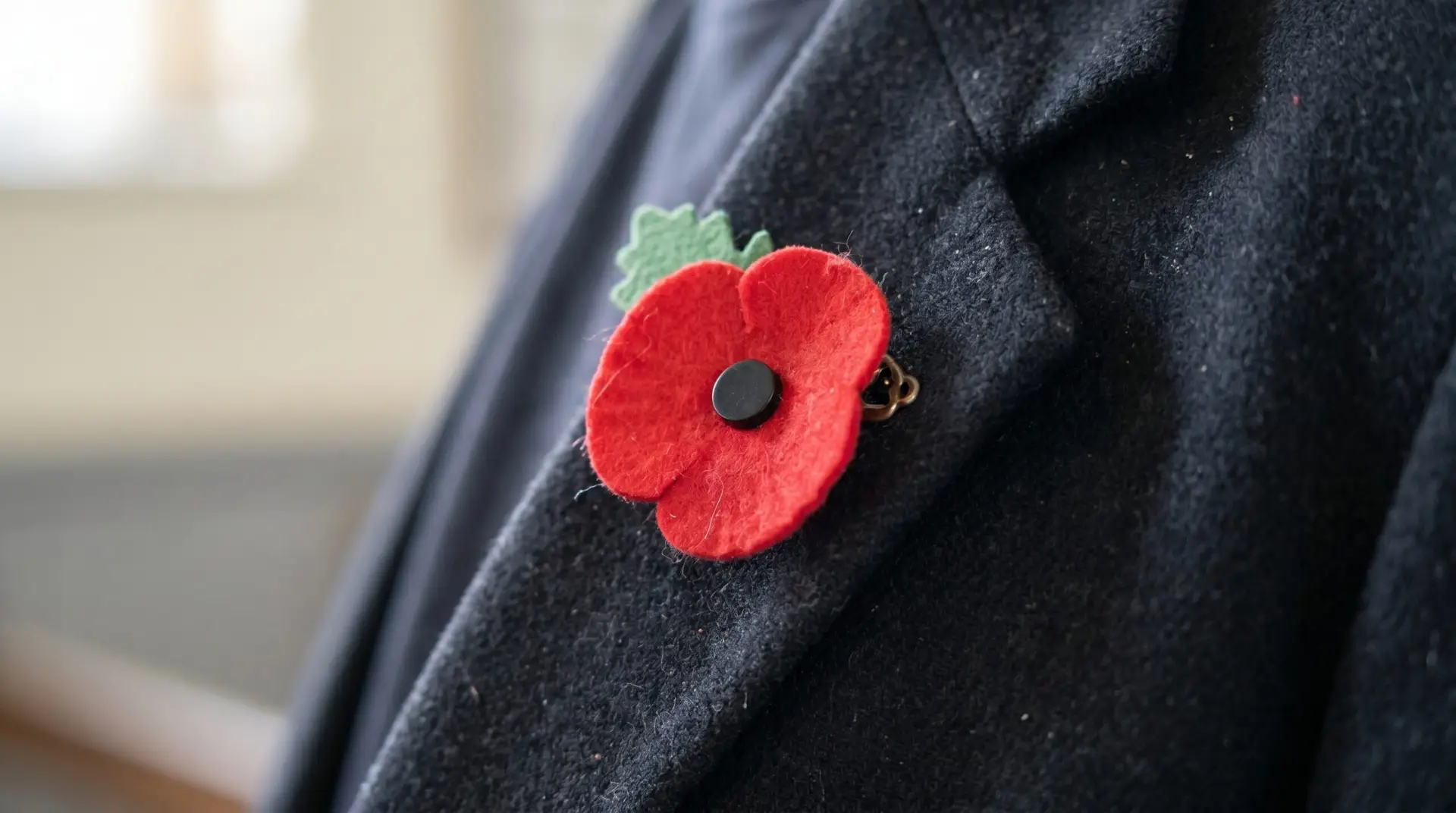
The institutional adoption of the poppy as a remembrance symbol followed within years of the poem’s publication. Moina Michael, an American academic and poet, was inspired by McCrae’s poem to wear and distribute red poppies in honor of war dead, beginning the modern remembrance poppy tradition. The American Legion adopted the poppy as its official memorial flower in 1920. The Royal British Legion launched the first British Poppy Appeal in 1921, with artificial poppies sold to raise funds for veterans and to provide visible remembrance markers. Canada, Australia, New Zealand, and other Commonwealth countries adopted the poppy similarly during the 1920s.
The annual rhythm of poppy remembrance follows specific dates in each country. Remembrance Day (UK, Canada, Australia, New Zealand, and other Commonwealth countries) falls on November 11, commemorating the armistice that ended World War One in 1918. Memorial Day (United States) falls on the last Monday of May, commemorating American war dead from all conflicts. Both holidays involve widespread poppy wearing and visible poppy displays at memorial events.
The Royal British Legion Poppy Appeal continues as the largest annual poppy-distribution program globally, with an estimated 40 million artificial poppies distributed annually across the United Kingdom in the weeks leading up to Remembrance Day. The American Legion poppy program continues at smaller scale. Veterans’ organizations across Commonwealth countries maintain similar programs.
The cultural depth of the poppy as remembrance flower means that wearing a poppy outside the appropriate commemorative context can read as inappropriate or disrespectful in some cultures, particularly the United Kingdom where poppy wearing is tightly linked to November 11 commemorative season. Use of poppy imagery in contexts unrelated to military memorial may need cultural sensitivity, particularly in the weeks leading up to Remembrance Day.
Color symbolism across poppy types
Poppy color shifts the symbolic reading significantly:
Red poppy (Papaver rhoeas): military remembrance, sacrifice, eternal honor. The dominant modern symbolism through the World War One Flanders Fields tradition. Used in remembrance commemorations and military memorial contexts.
White poppy: peace, pacifism, opposition to war. The white poppy was introduced in the United Kingdom in the 1930s by the Peace Pledge Union as an alternative remembrance symbol emphasizing peace rather than military sacrifice. The distinction has sometimes generated controversy but the white poppy has maintained its peace-symbolic role for nearly a century.
Purple poppy: animal war memorial. Introduced more recently to commemorate animals killed in military service (horses, dogs, pigeons, and others). The purple poppy is worn alongside or instead of the red poppy by readers wishing to acknowledge animal war service alongside human sacrifice.
Pink poppy (Shirley poppy series, pink cultivars): gentle remembrance, soft affection. The pink color shifts the symbolic register toward warmer relational warmth while retaining the remembrance theme. Often used in domestic flower arrangements rather than in formal memorial contexts.
Orange poppy (Papaver orientale orange varieties, California poppy): enthusiasm, creative energy, summer abundance. The orange color reads less as remembrance and more as bright summer expression. California poppy specifically has California state symbolic register.
Black poppy (Papaver somniferum dark cultivars): mystery, depth, contemplative grief. The dark color suits unconventional memorial registers and dramatic floral statements where the wearer wants distinctive symbolic weight.
The most culturally significant single color is red, which dominates the modern poppy symbolic vocabulary through the WW1 commemorative tradition. Other colors provide alternative or complementary readings but cannot fully replace the red poppy’s universal remembrance recognition.
The opium poppy and its history
The opium poppy (Papaver somniferum) holds an extraordinary place in human history through its pharmacological significance. The species has been cultivated for at least 5000 years, with archaeological evidence of opium poppy cultivation in Neolithic European settlements from approximately 3000 BC and earlier Mesopotamian written references to “joy plant” or “happiness plant” identifying the species in cuneiform records from approximately 2500 BC.
The active pharmacological compounds in opium poppy include morphine, codeine, thebaine, papaverine, and noscapine, all derived from the dried sap (opium) produced by the seed capsules when scored before maturity. These compounds have legitimate and important medical uses (morphine for severe pain management, codeine for cough and moderate pain, thebaine as precursor for various pharmaceutical opioids) and also significant addictive potential and recreational drug history.
The historical use of opium spans medical, recreational, ceremonial, and commercial categories. Ancient Greek and Roman medical writers (Hippocrates, Galen) discussed opium as legitimate medical treatment for pain and insomnia. Medieval Islamic and European medical traditions continued opium use. The eighteenth and nineteenth century opium trade between European powers (particularly Britain) and China produced the First and Second Opium Wars (1839-1842 and 1856-1860) that opened Chinese markets to European trade and resulted in the British annexation of Hong Kong. The twentieth century saw increasing regulation of opium trade culminating in international treaties (Hague Convention 1912, Single Convention on Narcotic Drugs 1961) that established the modern regulatory framework.
Modern opium poppy cultivation continues legally in several countries (Australia, France, India, Turkey, and others) for pharmaceutical manufacturing. Illegal opium poppy cultivation continues primarily in Afghanistan, Myanmar, Mexico, and Colombia for heroin and other illicit opioid production.
For ornamental gardeners, the relevant regulatory framework typically permits Papaver somniferum cultivation for ornamental purposes in most jurisdictions. Commercial harvest of opium or processing of poppy sap is heavily regulated. Some US states have stricter regulations than others; the United Kingdom permits ornamental cultivation without restrictions for personal garden use. Gardeners interested in cultivating Papaver somniferum for the attractive ornamental flowers should check local regulations before planting.
The seeds used in baking (poppy seed bread, bagels, cakes) come from Papaver somniferum. The seeds themselves contain minimal alkaloid content despite their species origin, but poppy seed consumption can produce small amounts of opioid metabolites in urine that may affect drug testing results.
Growing poppies in the garden
Poppies have different cultivation requirements depending on species and life cycle.
Annual poppies (Papaver rhoeas, Papaver somniferum). Direct-sow seeds in autumn (October to November in mild climates, late winter in colder climates) for spring and early summer bloom. Seeds require light for germination and should be surface-sown without burial. Self-sow freely in suitable conditions, producing volunteer plants from year to year. Plants reach 18 to 36 inches at maturity and bloom for 4 to 8 weeks before setting seed. Tolerate poor soils and dry conditions; do not require fertilization in most situations.
Perennial poppies (Papaver orientale, alpine and Himalayan species). Plant from container-grown specimens in autumn or early spring. Oriental poppies (P. orientale) tolerate most temperate climates but go dormant in summer after flowering, leaving bare soil for several months until autumn foliage regrowth. Alpine and Himalayan poppies require cooler conditions and more specific moisture management; success varies significantly by climate.
California poppy (Eschscholzia californica). Direct-sow seeds in autumn or early spring. Tolerates poor soils, drought, and full sun; struggles in heavy clay or wet conditions. Self-sows reliably in suitable climates. Bloom continues from late spring through autumn in California climates; shorter bloom periods in cooler or wetter climates.
All poppies dislike root disturbance once established. The taproot system characteristic of Papaver makes the plants difficult to transplant successfully. Direct seed sowing or planting from young pots produces better results than transplanting established mature plants.
Pests and diseases for poppies include aphids on new growth, powdery mildew in humid conditions, slug damage on seedlings, and root rot in poorly drained soils. Standard organic pest management approaches work for all four pest categories.
Poppy combines well in garden design with grasses, asters, agastache, and other prairie or meadow-style plants. The natural wildflower aesthetic of most poppy species suits meadow-style and informal garden designs better than formal bedding contexts.
Poppy in arrangements and gifts
Poppy as a cut flower is less commonly available than gladiolus because the delicate petals do not hold well after cutting and the individual flower life is only one or two days. Specialty florists may stock oriental poppy (Papaver orientale) in early summer; California poppy is rarely available as cut flower. The more accessible poppy gift category is seeds for the recipient’s own garden.
A packet of mixed Papaver seeds for autumn or early spring sowing costs from five to fifteen dollars and provides summer poppy blooms over the following year and beyond through natural self-seeding. The seed gift is particularly suitable for gardener recipients who appreciate the long-term cultivation rhythm and the wildflower aesthetic of poppy.
For commemorative or memorial gifts, an artificial remembrance poppy (the standard red field poppy form distributed by the Royal British Legion, American Legion, and equivalent veterans’ organizations) provides a meaningful symbolic gift. These poppies are typically sold for nominal contributions to veterans’ welfare programs, with the proceeds supporting veteran services. The gift suits memorial contexts honoring military service or commemorating fallen comrades.
A bouquet combining poppy with other late summer flowers (gladiolus as the August primary, summer roses, dahlias, or asters) creates a meaningful August birthday gift if oriental poppy or pink Shirley poppy is available from specialty florists. The combination provides the dual August birth flower reference and visual color variation.
For recipients with interest in World War One history or military commemoration, a poppy-themed gift combining either fresh red poppies (where available) or an artificial remembrance poppy with a book on Flanders Fields history or the John McCrae poem provides a culturally layered gift. The combination uses the flower as the primary symbolic element and the book or artifact as the educational supplement.
A jewelry piece with poppy motif work paired with peridot (the August birthstone) creates a coherent color and symbolic pairing for August birthdays. Several jewelry brands produce poppy-themed pieces specifically marketed for the August birthday and remembrance markets. Price tiers range from about forty dollars for simple poppy charms to several thousand dollars for fine commemorative pieces.
At a glance
Questions
Frequently asked
What does the poppy flower symbolize?
Consolation, peaceful sleep, and active remembrance. The Victorian readings included consolation and peaceful sleep (the latter from the opium poppy’s pharmacological associations). The dominant modern reading is military remembrance, fixed by the red field poppies that grew over Flanders battlefields after World War One and by the John McCrae poem “In Flanders Fields” (1915).
Why is the red poppy a symbol of military remembrance?
Red field poppies (Papaver rhoeas) grew naturally in the disturbed earth of Flanders battlefields after World War One battles, providing the visual association between bright red flowers and recent war dead. The John McCrae poem “In Flanders Fields” (1915) fixed this association in English-speaking remembrance tradition. The poppy is now worn on Remembrance Day (Commonwealth countries) and Memorial Day (United States) as the universal symbol of military commemoration.
What’s the difference between the red poppy and the white poppy?
The red poppy (Royal British Legion Poppy Appeal, American Legion) signals military remembrance and sacrifice. The white poppy (Peace Pledge Union, introduced 1930s) signals peace, pacifism, and opposition to war. The distinction sometimes generates controversy in commemorative contexts, but both colors have maintained their respective symbolic roles for nearly a century.
Is the opium poppy legal to grow?
Ornamental cultivation of Papaver somniferum is legal in most jurisdictions including most US states and the United Kingdom. Commercial harvest of opium or processing of poppy sap is heavily regulated. Check local regulations before planting if you have any concerns. The seed and ornamental garden use is typically permitted; the regulatory restrictions apply to extraction and processing of opium.
Why are poppies associated with sleep?
The opium poppy (Papaver somniferum) produces the alkaloid morphine, named after the Greek god of sleep Morpheus, because of its sedative pharmacological effects. The species name “somniferum” itself means “sleep-bringing” in Latin. The broader poppy symbolic association with sleep and consolation derives from these pharmacological characteristics of opium poppy.
Can I eat poppy seeds?
Yes, poppy seeds from Papaver somniferum are widely used in baking (poppy seed bread, bagels, cakes, pastries) and are legal in most jurisdictions. The seeds contain minimal alkaloid content but can produce small amounts of opioid metabolites in urine that may affect drug testing results. Poppy seeds are particularly significant in central and eastern European baking traditions.
What does the John McCrae poem “In Flanders Fields” say?
The poem was written in May 1915 by Canadian military physician John McCrae after the Second Battle of Ypres. The poem opens with “In Flanders fields the poppies blow / Between the crosses, row on row” and addresses both the war dead and the duty of the living to continue the cause. The poem first published in Punch magazine December 1915 and rapidly became the most widely circulated war poem in English-speaking countries, fixing the poppy as the universal symbol of military commemoration.
Are poppies hard to grow?
Annual poppies (Papaver rhoeas, Papaver somniferum) and California poppy (Eschscholzia californica) are among the easiest annual flowers to grow in suitable climates. Direct-sow seeds in autumn or early spring, do not bury (seeds need light for germination), and the plants establish themselves with minimal care. Perennial poppies (Papaver orientale) are also straightforward in suitable temperate climates. Himalayan blue poppy (Meconopsis) and similar specialty species are notoriously difficult and suit advanced gardeners only.
Can poppy seeds expire?
Poppy seeds remain viable for several years if stored in cool dry conditions, but viability declines gradually over time. Fresh seeds (within 1 to 2 years of harvest) germinate most reliably. Seeds older than 5 years may show reduced germination rates.
Sources
- Poppy (Papaver) · Encyclopedia Britannica
- Papaver growing guide · Royal Horticultural Society
Keep reading
August birth flower: gladiolus, poppy, and what they mean
August birth flowers by day: the Korean 365-day tradition
Gladiolus tattoo: meaning, designs, and Roman heritage
Birth flower by month: all 12 monthly flowers
Enjoying our flower guides? Add YourFlowersGuide as a preferred source on Google. It helps more readers find us.
Add to Preferred Sources