Most gardeners picture azaleas as dense, evergreen shrubs covered in spring flowers, but North America harbors a radically different lineage of these plants. Our native azalea species are entirely deciduous, dropping their leaves in autumn to conserve resources through the freezing winters of the Appalachian Mountains and eastern woodlands. These wild plants belong to the genus Rhododendron, sharing a close genetic relationship with their evergreen cousins from Asia, yet they have evolved completely distinct survival strategies. The leaves of a deciduous azalea are thinner and lack the heavy waxy cuticle found on evergreen varieties, making them highly efficient at photosynthesis during the short summer months but too fragile to survive hard frosts. By shedding their foliage, deciduous azaleas reduce water loss when ground moisture is locked up in ice, allowing them to channel their stored energy entirely into reproductive effort the following spring. When you encounter a wild azalea in the woods, you are looking at a plant that has perfectly calibrated its growth cycle to the rhythms of the North American deciduous forest.
Evolutionary adaptations of the wild azalea
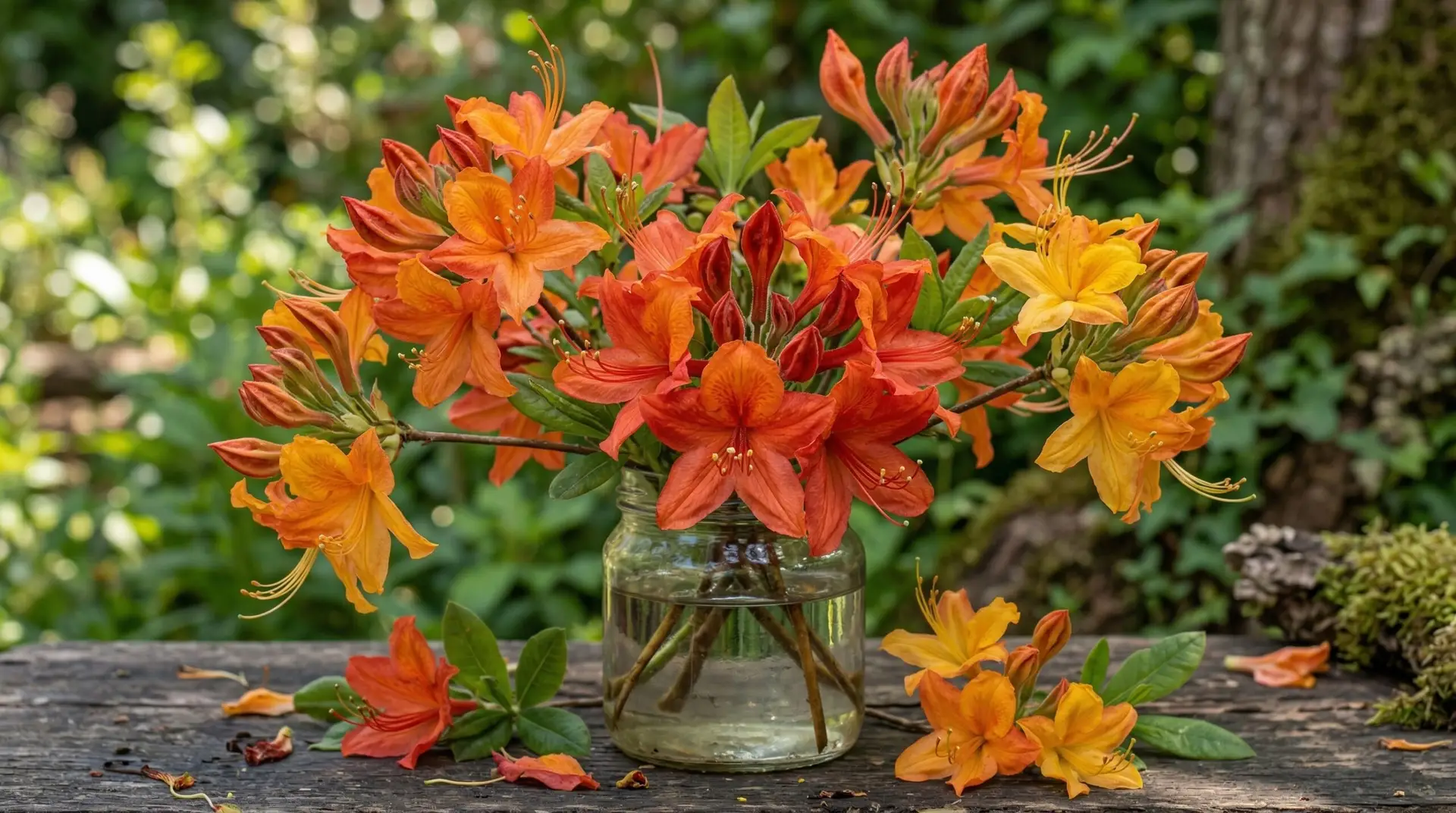
Consider the flame azalea (Rhododendron calendulaceum), a species that produces flowers in shades of yellow, orange, and red. The striking color variation in these flowers is a genetic response to the visual capabilities of their primary pollinators rather than a random occurrence. The blossoms feature long, sweeping stamens that extend far beyond the petals, acting as a specialized landing pad for large swallowtail butterflies. When a butterfly lands on these extended reproductive organs to reach the nectar hidden deep at the base of the floral tube, its wings brush against the pollen-bearing anthers. The pollen itself is bound together by sticky, thread-like structures called viscin threads, which ensure that large clumps of pollen attach securely to the insect. This precise mechanical design ensures that pollen is transferred efficiently from one plant to another across the sparse understory of the forest. Understanding this specific pollinator relationship explains why the flame azalea invests so much energy into producing large, brightly colored flowers in an otherwise shaded environment.
Fragrance and pollination in the woodland garden
While some species rely on bright colors to signal pollinators, others use complex chemical compounds to attract insects through the dense forest understory. The pinxterbloom azalea (Rhododendron periclymenoides) and the sweet azalea (Rhododendron arborescens) produce highly volatile floral oils that carry easily through the damp spring air. These scent molecules are specifically formulated to attract bumblebees and sphinx moths, which can detect the fragrance from miles away and navigate directly to the nectar source. The volatility of these floral compounds increases as the ambient air warms, meaning the flowers release their strongest scent exactly when their target insects are most active. In a woodland garden, planting these fragrant species creates a continuous succession of resources for local insect populations. You can establish a thriving early spring ecosystem by pairing the pinxterbloom azalea with ephemeral wildflowers like Virginia Bluebells, which bloom in the same dappled sunlight conditions. Adding early flowering shade plants such as Hellebore provides nectar for the very first bees to emerge, sustaining them until the wild azaleas open their buds.
Late bloomers and the survival of the plumleaf azalea
Most woodland shrubs flower in the spring to take advantage of the sunlight before the canopy trees leaf out completely. The plumleaf azalea (Rhododendron prunifolium) breaks this biological rule entirely by waiting until mid to late summer to open its orange-red flowers. This delayed blooming period is a fascinating evolutionary strategy to secure undivided attention from pollinators when most other forest plants have already finished flowering and set seed. By shifting its reproductive window, the plumleaf azalea avoids competing with the massive spring bloom, ensuring that ruby-throated hummingbirds reliably visit its nectar-rich blossoms. The tubular shape of the plumleaf azalea flower perfectly matches the beak length of these hummingbirds, demonstrating a classic case of co-evolution. This species has a narrow native range, historically restricted to just a few counties along the Georgia and Alabama border where specific ravine microclimates protect it from extreme heat. Growing this specific deciduous azalea in your garden acts as a form of ex situ conservation, helping to preserve a unique genetic lineage that relies on a highly specialized ecological niche.
Soil biology and root architecture
The success of a native azalea in cultivation depends entirely on what happens below the soil surface. These shrubs possess exceptionally fine, hair-like root systems that lack the robust taproots found in many other woody forest plants. Because their roots are so delicate, they cannot penetrate heavy, compacted clay or survive in waterlogged conditions where oxygen is scarce. In their natural habitat, wild azaleas grow in the loose, decomposing leaf litter of the forest floor, relying heavily on symbiotic relationships with ericoid mycorrhizal fungi. These specialized soil fungi colonize the outer cells of the azalea roots, secreting enzymes that break down organic matter and deliver nitrogen to the plant in exchange for synthesized carbohydrates. The fungi also require a highly acidic environment to function properly, which is why azaleas naturally thrive in soils with a pH between 4.5 and 5.5. Understanding that this plant is a shallow-rooted species dependent on fungal partners explains why it requires acidic, organically rich soil to thrive in a cultivated setting.
When you observe a native azalea preparing to bloom, you are watching a complex biological sequence unfold that began many months prior. The flower buds actually form during the previous summer, sitting dormant on the bare branches through the freezing temperatures of winter. The plant uses the changing day length and rising soil temperatures of spring as chemical triggers to break dormancy and expand those buds, timing the floral display precisely to the emergence of local pollinators. Inside those swollen buds, the plant has already pre-formed the fully formed stamens and nectar-producing glands needed for reproduction. Every aspect of the wild azalea, from its deciduous habit to its specialized floral tubes, is a direct reflection of the forest environment that shaped it over thousands of years. Planting one of these native shrubs brings a piece of deeply evolved North American ecology right to your doorstep, allowing you to witness these ancient botanical relationships firsthand.
More About Azaleas
Encore azaleas that bloom three times a year for non-stop garden color
Azalea garden design ideas for a breathtaking spring landscape under trees
Common azalea pests and diseases and organic methods to control them
How to grow azaleas in containers for stunning patio and entryway displays
Growing azaleas in acidic soil and how to lower soil pH naturally
How to choose the right azalea variety for your garden soil and climate
Azalea flower meaning and their place in Japanese garden culture and symbolism
Why azalea leaves are turning brown or yellow and how to save your shrub