Sweet pea flower meaning: Edwardian heritage, fragrance, and growing
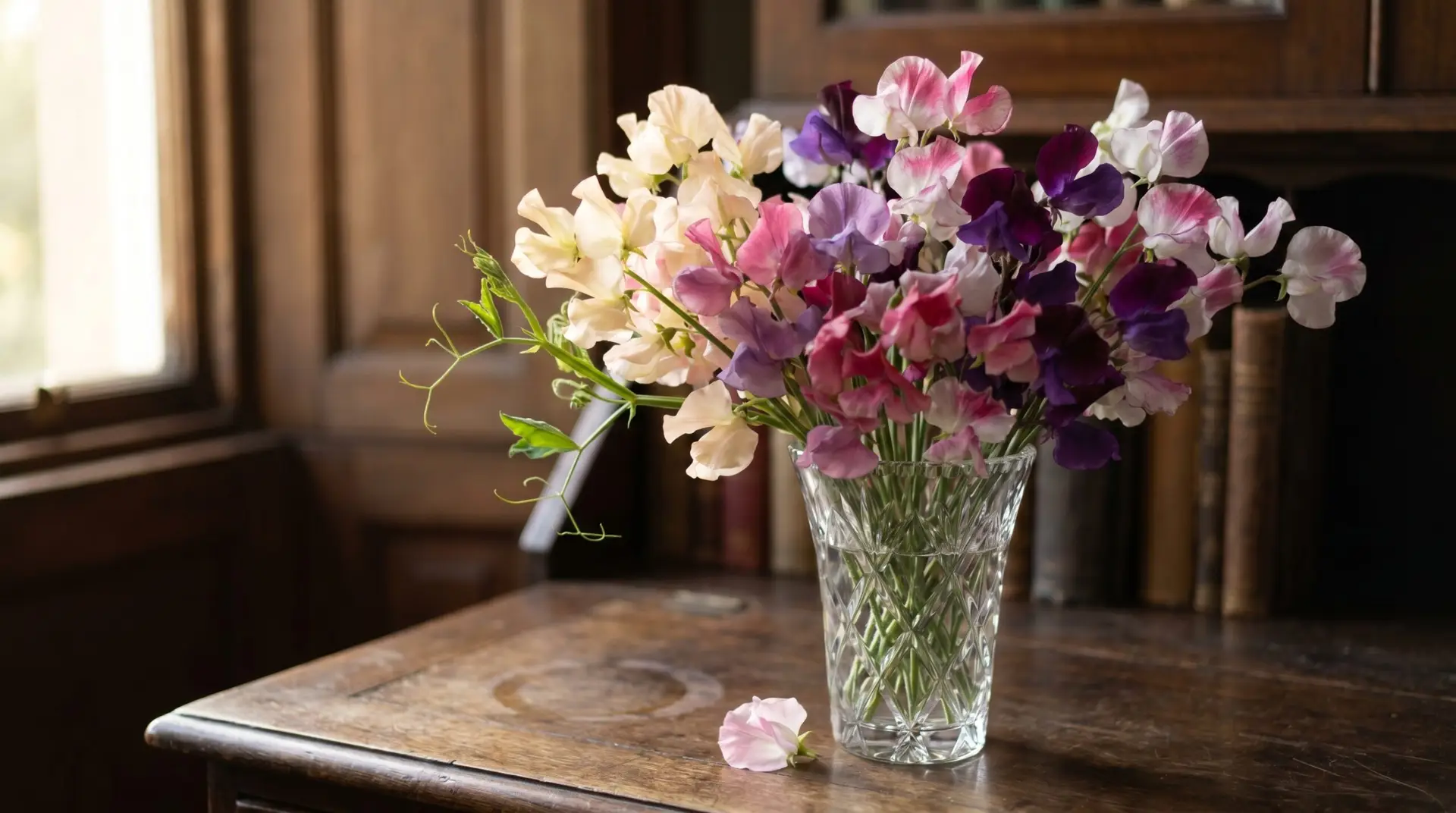
Sweet pea is April’s secondary birth flower in Western tradition. Where daisy stands for innocence and loyal love, sweet pea stands for blissful pleasure, gratitude for a lovely time, and gentle goodbye. The flower is Lathyrus odoratus in standard botanical naming, a Mediterranean annual climbing vine that has been cultivated in European gardens since 1699 and reached its peak ornamental popularity during the late Victorian and Edwardian eras (roughly 1880 to 1910).
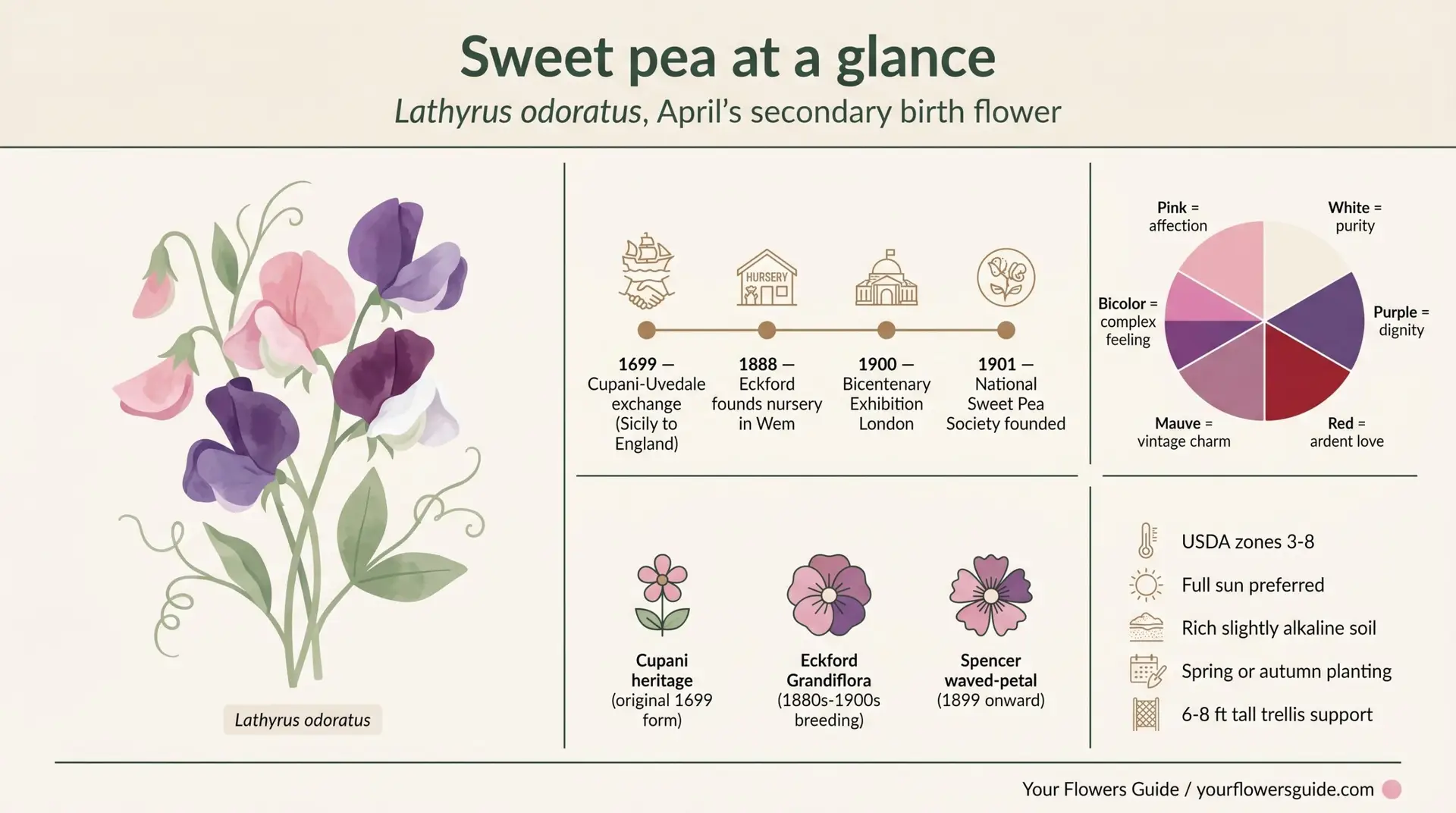
The modern sweet pea looks nothing like the wild Sicilian original. Scottish gardener Henry Eckford led the late-Victorian breeding work that transformed sweet pea from a small purple-blue Mediterranean wildflower into the elaborate fragrant cultivars that florists still stock today. The breeding history connects sweet pea to a specific traceable origin (Francesco Cupani’s 1699 seed exchange with Robert Uvedale), a documented era of intense horticultural development (Eckford’s nursery in Wem, Shropshire from 1888 onward), and a cultural peak that coincided with the broader Edwardian gardening obsession with fragrant ornamentals.
Sweet pea botany: Lathyrus odoratus
Sweet pea belongs to the genus Lathyrus in the family Fabaceae (the pea and bean family, also called Leguminosae). The genus Lathyrus contains about 160 species worldwide, with Lathyrus odoratus being the most culturally significant cultivated species. Native to Sicily, southern Italy, and the eastern Aegean islands, the species still grows wild in rocky coastal habitats throughout its native range.
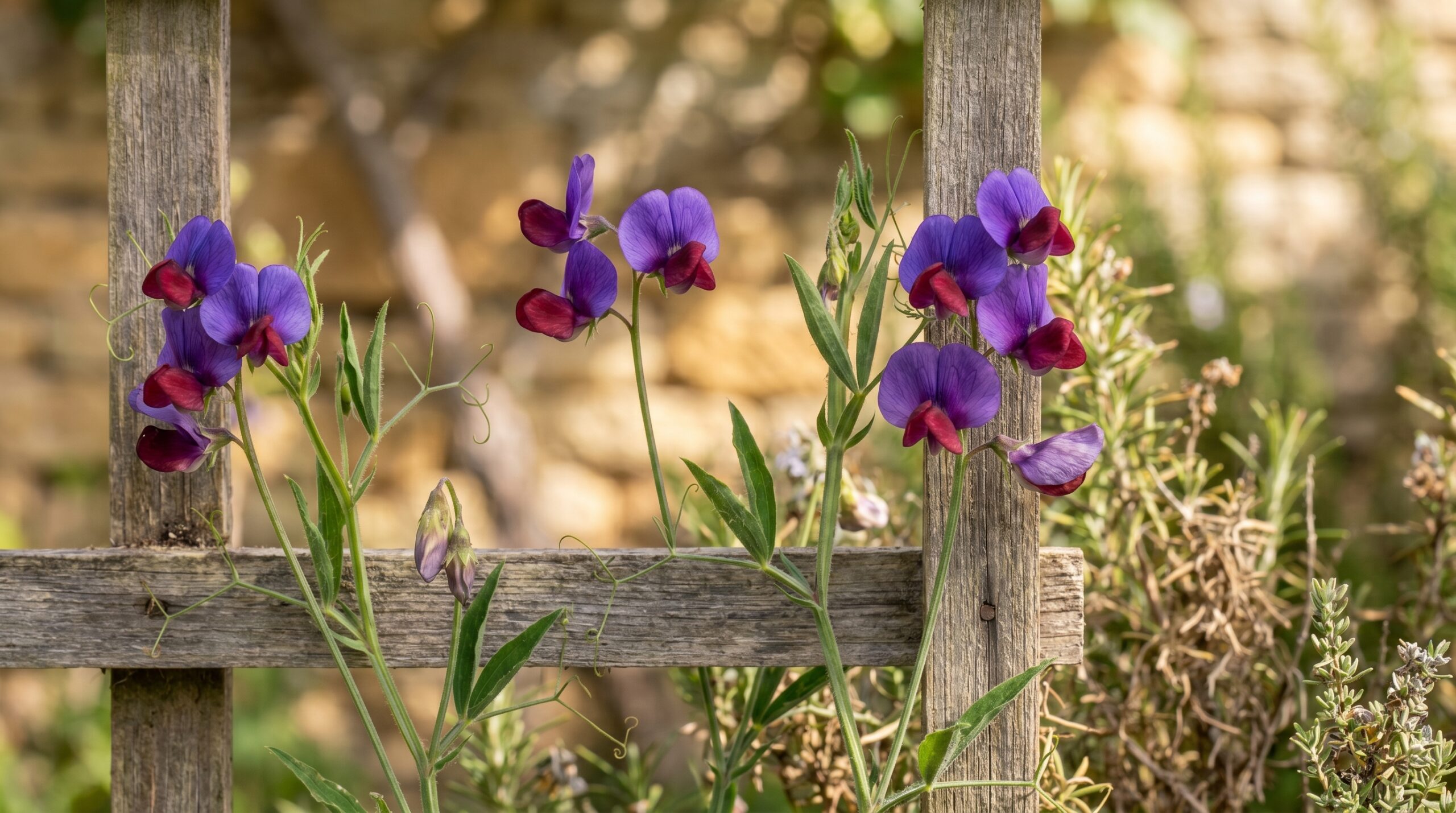
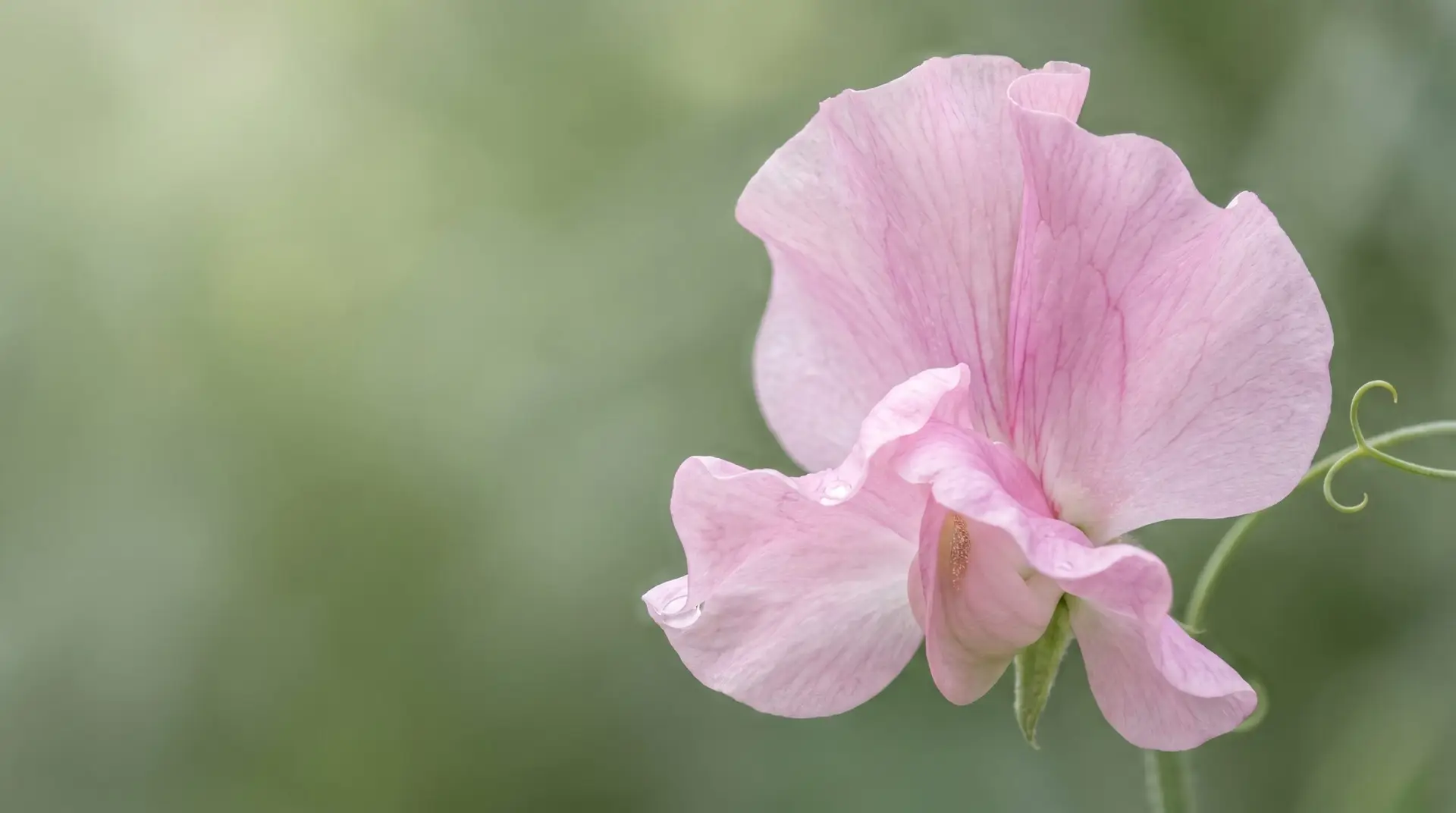
The plant is an annual climbing vine that reaches 6 to 8 feet on garden trellises through tendrils that wrap around any available support. The leaves are pinnate with several pairs of leaflets and a terminal pair of tendrils. The flowers appear in clusters of 4 to 6 per stem at the top of long flowering shoots, with each flower showing the characteristic butterfly shape of the pea family (Fabaceae). The flower structure includes a large upper banner petal, two lateral wing petals, and two lower keel petals fused together, giving the genus its overall appearance.
The original wild sweet pea has small purple-blue flowers (about 0.6 inch across) with mild fragrance. Modern garden cultivars look dramatically different from the wild form: flowers reach 1.5 to 2 inches across, with stronger and more complex fragrance, on longer stems suited to cut-flower use. The color range has expanded from the original purple-blue to include cream, white, pale pink, rose pink, mauve, deep purple, red, orange, and many bicolor patterns including the iconic “Painted Lady” form (white with pink banner) that dates from the eighteenth century.
The plant blooms from late spring through early summer in temperate climates (May through July typically), with the bloom window being one of the shorter ornamental periods in the gardening year. Cool weather extends bloom; hot summer weather ends the bloom rapidly. The plant declines after the bloom finishes and rarely overwinters in temperate climates, making sweet pea a true annual that must be replanted each year from seed or seedling.
Toxicity is important to note. The seeds of Lathyrus odoratus contain beta-aminopropionitrile, a neurotoxic compound that can cause lathyrism (a neurological condition) if consumed in large quantities over time. While casual handling of the plant is safe, the seeds should not be eaten and care should be taken when sweet pea is grown around children who might mistake the seed pods for edible peas.
The Cupani-Uvedale 1699 origin
The cultivated sweet pea has an unusually traceable origin. Francesco Cupani, a Sicilian Franciscan monk and botanist, cultivated the wild Mediterranean sweet pea at the monastery of Santa Maria della Grazia near Misilmeri in Sicily during the late seventeenth century. Cupani sent seeds to several European correspondents in 1699 as part of his broader botanical exchange network.
Robert Uvedale (1642 to 1722), an English schoolmaster and amateur botanist living in Enfield outside London, received Cupani’s seeds and grew them in his garden from 1699 onward. Uvedale’s garden was one of the most botanically significant private collections in late-seventeenth-century England, containing exotic plants from across Europe, the Mediterranean, and the New World. The sweet pea joined this collection and became the foundation of all subsequent English sweet pea cultivation.
Cupani also sent seeds to Caspar Commelin, the Dutch botanist who curated the Amsterdam Hortus Botanicus, and to several Italian correspondents. The Italian seed lines mostly disappeared from documented cultivation by the early eighteenth century, but the English line through Uvedale persisted and gradually spread through English gardening culture during the eighteenth century. Early eighteenth-century English seed catalogs listed sweet pea as an ornamental novelty with primarily purple-blue or “Painted Lady” (pink and white bicolor) forms available.
The 1699 date marks the documented start of sweet pea cultivation in England and serves as the anchor for the 1900 Bicentenary celebration that confirmed sweet pea’s late-Victorian and Edwardian cultural prominence.
Henry Eckford and the Edwardian breeding revolution
Henry Eckford (1823 to 1905) was a Scottish gardener and plant breeder who transformed sweet pea from a small Victorian-era ornamental novelty into the elaborate fragrant cultivars that anchor the modern sweet pea tradition. His breeding work in the 1880s and 1890s produced the largest single advance in sweet pea cultivation history.
Eckford began his sweet pea breeding work in the 1870s while working as head gardener at the Sandywell estate in Gloucestershire. He moved his sweet pea breeding operation to Wem, Shropshire, where he founded his own nursery in 1888. From this base, Eckford produced the cultivars that became the foundation of late-Victorian and Edwardian sweet pea cultivation across Britain.
The Eckford method involved careful selection of seedlings showing desirable traits (larger flowers, stronger fragrance, longer stems, color variation, frilled or “waved” petals), saving seeds from those selected plants, and continuing the selection process across multiple generations. Over more than two decades, Eckford introduced well over a hundred named cultivars, including the still-grown ‘Lady Grisel Hamilton’ (lavender), ‘Princess of Wales’ (deep purple), and ‘Captain of the Blues’ (deep blue-purple). Many of his cultivars remain in heritage seed catalogs today.
The “Grandiflora” sweet pea cultivars that Eckford developed had larger flowers (1.5 inches across versus the older 0.6 inch wild form), stronger and more complex fragrance, and the color range that defines modern sweet pea expectations. Eckford’s work made sweet pea the most popular cut flower in Edwardian England by 1900, surpassing rose, carnation, and daffodil in fresh-cut sales during the May-July bloom window.
The Spencer sweet pea, developed in 1899 by Silas Cole (head gardener at Althorp, the Spencer family estate), built on Eckford’s work by adding the distinctive frilled or “waved” petal that has dominated modern sweet pea breeding since the early twentieth century. Cole named his variety ‘Countess Spencer’ (pale pink with frilled edge), and the cultivar appeared at the 1900 Bicentenary Sweet Pea Exhibition where it caused immediate excitement among British gardeners. The Spencer-type sweet peas dominate modern florist trade today, with most commercial cultivars descended from Cole’s foundational variety.
Eckford’s heritage cultivars and the Spencer-type sweet peas together define the modern sweet pea tradition. Heritage seed suppliers (Owls Acre Sweet Peas, Roger Parsons Sweet Peas, Mr Fothergill’s) continue to offer original Eckford cultivars alongside modern hybrids.
The 1900 Bicentenary Exhibition
The 1900 Bicentenary Sweet Pea Exhibition in London marked 200 years since Cupani’s seed exchange with Uvedale (1699 to 1900) and cemented sweet pea’s status as the fashionable Edwardian flower. The event took place at the Crystal Palace in July 1900 and attracted enormous crowds. The exhibition featured competing displays of Eckford’s named cultivars alongside the new Spencer-type ‘Countess Spencer’ frilled-petal cultivar that Silas Cole introduced at the show.
The exhibition’s success led directly to the founding of the National Sweet Pea Society in 1901, which became (and remains) the international authority on sweet pea cultivation and breeding. The Society’s annual shows and cultivar registration system established the modern infrastructure of sweet pea culture and continues to operate today.
The 1900 Bicentenary event marked sweet pea’s peak cultural moment. The Edwardian era that followed (1901 to 1910) treated sweet pea as the most fashionable garden and cut flower in British society. Garden party photographs from the period almost always include sweet pea bouquets. Society magazine illustrations featured sweet pea prominently. Wedding bouquets across British high society chose sweet pea for its delicate appearance and intense fragrance. The flower’s popularity declined gradually after the First World War as gardening fashions shifted, but sweet pea retained its place in the British gardening calendar and continues to enjoy a steady following.
Fragrance characteristics and perfumery use
Sweet pea fragrance is unusually complex for the size of the flower. The scent combines honey-sweet notes with floral, slightly green, and faintly orange-blossom characteristics. Heritage cultivars (the original Eckford-era forms) typically have stronger fragrance than modern hybrid sweet peas, which were sometimes bred for color variation and stem length at the cost of fragrance intensity.
The strongest-fragrance heritage cultivars include ‘Cupani’ (close to the original 1699 form, still in cultivation), ‘Painted Lady’ (an old pink-and-white bicolor form), ‘Lord Nelson’ (an Eckford navy-blue cultivar introduced around 1907, after his death), and ‘Matucana’ (heritage purple-pink bicolor). Modern frilled-petal Spencer-type sweet peas vary in fragrance: some maintain strong scent (most Mammoth-type cultivars), while others trade fragrance for visual qualities (some modern multifloras and dwarf varieties).
Sweet pea has been used in commercial perfumery since the early twentieth century, particularly during the Edwardian era’s fragrance industry expansion. Coty Sweet Pea perfume launched in 1923 and remained available through much of the twentieth century. Modern niche perfumery occasionally features sweet pea as a heart note in compound fragrances, though the scent has declined in commercial perfumery relative to its Edwardian peak.
The fragrance reaches peak intensity in cool morning hours and in slightly humid conditions. Hot afternoon temperatures can suppress the scent through the scent fatigue mechanism that also affects sweet violet and other intensely fragrant species. A fresh bouquet of sweet peas brought indoors fills a small room with intense fragrance for the first day, with the scent gradually decreasing as the flowers age over the 3 to 5 day vase life.
Color symbolism within Lathyrus
Sweet pea color shifts the symbolic reading within the broader theme of blissful pleasure and gentle goodbye:
Pink sweet pea: youthful affection, gratitude for a lovely time. The most common gift form; suits birthday and anniversary contexts.
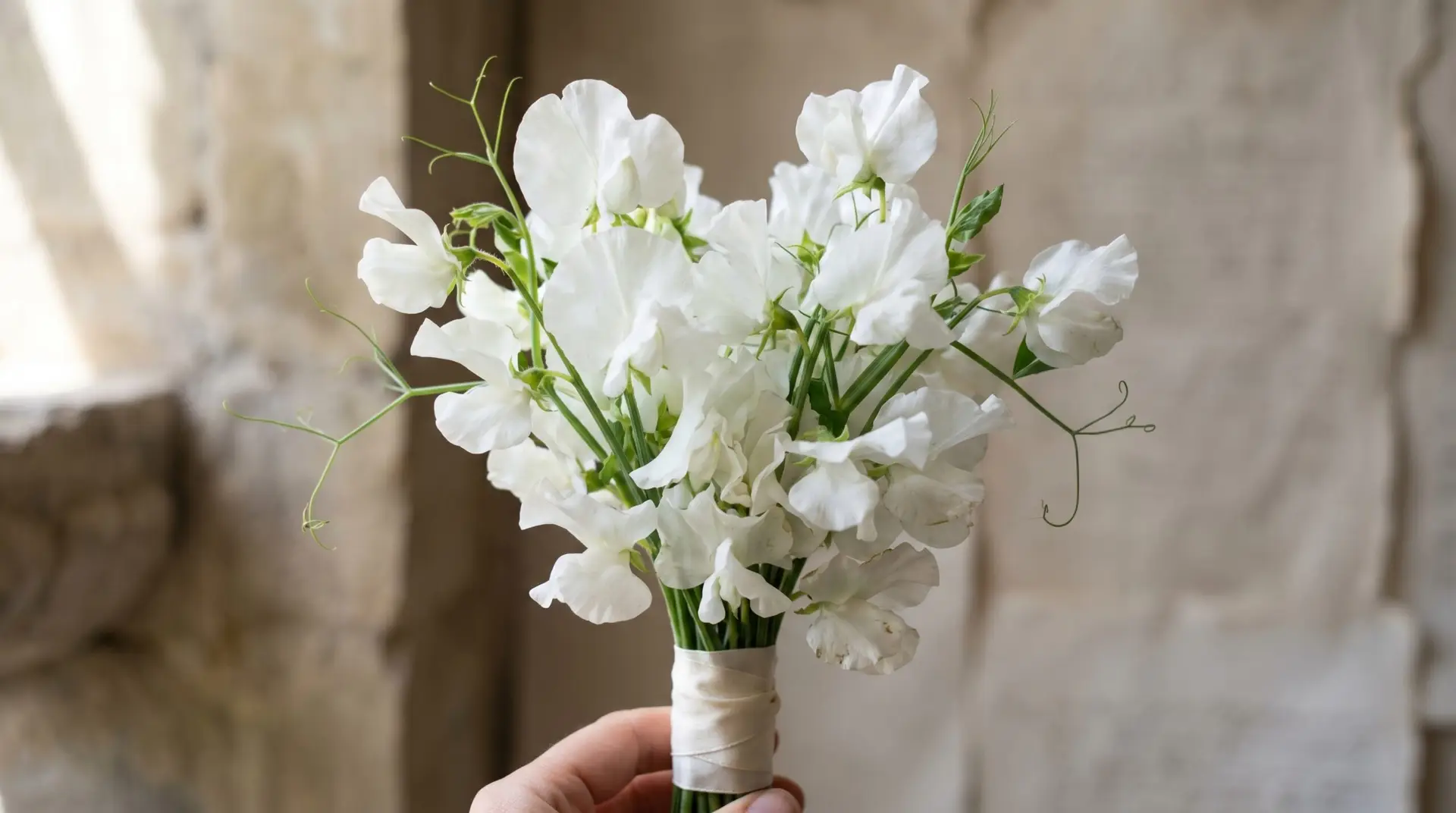
White sweet pea: purity, innocence, fresh beginnings. Wedding-bouquet favorite. The all-white sweet pea bouquet is one of the most elegant cut-flower compositions in the late spring florist trade.
Purple sweet pea: quiet dignity, refined affection. The original wild Sicilian color, preserved in ‘Cupani’ and other heritage cultivars.
Red sweet pea: ardent love, deep affection. Less common than pink or purple; striking when used in monochrome bouquets.
Mauve sweet pea: vintage charm, nostalgic affection. The Edwardian-era color preference, still favored for vintage-themed wedding bouquets.
Bicolor sweet pea (Painted Lady type): complex affection, mixed feelings honored. The original eighteenth-century bicolor form still in cultivation.
Mixed sweet pea bouquet: abundance of feeling, generous appreciation. The combination of multiple colors in one bouquet doubles the visual and fragrance impact.
The “gentle goodbye” reading deserves separate mention. Sweet pea is traditionally given as a farewell gift in Victorian floriography, signaling gratitude for a relationship or experience that is ending without hard feelings. The reading suits retirement bouquets, departure gifts, and the gentle end of relationships where the intent is to honor the connection rather than to mourn its end.
Growing sweet peas
Sweet peas do best in cool spring weather with rich soil and full sun. The cultivation requirements follow the plant’s native Mediterranean coastal habitat: sunny positions, cool early-season temperatures, and well-drained nutrient-rich soil.
USDA zones 3 through 8 cover the temperate climate range where sweet pea performs well as a spring-bloomer. Zone 9 and warmer can grow sweet peas only as winter annuals (planted in fall for winter and early spring bloom) because summer heat ends the bloom too quickly. Zone 2 and colder are typically too cold for reliable sweet pea outdoor cultivation; greenhouse cultivation is possible but uncommon.
Planting timing varies by climate. In zone 3-5 climates, direct-seed in early spring as soon as soil can be worked. In zone 6-7 climates, direct-seed in late winter or transplant seedlings started indoors in February. In zone 8 climates, autumn planting (October to November) gives the strongest performance with bloom from April through June. In zone 9-10 climates, plant in fall for winter bloom; summer heat ends the season.
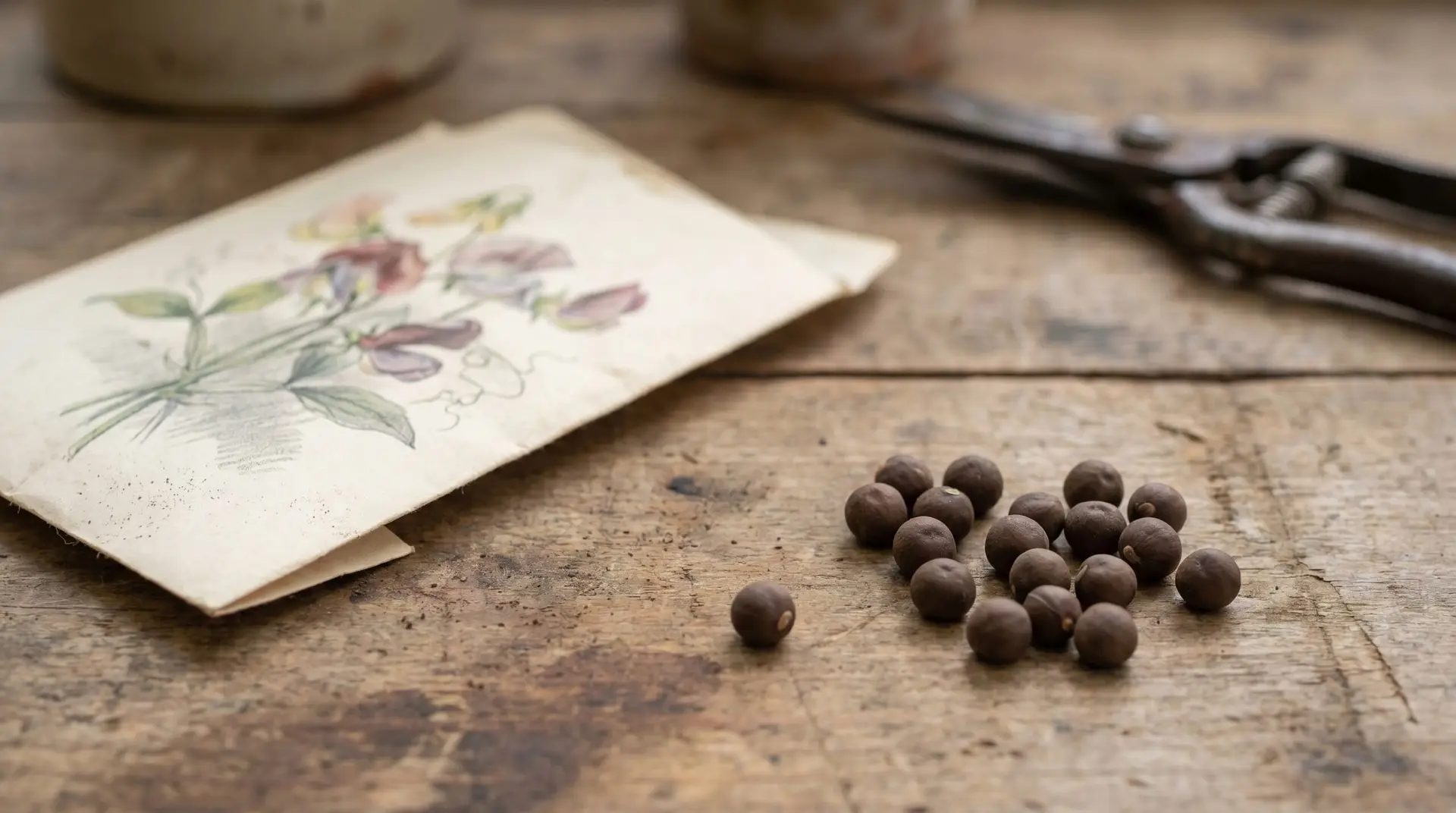
Seed preparation often involves nicking or scarifying the hard seed coat with a sharp knife or sandpaper to speed germination, then soaking the seeds overnight in water before planting. The traditional English gardening method recommends “soaking, scarifying, and sowing” as the preparation sequence.
Sun exposure should be full sun (at least six hours of direct sunlight daily). Partial shade significantly reduces bloom abundance.
Soil should be rich, well-drained, and slightly alkaline. Sweet peas are heavy feeders during their short bloom window and benefit from manure, compost, or balanced organic fertilizer added to the soil before planting. The traditional English method involves digging a deep trench (12 to 18 inches) and filling it with manure and compost the autumn before spring planting; the prepared trench gives the plants strong nutrient access during their brief season.
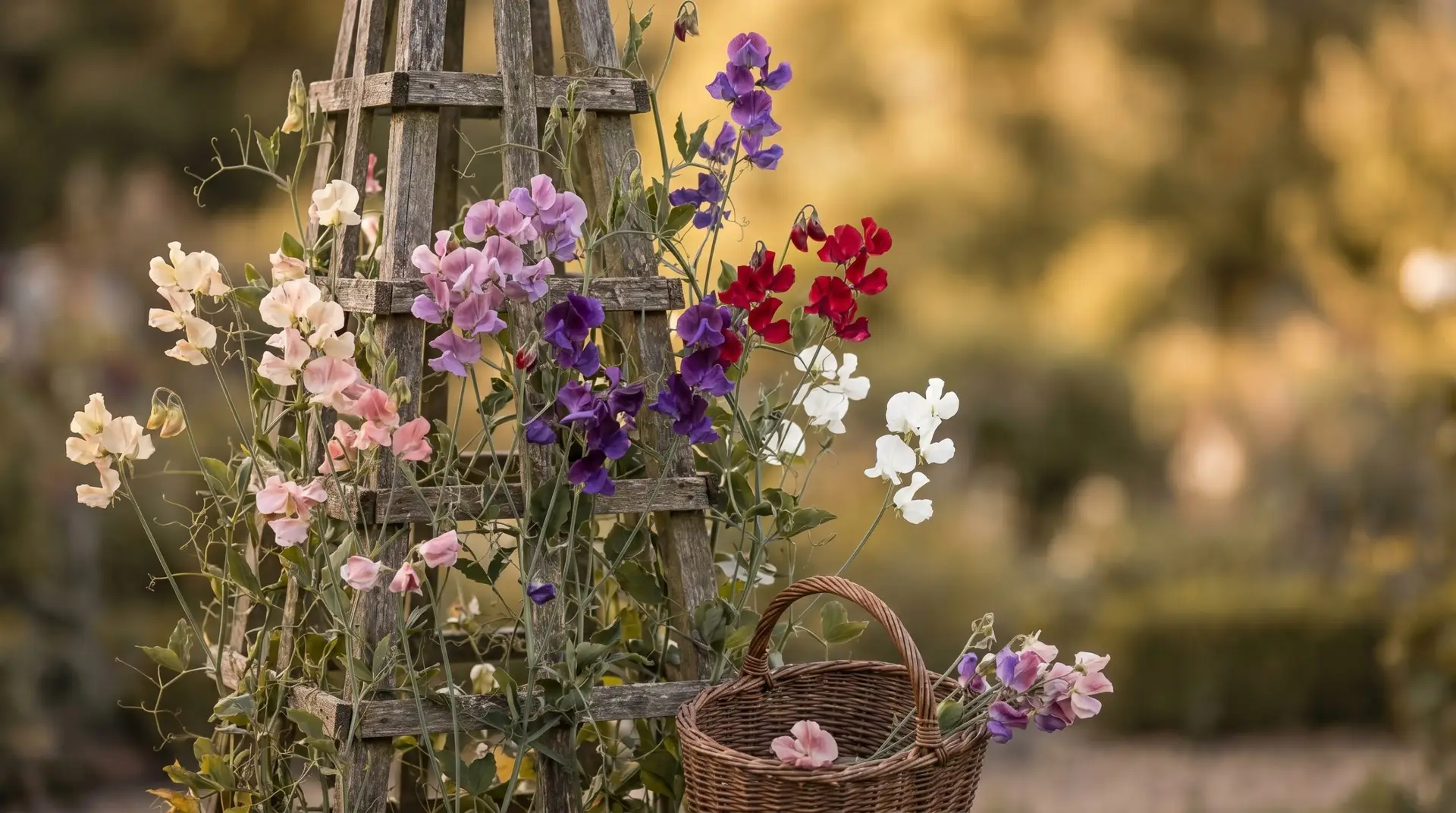
Support is essential. Sweet peas climb to 6 to 8 feet on tall trellises, netting, or twine supports. Provide the support at planting time so the young plants can find it as they grow. Modern gardeners use bamboo cane wigwams, jute or string netting, or metal tower trellises.
Pinching out the growing tips when plants reach 4 to 6 inches encourages bushier growth and more flowering shoots. Regular deadheading (removing spent flowers before seed pods form) extends the bloom window by several weeks.
Frequently asked
What does the sweet pea flower symbolize?
Blissful pleasure, gratitude for a lovely time, and gentle goodbye in modern Western floriography. The “gentle goodbye” reading particularly suits farewell gifts, retirement bouquets, and the honoring of relationships or experiences that are ending without hard feelings.
Why is sweet pea April’s birth flower?
Sweet pea blooms in May through July in most temperate climates, slightly later than April. Its assignment as April’s secondary birth flower reflects the Victorian-era convention that began before modern cultivars existed; the original sweet pea bloom window (in Mediterranean climates) was earlier than modern hybrids. The flower has also been associated with April through its Victorian-era symbolic register of gentle gratitude and farewell, themes that suit the late-spring transition.
Who is Henry Eckford?
Scottish gardener and plant breeder (1823-1905) who led the late-Victorian breeding work that transformed sweet pea into modern cultivated forms. Eckford founded his nursery in Wem, Shropshire in 1888 and introduced well over a hundred named cultivars during his career. Many of his cultivars (Lady Grisel Hamilton, Princess of Wales, Captain of the Blues) remain in heritage seed catalogs today.
When was sweet pea first cultivated?
1699, when Sicilian monk Francesco Cupani sent seeds to English schoolmaster Robert Uvedale at Enfield. Uvedale grew the plant from 1699 onward, and his cultivation became the foundation of all subsequent English sweet pea growing.
What was the 1900 Bicentenary Exhibition?
A major sweet pea exhibition in London marking 200 years since Cupani’s 1699 seed exchange. The event took place at the Crystal Palace in July 1900 and led directly to the founding of the National Sweet Pea Society in 1901. The new Spencer-type ‘Countess Spencer’ frilled-petal cultivar debuted at the exhibition and changed the direction of sweet pea breeding.
How fragrant are sweet peas?
Very. Heritage cultivars (Cupani, Painted Lady, Lord Nelson, Matucana) have strong honey-sweet floral fragrance with green and orange-blossom notes. Modern hybrid cultivars vary: some maintain strong fragrance, others trade scent for color variation or stem length. The fragrance reaches peak intensity in cool morning hours.
Are sweet pea seeds edible?
No. Sweet pea seeds contain beta-aminopropionitrile, a neurotoxic compound that can cause lathyrism (a neurological condition) if consumed in large quantities. Sweet pea is ornamental, not edible. Do not confuse sweet pea (Lathyrus odoratus) with edible garden pea (Pisum sativum); the two are different species in the same family but only the garden pea is edible.
How do you grow sweet peas?
Plant in full sun with rich well-drained slightly alkaline soil. Scarify and soak seeds before planting. Direct-seed in early spring (zones 3-5) or autumn (zone 8). Provide tall trellis support at planting time. Pinch growing tips for bushier growth and deadhead regularly to extend bloom.
How long do sweet pea blooms last as cut flowers?
Three to five days in the vase, which is shorter than most cut flowers. The short vase life suits sweet pea as a special-occasion bouquet rather than a long-lasting display.
Sources
- Sweet pea (Lathyrus odoratus) · Encyclopedia Britannica
- Sweet pea growing guide · Royal Horticultural Society
About this article. > Written and reviewed by the Your Flowers Guide editorial team. Botanical content from Britannica and the Royal Horticultural Society. Sweet pea breeding history references from National Sweet Pea Society archives. The Cupani-Uvedale 1699 origin is documented in standard horticultural history sources. Henry Eckford biographical and breeding work documented in Wem local history archives and the National Sweet Pea Society cultivar registry.