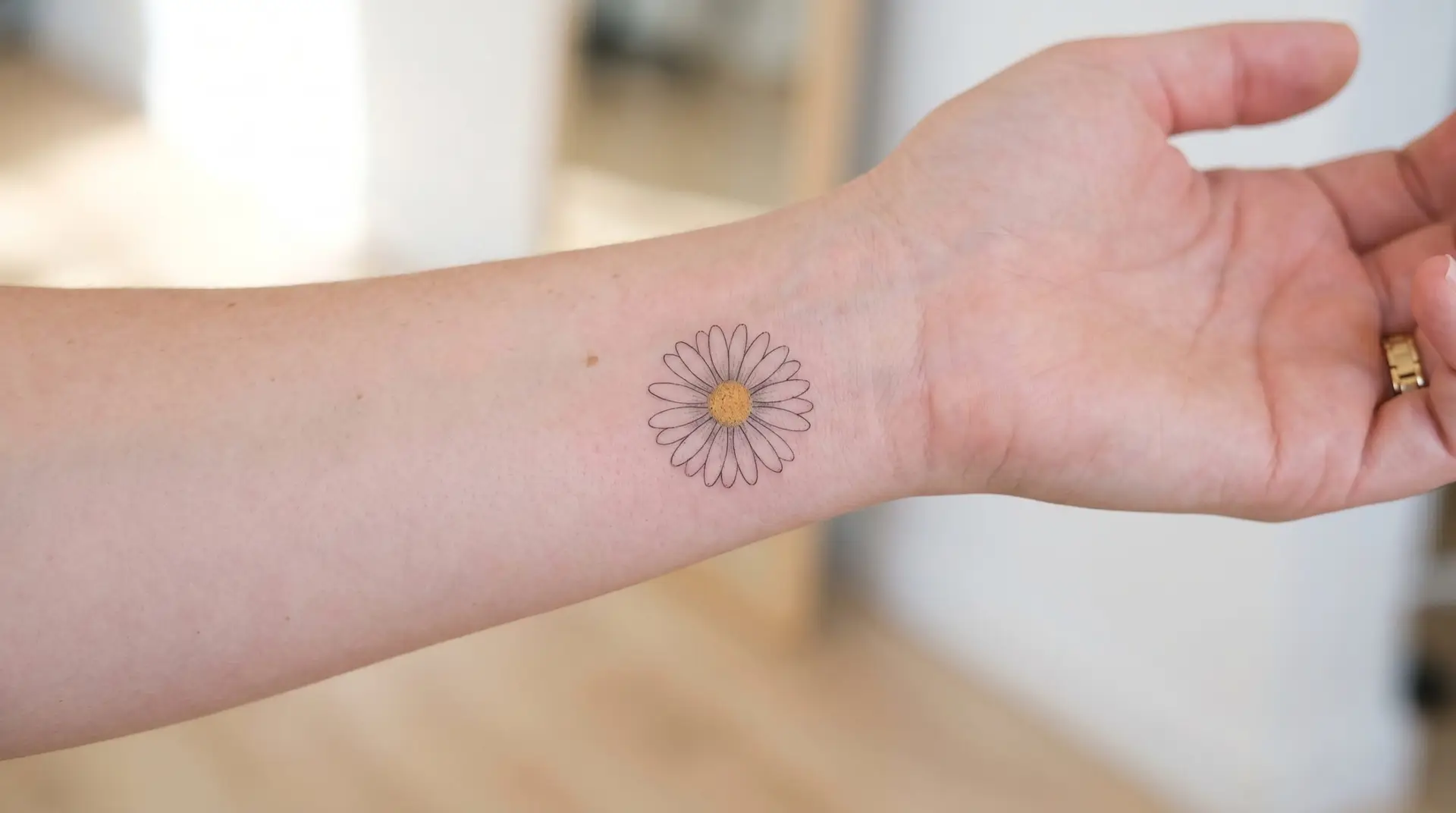
Daisy is April’s primary birth flower, and its symmetrical composite-head form makes it one of the most-tattooed birth flowers across modern tattoo culture. The flower symbolizes innocence, loyal love, and new beginnings in basic Western reading, with additional layers from Norse folklore (Freya tradition), Anglo-Saxon etymology (“day’s eye”), and Chaucer’s medieval English poetry. Daisy is a consistently popular tattoo subject, which signals broad continuing interest across age groups, genders, and tattoo culture subgroups.
The visual logic of daisy works exceptionally well for tattoos. The composite-head structure (ray florets around a disc center) reads correctly at almost any scale, from a 0.5-inch behind-ear placement to a 6-inch forearm composition. Daisy also supports a wide range of design approaches: minimalist single-line outlines, traditional bold-color American style, watercolor washes, photo-realistic detail, geometric stylization, and the distinctive daisy chain concept that is unique to this birth flower. April birthday readers find daisy among the most accessible tattoo subjects, suitable for both first-time tattoo experiences and elaborate larger compositions.
In this guide
Daisy’s design advantages
The daisy holds several design advantages that explain its enduring popularity in tattoo culture. The radial symmetry around a central yellow disc reads as a flower at any orientation, which gives the tattoo artist and the wearer flexibility in placement and rotation. Asymmetrical flowers like rose or peony require careful orientation decisions; daisy works equally well facing in any direction.
The flower’s recognizable silhouette works from 1-inch wrist tattoos to full-back compositions. This scalability sets daisy apart from most birth flowers, which either require medium-to-large scale to read correctly (rose, peony, dahlia) or thrive specifically at small scale (violet, snowdrop). Daisy hits a versatile middle position that supports any reader’s preferred size range.
Daisy ages well across all major tattoo styles. Even when ink colors fade over years of UV exposure, the daisy outline holds its shape. A 15-year-old daisy tattoo with faded yellow center still reads as a recognizable daisy, where a faded rose or peony tattoo often loses its identifying detail. This aging characteristic suits readers who want a tattoo with reliable long-term visual integrity.
The composite-head structure is forgiving for tattoo artists who are not specialists in floral work. The basic anatomy is simpler than rose or peony layered petal structures, which means a wider range of artists can execute a daisy tattoo well. Readers in smaller towns without specialist floral tattoo artists still have good options for daisy work.
Universal symbolism (innocence, loyalty, joy) gives daisy broad acceptability across cultural contexts. The flower has no controversial political or religious associations, no gender-specific reading, and no negative folk meanings. A daisy tattoo reads positively across most audiences, which suits readers who want their tattoo to land well in family, work, and social contexts.
Style options for daisy tattoos
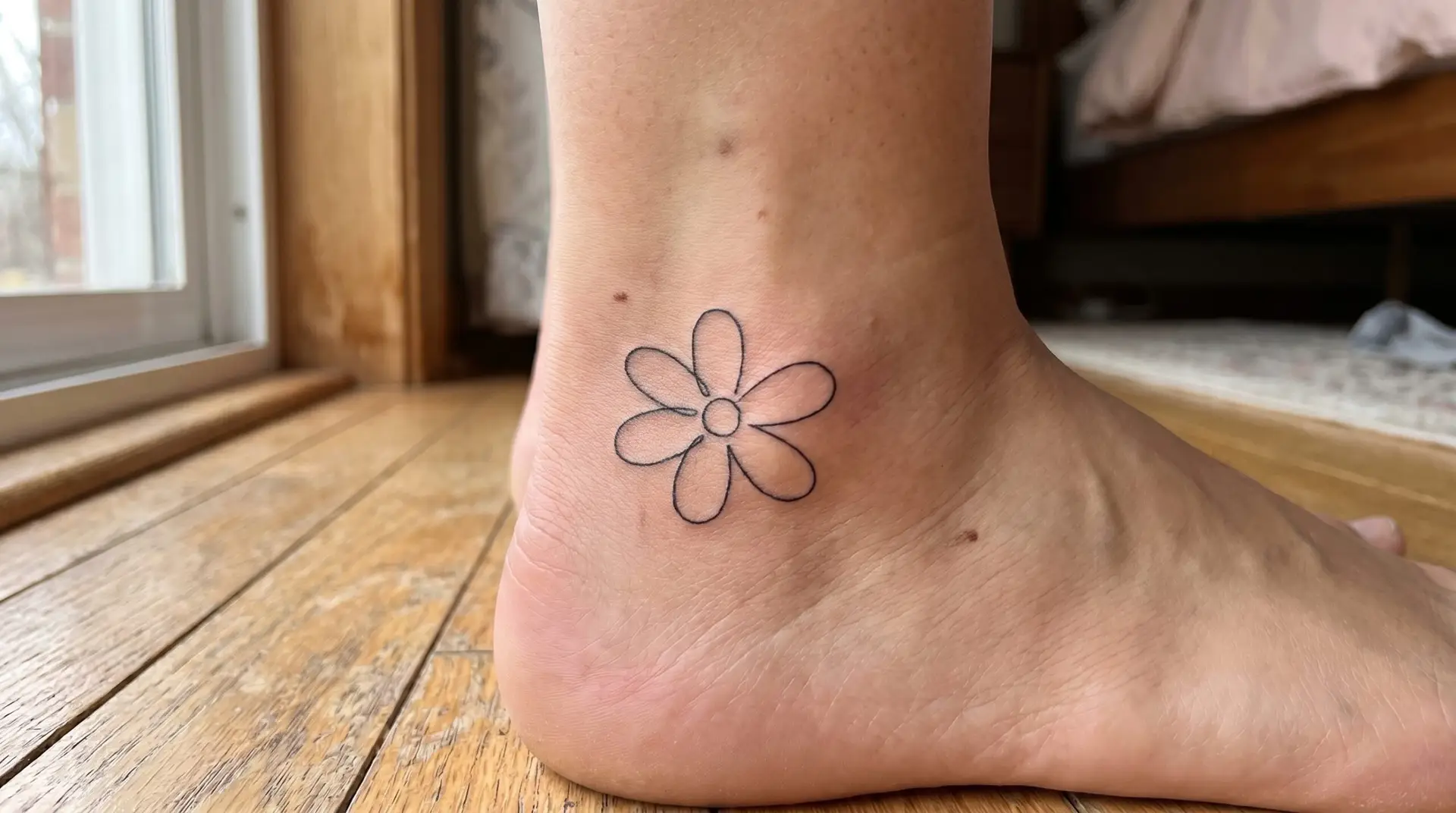
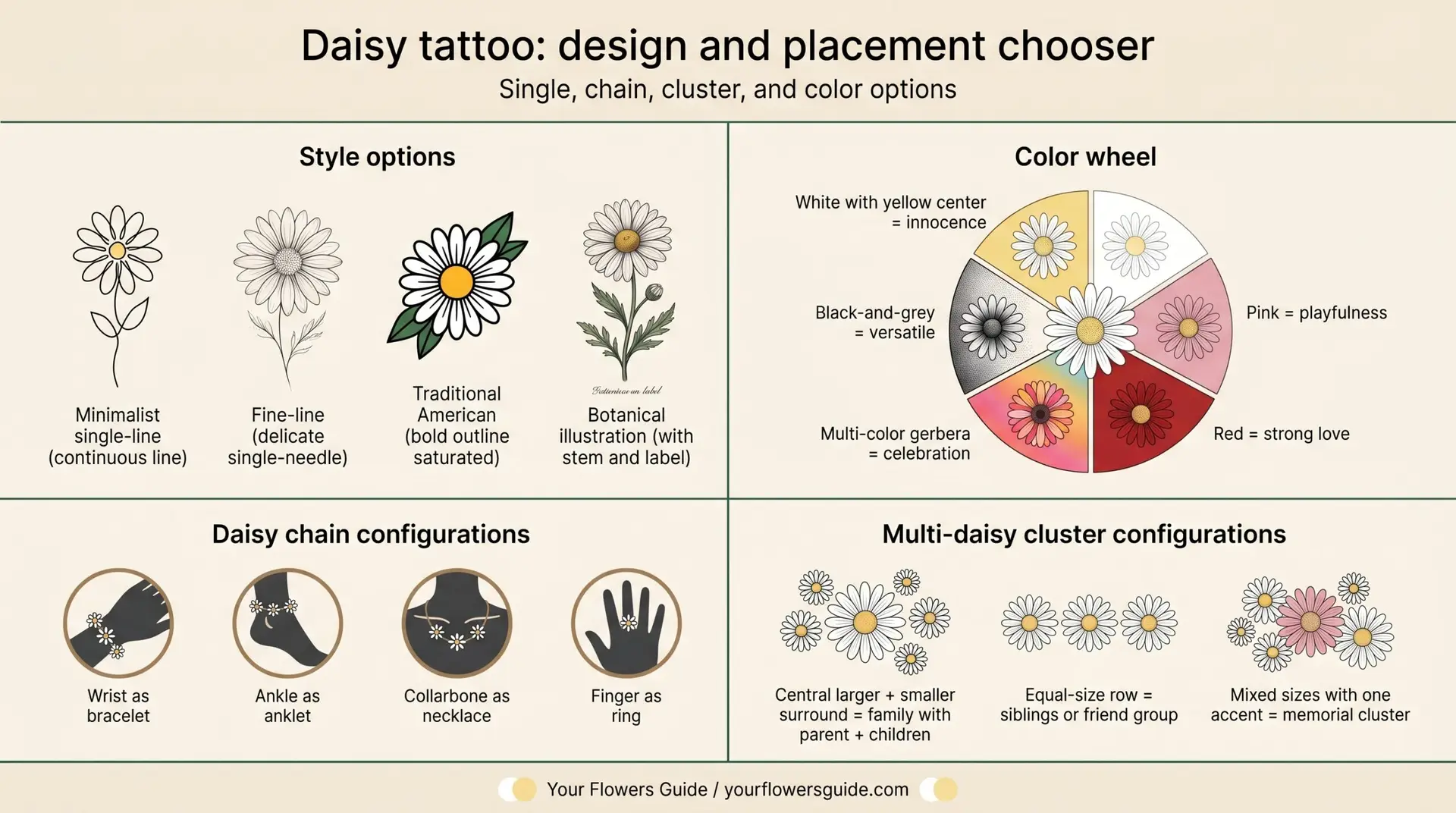
Style choice shapes longevity, placement options, and visual register. The main daisy tattoo styles in modern practice include:
Minimalist single-line. A single continuous line forms the daisy shape without lifting the artist’s needle from the skin. The most popular modern daisy style. Works at small scale (1 to 2 inches) and ages exceptionally well due to minimal ink saturation. Suits wrist, behind-ear, ankle, and finger placements.
Fine-line single-needle. Delicate petal-by-petal precision using a single needle rather than the standard 3-7 needle tattoo configuration. Renders the daisy’s symmetry with thin clean lines. Best at 1.5 to 2.5 inches. Touch-ups every 5 to 10 years standard.
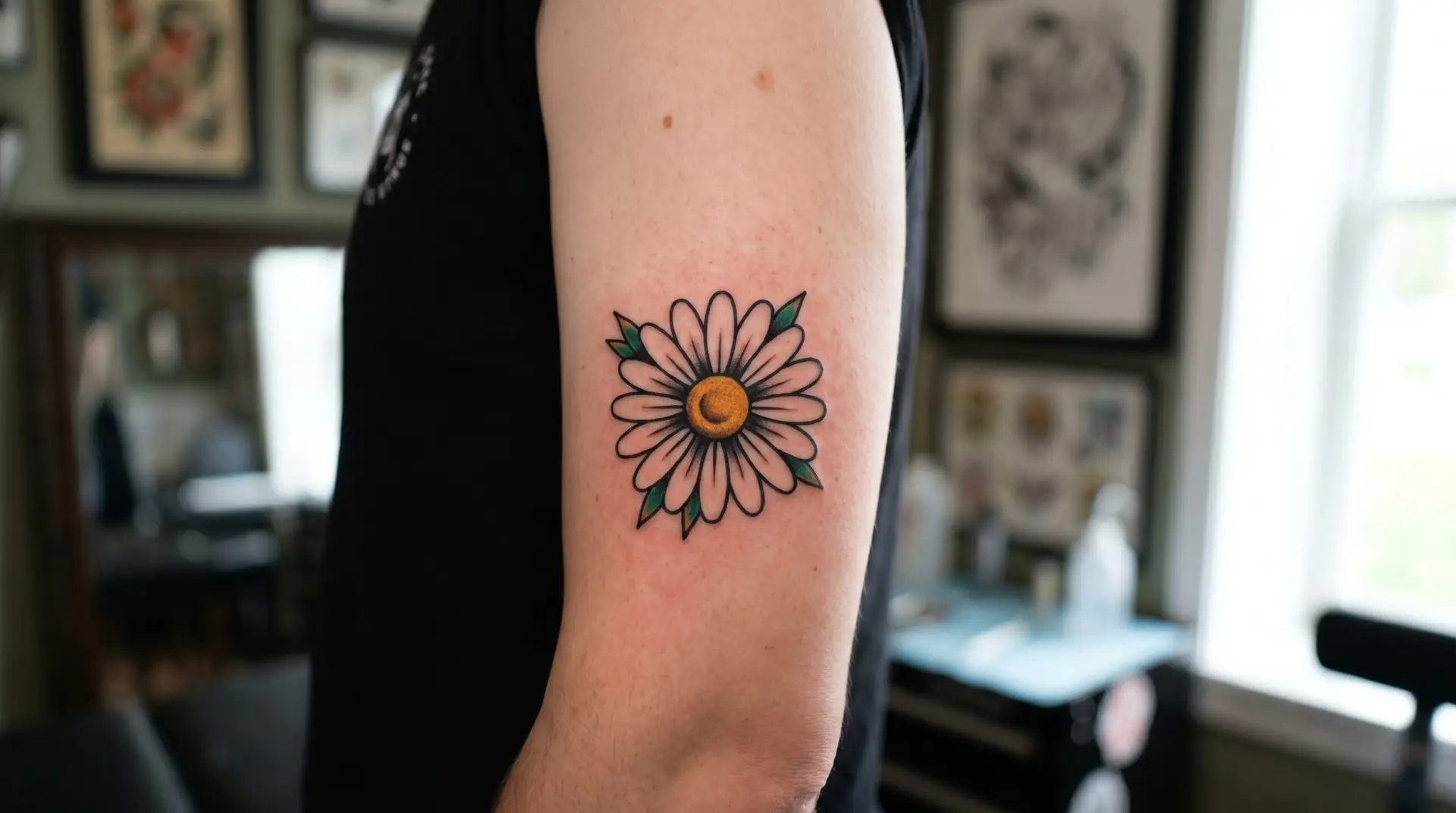
Traditional American. Bold outline, saturated white petals with yellow center, classic American tattoo aesthetic. Works at medium scale (2 to 4 inches) and holds visible color for 15 to 20 years before requiring touch-up.
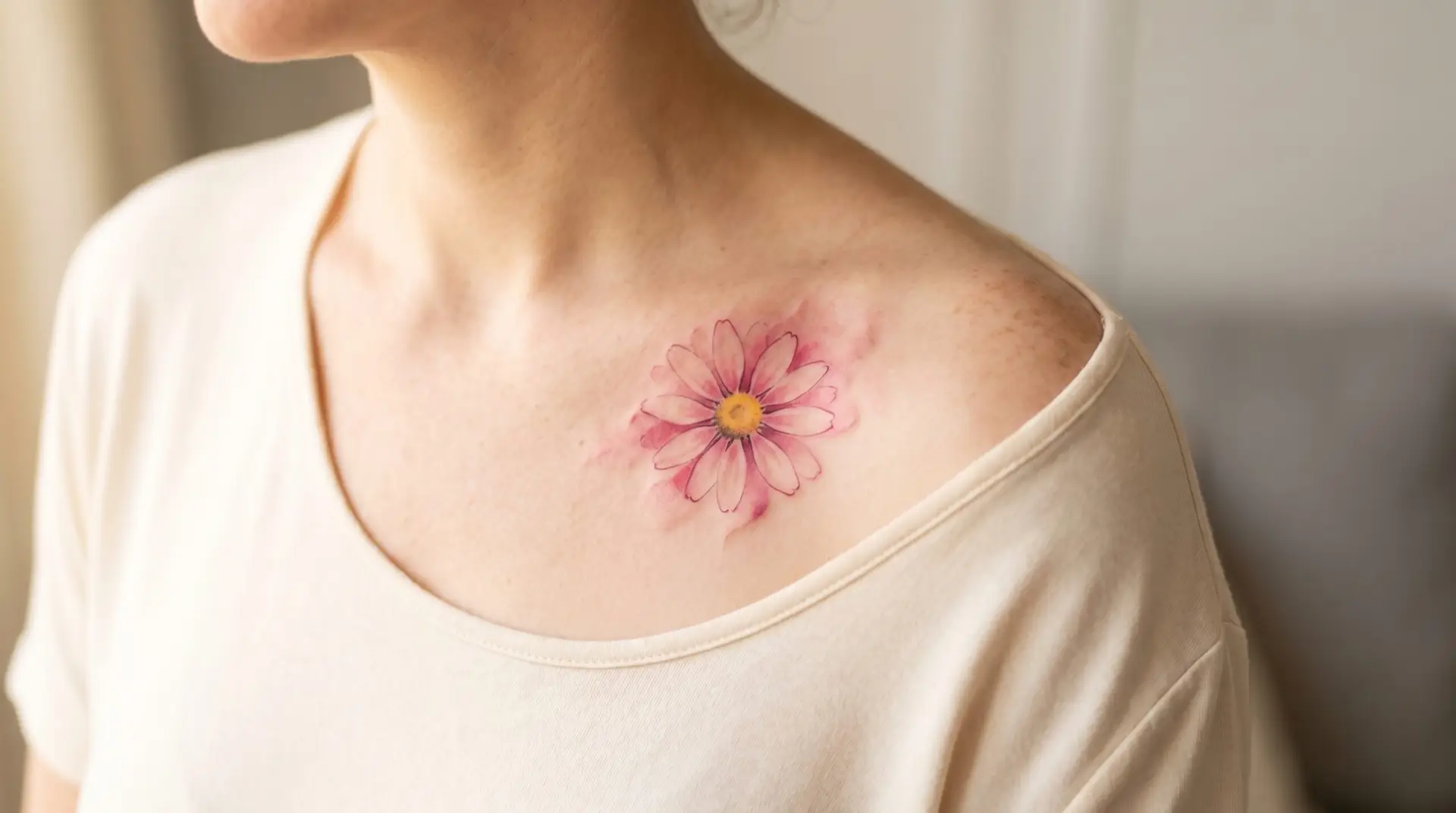
Watercolor. Soft pink, blue, or yellow bleeding outward from the central daisy outline, mimicking watercolor painting on skin. Suits ribs, upper arm, and shoulder blade placements. Requires touch-up every 3 to 5 years.
Realistic. Photo-realistic daisy with detailed petal texture and dimensional shading. Requires medium-large canvas (4 to 6 inches minimum) and skilled artist. Holds detail for 10 to 15 years.
Botanical illustration. Vintage scientific drawing aesthetic with stem, leaves, and small Latin label (“Bellis perennis”) integrated below the bloom. Works at medium to large scale (3 to 5 inches) and suits forearm, ribs, and back placements.
Geometric. Daisy stylized into geometric patterns, often with mandala integration or sacred-geometry framing. Suits readers who want symbolic flower imagery with strong graphic design appeal.
Dotwork. Texture built from small dots rather than solid lines or fills. Creates a soft fuzzy texture that suits daisy’s natural petal quality. Works at medium scale (2 to 3 inches).
Daisy chain tattoos: the unique April concept
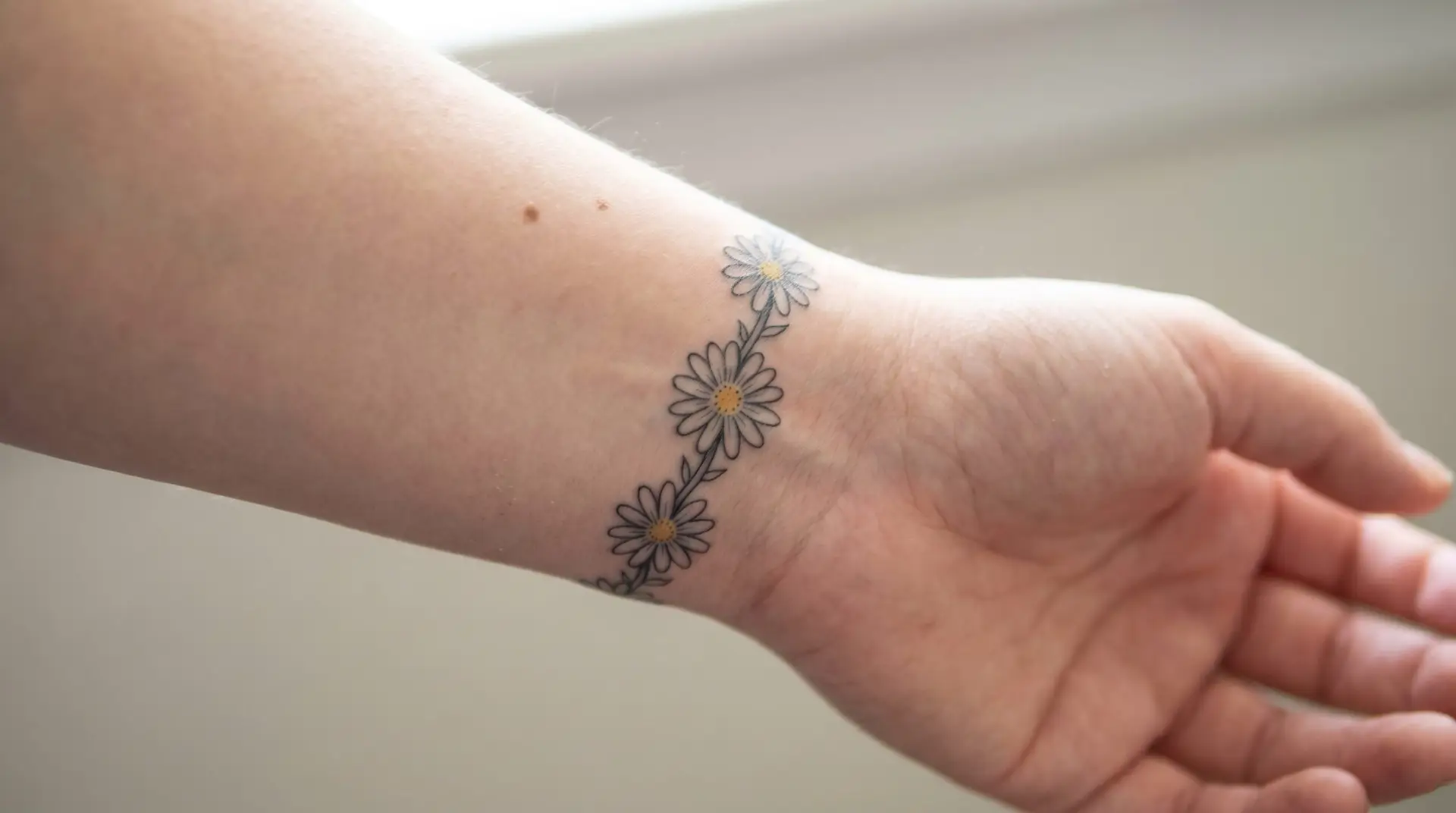
The daisy chain tattoo is unique to this birth flower. Daisy chains are a universal childhood craft across British, Northern European, and North American cultures: children link daisies together through slits in the stems, creating loose floral chains worn as necklaces, bracelets, or crowns. The childhood memory holds strong nostalgic weight for adult readers, and the chain form translates particularly well into tattoo design.
Common daisy chain tattoo placements include the following.
Wrist as bracelet. A chain of 5 to 8 small daisies wrapping the wrist completely or partially. Reads as a permanent bracelet. Pain moderate, fading slightly faster than other wrist tattoos due to the daily watch and sleeve friction. Touch-ups every 5 to 7 years standard.
Ankle as anklet. A chain wrapping the outer ankle, with 4 to 6 daisies along the visible arc. Lower pain than wrist due to ankle bone shape. Fades slower than wrist. Suits readers who want a discreet daisy chain that shows in summer or with sandals but hides under socks and shoes.
Neck as necklace. A chain crossing the collarbone in a gentle arc, with 5 to 7 daisies along the visible curve. Higher pain due to thin skin over bone. Reads as a permanent floral necklace and suits readers who want a chest-area tattoo that complements jewelry.
Single finger as ring. A small daisy chain wrapping one finger, typically the ring finger or middle finger, with 3 to 4 tiny daisies. Highest fade rate of any daisy chain placement due to constant friction from hand use; expect touch-ups every 2 to 3 years.
Symbolic readings for daisy chain tattoos vary by intent. The simplest reading is childhood preserved: the chain reminds the wearer of childhood meadow play and the casual creative happiness of unstructured outdoor time. A second reading treats each daisy as a person, with the chain showing the relationships connecting them: a parent-child daisy chain, a sibling chain, a chain of close friends. A third reading uses the chain memorial: each daisy stands for a deceased loved one, with the chain making them present together in a way that no longer happens in life.
Friend-group daisy chains have become a popular modern variation. A group of 3 to 6 friends each gets a matching daisy tattoo, with each individual tattoo containing just one daisy from the conceptual chain. When the friends stand together (at weddings, reunions, photo opportunities), the collective tattoos form the chain that no single member shows alone. The format works as a permanent group bond gesture and has gained particular traction among college roommates, bridal parties, and long-term friend groups.
Multi-daisy family and friend tattoos
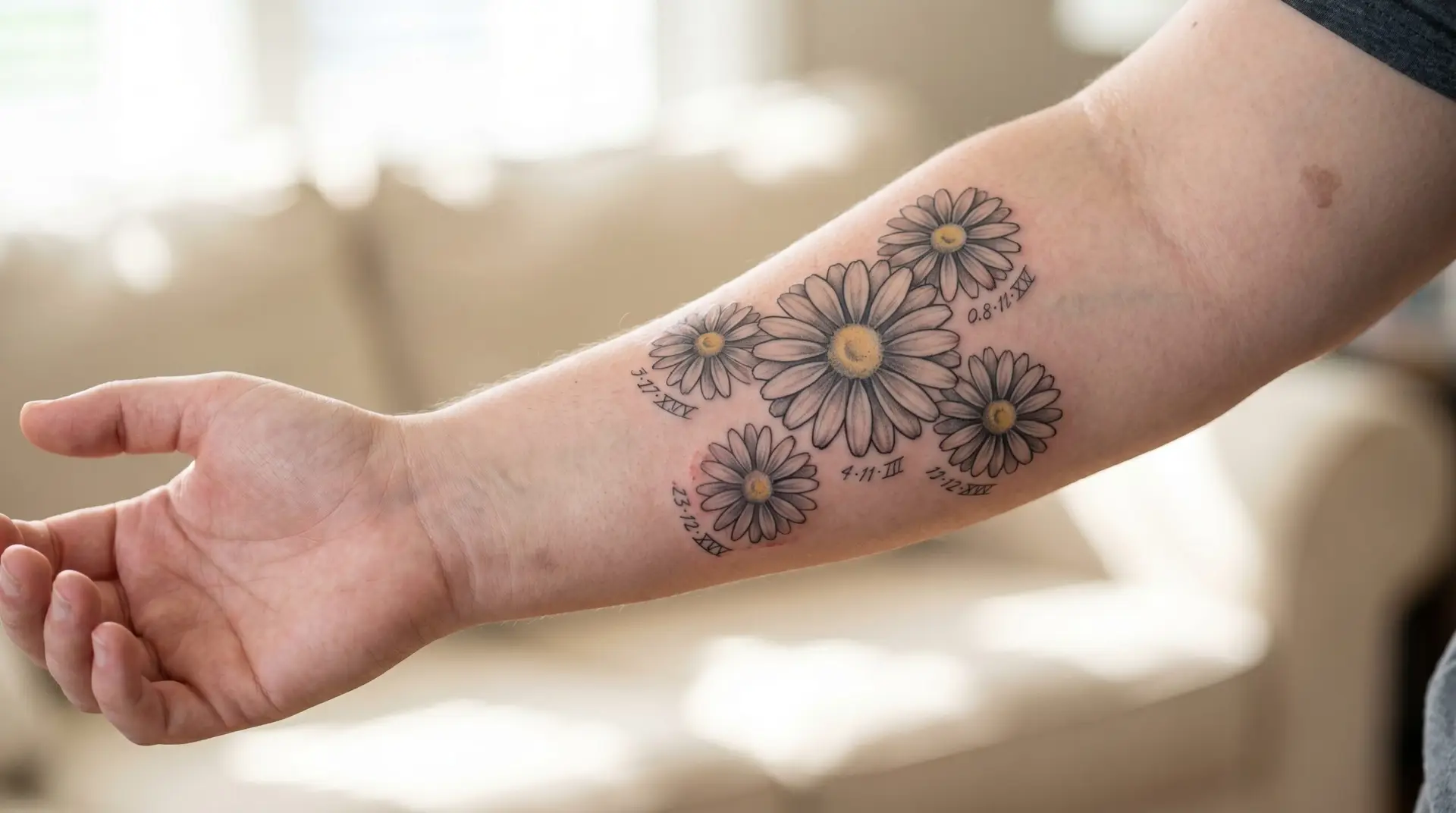
Beyond the linked daisy chain format, multi-daisy clusters work well for family and friend tattoos. A cluster of 3 to 5 daisies grouped together (rather than linked as a chain) marks members of a group without the explicit visual connection of the chain form.
Common configurations include the following. A central larger daisy surrounded by smaller daisies marks a parent with children or a matriarch with descendants. A row of equal-sized daisies stands for siblings or a friend group of equal standing. A cluster with one differently-colored daisy shows a group with one member who is distinct (deceased, separated, twin).
Memorial daisy clusters have become a particular subset of this category. Each daisy stands for a deceased loved one, with the cluster making them present in a single visual. Common variations include grandparents (cluster of 4 daisies for paternal and maternal grandparents), parents (cluster of 2 for both parents), and combined family clusters (mixed sizes covering multiple losses across generations).
Size variation within a cluster supports symbolic differentiation. Smaller daisies for children, larger daisies for parents and grandparents, with all daisies maintaining the same basic style for visual coherence. Color variation supports another dimension: white for living family members, slightly different shade or petal style for deceased members, occasional accent color for a specific person’s flower preference.
Name integration extends multi-daisy work. Each daisy paired with a small name in script (each person’s first name beneath their daisy), or a single name script flowing across the bottom of the cluster (the surname or family name). Roman numerals beneath daisies work for birth dates or memorial dates. Wedding bands or initial pairs work for couples integrated into a larger family composition.
Friend group multi-daisy compositions follow similar conventions. A group of friends each gets a matching cluster tattoo, with each cluster containing daisies for the entire group. Each person wears the complete friend group on their own skin, which gives the tattoo continuing meaning even after distance, time, or relationship change.
Color choices and symbolism
Color shifts the symbolic reading of the tattoo within the broader daisy meaning of innocence and loyalty:
White daisy tattoo (with yellow center): the most traditional choice. Innocence, purity, loyal love. The default reading for daisy as a birth flower tattoo and the most aged-well color combination for white-petal tattoos.
Pink daisy tattoo: playfulness, gentle love, youthful affection. Suits readers who want a softer feminine register without the dramatic visual of red or saturated colors.
Red daisy tattoo: strong love, ardent affection. Less common than white or pink but striking when executed in saturated red ink. Suits memorial tattoos honoring deep relationships.
Multi-color gerbera daisy tattoo: celebration, fun, and modern florist aesthetics. Gerbera’s wider color range (orange, deep pink, magenta) supports more dramatic tattoo work than wild Bellis perennis. Suits readers who want their daisy tattoo to be visually distinctive.
Black-and-grey daisy tattoo: versatile, ages well, pairs with almost any other tattoo work the wearer already has. The minimalist register without color complications.
Watercolor daisy tattoo: soft pastel bleeds in pink, yellow, blue, or green creating dreamy artistic effect. Modern aesthetic; fades faster than traditional but visually distinctive.
Florist symbolism translates directly into tattoo symbolism for daisy. The Korean tradition assigns daisy to March 6 with the meaning “playfulness,” which aligns with pink daisy tattoo symbolism. The white-with-yellow-center wild Bellis perennis form has the strongest “loyalty in love” reading from Chaucerian tradition. The choice of daisy color in tattoo work is a meaningful symbolic decision rather than purely aesthetic.
Placement options
Placement choice depends on size, visibility, and pain tolerance. Common daisy tattoo placements include the following.
Inner wrist: very popular for small daisy tattoos (1 to 2 inches). Low to moderate pain. Easy to show or cover with a watch.
Inner forearm: medium-scale designs (2 to 4 inches) including small clusters. Low pain. The visible-to-self orientation suits personal art.
Behind ear: tiny single daisy at 0.5 to 1 inch. Moderate pain. Discreet placement easily hidden by hair.
Ankle: single daisy or short chain at 1.5 to 2.5 inches. Low to moderate pain.
Outer upper arm: medium scale (2 to 3 inches) or larger cluster compositions. Low pain. Works for both visible and discreet display.
Shoulder blade: larger scale (3 to 5 inches), low pain, low daily visibility.
Collarbone: small daisy or daisy chain arc following the bone. Moderate to high pain.
Sternum: small floral composition between the breasts. High pain due to thin skin over bone.
Hip: discreet placement, low pain, suits readers wanting private personal art.
Foot top: small daisy at 1 to 1.5 inches. Moderate pain, faster fade due to footwear friction.
Ribs: larger composition (4 to 6 inches), high pain due to thin skin over bone and breath movement during tattooing, heals slowly.
Finger: very small single daisy at 0.5 to 1 inch. Highest fade rate of all placements; touch-ups every 2 to 3 years.
Design pairings
Common daisy tattoo pairings include the following.
Daisy plus name: script name flowing around or beneath the bloom. Most popular pairing for memorial and family tattoos.
Daisy plus date: birth date, anniversary date, or memorial date in Roman or modern numerals.
Daisy chain plus connected people: family or friend group represented as a connected chain (see daisy chain section above).
Multi-daisy cluster: family or friend group represented as a grouped composition.
Daisy plus quote: short literary or personal quote in script accompanying the daisy. Chaucer-derived quotes from the Legend of Good Women work well for literary readers.
Daisy plus zodiac: Aries (March 21 to April 19) or Taurus (April 20 to May 20) symbol paired with daisy.
Daisy plus diamond: the April birthstone color matches daisy’s bright clarity. Often rendered as a daisy with a small faceted diamond gemstone in the center.
Daisy plus bee or butterfly: the meadow ecosystem reference. Adds visual interest without changing the daisy’s symbolic register.
Daisy plus stem and leaves botanical: vintage botanical illustration style with the full plant structure.
Daisy plus matching flower (rose, violet, lily of the valley): combined birth flower tattoos honoring family members born in different months.
Aftercare for daisy tattoos
Standard tattoo aftercare applies: keep the tattoo clean and moisturized for the first two weeks, avoid direct sunlight and chlorinated water during initial healing, and follow your tattoo artist’s specific recommendations. Full healing takes 4 to 6 weeks for the surface and up to 6 months for the deeper layers. The American Academy of Dermatology aftercare guide (linked in Sources) covers the general protocol in detail.
Daisy-specific considerations follow. White ink ages variably depending on placement and skin type, with the white petals occasionally showing a slight yellowish tint after 5 to 10 years on UV-exposed placements. Tattoo artists experienced in daisy work often use a slightly off-white ink (rather than pure white) to preserve a more natural appearance as the tattoo ages.
Yellow center work uses similar ink characteristics to other yellow tattoo elements: faster fade than darker pigments, more visible aging on sun-exposed placements. Readers who want their daisy yellow center to hold saturation for 15 to 20 years should request deeper marigold-yellow rather than pale lemon-yellow during design consultation.
UV protection matters more for daisy tattoos than for darker-color work. Use mineral sunscreen daily on tattooed areas during the first summer after the tattoo, and continue daily SPF on visible-area daisy tattoos for long-term preservation of both white petals and yellow center.
Daisy chain tattoos that wrap a body part (wrist, ankle, finger) experience friction fade more quickly than single-placement daisies. Plan for touch-up appointments every 5 to 7 years for wrist and ankle chains; finger chains need touch-ups every 2 to 3 years due to constant hand use.
At a glance
Questions
Questions
Frequently asked
What does a daisy tattoo mean?
Innocence, loyal love, and new beginnings in basic Western reading. Additional layers include Norse folklore (Freya tradition), Anglo-Saxon etymology (“day’s eye”), and Chaucer’s medieval English poetry. The flower also serves as the April birth flower in standard birth flower lists.
What does the white daisy tattoo symbolize?
White is the most traditional daisy color and has the standard symbolic reading: innocence, purity, and loyal love. The Chaucerian medieval reading specifically emphasizes loyalty in love. For most readers choosing a first daisy tattoo, white is the default color that does not require additional explanation.
What is a daisy chain tattoo?
A daisy chain tattoo features multiple daisies linked together through their stems, mimicking the childhood craft of threading daisies into a chain to wear as a necklace, bracelet, or crown. The tattoo concept signals preserved childhood, connection between people (each daisy standing for a person), or memorial chains for deceased loved ones. Common placements include wrist as bracelet, ankle as anklet, collarbone as necklace, and finger as ring.
What size should a daisy tattoo be?
Daisy works at any scale from 0.5 inch (behind ear, finger) to 6+ inches (full back composition). The composite-head structure reads correctly across this wide range, which is one of the flower’s main tattoo advantages. A 1 to 3 inch tattoo is the most common size range for single-daisy designs.
Are daisy tattoos good for memorial tattoos?
Yes. The combination of innocence, loyalty, and the daisy chain memorial format (each daisy standing for a deceased loved one) suits memorial intentions well. White daisy is the traditional memorial color choice; black-and-grey work also suits memorial contexts where the wearer prefers monochromatic aesthetics.
Can I get a friend-group daisy chain tattoo?
Yes, friend-group daisy chains have become a popular modern variation. Each friend gets a matching daisy or small daisy chain segment, with the collective tattoos forming the complete chain when friends stand together. The format works well for bridal parties, college roommates, long-term friend groups, and family member sets.
Does white ink in daisy tattoos fade?
White ink ages variably depending on placement and skin type. Pure white ink can develop a slight yellowish tint after 5 to 10 years on sun-exposed placements. Many tattoo artists use slightly off-white ink for daisy work to preserve natural appearance as the tattoo ages. Black-and-grey daisy tattoos avoid this aging concern.
What’s the difference between a daisy and gerbera daisy tattoo?
Both refer to flowers in the Asteraceae family but in different genera. Classic daisy (Bellis perennis) gives the small white-and-yellow wildflower silhouette typical of meadow tattoos. Gerbera daisy gives a larger more dramatic flower with wider color range, suits more elaborate tattoo work. The two work well together in mixed compositions.
How long does a daisy tattoo last?
A well-executed daisy tattoo holds visible detail for 10 to 20 years before requiring touch-up, depending on style and placement. Minimalist single-line daisies age longest. Traditional bold-color daisies on protected placements hold color longest. Watercolor and finger placements require more frequent touch-ups.
Sources
Keep reading

April birth flower: daisy, sweet pea, and what they mean
April birth flowers by day: the Korean 365-day tradition
Sweet pea flower meaning: Edwardian heritage, fragrance, and growing
Birth flower by month: all 12 monthly flowers
Enjoying our flower guides? Add YourFlowersGuide as a preferred source on Google. It helps more readers find us.
Add to Preferred Sources