Lily of the valley tattoo: bell-flower designs, royal wedding inspiration, and placement
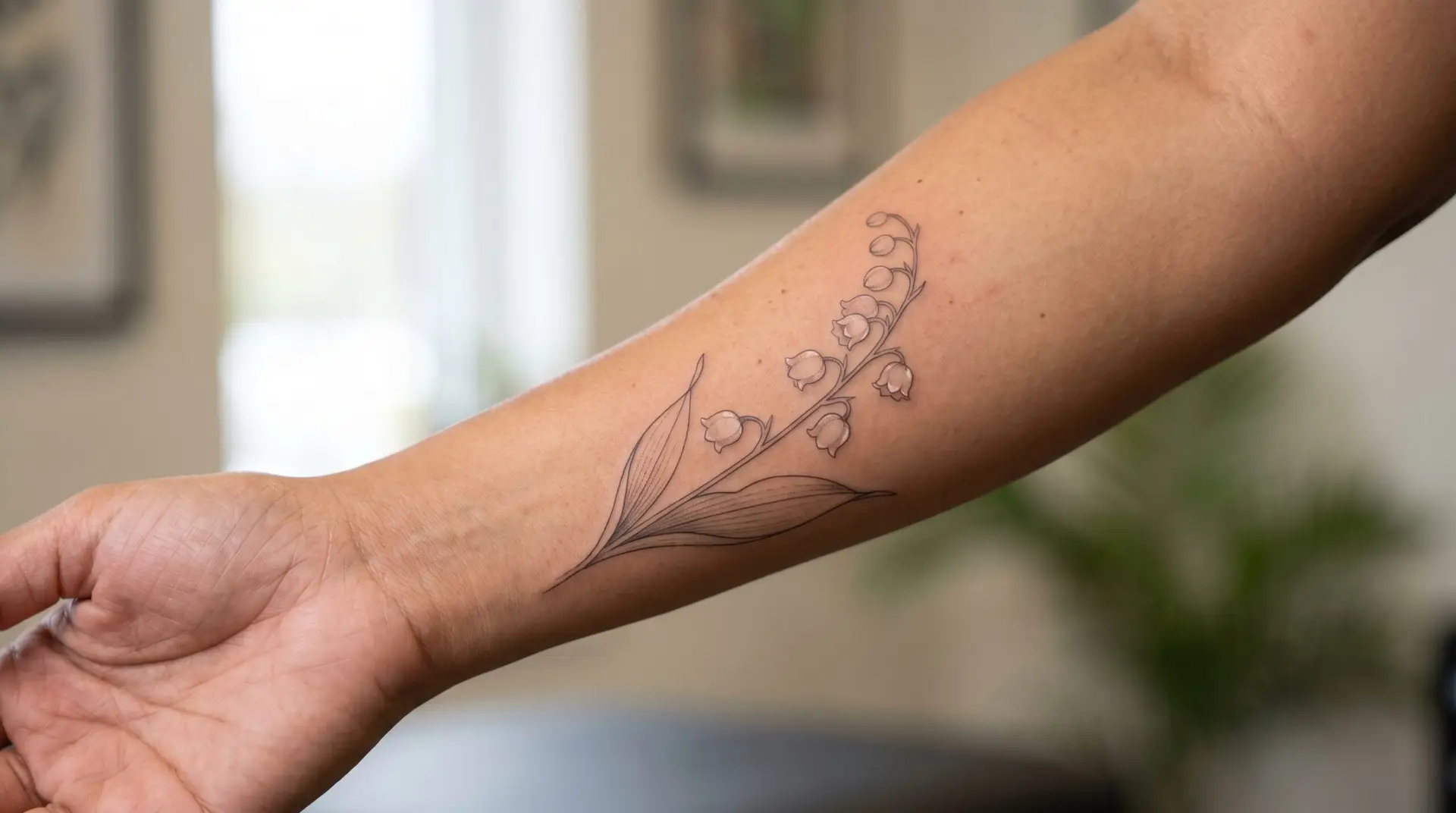
Lily of the valley is May’s primary birth flower, and its distinctive string of bell-shaped white flowers along an arching stem makes it one of the more elegant tattoo subjects in the birth flower calendar. The flower symbolizes return of happiness, humility, and sweetness in basic Western reading, with additional layers from French muguet tradition (since 1561), Christian Marian symbolism (“Our Lady’s tears”), and modern royal wedding heritage (Princess Grace, Queen Elizabeth II, Kate Middleton, Meghan Markle). The combination gives lily of the valley one of the deepest cultural anchorings of any birth flower tattoo subject.
Lily of the valley is a popular tattoo subject, with steady interest in related queries (lily of the valley tattoo ideas, lily of the valley tattoo meaning, and similar). The flower’s distinctive vertical composition supports unique tattoo design approaches not available with other birth flowers: the long string of nodding bell-flowers reads naturally as a flowing linear element on the body, suiting placements where a vertical orientation creates the strongest visual effect.
The bell-flower string composition
The lily of the valley tattoo composition differs significantly from most other floral tattoos. Where rose, peony, and dahlia tattoos center on a single bloom, and where daisy and aster tattoos use radial composition, lily of the valley has a uniquely linear flow: 5 to 15 small bell-shaped flowers arranged along one side of an arching stem. The composition reads as a flowing line rather than a focal point, which opens design possibilities that single-bloom flowers cannot offer.
Common compositional choices include the following.
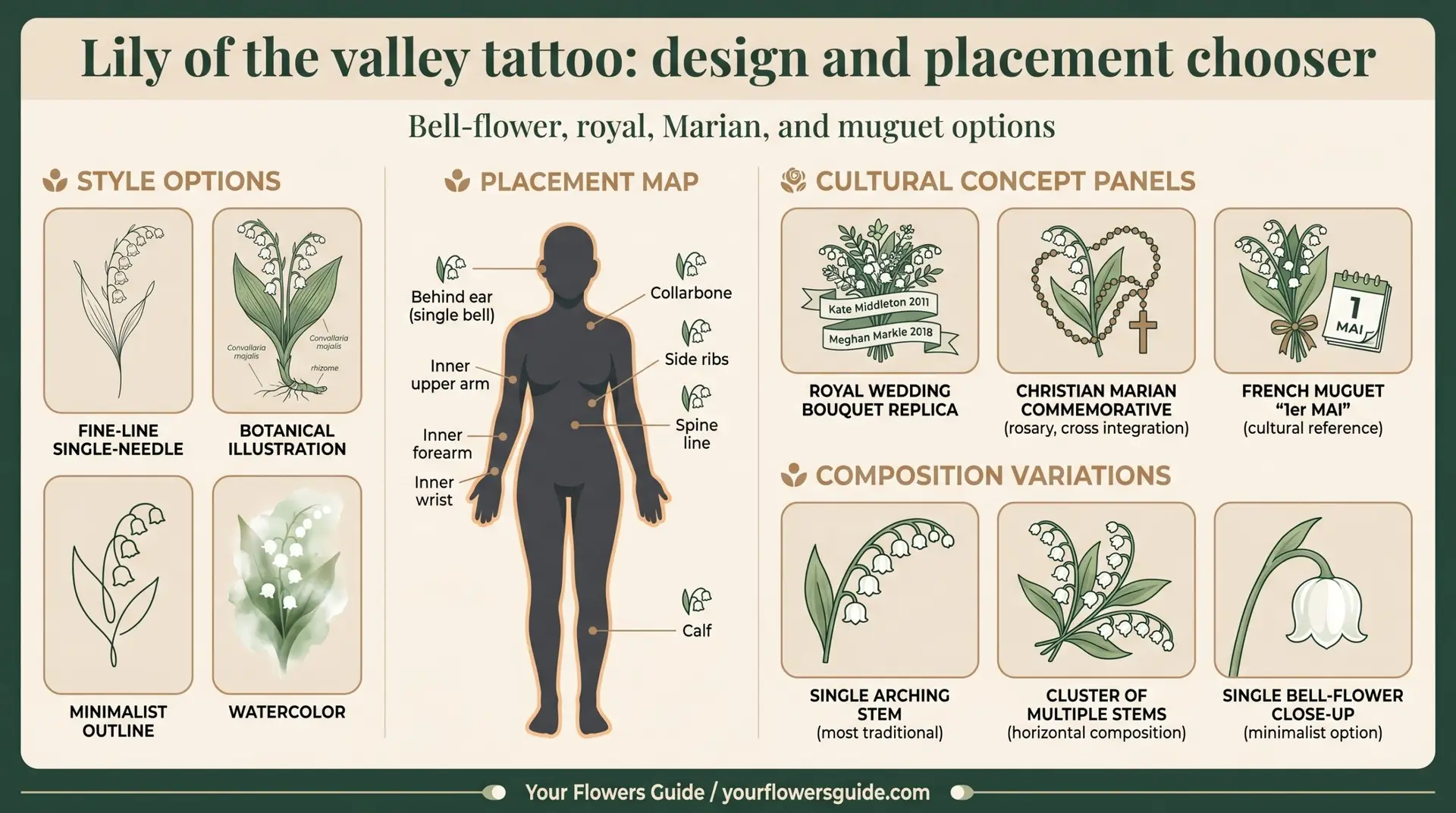
Single arching stem with full bell string. The most traditional lily of the valley tattoo composition. One stem with 5 to 12 bells reading from top to bottom in a graceful S-curve. Works particularly well on placements with vertical orientation: along the spine, the side of the arm or leg, the calf, or the rib line.
Cluster of multiple stems. Two to four arching stems grouped together with overlapping bell-flowers. The cluster creates a more horizontal composition that works on placements where vertical orientation is less suited (the front shoulder, the upper chest, the back of the hand near the wrist).
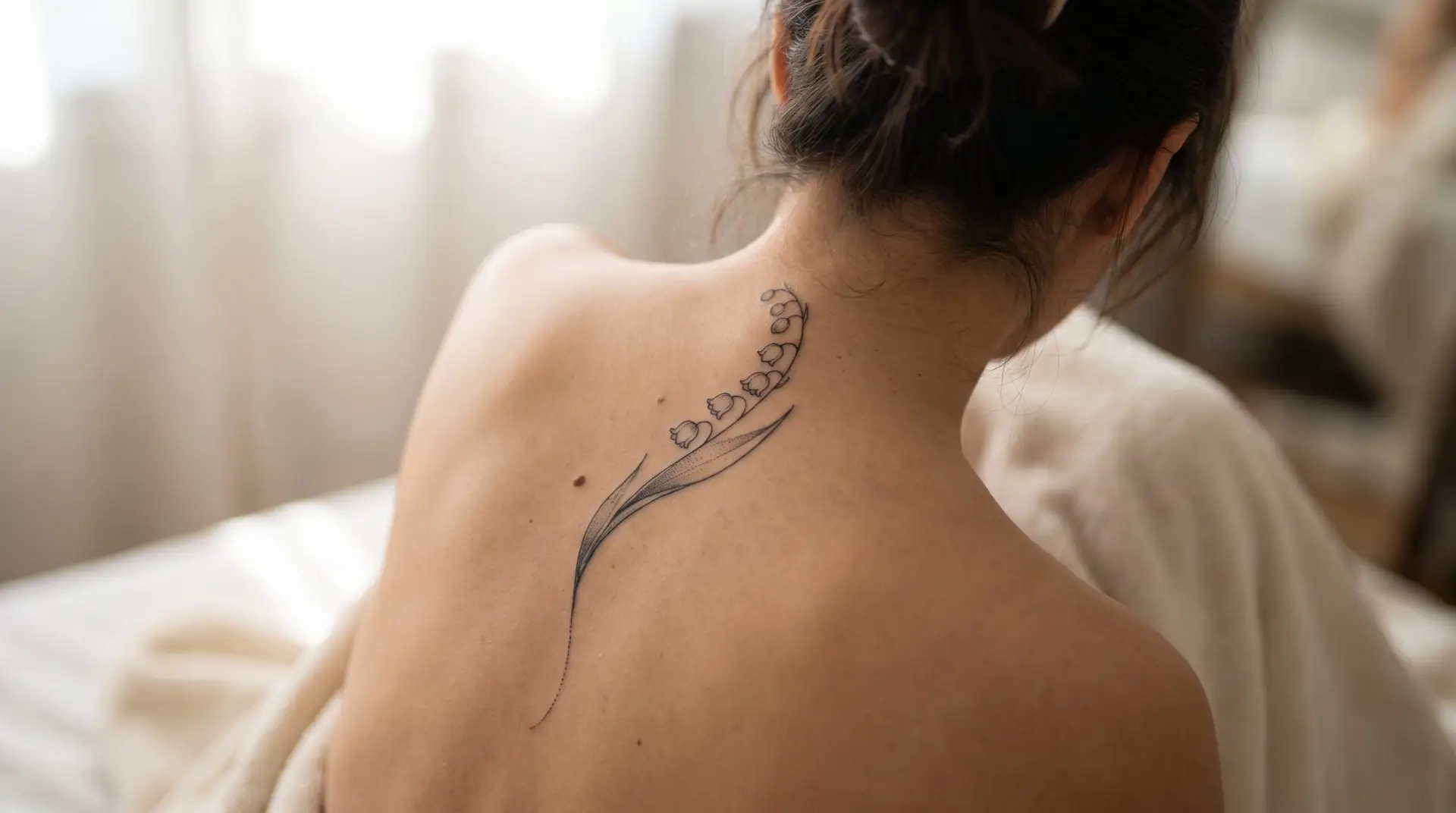
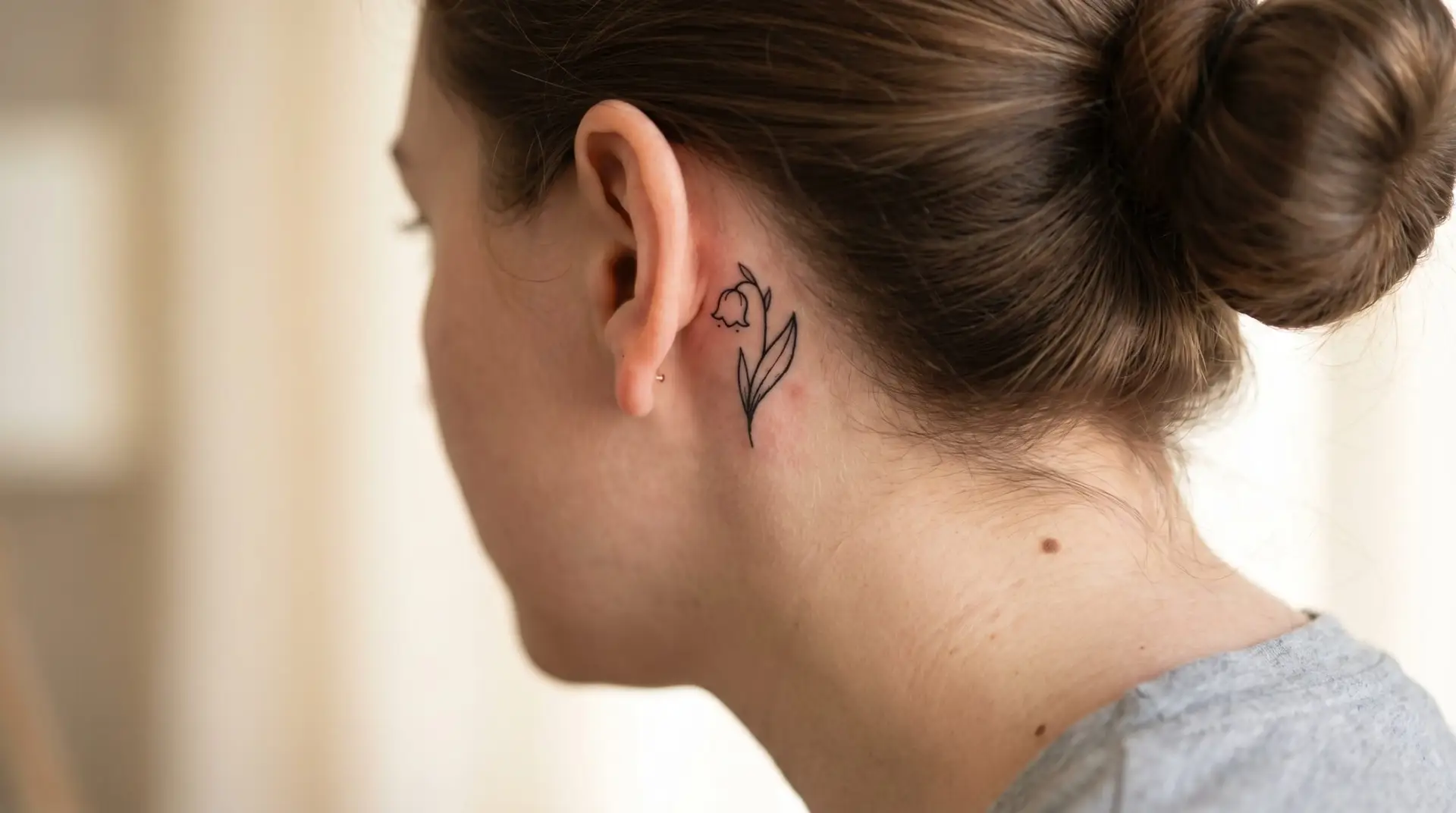
Single bell flower close-up. A minimalist option featuring just one bell-shaped flower in detail. Suits very small placements (behind the ear, finger, behind the neck) and reads as a more abstract floral reference than the recognizable lily of the valley string.
Bell string with broad leaves. A broader composition that includes the characteristic lance-shaped leaves at the base alongside the flower stem. The combination gives botanical-illustration completeness and suits medium-to-large placements where the artist can render both the flowers and the leaf detail clearly.
The compositional flexibility makes lily of the valley unusually adaptable across body placements. The same basic flower can be rendered as a small 1-inch wrist piece (single bell focus), a 4-inch forearm composition (full single stem), or a 6-inch spine-line piece (extended arching stem along the spine curve).
Style options for lily of the valley tattoos
Style choice shapes longevity, placement options, and visual register. The main lily of the valley tattoo styles include the following.
Fine-line single-needle. The most popular modern lily of the valley style. Thin clean lines render the bell-flower string with delicate precision suited to the flower’s small natural scale. Works at small to medium scale (1.5 to 4 inches). Touch-ups every 5 to 10 years are standard.
Botanical illustration. Vintage scientific drawing aesthetic with stem, leaves, and small Latin label (“Convallaria majalis”) integrated below the bloom. Works at medium to large scale (3 to 6 inches) and suits forearm, ribs, and back placements. The botanical style particularly suits readers who want the flower presented with botanical accuracy.
Minimalist outline. Single continuous arching line with 5 to 9 small bell impressions hanging from it. Very small scale (1 to 2 inches) works well. Ages exceptionally well due to minimal ink saturation.
Watercolor. Soft green stem with white-and-cream bell suggestions in watercolor wash. The soft aesthetic suits the flower’s delicate character. Requires touch-up every 3 to 5 years due to ink fade.
Realistic. Photo-realistic rendering with detailed bell-flower texture and dimensional shading. Requires medium-large canvas (4 to 6 inches minimum) and a skilled artist. Holds detail for 10 to 15 years.
Dotwork. Texture built from small dots rather than solid lines. Creates a soft fuzzy texture that suits the flower’s delicate quality.
White ink lily of the valley is sometimes requested but presents challenges. Pure white ink on lighter skin tones can appear faded or absent over time. Many tattoo artists recommend using off-white or pale grey ink with subtle highlights rather than pure white, which holds appearance better as the tattoo ages.
Royal wedding tattoo inspiration
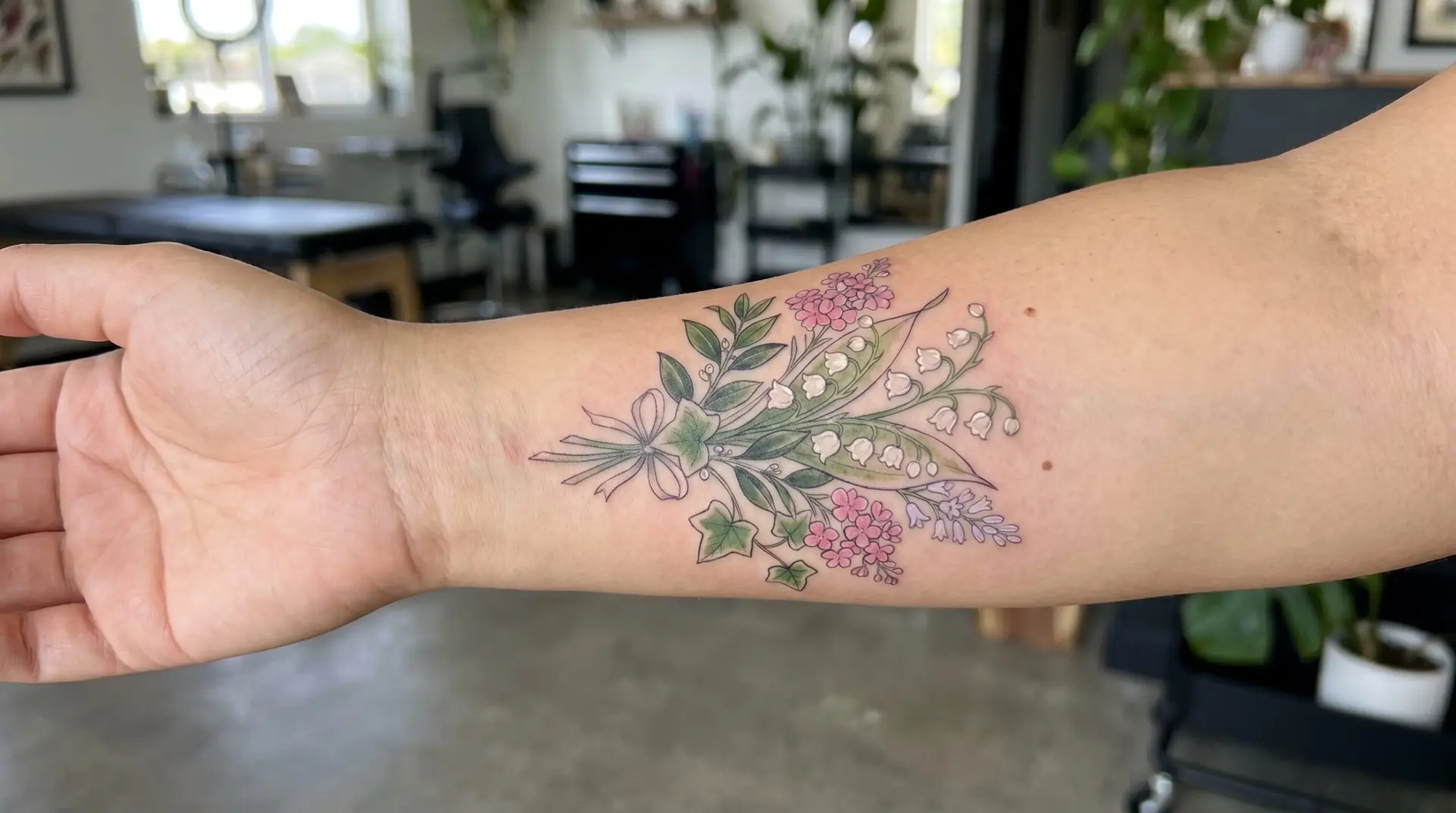
Kate Middleton’s 2011 royal wedding bouquet (which featured lily of the valley as a central element) raised interest in lily of the valley as a tattoo subject. The interest continued through Meghan Markle’s 2018 royal wedding (also featuring lily of the valley in her bouquet). The “royal wedding bouquet replica” tattoo became a recognizable category in modern bridal and milestone-anniversary tattoo work.
Common royal-inspired design approaches include the following.
Kate Middleton bouquet replica. A tattoo recreating the 2011 royal wedding bouquet composition: lily of the valley as central with myrtle (the traditional British royal wedding flower from Queen Victoria’s 1840 wedding), sweet william (homage to Prince William), ivy (loyalty), and hyacinth (constancy). Modern brides who married in the 2010s sometimes commission this design as a wedding-day commemorative tattoo, with the design referencing both their own wedding and the broader royal-bouquet tradition.
Meghan Markle bouquet replica. A tattoo recreating the 2018 royal wedding bouquet composition: lily of the valley with forget-me-not (Princess Diana tribute), sweet pea, jasmine, astilbe, and astrantia. The Princess Diana connection adds emotional weight that suits readers honoring family members who experienced loss.
Lily of the valley with royal cipher or symbol. A small monogram or royal-inspired motif incorporated alongside the lily of the valley. This works as a personal tribute design when the wearer has specific family or cultural connection to British royal heritage rather than just appreciation for the wedding aesthetic.
A sensitivity note: the royal-inspired tattoo reads best as personally meaningful (your own wedding day, your favorite flower, family heritage) rather than as a claim to royal status or identity. The design should resonate with the wearer’s actual life rather than functioning as costume.
Christian Marian commemorative tattoos
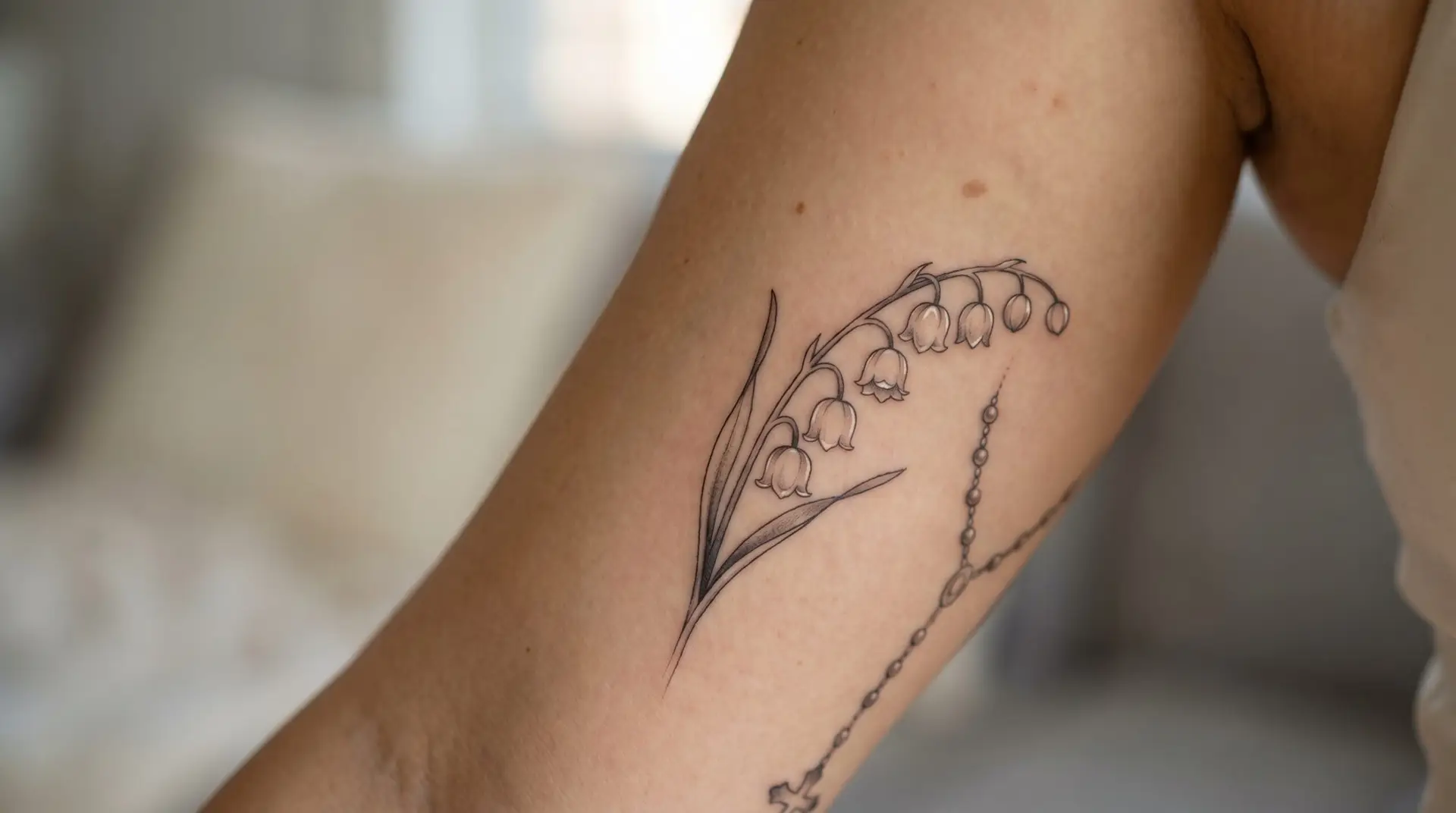
The Christian Marian symbolism of lily of the valley (“Our Lady’s tears” tradition) supports a meaningful tattoo register for Catholic and Marian-devotional readers. The tradition treats the flower as having sprung from the tears Mary shed at the foot of the cross during the crucifixion, giving lily of the valley spiritual significance in Catholic and broader Christian devotional culture.
Common Marian commemorative tattoo concepts include the following.
Lily of the valley with small cross. A small Christian cross integrated with the lily of the valley stem or beside the bouquet. Reads as a quiet devotional gesture suitable for placements that the wearer can see daily as personal reminder.
Lily of the valley with rosary integration. A rosary beads partially visible alongside the lily of the valley stem. The pairing connects the flower directly to Catholic prayer practice. Works particularly well on inner forearm placements where the wearer can see the design while praying or holding objects.
Lily of the valley with Mary medal imagery. A small medal-style Marian image (Our Lady of Lourdes, Our Lady of Guadalupe, Miraculous Medal, depending on the wearer’s specific devotional tradition) beside the flower. The medal imagery should be small and integrated rather than dominant.
Lily of the valley with Hail Mary script. A short fragment of the Hail Mary prayer (often the opening line “Ave Maria” or “Hail Mary, full of grace”) in small script alongside the flower. Works for Catholic readers who want the prayer reference made explicit.
Common placements for Marian commemorative tattoos include the inner forearm (visible daily reminder), inside upper arm (private devotional space), heart-side chest near the breastbone (close to the heart as Catholic tradition emphasizes), and the back of the neck (private placement visible when wearing hair up).
Modern Catholic women’s spiritual tattoo culture has grown significantly in the past decade, with Catholic tattoo studios and Catholic-aware tattoo artists working specifically with devotional tattoo design. The lily of the valley fits this culture as a particularly appropriate flower for Marian commemorative work.
French muguet May 1 commemorative tattoos
For readers with French cultural heritage or strong connection to the Fête du Muguet tradition, lily of the valley tattoos can hold specific French cultural meaning. The 1561 origin date and the long French tradition give muguet tattoos a different cultural register than the royal-wedding or Marian readings.
Common French muguet commemorative tattoo concepts include the following.
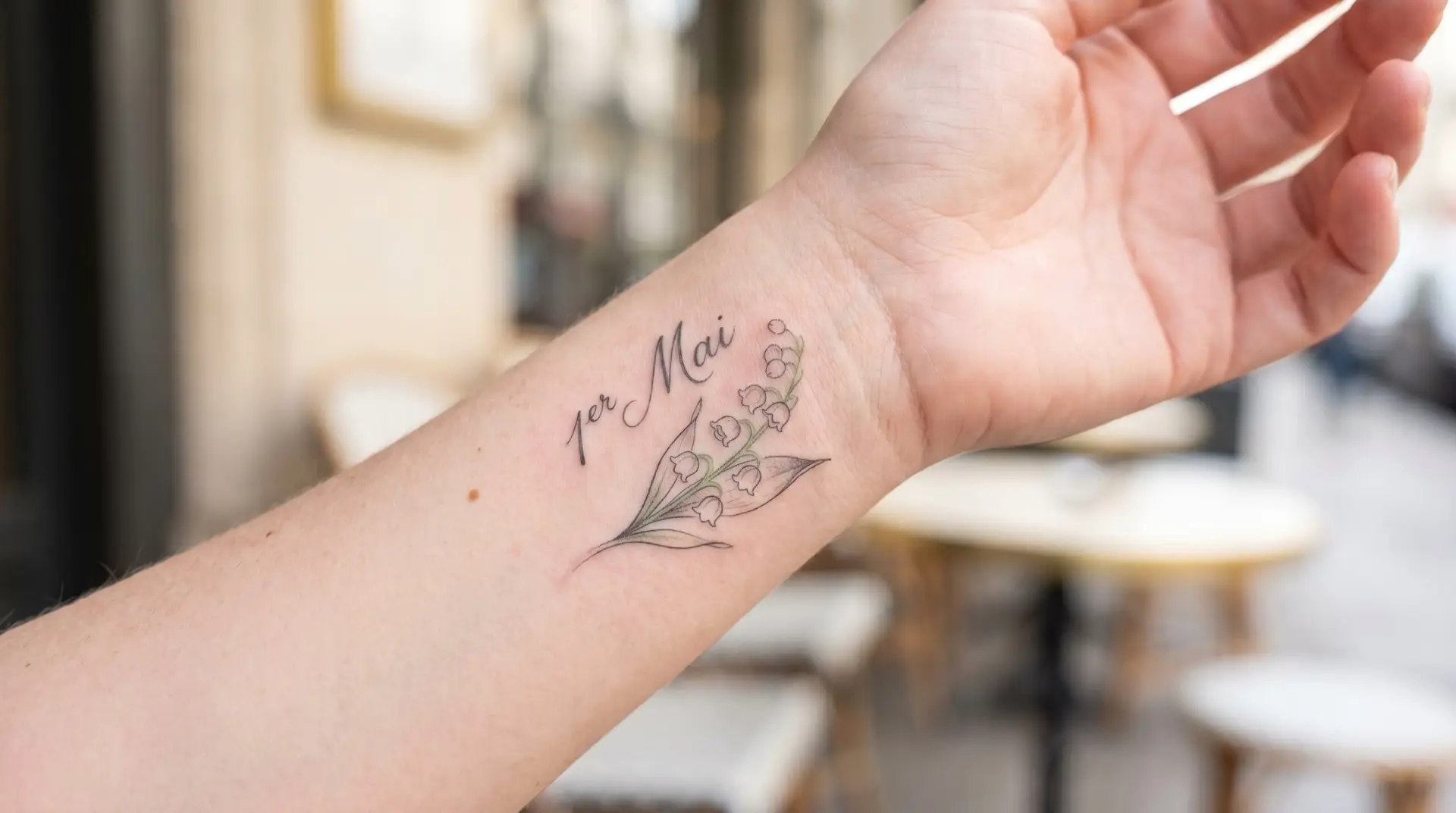
Lily of the valley with “1er Mai” date. The French phrase for May 1 (“1er Mai”) in small script alongside the flower. Reads as direct reference to the French May 1 muguet tradition and gives the tattoo specifically French cultural meaning.
Lily of the valley with small French tricolor accent. A subtle red-white-blue color accent in the design (a small ribbon, a tiny flag, or color accents in the leaves). Less common than other approaches but works for readers with strong French national identity.
Lily of the valley with French motto or phrase. A short French phrase such as “Porte-bonheur” (good luck charm), “Bonne fête” (happy holiday), or a personal French phrase that resonates with the wearer.
Lily of the valley + Eiffel Tower or Parisian skyline. A small skyline silhouette alongside the flower. Works for readers with personal connection to Paris (study abroad memory, family heritage, formative travel experience).
Placements for French muguet tattoos work similarly to other lily of the valley tattoos: wrist, forearm, behind ear, ankle, and shoulder all suit the design depending on the wearer’s preference for visibility.
Placement options
Common lily of the valley tattoo placements include the following.
Inner forearm: medium scale (2 to 4 inches) suits the natural vertical arching stem composition. Low pain, easy to show or cover.
Spine line: large scale (4 to 8 inches) following the spine curve from upper to mid back. The vertical arching composition matches the spine line exceptionally well. Moderate to high pain due to thin skin over vertebrae.
Side ribs: medium scale (3 to 5 inches) along the rib line. High pain due to thin skin over bone and breath movement during tattooing. The vertical composition follows the body’s natural curves well.
Inner wrist: small scale (1 to 2 inches), single short stem or single bell-flower. Low pain.
Behind ear: very small (0.5 to 1 inch), single bell-flower or short stem with 3 to 5 bells. Moderate pain. Fully hideable under hair.
Calf (outer side): medium scale (3 to 5 inches), vertical stem composition following the calf line. Low to moderate pain.
Ankle (outer): small to medium (1.5 to 3 inches), short stem. Low to moderate pain.
Collarbone: small horizontal cluster of 3 to 5 stems following the collarbone curve. Moderate to high pain.
Inner upper arm: medium scale (2 to 4 inches), private placement visible to self. Low pain.
Sternum: small composition between the breasts. High pain, intimate placement.
Design pairings
Common lily of the valley tattoo pairings include the following.
Lily of the valley plus name: script name flowing alongside or beneath the stem. Suits memorial and family tattoos.
Lily of the valley plus date: wedding date, birth date, or anniversary date in Roman or modern numerals.
Royal wedding flower combinations: Kate Middleton or Meghan Markle bouquet replicas (see royal section above).
Lily of the valley plus Christian Marian symbols: rosary, cross, Mary medal (see Marian section above).
Lily of the valley plus French muguet references: “1er Mai,” French motto, or Parisian skyline (see French section above).
Lily of the valley plus zodiac: Taurus (April 20 to May 20) or Gemini (May 21 to June 20) symbol.
Lily of the valley plus emerald: the May birthstone in green color harmony with the leaves. Often rendered as the flower with a small faceted emerald gemstone integrated.
Lily of the valley plus butterfly or bee: the spring meadow ecosystem reference.
Multi-generation family tattoo: matching lily of the valley tattoos for family members born in May (mother and daughter, sisters, grandmother and grandchildren).
Aftercare for delicate tattoos
Standard tattoo aftercare applies: keep the tattoo clean and moisturized for the first two weeks, avoid direct sunlight and chlorinated water during initial healing, and follow your tattoo artist’s specific recommendations. Full healing takes 4 to 6 weeks for the surface and up to 6 months for deeper layers. The American Academy of Dermatology aftercare guide (linked in Sources) covers the protocol in detail.
Lily of the valley-specific considerations follow. Fine-line work fades faster than bold-line work; expect touch-ups every 5 to 10 years for fine-line lily of the valley tattoos. The bell-flower string composition is particularly sensitive to fading because the individual bell-flower outlines are small and lose definition as ink ages.
White ink work in lily of the valley tattoos requires careful consideration. Pure white ink can develop a yellowish tint after 5 to 10 years on UV-exposed placements. Many tattoo artists use off-white or pale grey ink with subtle highlight technique rather than pure white, which holds appearance better over time. Some readers choose to leave the bell-flowers as outlined-only (no fill) to avoid the white-ink aging issue.
UV protection matters more for lily of the valley tattoos than for darker pigment work. Use mineral sunscreen daily on tattooed areas during the first summer after the tattoo. Visible-placement lily of the valley tattoos (wrist, forearm, collarbone) particularly benefit from continuing daily SPF use for long-term preservation.
Touch-up appointments are common practice. Schedule the 6-month touch-up at the time of the original appointment. Long-term touch-ups (every 5 to 10 years) maintain the bell-flower string detail definition.
Frequently asked
What does a lily of the valley tattoo mean?
Return of happiness, humility, and sweetness in basic Western reading. Additional layers include French muguet good-luck tradition (since 1561), Christian Marian symbolism (“Our Lady’s tears”), and modern royal wedding heritage (Princess Grace 1956, Kate Middleton 2011, Meghan Markle 2018). The flower is also May’s primary birth flower.
What is the most popular lily of the valley tattoo design?
A single arching stem with the full string of 5 to 12 bell-flowers, rendered in fine-line single-needle style at 2 to 4 inches on the inner forearm or along the side of the body where the vertical composition reads naturally. The royal wedding bouquet replica (with myrtle, sweet william, ivy, hyacinth) is also a popular design particularly for milestone wedding anniversary tattoos.
Where should I place a lily of the valley tattoo?
The flower’s vertical arching composition suits placements with vertical orientation: spine, side of arm, side of leg, rib line, calf. Inner forearm works particularly well for medium-scale designs. Smaller designs (single bell-flower or short 3-bell stem) work on wrist, behind ear, and ankle.
Can I get a Kate Middleton lily of the valley tattoo?
Yes. The 2011 royal wedding bouquet replica (lily of the valley with myrtle, sweet william, ivy, hyacinth) is a recognizable tattoo design category in modern bridal commemorative work. The design works best as personally meaningful (your own wedding day, your favorite flower, your appreciation for the royal aesthetic) rather than as a claim to royal status.
Is lily of the valley tattoo good for memorial tattoos?
Yes. The “return of happiness” reading fits memorial intentions particularly well, framing the tattoo as the promise of continuing joy beyond grief. The Christian Marian symbolism reinforces this reading for Catholic readers. White or pale color choices suit memorial registers; the bell-flower vertical composition suits both single-loss and multi-generation memorial designs.
Does white ink fade in lily of the valley tattoos?
Yes. Pure white ink can develop a yellowish tint after 5 to 10 years on UV-exposed placements. Many tattoo artists recommend off-white or pale grey ink with subtle highlight technique rather than pure white. Some readers choose to leave the bell-flowers as outlined-only without fill to avoid the white-ink aging issue entirely.
What is a French muguet tattoo?
A lily of the valley tattoo referencing the French Fête du Muguet (Lily of the Valley Day) tradition that has marked May 1 since 1561. The French “muguet” tattoo often includes “1er Mai” date in script or other French cultural references alongside the flower. The design suits readers with French cultural heritage or strong personal connection to French tradition.
How long does a lily of the valley tattoo last?
Fine-line lily of the valley tattoos hold visible detail for 5 to 10 years before requiring touch-up. Traditional bold-line work holds for 10 to 15 years. The bell-flower string composition is particularly sensitive to fading because individual bell outlines are small and lose definition as ink ages. Regular touch-up appointments maintain the design’s clarity over decades.
Sources
- Tattoo aftercare · American Academy of Dermatology
- Convallaria growing guide · Royal Horticultural Society
About this article. > Written and reviewed by the Your Flowers Guide editorial team. Tattoo aftercare references from the American Academy of Dermatology. Botanical content from the Royal Horticultural Society. Royal wedding references from official British royal family communications and contemporary press coverage. Christian Marian tradition references from Catholic devotional literature.