Honeysuckle flower meaning: Victorian bonds of love, fragrance, and growing
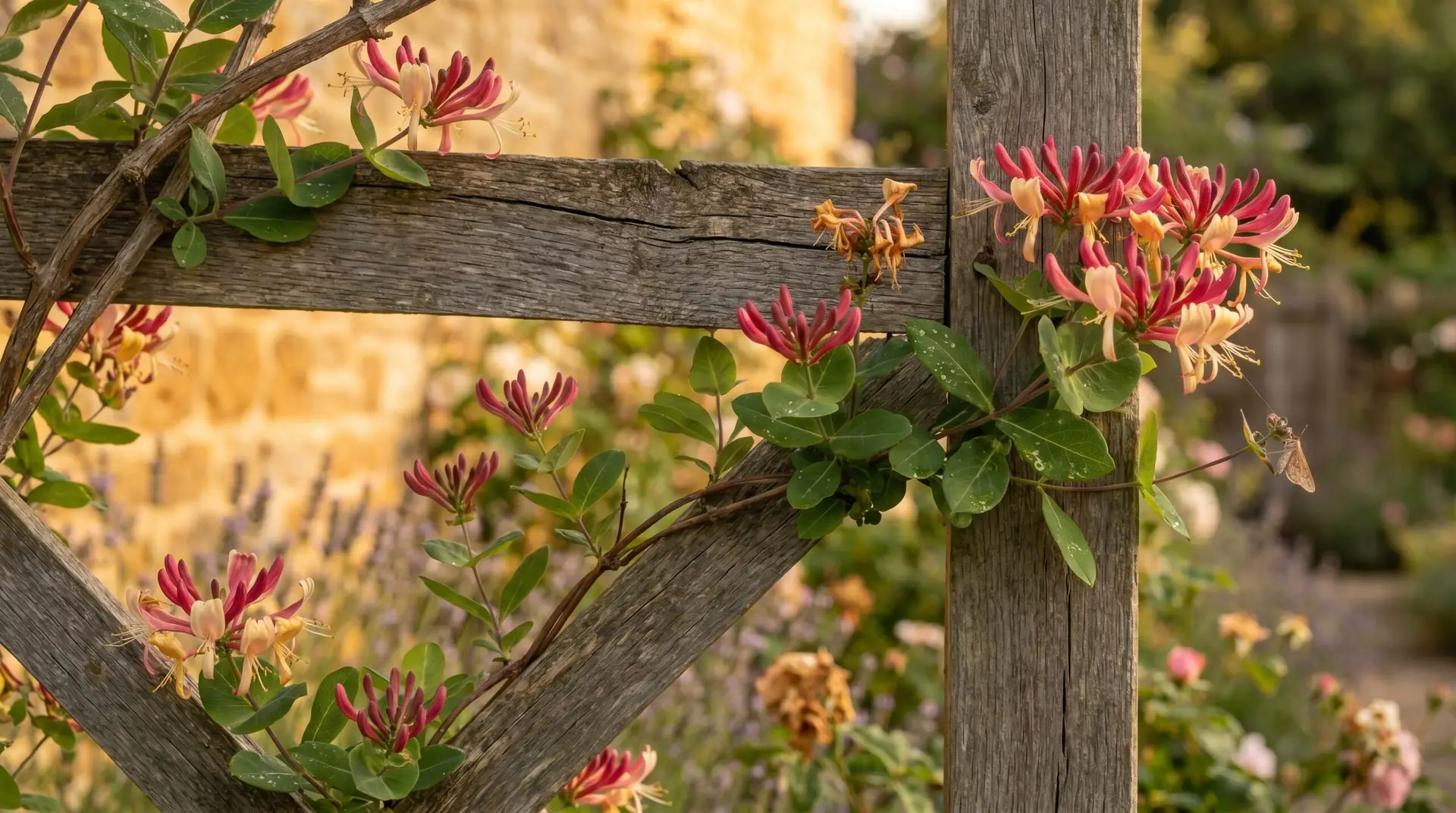
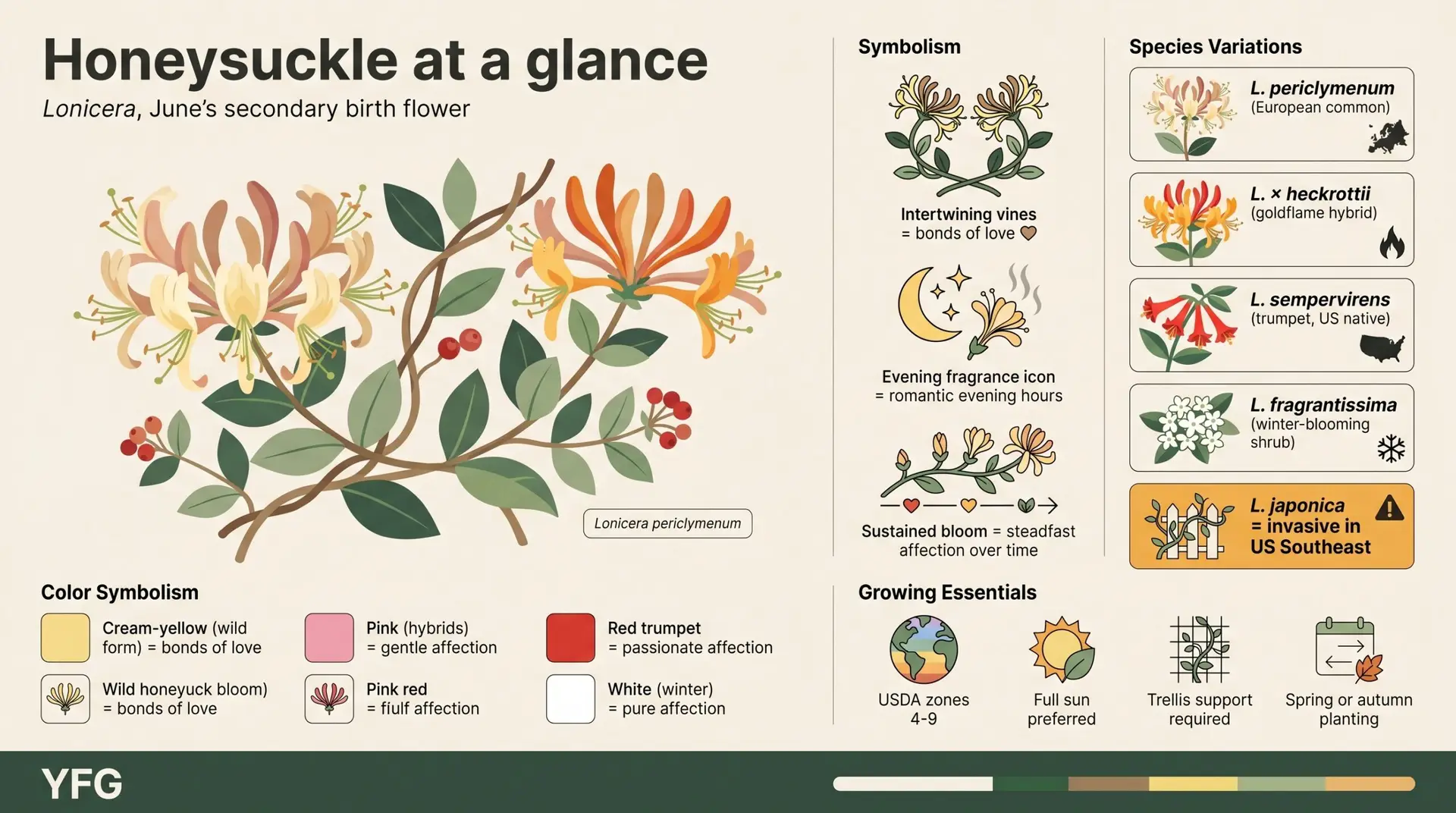
Honeysuckle is June’s secondary birth flower in Western tradition. Where rose stands for love in its many forms, honeysuckle stands for bonds of love, steadfast affection, and the intertwining of lives. The plant is Lonicera in standard botanical naming, with Lonicera periclymenum (the European common honeysuckle or woodbine) being the species most associated with the June birth flower tradition.
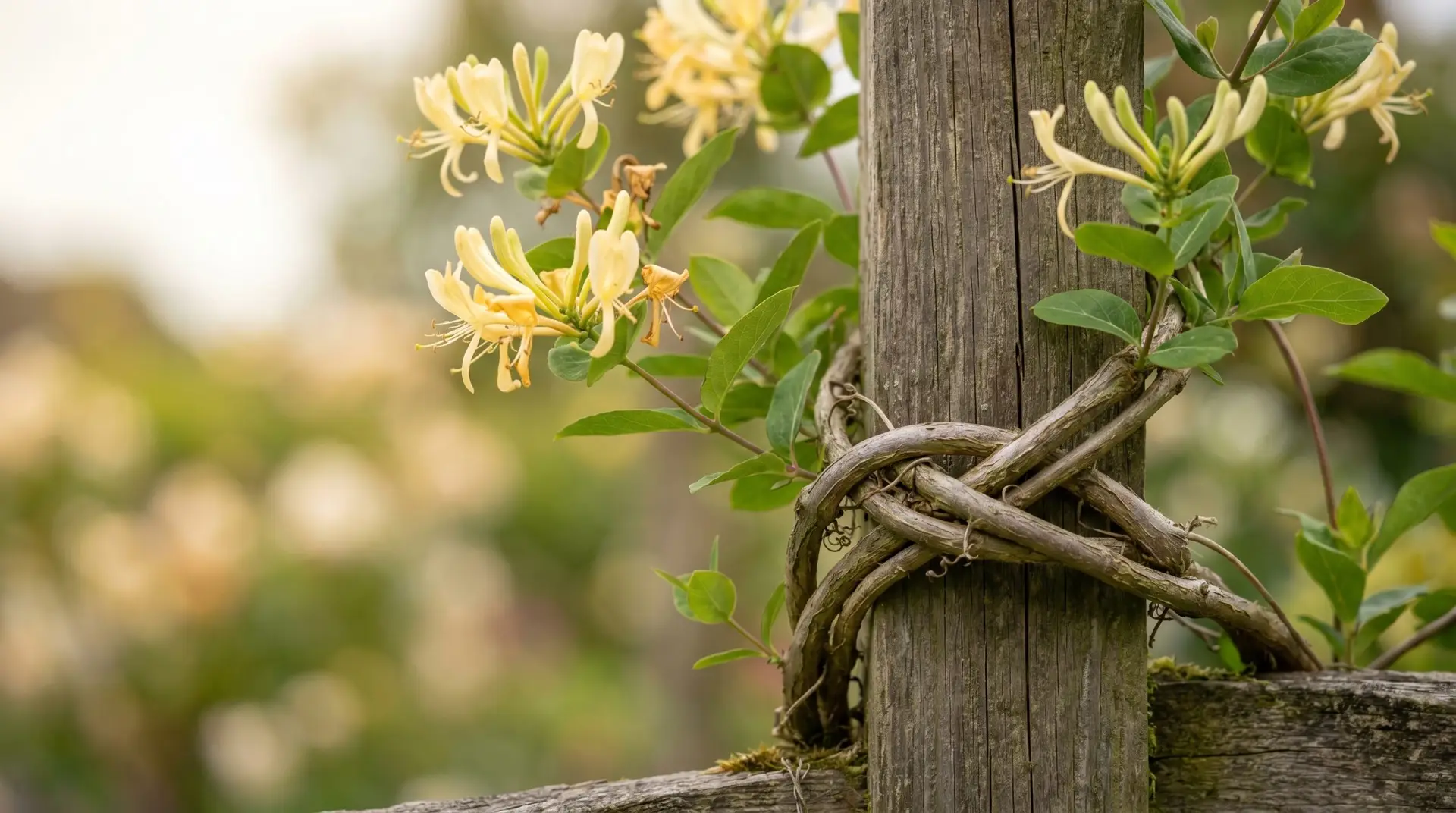
The Victorian floriography that codified the modern Western birth flower system gave honeysuckle a distinctive symbolic register based on the plant’s most observable characteristic: its climbing habit. Honeysuckle vines climb through whatever support they find, wrapping around tree branches, fences, trellises, and arbors as they grow. The visual of two stems intertwining around a shared support gave Victorian writers the metaphor of intertwined affection, of two lives growing together while sharing a supporting structure. This “bonds of love” reading remains the dominant symbolic interpretation of honeysuckle in modern Western flower language and explains the flower’s particular suitability for romantic anniversary gifts, wedding bouquets, and long-term relationship commemorations.
Honeysuckle botany: Lonicera periclymenum and species variations
Honeysuckle belongs to the genus Lonicera in the family Caprifoliaceae. The genus contains about 180 species globally, native to temperate regions of the Northern Hemisphere across Europe, Asia, and North America. The name Lonicera honors Adam Lonicer (1528 to 1586), a German botanist whose Kreuterbuch (an illustrated herbal, 1557) was an important sixteenth-century botanical reference.
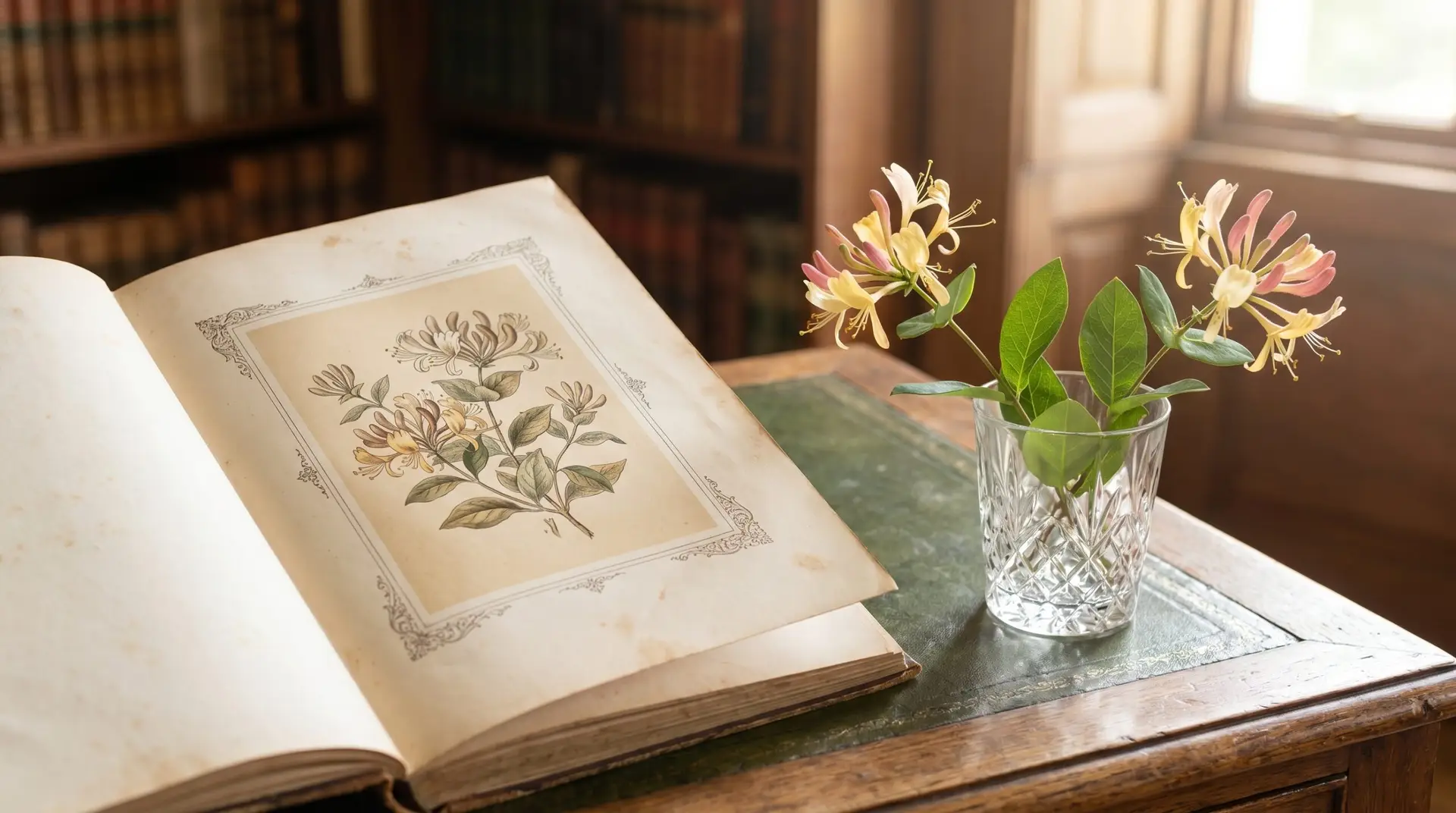
The species most associated with European honeysuckle tradition is Lonicera periclymenum (the common honeysuckle, woodbine, or European honeysuckle). The plant is a deciduous twining vine native to Britain, continental Europe, and western Asia, climbing through tendrils that wrap around any available support to reach 15 to 20 feet at maturity. The leaves are oval and arranged in opposite pairs along the stem, typically 1 to 2 inches long. The flowers appear in dense clusters at the tips of stems, with each individual flower showing the genus’s distinctive tubular form: petals fused into a long tube that opens at the end into two lips (an upper “hood” of four fused petals and a lower single petal).
Other commonly cultivated Lonicera species include:
Lonicera × heckrottii (the goldflame honeysuckle). A hybrid garden plant with showier flowers than wild common honeysuckle. Pink and yellow flower clusters; sterile (does not produce viable seed). Popular ornamental garden vine in Europe and North America.
Lonicera japonica (the Japanese honeysuckle). Native to East Asia (Japan, Korea, eastern China). Cream-yellow flowers turning yellow as they age, intensely fragrant. The species has become a serious invasive plant in much of the United States since its introduction in the 1800s, particularly in southeastern states.
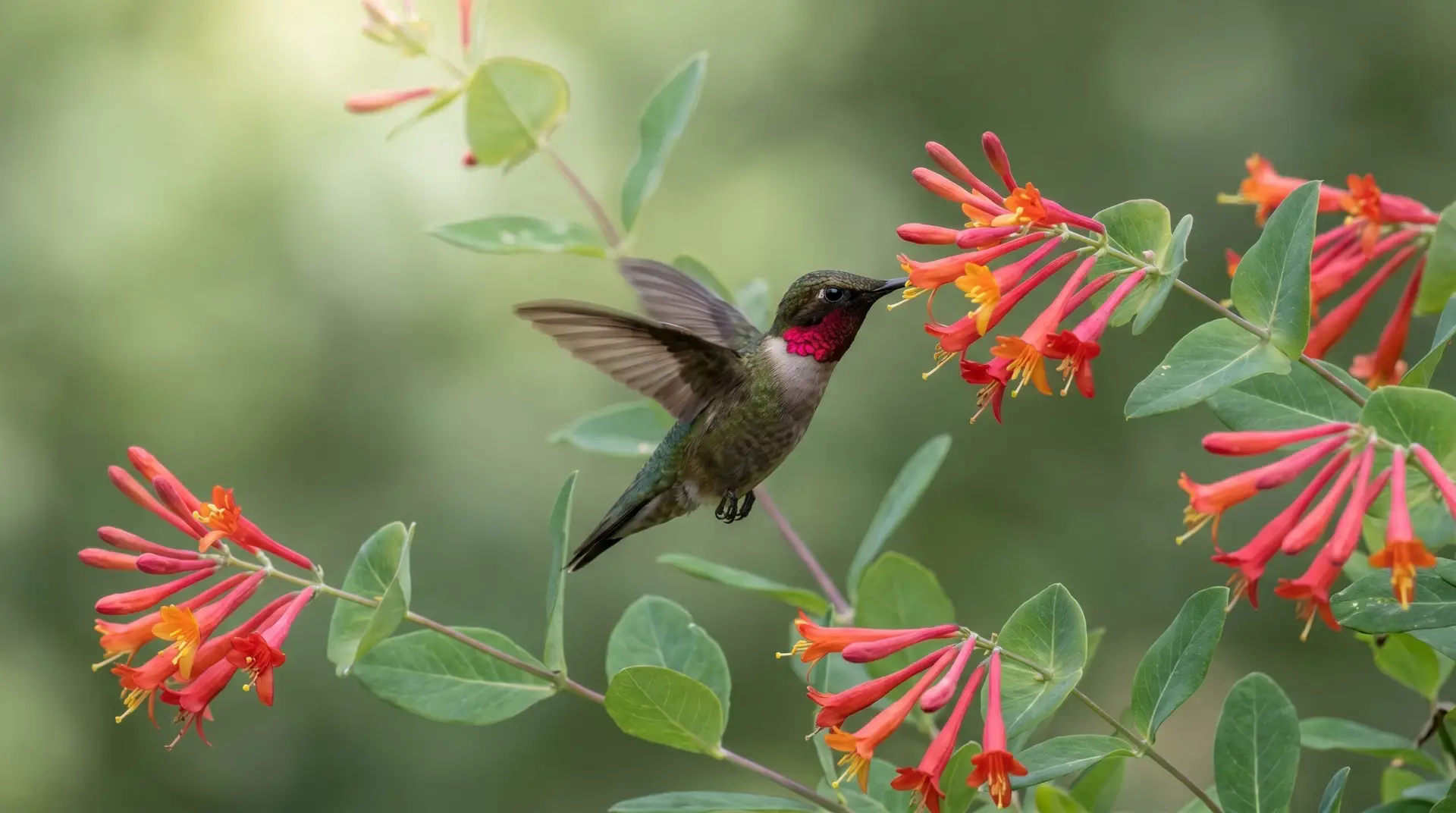
Lonicera sempervirens (the trumpet honeysuckle or coral honeysuckle). Native to eastern and southern United States. Larger tubular flowers in red-orange, hummingbird-pollinated. Less invasive than L. japonica.
Lonicera fragrantissima (the winter-blooming or fragrant honeysuckle). Native to China. A shrub form rather than climbing vine, with small intensely fragrant cream-white flowers in late winter through early spring (January through March in temperate climates).
Bloom timing for common honeysuckle runs from late spring through summer in temperate climates, with peak abundance in June and July. After flowering, the plant produces small red or black berries that are toxic to humans (mild gastrointestinal upset if eaten) but eaten by birds. Do not eat honeysuckle berries.
The Victorian bonds of love tradition
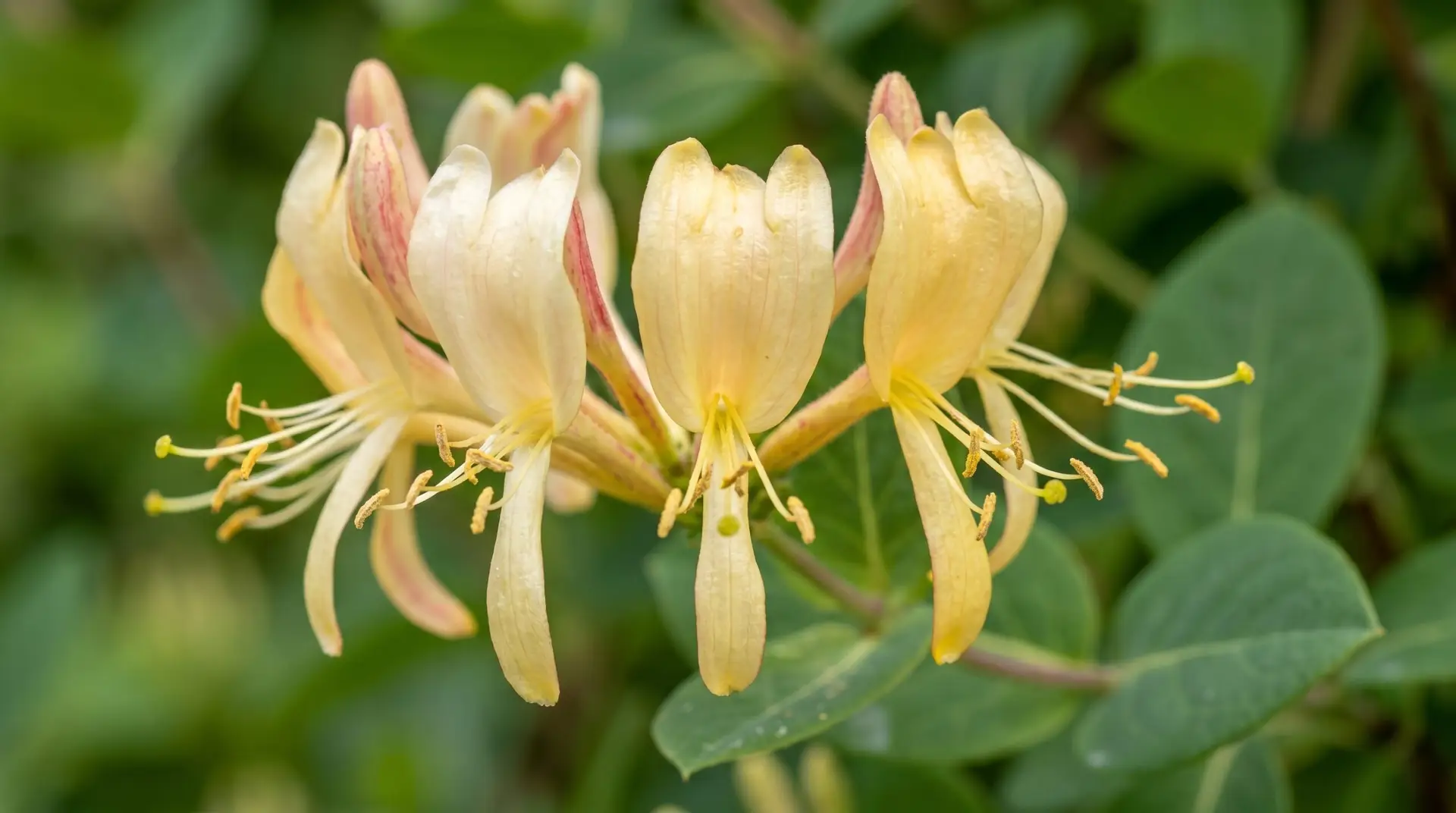
The Victorian floriography system, codified in nineteenth-century English flower books, gave honeysuckle a distinctive symbolic register. Robert Tyas (Sentiment of Flowers, 1836), Frederic Shoberl (Language of Flowers, 1834), and their successors assigned honeysuckle the readings of “bonds of love,” “devoted affection,” and “the bond of love” across multiple flower dictionaries. The Victorian conventions remain the dominant Western symbolic reading of honeysuckle in 2026.
The “bonds of love” reading drew on three interrelated observations about the plant. The climbing habit provided the most direct visual metaphor: honeysuckle vines climb through whatever support they find, wrapping around their host plant or structure as they grow. Two vines climbing the same support intertwine as they grow, the metaphor for two lives growing together through shared experience. The persistence of the climbing reflects the steadfastness of long-term relationships: honeysuckle does not redirect easily once attached to a support.
The intense fragrance reinforced the romantic register. Honeysuckle releases its strongest fragrance in the evening hours, the same time period when human social and romantic activities historically concentrated (evening walks in gardens, evening parties, evening courting visits). The combination of evening fragrance and climbing habit gave Victorian writers the symbolic register of nocturnal romance and the deepening of affection through time spent together in pleasant evening settings.
The continuing bloom characteristic added the third element. Common honeysuckle blooms for several weeks in late spring and summer, with flowers continuing to appear on new growth across the season. The continuing bloom contrasted with the brief peak bloom of rose, providing the symbolic register of sustained affection across long timescales rather than passionate intensity over short periods.
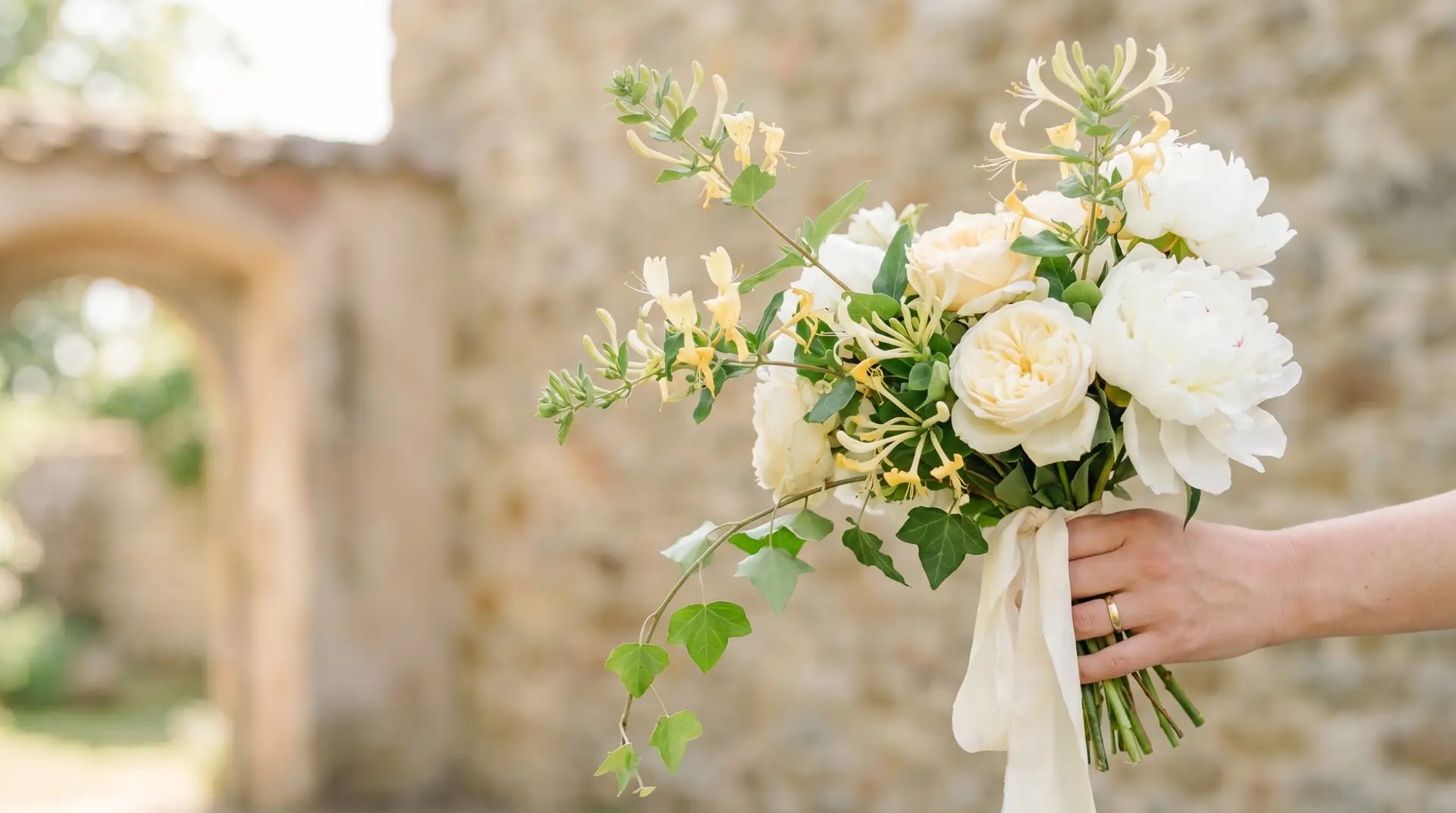
The Victorian symbolic register has remained durable in modern Western flower language. Modern wedding florists treat honeysuckle as a meaningful inclusion in bouquets specifically because of the “bonds of love” reading. Honeysuckle-and-rose combinations honor both the passionate love of rose and the steadfast bonds of honeysuckle, giving wedding bouquets layered romantic symbolism.
Fragrance characteristics and chemistry
Honeysuckle fragrance is one of the most distinctive single-flower scents in the European garden vocabulary. The scent combines sweet honey-like notes with floral and slightly green characteristics. Perfumers describe the fragrance as combining the sweetness of jasmine with a freshness that jasmine lacks, plus a slight nectar character that is unusual in fragrance work.
The chemistry behind the fragrance involves several volatile compounds, with linalool (also found in lavender and many other fragrant flowers), benzyl alcohol, and various sesquiterpenes as primary contributors. The fragrance reaches peak intensity in evening hours and warm humid conditions, both of which favor the volatile compound emissions from the plant.
The evening fragrance peak has an ecological explanation. Honeysuckle is pollinated primarily by moths, which fly at night. The plant’s fragrance evolution favored evening-timed emissions to attract its primary pollinators. Modern garden honeysuckle continues to follow this evolutionary pattern, releasing strongest fragrance in evening hours even when grown in environments without the original moth pollinators.
The fragrance carries unusually well in still air. A single mature honeysuckle vine on a garden fence or pergola can perfume an entire small garden during summer evenings, with the scent traveling significant distances. Gardeners often plant honeysuckle near patios, garden seating areas, or open windows specifically to enjoy the evening fragrance.
Commercial perfumery uses honeysuckle as a heart note in compound fragrances. The natural absolute is difficult and expensive to produce (the volatile compounds are present in low concentrations and degrade quickly), so most perfumery use today employs synthetic reconstructions of honeysuckle scent. Notable honeysuckle-containing perfumes include Estée Lauder Honeysuckle Splash (1996), Annick Goutal Le Chèvrefeuille (1995, named for the French word for honeysuckle), and various spring and summer fragrances from Jo Malone London, Yardley, and Crabtree & Evelyn.
The children’s tradition of pulling individual honeysuckle flowers from clusters and sucking the small nectar drop at the tube’s base is documented across British, Northern European, and North American childhood folklore. The “honey” suggested in the suckle gave the plant its English common name. The nectar drop is sweet and not harmful (different from the toxic berries); the flowers themselves are not harmful when handled or briefly tasted.
The climbing-vine symbolism
The climbing habit of honeysuckle is central to the plant’s symbolic tradition. Unlike rose (which stands on its own stems and requires no support to bloom), honeysuckle climbs through and over other plants and structures. The botanical character of climbing makes honeysuckle a fundamentally relational plant: it cannot reach its mature size without support, and the support shapes the plant’s growth direction.
This climbing dependency gave Victorian and pre-Victorian symbolic traditions the metaphor for relational dependence and mutual support. Two honeysuckle vines growing on the same support intertwine as they reach for light, sharing space and support without competing destructively. The image works as a metaphor for healthy long-term relationships where two lives intertwine through shared experiences without losing their individual identities.
The climbing-vine metaphor extends to other Victorian-era symbolic uses of climbing plants. Ivy has similar associations with attachment and loyalty in Victorian flower language. Wisteria suggests welcome and prolonged friendship through its similar climbing character. Clematis signals mental beauty and ingenuity. The climbing-plant family generally occupies a specific niche in Western floriography focused on relational and attachment themes rather than the individual-bloom focus of standalone flowering plants.
The “bonds of love” reading specifically connects to the visible intertwining of multiple honeysuckle vines growing on shared support. Wedding florists who incorporate honeysuckle in bouquets sometimes specifically arrange the stems to intertwine, making the symbolic message visible in the bouquet form itself. Modern wedding traditions sometimes incorporate this intertwining directly into ceremony elements: vows that mention growing together, ring exchanges where the rings interlock, hand-fasting ceremonies that physically bind hands together.
Color symbolism within Lonicera
Honeysuckle color has less symbolic weight than the broader plant’s “bonds of love” reading, but color variation does support some additional symbolic register:
Cream-yellow honeysuckle (Lonicera periclymenum wild form): the classic European honeysuckle symbolism. Bonds of love, steadfast affection, devoted bonds.
Pink honeysuckle (Lonicera × heckrottii and similar cultivars): gentle romantic affection. The pink color shifts the symbolic register toward sweeter and less stark associations.
Red or coral honeysuckle (Lonicera sempervirens): passionate affection, ardent love. The red color reads more dramatically and connects to broader red-flower romantic symbolism.
White honeysuckle (winter-blooming Lonicera fragrantissima): purity in affection, the gentle quiet side of romantic devotion. Less common as a birthday gift but suits memorial intentions where the honeysuckle’s bonds-of-love symbolism is wanted alongside the white color of remembrance.
Multi-color honeysuckle bouquets: abundance of affection, complexity of bonds. The combination of multiple honeysuckle varieties in one arrangement signals layered relationship dimensions.
Growing honeysuckle
Honeysuckle is one of the easiest climbing vines to grow in temperate climates. The plant tolerates a wide range of conditions and rewards basic care with reliable bloom and fragrance.
USDA zones 4 through 9 cover the temperate climate range where common honeysuckle performs well. Cooler zones (4 to 6) suit Lonicera periclymenum and Lonicera × heckrottii particularly. Warmer zones (7 to 9) work for all common species. Zone 10 and warmer can grow honeysuckle but bloom may decline due to lack of winter chill.
Sun exposure works best in full sun to light partial shade. Full sun produces the most abundant bloom; partial shade reduces flowering but keeps the plant healthy. Deep shade significantly reduces or eliminates bloom.
Soil tolerance is broad. Honeysuckle handles sandy, loamy, and clay soils without significant trouble. The plant tolerates acidic and alkaline pH within a wide range. The main soil requirement is reasonable drainage; waterlogged conditions cause root problems.
Planting timing in spring or autumn works in temperate climates. Spring planting (March to May depending on local frost dates) gives the plant the full growing season to establish before winter. Autumn planting (September to November) takes advantage of cooler temperatures and autumn rainfall but requires winter protection in colder zones.
Support is essential. Honeysuckle climbs through twining stems that need something to wrap around. Provide a trellis, pergola, fence, or arbor at planting time so the young plant has structure to climb. Wooden trellises typically last 5 to 10 years; metal supports last longer but heat up more in summer. Heavy support is needed for mature plants; a 10-year-old honeysuckle vine can weigh 50 to 100 pounds when fully grown.
Pruning maintains plant shape and bloom abundance. Common honeysuckle (Lonicera periclymenum) blooms on new wood, so prune in late winter or early spring to encourage new growth and abundant summer bloom. Trumpet honeysuckle (Lonicera sempervirens) and goldflame honeysuckle (Lonicera × heckrottii) bloom on both new and old wood, so light pruning at any time is acceptable.
Invasive species and Lonicera japonica caution
The Japanese honeysuckle (Lonicera japonica) is a serious invasive species across much of the United States, particularly in the Southeast (Tennessee, Georgia, Alabama, South Carolina, North Carolina, Virginia). The species was introduced in the 1800s as an ornamental and quickly escaped cultivation, displacing native vegetation in many ecosystems.
Identifying Lonicera japonica is important if you live in an affected region. The species has cream-yellow flowers that turn deeper yellow as they age (within a few days), intensely fragrant in evening hours. The leaves are oval and arranged in opposite pairs, similar to other honeysuckles, but with a slightly leathery texture and dark green color. The vine climbs aggressively and forms dense mats that overwhelm native vegetation.
Reading recommendations vary by region. In areas where Japanese honeysuckle is established as invasive, do not plant it intentionally and consider removing existing plants. The US Department of Agriculture lists L. japonica as a noxious weed in some states. In areas where it is not established (much of Europe, parts of the northern US, Canada), the plant remains a permissible ornamental but should be monitored for spread.
For garden honeysuckle in invasive-affected areas, choose native or non-invasive alternatives. Lonicera sempervirens (the native trumpet honeysuckle) provides similar climbing-vine ornamental value without invasive risk in eastern North America. Lonicera periclymenum (the European common honeysuckle) remains generally non-invasive in North American conditions, though it has naturalized in some areas of the Pacific Northwest.
Frequently asked
What does the honeysuckle flower symbolize?
Bonds of love, steadfast affection, and the intertwining of lives in modern Western reading. The Victorian floriography system codified these readings in the nineteenth century based on observations of the plant’s climbing habit (vines intertwining around shared supports), evening fragrance (associated with romantic evening hours), and continuing bloom (sustained affection across time).
Why is honeysuckle June’s birth flower?
Honeysuckle blooms abundantly in June across temperate climates with peak fragrance occurring on warm summer evenings. The climbing-vine character gave Victorian flower writers the metaphor of intertwined affection that fit naturally as the relational secondary flower paired with the romantic primary rose. The combination treats June as the month for love expressed both passionately (rose) and steadily (honeysuckle).
Is honeysuckle the same as rose?
No. Honeysuckle is in the family Caprifoliaceae (along with viburnum, weigela, and snowberry). Rose is in the family Rosaceae (with apple, pear, cherry, and other related species). The two are not closely related botanically; they share only the broader status as flowering plants. The pairing as June birth flowers reflects shared bloom timing and Victorian-era cultural conventions rather than botanical kinship.
Can you eat honeysuckle?
The flowers are not toxic and have a long children’s tradition of pulling individual flowers from clusters to suck the small nectar drop at the tube base. The “honey” of the suckle gave the plant its English common name. However, the berries are toxic to humans (mild gastrointestinal upset) and should not be eaten. Birds eat the berries safely; do not feed honeysuckle berries to children, pets, or yourself.
How fragrant is honeysuckle?
Very. The fragrance combines sweet honey-like notes with floral and slightly green characteristics. The scent reaches peak intensity in evening hours and warm humid conditions, with strong projection that can perfume an entire small garden from a single mature vine.
Is honeysuckle invasive?
Some species are, others are not. The Japanese honeysuckle (Lonicera japonica) is a serious invasive species across much of the United States, particularly in the Southeast. The European common honeysuckle (Lonicera periclymenum) is generally non-invasive in most regions. The native US trumpet honeysuckle (Lonicera sempervirens) is non-invasive. Check local invasive species lists before planting.
Why does honeysuckle smell stronger in the evening?
The plant evolved evening fragrance to attract moth pollinators that fly at night. The volatile compound emissions are timed to evening hours, and modern garden honeysuckle continues this evolutionary pattern even in environments without the original moth pollinators. Warm humid evenings produce the strongest fragrance projection.
How do you grow honeysuckle?
Plant in full sun to light partial shade with reasonable drainage. The plant tolerates sandy, loamy, and clay soils across acidic to alkaline pH. Provide tall trellis or pergola support at planting time. Prune in late winter for Lonicera periclymenum (blooms on new wood) or any time for L. sempervirens and L. × heckrottii (bloom on both new and old wood).
What perfumes feature honeysuckle?
Notable honeysuckle-containing perfumes include Estée Lauder Honeysuckle Splash (1996), Annick Goutal Le Chèvrefeuille (1995, named for the French word for honeysuckle), and various spring and summer fragrances from Jo Malone London, Yardley, and Crabtree & Evelyn. Most modern perfumery uses synthetic reconstructions of honeysuckle scent rather than natural absolute.
Sources
- Honeysuckle (Lonicera) · Encyclopedia Britannica
- Lonicera growing guide · Royal Horticultural Society
- USDA invasive species list (Lonicera japonica) · US Department of Agriculture
About this article. > Written and reviewed by the Your Flowers Guide editorial team. Botanical content from Britannica and the Royal Horticultural Society. Victorian floriography references from Robert Tyas (1836) and Frederic Shoberl (1834) primary sources. Invasive species information from USDA Plants Database.