October birth flower: marigold, cosmos, and what they mean
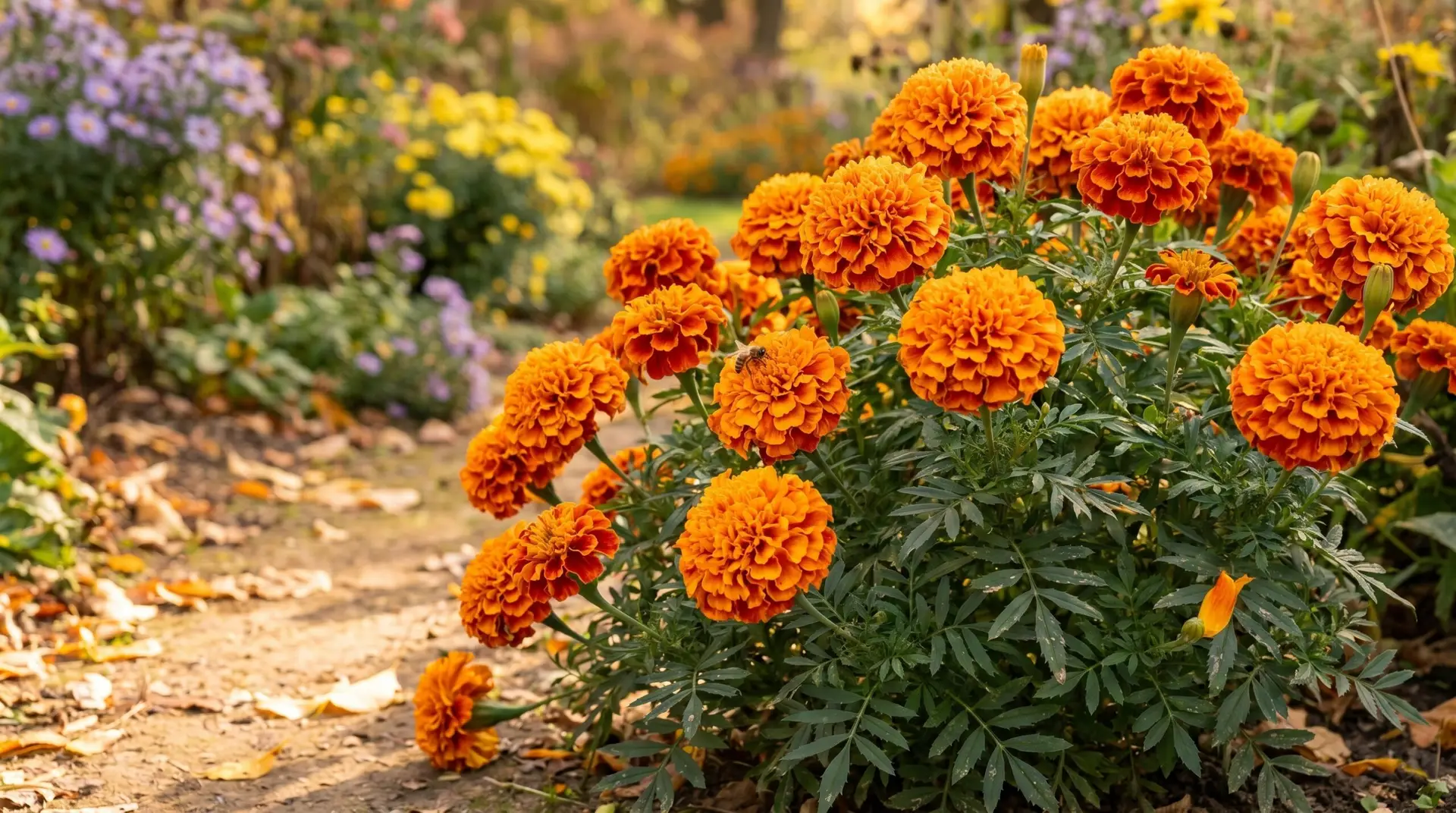
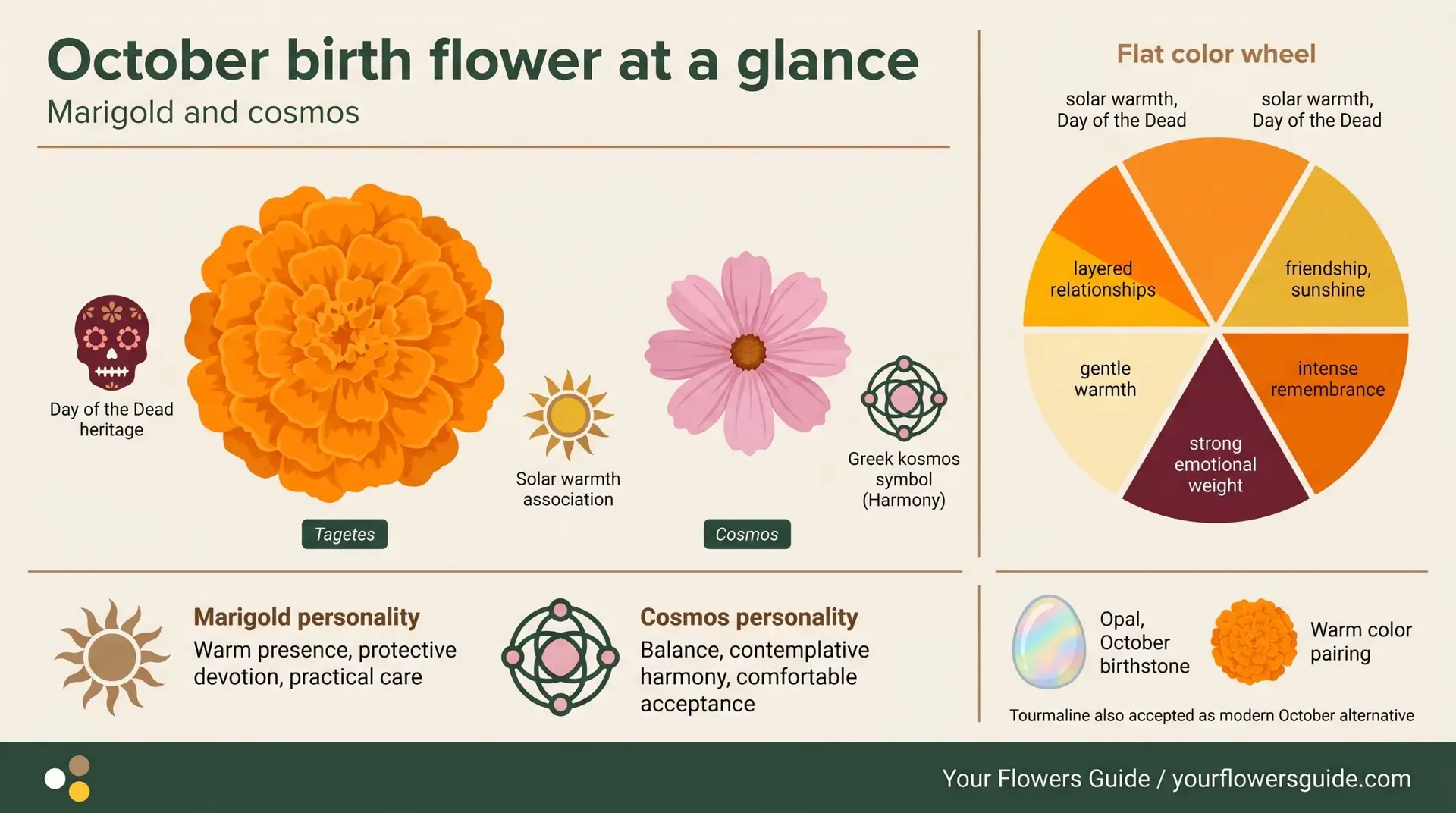
October has two birth flowers in Western tradition: marigold (genus Tagetes) as the primary, and cosmos (Cosmos bipinnatus and related species) as the secondary. Marigold signals warmth, creative passion, and protective remembrance through its deep Mexican Day of the Dead cultural anchor. Cosmos signals peace, balance, and harmony through the Greek “kosmos” etymology meaning ordered universe.
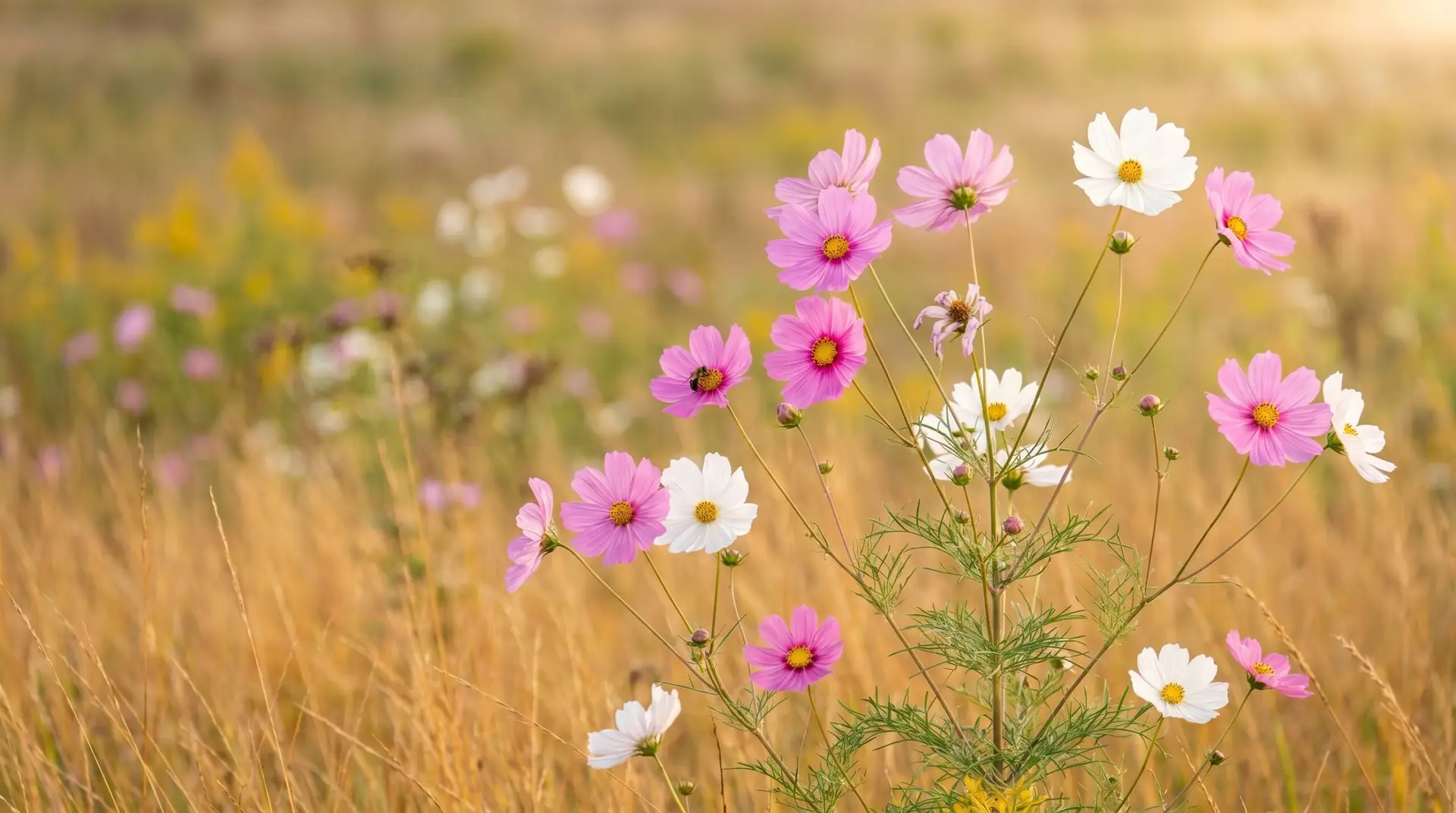
The two flowers share a thematic register of autumn warmth and reflective meaning suited to October’s deep autumn position. Marigold blooms abundantly from midsummer through frost with bright orange and yellow flowers covering plants that range from compact 6-inch bedding varieties to tall 4-foot African marigold cultivars. Cosmos blooms in daisy-like single or double forms on tall airy stems reaching 4 to 6 feet, with colors from pure white through pink, magenta, and the distinctive chocolate cosmos (Cosmos atrosanguineus). The deeper cultural weight of October comes from the Mexican and broader Latin American Day of the Dead (Día de los Muertos) tradition that uses marigold (cempasúchil, the Aztec name) as the central flower of the November 1-2 commemorative festival.
Marigold, the main October birth flower
Marigold refers primarily to the genus Tagetes in the family Asteraceae (the daisy family, the same large family that includes asters, chrysanthemums, sunflowers, dahlias, and many other major garden flowers). The genus Tagetes contains approximately 50 species native to the Americas (primarily Mexico and South America). The species most associated with the modern garden birth flower tradition are Tagetes erecta (African marigold or Mexican marigold, the tall species), Tagetes patula (French marigold, the smaller bushy species), and Tagetes tenuifolia (signet marigold, the smallest species with delicate ferny foliage).
The “marigold” common name is also applied to several other plant genera not in Tagetes. Pot marigold (Calendula officinalis) is unrelated to Tagetes despite the common name; it belongs to the genus Calendula and has different botanical characteristics. Marsh marigold (Caltha palustris) belongs to the family Ranunculaceae and is also unrelated. Standard birth flower tradition refers to Tagetes when discussing “marigold” as October’s birth flower.
The plants are warm-season annuals (cold-tender) that grow rapidly from spring planting to autumn frost. Growth habits vary by species: French marigolds reach 6 to 12 inches tall in compact bushy form with dense flower production, African marigolds reach 18 to 48 inches tall with larger dense flower heads, and signet marigolds reach 8 to 12 inches with delicate ferny foliage and small open flowers. The leaves are typically deeply divided with the characteristic strong marigold scent that distinguishes the genus from other composite flowers; the scent comes from essential oils that have insect-repellent properties valuable in garden companion planting.
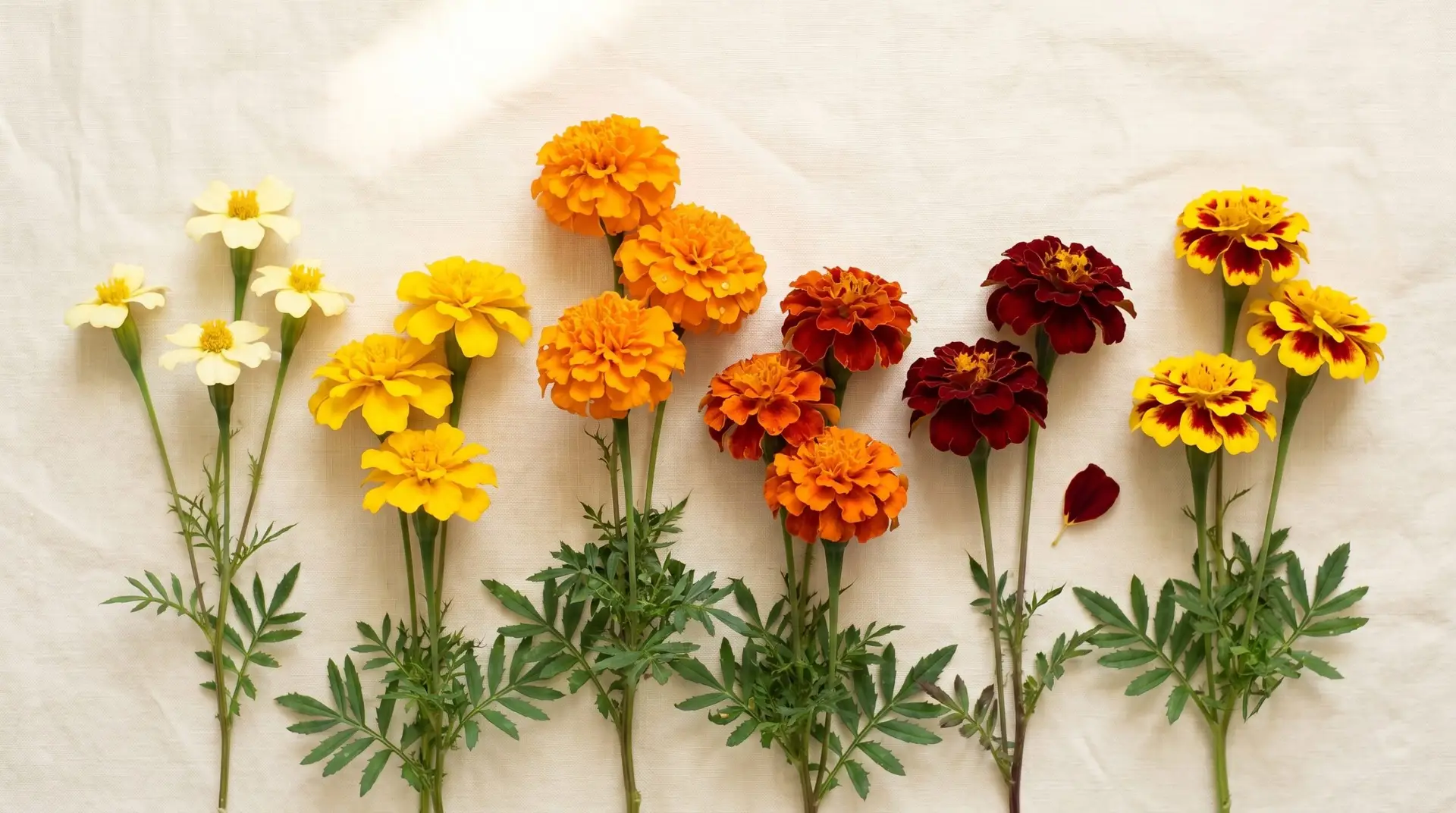
Modern marigold cultivation includes an extraordinary range of color and form within the orange-to-yellow color family. Standard colors include cream-white, pale yellow, bright golden yellow, bright orange, deep orange, burgundy-red, and bicolor combinations (orange with red markings, yellow with red picotee edges). Flower forms range from single daisy-like blooms with visible central discs to fully doubled pompom-style blooms with no visible disc.
Bloom timing runs from late spring through autumn frost in temperate climates, with peak abundance in late summer through October. The October position in the Western birth flower tradition reflects this late-season abundance combined with the flower’s central role in the Day of the Dead commemorative season that peaks November 1-2 (technically early November but culturally anchored in the autumn season).
Garden marigolds have important practical functions beyond ornamental beauty. The strong scent of marigold foliage repels several common garden pests including nematodes in the soil (where extensive Tagetes plantings can reduce nematode populations affecting subsequent vegetable crops) and various insect pests above ground. Companion planting tradition includes marigolds throughout vegetable gardens for these natural pest management benefits.
Cosmos, the secondary October birth flower
Cosmos belongs to the genus Cosmos in the family Asteraceae. The genus contains approximately 35 species native to Mexico, South America, and parts of southern North America. The species most associated with garden tradition are Cosmos bipinnatus (common garden cosmos, with pink, white, magenta, or purple flowers), Cosmos sulphureus (yellow cosmos or sulphur cosmos, with bright yellow to orange flowers), and Cosmos atrosanguineus (chocolate cosmos, with deep chocolate-red flowers that have a distinct chocolate scent and are nearly extinct in the wild).
The plants are warm-season annuals (with one notable exception in chocolate cosmos which is a tender perennial). Standard garden cosmos species grow rapidly from spring planting to autumn frost, reaching 3 to 6 feet tall with airy ferny foliage and abundant daisy-like flowers on slender wiry stems. The flowers are 2 to 4 inches across with the characteristic single or semi-double daisy form, central yellow disc, and 8 to 12 wide ray petals. The Greek “kosmos” name (meaning ordered universe or harmony) was given to the plant by Spanish missionary priests in Mexico who admired the orderly symmetry of the flower form; the name became the basis for the modern Western “cosmos” (the universe) usage as well.
Bloom timing extends from midsummer through autumn frost in temperate climates, with peak abundance in late summer and early autumn. Cosmos blooms throughout October in suitable climates, providing the late-season pollinator support similar to asters and giving the species its October secondary birth flower position.
Cosmos symbolism in Victorian floriography includes “peace,” “balance,” “harmony,” and “modesty.” The Greek “kosmos” etymology provides the foundational symbolic anchor connecting the flower to themes of natural order, balance, and the universe. The modern reading extends the harmony symbolism to include themes of inner peace, contemplative awareness, and the beautiful simplicity of well-ordered systems.
Chocolate cosmos (Cosmos atrosanguineus) has distinctive cultural and botanical significance. The species is nearly extinct in the wild (last documented wild populations recorded in Mexico in the early twentieth century before disappearing), with all currently cultivated plants descended from a single clone collected before the wild extinction. The flowers produce a distinct chocolate scent that becomes most noticeable in warm afternoon sun, giving the variety its unusual name. The species is currently being studied for potential botanical garden reintroduction programs.
For deeper coverage of cosmos varieties, the Greek “kosmos” etymological connection, chocolate cosmos rarity, and growing notes, see the cosmos deep dive article.
The Day of the Dead tradition
Marigold holds an unmatched cultural symbolic register through its central role in Mexican and broader Latin American Day of the Dead (Día de los Muertos) commemorative tradition. The Tagetes erecta marigold known as cempasúchil (or cempazúchitl, from the Nahuatl “cempohualxochitl” meaning “twenty-petal flower”) has been the primary commemorative flower of the Day of the Dead for centuries, with documented use extending back to pre-Columbian Aztec religious tradition.
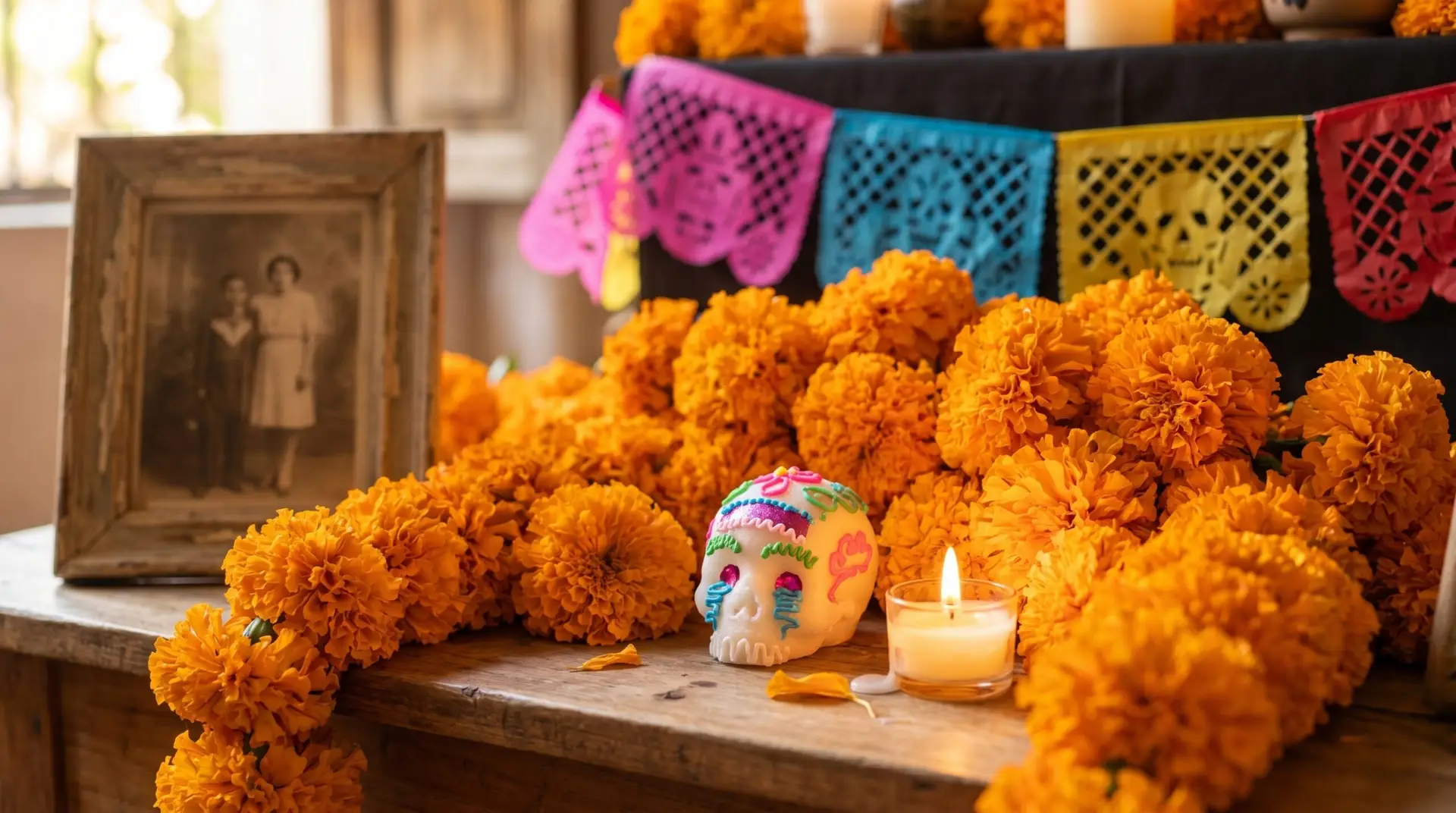
The Day of the Dead occurs annually on November 1-2 (technically All Saints’ Day and All Souls’ Day in the Catholic liturgical calendar, with the Day of the Dead synthesizing indigenous Aztec religious tradition with Catholic commemorative practice). The festival commemorates deceased family members and ancestors with elaborate household and cemetery altars (ofrendas) decorated with photographs of the deceased, favorite foods and drinks of the departed, decorative skulls (calaveras), and abundant marigold flowers. The marigolds are believed to guide the spirits of the dead back to their families for the brief annual visit.
The cultural symbolism of marigold in the Day of the Dead tradition includes several layers. The bright orange and yellow colors are associated with the sun, providing both visible light and spiritual warmth to guide returning spirits. The strong distinctive marigold scent is believed to be detectable by the deceased even from the spirit realm, providing olfactory guidance alongside the visual light. The dense flowering habit of cempasúchil provides extensive material for the elaborate altar decorations and pathway markers (camino de las flores) that visibly guide spirits from the cemetery or graveyard to the household altar.
The pre-Columbian Aztec use of cempasúchil documented in Spanish colonial-period sources (Bernardino de Sahagún’s Florentine Codex, 1577) confirms the flower’s significance in Aztec religious tradition before the Spanish colonial period. The Aztec celebrated Mictecacihuatl (the goddess of death) and her husband Mictlantecuhtli (the god of the dead) with cempasúchil offerings during the eighth and ninth months of the Aztec calendar (approximately late summer and early autumn). The post-conquest synthesis with Catholic All Souls’ Day produced the modern Day of the Dead as continuous cultural practice from Aztec tradition through the colonial and modern periods.
Modern Mexican production of cempasúchil is significant. Mexican farms produce thousands of tons of cempasúchil flowers annually for the Day of the Dead market, with peak harvest in mid to late October for the November 1-2 festival period. Cempasúchil exports to the United States and other countries with significant Mexican-heritage populations supply the international Day of the Dead commemorative practice that has expanded globally as Mexican cultural awareness has grown.
The October birth flower position of marigold in Western tradition reflects both seasonal availability and the cultural anchor in the late October period leading to the November Day of the Dead festival. October-born readers with Mexican heritage or interest in Latin American culture have particularly meaningful connection to the marigold birth flower assignment.
UNESCO recognized the Mexican Day of the Dead as Masterpiece of the Oral and Intangible Heritage of Humanity in 2003, formalizing the international cultural recognition of the tradition. The 2017 Pixar/Disney animated film “Coco” introduced Day of the Dead traditions to broader international audiences, with cempasúchil featuring prominently throughout the film’s visual identity. These cultural recognitions have substantially increased global awareness of the marigold-Day of the Dead connection.
What marigold colors mean
Marigold color shifts the symbolic reading within the broader theme of warmth and protective remembrance:
Bright orange marigold: the most traditional and most iconic. Solar warmth, life energy, the dominant Day of the Dead commemorative color. The classic cempasúchil color and the standard for marigold cultural symbolism.
Bright golden yellow marigold: joy, friendship, sunshine warmth. The yellow color provides slightly gentler register than the deeper orange while maintaining the warm solar associations.
Deep orange marigold: intense remembrance, passionate warmth, sustained energy. The deeper orange suits memorial contexts emphasizing depth of feeling.
Burgundy-red marigold: strong emotional weight, dramatic remembrance. Less common than the orange and yellow but striking when used for contexts emphasizing serious symbolic register.
Cream or pale yellow marigold: quiet warmth, gentle remembrance, soft cheerful affection. The lighter colors suit contexts wanting gentler register than the bold orange.
Bicolor marigold (orange with red markings, yellow with red picotee): layered symbolism, complex feelings, natural variation. The bicolor cultivars suggest the complexity of authentic relationships and memorial contexts.
Florist usage treats marigold as the warm-color autumn flower across most temperate climate florist trade. Marigolds work well for autumn birthday celebrations, Day of the Dead commemorative arrangements, memorial services emphasizing warmth and continuing connection, and informal cheerful bouquets for harvest-season contexts.
October personalities by flower symbolism
Reading personality from a birth flower is closer to a horoscope than to psychology. Take it as a useful lens, not as evidence. The two October flowers offer complementary readings that combine into a distinctive personality profile.
The marigold side of October reads as warm presence and protective devotion. People in the marigold profile have natural warmth that draws others toward them (the solar association made visible in personality), commitment to honoring memory and maintaining connection with those important to them (the Day of the Dead commemorative tradition extended to relationship style), and the kind of practical care that shows up in concrete actions rather than abstract sentiment. The strong scent and pest-repellent properties of marigold connect to a protective dimension: marigold-profile people often demonstrate their care through active protection of those around them rather than through purely emotional expression.
The cosmos side reads as balance and contemplative harmony. People in the cosmos profile have heightened awareness of patterns and proportion in human relationships and natural systems (the Greek “kosmos” ordering tradition extending into personal sensibility), comfort with both action and stillness in alternating rhythm (the airy stem structure and abundant bloom pattern suggesting both lightness and productivity), and the kind of peace that comes from comfortable acceptance of natural order rather than from forced control. The cosmos-profile person often finds satisfaction in seeing systems work well together and in contributing to broader harmony rather than in dramatic individual achievement.
The combination describes an October personality that pairs warm protective devotion (marigold) with balanced contemplative harmony (cosmos). October-born readers who describe themselves as both actively caring and comfortably accepting of natural rhythms will recognize the fit.

Gift ideas for October birthdays
October birthdays fall in peak autumn season across most of the northern hemisphere, which makes both birth flowers seasonally available. Gift logic varies by recipient preference and occasion register.
Marigold as a cut flower is widely available in late summer and autumn florist trade. A bouquet of mixed-color marigolds (orange, yellow, deep orange) makes a meaningful October gift, with the warm autumn color palette suiting both transitional-season decor and birthday celebration. Florist prices typically run from thirty to ninety dollars for a marigold-featured bouquet. Marigolds combine well in bouquets with chrysanthemums (matching autumn season), sunflowers, dahlias, and ornamental wheat or grasses.
Marigold seeds for spring planting give a long-term gift that returns through self-seeding in suitable climates. Specialty seed suppliers offer named marigold varieties at prices from five to fifteen dollars per packet. The recipient plants seeds in late spring for summer through autumn bloom in the same year. The plant is one of the easiest annual flowers to grow and tolerates most temperate climate garden conditions.
Cosmos as a cut flower is available in late summer and autumn florist trade, though less commonly than marigold. A bouquet of mixed-color cosmos (pink, white, magenta, with occasional chocolate cosmos accent if available) makes an elegant alternative gift emphasizing the daisy-like flower form and airy growth habit. Cosmos combines well with sunflowers, dahlias, and ornamental grasses.
A bouquet combining marigolds as the warm October statement with cosmos for visual variation and other late-season flowers (chrysanthemums, dahlias, ornamental grasses) creates a meaningful October birthday gift. The combination provides both birth flower references and the visual abundance of peak autumn flower availability.
For recipients with interest in Mexican culture, Day of the Dead tradition, or Latin American heritage, a marigold gift specifically connected to the Day of the Dead theme can include sugar skulls (decorative calaveras), papel picado (decorative tissue paper banners), and other Day of the Dead commemorative elements alongside the marigolds. The combination is particularly meaningful for October birthdays falling in the lead-up to the November 1-2 festival period.
For recipients with interest in chocolate cosmos as the rare specialty cosmos variety, a chocolate cosmos plant (where commercially available) provides a distinctive specialty gift. The plant is more demanding than common cosmos (requiring perennial culture in suitable climates and overwintering protection in cold climates) but the chocolate scent and the unusual species make it memorable for enthusiast recipients. Prices for chocolate cosmos plants typically run from twenty to fifty dollars from specialty perennial nurseries.
A jewelry piece combining marigold or cosmos motif work with opal (the October birthstone) creates a coherent color and cultural pairing. Opal’s iridescent color play creates striking contrast with both the warm marigold colors and the cool cosmos pinks. Price tiers range from about forty dollars for simple opal studs to several thousand dollars for fine pieces with floral motif work. Tourmaline is also accepted as an October birthstone in modern jewelry tradition, with the multicolor “watermelon” tourmaline particularly popular for October gift contexts.

Frequently asked
What is October’s birth flower?
Marigold as the primary and cosmos as the secondary. Marigold refers to the genus Tagetes in the family Asteraceae. Cosmos refers to the genus Cosmos in the same family. Both are warm-season annuals native to the Americas (primarily Mexico).
Why is marigold October’s birth flower?
Marigold has peak bloom from midsummer through autumn frost, with strong availability throughout October. The flower also has unmatched cultural significance through its central role in Mexican Day of the Dead (Día de los Muertos) commemorative tradition, where cempasúchil (Tagetes erecta) serves as the primary commemorative flower for the November 1-2 festival.
What does the marigold flower symbolize?
Warmth, creative passion, and protective remembrance. The symbolism draws on the Day of the Dead commemorative tradition (the marigold as bridge between living and deceased through bright color and strong scent guiding spirits home) and the broader solar warmth associations through the bright orange and yellow flower colors.
What does cosmos symbolize?
Peace, balance, and harmony. The Greek “kosmos” etymology (meaning ordered universe) provides the foundational symbolic anchor connecting the flower to themes of natural order, balance, and the harmony of well-ordered systems.
Why is marigold used for the Day of the Dead?
Cempasúchil (the Aztec Nahuatl name for Tagetes erecta marigold) has been the primary Day of the Dead commemorative flower for centuries, with documented use extending back to pre-Columbian Aztec religious tradition. The bright orange and yellow colors associated with the sun provide spiritual warmth and visible light to guide returning spirits. The strong distinctive marigold scent is believed to be detectable by the deceased even from the spirit realm, providing olfactory guidance alongside the visual light.
What is the difference between Tagetes marigold and Calendula pot marigold?
Tagetes marigold (the October birth flower) is the warm-season annual native to Mexico with strong distinctive scent and orange to yellow flowers. Calendula pot marigold is a cool-season annual native to Mediterranean Europe with milder scent and yellow to orange flowers. The two are not closely related botanically (Tagetes and Calendula are different genera, though both in family Asteraceae). Standard birth flower tradition refers to Tagetes when discussing “marigold.”
Are marigolds good companion plants?
Yes. Marigolds (particularly Tagetes patula French marigold and Tagetes erecta African marigold) are widely used as companion plants in vegetable gardens because the strong scent of marigold foliage repels several common garden pests. Marigolds in the soil over a growing season can also reduce populations of plant-damaging nematodes affecting subsequent vegetable crops.
What is chocolate cosmos?
Chocolate cosmos (Cosmos atrosanguineus) is a rare specialty cosmos with deep chocolate-red flowers that produce a distinct chocolate scent in warm sun. The species is nearly extinct in the wild, with all currently cultivated plants descended from a single clone collected before the wild extinction. Available from specialty perennial nurseries but more demanding to grow than common cosmos.
What birthstone goes with October’s birth flower?
Opal (the traditional October birthstone) or tourmaline (modern alternative). Opal’s iridescent color play creates striking contrast with both the warm marigold colors and the cool cosmos pinks. Tourmaline includes a wide range of colors including the multicolor “watermelon” tourmaline particularly associated with October gift contexts.
When do marigolds bloom?
Marigolds bloom from late spring through autumn frost in temperate climates, with peak abundance in late summer through October. In suitable warm climates, the bloom period can extend earlier and later. Marigolds are warm-season annuals that die at the first hard frost in cold climates.
Sources
- Marigold (Tagetes) · Encyclopedia Britannica
- Tagetes growing guide · Royal Horticultural Society
- Cosmos (Cosmos) · Encyclopedia Britannica
About this article. > Written and reviewed by the Your Flowers Guide editorial team. Botanical content from Britannica and the Royal Horticultural Society. Pre-Columbian Aztec religious tradition references via Bernardino de Sahagún’s Florentine Codex (1577) and standard Mexican cultural history sources. Day of the Dead cultural references cross-verified with UNESCO Masterpiece recognition documentation (2003).