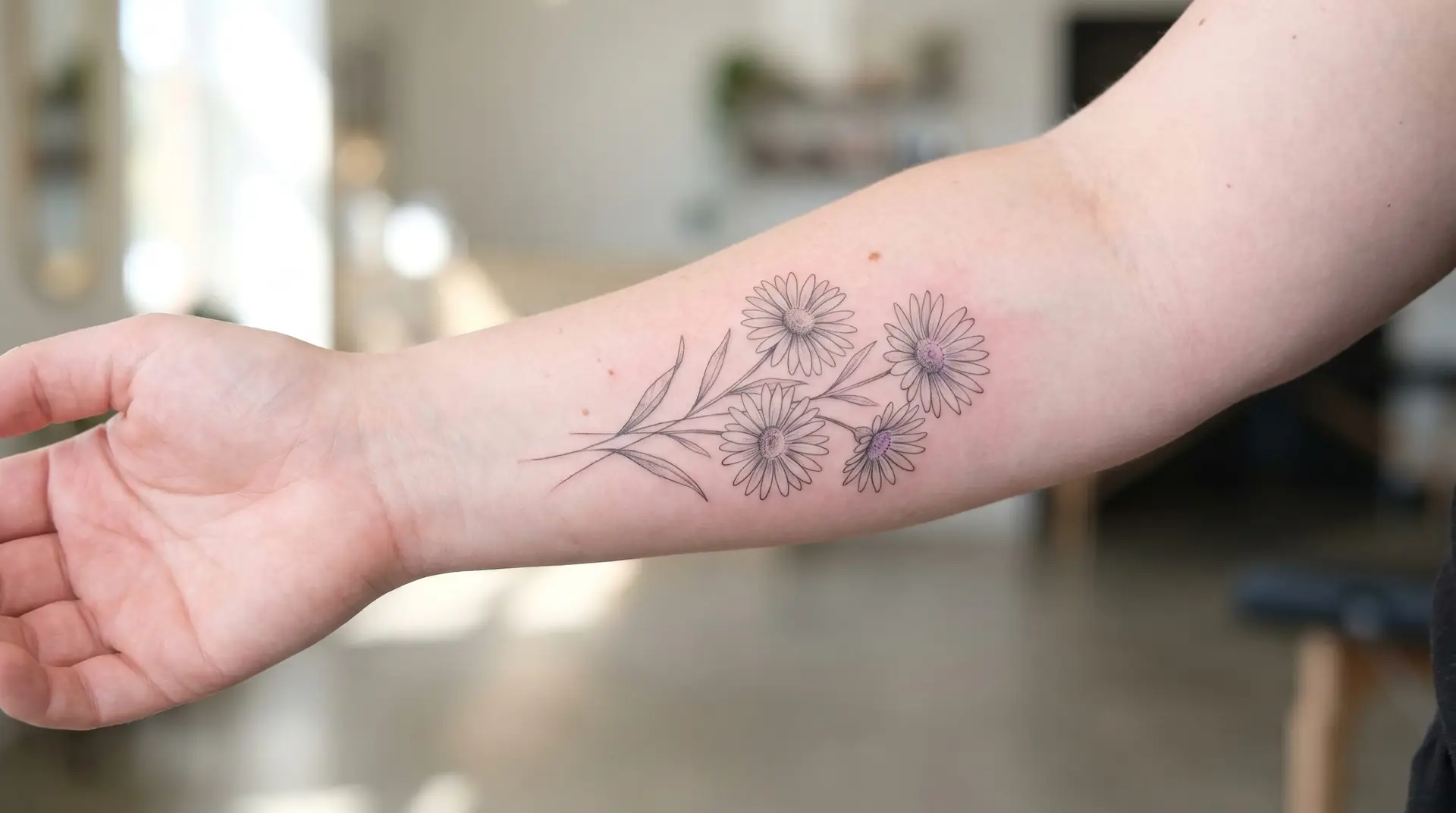
An aster tattoo is a meaningful choice for September-born readers and for anyone drawn to flower tattoos with classical Greek heritage and celestial-symbolic depth. The flower’s distinctive star-shaped form, dense cluster habit, and Greek mythological connection give the design naturally elegant visual character and rich symbolic content that suits a wide range of tattoo aesthetics from minimalist fine-line work to bold botanical illustration.
The aster’s relatively small individual flower size (1 to 3 inches across in most species) and the natural cluster habit (multiple flowers on each stem) give aster tattoos design flexibility that few other birth flower subjects can match. The same wearer can choose a single-bloom delicate fine-line aster at small scale (2 to 3 inches) or a dense flowering cluster at substantial scale (8 to 14 inches) depending on placement and desired visual impact. Combined with the wisdom-and-faith symbolic register, this design flexibility has made aster tattoos increasingly popular over the last decade for thoughtful birth flower tattoo wearers.
In this guide
What an aster tattoo means
Aster tattoo meaning draws on several layered symbolic registers. The personal birth flower register applies for September-born wearers. The classical heritage register applies for anyone drawn to themes of wisdom, divine justice, and celestial connection through the Astraea myth (the goddess of justice linked to the aster in later floral legend). The personal-meaning register applies for wearers who select aster for individual reasons (commemoration of someone with notable wisdom or fairness, personal recognition of contemplative or scholarly inclinations, or memorial honoring of a relationship that involved patient observation and quiet understanding).
The Astraea story gives aster tattoos a strong symbolic anchor. In classical tradition Astraea was the goddess of justice and innocence who lived among people during the Golden Age and withdrew from the earth as human conduct declined, becoming the constellation Virgo. A later floral legend, from nineteenth-century flower writers rather than the ancient texts, holds that asters sprang from her tears where they fell. The Greek word “aster” means “star,” and that star image, together with the Astraea associations, makes aster tattoos meaningful for wearers drawn to themes of justice, contemplative wisdom, and quiet hope.
The star-shaped flower form provides natural visual symbolism that extends beyond the specific Greek myth. The radial arrangement of narrow ray petals around the central yellow disc creates an obvious star pattern that connects the aster to broader cultural traditions of star symbolism across multiple cultures. Astronomers, astrologers, navigation enthusiasts, and others with star-related interests sometimes choose aster tattoos for this broader celestial connection rather than for the specific Greek mythological framing.
Memorial aster tattoos work well for honoring deceased relationships that involved wisdom, fairness, or quiet contemplation. The aster’s combination of beauty and reflection makes it particularly suitable for memorials honoring teachers, mentors, grandparents, or others whose presence in the wearer’s life involved patient guidance and considered judgment. The seasonal autumn bloom timing of aster also gives the flower resonance for memorials of those whose lives reached their natural fulfillment late in life or who died during autumn.
Design styles for aster tattoos
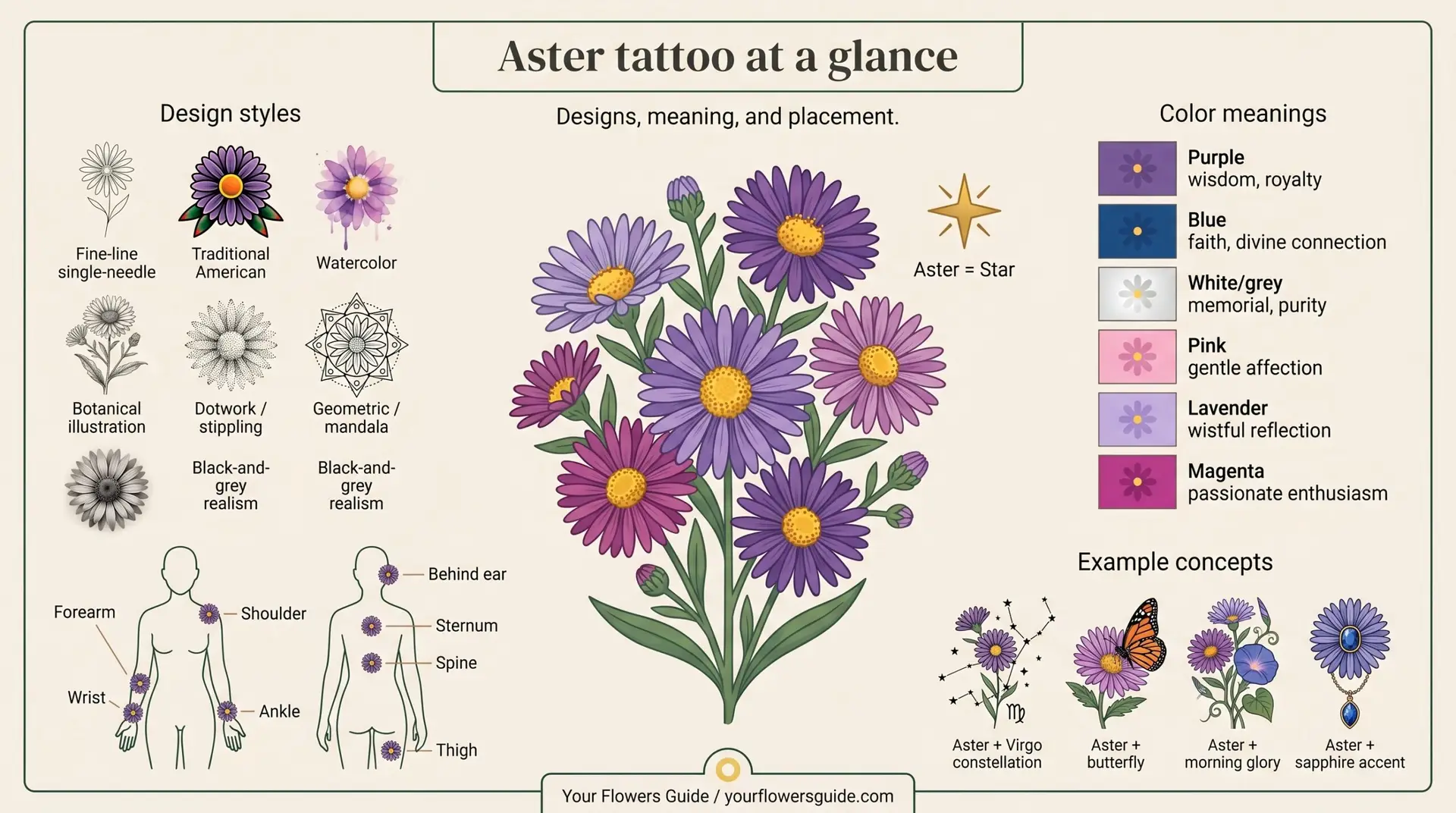
Several tattoo style traditions work well for aster depending on the wearer’s aesthetic preferences and the symbolic register the design needs to express.
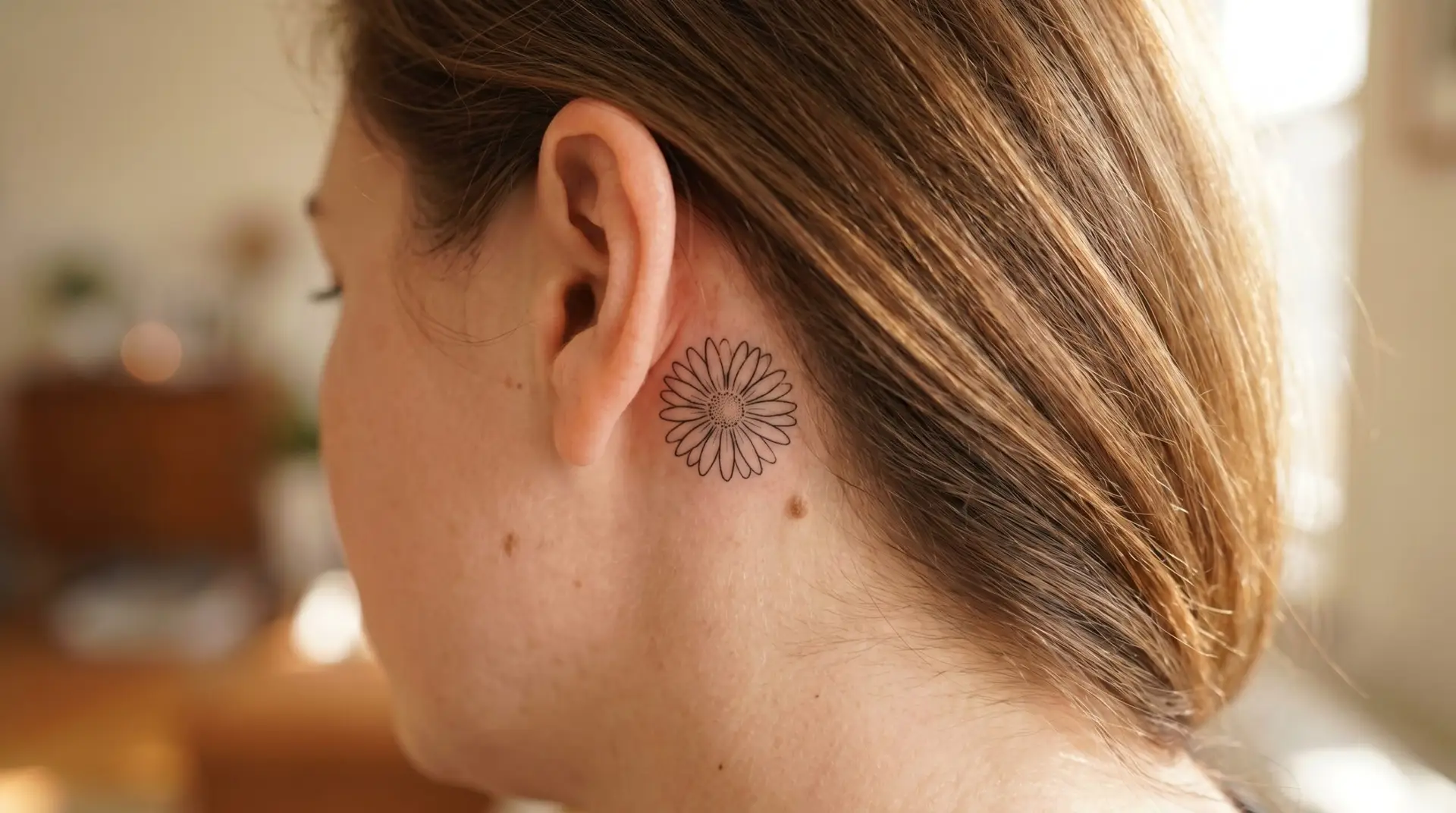
Fine-line single-needle style produces the most delicate aster tattoos, with very thin clean lines that capture the flower’s structural detail at small to medium scale (3 to 6 inches typical). Fine-line aster tattoos often feature single individual blooms with detailed ray petals around the central disc, allowing the star pattern to be clearly visible at small scale. The style suits wearers who want subtle elegant aster imagery rather than bold statement work.
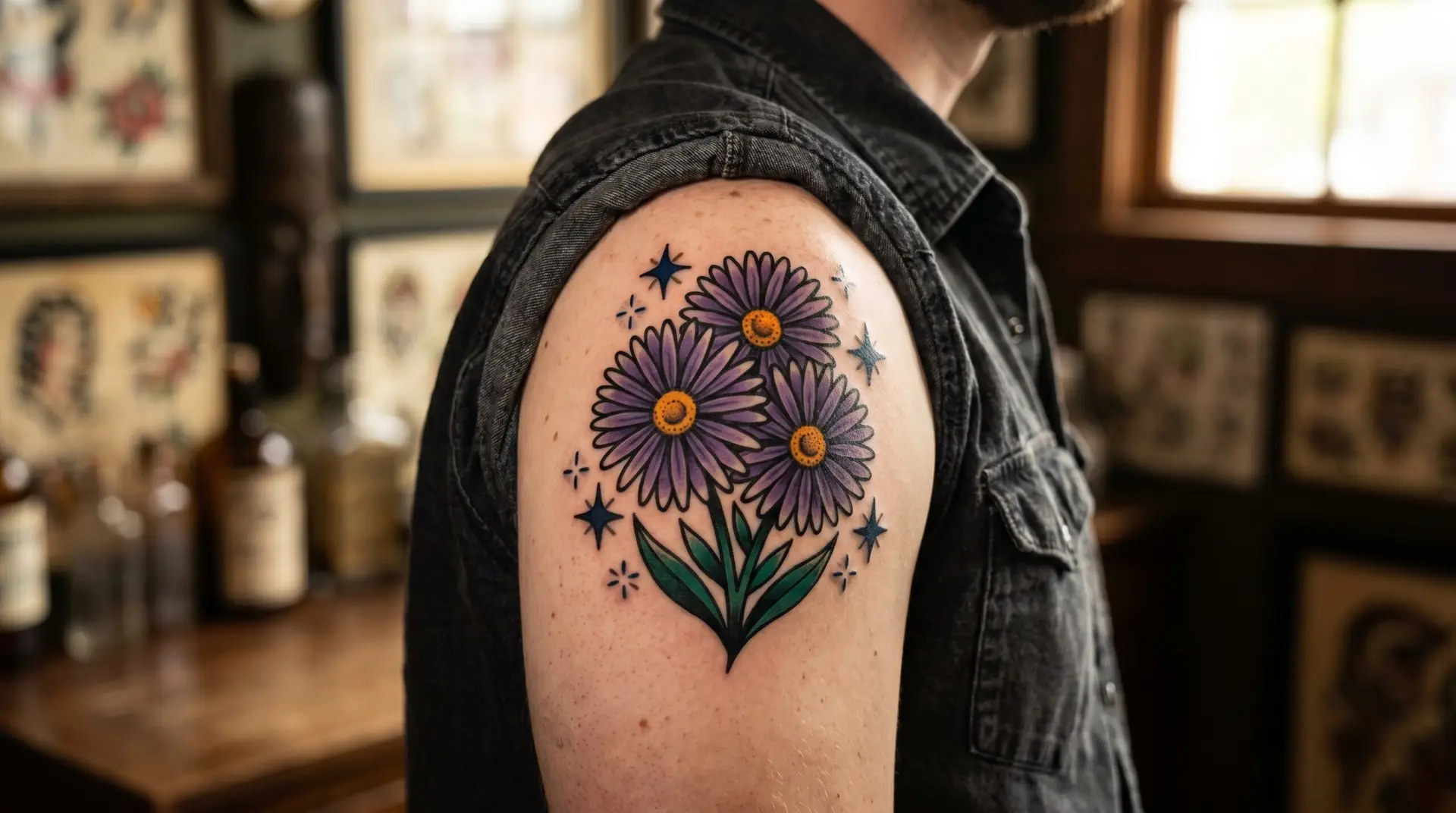
Traditional American (Sailor Jerry) and neo-traditional styles produce bolder aster tattoos with thick dark outlines, flat saturated color fill (typically purple, blue, or pink), and graphic stylization that prioritizes visual impact over botanical accuracy. The style ages well because of the heavy line work that maintains structural clarity even as decades of color fading occur. Traditional aster tattoos often emphasize the star symbolism through the radial petal arrangement and accompanying star or celestial elements.
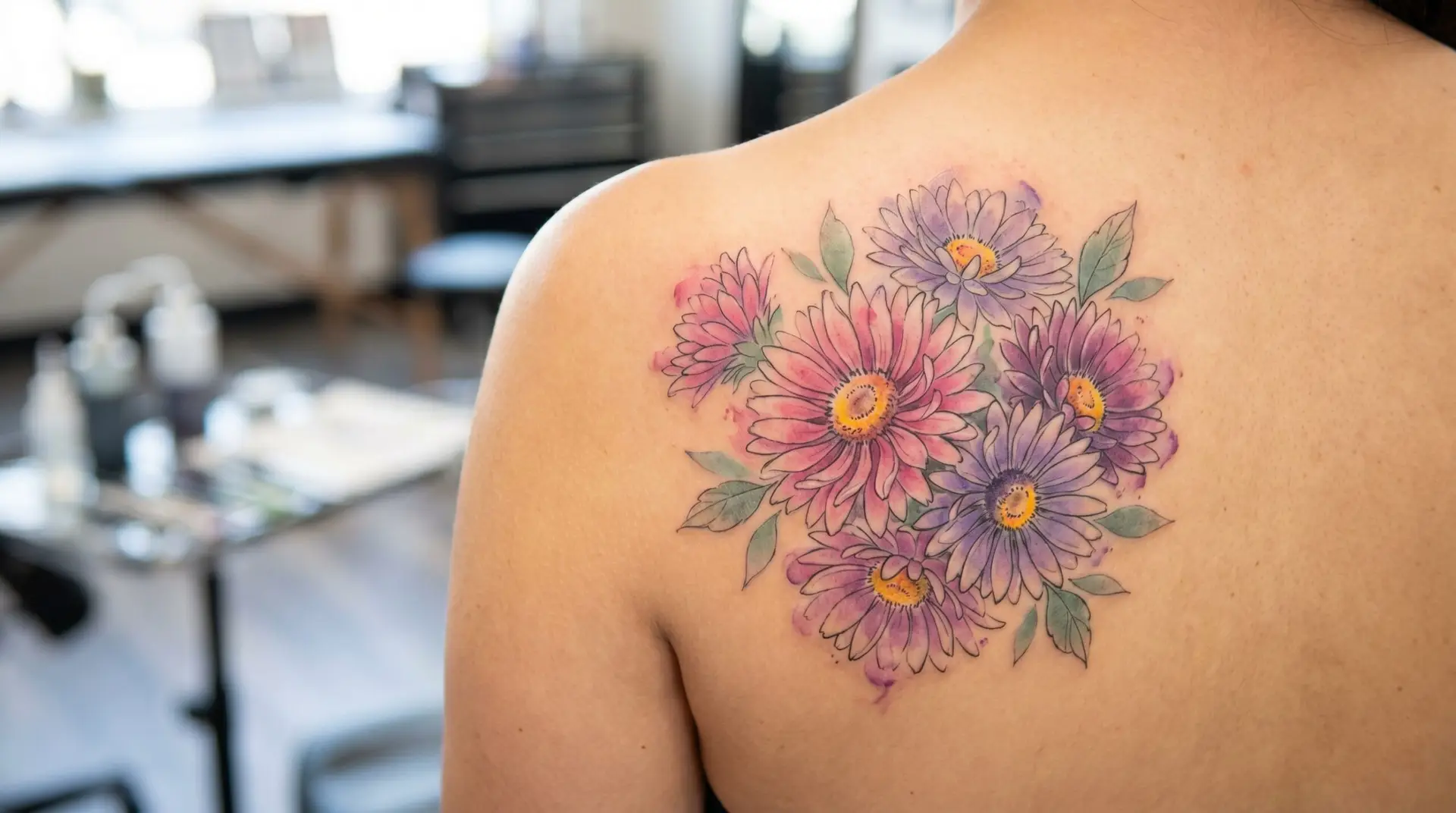
Watercolor aster tattoos use the characteristic color-bleed technique to suggest watercolor painting applied to skin, creating soft dreamy color transitions around the central botanical outline. The style works particularly well for purple, pink, and blue asters where the soft color blending matches the natural variation in the flower’s coloring. Watercolor tattoos require regular touch-up work as the soft edges fade more rapidly than hard-line work.
Botanical illustration style produces the most botanically accurate aster tattoos, with detailed line work showing the precise flower structure, central disc, individual ray petals, narrow leaves, and stem. The style suits wearers who value scientific accuracy and who want a tattoo that reads as botanical specimen illustration rather than as decorative stylization.
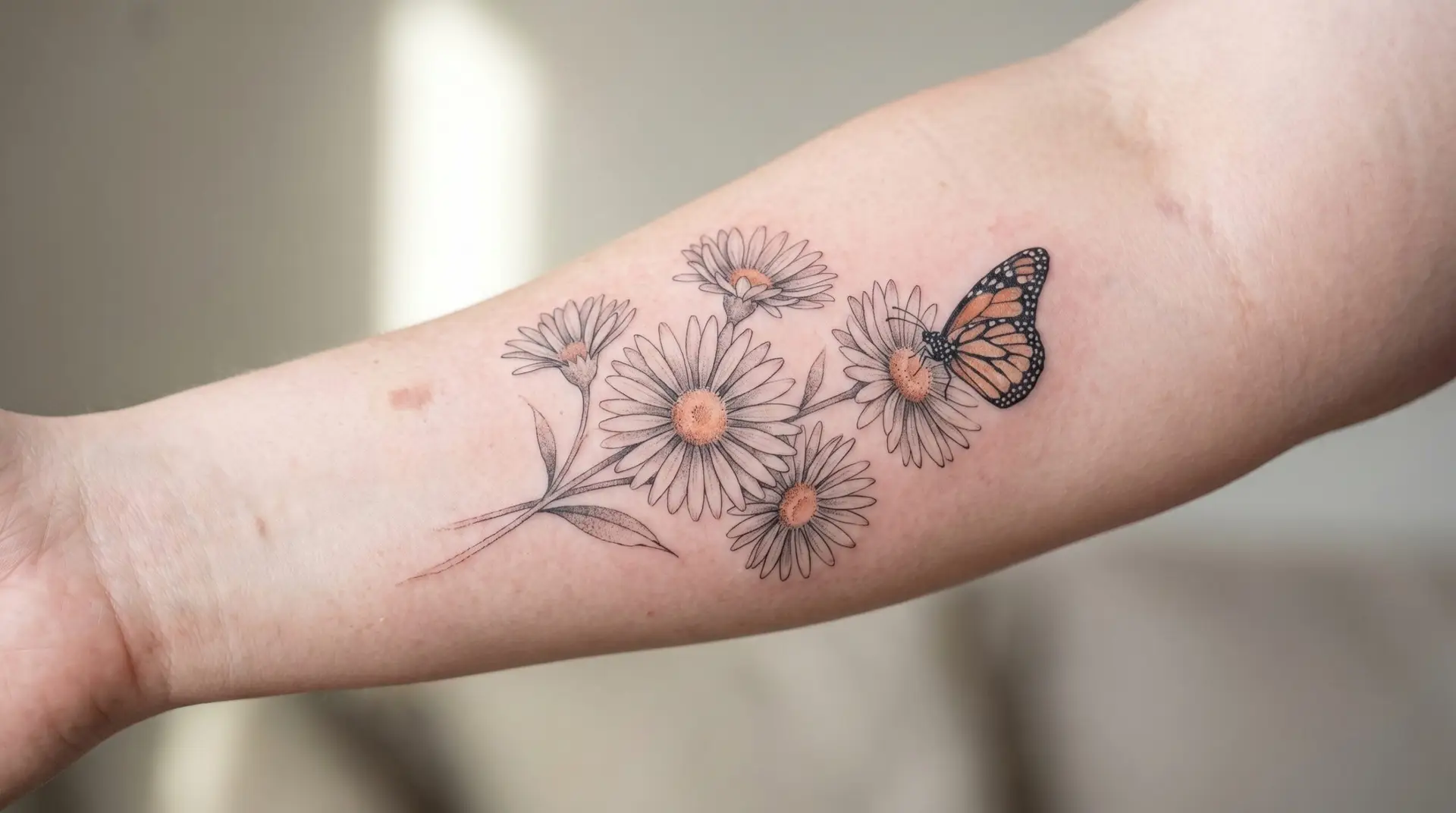
Dotwork and stippling aster tattoos use small dots and stippling patterns to create the flower form without traditional line work, producing distinctive textured aster tattoos that work particularly well for the dense composite flower form. The style requires highly skilled tattoo artists and produces tattoos with distinctive contemporary aesthetic.
Geometric and abstract aster tattoos use the star pattern of the flower as the basis for stylized designs incorporating sacred geometry, mandala framework, or geometric pattern work. The star symbolism of the flower lends itself naturally to geometric stylization.
Black-and-grey realism produces highly detailed photo-realistic aster tattoos in black ink with grey-scale shading. The style requires highly skilled tattoo artists and works well for memorial designs where the absence of color gives the tattoo a dignified gravitas suitable for memorial purposes.
Color choices and symbolism
Aster tattoo color choice extends the broader aster color symbolism into the personal meaning of the tattoo:
Purple aster tattoo: wisdom, royalty, contemplative depth. The most traditional and iconic color choice that anchors the design in the classical Greek symbolic register.
Blue aster tattoo: faith, divine connection, celestial reference. The blue color reinforces the star symbolism through visual association with the night sky.
White or grey aster tattoo (black-and-grey realism): purity, dignified memorial, classical elegance. Often chosen for serious memorial designs where the grey-scale work matches the symbolic register.
Pink aster tattoo: gentle affection, sensitivity, sweet remembrance. Often chosen for tattoos commemorating close gentle relationships rather than dramatic memorial contexts.
Lavender aster tattoo: wistful reflection, peaceful awareness. The lavender color reads contemplatively and suits wearers wanting quiet symbolic register.
Magenta or deep pink aster tattoo: passionate enthusiasm, intense affection. The brighter color suits cheerful bold floral statements.
Multi-color aster cluster tattoo: layered symbolism, natural variation, the visual of autumn meadow diversity. Mixed-color aster cluster tattoos use the natural color range of asters to suggest the abundance of autumn bloom.
Color saturation choice matters significantly for tattoo longevity. Saturated colors fade more rapidly than muted tones, and lighter colors (pale pink, pale lavender, white) fade faster than darker colors (deep purple, navy blue, magenta). Wearers choosing saturated aster colors should expect to need touch-up work every 5 to 10 years to maintain the original color intensity. Black-and-grey designs maintain their visual integrity longest, often remaining clear for 20+ years before requiring significant touch-up work.
Placement guide
Aster tattoo placement choice depends on the design scale, the desired visibility, and the wearer’s aesthetic and professional considerations.
Forearm: the most popular aster tattoo placement. The forearm provides comfortable canvas for both single-bloom designs (3 to 5 inches) and clustered multi-flower designs (5 to 8 inches). Inner forearm placement gives a more private feeling; outer forearm placement creates more visible statement work.
Shoulder and upper arm: aster cluster tattoos work well on the shoulder where the body provides ample canvas space for dense multi-flower designs. The placement allows medium to large scale (5 to 10 inches) and provides good visibility for the wearer.
Wrist: small delicate single-bloom aster tattoos (2 to 3 inches) work well for wrist placement where the subtle elegant imagery matches the compact visual space. Common for wearers who want birth flower symbolism without bold statement work.
Behind ear and neck: very small minimalist single-bloom aster tattoos (1 to 2 inches) work for behind-ear and neck placement. The placement is unconventional and reads as personal aesthetic choice rather than as commemorative statement.
Ankle: small to medium aster tattoos (2 to 5 inches) work on the inner or outer ankle. The placement suits wearers who want feminine elegant imagery in a more private location.
Sternum and ribs: larger aster cluster designs (6 to 12 inches) work along the sternum or down the ribs, taking advantage of the body’s natural vertical line. The placement is more painful than forearm or upper arm work because of proximity to bone.
Spine: large vertical aster cluster designs along the spine work for wearers wanting dramatic large-scale statement work. The placement allows 10 to 18 inches of detailed botanical work.
Thigh and hip: medium to large aster designs (5 to 12 inches) work on the thigh where the body provides ample canvas space and where clothing typically covers the tattoo for professional contexts.
Example design concepts
Several design concepts demonstrate effective ways to combine aster imagery with other symbolic elements:
Aster with star and constellation imagery. An aster cluster rendered alongside small star elements or a constellation pattern (particularly the Virgo constellation, where Astraea was said to dwell after leaving earth) directly invokes the Greek mythological heritage. Effective for wearers drawn to astronomy or to classical Greek cultural themes.
Aster with date or commemorative element. An aster tattoo with a small date (memorial date or birth date) or initials provides specific personal commemorative content alongside the symbolic floral imagery. Common for memorial designs honoring deceased loved ones.
Multi-bloom aster cluster. A botanical illustration style aster tattoo showing a dense cluster of multiple bloom heads emphasizes the natural cluster habit of the species. The visual rhythm of multiple flowers creates dynamic interest within a single design.
Aster with Greek script or Astraea reference. An aster tattoo with small Greek script (the word “Αστραία” meaning Astraea, or a chosen Greek phrase) extends the classical heritage symbolism into directly readable script content. Suits wearers with serious interest in classical Greek culture.
Aster with bee or butterfly. An aster tattoo with a small bee or butterfly on one of the flowers acknowledges the species’s important role as late-season pollinator support and adds gentle natural imagery to the central floral subject.
Aster paired with morning glory. September-born wearers sometimes combine aster and morning glory (both September birth flowers) in a single design. The combination provides both birth flower references and visual contrast between the small daisy-like aster and the large trumpet-shaped morning glory.
Aster with sapphire color accent. An aster tattoo with small deep blue color accents suggesting sapphire (the September birthstone) provides the complete September birth flower and birthstone reference in a single design.
Watercolor aster on shoulder blade. A purple or pink aster cluster rendered in watercolor style on the shoulder blade creates a flowing artistic statement that uses the back’s natural canvas space and the soft watercolor technique to suggest beauty and seasonal transition.
Minimalist single-bloom aster on wrist. A small fine-line drawing of a single aster bloom on the wrist provides elegant subtle aster reference at minimal scale. The style suits wearers who want birth flower symbolism without bold statement work.
Geometric aster mandala. An aster’s natural star pattern serves as the central element of a larger mandala design incorporating sacred geometry. The combination suits wearers drawn to spiritual or contemplative tattoo aesthetics.
Aftercare and longevity
Standard tattoo aftercare applies to aster tattoos: keep the area clean with gentle unscented soap, apply a thin layer of recommended healing ointment for the first week, avoid direct sun exposure during the initial healing period (2 to 4 weeks), and avoid swimming or full water submersion until fully healed.
Aster tattoo longevity depends primarily on the line work quality, the color saturation, and the wearer’s skin and lifestyle factors. Fine-line aster tattoos typically need touch-up work every 5 to 10 years to maintain the original line clarity. Traditional and bold-line tattoos maintain their structural clarity longest, often for 15 to 25 years before requiring touch-up. Watercolor tattoos require the most frequent touch-up work because the soft edges fade more rapidly than hard line work.
The small detailed structure of aster flowers (multiple narrow ray petals around the central disc) requires highly skilled tattoo artists to render at small scale without the detail becoming muddied. Wearers should consult experienced artists with portfolio examples of small detailed flower work before committing to small-scale aster designs.
Sun exposure is the primary cause of tattoo color fading. Wearers should apply high-SPF sunscreen (SPF 50+) to the aster tattoo area whenever the tattoo will be exposed to direct sun, particularly during peak summer months. Long-term consistent sun protection significantly extends the visual longevity of colored aster tattoos.
Skin changes over time affect aster tattoo appearance. Tattoos on areas of skin that stretch significantly (abdomen, hip, thigh, breast) can distort over time. Wearers planning significant body changes should discuss placement with their tattoo artist to choose locations that will hold the design well over decades.
At a glance
Questions
Questions
Frequently asked
What does an aster tattoo mean?
Wisdom, faith, and valor. The symbolism comes from the Greek classical heritage through the goddess Astraea (the personification of justice and starlight) and the traditional story of aster origin as Astraea’s tears falling from heaven to earth. The Greek “aster” literally meaning “star” provides the celestial symbolic anchor.
Are aster tattoos popular?
Yes, aster tattoos have grown in popularity over the last decade. The combination of distinctive star-shaped flower form, design flexibility (small delicate to large cluster work), Greek classical heritage, and the symbolic register of wisdom and contemplation has made aster a frequently chosen birth flower tattoo for September-born wearers.
Where is the best place for an aster tattoo?
The forearm is the most popular placement for medium-scale designs. Wrist and behind-ear placements work for small delicate single-bloom designs. Shoulder, upper arm, sternum, and spine placements work for larger cluster designs. Ankle and thigh placements work for medium-scale designs with more private visibility.
Can I get a small aster tattoo?
Yes, small aster tattoos (1 to 3 inches) work well for wrist, behind-ear, ankle, and finger placements. The challenge with small aster designs is the multiple narrow ray petals that require skilled tattoo artists to render at small scale without losing structural detail. Choose an experienced fine-line tattoo artist for small aster work.
How long does an aster tattoo take?
A small fine-line aster tattoo (2 to 3 inches) typically takes 1 to 2 hours. A medium botanical illustration aster cluster (5 to 8 inches) takes 3 to 5 hours. A large detailed aster cluster (10 to 18 inches, spine or back work) typically requires multiple sessions totaling 8 to 12 hours.
Is an aster tattoo good for women?
Aster tattoos work well for any wearer regardless of gender. The small delicate flower form and the wisdom-faith symbolic register are particularly popular for wearers wanting refined feminine imagery, but the design flexibility (from delicate fine-line to bold traditional) suits any aesthetic preference.
Can I combine aster with other flowers?
Yes. Common combinations include aster with morning glory (both September birth flowers), aster with sunflowers (matching autumn season), aster with butterflies, and aster with stars or constellation imagery. The combinations layer additional meaning onto the central aster symbolism.
How much does an aster tattoo cost?
Costs vary by artist skill level, geographic location, design complexity, and tattoo size. A small fine-line aster typically costs from $120 to $350. A medium botanical illustration aster costs from $350 to $900. Large detailed aster work (cluster or back) typically costs from $900 to $2500+ across multiple sessions.
Does an aster tattoo hurt?
Pain level depends on placement. Forearm, upper arm, and outer thigh are typically among the less painful. Spine, sternum, rib cage, ankle, and behind-ear placements are typically among the more painful because of proximity to bone or thin skin areas.
Keep reading

September birth flower: aster, morning glory, and what they mean

September birth flowers by day: the Korean 365-day tradition

Morning glory flower meaning: Japanese culture, color, and growing
Birth flower by month: all 12 monthly flowers
Enjoying our flower guides? Add YourFlowersGuide as a preferred source on Google. It helps more readers find us.
Add to Preferred Sources