Primrose flower meaning: Celtic fairy folklore, botany, and growing
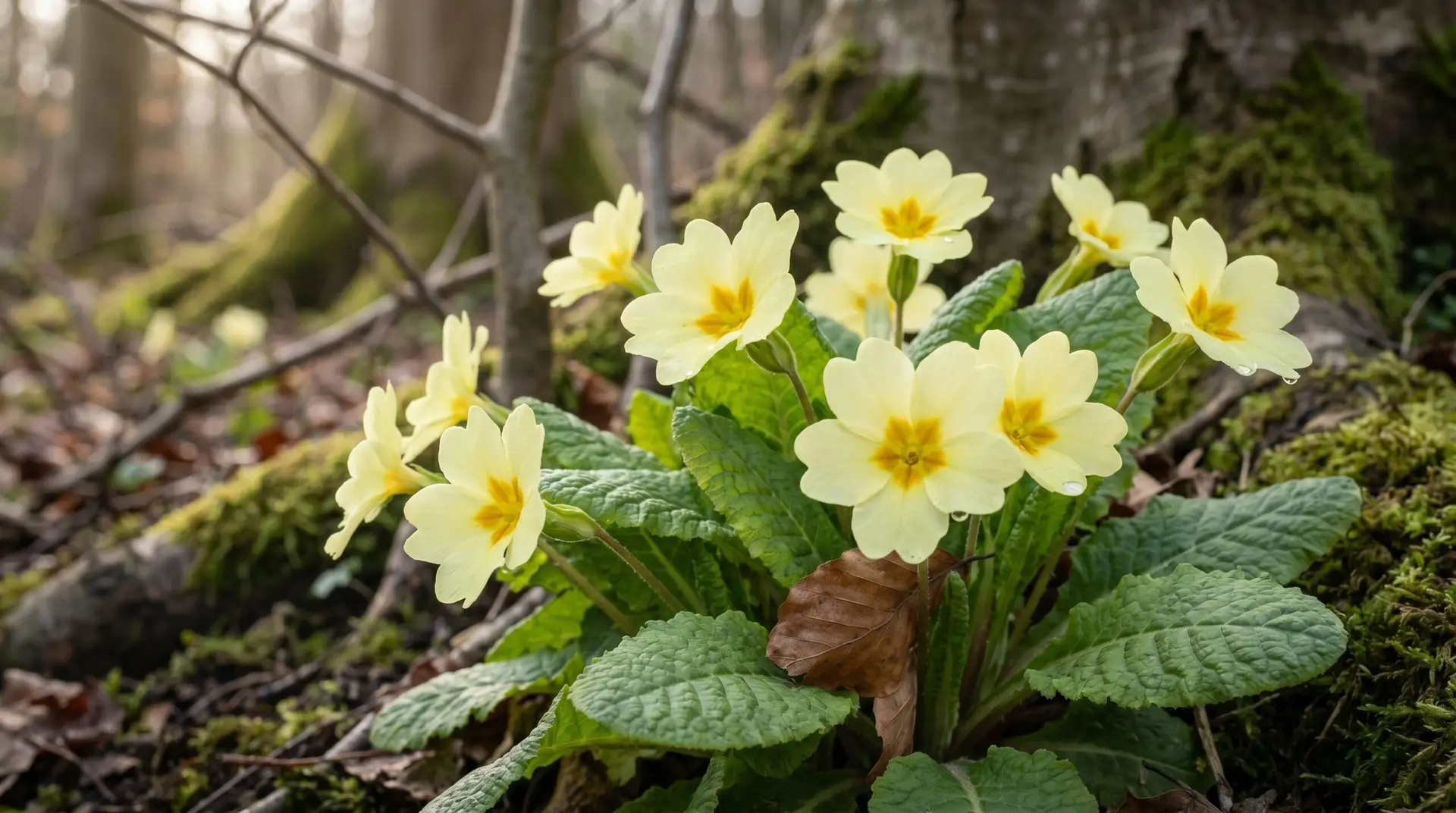
Primrose is February’s secondary birth flower in Western tradition. Where violet stands for modest faithfulness, primrose stands for first beginnings, young love, and the early stirrings of spring. The flower is Primula vulgaris in standard botanical naming, the yellow-flowered woodland native of the British Isles and continental Europe that gives the entire genus Primula its name.
The Victorian writers who codified the modern Western birth flower system chose primrose for February for two practical reasons. First, primrose blooms in late winter through early spring in temperate climates and is one of the few flowers available outdoors during the February window. Second, the Latin etymology of Primula (from primus, meaning first) reinforced the symbolic reading of newness and first beginnings that fit February’s transitional character between winter and spring. The flower has additional layers from Celtic fairy folklore, Christian Marian associations, and a real edible-flower tradition that survives in modern French and English confectionery.
Primrose botany: Primula vulgaris
Primrose belongs to the genus Primula in the family Primulaceae, which contains about 500 species native primarily to Europe, Asia, and North America. The most commonly cultivated species and the one specifically associated with the February birth flower tradition is Primula vulgaris, the common primrose, a perennial herb native to woodlands across Western and Southern Europe, North Africa, and parts of Western Asia.
Other commonly grown Primula species include Primula veris (the cowslip, taller with multiple yellow flowers clustered on a single stem), Primula × polyantha (modern garden hybrids in many colors), and Primula auricula (a small alpine species prized by specialist collectors). Each species has its own folk associations and uses, but Primula vulgaris is the default English-language reference for “primrose” without qualifier.
The plant forms a rosette of crinkled mid-green leaves close to the ground, typically 4 to 6 inches across, with pale yellow five-petal flowers emerging on short individual stems just above the leaf rosette. Each flower is about 1 inch across with a darker yellow-orange eye in the center and five overlapping petals that often appear slightly notched at the tip. The wild form blooms in February through April in mild climates and from March through May further north.
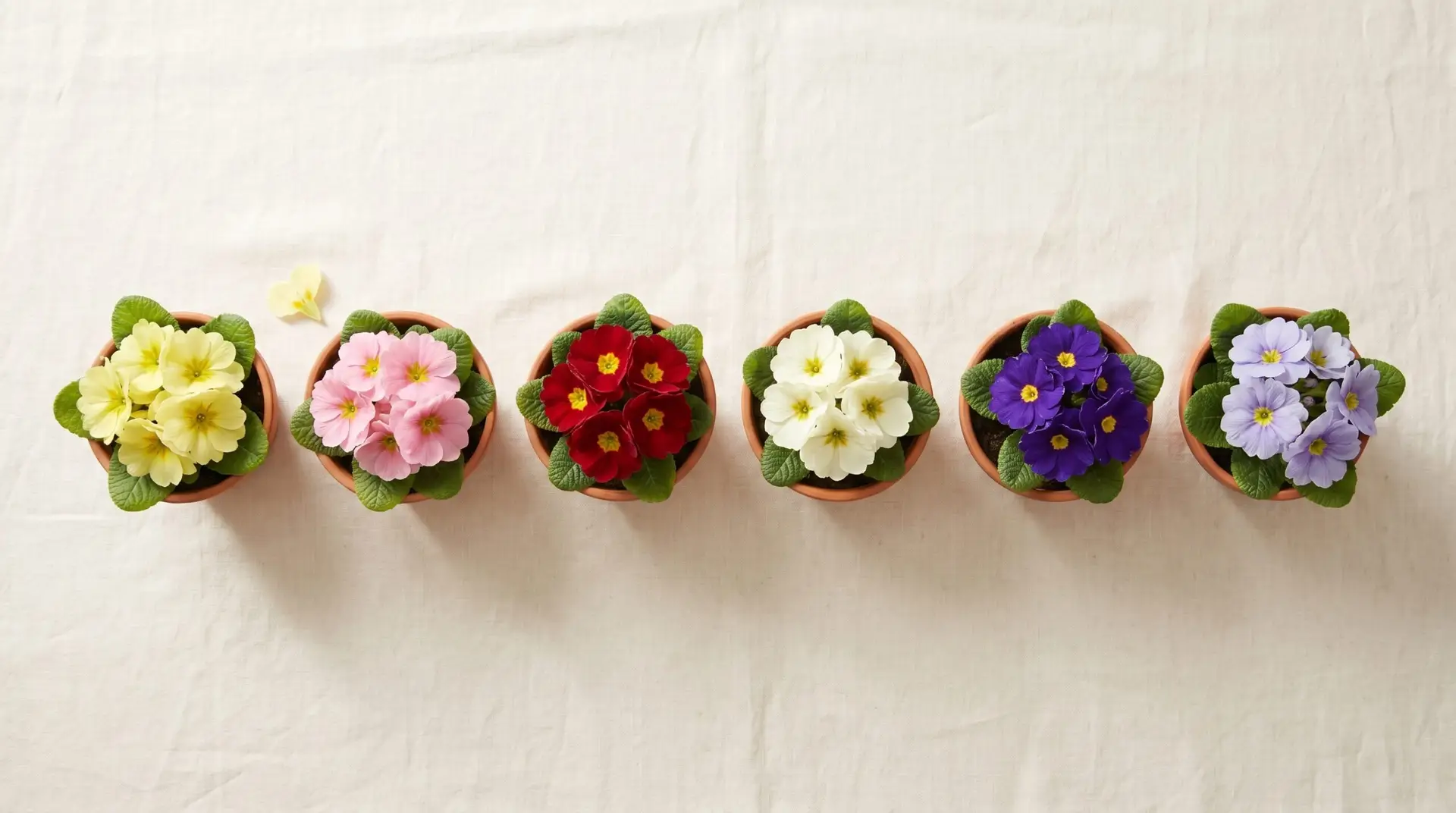
Modern Primula hybrids expand the color range significantly. Garden centers in late winter typically stock primroses in pink, red, purple, white, blue, and bicolor patterns alongside the traditional yellow. These hybrids are generally Primula × polyantha (sometimes called polyanthus primrose), a complex hybrid involving Primula vulgaris, Primula veris, and other Primula species crossed for color variation and improved garden performance. The hybrids work well in containers, garden borders, and as forced indoor winter color, which is why they dominate commercial primrose sales in modern garden centers.
The plant blooms most reliably in cool partial shade with rich moist soil. Naturalized primrose colonies appear most often at the edges of deciduous woodlands and on damp grassy banks. Primula vulgaris is hardy in USDA zones 4 through 8 and tolerates winter cold well; it suffers more in summer heat and humid southern climates than in cold northern ones.
Etymology: “the first rose”
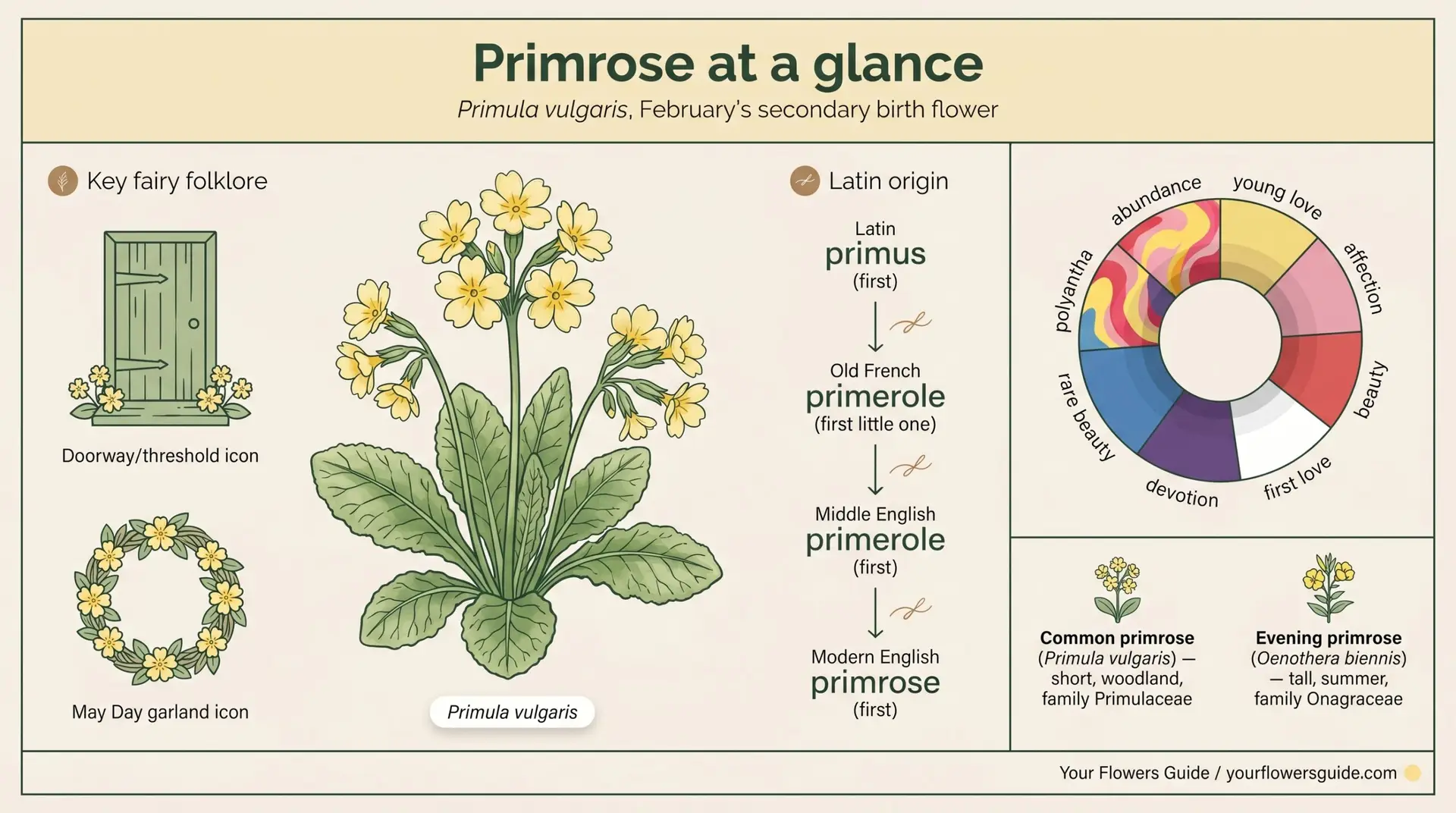
The English name “primrose” looks like “first rose” at first reading, and that intuition reflects the actual etymological history. The Latin root Primula derives from primus (first), and the English name traveled through medieval French and Middle English with a similar symbolic claim built into the word.
Early English forms of the name appear in medieval texts, and the word evolved through Middle English “primerole” (influenced by Old French) to the modern English “primrose” by the sixteenth century. Throughout this evolution, the underlying claim of being “the first rose” of spring stayed embedded in the name, even though primrose is not a rose botanically (true roses belong to the genus Rosa in the family Rosaceae, while primrose belongs to Primula in Primulaceae).
The naming reflects observation rather than taxonomy. Medieval European gardeners and herbalists recognized primrose as one of the earliest spring flowers in their temperate woodland environment, and “first rose” was a poetic acknowledgment of that seasonal position rather than a botanical claim. The same pattern appears in the Latin scientific naming: Primula vulgaris means “common little first one,” with vulgaris in the older sense of “common, ordinary, native to the country” rather than the modern English connotation of “vulgar.”
The Catholic Marian tradition adds another etymological layer. The cluster of flowers on a single stem in Primula veris (cowslip) was sometimes called “Our Lady’s keys” in medieval English folk tradition, with the flower cluster compared to a bunch of keys hanging from the Virgin Mary’s belt. This association linked primrose to Marian symbolism and early-spring religious observance, particularly Candlemas (February 2) and the feast of the Annunciation (March 25). The Marian association declined after the Reformation in Protestant Europe but persisted in Catholic regions and continues to appear in modern liturgical flower traditions.
Celtic fairy folklore: primrose as fairy doorway
Primrose holds a distinctive place in Celtic fairy folklore. In Irish and Welsh tradition, primroses are fairy flowers, and primrose-related practices appear in folk customs through the early twentieth century in rural Ireland and Wales.
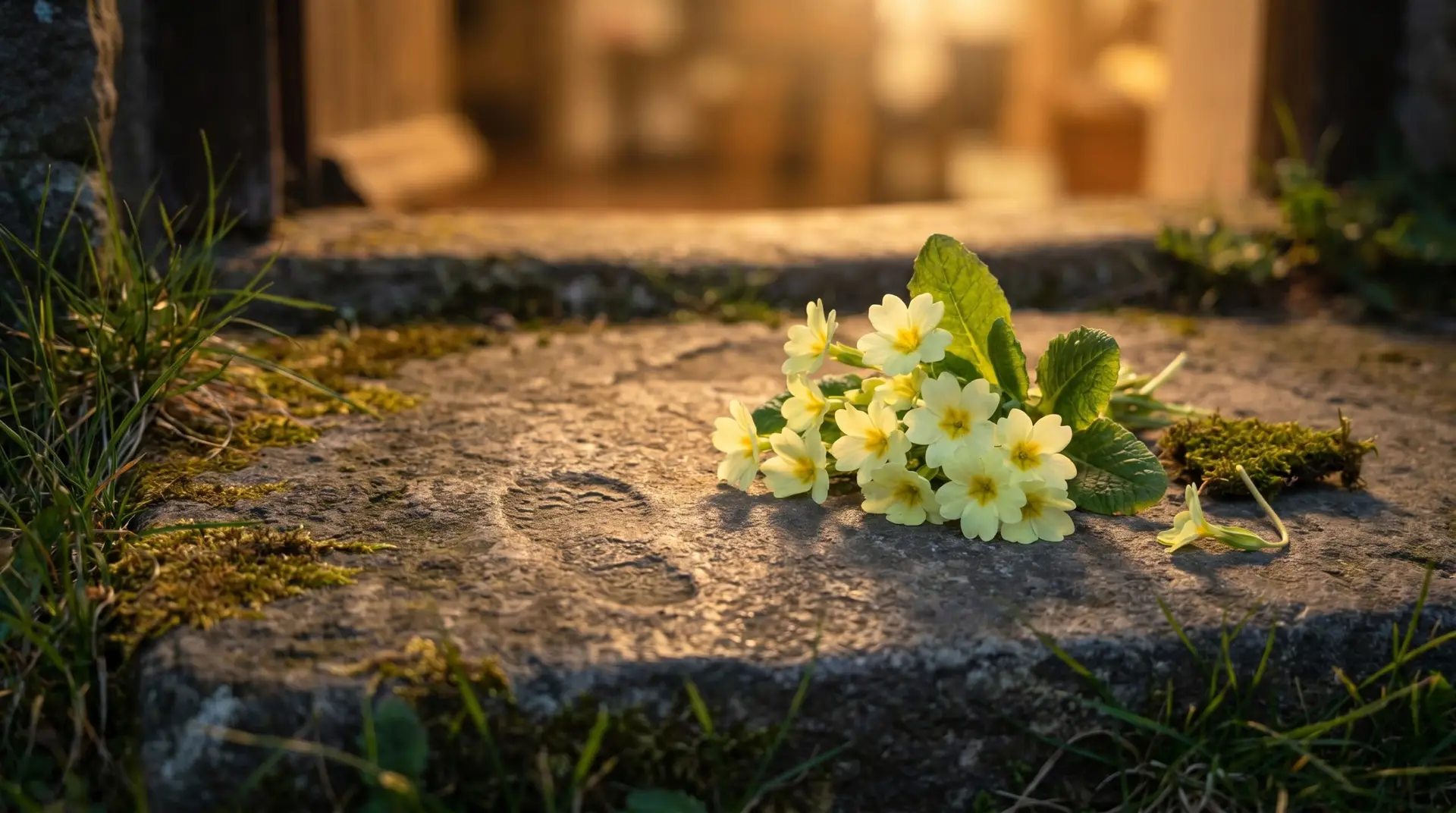
The core belief is that primroses can open passages to the fairy realm. A bunch of primroses left on a doorstep is sometimes said to mark the threshold between the human world and fairyland, allowing fairies to cross over on certain nights. A single primrose placed in a kitchen window was sometimes used as a folk charm to keep mischievous fairies away from food stores, while a small bouquet of primroses on the doorstep was thought to welcome friendly household fairies.
Irish folk vocabulary called yellow primrose petals “fairy butter” for their color and the slight sweetness of the petal when chewed. The petals were sometimes used in folk medicine and folk cuisine in coastal Ireland and Wales as a connection between human food and the fairy realm.
May Day tradition (Bealtaine in Irish, the first of May) included primrose garlands left at doorways across rural Ireland and parts of Wales. The custom served two functions in the folk reading: welcoming friendly fairies to the household for the new growing season, and warding off mischievous or dangerous fairies who might cause harm during the threshold period between winter and summer.
The English literary tradition incorporated primrose-fairy associations from early modern literature onward. Edmund Spenser’s The Faerie Queene (1590) references primroses in fairy-court settings. Shakespeare’s A Midsummer Night’s Dream (about 1595) places primroses in the fairy forest where Oberon and Titania hold court, with Puck’s “primrose bed” appearing as a place of fairy enchantment. Modern fantasy literature inherits these associations: J.R.R. Tolkien’s Middle-earth includes primroses in Hobbit gardens with implied folk significance, and Terry Pratchett’s Discworld novels reference traditional primrose fairy lore for comic effect.
The fairy connection feeds back into the Victorian birth flower reading of primrose as “young love” and “first beginnings.” A flower that opens passages between worlds, that signals the first stirring of spring after winter, and that appears in fairy-tale literary tradition naturally accumulates symbolic weight around themes of newness, romance, and the magic of first experiences. The cottage-garden aesthetic of carpets of primrose under deciduous trees in early spring reinforces the fairy-tale visual register that the symbolism implies.
Primrose vs evening primrose: critical disambiguation
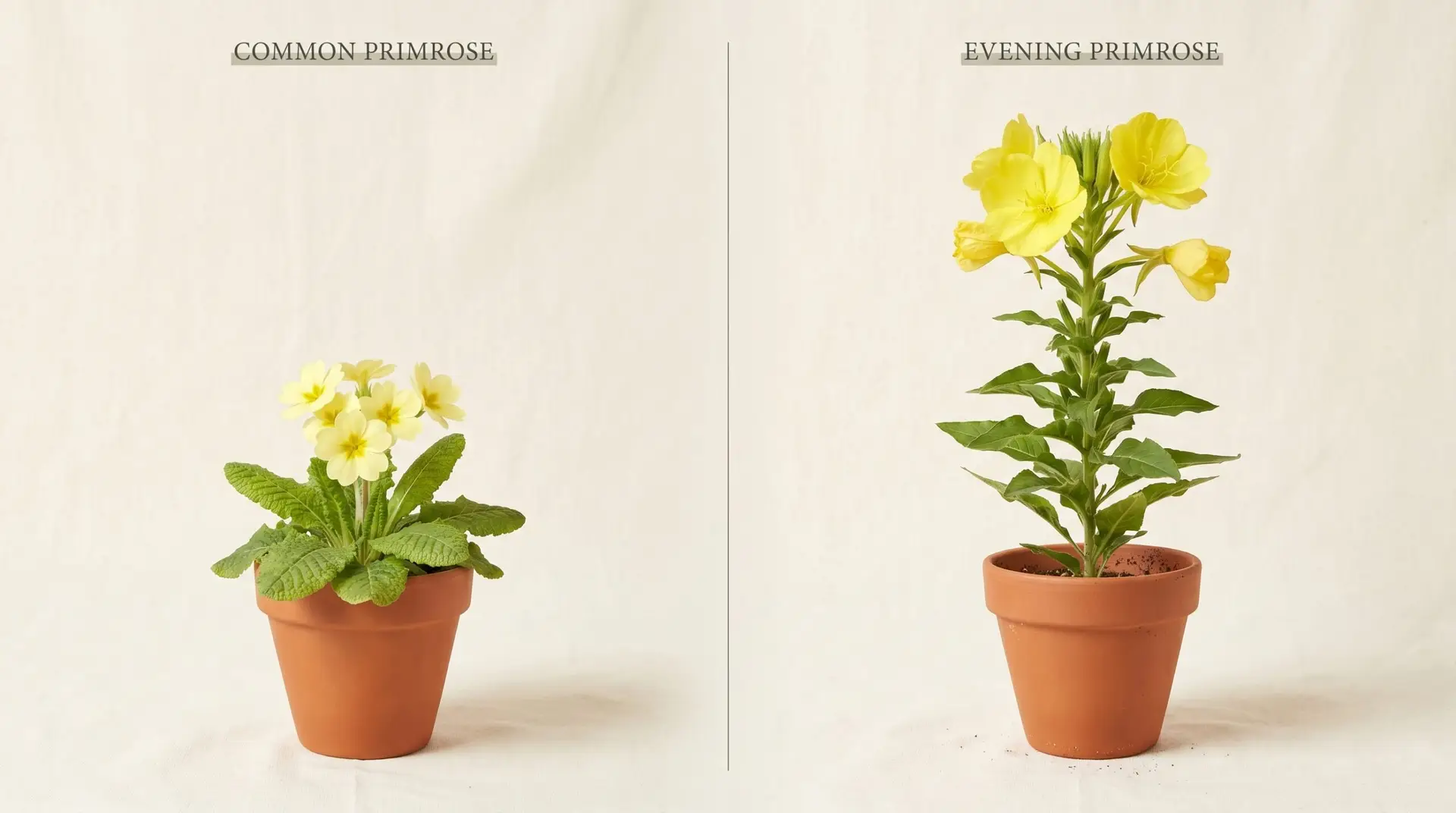
Real reader confusion exists between primrose and evening primrose. The two plants share an English name but belong to completely different botanical families and have unrelated histories, uses, and symbolic readings.
Primrose (Primula vulgaris) is the subject of this article. Family Primulaceae, native to temperate Europe, cool-climate spring-blooming perennial with a rosette of crinkled leaves and small pale yellow flowers on short stems. Bloom time: February through May depending on climate. Edible petals used in medieval European cuisine. Symbolic meaning: first beginnings, young love, fairy folklore associations.
Evening primrose (Oenothera biennis) is a completely different plant. Family Onagraceae, native to North America, tall biennial growing 3 to 5 feet with large yellow four-petal flowers that open in the evening (hence the common name). Bloom time: late summer and early fall. Seeds yield evening primrose oil, sold as a dietary supplement in modern health food markets for various claimed health benefits. Symbolic meaning in Victorian floriography: weak love, ephemeral pleasure (a reading based on the flower’s habit of opening for just one evening before withering).
The two plants are not closely related botanically. The shared common name reflects nothing more than the English-language convention of calling unrelated plants “primrose” because both have yellow flowers and bloom in seasons when other flowers are less common.
For practical purposes: if you see “primrose oil” as a supplement ingredient, that is evening primrose oil from Oenothera biennis seeds, not from common primrose. If you see “primrose” as a birth flower or Victorian symbolic flower, that is Primula vulgaris, the cool-climate spring-blooming woodland flower. The two should not be conflated, and modern flower guides that list both should make the distinction explicit.
Color symbolism within Primula
Color shifts the symbolic reading of primrose within the broader theme of first beginnings and young love. Modern Primula hybrids offer a wide color range that supports detailed color symbolism beyond the wild yellow form.
Yellow primrose is the most traditional and the standard Victorian reading. Young love, modest charm, and the first stirrings of spring. The Korean daily-flower tradition assigns yellow primrose a meaning along the lines of youth and longing, which matches the Western reading closely.
Pink primrose reads as feminine affection and youthful innocence in modern Western floriography. The pink color shifts the symbolic register slightly more toward romantic affection while keeping the core “young love” theme.
Red primrose carries a meaning of “natural beauty” in the Korean daily-flower tradition and “unparalleled beauty” in some modern Western readings. The red primrose form is a hybrid color rather than a wild species.
White primrose reads as first love in the Korean daily-flower tradition and as pure devotion in modern Western readings. The white form is sometimes used in wedding bouquets where the bride wants the first beginnings symbolism without the visual weight of more dramatic flowers.
Purple primrose reads as devotion and royalty. Less common in commercial trade than yellow and pink.
Blue primrose is the rarest color form and the most prized by collectors. Genuine blue primrose cultivars are difficult to breed because primrose pigments naturally lean toward warm tones; true blue requires careful hybrid selection. Blue primrose reads as eternal love and rare beauty.
Polyantha (cluster primrose) is a growth form rather than a single color, with multiple flowers per stem. The polyantha form reads as abundance and fertility in symbolic terms and dominates modern garden center commercial primrose sales.
Growing primroses
Primroses do best in cool climates with rich moist soil and partial shade. The plant is native to deciduous woodland understory in temperate Europe, and the cultivation requirements follow that native habitat.
USDA zones 4 through 8 cover most of the temperate climate range where primrose thrives. Zones 9 and warmer typically experience too much summer heat for primrose to perform well as a perennial; in these warmer zones, primrose works best as an annual planted in fall for winter and early spring bloom, then replaced when summer heat arrives. Zones 3 and colder are sometimes marginal depending on snow cover (primrose tolerates extreme cold under snow but suffers in cold without insulation).
Sun exposure should be partial shade. Direct hot afternoon sun stresses the plant and shortens the bloom period. Morning sun with afternoon shade works well, as does dappled light under deciduous trees that leaf out after the primrose bloom finishes in early spring.
Soil should be humus-rich, consistently moist, and slightly acidic to neutral. Primroses suffer in dry sandy soils and in heavy clay that holds water in winter. The native woodland habitat provides the model: leaf litter mulch, decomposed organic matter throughout the root zone, and consistent moisture without standing water.
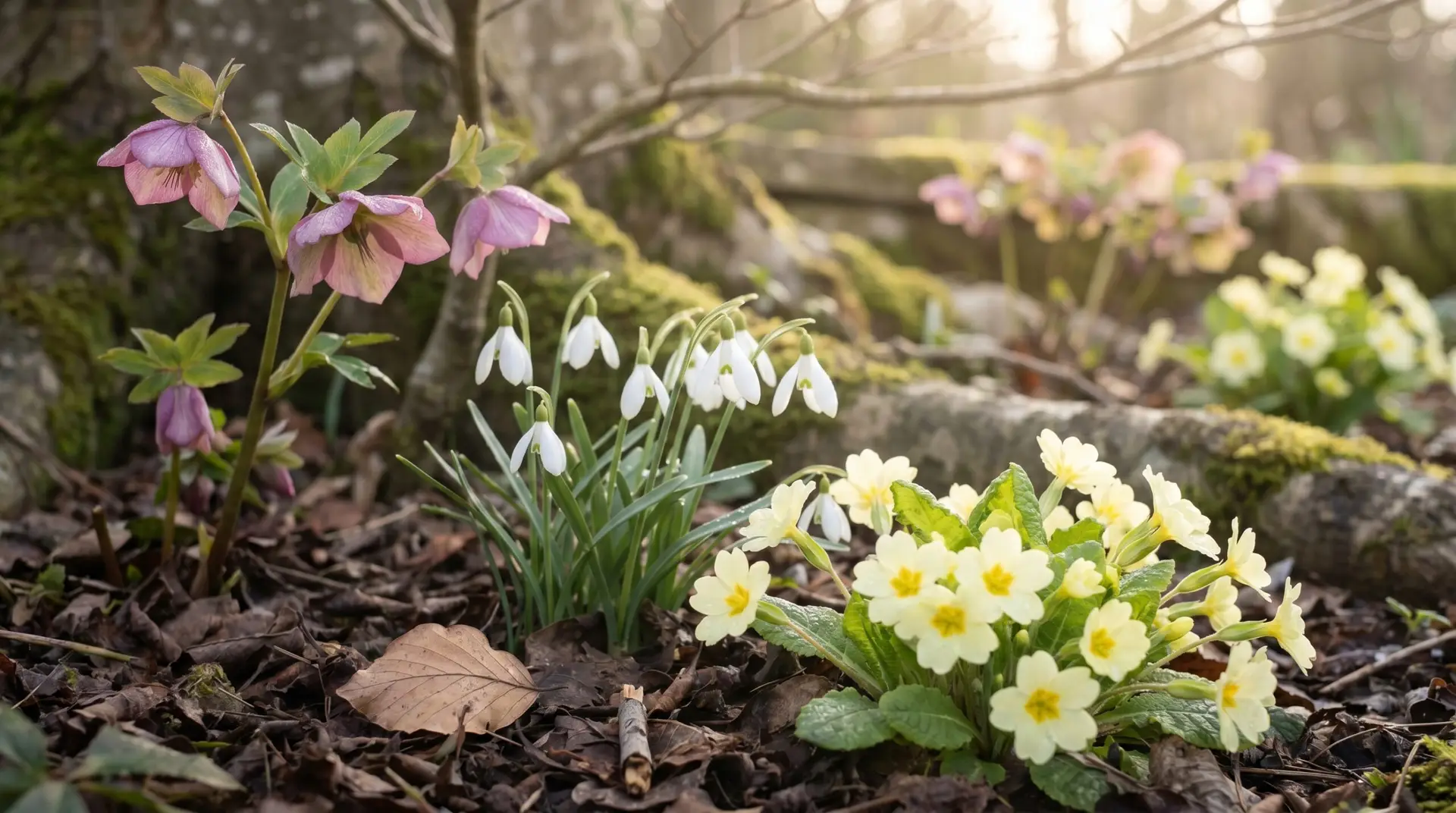
Naturalizing primroses in a shady garden corner is straightforward. The plant spreads by seed (allow seed pods to mature and self-sow) and by clump division (lift mature clumps every 3 to 5 years and divide them to prevent crowding). Pairing primroses with snowdrops (Galanthus nivalis) and hellebores creates a coherent late-winter-and-early-spring shade garden that holds visual interest from January through May in mild climates.
Container culture is popular for indoor winter color. Garden centers sell forced primroses in small pots from January through March; these plants can flower indoors for 3 to 6 weeks before declining. After the bloom period, the pots can be planted outdoors in a shady garden corner to naturalize for the following year.
Pests include slugs (which favor primrose leaves and flowers), aphids on new growth, and vine weevil grubs in the root system. Standard organic pest management approaches work for all three pests.
Edibility and medieval cuisine
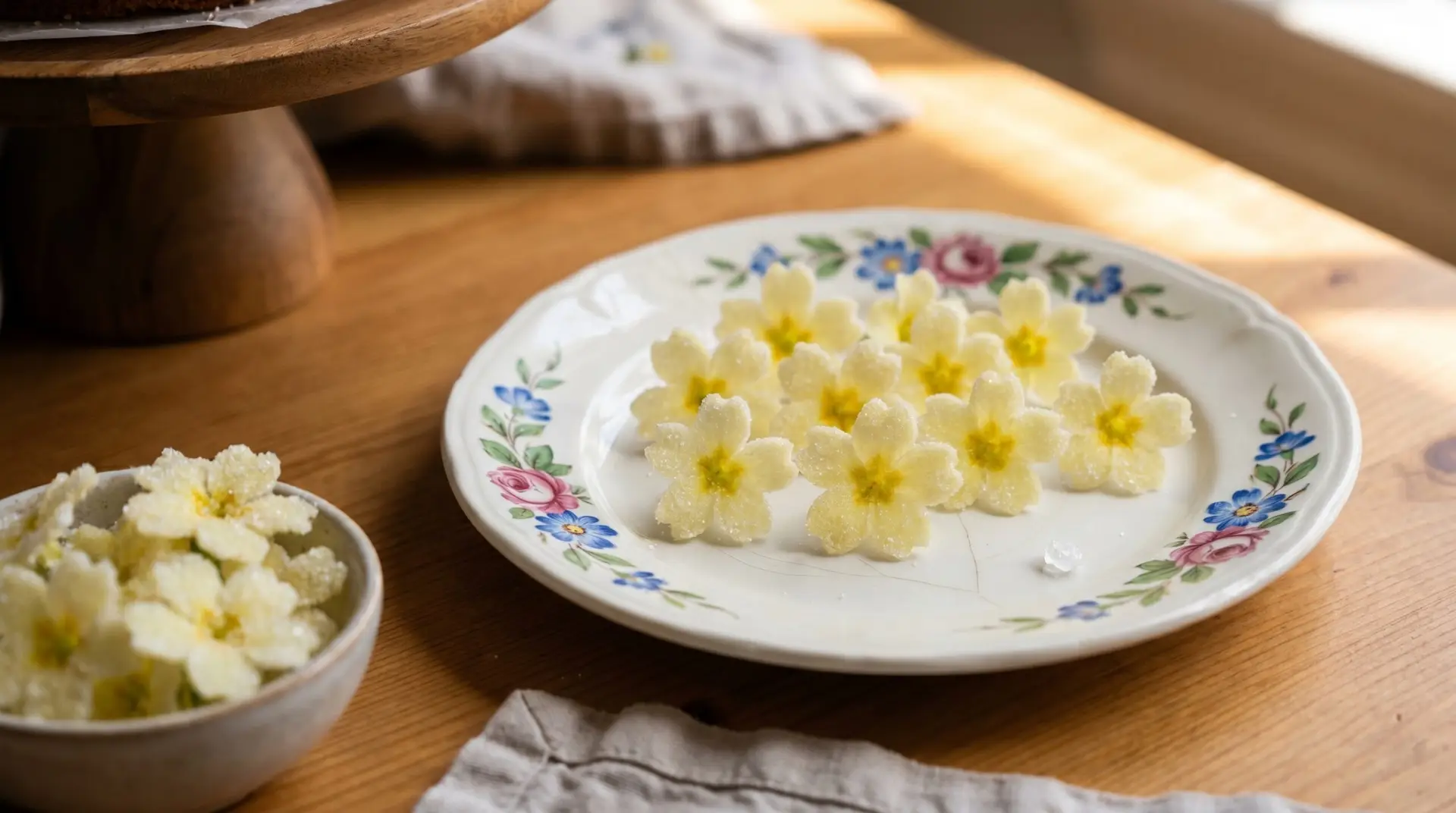
Primrose flowers are edible and have been used in European cuisine since at least the medieval period. The petals taste mildly sweet with a faint floral note and pair well with creamy desserts, salads, and fruit dishes. Modern foragers and edible flower enthusiasts continue the tradition with primrose petals as garnish and as a subtle flavoring ingredient.
Crystallized primroses are a real historical confection, similar to crystallized violets but less commercially produced. The procedure involves coating fresh petals in beaten egg white and fine sugar, then drying the coated petals until the sugar forms a crisp crust around the preserved flower. Crystallized primroses appear in nineteenth-century English and French confectionery cookbooks and survive as occasional specialty patisserie items in modern Europe.
Primrose wine is a traditional folk wine in rural England, made from primrose flowers fermented with sugar and yeast. The wine has a pale yellow color and a delicate floral flavor. Modern home winemakers occasionally make primrose wine as a heritage craft; commercial production is essentially nonexistent.
Primrose petals in salads adds color and subtle sweetness. The petals work well in spring salads with fresh greens, soft cheeses, and light citrus dressings. Use only primroses you have grown yourself or have identified with certainty, and avoid primroses from roadsides or treated garden centers due to pesticide concerns.
Medieval European herbal medicine used primrose roots and leaves for various claimed therapeutic purposes including headache relief and respiratory conditions. Modern medical practice does not support these uses, and primrose root contains saponins that can cause stomach upset in large quantities. The flower petals are safe for normal culinary use; the roots and large leaf quantities should be avoided.
Frequently asked
What does the primrose flower symbolize?
First beginnings, young love, and the early stirrings of spring in modern Western floriography. The Latin etymology of Primula (from primus, meaning first) reinforces the “first” symbolism. The flower also has strong Celtic fairy folklore associations as a doorway to the fairy realm.
Is primrose the same as evening primrose?
No. Primrose (Primula vulgaris) and evening primrose (Oenothera biennis) belong to completely different botanical families. Primrose is a cool-climate spring-blooming woodland flower from Europe; evening primrose is a tall North American summer-blooming biennial. The two share an English name but have unrelated histories, uses, and symbolic readings.
Why is primrose called “first rose”?
The English name comes from the Latin primus (first), reflecting the plant’s position as one of the earliest spring flowers in temperate European woodlands. The “rose” portion of the name is symbolic and traditional rather than botanical; primrose is not in the rose family.
What is the Celtic fairy folklore of primrose?
Irish and Welsh folk tradition treats primrose as a doorway to the fairy realm. Primroses on a doorstep could allow fairies to cross between worlds, and a primrose in a kitchen window was a charm against mischievous fairies. May Day primrose garlands welcomed friendly fairies and warded off mischievous ones.
What does the yellow primrose mean?
Young love, modest charm, and the first stirrings of spring. Yellow is the wild form of Primula vulgaris and the most traditional symbolic reading. The Korean daily-flower tradition assigns yellow primrose a meaning along the lines of youth and longing.
Can you eat primrose flowers?
Yes. Sweet primrose petals (from Primula vulgaris) are edible and have been used in European cuisine since the medieval period. Common uses include crystallized confections, salad garnish, and primrose wine. Use only primroses you have grown yourself or have identified with certainty, and avoid roadside or treated-lawn primroses due to pesticide concerns.
How do you grow primroses?
Plant in partial shade with rich moist soil, in USDA zones 4 through 8. The native woodland habitat provides the model: leaf litter mulch, decomposed organic matter, consistent moisture, and protection from hot afternoon sun. Divide clumps every 3 to 5 years to prevent crowding. Pair with snowdrops and hellebores for a coherent late-winter shade garden.
Why is primrose February’s birth flower?
Primrose blooms in late winter through early spring in temperate climates and is one of the few flowers available outdoors during the February window. Victorian writers who codified the modern Western birth flower system chose primrose for February for this practical seasonal reason and for the symbolic match between the Latin etymology of “first” and February’s transitional character between winter and spring.
What is the difference between primrose and cowslip?
Both are in the genus Primula. Primrose (Primula vulgaris) has individual flowers on short separate stems rising just above a leaf rosette. Cowslip (Primula veris) has a cluster of multiple yellow flowers on a single taller stem, which is why medieval English folk tradition compared cowslip clusters to bunches of keys (“Our Lady’s keys” in Marian usage). The two species hybridize naturally where their ranges overlap.
Sources
- Primrose (Primula) · Encyclopedia Britannica
- Primula growing guide · Royal Horticultural Society
- Evening primrose (Oenothera biennis) · Encyclopedia Britannica
About this article. > Written and reviewed by the Your Flowers Guide editorial team. Botanical content from Britannica and the Royal Horticultural Society. Celtic fairy folklore from documented Irish and Welsh folk tradition references. Shakespeare reference from A Midsummer Night’s Dream Act 2 Scene 1 (Folger Shakespeare Library standard edition).