Morning glory flower meaning: Japanese culture, color, and growing
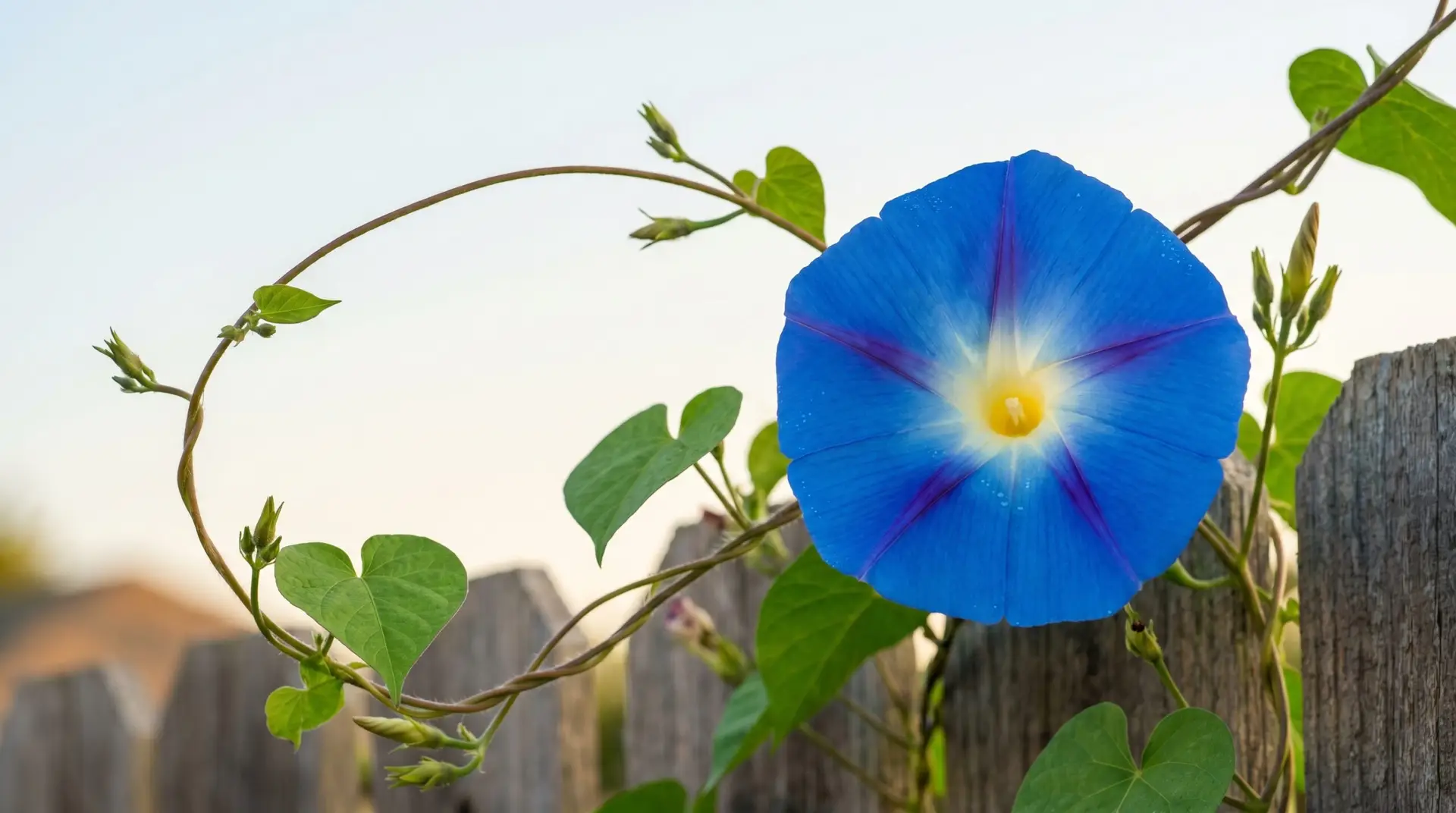
Morning glory is September’s secondary birth flower in Western tradition. Where aster signals wisdom and Greek classical heritage, morning glory signals affection, love returned, and the meaningful brevity of one-morning beauty. The flower refers primarily to the genus Ipomoea in the family Convolvulaceae, with several other related genera (Convolvulus, Calystegia, Pharbitis) sometimes included under the broader “morning glory” common name.
The morning glory holds an unusually rich cultural register that extends well beyond Western Victorian floriography. The Japanese asagao (朝顔, literally “morning face”) tradition has produced centuries of dedicated cultivation, breeding, and poetic expression that no Western flower tradition can match. The simple one-morning life of the bloom has provided one of the most powerful flower metaphors for impermanence and the value of momentary beauty across multiple cultures. The combination of brief intense beauty, climbing vine growth habit, and toxic seeds gives morning glory a distinctive set of symbolic and practical considerations.
Morning glory botany: Ipomoea and relatives
The genus Ipomoea contains approximately 600 species native to temperate and tropical regions across every inhabited continent. The most culturally and horticulturally significant species are the following.
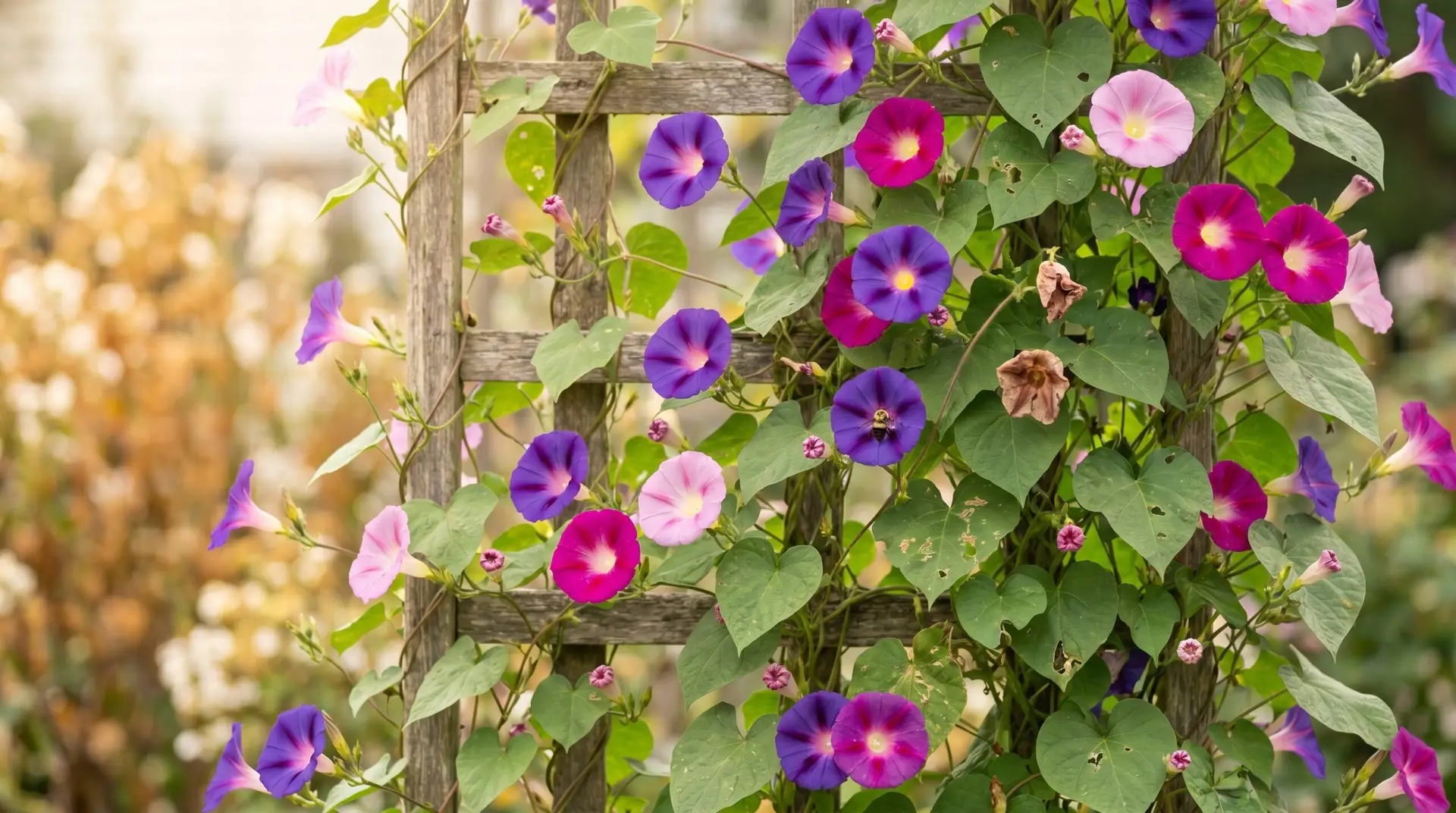
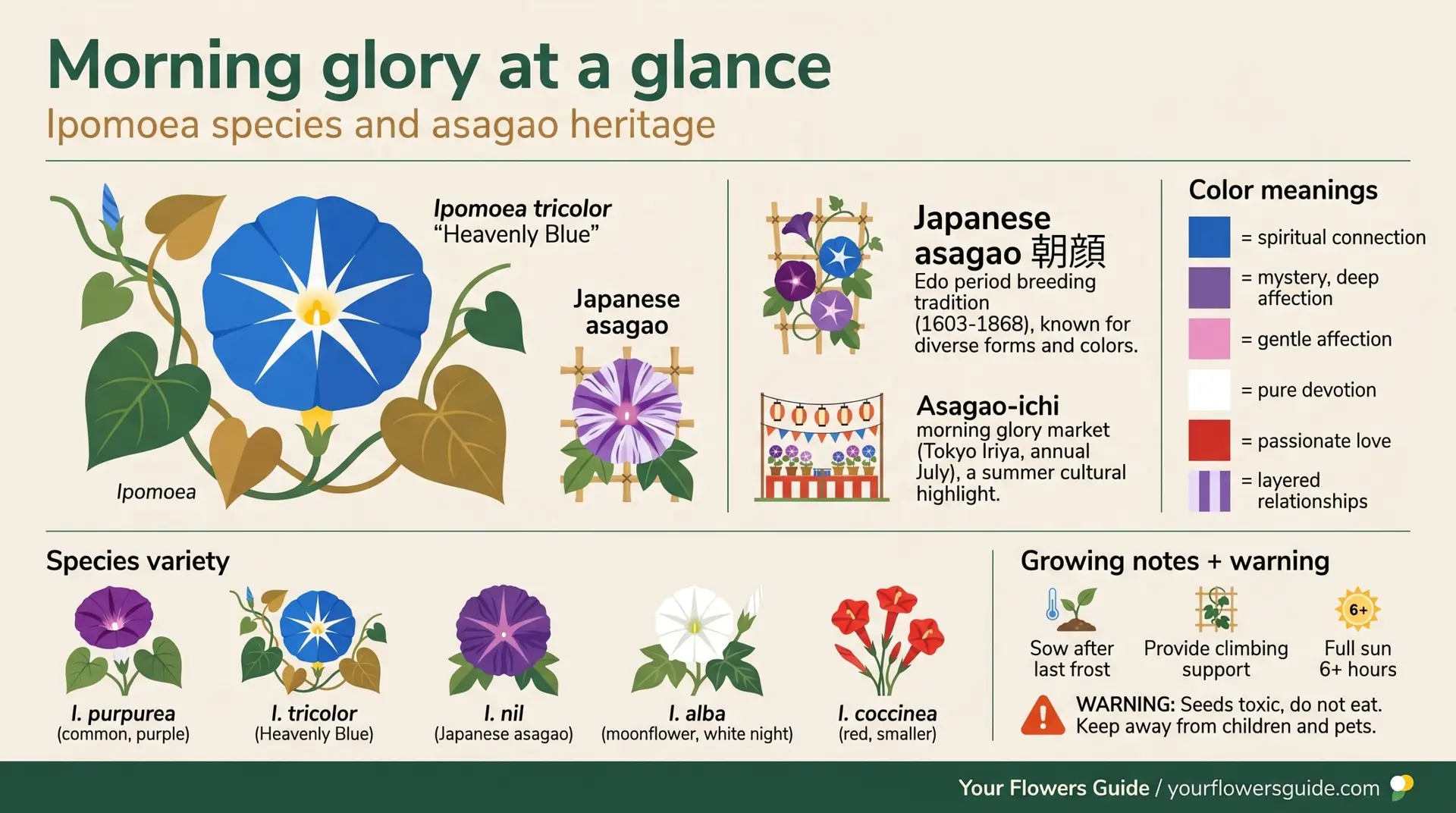
Ipomoea purpurea (common morning glory). Native to Central and South America. The standard morning glory of European and American gardens, with deep purple, magenta, pink, or white flowers and heart-shaped (cordate) green leaves. Vigorous twining vine reaching 10 to 15 feet in a single growing season. Self-sows freely in suitable climates, sometimes to the point of becoming invasive in southern US states and similar warm-climate regions.
Ipomoea tricolor (Heavenly Blue morning glory). Native to Mexico and Central America. The species famous for the brilliant pure blue “Heavenly Blue” cultivar, considered one of the most beautiful blue flowers in temperate gardens. Flowers reach 4 to 5 inches across with the characteristic five-pointed star pattern visible at the center, opening at dawn with brilliant clear blue color, fading to pink before closing in mid-morning. The species has been important in ethnobotany because of the ergoline alkaloid content of the seeds.
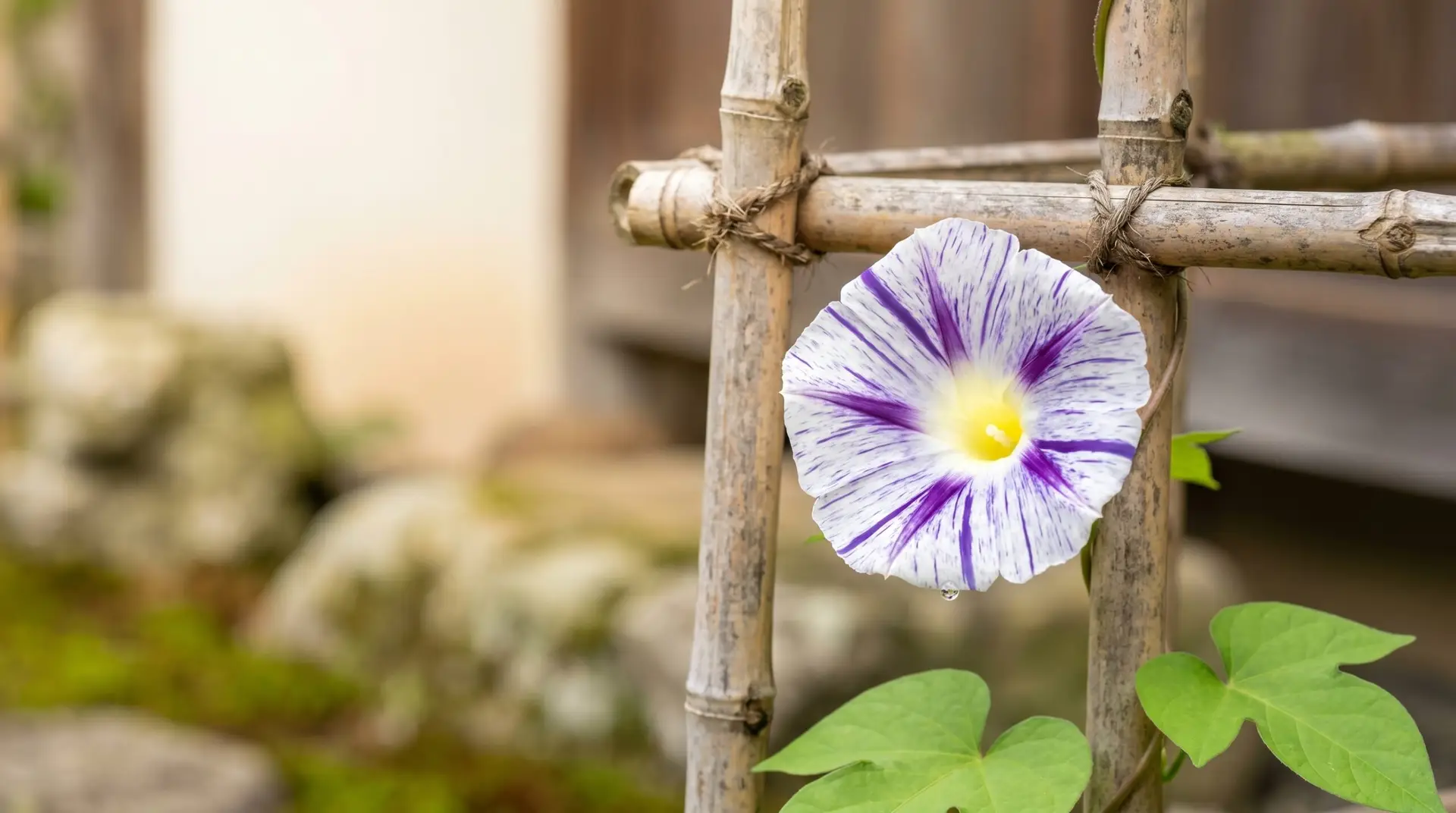
Ipomoea nil (Japanese morning glory, asagao). Native to tropical Asia, with extensive Japanese cultivation history. The species of Japanese asagao tradition, with centuries of dedicated Japanese hobbyist breeding producing extraordinary cultivar diversity not found in Western horticulture. Some specialized Japanese cultivars show unusual flower shapes, color combinations, and growth patterns. Japanese asagao societies and breeding programs continue today as significant horticultural traditions.
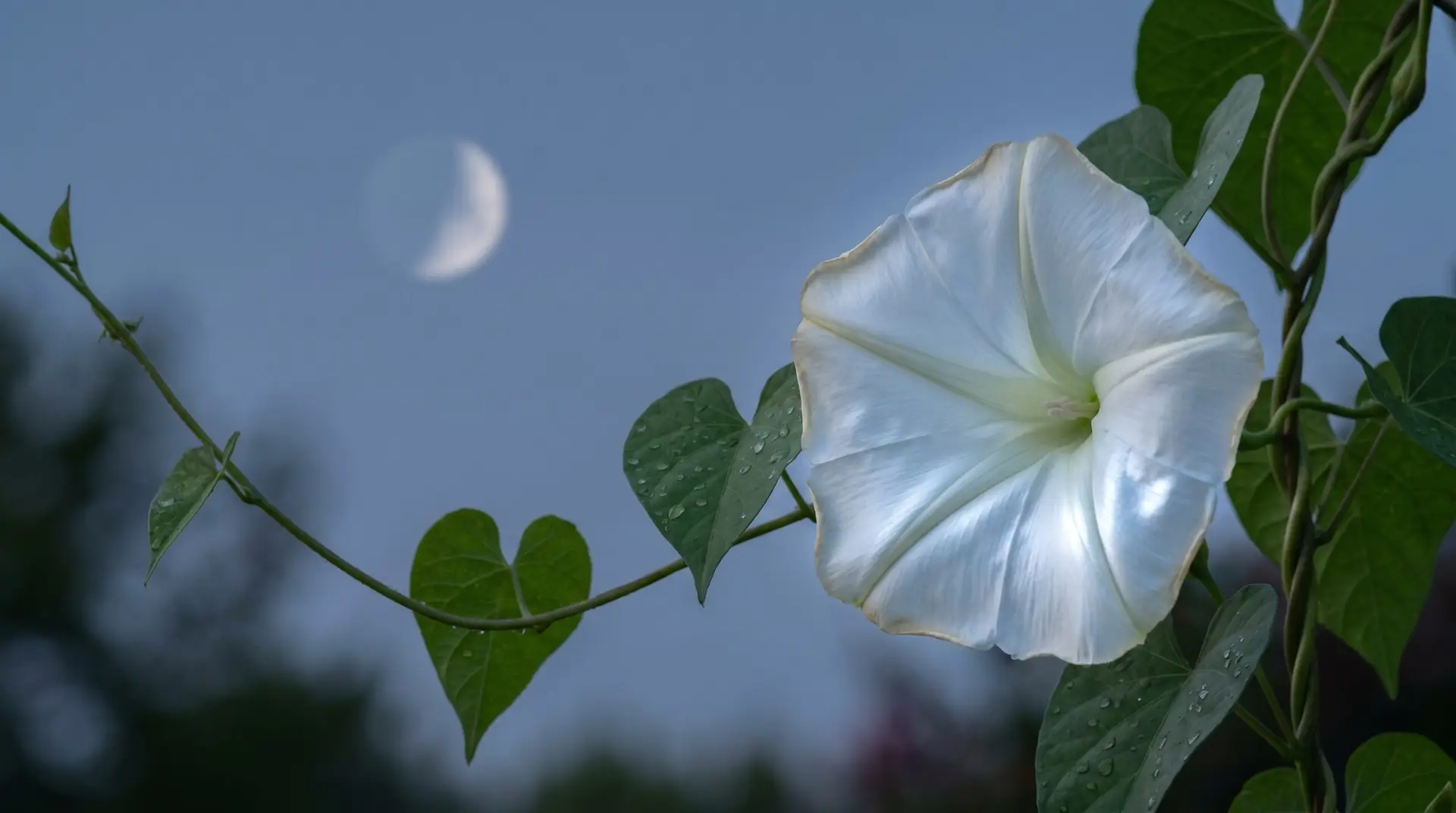
Ipomoea alba (moonflower). Closely related to morning glory but with the opposite blooming pattern: large pure white fragrant flowers opening at dusk and remaining open through the night before closing at dawn. Often planted alongside morning glory for combined day/night flowering. Native to tropical Americas.
Ipomoea batatas (sweet potato). The edible tuber sweet potato is botanically a member of the morning glory family, with similar climbing vine habit but distinctive heart-shaped leaves and small light-purple to white flowers. Ornamental sweet potato cultivars with distinctive chartreuse or purple foliage are widely grown for foliage rather than flowers.
Ipomoea coccinea (red morning glory, mexican morning glory). Smaller flower size than other morning glories but distinctive bright red color. Vigorous self-sowing climbing annual.
The visual character across all Ipomoea species centers on the funnel-shaped flower form with five-pointed star pattern at the center (visible as fine ridges or lighter color radiating from the throat to the petal edges), the heart-shaped or lobed green leaves, and the vigorous twining vine growth habit. Each individual flower lives only one day (morning species) or one night (moonflower), with the plant producing dozens of sequential blooms over the season.
Japanese asagao culture
The Japanese morning glory tradition (asagao, 朝顔, literally “morning face”) provides the deepest cultural reading of morning glory across global flower traditions. Japan has cultivated and developed asagao for over a thousand years, with the most intensive cultivar development occurring during the Edo period (1603-1868) when Japanese horticultural societies produced thousands of unusual asagao cultivars unknown in any other tradition.
The historical introduction of morning glory to Japan dates to the Nara period (710-794 AD), with the species probably introduced from China where it was originally cultivated for the medicinal properties of the seeds. The Japanese term “asagao” appears in the eighth-century Manyoshu (萬葉集), the earliest surviving collection of Japanese poetry, suggesting that the plant was culturally established within a century or two of its introduction.
The Edo period saw the most intensive Japanese asagao development. Hobbyist societies (asagao-renju, 朝顔連中) developed across Japan in the late Edo period, producing thousands of unusual cultivars with extraordinary flower shapes (deeply cleft petals creating star or windmill forms, doubled flowers, leaf-form mutations affecting flower appearance, miniature forms only 1 inch across, and giant forms reaching 6 inches across) and color combinations (striped, speckled, picotee edges) unknown in Western Ipomoea cultivation. The two major asagao breeding peaks (Bunka-Bunsei era, 1804-1830, and the Kaei-Ansei era, 1848-1860) produced cultivars considered the finest asagao varieties ever developed.
Modern Japanese asagao culture continues these traditions through several active hobbyist organizations and the major annual Asagao-ichi (朝顔市, morning glory market) held in early July in Tokyo’s Iriya area. The market dates to the nineteenth century, with roots in the late Edo period, and attracts hundreds of thousands of visitors to view and purchase the latest cultivars from contemporary breeders. The Japan Asagao Society (日本朝顔協会) maintains cultivar registers and breeding standards continuing the Edo period traditions.
Japanese poetry has used asagao extensively as a seasonal symbol for late summer and early autumn, for impermanence (the one-morning flower life), for unrequited love, and for the brief beauty of human relationships. The poet Matsuo Basho (1644-1694) and many other classical Japanese poets have referenced asagao in haiku and longer forms. Modern Japanese cultural reference continues to use asagao as the typical symbol of brief intense beauty.
The genetic and breeding science significance of Japanese asagao has emerged more recently. The Japanese asagao breeding tradition produced morphological mutations that modern genetics has identified as significant model system for understanding plant developmental biology. Several Japanese universities maintain asagao genetic stocks for ongoing research, and asagao has emerged as one of the more important plant model systems for understanding the genetics of flower color, shape, and development.
Color symbolism across morning glory varieties
Morning glory color shifts the symbolic reading within the broader theme of affection and brief beauty:
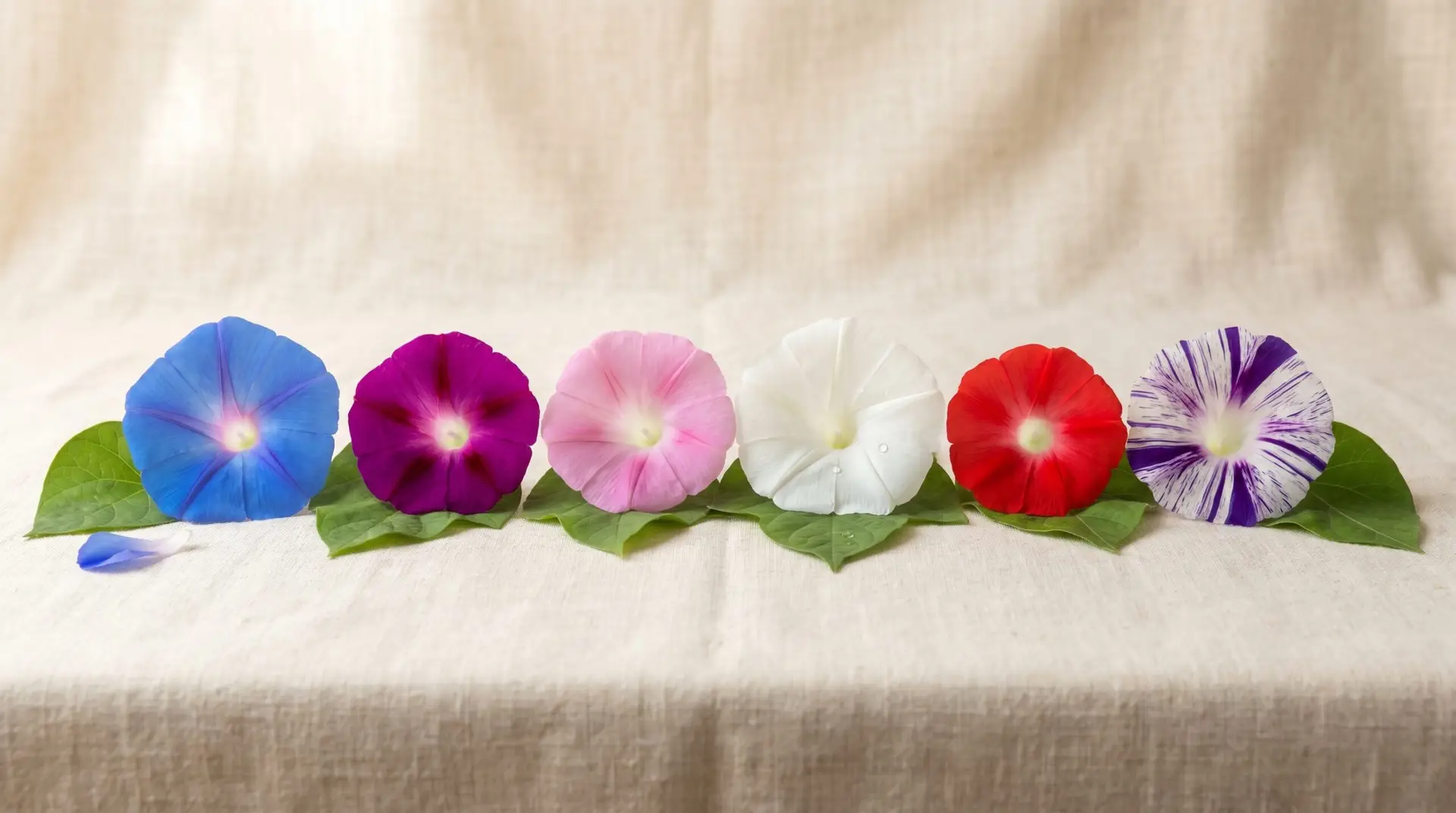
Blue morning glory (Ipomoea tricolor “Heavenly Blue”): spiritual connection, divine love, the rare beauty of true blue. The most culturally weighted color because of the rarity of true blue in flowering plants and the iconic cultivar’s status as the standard for blue morning glory.
Purple morning glory (Ipomoea purpurea): the most traditional and most common. Mystery, contemplation, deep affection. The dominant color in wild and naturalized populations across temperate climates.
Pink morning glory: gentle affection, sweet thoughts, feminine warmth. Often chosen for romantic gift contexts and bouquets emphasizing softer symbolic register.
White morning glory: pure devotion, innocence, beginnings. The white provides the most formally appropriate register for wedding contexts (paired with sunrise themes) and for spiritual occasions.
Red morning glory (Ipomoea coccinea): passionate love, intense desire. The bright red color shifts the symbolic register toward the deeper romantic register.
Magenta or deep pink morning glory: vibrant affection, joyful celebration. The brighter color suits cheerful bold floral statements.
Striped or bicolor morning glory (various Japanese cultivars): layered relationships, complex feelings, the natural variation of authentic affection. Japanese cultivars often show striped or speckled color combinations that have specific Japanese cultural symbolic readings beyond Western tradition.
The most culturally significant single color globally is blue, particularly through the iconic Ipomoea tricolor “Heavenly Blue” cultivar which has become the standard reference for true blue in temperate gardens. The Japanese asagao tradition has produced an extraordinary range of colors and patterns not found in Western Ipomoea cultivation, providing additional symbolic registers for wearers familiar with Japanese cultural traditions.
Toxicity and ergoline alkaloid history
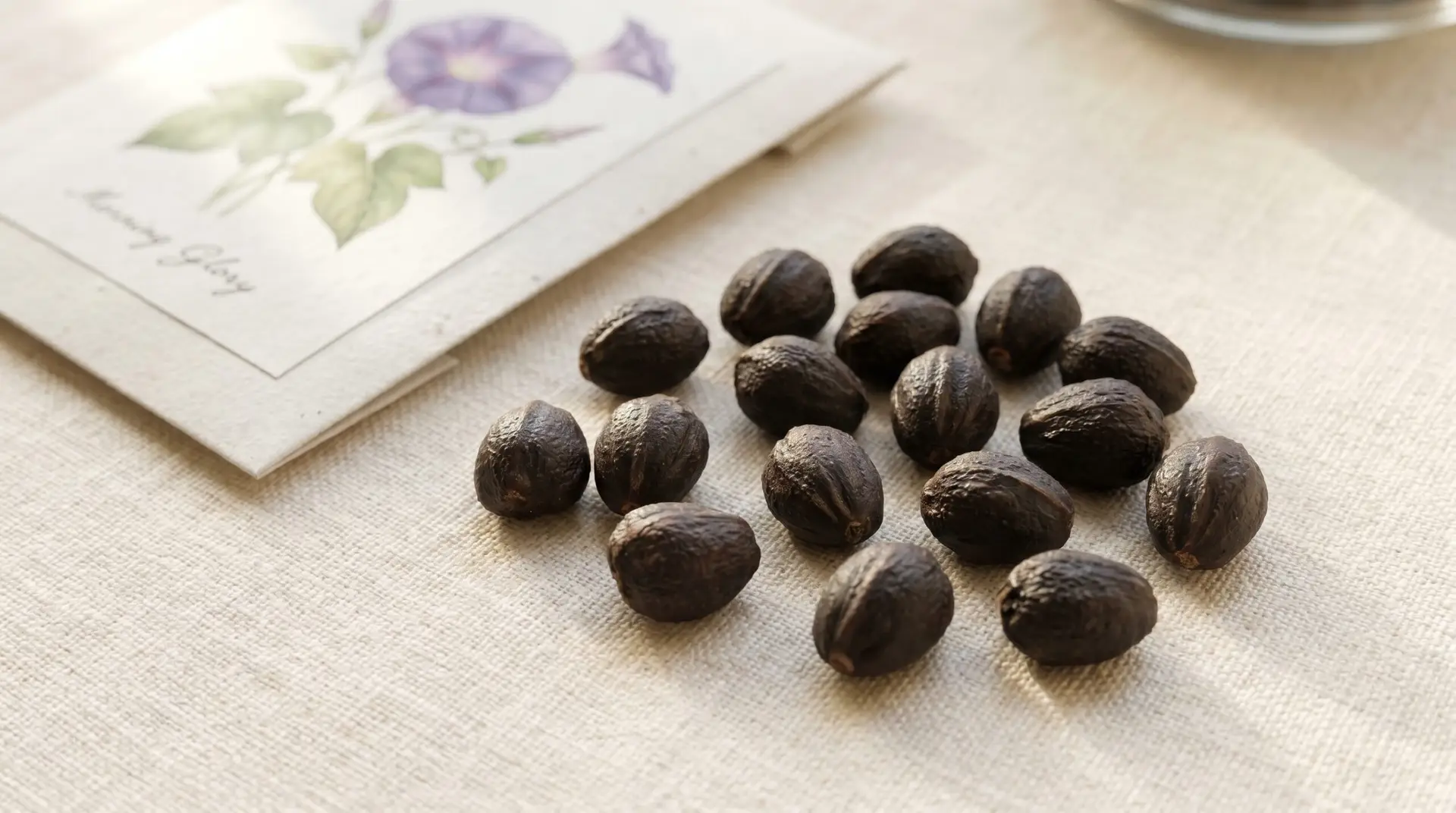
Morning glory seeds (particularly Ipomoea violacea and Ipomoea tricolor) contain ergoline alkaloids similar to those found in ergot fungus. The active compounds include lysergic acid amide (LSA) and related ergoline derivatives. These compounds have psychoactive properties similar to but milder than LSD (lysergic acid diethylamide), with significant individual variation in response and potential for serious toxic effects.
The traditional and indigenous use of morning glory seeds for psychoactive purposes has documented history in pre-Columbian Mesoamerican cultures. The Aztec used Ipomoea violacea seeds (called “tlitliltzin” in Nahuatl) and the related Turbina corymbosa seeds (“ololiuhqui”) in religious ceremonies. The Mazatec people of southern Mexico continue limited ceremonial use of these seeds in some traditional religious contexts.
The modern recognition of morning glory seeds as a recreational substance dates to mid-twentieth century scientific research. Albert Hofmann (the Swiss chemist who first synthesized LSD) isolated and identified the active ergoline compounds in morning glory seeds in 1960, confirming their relationship to LSD. Subsequent recreational use of morning glory seeds in the United States and other countries during the 1960s and 1970s led to seed industry treatment practices designed to prevent recreational use.
A persistent claim holds that commercial morning glory seeds are deliberately coated with poison, such as methylmercury, to deter recreational use. There is no good evidence for this, and it is best treated as a myth rather than fact. Some ornamental seeds do carry standard fungicide or handling coatings, as many garden seeds do, and any treated seed is sold for planting rather than eating. The genuine hazard is the seeds’ own ergoline alkaloid content described above, which makes eating morning glory seeds unsafe regardless of any coating.
The toxicity profile of morning glory seeds includes acute effects (nausea, vomiting, confusion, hallucinations, anxiety, increased heart rate, elevated blood pressure) and potential long-term effects with repeated use. Severe acute toxicity can include serious cardiac and psychiatric complications requiring emergency medical treatment.
For household and garden safety, the relevant warnings include the following. Do not eat any morning glory seeds. Keep seeds away from children and pets. Wear gloves when handling treated seeds. If pets or children may have consumed morning glory seeds, contact poison control immediately. The fresh flowers and leaves do not have significant toxicity but should also not be consumed.
Growing morning glory in the garden
Morning glory is among the easier annual climbing vines to grow in most temperate climate gardens.
Sow seeds directly outdoors after the last frost date (typically late spring) when soil has warmed sufficiently for reliable germination. Morning glory seeds have hard outer coats that benefit from pre-sowing treatment to improve germination rates: either scarify the seeds lightly (rubbing with sandpaper to abrade the coat) or soak in warm water for 12 to 24 hours before planting. Plant seeds 1/4 to 1/2 inch deep with 4 to 6 inches between seeds along a trellis, fence, or other climbing support structure.
The plants require full sun (6 or more hours daily) for best flowering and tolerate average to poor soil conditions. Rich fertile soils actually produce excessive vine growth at the expense of flowering, so morning glory benefits from lean rather than amended soil. Adequate water during the establishment period (first 4 to 6 weeks) supports vine development; established plants tolerate drought reasonably well.
Climbing supports are essential for morning glory. The vines twist around any vertical surface (trellis, fence, wire, twine, neighboring plants), reaching 10 to 30 feet of vine growth in a single season depending on species and conditions. Provide support before planting so the vines can climb naturally as they develop; staking after the vines have spread on the ground produces tangled growth that’s difficult to redirect.
Bloom timing runs from midsummer through autumn frost, with peak abundance in late summer and early autumn. Each individual flower lives only one morning, opening at dawn and closing or fading by midday. A healthy plant produces dozens of sequential blooms throughout the flowering period, with new flowers opening each morning.
Pests and diseases for morning glory include leaf miners on the foliage (cosmetic damage that does not affect flowering), aphids on new growth, and occasional fungal leaf spot diseases in humid conditions. The plants are typically pest-resistant overall and do not require regular pest management interventions.
Self-seeding is significant. Morning glory drops seeds prolifically throughout the flowering season; in suitable climates the plants self-sow reliably, producing volunteer plants from year to year without additional planting. In some warm climates (US South, parts of California, Florida), morning glory can become invasive through aggressive self-seeding and may require active management to prevent unwanted spread.
Companion planting works well with morning glory paired with sunflowers (the sturdy sunflower stems provide natural climbing support), corn (traditional native American “three sisters” companion planting with corn, beans, and squash sometimes substitutes morning glory for beans for ornamental rather than food purposes), or any other vertical garden structure.
Morning glory in gifts and seasonal celebrations
Morning glory as a cut flower is rare because the brief flower life (one morning) makes the species impractical for florist trade. The accessible morning glory gift category is seeds for the recipient’s own garden.
A packet of mixed Ipomoea seeds for spring sowing costs from five to fifteen dollars and provides summer to autumn vine bloom over the following growing season and beyond through self-seeding. The seed gift is particularly suitable for gardener recipients who appreciate the climbing vine aesthetic and the morning bloom rhythm. Specialty seed suppliers offer rare Japanese asagao cultivars at higher prices ($15 to $40 per packet) for serious gardener recipients interested in unusual flower forms.
A living morning glory plant in a hanging basket or trellis pot can work as a gift for recipients with porch or balcony space who do not have garden ground. The plant produces continuous summer-to-autumn bloom and provides daily fresh morning glory experiences during the flowering period.
For Japanese cultural gift contexts, a high-quality asagao cultivar or seed gift combined with reference materials on Japanese asagao tradition provides a culturally layered gift. The combination uses the seeds or plant as the primary gift element and the reference materials as the educational supplement. Some traditional asagao breeders and dealers continue to operate in Japan, with limited international shipping for serious collectors.
A bouquet combining asters as the September primary statement with sunflowers, dahlias, and morning glory accents (where fresh morning glory is available from specialty florists or the gift-giver’s own garden) creates a meaningful September birthday gift. The combination uses both September birth flowers and seasonal late-summer flowers for visual abundance and dual symbolic registers.
For recipients with interest in Japanese culture or in unusual horticultural traditions, a gift centered on Japanese asagao with reference materials on the Edo period asagao tradition provides distinctive cultural gift content. The Asagao-ichi morning glory market in Tokyo (early July annual) can be a destination travel gift for serious horticulturists or for cultural travel enthusiasts.
A jewelry piece with morning glory motif work paired with sapphire (the September birthstone) creates a coherent color and symbolic pairing for September birthdays. The deep blue of sapphire matches well with the iconic Heavenly Blue morning glory color. Price tiers range from about forty dollars for simple sapphire-and-floral pieces to several thousand dollars for fine commemorative work.
Frequently asked
What does the morning glory flower symbolize?
Affection, love returned, and mortality. The Victorian readings included “affection,” “love returned,” “departed friends,” and “mortality” (the latter from the one-day flower life). The dominant modern Western reading focuses on affection and the meaningful brevity of one-morning beauty. Japanese cultural reading (asagao) is more developed, with extensive symbolic register for impermanence, unrequited love, and the brief beauty of human relationships.
Why do morning glory flowers only last one day?
Each morning glory flower opens at dawn with full color and beauty, then closes and withers by midday as the petals fade. The brief flower life is the species’s reproductive strategy: each plant produces dozens of sequential blooms over the season, with each individual flower lasting just long enough for the morning’s pollinator activity (primarily hummingbirds, bumble bees, and some specialized morning glory bees). The brief beauty has become a powerful symbolic register for fleeting moments and dawn renewal across cultures.
What is the difference between morning glory and bindweed?
Both belong to family Convolvulaceae and have similar climbing vine habit with funnel-shaped flowers. Morning glory (genus Ipomoea) is the ornamental garden plant with large showy flowers (2 to 5 inches across). Bindweed (genus Convolvulus or Calystegia depending on species) is the typically smaller-flowered (1 to 2 inches across) wild relative, often considered an invasive weed in agricultural contexts. The two are sometimes confused but represent distinct ornamental vs weedy uses of the family.
Are morning glory seeds dangerous?
Yes. Morning glory seeds (particularly Ipomoea violacea and Ipomoea tricolor) contain ergoline alkaloids with potential psychoactive and toxic effects if consumed in significant quantities. Most morning glory seeds sold for ornamental garden use are treated with toxic anti-germination chemicals to prevent recreational use. Do not eat any morning glory seeds. Keep seeds away from children and pets. If consumption is suspected, contact poison control immediately.
What is Japanese asagao?
Japanese asagao (朝顔, literally “morning face”) is the Japanese morning glory tradition, with over 1000 years of cultivation history. The most intensive cultivar development occurred during the Edo period (1603-1868) when Japanese horticultural societies produced thousands of unusual asagao cultivars with extraordinary flower shapes, color combinations, and growth patterns unknown in Western Ipomoea cultivation. The tradition continues today through active Japanese asagao societies and the annual Asagao-ichi morning glory market in Tokyo.
Why is “Heavenly Blue” morning glory famous?
Ipomoea tricolor “Heavenly Blue” is considered one of the most beautiful blue flowers in temperate gardens because true blue color is genuinely rare in flowering plants. The cultivar produces brilliant clear blue flowers 4 to 5 inches across, opening at dawn with intense color that fades to pink before closing. The cultivar has become the standard reference for blue morning glory and one of the iconic cultivars for true blue color in any garden flower.
Are morning glory invasive?
Yes, in suitable warm climates. Morning glory drops seeds prolifically and can self-sow aggressively. In US Southern states, parts of California, Florida, and similar warm climates, morning glory can become invasive through aggressive self-seeding. In cooler temperate climates, morning glory typically does not survive winter as established plants but may persist through self-seeding in suitable conditions.
Can I grow morning glory indoors?
Limited success. Morning glory requires full sun (6+ hours daily) and adequate space for vine growth (10 to 30 feet at full development). Indoor cultivation is possible in conservatories or large sunrooms with appropriate climbing support and adequate light, but most indoor conditions do not provide adequate light or space. Outdoor growing in suitable summer climates produces much better results.
When should I plant morning glory seeds?
Late spring after the last frost date, when soil has warmed sufficiently for reliable germination. Pre-treat seeds (scarification or warm water soaking) before planting to improve germination. Plant 1/4 to 1/2 inch deep with 4 to 6 inches between seeds along a climbing support structure. Direct outdoor sowing typically produces better results than starting seeds indoors because morning glory dislikes root disturbance during transplanting.
Sources
- Morning glory (Ipomoea) · Encyclopedia Britannica
- Ipomoea growing guide · Royal Horticultural Society
About this article. > Written and reviewed by the Your Flowers Guide editorial team. Botanical content from Britannica and the Royal Horticultural Society. Japanese asagao cultural references from Japan Asagao Society documentation. Ipomoea ethnobotany and ergoline alkaloid references from Albert Hofmann’s research and standard ethnopharmacology sources.