Marigold tattoo: meaning, designs, and Day of the Dead heritage
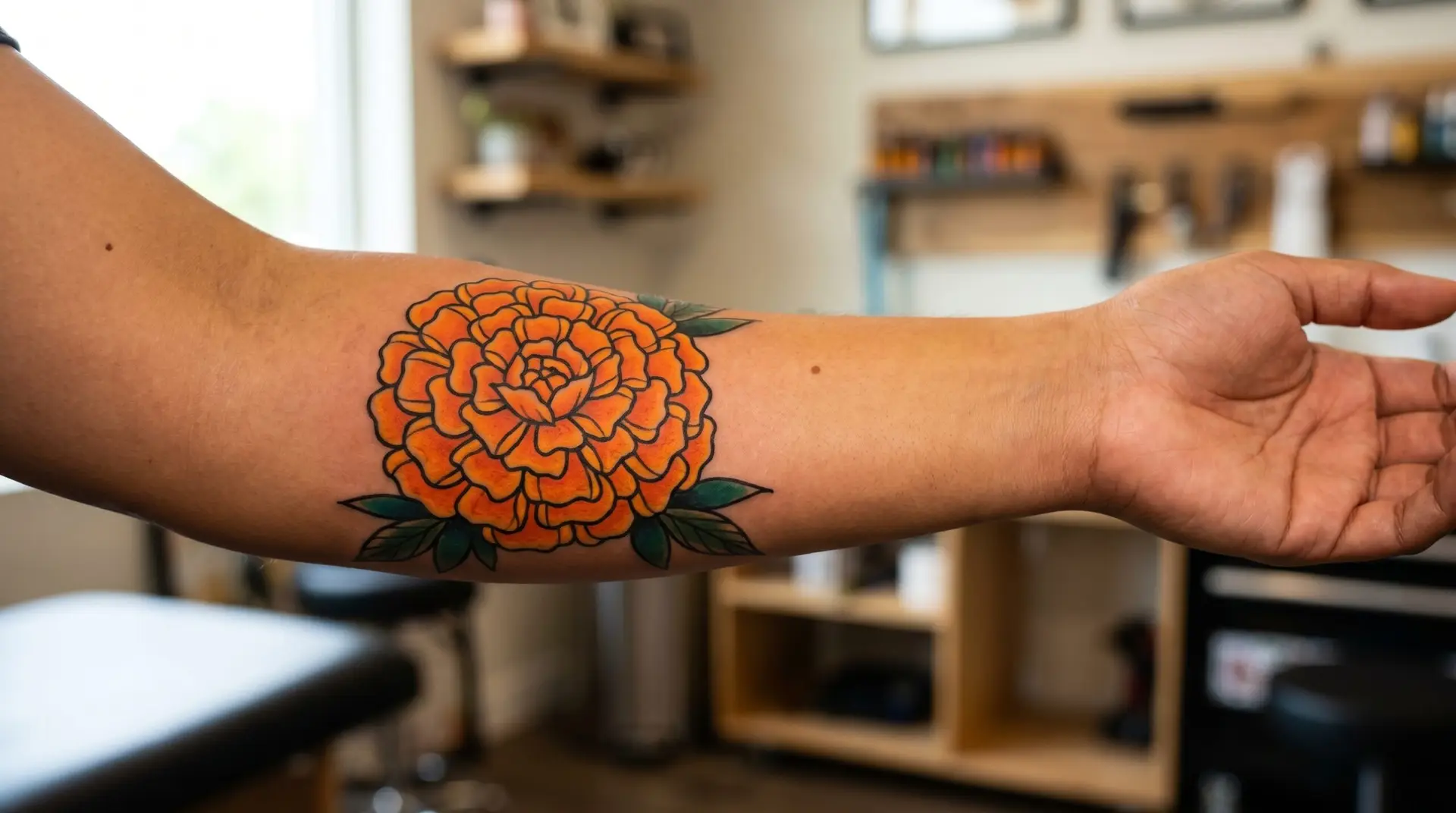
A marigold tattoo is a powerful choice for October-born readers, for Mexican-heritage and Latin American-heritage wearers, and for anyone drawn to flower tattoos with deep cultural symbolic weight through the Day of the Dead commemorative tradition. The flower’s dense layered pompom form, bright warm colors, and unmatched cultural heritage give the design distinctive visual impact and rich symbolic content. Marigold tattoos have grown substantially in popularity over the last decade alongside increased international recognition of Mexican Day of the Dead traditions through cultural events, films like Coco (2017), and broader recognition of Latin American cultural heritage.
The combination of dramatic warm color, dense flower form, and cultural symbolic depth makes marigold particularly well-suited to memorial tattoo contexts where the wearer wants to honor deceased loved ones through the cempasúchil (cempasúchil being the Aztec Nahuatl name for the Tagetes erecta marigold) Day of the Dead tradition. The flower’s prominent role in altar (ofrenda) decorations as the guide for returning spirits gives marigold tattoos particularly strong significance for memorial purposes alongside other Day of the Dead commemorative practices.
What a marigold tattoo means
Marigold tattoo meaning draws on several layered symbolic registers. The personal birth flower register applies for October-born wearers. The Mexican Day of the Dead cultural heritage register applies for Mexican-heritage and Latin American-heritage wearers, and for anyone drawn to the cempasúchil tradition for memorial purposes. The personal-meaning register applies for wearers who select marigold for individual reasons (commemoration of someone with warm protective presence, personal recognition of caring and devotional inclinations, or memorial honoring of a relationship that involved strong nurturing or protective dimension).
The Day of the Dead cultural heritage gives marigold tattoos their deepest symbolic anchor. The cempasúchil marigold is the central Day of the Dead commemorative flower and is associated with Indigenous Mexican commemorative tradition that predates the colonial era. The flower is believed to guide the spirits of the dead back to their families for the brief annual November 1-2 visit, with the bright orange color providing visible light and the strong distinctive scent providing olfactory guidance. A marigold tattoo therefore signals warmth (the solar association), creative passion (the bright vibrant color expression), and protective remembrance (the active honoring of deceased loved ones with practical commemorative significance).
The pre-colonial heritage extends the symbolic depth beyond the modern Day of the Dead synthesis with Catholic All Souls’ Day. Aztec religion included death deities such as Mictecacihuatl (goddess of the underworld) and Mictlantecuhtli (god of the dead), and the marigold’s commemorative role gives the flower a religious-historical depth that extends from contemporary Mexican-American Day of the Dead practice back through colonial-period syncretism to earlier Indigenous tradition.
Memorial marigold tattoos work particularly well for honoring deceased relatives, friends, or family pets where the wearer wants to invoke the Day of the Dead commemorative spirit. The marigold’s role as the bridge between living and deceased through bright color and strong scent gives the design particular significance for memorial purposes. Some wearers choose marigold tattoos specifically as personal ofrenda markers, treating the body as a permanent altar element honoring those who have died.
Modern non-memorial marigold tattoos also work well for wearers wanting warm protective imagery, autumn season aesthetic, or Mexican cultural reference without specific Day of the Dead commemorative content. The flower’s bright orange color and dense pompom form provide naturally elegant visual character at a wide range of tattoo scales from small fine-line designs to large bold botanical illustrations.
Design styles for marigold tattoos
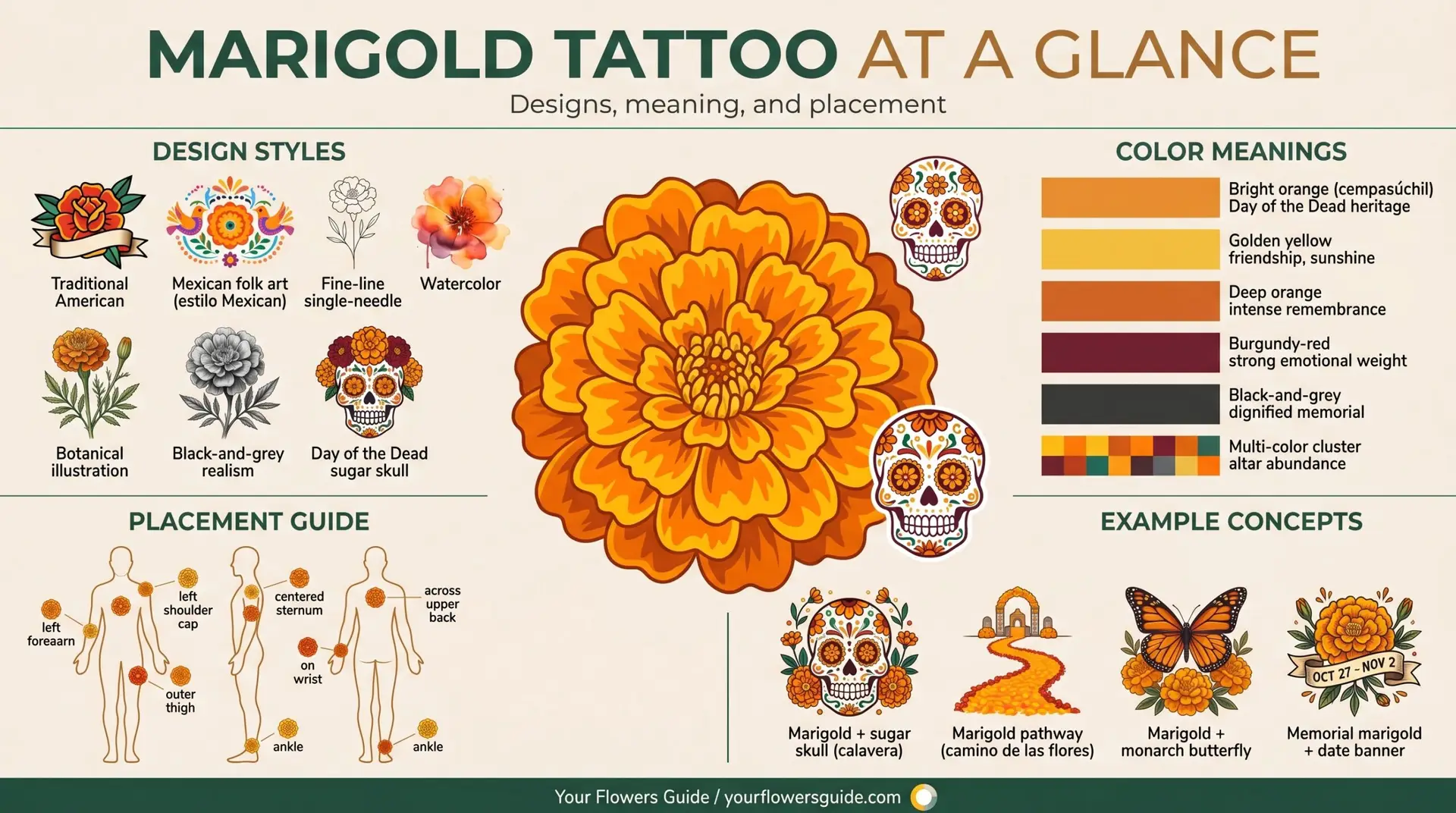
Several tattoo style traditions work well for marigold depending on the wearer’s aesthetic preferences and the symbolic register the design needs to express.
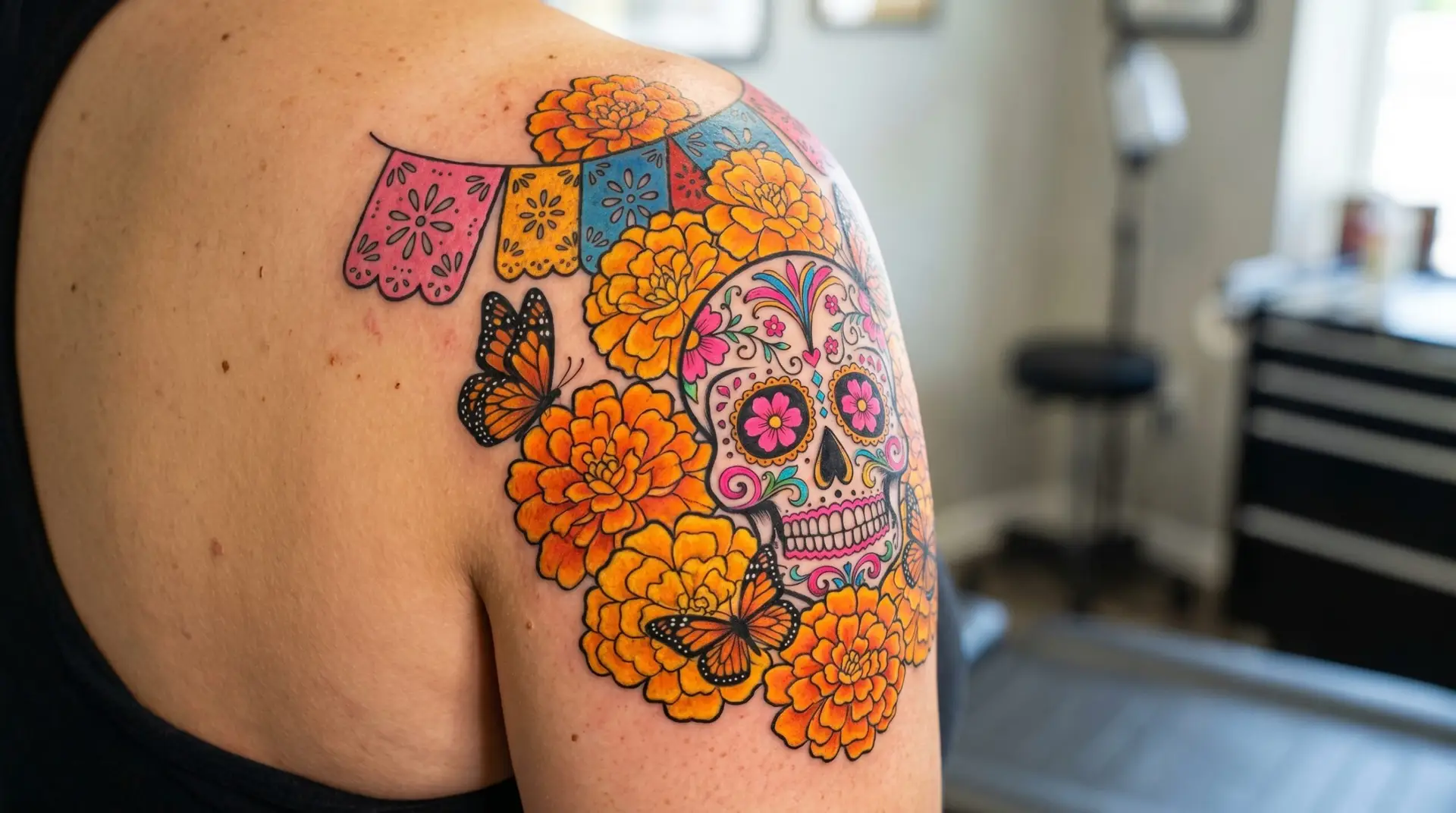
Traditional American (Sailor Jerry) and neo-traditional styles produce bold dramatic marigold tattoos with thick dark outlines, flat saturated orange color fill, and graphic stylization that prioritizes visual impact over botanical accuracy. The style ages well because of the heavy line work that maintains structural clarity even as decades of color fading occur. Traditional marigold tattoos often emphasize the Day of the Dead heritage through accompanying elements (sugar skulls, papel picado banners, Mexican folk art decorative elements).
Mexican folk art style (estilo Mexican) draws on the traditional decorative style of Mexican folk crafts to render marigold tattoos with characteristic flat color fields, decorative geometric patterns, and Day of the Dead cultural elements. The style suits wearers wanting explicit Mexican cultural identity expression alongside the marigold symbolism.
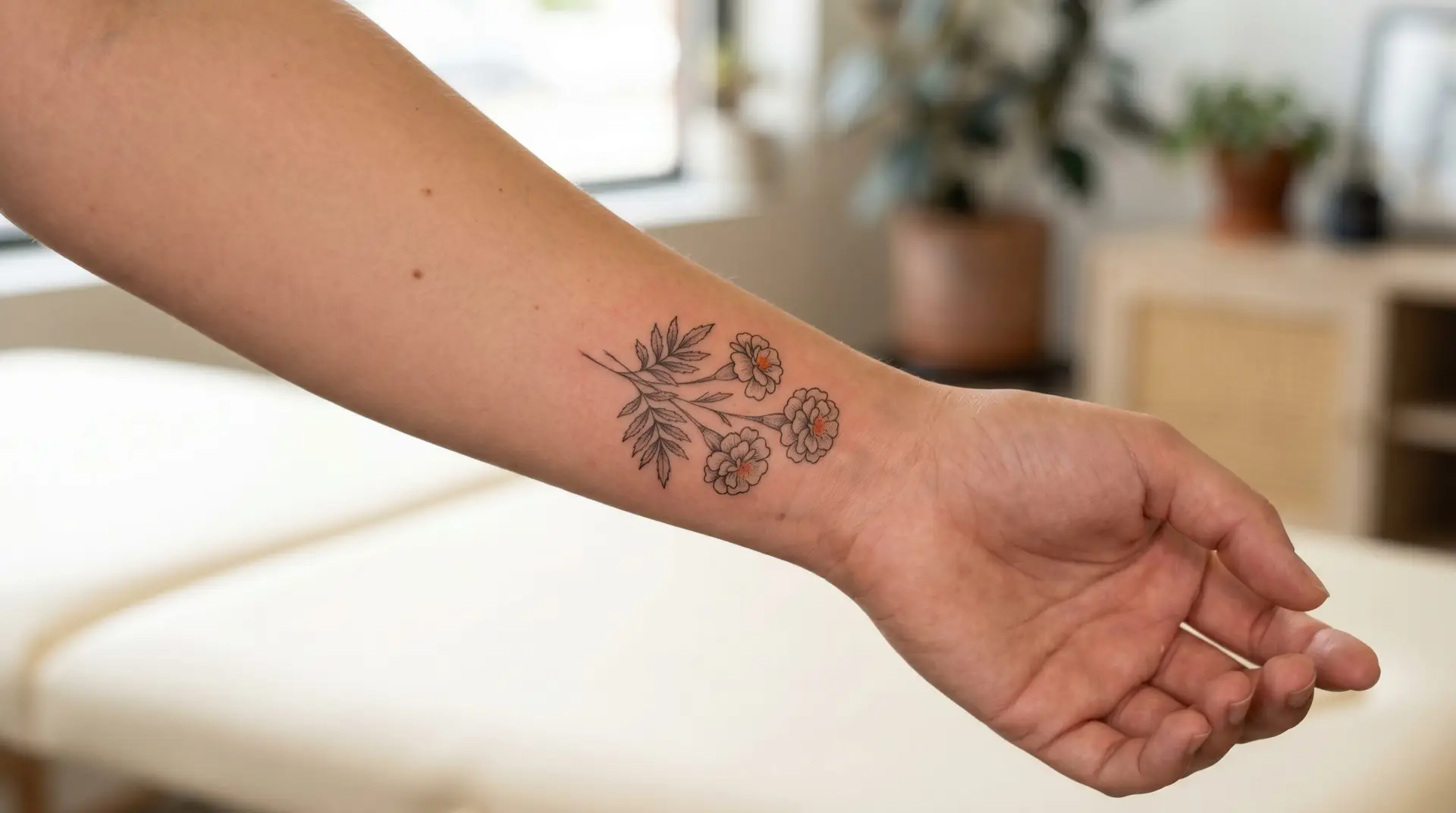
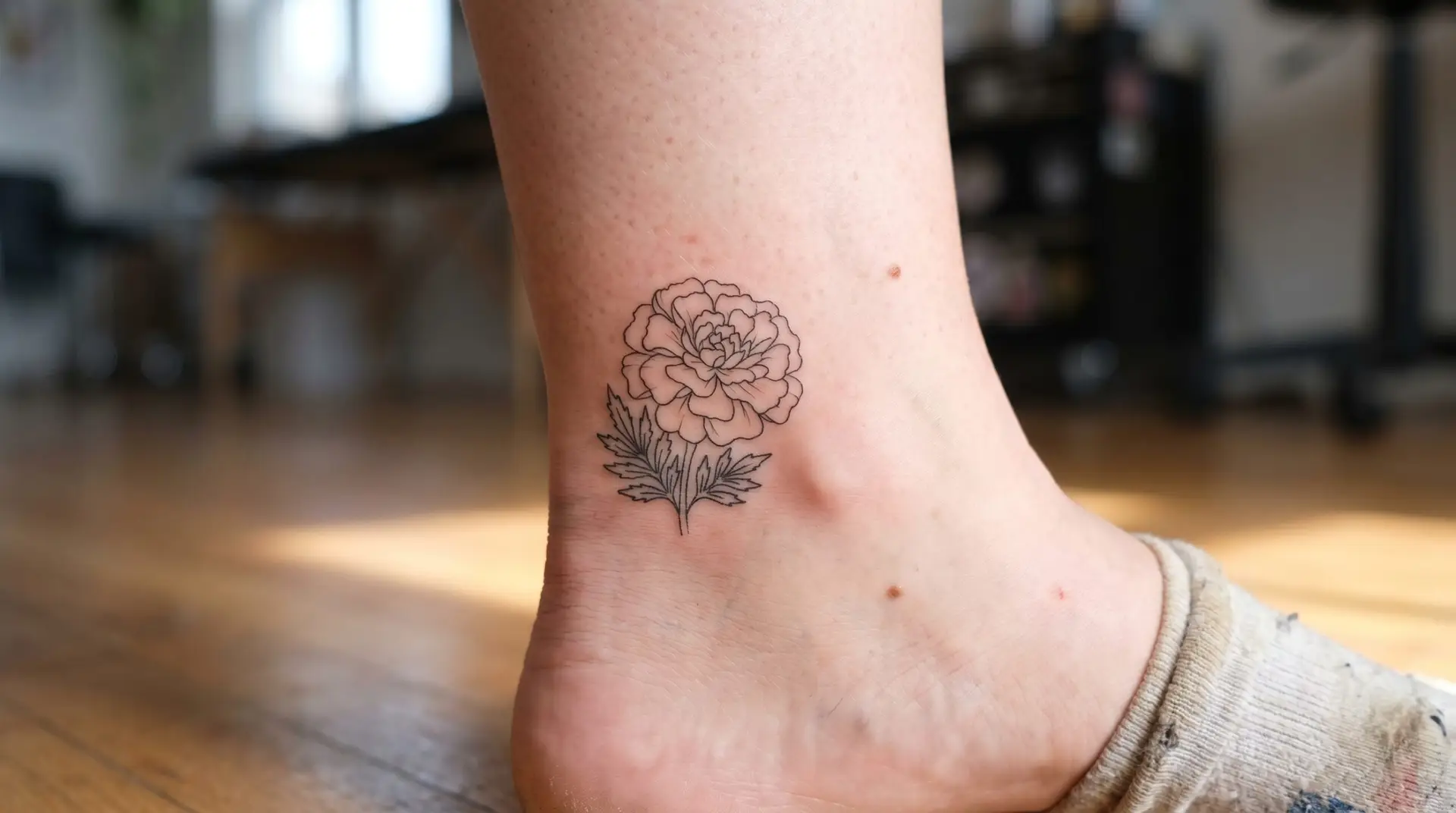
Fine-line single-needle style produces delicate marigold tattoos with very thin clean lines that capture the dense flower structure at small to medium scale (3 to 6 inches typical). Fine-line marigold tattoos require highly skilled tattoo artists because of the dense layered petal structure of the species. The style suits wearers who want subtle elegant marigold imagery rather than bold cultural statement work.
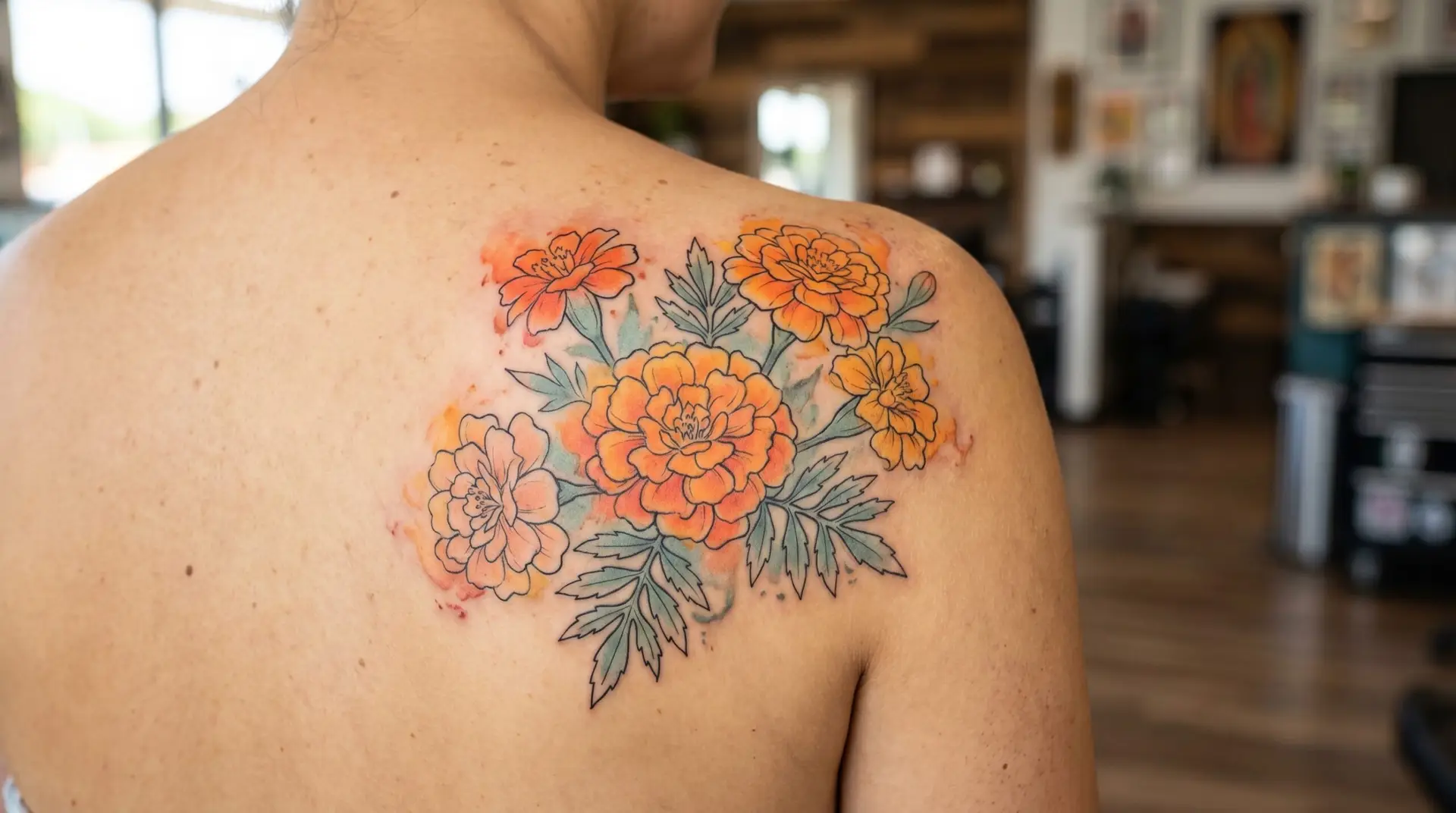
Watercolor marigold tattoos use the characteristic color-bleed technique to suggest watercolor painting applied to skin, creating soft dreamy color transitions around the central botanical outline. The style works particularly well for orange and yellow marigolds where the warm color blending matches the natural variation in the flower’s coloring. Watercolor tattoos require regular touch-up work as the soft edges fade more rapidly than hard-line work.
Botanical illustration style produces botanically accurate marigold tattoos with detailed line work showing the precise dense petal structure, foliage detail, and stem characteristics. The style suits wearers who value scientific accuracy and who want a tattoo that reads as botanical specimen illustration.
Black-and-grey realism produces highly detailed photo-realistic marigold tattoos in black ink with grey-scale shading. The style works particularly well for memorial designs where the absence of color gives the tattoo a dignified gravitas suitable for memorial purposes, though the loss of the iconic orange color does shift the symbolic register away from the Day of the Dead tradition.
Day of the Dead sugar skull style explicitly combines marigold imagery with the characteristic sugar skull (calavera) decorative form, creating tattoos that directly invoke the full Day of the Dead commemorative aesthetic. The style suits wearers wanting maximum Mexican cultural identity expression and explicit Day of the Dead memorial register.
Color choices and symbolism
Marigold tattoo color choice extends the broader marigold color symbolism into the personal meaning of the tattoo:
Bright orange marigold tattoo (cempasúchil orange): the most traditional and most iconic. Solar warmth, life energy, Day of the Dead commemorative register. The dominant choice for Mexican cultural heritage and memorial designs.
Bright golden yellow marigold tattoo: joy, friendship, sunshine. The yellow color provides slightly gentler register than the deeper orange while maintaining the warm solar associations.
Deep orange marigold tattoo: intense remembrance, sustained energy, passionate warmth. The deeper orange suits memorial contexts emphasizing depth of feeling.
Burgundy-red marigold tattoo: strong emotional weight, dramatic remembrance, gothic elegance. The darker color suits unconventional memorial contexts and wearers wanting deeper symbolic register.
Black-and-grey marigold tattoo: dignified memorial, classical elegance, refined gravitas. The grey-scale work suits serious memorial contexts where the wearer wants formal symbolic register without bright color.
Multi-color marigold cluster tattoo: layered symbolism, abundance, the visual of Day of the Dead altar decoration. Mixed-color marigold cluster tattoos use the natural color range to suggest the abundance of commemorative altar arrangement.
Color saturation choice matters significantly for tattoo longevity. The bright orange and yellow colors fade faster than darker colors and need touch-ups sooner to restore the original intensity. Black-and-grey designs maintain their visual integrity longest before requiring significant touch-up work.
Placement guide
Marigold tattoo placement choice depends on the design scale, the desired visibility, and the wearer’s aesthetic and professional considerations.
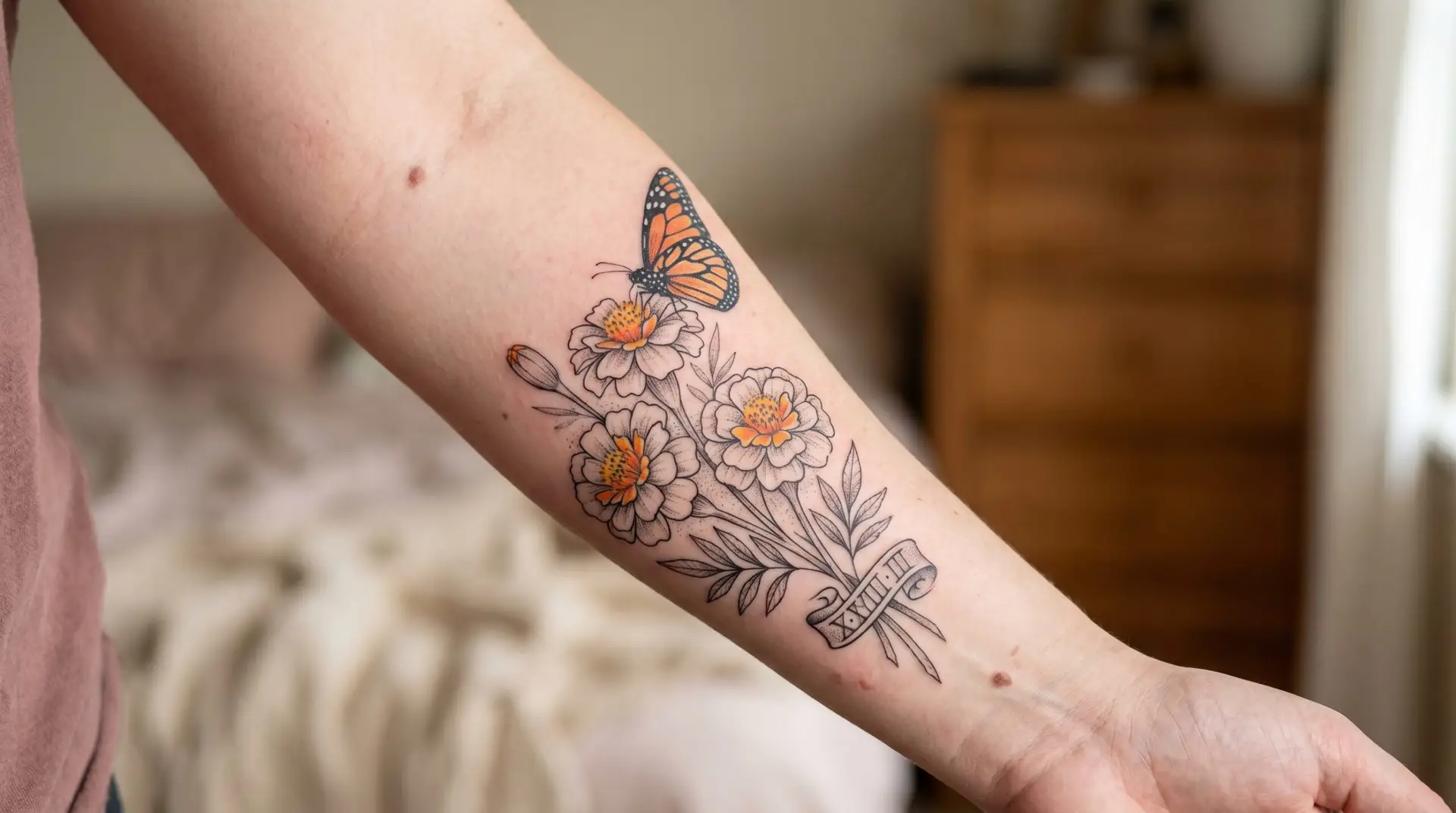
Forearm: the most popular marigold tattoo placement. The forearm provides comfortable canvas for both single-bloom designs (3 to 5 inches) and clustered multi-flower designs (5 to 9 inches). Inner forearm placement gives a more private feeling; outer forearm placement creates more visible cultural statement work.
Shoulder and upper arm: marigold cluster tattoos work well on the shoulder where the body provides ample canvas space for dense multi-flower designs. The placement allows medium to large scale (5 to 10 inches) and provides good visibility for cultural identity expression.
Sternum and ribs: larger marigold cluster designs with Day of the Dead elements work along the sternum or down the ribs for wearers wanting dramatic memorial statement work. The placement is more painful than forearm work because of proximity to bone, but the visual result can be striking for memorial designs.
Sleeve: full or partial sleeve marigold designs work for serious cultural identity expression, often combined with sugar skulls, papel picado, and other Day of the Dead decorative elements. Sleeves require substantial time and cost investment but provide the most dramatic Day of the Dead heritage expression.
Thigh and hip: medium to large marigold designs (6 to 12 inches) work well on the thigh where the body provides ample canvas space. Thigh placement allows the wearer to control visibility (typically covered by clothing) while having a substantial detailed tattoo.
Wrist and ankle: small delicate single-bloom marigold tattoos (2 to 4 inches) work for wrist and ankle placement. These small placements suit wearers who want marigold birth flower symbolism without bold cultural statement work.
Back: large marigold cluster designs or full Day of the Dead memorial scenes work on the back where the body provides the largest possible canvas. Back placements allow 10 to 20 inches of detailed work for serious memorial designs.
Neck and behind ear: very small minimalist marigold tattoos work for neck and behind-ear placements. The placement is unconventional and reads as personal aesthetic choice or subtle cultural identity rather than as explicit cultural statement.
Example design concepts
Several design concepts demonstrate effective ways to combine marigold imagery with other symbolic elements:
Marigold with sugar skull (calavera). A marigold cluster rendered alongside a decorated sugar skull (calavera) directly invokes the full Day of the Dead commemorative aesthetic. The combination provides maximum cultural identity expression and clear memorial register. Common for Mexican-heritage memorial tattoos.
Marigold with date or name. A marigold tattoo with a small date (memorial date) or name provides specific personal commemorative content alongside the symbolic floral imagery. Common for personal memorial designs honoring specific deceased loved ones.
Marigold pathway (camino de las flores). A design showing a pathway of marigold petals leading from one point to another invokes the traditional Day of the Dead altar pathway that guides returning spirits from cemetery to household altar. Effective for memorial tattoos honoring relationships with deceased relatives.
Marigold with papel picado. A marigold cluster combined with stylized papel picado (Mexican decorative cut-paper banner) provides explicit Day of the Dead cultural reference alongside the floral subject. Common for cultural identity tattoos celebrating Mexican-American heritage.
Marigold and cosmos pairing. October-born wearers sometimes choose to combine marigold and cosmos (both October birth flowers) in a single design. The combination provides both birth flower references and visual contrast between the dense pompom marigold and the airy daisy-like cosmos.
Marigold with monarch butterfly. A marigold tattoo with a small monarch butterfly invokes the broader Mexican cultural symbolism (monarch butterflies migrate to Mexico for winter, and the butterfly’s arrival in Mexican forests during late October and early November aligns with the Day of the Dead season, with some traditions interpreting the butterflies as returning spirits of the dead). The combination layers Mexican cultural symbolism through both flower and butterfly imagery.
Marigold with opal color accent. A marigold tattoo with small iridescent color accents suggesting opal (the October birthstone) provides the complete October birth flower and birthstone reference in a single design.
Memorial marigold with portrait. A marigold cluster framing a small portrait of a deceased loved one provides explicit memorial commemorative content with the marigold as the symbolic frame. The style requires highly skilled tattoo artists for the portrait work and produces deeply personal memorial designs.
Minimalist single marigold on wrist. A small fine-line drawing of a single marigold bloom on the wrist provides elegant subtle marigold reference at minimal scale. Suits wearers who want birth flower symbolism without bold cultural statement work.
Full Day of the Dead memorial sleeve. A full sleeve combining marigolds, sugar skulls, papel picado, portrait elements, and other Day of the Dead decorative elements provides comprehensive Day of the Dead heritage expression. The style requires substantial time and cost investment but produces deeply meaningful Mexican cultural identity tattoos.
Aftercare and longevity
Standard tattoo aftercare applies to marigold tattoos: keep the area clean with gentle unscented soap, apply a thin layer of recommended healing ointment for the first week, avoid direct sun exposure during the initial healing period (2 to 4 weeks), and avoid swimming or full water submersion until fully healed.
Marigold tattoo longevity depends primarily on the line work quality, the color saturation, and the wearer’s skin and lifestyle factors. The bright orange and yellow colors characteristic of marigold tattoos fade faster than darker inks and generally need touch-ups sooner than bold blackwork, which holds its structural clarity longest. Plan for periodic color touch-ups to keep the original intensity.
Sun exposure is the primary cause of tattoo color fading and particularly affects bright orange and yellow marigold designs. Wearers should apply high-SPF sunscreen (SPF 50+) to the marigold tattoo area whenever the tattoo will be exposed to direct sun, particularly during peak summer months. Long-term consistent sun protection significantly extends the visual longevity of orange marigold tattoos.
Skin changes over time affect marigold tattoo appearance. Tattoos on areas of skin that stretch significantly (abdomen, hip, thigh, breast) can distort over time. Wearers planning significant body changes should discuss placement with their tattoo artist to choose locations that will hold the design well over decades.
Frequently asked
What does a marigold tattoo mean?
Warmth, creative passion, and protective remembrance. The symbolism draws on the Day of the Dead commemorative tradition (the marigold as bridge between living and deceased through bright color and strong scent guiding spirits home) and the broader solar warmth associations. For Mexican-heritage wearers, the marigold tattoo also expresses cultural identity through the cempasúchil tradition.
Why is marigold important in Mexican Day of the Dead tradition?
Cempasúchil (the Nahuatl name for Tagetes erecta marigold) is the central Day of the Dead commemorative flower and is associated with Indigenous Mexican commemorative tradition that predates the colonial era. The bright orange and yellow colors provide spiritual warmth and visible light to guide returning spirits. The strong distinctive marigold scent is believed to help guide the deceased home.
Where is the best place for a marigold tattoo?
The forearm is the most popular placement. Shoulder, sternum, and rib placements work well for larger cluster designs. Sleeves and back placements work for serious cultural identity expression with multiple Day of the Dead elements. Wrist and ankle placements work for small delicate designs.
Can I get a marigold tattoo without being Mexican?
Yes, marigold tattoos can be appropriate for non-Mexican wearers in several contexts: October birth flower marker, personal memorial commemoration not invoking specific Mexican cultural elements, general autumn season aesthetic. Wearers should be thoughtful about combining marigolds with explicitly Mexican cultural elements (sugar skulls, papel picado, Day of the Dead-specific symbolism) if not of Mexican heritage, as cultural appropriation concerns may apply. Simple botanical marigold designs without Mexican-specific cultural elements are generally appropriate for any wearer.
How long does a marigold tattoo take?
Session time varies widely by size, detail, style, and artist pace. Small fine-line work is usually completed in a single session, while large detailed pieces and full Day of the Dead sleeve work require multiple sessions, sometimes spread over many months. Your artist can give a realistic time estimate during the design consultation.
Is a marigold tattoo good for women?
Marigold tattoos work well for any wearer regardless of gender. The warm orange color, dense pompom flower form, and cultural symbolic register suit a wide range of aesthetic preferences. Both delicate fine-line and bold traditional styles work effectively.
Can I combine marigold with other flowers?
Yes. Common combinations include marigold with cosmos (both October birth flowers), marigold with sunflowers (matching warm color palette), marigold with chrysanthemums (autumn season match), marigold with monarch butterflies (Mexican cultural pairing), and marigold with sugar skulls (Day of the Dead pairing). The combinations layer additional meaning onto the central marigold symbolism.
How much does a marigold tattoo cost?
Cost varies widely by artist skill level, geographic region, design complexity, and tattoo size. Larger and more detailed work, including full Day of the Dead sleeve work, costs more and may span multiple sessions. Ask your chosen artist for a quote based on your specific design.
Does a marigold tattoo hurt?
Pain level depends on placement. Forearm, upper arm, and outer thigh are typically among the less painful. Spine, sternum, rib cage, ankle, and behind-ear placements are typically among the more painful because of proximity to bone or thin skin areas.
Sources
- Marigold (Tagetes) · Encyclopedia Britannica
About this article. > Written and reviewed by the Your Flowers Guide editorial team. Botanical content from Britannica. Tattoo aftercare references from American Academy of Dermatology Association. Aztec religion and culture background via Bernardino de Sahagún’s Florentine Codex. Day of the Dead cultural references cross-verified with UNESCO Masterpiece recognition documentation (2003).