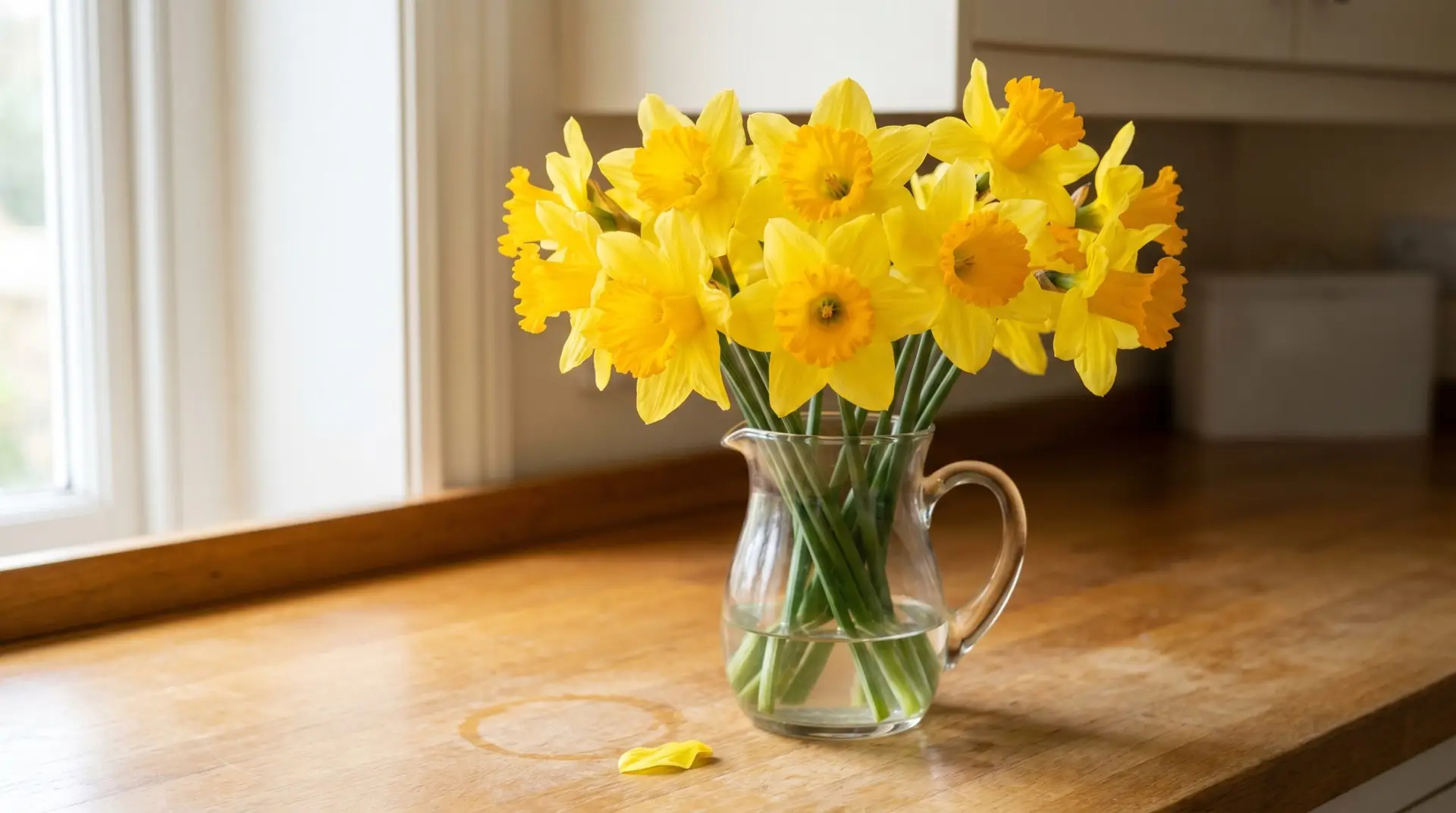
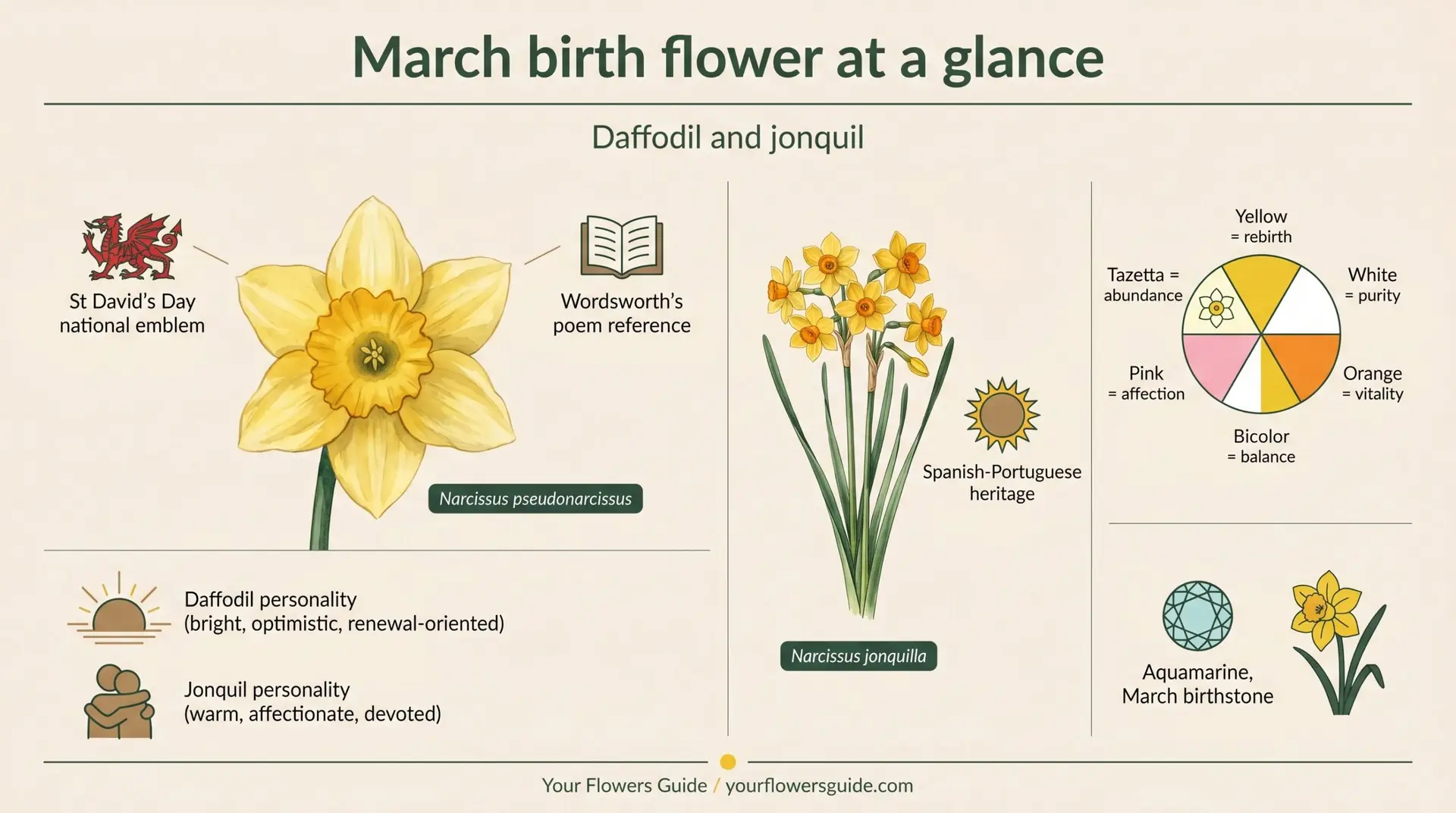
March has two birth flowers in Western tradition: daffodil (Narcissus, primarily N. pseudonarcissus and N. poeticus) as the primary, and jonquil (Narcissus jonquilla) as the secondary. Daffodil stands for rebirth, new beginnings, and hope. Jonquil stands for affection returned, sympathy, and desire.
Both flowers belong to the genus Narcissus and bloom in March across temperate Europe and North America. Daffodil has the broader cultural reach of the two and connects March to several distinctive cultural traditions: the Welsh St David’s Day on March 1 (where daffodils are worn as the Welsh national emblem), Wordsworth’s poem “I Wandered Lonely as a Cloud” (the most-quoted nature poem in the English language), and the Greek myth of Narcissus (which gives the genus its botanical name). The Royal Horticultural Society maintains the official International Daffodil Register, which lists over 27,000 registered cultivars, making daffodil one of the most extensively bred flowering plants in horticultural history. Jonquil has a more regional cultural history rooted in Spain, Portugal, and southern France, with its fragrant character setting it apart from the broader daffodil family.
In this guide 8 sections
Daffodil, the main March birth flower
Daffodil belongs to the genus Narcissus in the family Amaryllidaceae. The genus contains about 50 to 60 species (with botanical consensus varying slightly between sources) and several thousand named cultivars. The Royal Horticultural Society International Daffodil Register lists over 27,000 named cultivars, reflecting more than two centuries of intensive breeding for color, form, fragrance, and garden performance.
The plant grows from an underground bulb, with long strap-like leaves emerging in late winter alongside the flower stalk. The flower stalk bears one to several flowers per stem depending on species and cultivar; large-cup garden cultivars typically have one flower per stem, while tazetta types (like Narcissus tazetta and N. papyraceus) have clusters of multiple small flowers per stem.
The classic daffodil flower anatomy includes six outer petal-like structures called tepals (botanically not true petals; they include the three sepals fused with three petals), a central trumpet or cup called the corona, and the reproductive structures (stamens and pistil) inside the corona. The corona shape varies enormously across cultivars, from the deep narrow trumpet of Narcissus pseudonarcissus to the flat shallow cup of the Poeticus narcissus.
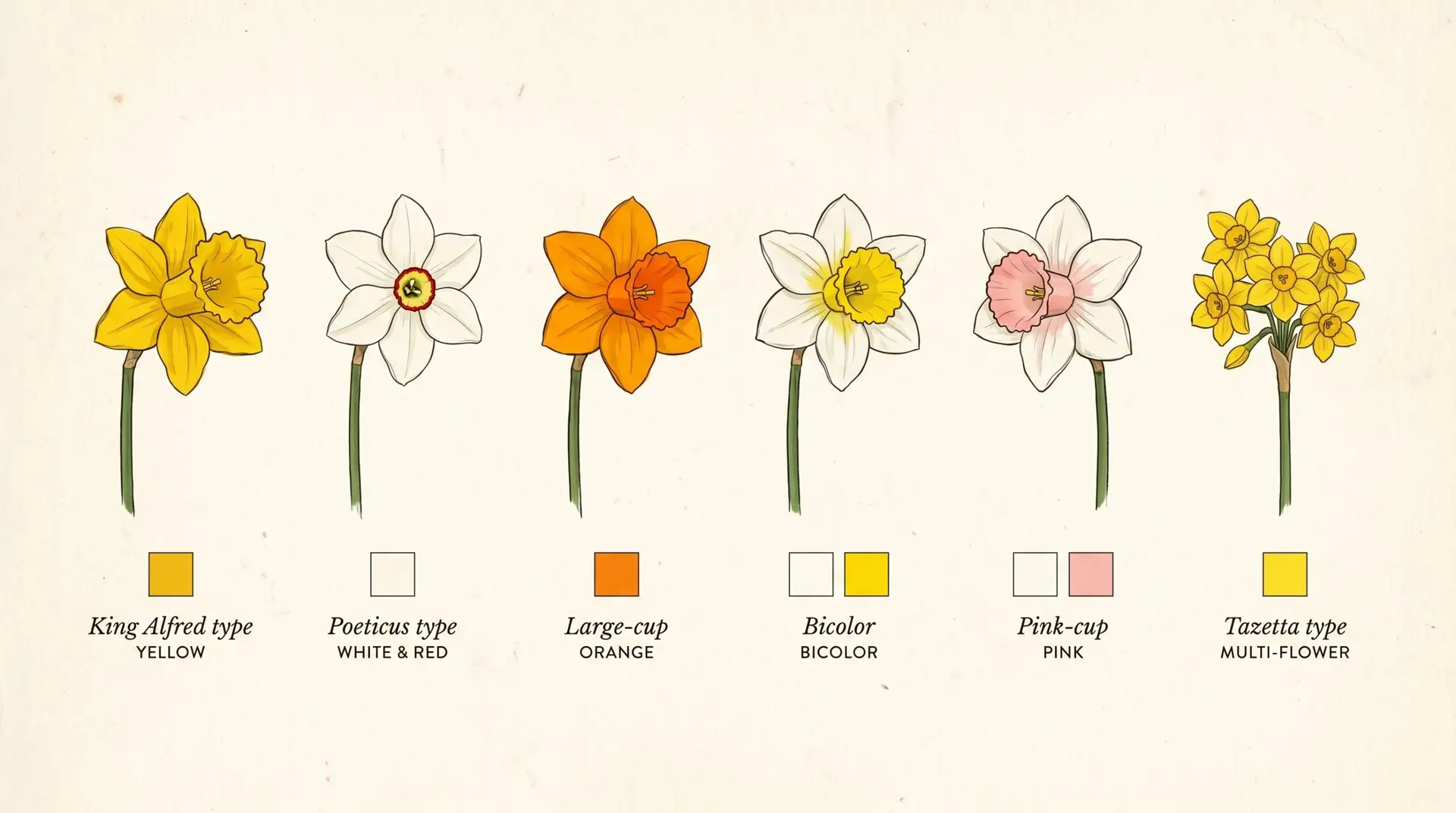
Color range across the genus and its cultivars includes yellow (the most iconic and dominant color), white (Poeticus and white tazetta types), orange (some large-cup cultivars), bicolor (white tepals with yellow or orange corona, the most popular modern garden form), pink (a twentieth-century breeding achievement), peach, and even green-edge varieties. The yellow form predominates in wild populations and remains the dominant color in commercial cut-flower production.
Daffodils are native to meadows, woodlands, and rocky hillsides of Europe, North Africa, and western Asia. The most familiar wild species in British and Western European contexts is Narcissus pseudonarcissus, the “Lent lily” or “wild daffodil,” which gives the genus its common English name. The plants naturalize readily in suitable climates and form spreading colonies that persist for decades; some daffodil colonies in old English country estates have continued blooming in the same spots for over two hundred years.
Daffodil bloom timing runs from late February through May depending on cultivar and climate. Early cultivars bloom in February in mild climates; mid-season cultivars bloom in March (which makes daffodil the natural March birth flower in temperate northern hemisphere climates); late cultivars bloom in April and May, with the Poeticus narcissus closing the daffodil season in many gardens.
Jonquil, the secondary March birth flower
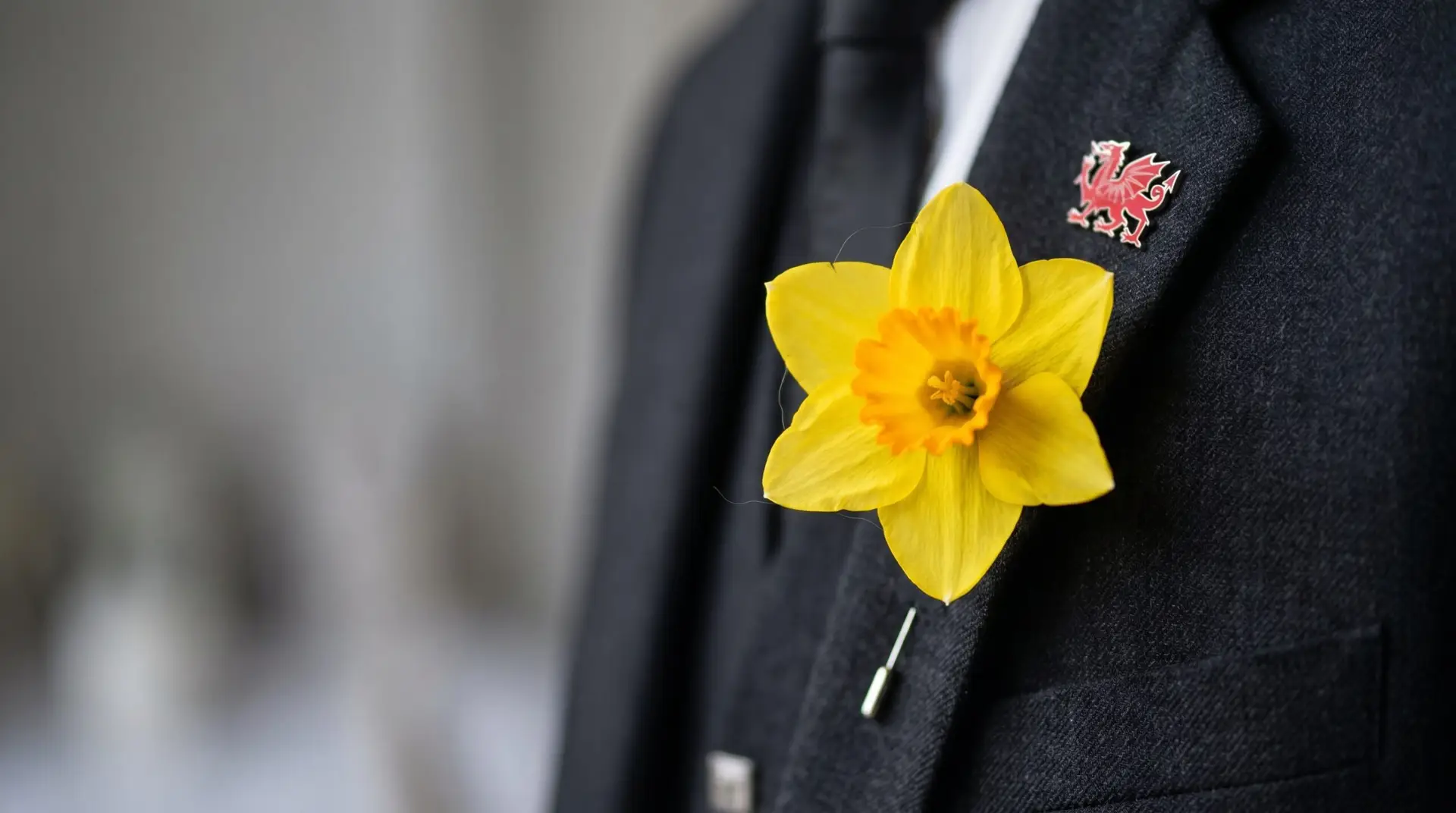
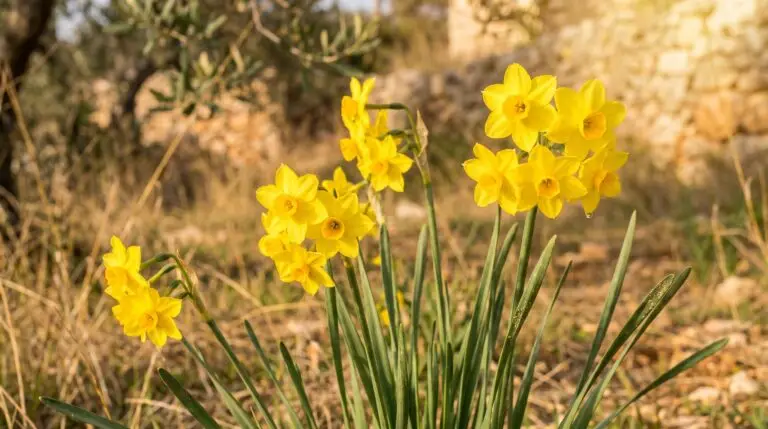
Jonquil refers specifically to Narcissus jonquilla, a Mediterranean species within the broader Narcissus genus. The species is native to Spain, Portugal, and southern France, and it has been cultivated since at least the sixteenth century for its distinctive fragrance.
Jonquil differs from common daffodil (N. pseudonarcissus) in several visible ways. Each jonquil stem typically bears 4 to 7 small flowers in a cluster rather than the single large flower per stem of garden daffodil. The flowers are smaller (about 1 to 1.5 inches across versus the 3-inch flowers of large garden daffodils). The leaves are narrow and rush-like rather than the broad strap-like leaves of common daffodil, which is why the Spanish common name “junquillo” (from junco, meaning rush) was adopted into English as “jonquil.” The fragrance is unusually intense for the Narcissus genus, with a sweet rich quality that has supported continued commercial perfumery use.
Jonquil bloom timing runs from March through April in most temperate climates. The flowers are predominantly yellow, with some white and bicolor cultivars available in modern garden trade.
The full Narcissus jonquilla botany, the historical cultivation in Spain and Portugal, the perfumery uses, and the careful distinction between true jonquil and other small-flowered Narcissus species are covered in the jonquil deep dive article.
Welsh St David’s Day and the daffodil emblem
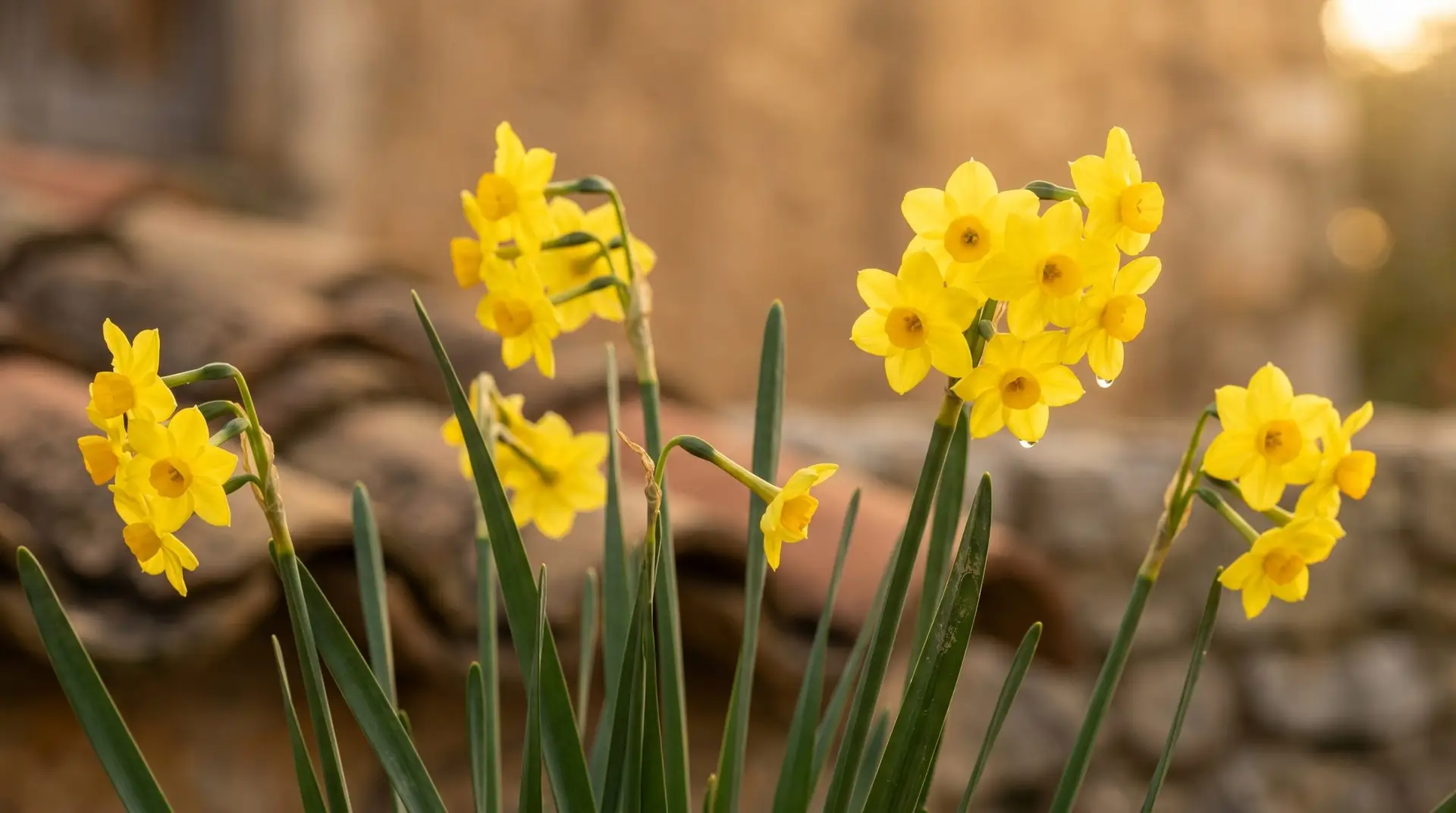
March 1 is St David’s Day, the feast day of Wales’s patron saint Dewi Sant (St David). The daffodil is one of two national symbols of Wales (alongside the leek), and Welsh people traditionally wear a daffodil on St David’s Day in schools, parades, rugby matches, and civic events. This connection makes daffodil the only major Western birth flower that doubles as a national civic symbol with a specific calendar date.
The Welsh language preserves the close linguistic connection between daffodil and leek. The Welsh word for leek is “cenhinen,” and the Welsh word for daffodil is “cenhinen Bedr” (literally “Peter’s leek”). The shared root reflects the visual similarity of the two plants when not in flower; the bulbous base and strap-like leaves resemble each other. The leek was the older Welsh national symbol, traditionally associated with a sixth-century battle in which Welsh soldiers wore leeks in their hats to distinguish themselves from Anglo-Saxon enemies. The daffodil rose as a competing or complementary symbol in the nineteenth and early twentieth centuries.
David Lloyd George, the Welsh-born British Prime Minister from 1916 to 1922, popularized the daffodil over the leek in state ceremonies during his political career. He wore daffodils at state functions in the early twentieth century and encouraged the daffodil as a more dignified Welsh symbol than the leek. The Welsh nationalist movement formally adopted the daffodil as a national emblem in 1907, and the symbol gained continuing institutional support through the twentieth century. The modern Welsh Rugby Football Union uses the daffodil in its branding alongside the Prince of Wales feathers and the Welsh dragon.
St David himself, born about 500 AD and died about 589 AD, was a Welsh bishop and the founder of monasteries throughout Wales. His final words, traditionally recorded as “Be joyful, keep the faith, do the little things” (in Welsh: “Byddwch lawen, cadwch eich ffydd, a gwnewch y pethau bychain”), continue to function as a Welsh national motto. His tomb is in St Davids Cathedral, Pembrokeshire, which remains an active pilgrimage site. The cathedral itself dates from the twelfth century and was built on the site of David’s sixth-century monastic foundation.
The daffodil fits Welsh symbolism on multiple levels. The flower’s late winter and early spring bloom aligns with Welsh seasonal calendars and the timing of St David’s Day on March 1. The yellow color matches the gold of the Welsh dragon on the national flag. The plant’s tendency to spread and naturalize in suitable conditions provides a botanical metaphor for cultural continuity. The March 1 timing creates a natural national-day-flower pairing that has no equivalent in other major Western birth flower traditions.
This level of national-political-religious-cultural integration is unique among Western birth flowers. The daffodil functions not just as a symbolic flower for a month but as a living national emblem for an entire country.
Wordsworth’s “Daffodils” poem
William Wordsworth’s “I Wandered Lonely as a Cloud,” commonly called “Daffodils,” is the most-quoted nature poem in the English language. The poem was composed in 1804, first published in 1807 in Wordsworth’s collection Poems in Two Volumes, and revised for republication in 1815. The revised 1815 version is the form most commonly encountered in modern anthologies and school curricula.
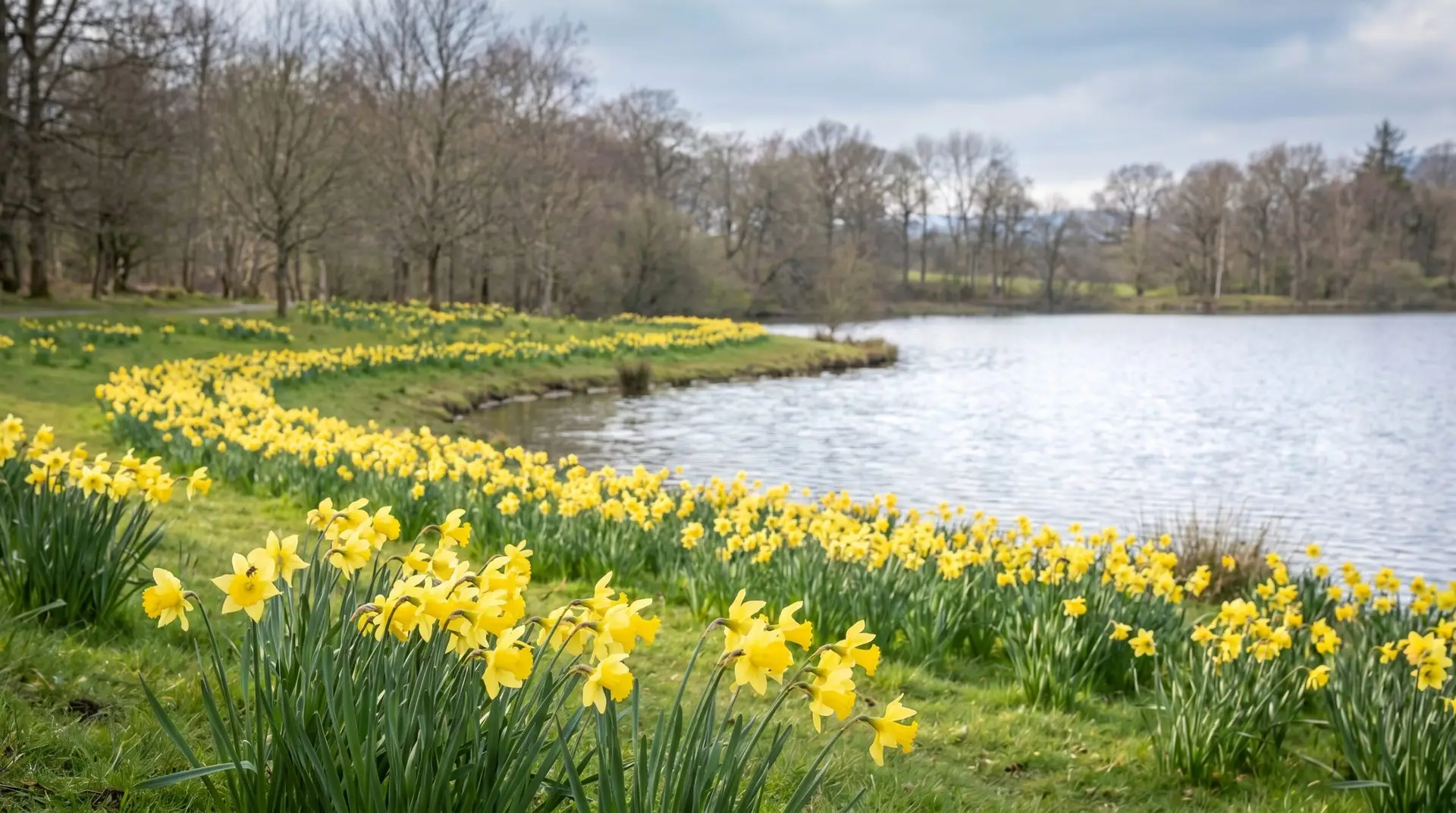
The poem describes a moment Wordsworth experienced near Ullswater in the English Lake District in April 1802. He and his sister Dorothy Wordsworth walked beside the lake on April 15, 1802, and encountered a long stretch of wild daffodils blooming along the shore. Dorothy’s journal entry from the same day records the encounter in detailed prose; her observation that the daffodils “tossed and reeled and danced” later contributed directly to Wordsworth’s poetic image of the flowers as a dancing crowd.
The poem’s central images, “host of golden daffodils” and “they flash upon that inward eye / Which is the bliss of solitude,” remain among the most familiar lines in English nature poetry. The poem appears in standard British school curricula and has been translated into dozens of languages. The Wordsworth Trust at Dove Cottage in Grasmere, where Wordsworth lived from 1799 to 1808 and where the poem was likely composed, holds the manuscript among its primary collections and continues to function as a literary pilgrimage site.
The Lake District daffodils that Wordsworth saw were Narcissus pseudonarcissus, the wild Lent lily, in their natural English habitat. The species still grows in colonies throughout the Lake District, and the Ullswater stretch where the original encounter occurred is now a National Trust site with seasonal daffodil walks each spring. Modern visitors in early April can see the same kind of scene that Wordsworth described, with wild daffodils flowering along the lake shore in dense naturalized populations.
The Wordsworth connection adds a distinctive literary register to daffodil symbolism for English-speaking readers. A March birthday gift of daffodils for an English-speaking recipient often draws on this layer implicitly, even if the giver and receiver do not name the poem directly.
What daffodil colors mean
Daffodil color shifts the symbolic reading within the broader theme of rebirth and new beginnings. Standard Western readings include:
- Yellow daffodil: the most iconic color. Rebirth, joy, sunshine, and the arrival of spring. The default reading for daffodil as a gift flower.
- White daffodil: purity, respect, and contemplative joy. The Poeticus narcissus (white tepals with small red-edged cup) has this reading most strongly.
- Orange daffodil: vitality, warmth, and bold optimism. Large-cup orange cultivars (like ‘Fortissimo’ and ‘Ambergate’) have this reading.
- Bicolor daffodil (white with yellow or orange corona): balanced renewal, the meeting of purity and energy. The dominant modern garden form.
- Pink daffodil: affection, gentle joy, and feminine renewal. A twentieth-century breeding achievement; the pink color appears in the corona rather than the tepals.
- Multi-cluster daffodil (tazetta, paperwhite): abundance, friendship, and shared joy. The cluster form has community symbolism that single-flower forms do not.
Florist usage treats daffodil as the spring-rebirth flower for any occasion that calls for hope, new beginnings, or seasonal joy. Daffodils work well for birthday bouquets, get-well arrangements, congratulations on new ventures, and Easter-season gifts. The flower works less well for romantic anniversaries or memorial occasions, where the rebirth symbolism reads slightly mismatched to the intended message.
March personalities by flower symbolism
Reading personality from a birth flower is closer to a horoscope than to psychology. Take it as a useful lens, not as evidence. The two March flowers offer complementary readings that many March-born readers find recognizable.
The daffodil side of March reads as bright optimistic energy: the willingness to begin again, the capacity for renewal after setbacks, and a natural sunny disposition that draws others to the daffodil-personality person. Daffodil-profile people are the friends who suggest new projects, the family members who maintain holiday traditions across generations, and the colleagues who can find the silver lining in difficult circumstances.
The jonquil side reads as warm affectionate devotion: the desire to give and receive affection, the willingness to extend sympathy in difficult times, and a quietly persistent attention to relationships. Jonquil-profile people are the partners who remember small anniversaries, the friends who check in after difficult news, and the family members who maintain the network of family connections through phone calls and small gestures.
The combination describes a March personality that pairs sunny optimism with warm relational attention. March-born readers who describe themselves as both naturally hopeful and deeply attentive to relationships will recognize the fit.
Gift ideas for March birthdays
March birthdays fall in peak daffodil season across most of the northern hemisphere, which makes daffodils a particularly accessible and seasonal gift. Cut daffodils are widely available in supermarkets, florists, and farmers’ markets during March and the surrounding weeks.
A simple bouquet of yellow daffodils is the classic March birthday flower. Pairing daffodils with tulips, hyacinths, or freesia creates a fuller spring bouquet without losing the daffodil-forward character. Daffodil-only bouquets work well in clear glass vases that show the green stems through the water.
Daffodil bulbs as a gift for autumn planting are an alternative that gives a long-lasting return. Bulb specialists offer mixed daffodil collections in fall ranging from about fifteen dollars for a basic mix to over a hundred dollars for premium named cultivars. The recipient plants the bulbs in October or November and enjoys the bloom the following March, which makes the gift function as an annual reminder of the birthday connection.
Potted daffodils (“forced” daffodils brought into bloom indoors) are another March option. Garden centers stock potted daffodils from January through March, and the plants bloom indoors for two to three weeks before declining. After the bloom period, the pots can be planted outdoors to naturalize for the following year.
For literary recipients, a small leather-bound copy of Wordsworth’s poems paired with a daffodil bouquet draws on the cultural connection between March, daffodil, and English nature poetry. Used and antique bookshops often carry nineteenth-century Wordsworth editions at price points from twenty to two hundred dollars depending on the binding and printing condition.
For Welsh recipients or readers with Welsh family connections, a small leek-and-daffodil themed gift drawing on St David’s Day tradition adds a cultural layer that no other March flower can provide. Welsh specialty shops and online retailers offer leek-and-daffodil enamel pins, tea towels, and small jewelry pieces with the dual national symbols.
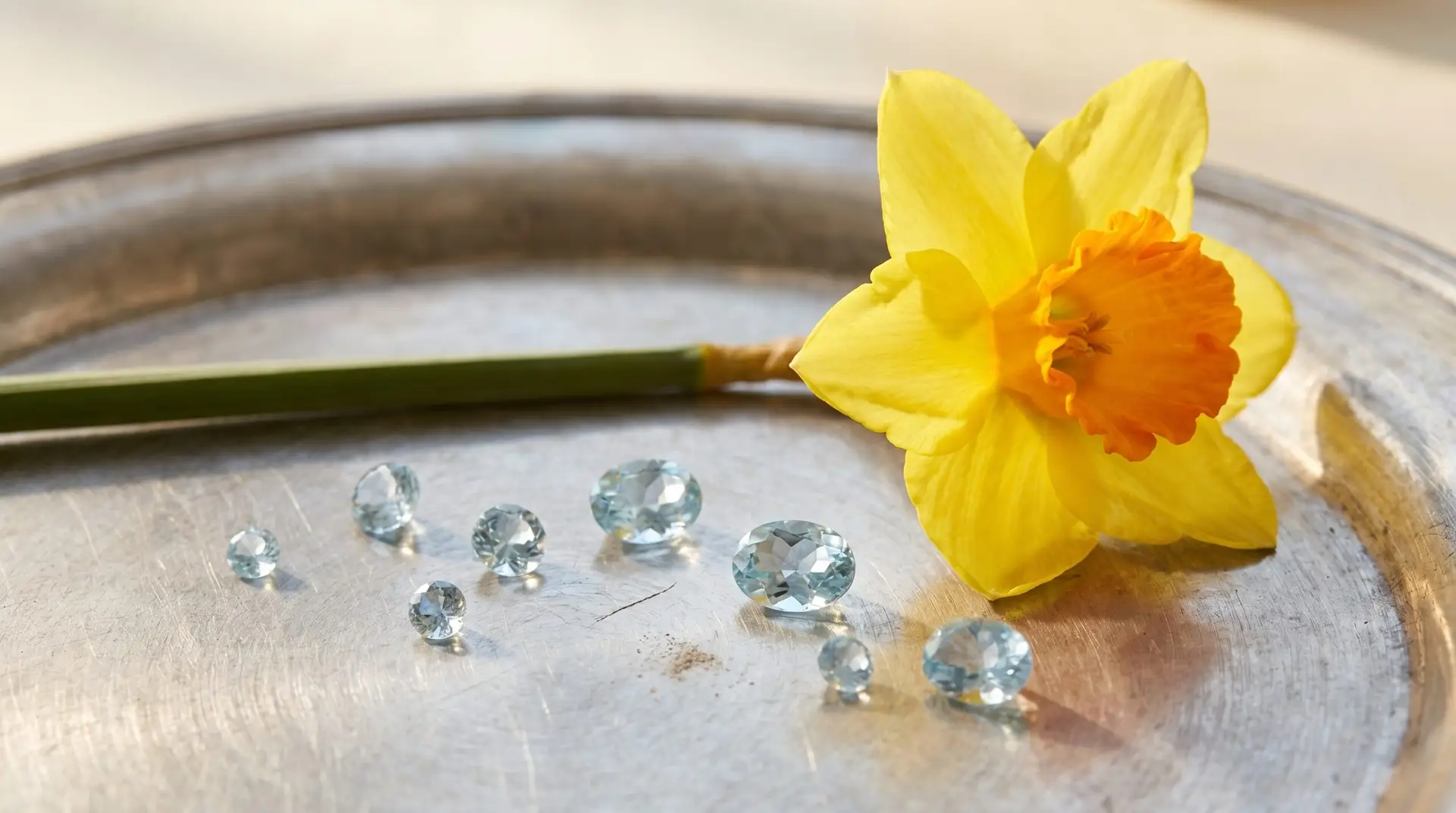
A jewelry piece combining daffodil motif work with aquamarine (the March birthstone) draws on both the birth flower and the birthstone in a single design. Aquamarine’s pale blue does not naturally harmonize with daffodil yellow, but contrasting-color pairings work well in modern jewelry design.
At a glance
Questions
Frequently asked
What is March’s birth flower?
Daffodil as the primary and jonquil as the secondary. Daffodil is Narcissus pseudonarcissus or related Narcissus species, a bulb-grown perennial with the distinctive trumpet-shaped corona. Jonquil is Narcissus jonquilla, a Mediterranean Narcissus species with multiple small fragrant flowers per stem.
Why is daffodil March’s birth flower?
Daffodil blooms in March across most of the temperate northern hemisphere, making it the most visible and culturally significant flower in March gardens. The species also has the strongest national-civic association of any Western birth flower (Welsh St David’s Day on March 1) and the strongest literary association (Wordsworth’s poem “I Wandered Lonely as a Cloud,” the most-quoted English nature poem).
Are daffodils and narcissus the same flower?
Yes and no. All daffodils are species or cultivars within the genus Narcissus, so the botanical name “narcissus” covers all daffodils. In common English usage, “daffodil” typically refers to the large-trumpet types (especially Narcissus pseudonarcissus and its cultivars), while “narcissus” sometimes refers more narrowly to other species within the genus, particularly the white Poeticus narcissus and tazetta multi-flower types. The terminology varies regionally; in American English, “daffodil” covers the whole genus, while in British English the distinction is more often preserved.
What does Wordsworth’s daffodil poem mean?
The poem describes a moment of joy at encountering wild daffodils along Ullswater in the English Lake District in April 1802, and the way that visual memory continues to give the poet pleasure long afterward. The famous closing line, “they flash upon that inward eye / Which is the bliss of solitude,” states the poem’s central claim that vivid encounters with nature can return as mental images that provide ongoing emotional sustenance. The poem became central to English Romantic nature poetry and remains the most-quoted nature poem in the English language.
Why do Welsh people wear daffodils on March 1?
March 1 is St David’s Day, the feast day of Wales’s patron saint Dewi Sant (St David), and daffodil is one of two national symbols of Wales (alongside the leek). The daffodil tradition rose in the nineteenth and early twentieth centuries, supported particularly by Welsh-born British Prime Minister David Lloyd George. Welsh schools, parades, rugby teams, and civic events all incorporate daffodils on March 1 as a national emblem.
Are daffodils poisonous?
Yes, daffodil bulbs and to a lesser extent the rest of the plant contain alkaloids that are toxic if eaten. Daffodil poisoning causes nausea, vomiting, and digestive upset in humans, and the bulbs can be dangerous to dogs and cats. The flowers and cut stems are generally safe to handle, but the sap can cause skin irritation in sensitive people. Keep daffodil bulbs away from edible plant storage, and educate children about not eating any part of the daffodil plant.
What is the difference between daffodils and jonquils?
Both are species in the Narcissus genus. Daffodil (especially Narcissus pseudonarcissus) typically has one large trumpet-shaped flower per stem with broad strap-like leaves. Jonquil (Narcissus jonquilla) typically has 4 to 7 small fragrant flowers per stem with narrow rush-like leaves. The Spanish common name “junquillo” reflects the rush-like leaf shape. Jonquil flowers are smaller, more fragrant, and clustered; daffodil flowers are larger, less fragrant, and typically single per stem.
What does daffodil yellow mean in flower language?
Rebirth, joy, the arrival of spring, and new beginnings. Yellow is the iconic daffodil color and the most universal symbolic reading. The Welsh national emblem connection, the Wordsworth poem reference, and the general spring-arrival symbolism all reinforce the rebirth-and-joy reading.
What birthstone goes with March’s birth flower?
Aquamarine is the modern March birthstone, with bloodstone as the traditional alternative. Aquamarine’s pale blue does not naturally harmonize with daffodil yellow, but contrasting-color jewelry pairings work well in modern design. Bloodstone (a dark green chalcedony with red flecks) pairs more naturally with the green of daffodil stems and leaves.
Sources
- Daffodil (Narcissus) · Encyclopedia Britannica
- Daffodil growing guide · Royal Horticultural Society
- International Daffodil Register · Royal Horticultural Society
- I Wandered Lonely as a Cloud · William Wordsworth, Poetry Foundation
Keep reading
March birth flowers by day: the Korean 365-day tradition
Jonquil flower meaning: botany, Spanish heritage, and fragrance
Daffodil tattoo: designs, color symbolism, and placement
Birth flower by month: all 12 monthly flowers
Enjoying our flower guides? Add YourFlowersGuide as a preferred source on Google. It helps more readers find us.
Add to Preferred Sources