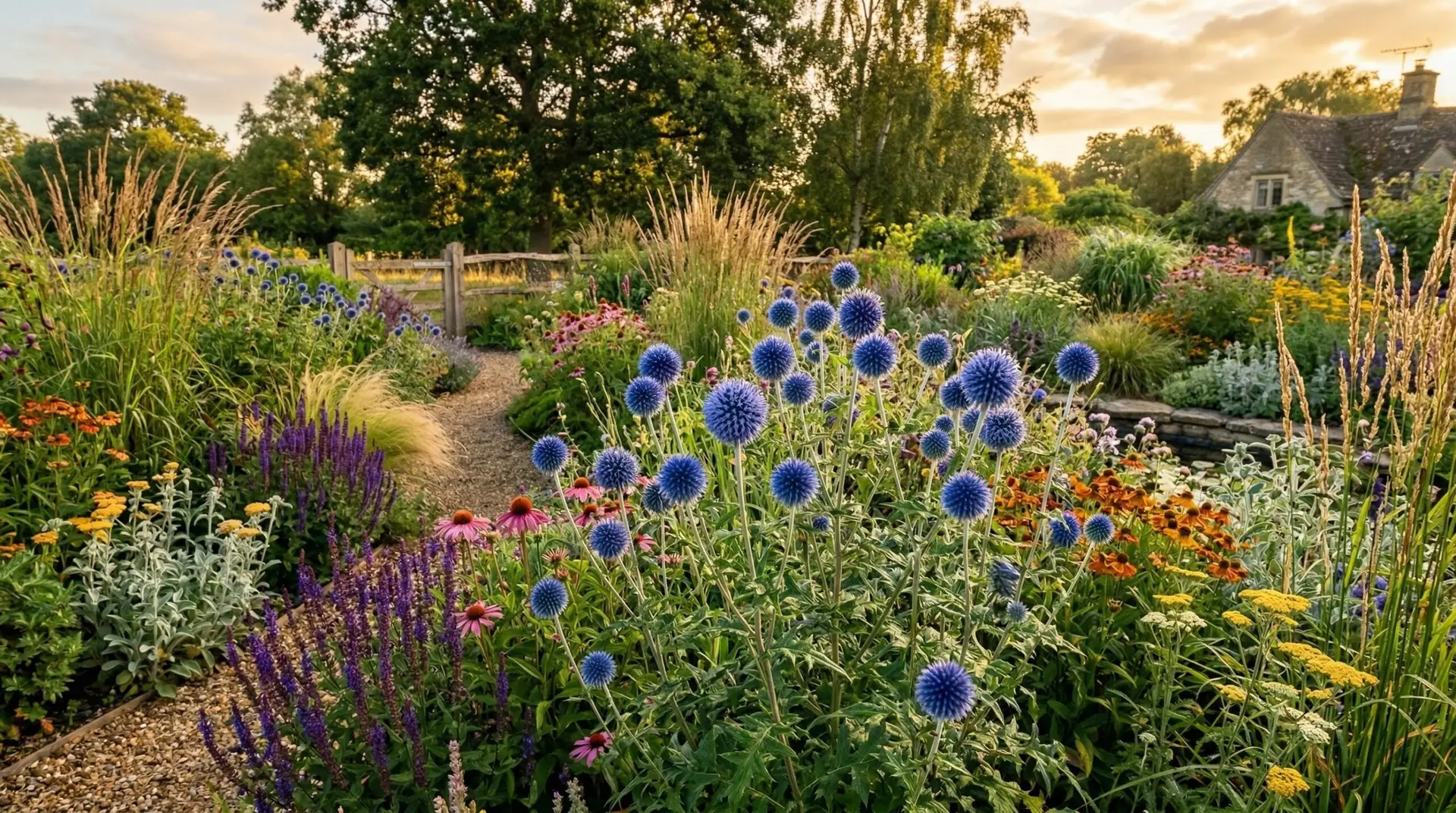
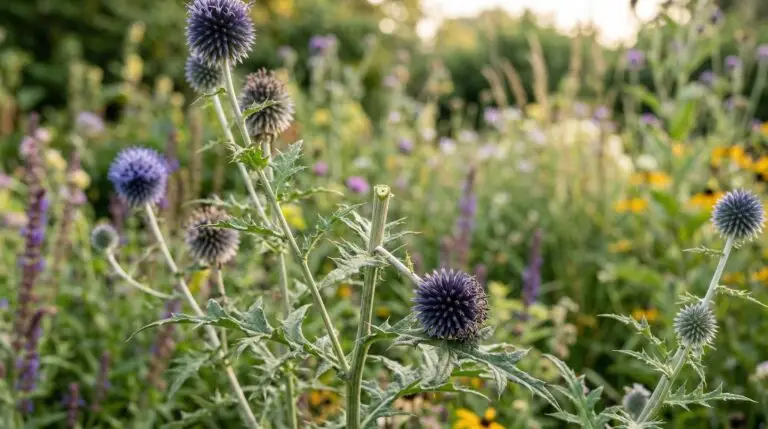
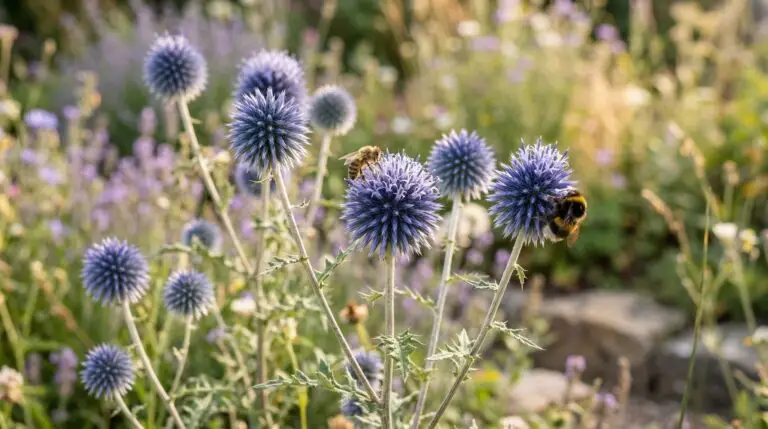
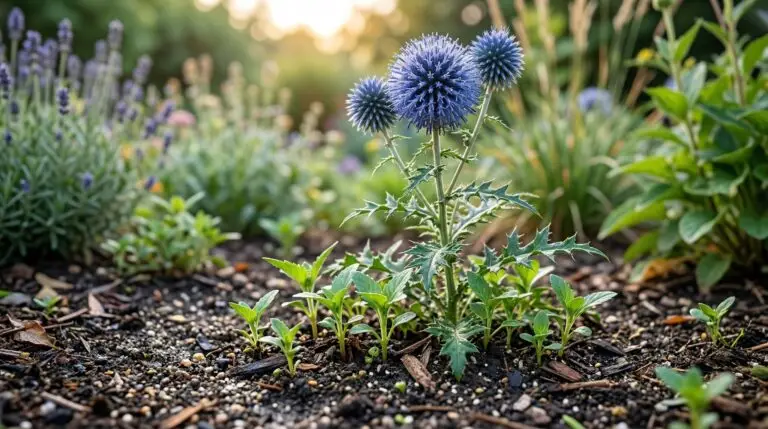
I wish you could see the garden right now, just as the morning fog begins to lift off the back beds. The globe thistle stands entirely still in the damp air, holding its perfect geometric spheres high above the softer, dew-soaked foliage. The color is not quite blue, but rather a cold, metallic steel that shifts toward violet when the direct sun finally strikes it. You can hear the low, steady hum before you even reach the gravel path, as dozens of heavy bumblebees cling to the spiky, spherical flower heads. The scent rising from the earth is dusty and dry, like sun-baked clay mixed with the faint, sharp tang of crushed sage. The dew catches on the tiny, star-shaped florets that make up each round head, turning the whole plant into a constellation of moisture and light. The foliage below is deeply cut and armed with soft spines, painted dark green on top with an underside of chalky white. When the wind moves through the border, the entire plant flashes silver and green, a restless metallic ocean beneath the steady blue planets of the flowers.
Contents 3 sections
The geometry of the late summer garden
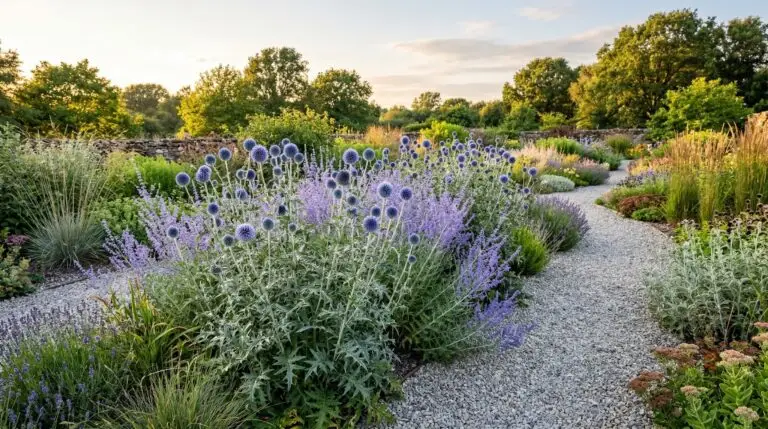
Globe thistle garden design relies heavily on this stark, unapologetic geometry to create structure and visual interest. In a modern perennial garden, we use these rigid spheres to interrupt the billowing clouds of softer, less defined plants. You can run your hand along the stems and feel the rough, ribbed texture that holds the heavy flower heads upright even after a pounding rain. When you plant them next to the flat, mustard-yellow landing pads of yarrow, the contrast is immediate and sharp. The flat umbels and the perfect spheres create a visual tension that keeps the eye moving actively across the flowerbed. The light hits the spherical heads differently throughout the day, casting deep, crescent-shaped shadows across the blue florets by mid-afternoon. It is a masterclass in form, proving that a garden needs strong bone structure and rigid lines just as much as it needs soft petals.
This focus on shape over pure color is the foundation of prairie-style gardens and naturalistic planting. The sharp, thistle-like architecture provides a resting place for the eye amidst the chaotic, swaying masses of tall grasses and daisy-like blooms. Picture a wide drift of coneflower with their swept-back pink petals and rusty orange cones baking in the August heat. Now imagine the cool, icy blue globes of the thistle rising straight through that warm sea of pink and orange. The contrast of the cool, saturated blue against the warm earth tones creates a visual vibration that changes entirely as the sun crosses the sky. The globe thistle stands completely still while the grasses around it whip and bow in the wind. This solid, unchanging presence anchors the wilder elements of the design, giving the garden a sense of deliberate intention rather than overgrown neglect.
Planting and tending the steel blue spheres
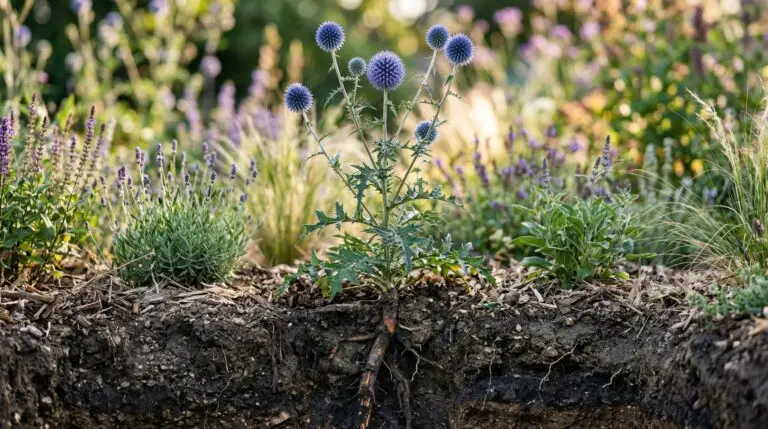
You will know you have the right spot for globe thistle when the soil feels gritty and slips quickly through your fingers. These plants demand excellent drainage and despise heavy clay that clings like wet pottery to their deep taproots. When you dig the planting hole, the earth should smell dusty and dry, the kind of soil that bakes hard and pale in the July sun. The thistle builds a long, fleshy root that drives straight down into the dark, searching for moisture deep below the surface of the soil. Because of this massive root, they resent being moved once they settle into their permanent home. You must choose their location with a long-term vision, picturing how tall and wide they will stand in three or four years. Watering them feels almost unnecessary once they mature, as they thrive in the dry, baking heat that causes softer plants to wilt and fold their leaves.
The late summer heat brings out the most intense colors in the dry garden palette. The metallic blue of the globe thistle reaches its peak saturation just as the golden, dark-centered faces of black eyed Susan begin to open in the surrounding beds. The saturated blue and the rich, egg-yolk yellow sit on opposite sides of the color wheel, making both plants appear brighter when their leaves touch. The scent of the garden in this season is heavy and rich, smelling of drying grass, warm pollen, and sun-baked stones. You can hear the dry rustle of the thistle leaves brushing against each other when a heavy gust of wind pushes through the border. The flowers themselves are rough to the touch, like tiny, tightly packed bristle brushes, yet the bees sleep right on the blooms, intoxicated by the nectar. You can walk out at dusk and see the fuzzy bodies of bumblebees tucked perfectly into the curves of the blue spheres, waiting for the morning sun to warm them.
A long season of texture and frost
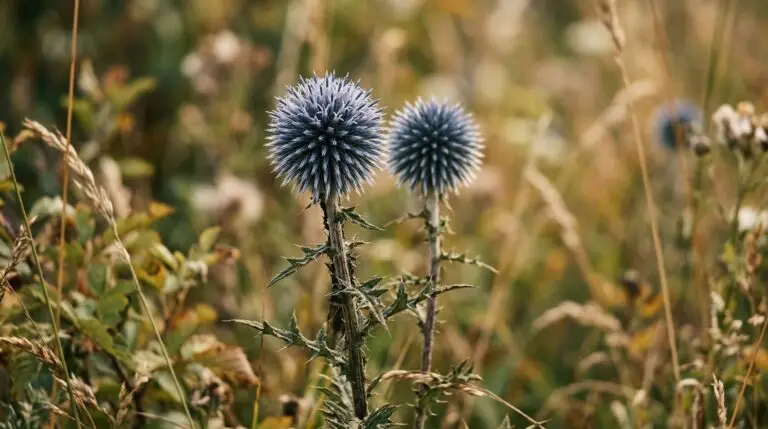
The beauty of architectural plants is that their work does not end when the color drains from the petals. As autumn sets in, the steel blue fades away from the globes, leaving behind a pale, silvery taupe that eventually dries to a rich biscuit brown. The stems harden into woody, rigid poles that stand defiant against the heavy November winds. The papery seeds remain tightly packed in their spherical formations, rattling softly like dry grain when you brush past them in a heavy winter coat. When the first deep freeze arrives, the garden transforms into a monochrome sketch of its summer self. The frost crystallizes on every tiny, pointed bract of the globe thistle, turning the brown spheres into heavy, glittering ornaments of white ice. The morning light catches these frozen globes, illuminating the exact geometry that has anchored this space since the soft, humid days of July.
More About Globe Thistle
How to grow globe thistle for perfectly round steel-blue flower heads that bees adore
Dried globe thistle flower heads for everlasting arrangements that last for years
Best globe thistle varieties from compact Veitch’s Blue to towering Taplow Blue
How to control globe thistle self-seeding and prevent unwanted spread in borders
Globe thistle as a pollinator powerhouse attracting more bees than almost any perennial
Globe thistle flower meaning and the quiet strength of this spiny blue sphere
Globe thistle companions: what to grow and what to avoid
Growing globe thistle from seed for the most budget-friendly perennial border
Globe thistle for hot dry slopes and problem areas where other perennials fail
Enjoying our flower guides? Add YourFlowersGuide as a preferred source on Google. It helps more readers find us.
Add to Preferred Sources