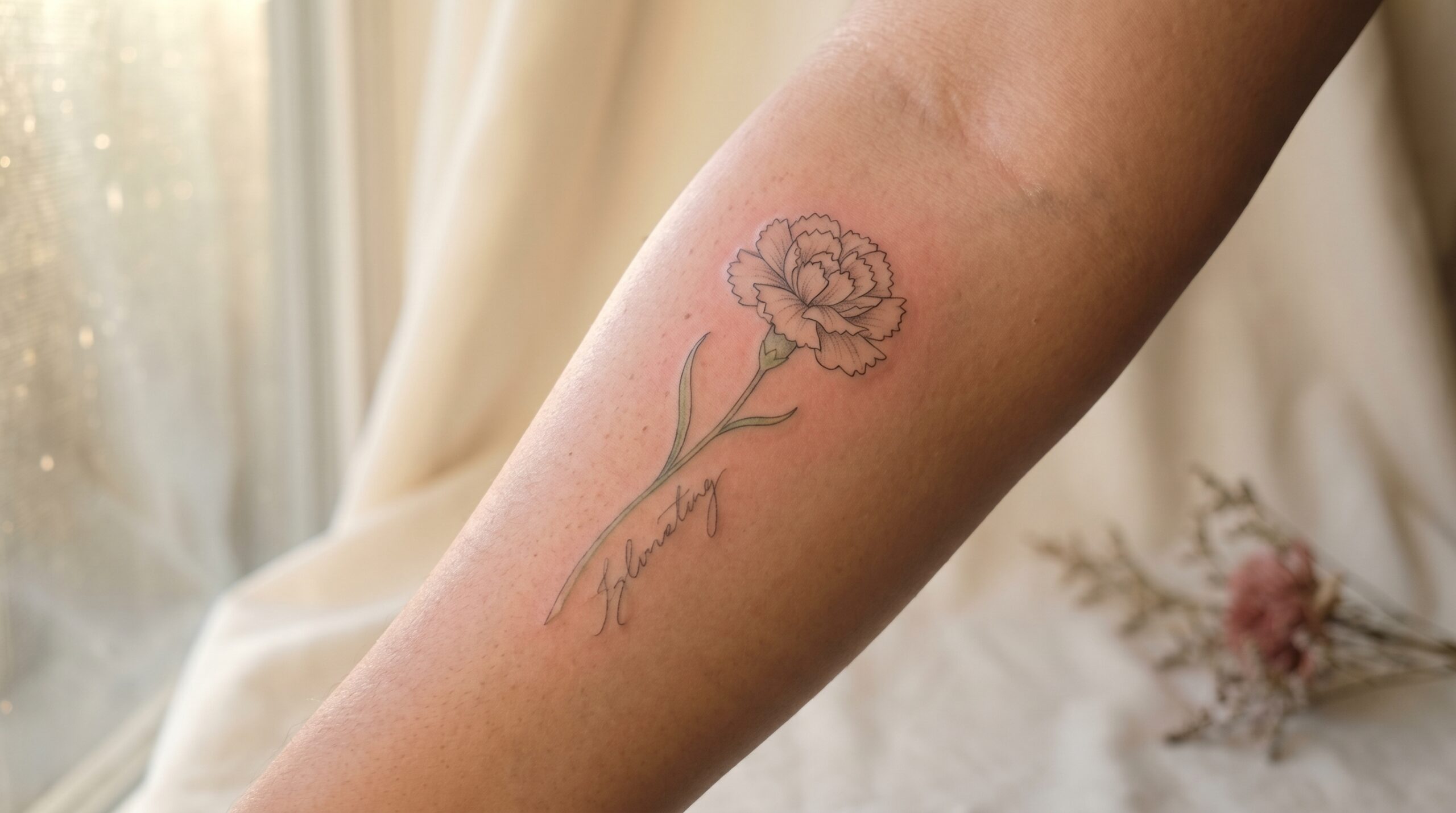
Carnation is January’s primary birth flower, and the densely-layered ruffled petals make it one of the more design-friendly tattoo subjects in the birth flower calendar. The flower works at small or large scales, ages well across most tattoo styles, and has strong cultural meaning that gives the tattoo intent beyond pure aesthetics.
Most carnation tattoos fall into two broad categories. The first is birth flower commemoration: someone born in January gets a carnation as a personal birth-month symbol, often paired with a name or date. The second is memorial: a white carnation honors a deceased mother, drawing on the Anna Jarvis Mother’s Day tradition that has assigned white carnation to memorial use since 1908. Both categories work in the same design vocabulary but read differently depending on color and placement.
In this guide
Why carnation works as a tattoo subject
Carnation petals stack in several layered rows around a central core, creating natural visual depth even in flat ink. This layered structure has practical tattoo benefits. The bloom still reads as a carnation at one-inch scale or at six-inch scale, so size choice is genuinely flexible. The layered petals also hide minor ink fade well: as outer petals lose color over the years, the inner rows still show the form clearly, which is one reason carnation tattoos age more gracefully than tightly-detailed single-form flowers.
Color flexibility is another advantage. Carnation comes in red, pink, white, yellow, purple, orange, and striped patterns in real life, and each color has distinct meaning in the Western language of flowers. A tattoo client can pick the color that matches the intended message: red for passionate love, white for memorial, pink for mother’s love, and so on. Most other birth flowers offer only two or three meaningful color choices.
Compared to rose, carnation is the softer aesthetic. Rose tattoos read as bold and often masculine-coded; carnation tattoos read as gentler, more delicate, with the ruffled-petal feel closer to peony or chrysanthemum than to the angular rose. For clients who want a meaningful flower tattoo without the intensity of rose imagery, carnation is the natural alternative.
Style options
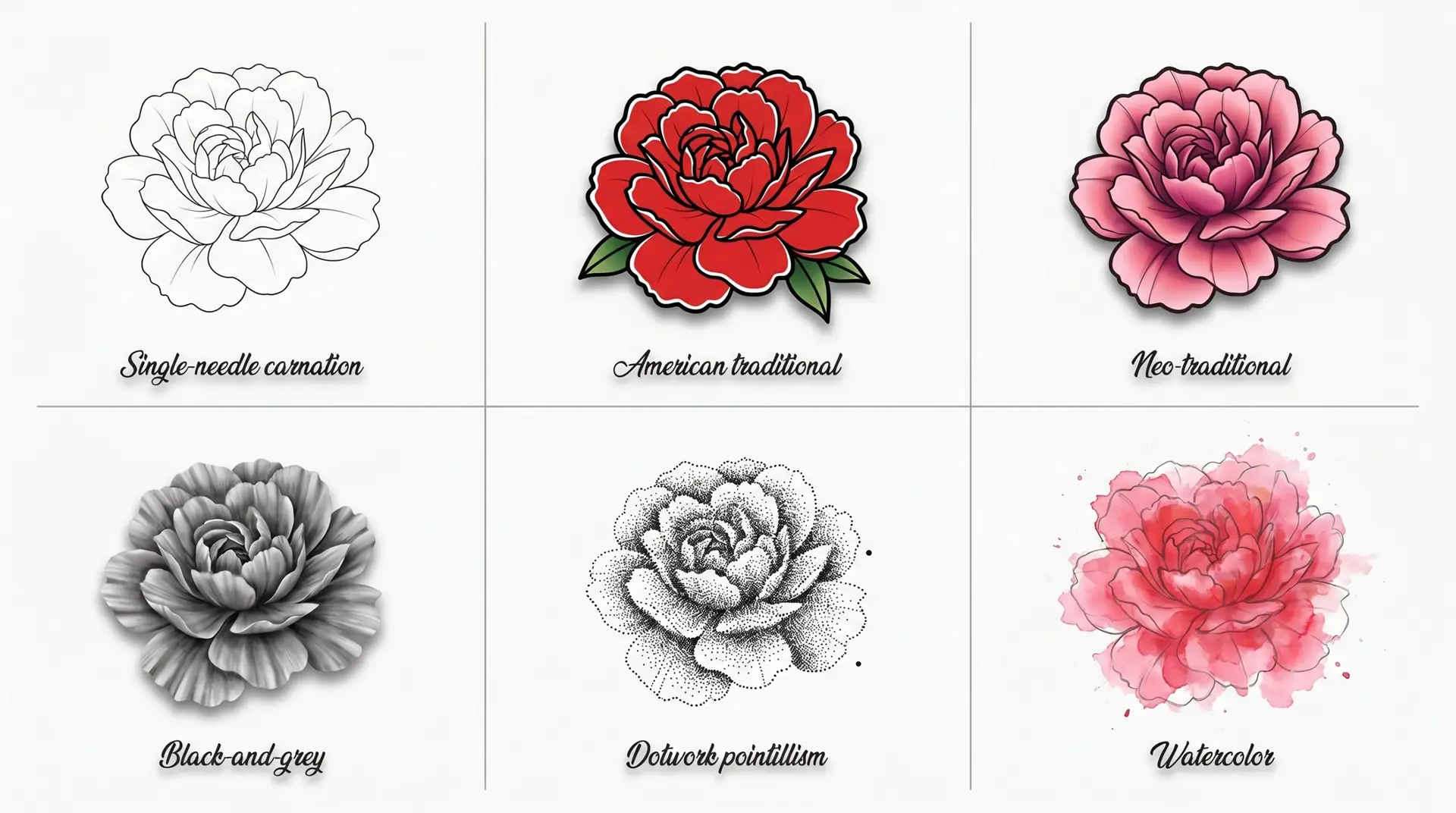
Fine linework shows the ruffled petal edges with single-needle precision. Best for small to medium pieces (wrist, behind ear, sternum). Pairs well with delicate script for name or date integration. Fades faster than bolder styles, so expect touch-ups every 5 to 8 years.
American traditional uses bold outlines and saturated reds, often modeled on the classic boutonniere carnation. Strong choice for medium pieces on the forearm or upper arm. Ages excellently; the bold lines hold form for 20+ years with basic care.
Neo-traditional keeps the bold outline tradition but adds modern color depth and more shading. Works for larger pieces (shoulder, back, thigh) where the artist has room to build up tonal range.
Realistic renders the petal-by-petal detail photo-style. Needs a skilled artist, a large enough canvas (minimum 4-5 inches), and a longer session (3-6 hours for a medium realistic carnation). Best on the upper arm, shoulder, thigh, or back.
Dotwork builds the bloom through points rather than lines. Gives carnation a soft fluffy quality that suits the flower’s naturally ruffled form. Ages well; dotwork softens slightly over years but does not lose recognizable structure.
Watercolor uses color bleed effects that match carnation’s natural color graduation from petal edge to center. Visually striking but the most fade-prone style. Touch-ups every 5 to 10 years are standard.
Botanical illustration style mimics vintage scientific drawings, often with the Latin name (Dianthus caryophyllus) included as a label. Popular minimalist trend, especially on the inner forearm.
Mother’s Day memorial carnation tattoos
Carnation has a stronger memorial tradition than any other birth flower. The connection traces to Anna Jarvis, who founded the American Mother’s Day in 1908 and chose white carnation as the official flower in honor of her own mother. The convention that developed assigns white carnation to honor a deceased mother and pink or red carnation to honor a living one. Tattoo artists working in birth flower designs see carnation memorial tattoos regularly, particularly around Mother’s Day and around the anniversary of a mother’s death.
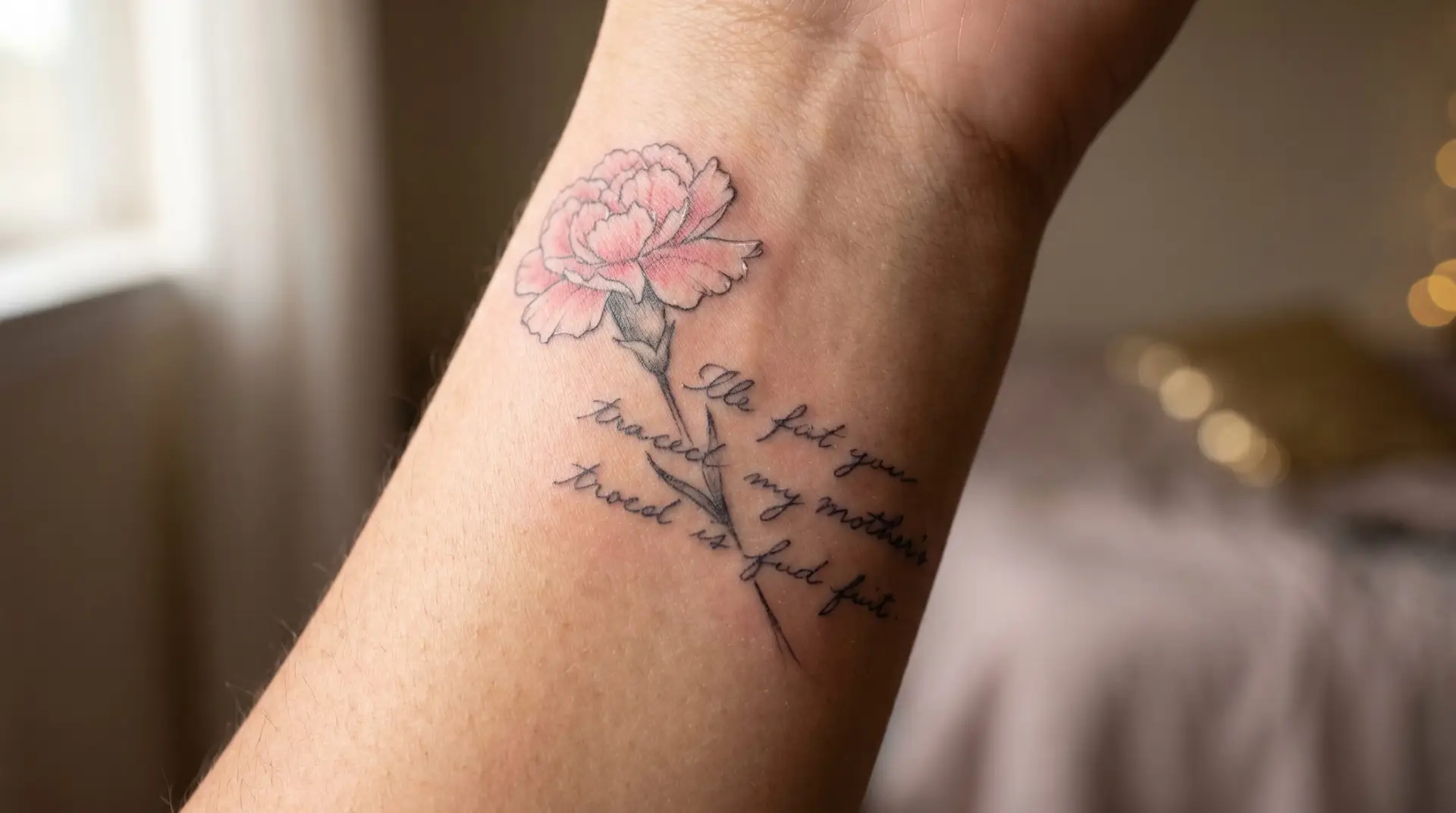
Common memorial design patterns include a white carnation with the mother’s name and birth-death dates in script below the bloom, a single white carnation tucked into a small bouquet of the mother’s other favorite flowers, and a carnation with a handwritten quote from the mother traced as tattoo art (handwriting reproduction is a growing memorial tattoo trend that works well with floral imagery). Multiple carnations in a cluster can represent children honoring the same mother, with one bloom per child sometimes used for siblings getting matching tattoos.
A few practical notes for memorial work. The artist consultation matters more than for decorative tattoos: the emotional weight calls for an artist who can hold space for that conversation rather than rushing to design. Placement that shows the tattoo daily (inner forearm, inner wrist, over the heart) reinforces the remembrance function; hidden placements (back, hip) work for clients who want the tattoo private. Color choice follows the Jarvis convention: white for a deceased mother, pink or red for a living mother who is being honored rather than mourned. Some clients combine both: a white carnation for the deceased mother alongside a pink carnation for a grandmother still living.
Color choices and symbolic meaning
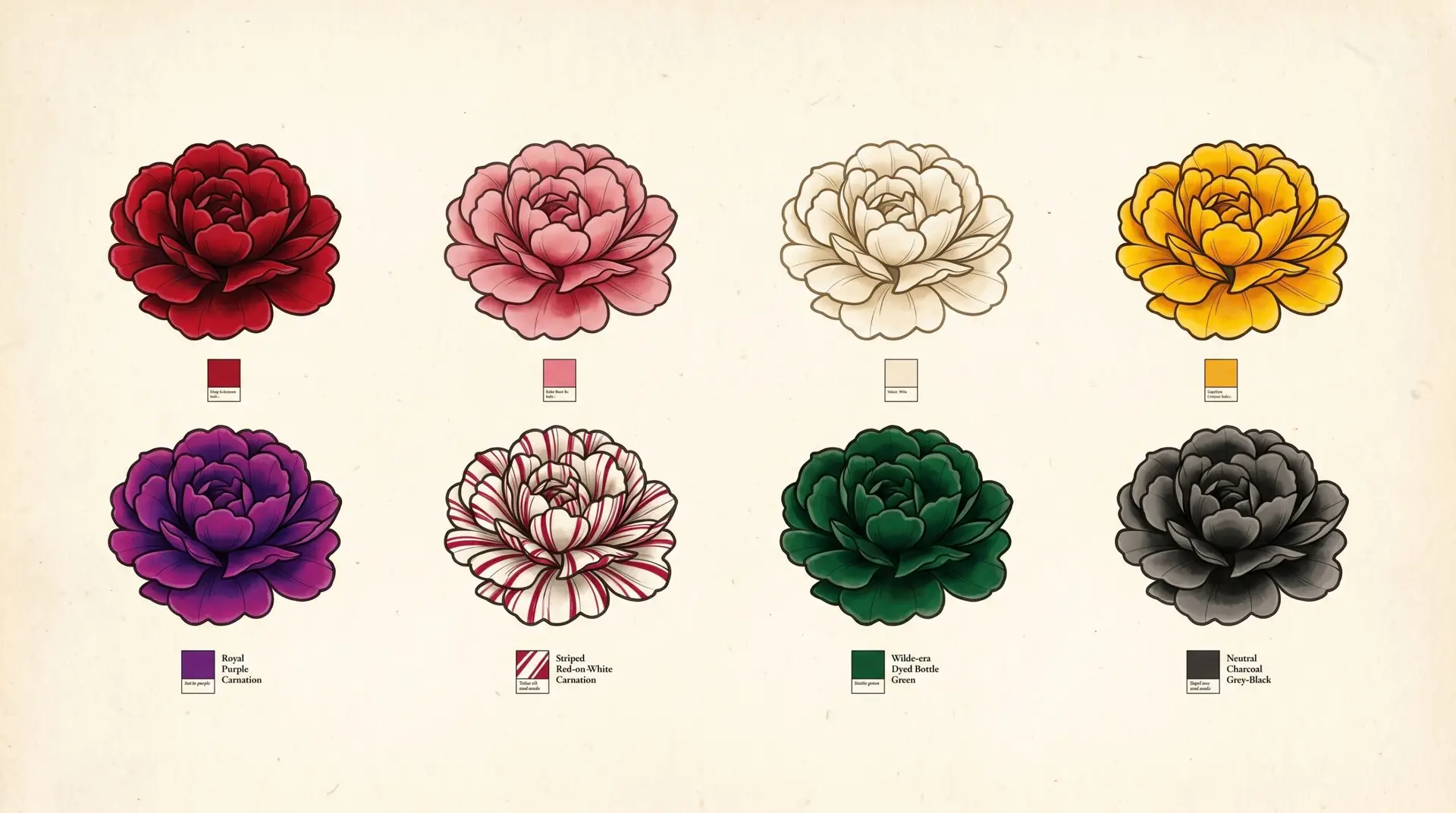
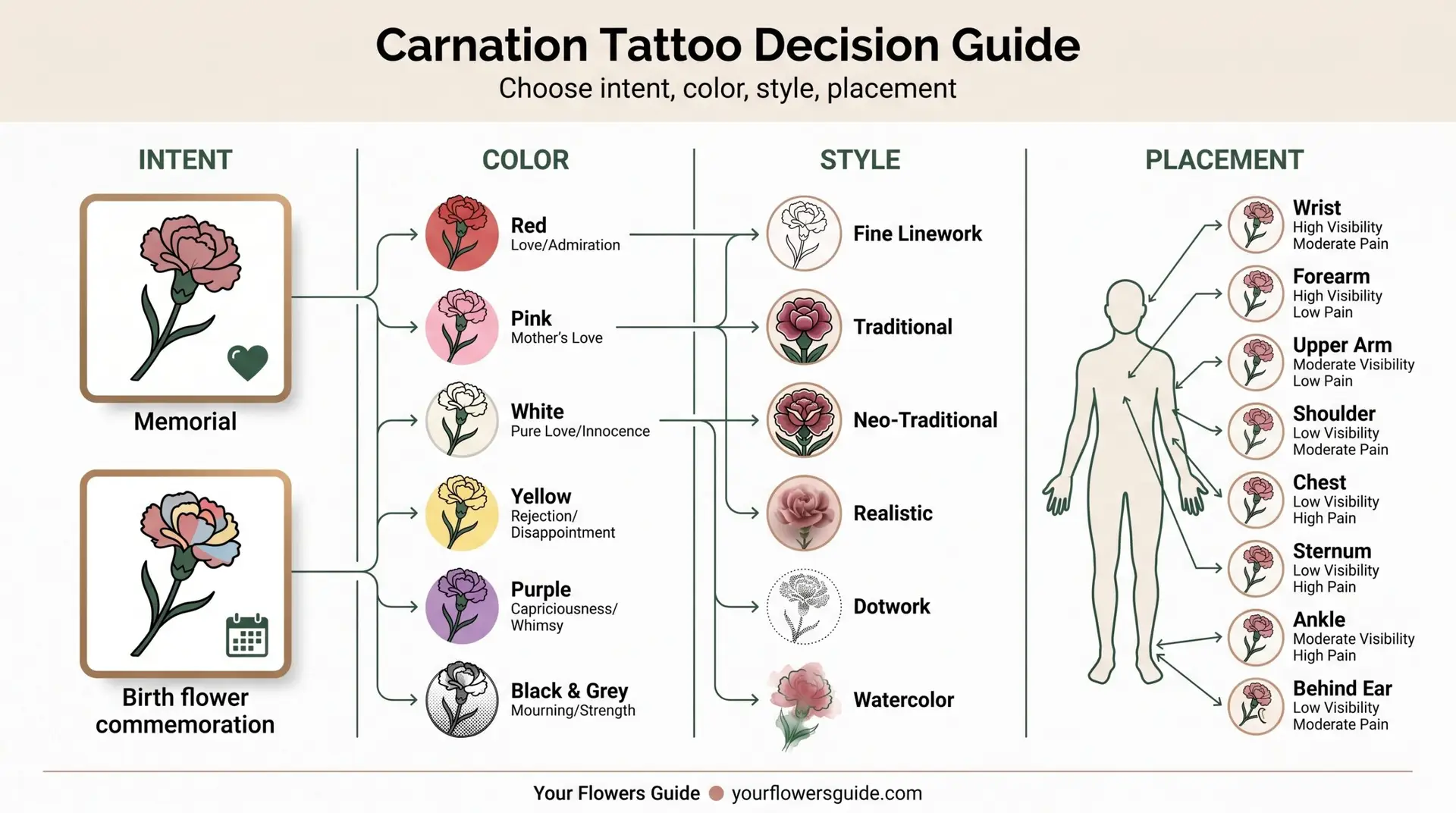
- Red carnation tattoo: passionate love, deep admiration. The standard romantic-partner choice. Dark red holds the strongest reading.
- Pink carnation tattoo: mother’s love (from the Christian Marian tradition), gratitude, gentle affection. The traditional choice for honoring a living mother.
- White carnation tattoo: pure love, remembrance, deceased mother memorial. The Anna Jarvis convention. Note: white ink fades fastest of all tattoo colors and requires touch-ups every 3 to 5 years.
- Yellow carnation tattoo: uncommon. Victorian “disappointment” reading has faded, but the unusual color choice still raises questions from viewers.
- Purple carnation tattoo: capriciousness, unpredictability. A bold personality statement rather than a love token.
- Striped carnation tattoo: visually striking, symbolizes refusal or regret in Victorian reading (“I cannot be with you”). Clients should know the symbolism before committing.
- Green carnation tattoo: a historical footnote with continuing meaning. Oscar Wilde and his late-Victorian London circle wore dyed green carnations in the 1890s as a discreet signal of gay identity. A green carnation tattoo today still reads as an LGBT history reference for viewers who know the tradition.
- Black-and-grey carnation: versatile, ages best of all options. The standard choice for clients who want longevity over color symbolism.
For clients uncertain about color, the most common compromise is pink (which has gentle positive meanings under any reading) or black-and-grey (which sidesteps color-symbolism entirely while keeping the bloom recognizable).
Placement options
Inner wrist: small minimalist work, often memorial. Visible daily, low pain (3-4 hours sleep recovery), heals in 2-3 weeks. Fades faster than thicker skin areas, so touch-ups every 5 years for fine detail.
Inner forearm: medium scale memorial or ornamental. Visible to the client daily, easy to cover with long sleeves when needed. Moderate pain, heals in 2-3 weeks, ages well.
Outer forearm: medium-large pieces, more visible to others. Same healing time as inner forearm. Best placement for botanical-illustration style with Latin name labels.
Upper arm: single carnation or cluster. Easy to hide under short sleeves. Moderate pain, heals quickly.
Shoulder blade: large multi-flower pieces. Hidden in most clothing, visible in sleeveless or backless wear. Healing takes longer (3-4 weeks) due to the larger area and skin movement.
Chest over heart: intimate memorial placement. High pain rating (especially over the sternum and near the collarbone), heals in 3-4 weeks. Visible only to the client and intimate partners.
Sternum: vertical orientation for stacked carnations or a single bloom with stem. High pain, dramatic visual when revealed.
Ankle: small ornamental. Lower visibility, easy to hide with socks. Tends to fade faster from shoe friction.
Behind ear: tiny minimalist single bloom. Heals fast (1-2 weeks). Discreet but visible when hair is up.
Thigh: large detailed pieces with room for full botanical context (bloom, stem, leaves, supporting elements). Moderate pain, hidden under most clothing, ideal canvas for realistic style.
Design pairings
Carnation pairs cleanly with other elements because the ruffled bloom has a strong central form that anchors compositions without competing visually.
Carnation with script name is the single most common combination, especially for memorial work. The name typically sits below or beside the bloom in fine cursive or a typewriter-style font, depending on whether the tattoo aims for delicate or modern aesthetic.
Carnation with date marks a birth, memorial, or anniversary. Roman numerals are popular for the date integration; standard digits work equally well in clean fonts.
Carnation with handwritten quote uses a tracing of the honored person’s actual handwriting (typically the mother’s, for memorial work). Requires a high-quality photo of the original handwriting for the artist to reference. This is one of the fastest-growing memorial tattoo trends.
Carnation with Capricorn or Aquarius zodiac symbol integrates the January birth flower with the birth-month zodiac (Capricorn for December 22 to January 19, Aquarius for January 20 to February 18). Works as a personal birth-marker design.
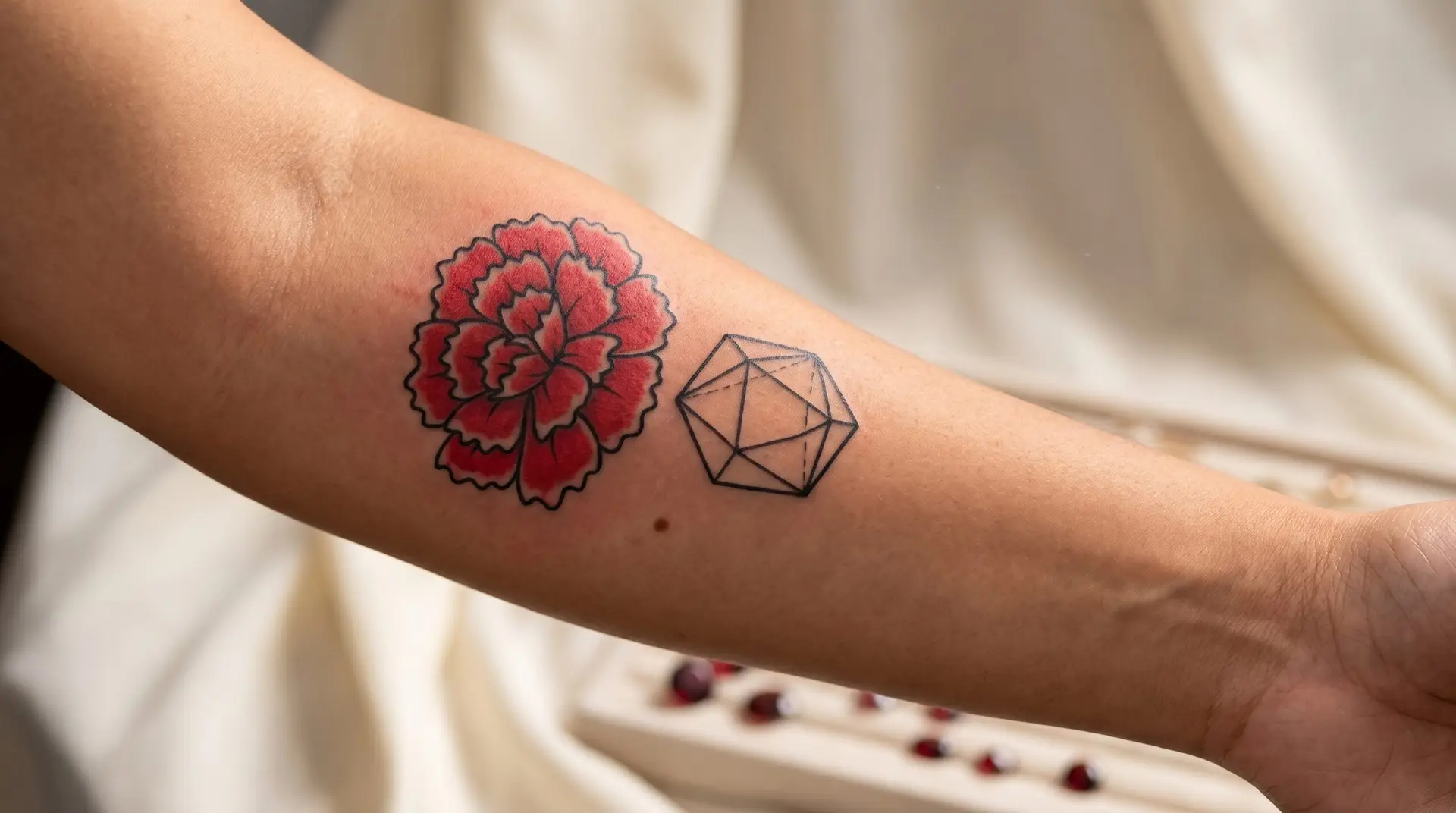
Carnation with garnet stone combines the January birth flower with the January birthstone. The red garnet pairs visually with red carnation, and the stone can be rendered as a faceted gem at the base of the bloom or as a small accent.
Multi-carnation composition shows family members. Three carnations for three children, four for four siblings, and so on. Color variation can distinguish individual people (one white for a deceased relative among living-relative pinks).
Carnation with dove signals peace and memorial symbolism, often used in Christian-context memorial tattoos.
Carnation with cross combines floral and Christian symbolism explicitly, common for clients raised in Catholic tradition.
Aftercare specifics for carnation tattoos
General tattoo aftercare basics (the first two weeks of healing, ointment use, scab management) follow the standard guidelines that any responsible artist provides. The carnation-specific concerns matter more for the long-term appearance of the tattoo.
The densely-layered petal structure means that aggressive scab removal in the first two weeks can disrupt the petal-edge definition that gives the tattoo its carnation-character. Keep the area moisturized through the scabbing phase rather than letting scabs dry hard, and never pick at scabs that form over fine line work. Petal edges that lose definition during healing can be touched up later, but prevention is easier than correction.
Color longevity varies by hue. Pink ink fades faster than red, white ink fades fastest of all. For a pink carnation memorial tattoo on an exposed area (inner wrist, forearm), expect to touch up every 3-5 years to maintain the color depth. For black-and-grey carnation tattoos, touch-ups are needed less often: every 7 to 10 years for sun-exposed areas, longer for covered placements.
Memorial tattoos sit on the forearm or wrist most often, which puts them in daily sun exposure. A consistent sunscreen routine (SPF 30+ on the tattoo whenever exposed) extends color life by years. Skip the sunscreen and pink carnation fades to peach in 3-4 years on an exposed forearm.
Six-month and one-year check-ins with the artist are worth scheduling. At six months the artist can assess healing and recommend touch-ups before fade becomes obvious. At one year the tattoo has fully settled and any touch-up work blends in cleanly with the original.
At a glance
Questions
Questions
Frequently asked
What does a carnation tattoo mean?
Carnation meaning depends on color. Red means passionate love. Pink means mother’s love or gratitude. White means pure love or memorial (especially for a deceased mother per the Anna Jarvis Mother’s Day tradition). Yellow means disappointment in strict Victorian reading. The general theme across all colors is love and devotion.
Are carnation tattoos good for Mother’s Day memorial?
Yes. The Anna Jarvis Mother’s Day tradition has assigned white carnation to memorial use since 1908, and carnation has stronger memorial tradition than any other birth flower. The most common memorial design is a white carnation with the mother’s name and birth-death dates in script below the bloom.
What does a red carnation tattoo symbolize?
Passionate love and deep admiration. The standard choice for romantic-partner tattoos. Dark red holds the strongest reading; a lighter red or pink-red still reads as love but with softer emotional weight.
What does a white carnation tattoo mean?
Pure love, remembrance, and deceased mother memorial. The white carnation is the Anna Jarvis-defined Mother’s Day flower for honoring a deceased mother. Note that white ink fades fastest of all tattoo colors and requires touch-ups every 3-5 years.
How big should a carnation tattoo be?
Carnation works at any scale from one inch to full sleeve. For inner wrist or behind ear, plan for 1-2 inches. For forearm, 3-5 inches. For shoulder or thigh, 6 inches and up. Realistic style needs at least 4-5 inches to show petal-by-petal detail clearly.
Will a carnation tattoo age well?
Yes, better than most flower tattoos. The layered petal structure hides minor fade well, and the bloom still reads as a carnation even when outer petals lose color depth. Black-and-grey ages best (7-10 year touch-up cycle). Bold traditional and dotwork age second-best. Watercolor and white ink fade fastest (3-5 year touch-up cycle).
Can I get a carnation tattoo with my mother’s handwriting?
Yes. Mother’s handwriting tattoos are one of the fastest-growing memorial tattoo trends, and carnation works particularly well with handwriting integration because the bloom anchors the composition while leaving negative space for the script. The artist needs a high-quality reference photo of the original handwriting (clear lighting, sharp focus, ideally a full sentence rather than just a signature).
What is the green carnation tattoo significance?
Oscar Wilde and his late-Victorian London circle wore dyed green carnations in their buttonholes during the 1890s as a discreet identifier of gay identity. Florists dyed white carnations green specifically for the purpose. A green carnation tattoo today still reads as an LGBT history reference for viewers who know the tradition, though the signal is subtle enough that most viewers will simply see the unusual color choice.
Sources
Keep reading

January birth flower: carnation, snowdrop and what they mean

January birth flowers by day: the Korean 365-day tradition
Snowdrop flower meaning: botany, Candlemas, and galanthophilia
Birth flower by month: all 12 monthly flowers
Enjoying our flower guides? Add YourFlowersGuide as a preferred source on Google. It helps more readers find us.
Add to Preferred Sources