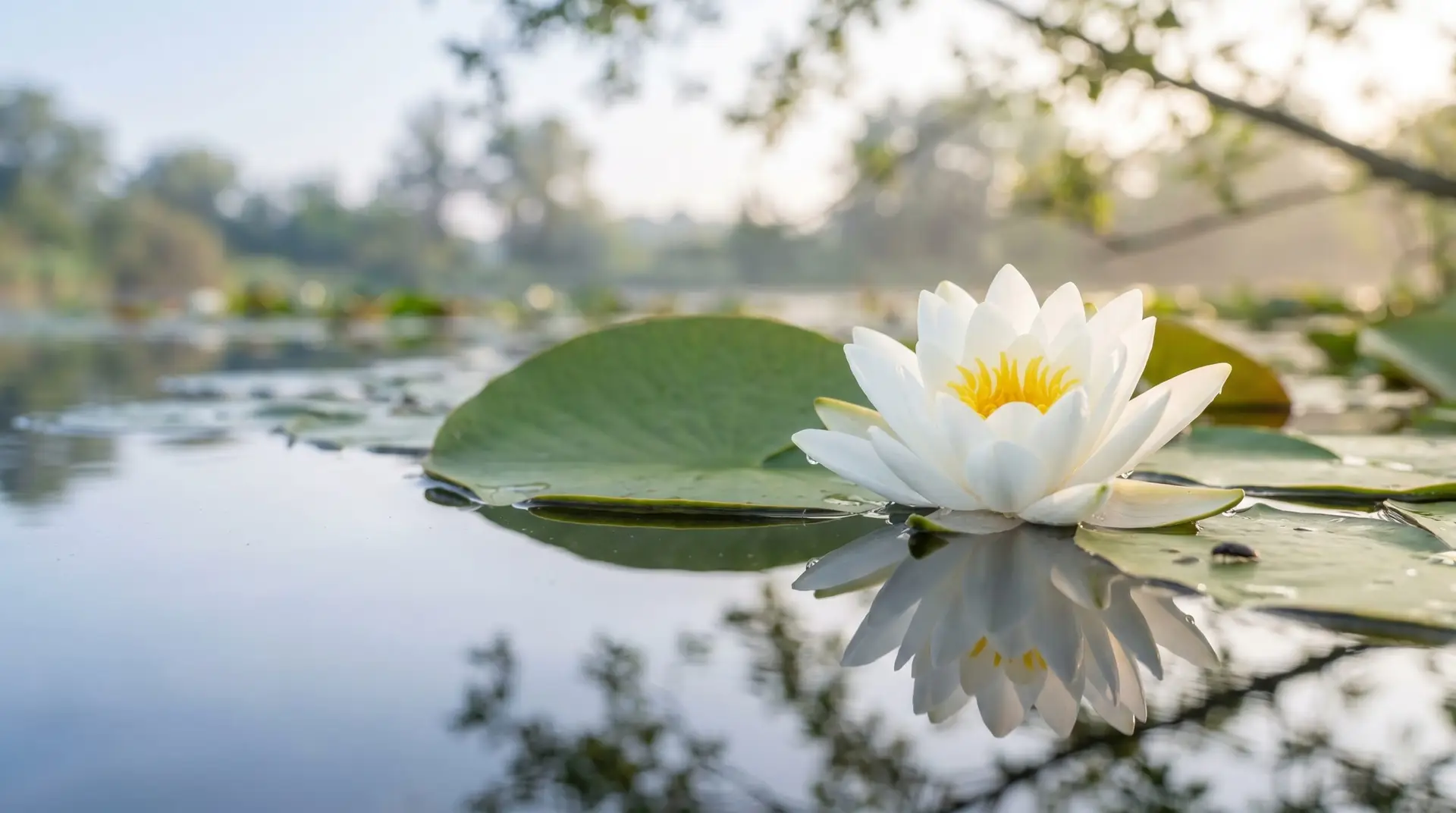
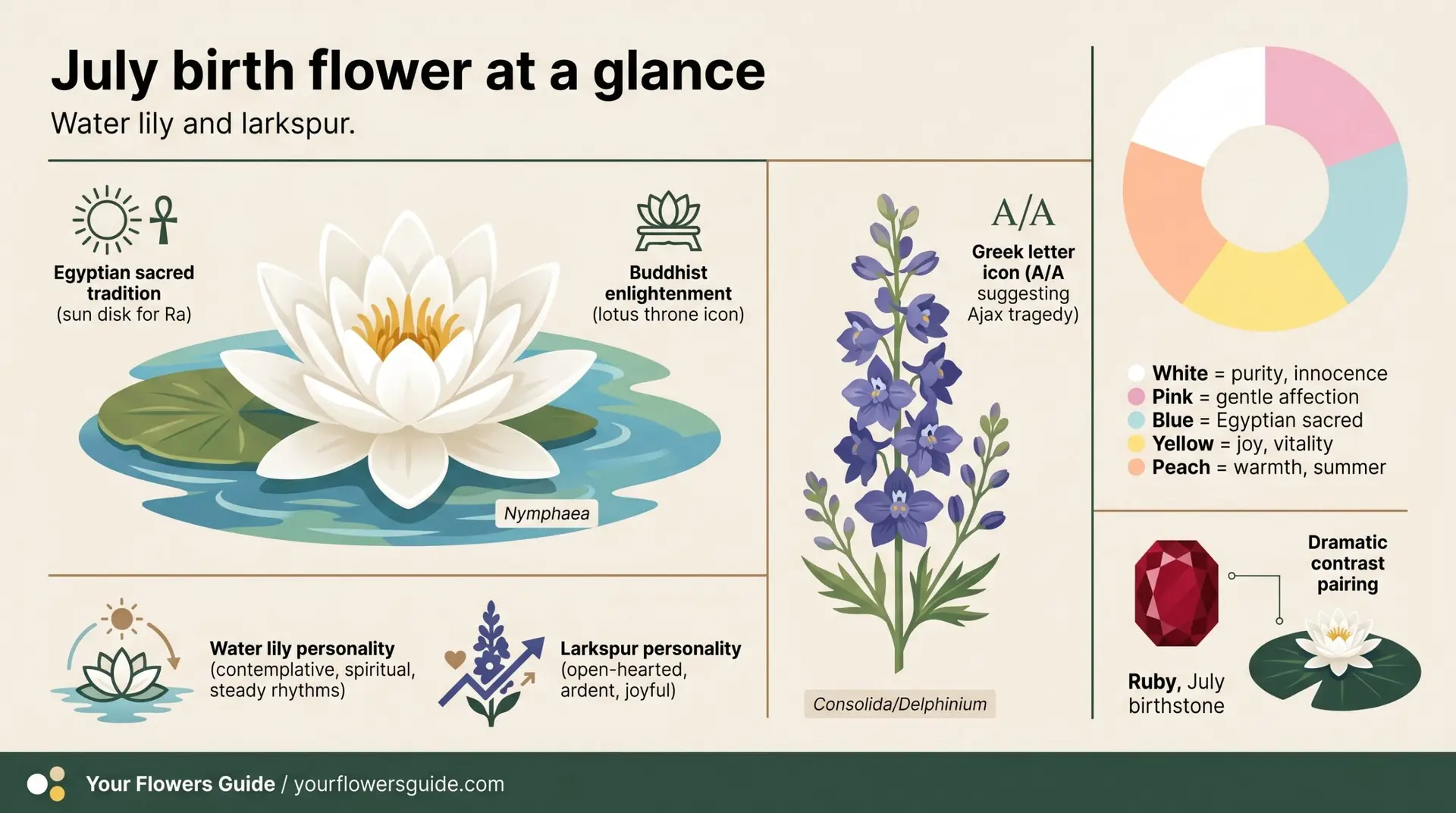
July has two birth flowers in Western tradition: water lily (Nymphaea) as the primary, and larkspur (Consolida and Delphinium) as the secondary. Water lily stands for purity, enlightenment, and rebirth. Larkspur stands for an open heart, ardent attachment, and joyful affection.
The two flowers create a striking visual contrast that defines the July floral identity. Water lily floats on still pond water with broad round leaves and large many-petaled blooms that open at dawn and close at dusk in a daily cycle. Larkspur grows on tall spires (2 to 4 feet) with dense vertical racemes of small flowers. The horizontal water lily and the vertical larkspur together provide both still and dynamic visual elements suited to peak summer gardens. The deeper cultural weight of water lily comes from the ancient Egyptian sacred water lily tradition that predates Greek mythology by two thousand years and gave the flower its strongest religious-symbolic anchor across the entire Western birth flower vocabulary.
In this guide 7 sections
Water lily, the main July birth flower
Water lily belongs to the genus Nymphaea in the family Nymphaeaceae. The genus contains approximately 70 species native to temperate and tropical regions across every inhabited continent. The species most associated with the European birth flower tradition is Nymphaea alba, the white European water lily, native to most of Europe and parts of Asia and North Africa.
The plant is a perennial aquatic that grows from rhizomes anchored in pond mud or shallow lake bottoms. The broad round leaves (lily pads) float on the water surface, providing the characteristic flat-leaf platform that distinguishes water lily visually from other pond plants. The flowers float on the water surface beside the leaves, with each flower reaching 3 to 8 inches across (varying by species) and containing many petals around a central group of yellow stamens. The flowers open at dawn and close in late afternoon, repeating this daily cycle for 3 to 4 days before the spent flower sinks to set seed underwater.
Modern water lily cultivation includes tropical species and hybrids that extend the color range beyond the wild European white. Pink water lilies (Nymphaea ‘Aurora’ and related cultivars), blue water lilies (Nymphaea caerulea, the Egyptian water lily, and tropical hybrids), yellow water lilies (Nymphaea mexicana and hybrids), and peach water lilies are all available in modern garden trade. Tropical species require warmer water than temperate hybrids and typically need overwintering indoors in zones colder than USDA zone 9.
Bloom timing runs from late spring through autumn in temperate climates, with peak abundance in July and August. The July position in the Western birth flower tradition reflects this peak summer bloom timing combined with the flower’s deep cultural symbolism. Victorian flower writers chose water lily for July because it was both the most visually iconic summer water flower and the species with the strongest religious-historical symbolism inherited from ancient Egyptian and Buddhist traditions.
The water lily should not be confused with the true lotus (Nelumbo nucifera, the sacred lotus). The two plants are visually similar and culturally blended in much popular reference, but they belong to entirely different botanical families. True lotus (Nelumbo, family Nelumbonaceae) has leaves that rise above the water surface on stems, while water lily (Nymphaea, family Nymphaeaceae) has leaves that float on the water surface. The Egyptian “lotus” of art history is actually Nymphaea caerulea, the blue water lily, not the true lotus.
Larkspur, the secondary July birth flower
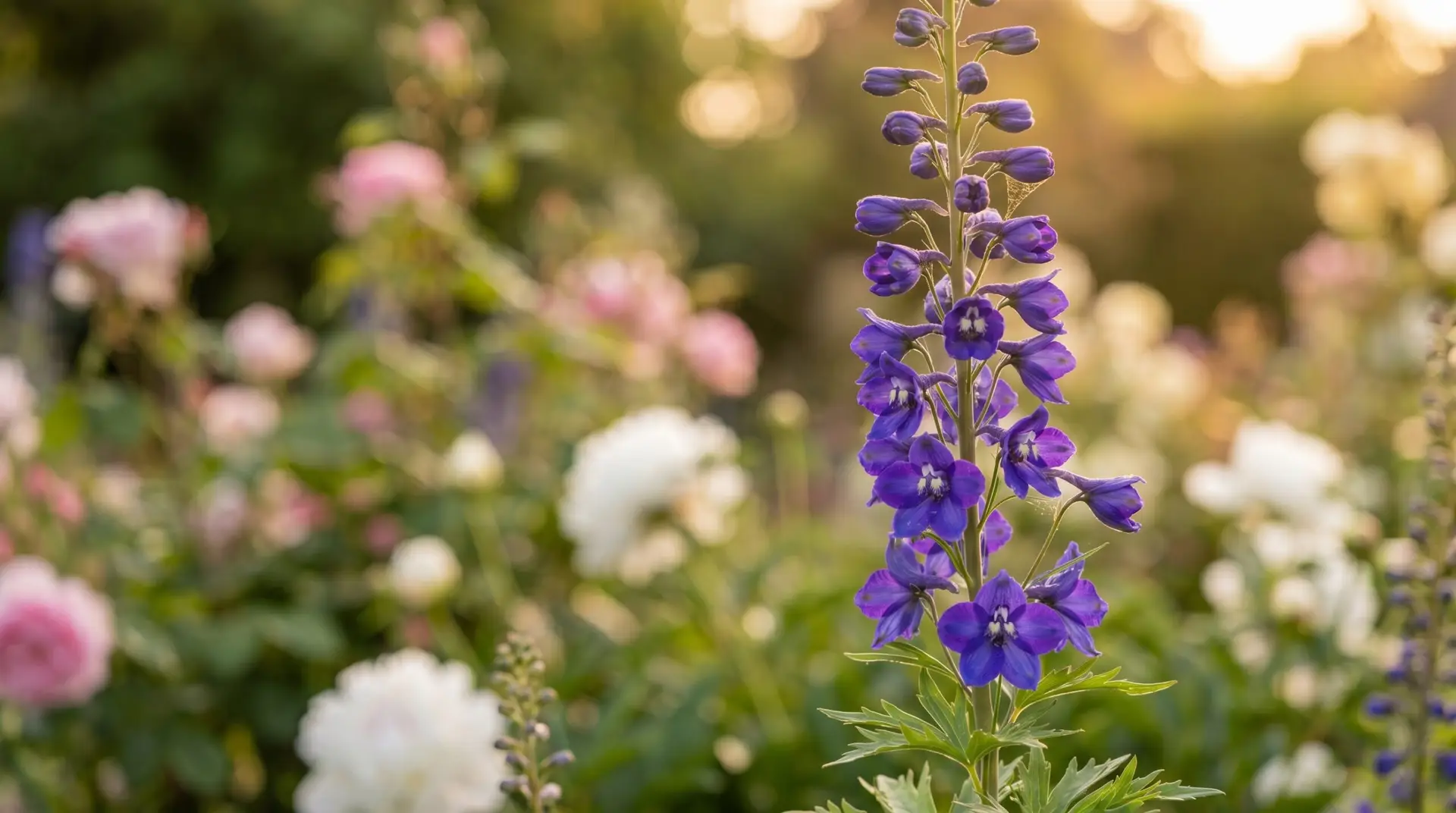
Larkspur refers to two related genera in the family Ranunculaceae: Consolida (the annual larkspur, formerly classified within Delphinium) and Delphinium (the perennial larkspur). Both genera contain plants with tall spire-like flowering stems, deeply divided leaves, and dense racemes of small flowers with the characteristic spurred form that gives the genus its common name. Larkspur is what most English-speaking gardeners call the annual Consolida ajacis (formerly Delphinium consolida) and similar species; “delphinium” usually refers to the larger perennial garden varieties.
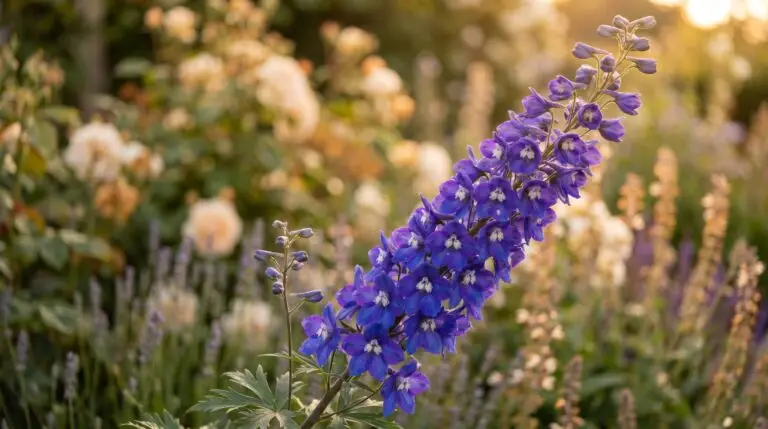
The plant grows on tall spires reaching 2 to 4 feet for annual larkspur and 4 to 6 feet for perennial delphinium hybrids. The flowering racemes contain dozens of small flowers along the upper portion of each spire, with each individual flower showing five petal-like sepals around the smaller true petals and a distinctive backward-pointing spur containing nectar. The color range covers deep blue-purple (the most iconic and most common), pink, lavender, white, and salmon.
Bloom timing in July across most temperate climates makes larkspur a natural July birth flower companion to water lily. The two flowers provide complementary visual elements: still water and tall vertical spire, broad horizontal floating leaves and narrow upright stems.
Larkspur symbolism in Victorian floriography includes “open heart” (the central tradition reading), “ardent attachment,” “joyful affection,” and “lightness.” The “first love” reading sometimes appears in older sources but is less dominant in modern references. The Greek mythological connection (the markings inside the flower were said to spell letters from the Ajax tragedy) provides additional symbolic depth.
Toxicity is important to note. All parts of larkspur (Consolida and Delphinium) contain alkaloids that are toxic to humans and livestock if eaten. Larkspur poisoning has historically been a significant cattle-mortality cause in western US grazing lands where Delphinium species grow wild. Do not eat any part of larkspur; keep pets and small children away from cut-flower stems and growing plants.
For deeper coverage of Consolida vs Delphinium taxonomy, the Greek mythological Ajax tradition, and the larkspur toxicity history, see the larkspur deep dive article.
The Egyptian sacred water lily
The water lily holds a deep religious-symbolic anchor through its central role in ancient Egyptian culture. The Egyptian “lotus” that appears throughout ancient Egyptian art, religion, and tomb iconography is botanically the blue water lily (Nymphaea caerulea), with the white water lily (Nymphaea lotus) appearing as a secondary religious flower. The tradition documented in Egyptian visual culture dates back thousands of years, predating Greek mythology, and gives water lily a long religious-historical heritage.
Egyptian religion treated the water lily as a symbol of creation, rebirth, and the daily cycle of the sun god Ra. The flower’s daily behavior provided the central religious metaphor: each evening the flower closed and sank below the water surface (figuring the death of the sun at sunset); each morning it rose again and opened (figuring the rebirth of the sun at dawn). This daily resurrection pattern made the water lily the primary religious symbol of the sun god Ra and of broader Egyptian conceptions of death and rebirth. Egyptian creation myths featured the water lily prominently, with one major tradition holding that the original god (variously identified as Ra, Atum, or Nefertem depending on regional tradition) emerged from a primordial water lily that rose from the chaos waters at the beginning of time.
Egyptian art shows water lily in nearly every domestic, religious, and afterlife depiction across multiple dynasties spanning over 3000 years. Tomb paintings include water lily in feast scenes, garden settings, and funerary offerings. Temple decoration uses water lily motifs on column capitals (the famous “lotus column” architectural form), wall reliefs, and ceremonial vessels. Royal jewelry and funerary objects incorporated water lily designs extensively. Tutankhamun’s tomb (discovered 1922) included water lily petals scattered on the pharaoh’s funerary mummy alongside other floral and ceremonial elements, confirming the flower’s central religious-funerary role.
The Buddhist enlightenment tradition that became globally familiar in modern times draws on similar daily-renewal symbolism, though Buddhist iconography traditionally uses the true lotus (Nelumbo nucifera) rather than the water lily. The two flower types became visually conflated in much popular Western reference, with “lotus” often used loosely to mean either Nymphaea or Nelumbo. The careful botanical distinction matters less for the symbolic register: both flowers show similar readings of purity, enlightenment, and rebirth across their respective religious traditions, and the Victorian flower writers who codified the modern Western birth flower system drew on the combined symbolic weight without strictly distinguishing the two plants.
Modern Egyptian national symbols continue to feature water lily prominently. The flower appears on Egyptian government seals, currency, and cultural references as a recognized symbol of continuing Egyptian identity across the ancient-to-modern timespan. A July-born reader with Egyptian family heritage or strong personal connection to Egyptian culture can read the water lily birth flower assignment as a particularly meaningful cultural reference.
What water lily colors mean
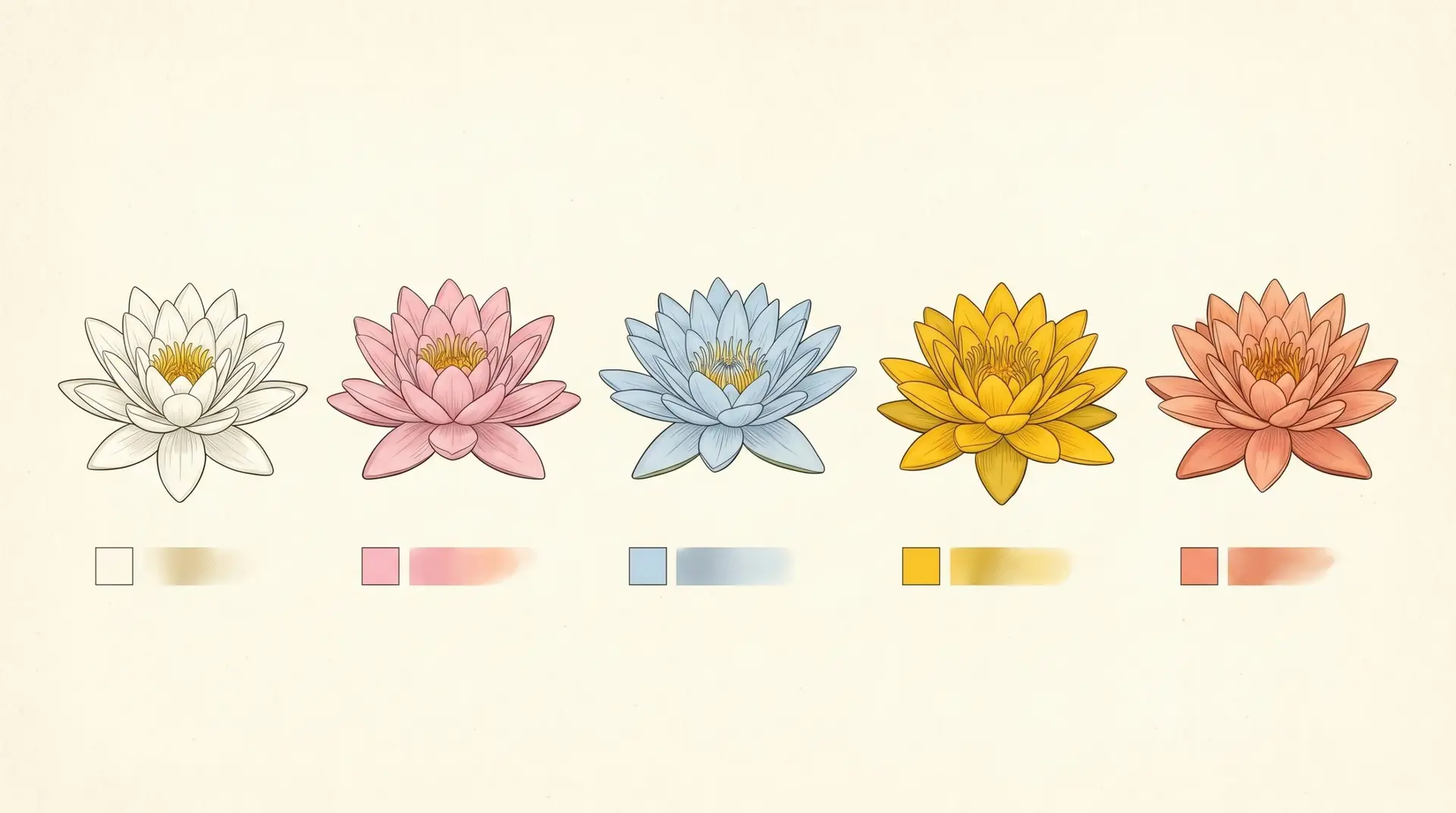
Water lily color has distinct symbolic readings within the broader theme of purity and rebirth:
White water lily (Nymphaea alba and similar): the most traditional. Pure purity, innocence, spiritual awakening. The classic European symbolic reading and the dominant funeral/sympathy choice within the water lily family.
Pink water lily (Nymphaea ‘Aurora,’ Nymphaea rubra hybrids): gentle affection, romantic devotion. The pink color shifts the spiritual reading slightly toward warmer relational warmth.
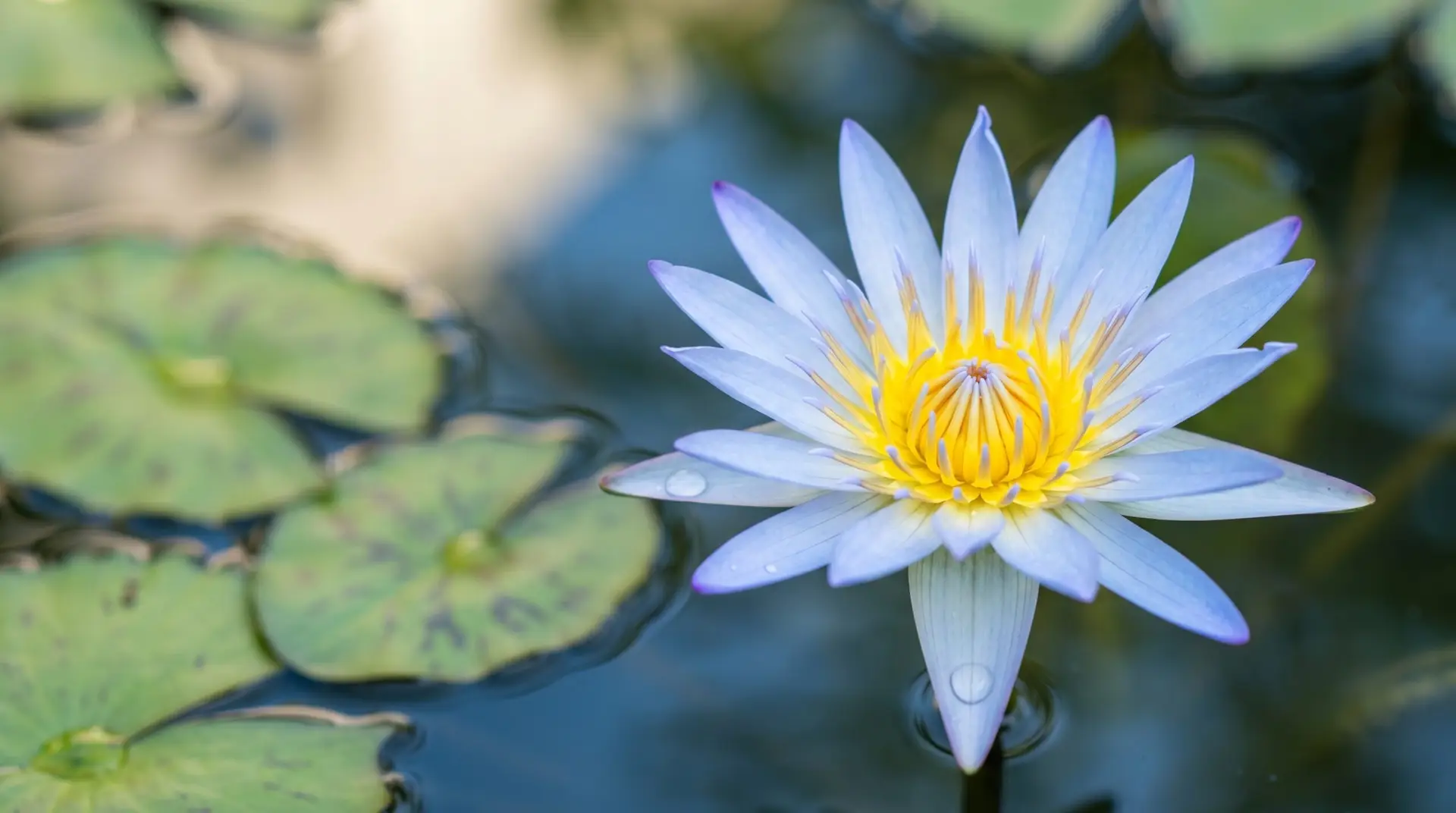
Blue water lily (Nymphaea caerulea, the Egyptian water lily): ancient Egyptian sacred symbolism, enlightenment, divine consciousness. The most culturally weighted of all water lily colors because of the direct Egyptian religious connection.
Yellow water lily (Nymphaea mexicana and hybrids): joy, sunshine, vitality. Less culturally weighted than the religious colors but visually striking in garden settings.
Peach or salmon water lily (modern hybrids): warmth, gentle pleasure, summer abundance. Modern color forms developed primarily through twentieth-century hybridization.
Multi-color or bicolor water lily: layered symbolism. Modern hybrid varieties sometimes show color transitions within a single flower (white center to pink outer petals, for example) that express combined readings.
Florist usage treats water lily as the spiritual-occasion flower across both Western and East Asian traditions. Water lilies work well for weddings (purity, new beginnings), funerals (rebirth, peace), memorial services, anniversaries with spiritual significance, and birthdays where the recipient values the religious or contemplative dimension of flower gifting.
July personalities by flower symbolism
Reading personality from a birth flower is closer to a horoscope than to psychology. Take it as a useful lens, not as evidence. The two July flowers offer contrasting readings that combine into a distinctive personality profile.
The water lily side of July reads as quiet depth and spiritual awareness. People in the water lily profile are the contemplatives who think deeply before speaking, the ones who maintain inner stillness through external chaos, and the ones whose presence has a calming effect on others around them. The daily-renewal pattern of the flower (opening at dawn, closing at dusk) suggests reliable rhythms in personality: people who hold steady patterns of rest and engagement across years and decades. The Egyptian sacred-symbol layer adds a spiritual-philosophical register that suits July-born readers drawn to religious, contemplative, or philosophical interests.
The larkspur side reads as openness and joyful enthusiasm. People in the larkspur profile have open hearts (ready to engage with new people and experiences), ardent attachment (the willingness to invest deeply when something matters to them), and joyful affection (an expressive quality that others recognize and remember). The tall spire form of larkspur connects to ambition and visible achievement: larkspur-profile people often pursue clear visible goals with sustained focus.
The combination describes a July personality that pairs contemplative depth (water lily) with expressive enthusiasm (larkspur). July-born readers who describe themselves as both quietly thoughtful and openly engaged with the world will recognize the fit.
Gift ideas for July birthdays
July birthdays fall in peak summer bloom across most of the northern hemisphere, which makes both birth flowers seasonally available. Gift logic varies by recipient preference and occasion register.
Water lily as a cut flower is rare in commercial florist trade because the flowers do not hold well after cutting (they close in transit and do not reopen reliably indoors). The most accessible water lily gift category is a living plant or a pond installation for recipients with garden ponds. Specialty water garden suppliers ship dormant rhizomes from spring through autumn at prices typically running from twenty to fifty dollars for a starter plant.
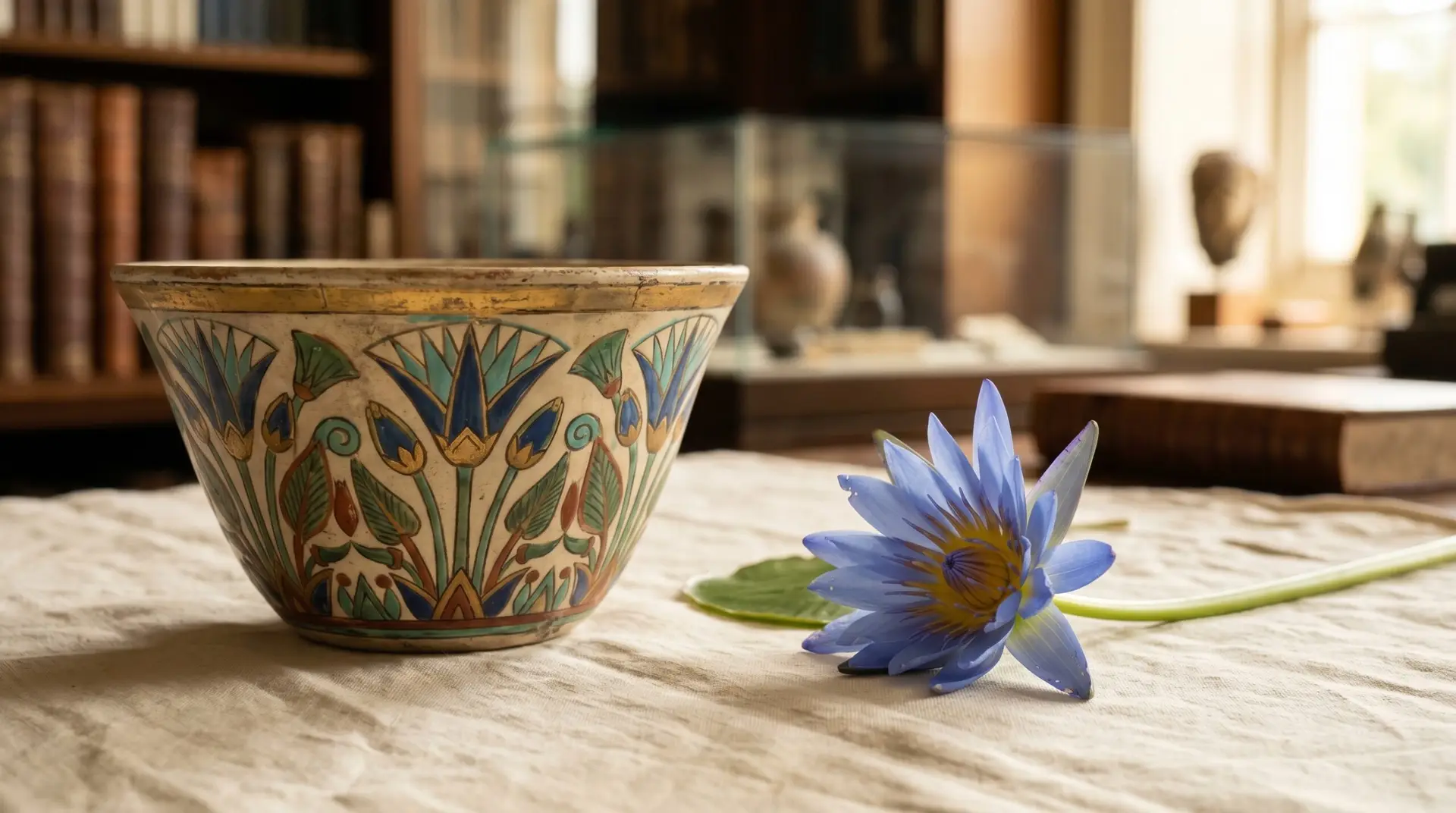
A small tabletop water garden with a single water lily can work as a substitute for recipients without outdoor pond space. The setup involves a wide shallow ceramic bowl, water, a single Nymphaea pygmaea (the smallest cultivated water lily species), and aquatic gravel. Total setup typically costs from forty to one hundred dollars and provides indoor summer water-feature interest.
Larkspur as a cut flower is widely available in summer florist trade. A bouquet of larkspur spires in mixed colors (deep blue, pink, lavender, white) makes a striking vertical-element gift bouquet. Larkspur pairs well with peonies, sweet peas, and other summer-bouquet flowers. Florist prices typically run from forty to one hundred dollars for a mixed-flower bouquet featuring larkspur as the central spire element.
Water lily and larkspur seeds for gardeners give a long-term gift that returns each summer. Heritage seed suppliers offer Consolida ajacis seeds (annual larkspur) and various Nymphaea seeds at affordable prices from five to twenty dollars per packet. The recipient plants seeds in spring for summer bloom.
For recipients with interest in Egyptian culture or symbolic depth, a Nymphaea caerulea (blue Egyptian water lily) plant gives a culturally meaningful gift. The species is more demanding to grow than common European water lilies (warmer water requirements, often needs overwintering indoors in temperate climates), but the cultural significance justifies the additional care for interested recipients.
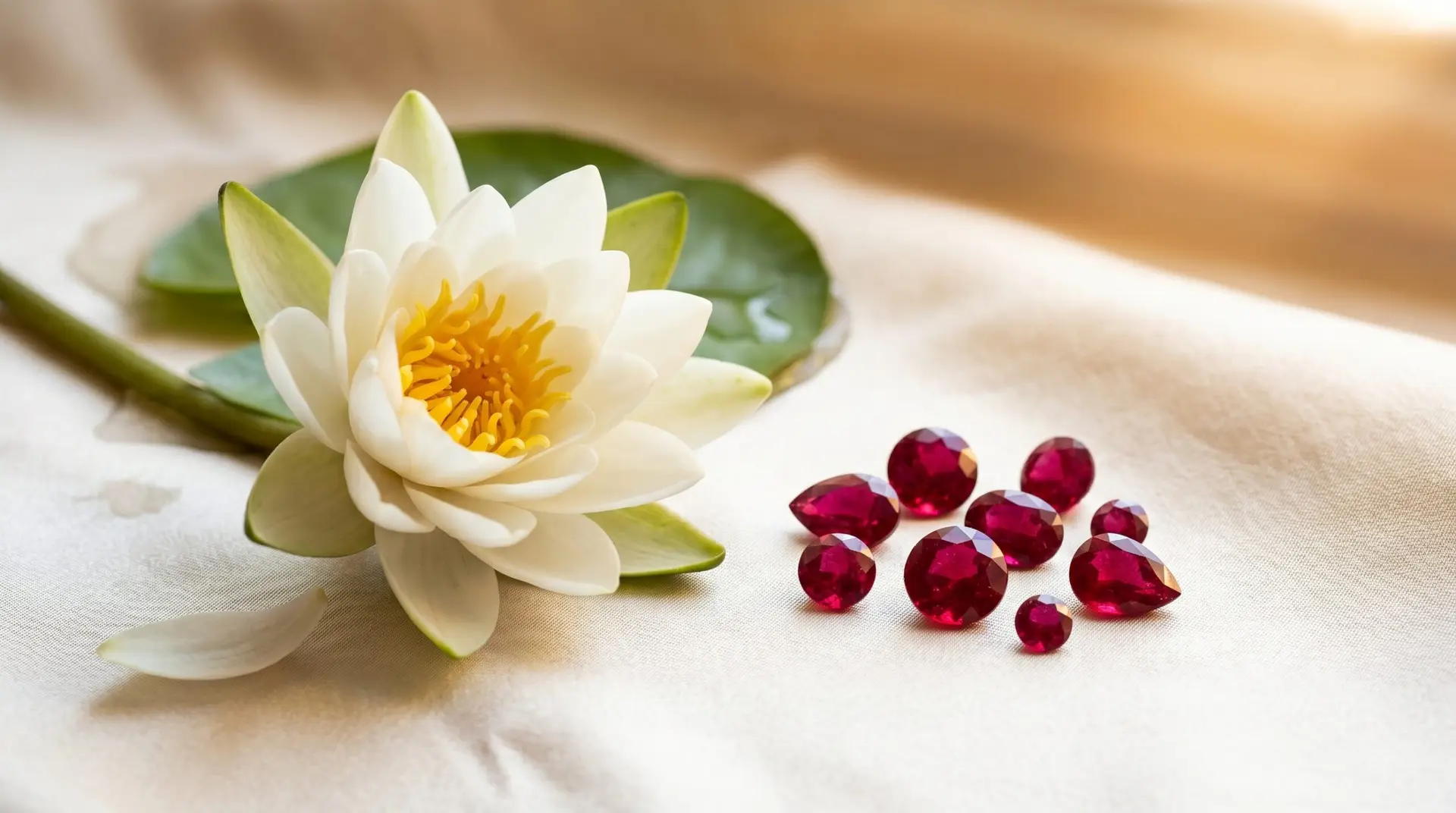
A jewelry piece combining water lily motif work with ruby (the July birthstone) creates a coherent color and cultural pairing. Ruby’s deep red contrasts naturally with most water lily colors (white, pink, blue), making jewelry that pairs the two visually striking. Price tiers range from about fifty dollars for simple ruby studs to several thousand dollars for fine pieces with water lily motif work.
At a glance
Questions
Frequently asked
What is July’s birth flower?
Water lily as the primary and larkspur as the secondary. Water lily is the genus Nymphaea with approximately 70 species. Larkspur refers to the genera Consolida (annual) and Delphinium (perennial), both in the family Ranunculaceae.
Why is water lily July’s birth flower?
Water lily has peak bloom in July across temperate climates. The flower also has a deep religious-symbolic anchor through its central role in ancient Egyptian culture (Nymphaea caerulea as a sacred flower associated with the sun, documented in Old Kingdom Egyptian art). Victorian flower writers chose water lily for July because of both seasonal availability and this long cultural heritage.
What is the difference between water lily and lotus?
The two plants belong to entirely different botanical families despite visual similarity and common cultural conflation. Water lily (Nymphaea, family Nymphaeaceae) has leaves that float on the water surface. True lotus (Nelumbo nucifera, family Nelumbonaceae) has leaves that rise above the water surface on stems. The Egyptian “lotus” of art history is actually Nymphaea caerulea (blue water lily), not true lotus. Buddhist iconography traditionally uses true lotus, though the two plants are often blended in popular Western reference.
What did water lily mean in ancient Egypt?
Water lily was the central religious symbol of the sun god Ra and of broader Egyptian conceptions of death and rebirth. The flower’s daily cycle of opening at dawn and closing at dusk figured the daily resurrection of the sun. Egyptian creation myths featured the water lily prominently. The flower appears in nearly every Egyptian domestic, religious, and afterlife depiction across over 3000 years of Egyptian art.
Is larkspur poisonous?
Yes, all parts of larkspur (Consolida and Delphinium) contain alkaloids toxic to humans and livestock if eaten. Larkspur poisoning has historically been a significant cattle-mortality cause in western US grazing lands. Do not eat any part of larkspur; keep pets and small children away from cut-flower stems and growing plants.
What’s the difference between larkspur and delphinium?
Both belong to the family Ranunculaceae. Larkspur typically refers to the annual Consolida species (Consolida ajacis and related), while delphinium typically refers to the perennial Delphinium species. The two are closely related and visually similar; older botanical references sometimes classified Consolida within Delphinium. The functional distinction for gardeners: larkspur (Consolida) is annual and grown from seed each year, delphinium (Delphinium) is perennial and returns from established plants.
What birthstone goes with July’s birth flower?
Ruby. The deep red of ruby creates dramatic visual contrast with water lily’s typical white, pink, or blue colors. Ruby was traditionally associated with July through both Western birthstone tradition (formalized 1912) and older folk associations.
Can you eat water lily?
Some species are edible and have traditional culinary uses in various cultures. Egyptian Nymphaea caerulea was used in ancient Egyptian religious-culinary contexts (the petals were sometimes used in ceremonial drinks). Asian traditions use various Nymphaea species in cuisine. However, do not eat water lilies from unknown sources or without botanical identification; some species contain compounds with significant pharmacological activity, and water lily growing in polluted ponds can absorb contaminants from the water.
Why was water lily sacred to ancient Egyptians?
The daily cycle of the flower (opening at dawn, closing at dusk, sinking below water and rising again) provided the central religious metaphor for the daily resurrection of the sun god Ra. Egyptian religion treated the cycle as the foundational pattern of all life and renewal. The flower appears in creation myths as the source of the original god emerging from primordial waters.
Can I grow water lilies in a small space?
Yes. Pygmy water lilies (Nymphaea pygmaea and similar small species) work in containers as small as a half-barrel water feature or large ceramic bowl. The smaller species reach only 12 to 18 inches across at maturity and tolerate containers without difficulty. Larger water lily species need pond installation with adequate depth (12 to 24 inches typically) and surface area.
Sources
- Water lily (Nymphaea) · Encyclopedia Britannica
- Nymphaea growing guide · Royal Horticultural Society
- Larkspur (Consolida, Delphinium) · Encyclopedia Britannica
Keep reading

July birth flowers by day: the Korean 365-day tradition
Larkspur flower meaning: Greek mythology, growing, and toxicity
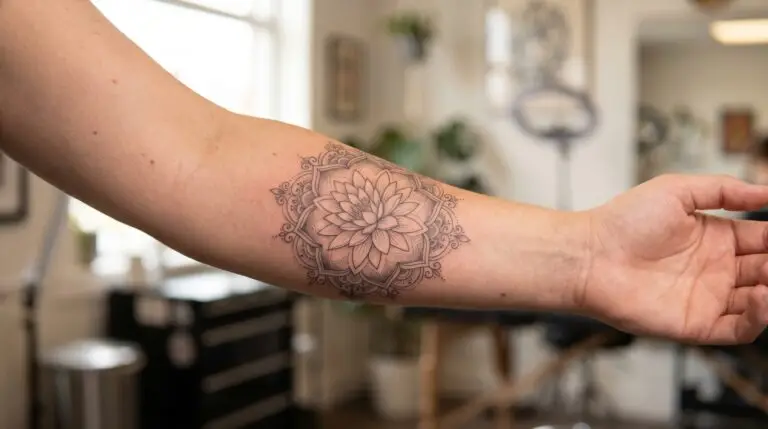
Water lily tattoo: designs, Egyptian heritage, and placement
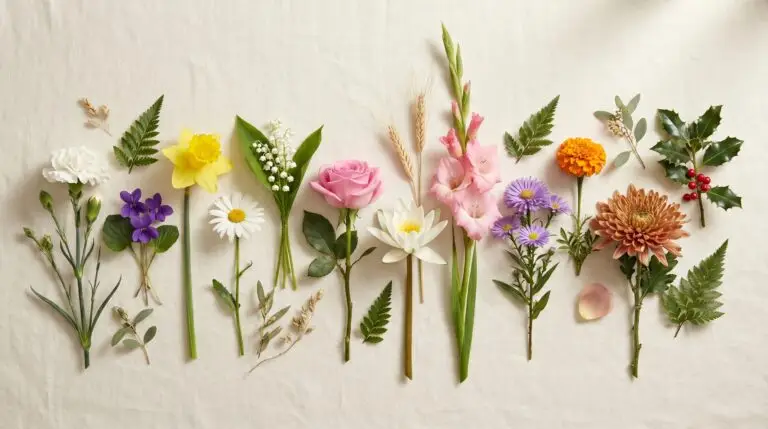
Birth flower by month: all 12 monthly flowers
Enjoying our flower guides? Add YourFlowersGuide as a preferred source on Google. It helps more readers find us.
Add to Preferred Sources