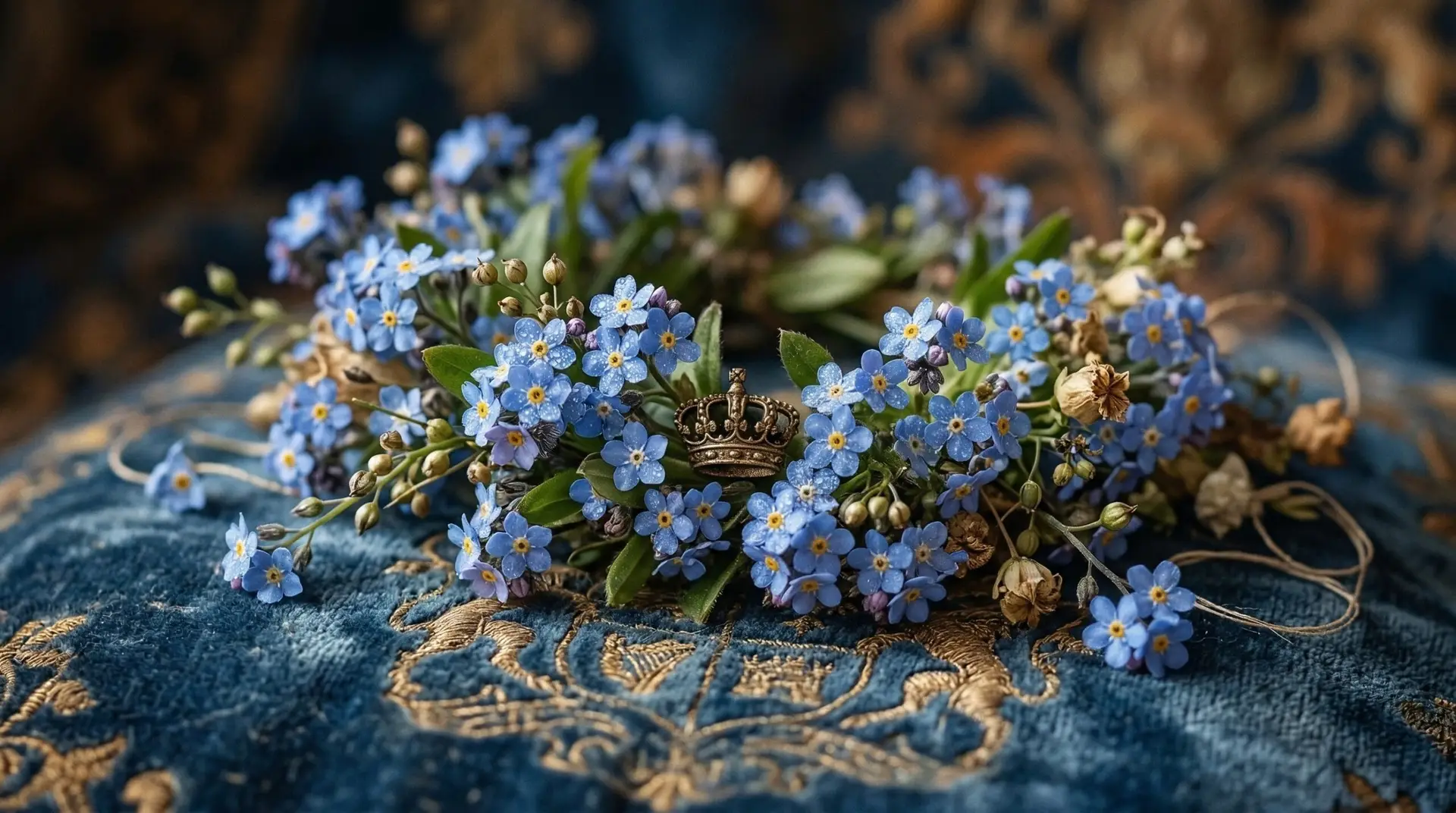
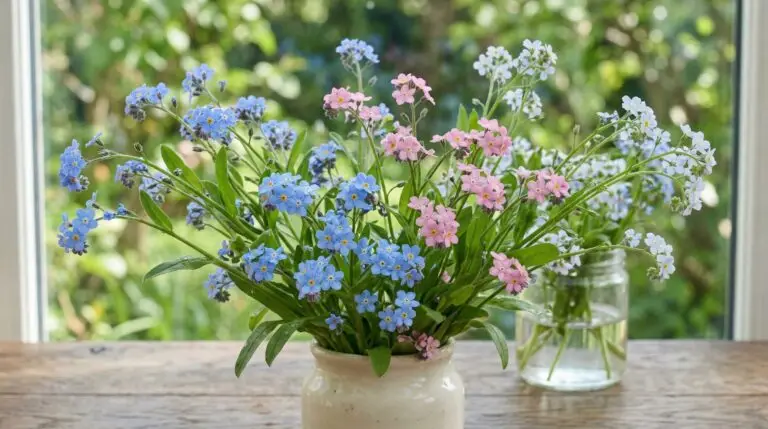
In the late fourteenth century, an exiled English nobleman chose a small blue wildflower as his personal emblem. Henry Bolingbroke, the future King Henry IV of England, faced banishment by his cousin Richard II in 1398. Before leaving the country, Henry adopted the Myosotis flower and incorporated it into his heavy gold collar of SS. He paired the botanical symbol with the Old French motto “Souveigne vous de moy”, asking his supporters to remember him during his absence. This political maneuver marks the beginning of documented forget-me-not history in the English language. The humble plant transformed instantly from a common woodland weed into a powerful badge of political loyalty.
When Henry returned to claim the throne in 1399, his followers wore the blue blossoms to signal their allegiance to the new regime. The flower offered a stark contrast to the heavy, formal heraldry of the era. While other monarchs relied on grand botanical symbols like the rose to project military power and dynastic claims, Henry used the forget-me-not to evoke a sense of intimate personal loyalty. His supporters embroidered the five-petaled flowers onto their tunics and painted them onto wooden shields. This strategic use of a delicate plant embedded the flower deeply into the English cultural consciousness. It established a permanent connection between the small blue blooms and the act of faithful remembrance.
Contents 4 sections
Romantic poetry and the language of grief
By the early nineteenth century, the cultural meaning of the plant shifted away from royal politics toward deeply personal sentiment. English Romantic poets adopted the flower as a favored subject for exploring human memory and the inevitability of loss. William Wordsworth frequently referenced the plant in his writing, viewing its fragile blue petals as a mirror for fleeting human emotions. Writers of the Romantic period believed that native, wild plants possessed a pure emotional resonance that heavily cultivated garden varieties lacked. They favored the simple woodland forget-me-not over exotic hothouse specimens like the lily when writing about authentic grief. The flower became a literary device used to discuss how memory persists even as the physical world decays around us.
European folklore heavily influenced this literary movement and cemented the forget-me-not cultural significance across the continent. A widespread German legend described a medieval knight walking along the Danube with his lover. When he attempted to pluck a cluster of blue flowers growing on the riverbank, the weight of his armor pulled him into the swift current. As he drowned, he threw the blossoms to his lover and shouted out a plea for her to remember him. Poets and translators carried this tragic narrative into English, French, and Italian literature throughout the 1800s. Readers embraced the story entirely, and the flower became universally understood as a literal embodiment of eternal love and tragic separation.
Preserving memory in Victorian material culture
The Victorian era moved this literary symbolism out of poetry books and into the physical practice of everyday life. Middle-class women developed a deep fascination with floriography, the language of flowers, and spent hours creating elaborate pressed flower art. The forget-me-not was the most highly prized specimen for these sentimental albums and personal herbariums. Its flat, simple structure made it incredibly easy to press between the heavy pages of a book, and the petals retained their distinct blue color for decades after drying. Women carefully arranged these dried blooms on paper to commemorate specific dates, departed friends, or children who died in infancy. The physical flower served as a tangible piece of memory that could be kept in a parlor drawer.
This obsession with physical preservation elevated the forget-me-not in art and decorative objects throughout the nineteenth century. Artisans painted the blue blossoms onto porcelain teacups, carved them into wooden mourning boxes, and wove them into hair jewelry made from the locks of deceased relatives. Presenting someone with a forget-me-not during this era was understood as a direct request for lifelong devotion. The flower appeared constantly in the margins of illuminated manuscripts, on the embossed covers of diaries, and on commercially printed greeting cards. It functioned as a visual shorthand for memory itself, instantly recognizable to anyone living in Victorian society. The plant had fully transitioned from a living organism into a standardized cultural icon.
A clandestine symbol of resistance
In the twentieth century, the flower returned to its medieval roots as a dangerous political emblem of loyalty under persecution. During the rise of the Nazi regime in Germany in the 1930s, the state systematically suppressed Freemasonry, confiscating lodge properties and arresting members. German Freemasons needed a subtle way to identify one another in public without attracting the attention of the secret police. In 1938, a Nazi charitable organization called the Winterhilfswerk sold small enamel forget-me-not pins to raise money for state welfare programs. Freemasons quietly adopted this specific pin as a replacement for their traditional square and compass emblem. Wearing the state-approved blue flower allowed members to signal their fraternity and mutual support right under the eyes of their oppressors.
After the Second World War ended, the United Grand Lodges of Germany officially adopted the forget-me-not pin as an emblem of the suffering their members endured. The flower took on a heavy new layer of historical meaning, representing those who maintained their principles through years of violence and dictatorship. Just as the red poppy became the universal flower of remembrance for soldiers lost in the trenches of the First World War, the blue forget-me-not became a specific memorial for persecuted fraternities. Masonic lodges around the world still use the flower today to honor members who have died and to remember the dark years of the 1930s and 1940s. The plant continues to serve as a quiet marker of survival and institutional memory.
Cultivating history in the modern garden
Modern gardeners who plant Myosotis species continue a tradition that spans centuries of human emotion and political upheaval. The cultivation techniques for these plants have changed very little since Victorian horticulturists first selected them for deeper blue colors and larger bloom sizes. Sowing these tiny seeds in damp, shaded borders recreates the exact visual effect that inspired medieval kings, Romantic poets, and wartime resistance fighters. Every time these bright blue flowers emerge in the spring, they carry the accumulated weight of exiled monarchs, grieving lovers, and secret societies. The simple act of growing them today keeps this long cultural history alive in the soil of contemporary gardens. The forget-me-not remains exactly what its name demands, a living mechanism for remembering the past.
More About Forget-me-nots
Forget-me-nots in containers and window boxes for spring cottage charm

Forget-me-not flower meaning and the romantic legend behind the name

Growing forget-me-nots from seed and the simple trick of fall sowing for spring flowers

How to control forget-me-nots when self-sowing becomes too enthusiastic
How to grow forget-me-nots for clouds of tiny blue flowers in spring gardens

Water forget-me-nots for pond edges and stream banks that stay wet

Forget-me-nots as ground cover under spring bulbs for a layered woodland look
Forget-me-nots for wedding flowers and the sentimental meaning for bridal bouquets
Best forget-me-not varieties from classic blue Myosotis to pink and white forms
Enjoying our flower guides? Add YourFlowersGuide as a preferred source on Google. It helps more readers find us.
Add to Preferred Sources