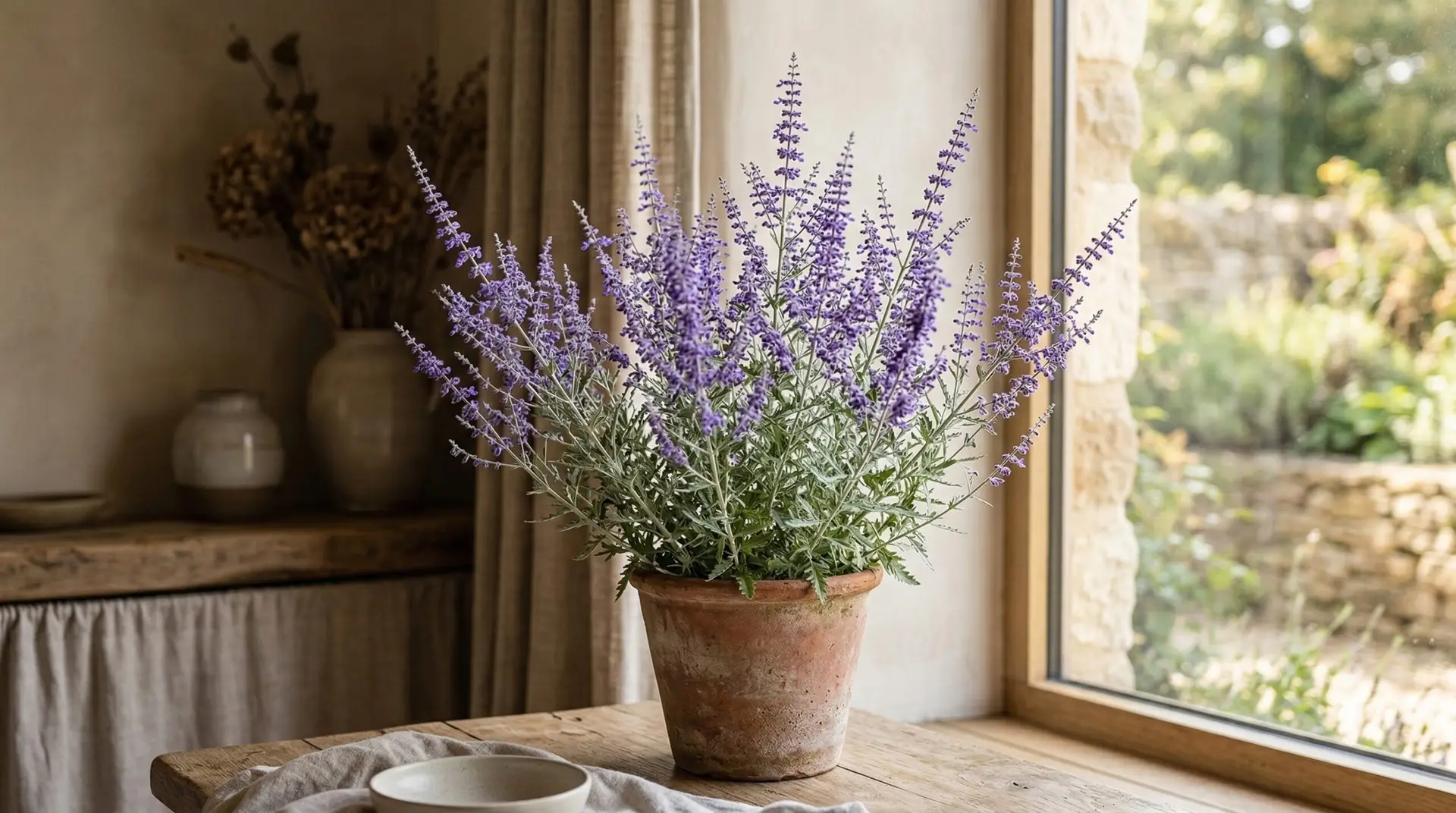
The late August morning breaks with a heavy, cold dew that leaves the grass wet until nearly noon. Most of the garden has surrendered to the heat of the preceding weeks, dropping leaves and going to seed in the quiet anticipation of autumn. Yet, standing at the edge of the gravel path, a massive cloud of pale violet and silver commands the space, entirely alive with a low, vibrating hum. This is the Russian sage, rising chest-high and sprawling outward with an untamed, wild grace. I watch a solitary bumblebee, its thorax dusted with pale yellow pollen, grab onto a tiny tubular blossom. The weight of the insect pulls the slender stem downward in a slow, graceful arc before the bee releases its grip and moves to the next flower. In a season defined by endings, this plant offers a profound and generous continuation, feeding the winged workers that are desperately preparing for the coming frost.
We often plant gardens for our own visual pleasure, choosing colors and forms that satisfy some internal craving for order or beauty. But to observe perovskia pollinators at work is to understand that a garden is fundamentally a feeding ground, a working ecology where survival is the primary currency. From mid-July through the fading days of September, this plant produces an unbroken succession of tiny, nectar-rich flowers along its chalky white stems. This two to three month bloom period is a lifeline for local insect populations. While early summer offers an abundance of food, the late summer environment can be a desert for foraging insects. Russian sage bridges this difficult gap, offering reliable sustenance when the days grow shorter and the shadows lengthen. The sheer volume of flowers on a mature plant ensures that hundreds of insects can feed simultaneously without exhausting the supply.
Contents 3 sections
A quiet persistence in the late season
Gardening teaches a slow acceptance of what a place actually is, rather than what we might wish it to be. My soil is rocky and drains with a speed that leaves water-loving plants withered by July, but Russian sage thrives in exactly these sparse, unforgiving conditions. It asks for nothing more than full sun and earth that refuses to hold moisture. When we try to coddle it with rich compost or extra water, the plant responds by growing weak, floppy stems that collapse under their own weight. It shares this ascetic preference with lavender, another Mediterranean spirit that demands dry feet and hot afternoon sun. Learning to grow these plants means learning to withhold our heavy-handed care. We must step back, allow the soil to bake, and trust the deep, woody taproots to find what they need far below the surface.
The physical act of tending the plant requires a similar kind of patient restraint. In the deep cold of January, the silver stems stand completely bare, catching the low winter light and holding the frost. It is tempting to cut them to the ground when the first warm day arrives in March, but the hollow stems provide shelter for overwintering insects, and the plant itself is slow to awaken. I wait until April, when tiny gray-green buds finally appear low on the woody base, before I take the pruning shears to the old growth. Cutting the stems releases a sharp, medicinal scent, a pungent mix of sage and camphor that clings to my gloves for days. It is a clean, waking smell that signals the true beginning of the growing season. The new growth emerges quickly after that, soft and silvery, reaching upward to claim its space alongside the emerging stalks of coneflower and other summer companions.
The steady rhythm of the winged foragers
By the time the first violet blooms open in the summer heat, the insects are already waiting. The relationship between the flowers and the Russian sage bees that work them is an exercise in perfect, evolved geometry. The lower lip of each tiny blossom acts as a landing pad, perfectly sized for the feet of a honeybee or a small native bumblebee. I sit on the warm gravel for an hour just watching them navigate the towering spikes. A honeybee approaches methodically, starting at the bottom of a flowering stem and spiraling upward, probing each calyx for nectar before flying to the base of the next stalk. They work with a frantic, single-minded focus, their wings a blur of translucent motion against the soft blue background. The air is thick with their collective sound, a deep and resonant vibration that feels like the very pulse of the garden.
It is not just the honeybees that find refuge in these silver branches. Tiny solitary bees, hoverflies, and the occasional late-season butterfly all gather in the sprawling canopy. The diversity of life here rivals the frantic activity I observe earlier in the season around the catmint, but with an added urgency born of the approaching autumn. Wasps, often maligned but essential to the balance of the insect world, patrol the perimeter, hunting for pests among the fragrant leaves. The plant holds this entire community together, providing both food and a dense, protective structure where smaller insects can hide from predatory birds. Watching this complex web of interactions, the boundary between the cultivated garden and the wild world dissolves completely. The plant becomes a living architecture, a temporary city built of nectar, pollen, and silver leaves.
Gathering light before the frost
As September gives way to October, the angle of the sun shifts, casting long, golden shadows across the yard by mid-afternoon. The Russian sage begins to lose its deep blue color, the tiny petals drying and falling away to leave behind pale, mauve-colored calyxes. Yet, even as the color fades, the nectar flows, and the bees continue their daily visitation. The mornings are colder now, and the insects are slow to arrive, waiting for the sun to warm the silver stems before they begin their work. Sometimes I find a bumblebee asleep on a flower spike at dawn, its body perfectly still, anchored to the plant by its mandibles to survive the chill of the night. As the sun touches the frost on the leaves, the bee slowly stirs, warming its flight muscles with a low, audible vibration. It is a moment of profound vulnerability and resilience, played out on a single stem.
Eventually, the hard freeze will come, turning the remaining foliage brown and signaling the end of the long harvest. The bees will retreat to their hives and underground burrows, carrying with them the concentrated energy of the late summer sun. The garden will strip itself down to bare soil and dormant crowns, entering the quiet sleep of winter. But the pale stems of the sage will remain standing, casting thin shadows across the snow. They hold a physical memory of the heat, the light, and the thousands of wings that beat among them just weeks before. To plant for pollinators is to participate in this ancient, unbroken cycle of provision and rest. We put the roots in the ground, we wait for the rain, and we watch as the wild world comes to take exactly what it needs to survive the dark months ahead.
More About Russian Sage
Russian sage companion plants: what to grow and avoid
How to grow Russian sage for airy lavender-blue clouds that float above the summer border
Russian sage versus lavender and which silver-stemmed blue bloomer is right for your garden
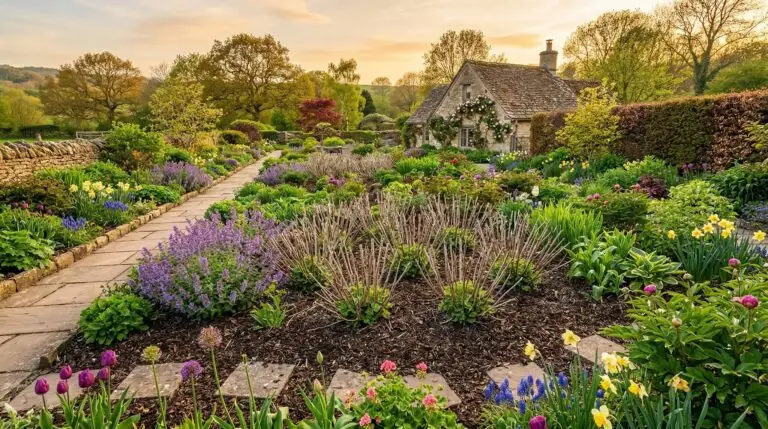
How to prune Russian sage in spring without ending up with a woody tangled mess
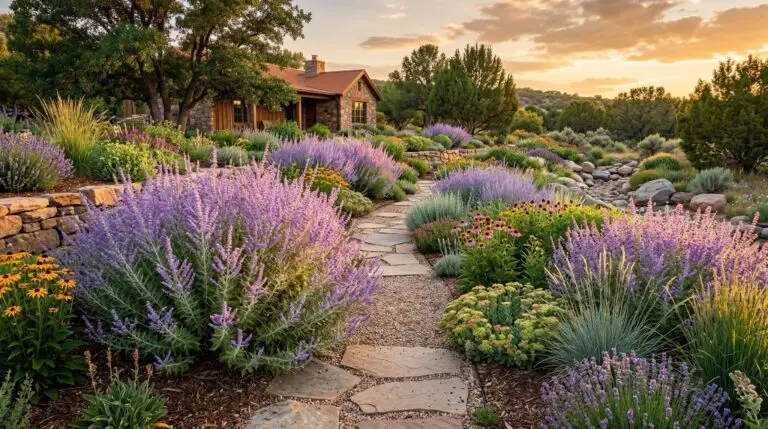
Russian sage as a drought-tolerant superstar for waterwise and xeriscape gardens
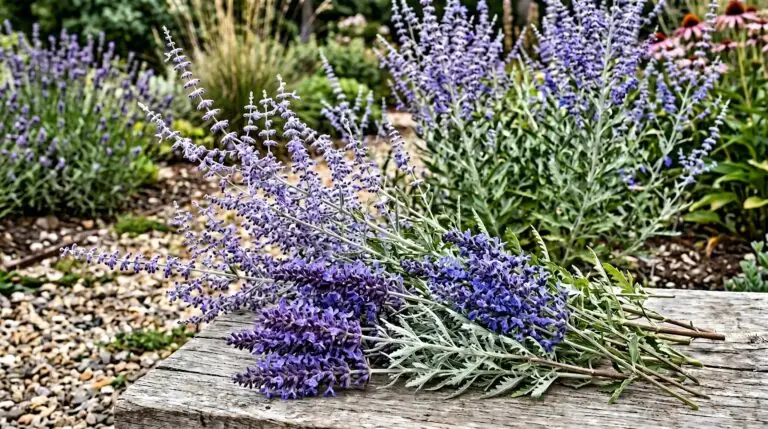
Best Russian sage varieties from compact Little Spire to silvery Blue Jean Baby
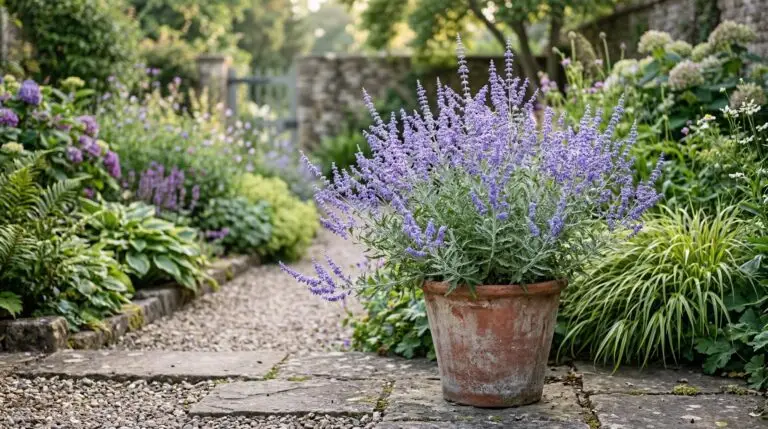
Growing Russian sage in containers for silver-blue drama on sunny patios
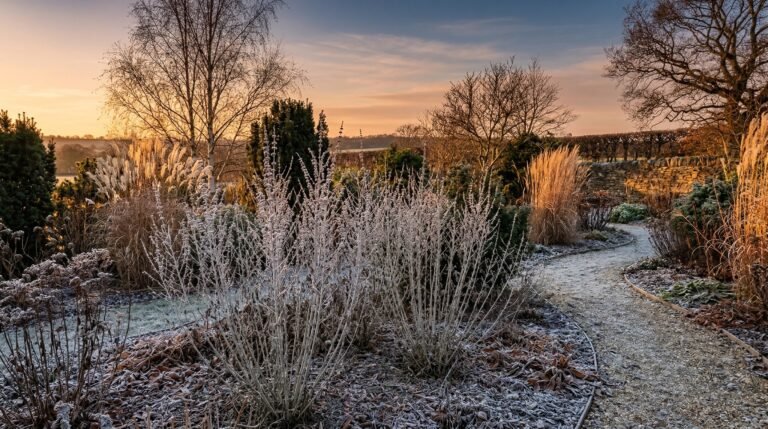
Russian sage in winter and the silver-white stems that bring structure to the frozen garden
Enjoying our flower guides? Add YourFlowersGuide as a preferred source on Google. It helps more readers find us.
Add to Preferred Sources