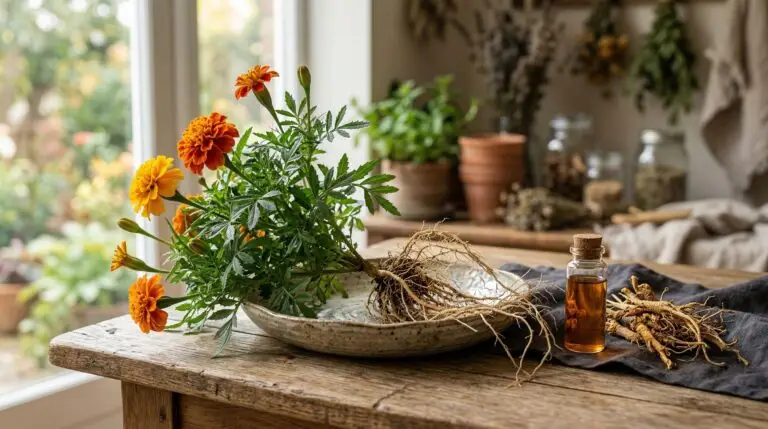
What to plant with Marigold
The pairing · pick a flower
All Marigold companions
What not to plant near Marigold
The best companions for marigolds, explained
Marigold carries the biggest reputation of any flower in a companion-planting guide, and most of that reputation rides on a claim that is only partly true, which makes the honest companion list more useful than the mythical one. Once the pest-control story is set aside, marigold turns out to be an easy, unfussy partner: full sun, quick drainage, and a long, heat-tolerant bloom season that lines up almost exactly with the classic warm-color cutting-garden annuals. Zinnias are the strongest match on the list, sharing marigold’s exact light and soil needs and blooming continuously through the same stretch of the calendar, so the two read as one bed rather than two schedules layered awkwardly on top of each other. Cosmos does something subtler: it actually prefers leaner, poorer soil than marigold tolerates, which means it never competes for fertility, and its ferny, wind-blown foliage is the cleanest textural contrast marigold has, coarse mounds against airy lace. Dahlia and sunflower both share the same sun-hungry, heat-loving profile, and both peak in the same late-summer window, though each carries its own caveat worth knowing before you plant them close, dahlia’s nematode vulnerability is gardener folklore rather than a documented finding, while sunflower’s root chemistry is the better-sourced of the two.
Where marigold genuinely lacks something, blue salvia and petunia fill the gap by design rather than mechanism. Marigold has no true blue anywhere in its own palette, so a spiky, violet-blue partner in the same full sun and drainage supplies the one color and the one vertical shape a mounded orange or yellow bed cannot produce on its own. Petunia does a smaller job well: its trailing, low habit softens the hard edge marigold’s upright form leaves along a path, container rim, or bed border, and it tolerates the same summer heat without missing a beat. None of these five pairings depend on a repellent effect or a hidden chemical benefit. They work because the plants want the same things at the same time, which is a lower bar than the folklore promises but a far more reliable one.
What not to plant near marigold
The honest avoid list for marigold is short, and it looks different from most flowers’ avoid lists because marigold’s real problems run in the opposite direction from usual. Instead of being a fussy plant that other flowers overwhelm, marigold is the one doing the overwhelming: its roots release thiophene compounds, including alpha-terthienyl, the same chemistry responsible for its documented nematode suppression, and peer-reviewed rhizosphere research has measured that this exudate can slow the growth of a competing neighbor planted close by. Stunted bean growth planted next to marigold is a widely repeated field observation among gardeners, and it fits the documented pattern even though the beans-specific case has not been tested as directly as the effect on other competing plants, so the safer move is real distance between marigold and any legume rather than tucking beans in as a border planting.
The second avoid is simple physiology rather than chemistry: marigold needs six or more hours of direct sun to bloom well, and it stalls out fast in shade, so any shade-requiring companion, hosta, fern, or the like, sets up a straightforward light conflict that no amount of soil prep will fix. The third is a softer one that surprises people who assume every flower wants more feeding: extension sources note that overly rich, heavily fertilized soil pushes marigold toward lush leaves at the expense of flowers, so pairing it with a genuinely heavy feeder on a shared fertilizer schedule works against marigold’s own bloom rather than helping it. What is conspicuously absent from this list is anything about zinnia or geranium. Several low-authority gardening sites list both as marigold "enemies," describing conflicts in vivid, anecdotal terms with no mechanism behind them, and that claim does not survive contact with the actual research. Zinnia’s cultural needs match marigold’s almost exactly, which is the opposite of a conflict, and no citable source offers a real reason geranium and marigold would clash. Treat any "avoid" list that cannot name a mechanism with real skepticism, marigold’s own reputation is proof of how far an unsupported claim can travel.
Do they like the same conditions?
Marigold is one of the least soil-fussy flowers on this site, and that changes the shared-conditions test in a useful way. Where a plant like hydrangea forces every companion through a narrow acid-soil, consistent-moisture filter, marigold tolerates clay, sand, and loam, a wide pH range, and real drought once established, so almost any full-sun annual clears the soil bar without effort. Sun is the one condition that actually sorts companions into workable and unworkable categories: marigold wants six to eight or more hours of direct light and drops bloom fast in shade, so every plant on the companion list above, zinnia, cosmos, dahlia, sunflower, blue salvia, petunia, shares that same sun-hungry profile, confirmed independently across extension sources for each species. Water is a similar non-issue. Marigold is more drought-tolerant than most bedding annuals once it settles in, which widens the realistic pairing pool considerably compared to a thirstier host, and none of the companions above need meaningfully more water than marigold already tolerates.
The one condition worth naming honestly, because it undercuts a genuinely popular myth, is that marigold’s own bloom performance actually declines with too much fertilizer, the opposite of what most flowers want. Extension sources are consistent on this: marigold is a low feeder that needs little more than a slow-release fertilizer at planting time, and pushing it further with a heavily fed, high-nitrogen bed sends the plant’s energy into leaf growth instead of bloom. That single fact reframes a few pairing decisions. Cosmos, which independently prefers lean soil for the same foliage-over-flower reason, turns out to be an unusually good fertility match rather than just a lucky coincidence, and it is one more reason not to treat a marigold bed the way you would treat a rose bed, rich and heavily fed. The African/American marigold (Tagetes erecta) grown on this site’s own pillar page runs taller and showier than the compact French marigold (Tagetes patula) most companion articles are actually picturing, one to four feet against six to twelve inches, so height-pairing decisions should account for that difference rather than assuming every "marigold companion" list is describing the same plant.
How to plant them together
Space every companion here at least 12 to 18 inches from marigold’s base, both to give roots room and to keep marigold’s thiophene-releasing root zone from crowding a sensitive neighbor too closely. Zinnia and cosmos can sit as close as 12 inches since neither competes hard for fertility or water, while dahlia and sunflower want 18 to 24 or even 36 inches given their size at maturity and, in sunflower’s case, its own allelopathic root chemistry working in the opposite direction. Build the bed in layers by height rather than planting everything at one level: petunia or a low blue-and-violet edging plant like ageratum at the front, marigold and zinnia at mid-height doing most of the color work, and cosmos, dahlia, or sunflower rising behind as a taller backdrop that does not shade the shorter bloomers out.
Timing matters more here than it does for a perennial host, since marigold is grown as a warm-season annual almost everywhere, started indoors six to eight weeks before the last frost and set out once frost danger passes. Plant every annual companion, zinnia, cosmos, petunia, on the same rough schedule so nothing gets a head start that shades out a slower-germinating neighbor. In containers, marigold’s tolerance for average soil and moderate drought makes it an easy anchor plant: pair it with a trailing petunia at the pot’s edge and a taller cosmos or salvia at the center for a self-contained version of the same bed-layering logic. If nematode suppression for a future vegetable bed is the actual goal rather than a decorative pairing, that is a separate project entirely: it requires a solid, dense planting of marigold alone, tilled into the soil as green manure at least two months before the target crop goes in, not a border planted alongside it.
Does companion planting actually work for marigold?
The honest verdict splits cleanly down the middle, and the split itself is the most useful thing this page can tell you. Proven, and backed by university research actually opened for this page: marigold suppresses root-knot nematodes, but only when grown as a dense cover crop and tilled into the same bed at least two months ahead of the target planting, a mode of use almost nobody who scatters a few marigolds along a garden border is actually practicing. French marigold interplanted with tomatoes measurably reduces glasshouse whitefly settlement through airborne limonene, a real, published, mechanism-based effect, though it is specific to that pest and that plant combination rather than a general insect repellent. Partial and worth naming honestly: marigold’s own thiophene chemistry can slow the growth of some neighboring roots, which makes marigold a mild bad neighbor to sensitive plants immediately at its base even as that same chemistry does real pest-suppression work elsewhere.
Folklore, and this is the larger bucket than most people expect: university research has found no reliable evidence that marigold’s scent alone repels aphids, hornworms, or the general run of garden insects that consumer sources credit it with deterring. Deer avoidance is inconsistent and drops off once deer get hungry enough or habituated to the smell, closer to a nutritional non-preference than a chemical repellent, and a landscape planting alone is not a documented mosquito control method, whatever compounds show up in a lab extract of the leaves. There is also a genuine nuance specific to this flower’s own catalog: double, pompom-style blooms are a well-documented general problem for pollinators, since the extra petals that give a flower its fuller look also hide the pollen and nectar a bee is after, and published visitation research on Tagetes erecta itself, the marigold grown on this site, confirms cultivars vary widely, by as much as tenfold, in how much bees actually use them. If a pollinator garden is the actual goal, choosing an open-centered, less-doubled cultivar is worth doing on that general principle even where the marigold-specific study did not isolate bloom form as the cause. None of this makes marigold a bad plant or a bad companion. It makes marigold the clearest example on this entire site of why "does it work" needs a real answer instead of a slogan, because for this flower specifically, the true answer depends entirely on how you plant it.
Frequently asked questions
Do marigolds actually repel pests when planted in a vegetable garden?
Only in specific, well-documented cases, not as a general rule. French marigold interplanted with tomatoes measurably reduces whitefly settlement through airborne limonene, and marigold grown as a dense cover crop for at least two months before planting suppresses root-knot nematodes. A few marigolds scattered along a border do not reliably repel aphids, hornworms, or most other common pests, and university extension research has found no strong evidence for that broader claim.
What is the difference between French marigold and African marigold for companion planting?
French marigold (Tagetes patula) is compact, six to twelve inches tall, often single-bloomed, and the type used in most whitefly and nematode research. African or American marigold (Tagetes erecta), the flower on this page, grows one to four feet tall with mostly double, pompom-style blooms. The taller habit changes which companions make sense height-wise, and the double blooms are less accessible to pollinators than French marigold’s more open flowers.
Is calendula the same plant as marigold?
No. Calendula officinalis, also called pot marigold, is in a different genus entirely, and shares only the daisy family (Asteraceae) with Tagetes marigolds. Calendula tolerates cooler weather and has a single, open-centered bloom that is genuinely better for pollinators than most Tagetes erecta cultivars. Companion advice written for one does not reliably transfer to the other.
What can I plant in front of marigold to soften the edge of the bed?
Petunia is the classic choice, with a trailing, low habit that spills over a path edge or container rim and tolerates the same summer heat and drainage marigold needs. Ageratum works at a similar scale and adds a blue-violet color contrast marigold’s own palette lacks.
Do marigolds attract bees and butterflies?
Yes, but with a real caveat specific to this species. Single-bloom marigold cultivars attract pollinators well, while the double, pompom-style blooms that dominate Tagetes erecta hide much of their pollen and nectar behind extra petals, a well-documented general problem for any doubled flower. Published visitation research on marigold cultivars specifically confirms bees do not treat them equally, with some cultivars drawing as much as ten times the visits of others. If pollinators are the priority, check the cultivar before assuming every marigold performs the same.
Sources
ENY-056/NG045: Marigolds (Tagetes spp.) for Nematode Management, UF/IFAS Extension · Companion planting with French marigolds protects tomato plants from glasshouse whiteflies through the emission of airborne limonene, PLOS ONE · Managing Pests in Gardens: Floriculture, Marigold, UC IPM · Tagetes (Marigold), NC State Extension Gardener Plant Toolbox · Plant Density and Rhizosphere Chemistry: Does Marigold Root Exudate Composition Respond to Intra- and Interspecific Competition?, Journal of Chemical Ecology · Variation in pollinator visitation among garden cultivars of marigold, portulaca, and bidens, Journal of Economic Entomology · Sunflowers, Ask Extension (Cooperative Extension System) · Marigolds, University of Minnesota Extension · Allelopathy in the Home Garden, Penn State Extension
More About Marigolds
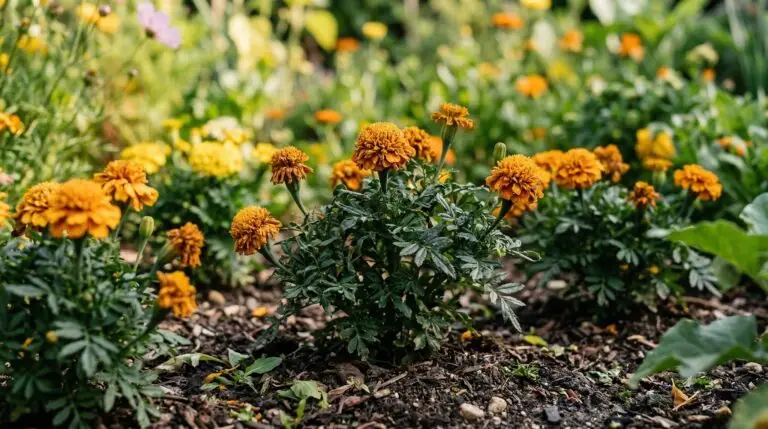
Why marigolds stop blooming in midsummer heat and how to get them flowering again
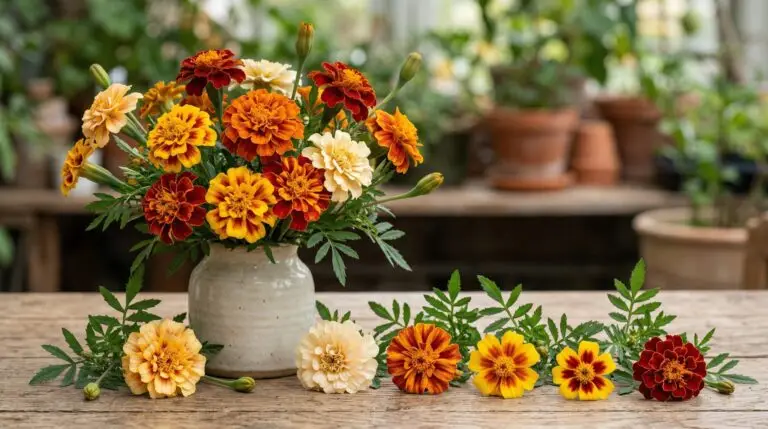
Best marigold varieties from tiny French Bonanza to towering African Antigua
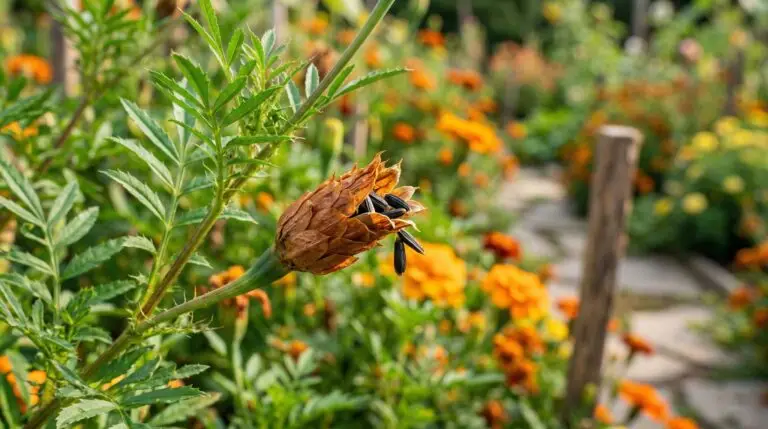
Growing marigolds from seed so easily that children can do it on their first try

Marigold meaning, from the sun and celebration to Victorian grief
Signet marigolds for edible flowers that taste like citrus in salads and cocktails
Marigolds in containers and window boxes for instant summer curb appeal
How to grow marigolds for bulletproof color from planting day to first frost