January birth flower: carnation, snowdrop and what they mean

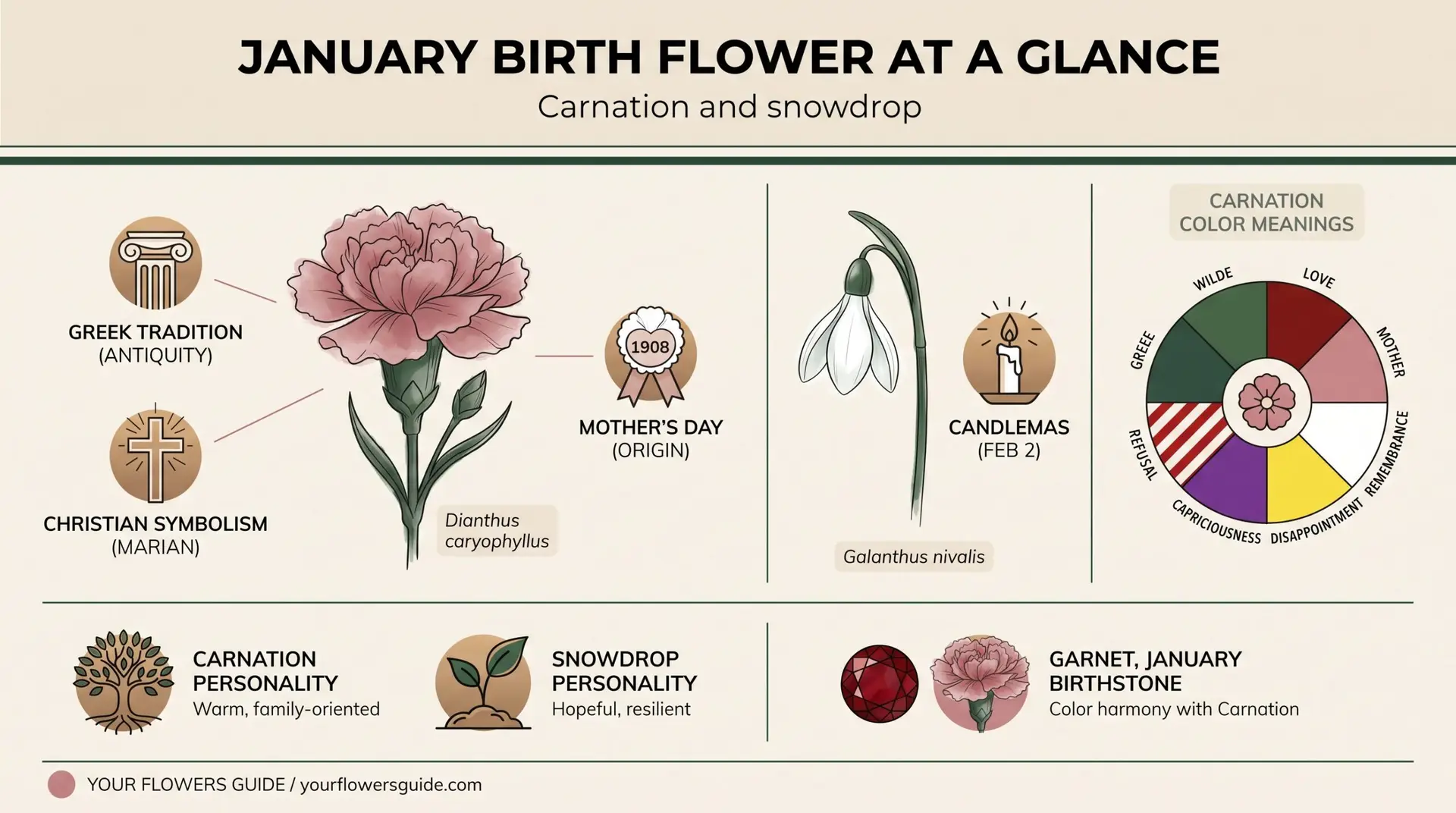
January has two birth flowers in Western tradition: carnation (Dianthus caryophyllus) as the primary, and snowdrop (Galanthus nivalis) as the secondary. Carnation means love and devotion. Snowdrop means hope and rebirth.
Carnation is a Mediterranean perennial available in florist supply year-round. Snowdrop is a small cold-tolerant bulb that blooms outdoors in late winter, pushing through frosted topsoil and patches of snow. Carnation has been cultivated continuously since ancient Greek and Roman times, with symbolic ties to three traditions: classical Greek, early Christian, and modern American Mother’s Day. Snowdrop’s main cultural anchor is the Christian feast of Candlemas on February 2.
The primary flowerCarnation, the main January birth flower
Carnation belongs to the genus Dianthus in the pink family (Caryophyllaceae). There are about 300 wild species, and thousands of named cultivars from more than 2,000 years of breeding. The species in modern florist supply is Dianthus caryophyllus, native to the northern Mediterranean coast.
Florists carry three main forms. Standard carnations have one large bloom per stem. Spray carnations have several smaller blooms on branched stems. Miniature carnations have the smallest blooms in dense clusters. Standard form dominates formal arrangements; spray form fills mixed bouquets.
The defining feature is the ruffled fringe along each petal edge, combined with several layered rows of petals. This gives the bloom its dense ruffled look. The layered structure also explains the long vase life: 10 to 14 days with daily water changes, longer than most cut flowers. As outer petals fade, the inner rows still look intact, so the bloom keeps its form well past the point where a rose or tulip would collapse.
The secondary flowerSnowdrop, the secondary January birth flower
Snowdrop is Galanthus nivalis, the most common species in a small genus of about 20 cold-climate bulbs in the family Amaryllidaceae. Galanthus comes from the Greek gala (milk) and anthos (flower). Nivalis is Latin for “of snow.”
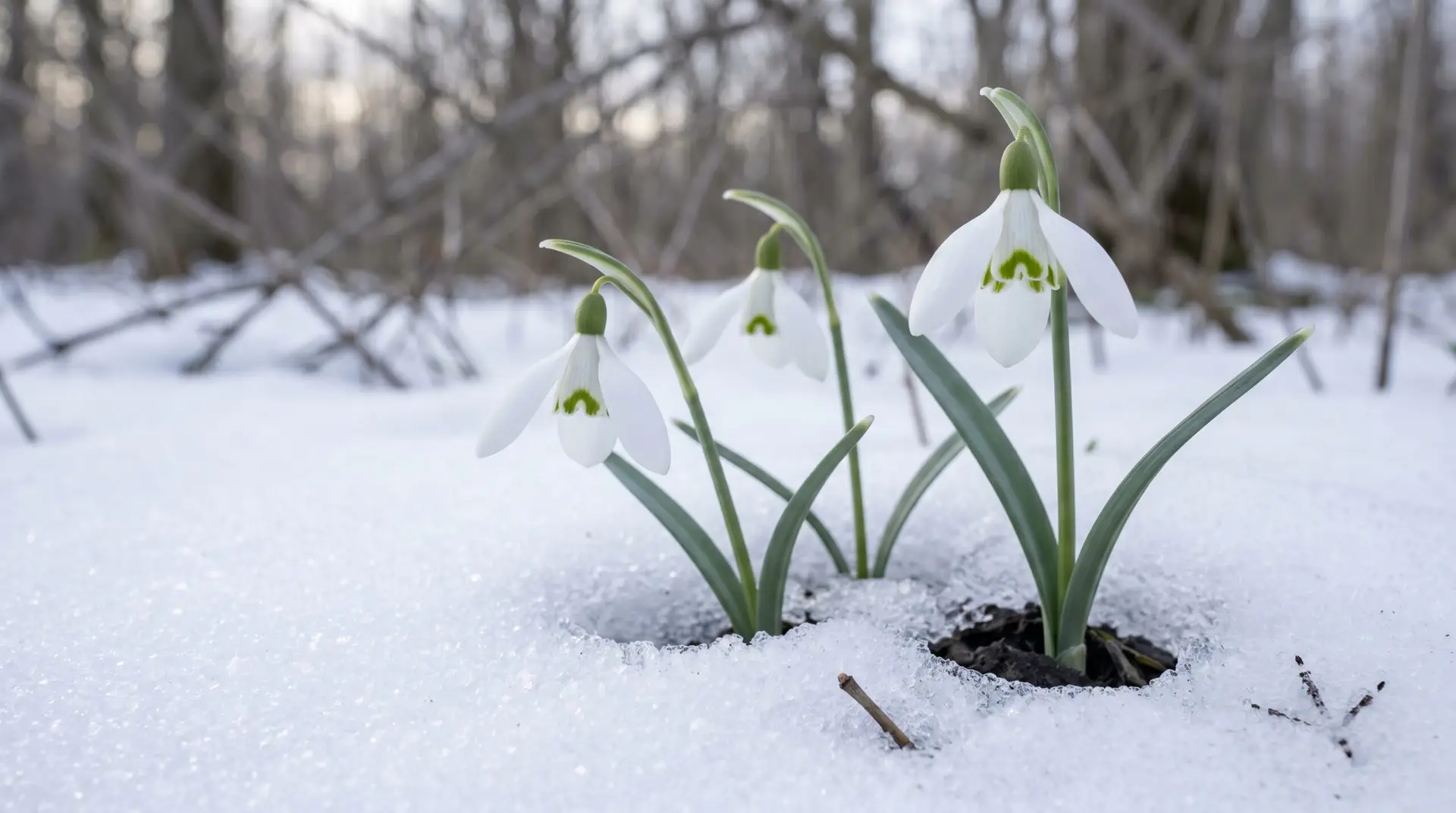
Bloom timing is the unusual feature. Snowdrop bulbs activate before most spring bulbs, often pushing through frosted topsoil and patches of snow in late January and February. The bulb sits below the frost line, so what the flower stalk pushes through is the frozen surface crust, not deeply frozen ground. The plant carries antifreeze proteins that protect cells below freezing. The flower closes at night and opens again at dawn for two to three weeks before the petals drop.
The name “Candlemas bells” comes from the bloom’s timing near the Christian feast of Candlemas on February 2. The connection gave snowdrop its symbolic readings of purity and consolation in Western flower tradition. More on snowdrop flower meaning, including the Candlemas tradition and the galanthophilia collecting tradition.
A short historyCarnation’s cultural history
Carnation’s January assignment rests on more than 2,000 years of continuous cultivation and symbolic use. Three distinct cultural traditions still show up in modern usage.
Greek and Roman antiquity. The botanical name Dianthus combines the Greek dios (of God or Zeus) and anthos (flower). The literal meaning is “flower of God.” The Greek botanist Theophrastus described Dianthus in his “Enquiry into Plants” in the fourth century BC, one of the earliest detailed botanical references in Western writing.
Early Christian symbolism. A Christian legend places the first pink carnations at the foot of the cross, growing where Mary’s tears fell. The story made pink carnation a symbol of a mother’s love and Mary’s grief. Leonardo da Vinci’s “Madonna of the Carnation” (around 1473 to 1474, now in the Alte Pinakothek in Munich) shows the infant Christ reaching for a pink carnation that Mary holds out.
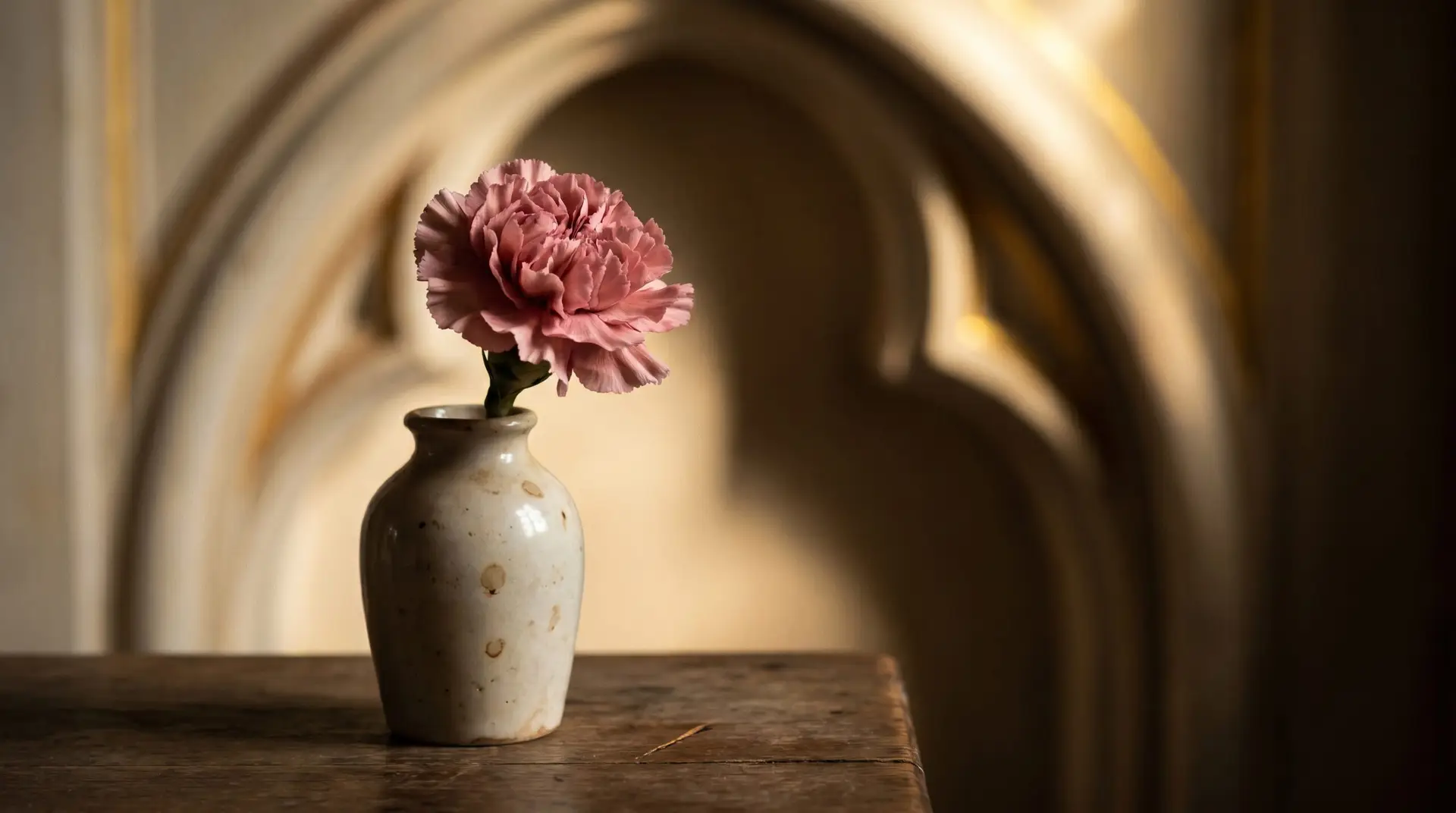
Modern American Mother’s Day. Anna Jarvis founded the American Mother’s Day in 1908 as a memorial for her own mother. She chose white carnation as the official flower because her mother had loved white carnations. The convention that developed: white carnation honors a deceased mother, pink or red carnation honors a living one. President Woodrow Wilson signed Mother’s Day into national observance in 1914, and the tradition then spread internationally.
Color meaningsWhat carnation colors mean
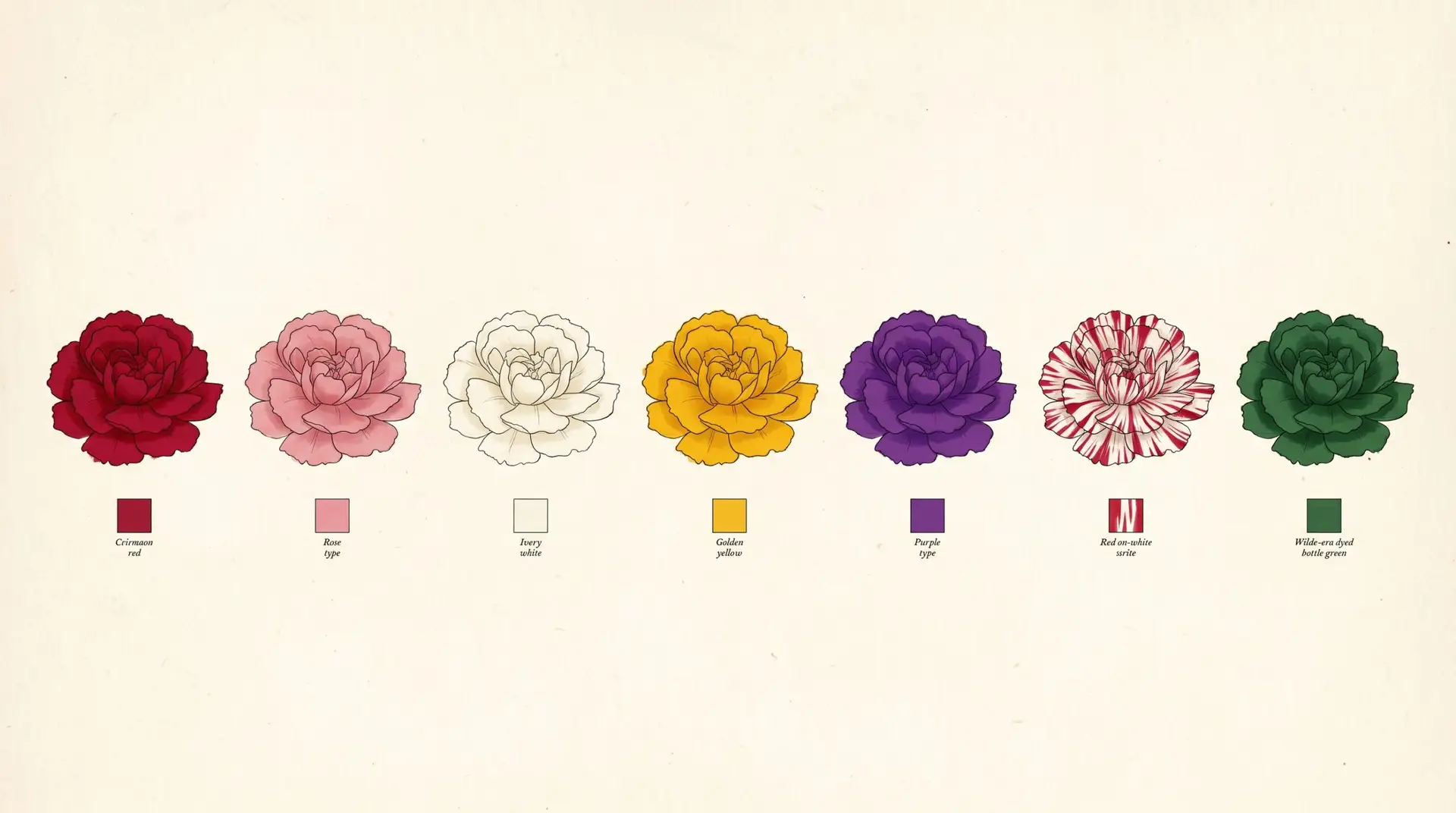
Carnation color shifts the meaning within the broader theme of love and devotion. The Victorian language of flowers codified these readings in the nineteenth century, and most are still in use:
- Red carnation: deep love and admiration. The standard Valentine’s Day choice. Dark red has the strongest reading.
- Pink carnation: mother’s love (from the Christian Marian tradition), gratitude, gentle affection. The Mother’s Day color for a living mother.
- White carnation: pure love, remembrance, good luck. The Mother’s Day color for a deceased mother.
- Yellow carnation: disappointment or rejection in strict Victorian reading. The negative reading has faded.
- Purple carnation: capriciousness and unpredictability.
- Striped carnation: refusal or regret (“I cannot be with you”).
For Mother’s Day gifts where the color tradition is unclear, a mixed pink and white bouquet is the safest choice. For Valentine’s Day, dark red. For sympathy arrangements, white. The 10-14 day vase life keeps the symbolic color visible far longer than most cut flowers.
SymbolismJanuary personalities by flower symbolism
Reading personality from a birth flower is closer to a horoscope than to psychology. Take it as a useful lens, not as evidence. The two January flowers offer a contrast that many readers find meaningful.
The carnation side reads as warm and family-oriented: the ones who keep family connections at the center of their lives, who show quiet strength through long difficult periods, and who value tradition. The snowdrop side reads as hopeful and resilient: the early movers, the friends who reach out first when someone is having a hard time. Many January-born readers describe themselves as both deeply loyal and quietly resilient, and the two flowers fit that combination.
Gift guideGift ideas for January birthdays
January birthdays are tricky to gift for. Many fall close to the holiday season’s end, and gift fatigue is real. Cold weather also rules out the spring and summer floral options. The two birth flowers offer practical solutions.
A fresh carnation bouquet is the simplest January birthday gift. Florist availability is reliable year-round, and vase life runs 10-14 days, longer than most cut flowers. Color choices match the relationship: pink or red for romantic partners, mixed pink and white for mothers and grandmothers, multi-color cheerful mixes for friends.

Snowdrop bulbs are a different category of gift. The bulbs need autumn planting for next-winter bloom, so the recipient gets the flowers ten months after the gift. A bag of bulbs given in January with the suggestion to plant them in October becomes a decades-long flower gift. Other options: garnet jewelry, Caron’s “Bellodgia” perfume (a classic carnation fragrance released in 1927), and crystallized carnation petals for cooking. Most thoughtful gifts fall in the $25 to $75 range.
Frequently asked
What is January’s birth flower?
Carnation as the primary and snowdrop as the secondary. Carnation is Dianthus caryophyllus, a Mediterranean perennial available year-round in florist supply. Snowdrop is Galanthus nivalis, a cold-tolerant wild bulb that blooms outdoors in late winter.
What does the January birth flower mean?
Carnation means love and devotion, with the specific reading depending on color. Snowdrop means hope, rebirth, sympathy, and consolation, from its place as the first wild bloom of the year and its tie to the Christian Candlemas feast.
Are carnations the Mother’s Day flower?
Yes. Anna Jarvis founded the American Mother’s Day in 1908 and chose the white carnation as the official flower. The convention assigns white carnation to honor a deceased mother and pink or red carnation to honor a living one.
What birthstone goes with January’s birth flower?
Garnet. The deep red of garnet pairs visually with red carnation, and jewelry combining the two makes a coherent January birthday gift.
Is snowdrop poisonous?
Yes, mildly to moderately. All parts contain the alkaloid galantamine, with the bulbs most concentrated. The same alkaloid is the active compound in the Alzheimer’s drug Razadyne.
Sources
- Carnation (Dianthus) · Encyclopedia Britannica
- Dianthus growing guide · Royal Horticultural Society
- Galanthus nivalis (snowdrop) · Encyclopedia Britannica
- Madonna of the Carnation (Leonardo da Vinci, c. 1473-74) · Alte Pinakothek Munich
Written and reviewed by the Your Flowers Guide editorial team. Botanical sources from Britannica and the Royal Horticultural Society. Leonardo da Vinci scholarship via the Alte Pinakothek Munich. Primary historical sources on the Anna Jarvis Mother’s Day tradition.