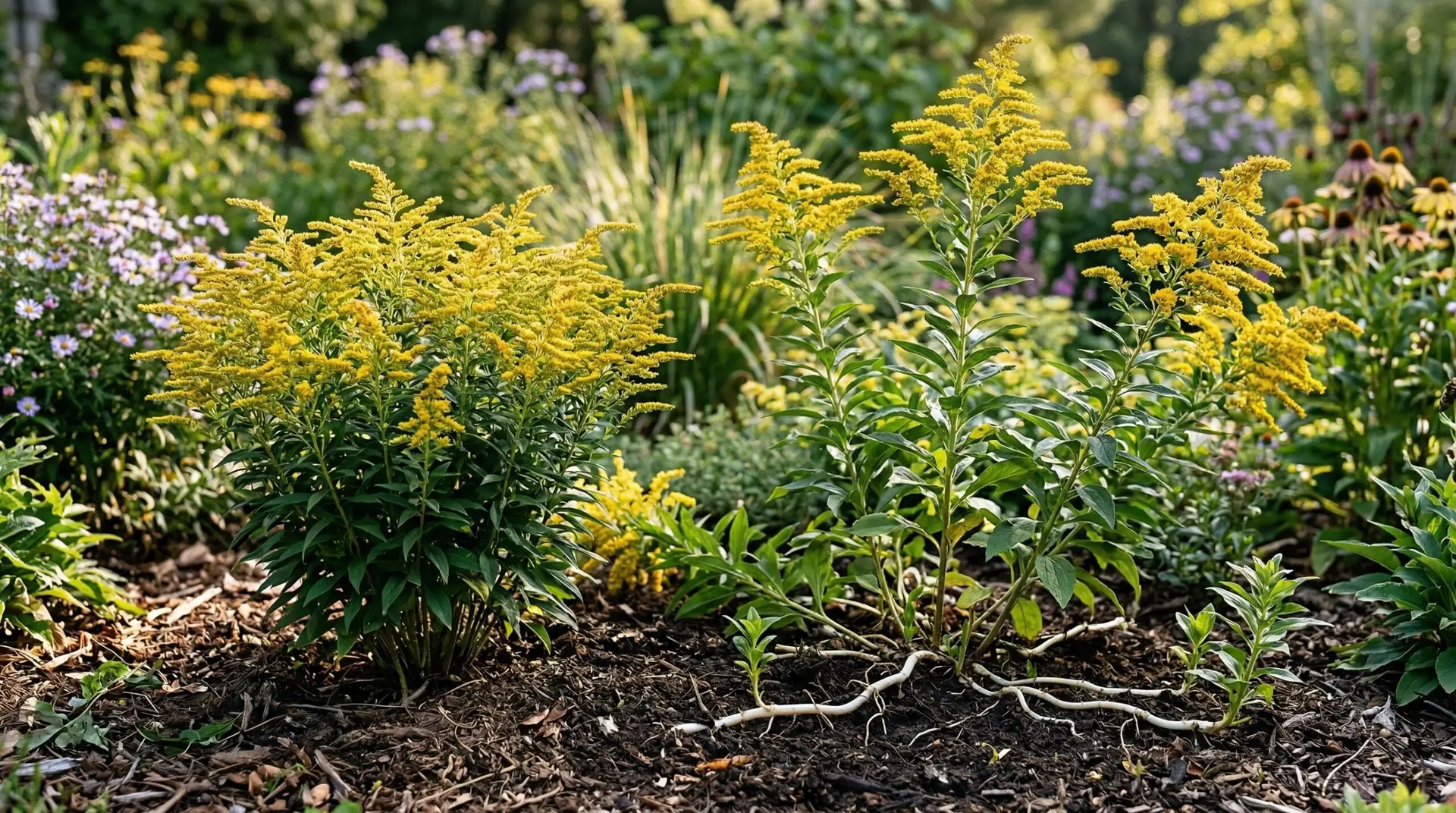
Gardeners often bring goldenrod into their yards hoping for late-season color, only to find it choking out every other plant in the bed a few years later. The frustration is entirely justified when you realize that many native goldenrod species spread through aggressive underground rhizomes that care nothing about your carefully planned garden layout. When goldenrod invasive tendencies take over, it usually means you planted a wild species meant for open meadows rather than a cultivated variety bred for tight spaces. You might spend hours pulling up thick, ropey roots only to see new shoots pop up a few weeks later from fragments left behind in the soil. Controlling goldenrod starts with understanding how it moves, which happens both underground through those rhizomes and above ground through seed dispersal. If you want to keep this plant in your garden without letting it become a nuisance, you have to tackle both methods of reproduction simultaneously.
Contents 4 sections
Selecting clumping varieties instead of wild spreaders
The biggest mistake people make is digging up a wild goldenrod plant from a roadside ditch and dropping it directly into a mixed perennial border. Those wild species, like Canada goldenrod, are genetically programmed to colonize large areas quickly to outcompete other vegetation. If you want goldenrod spreading to stop before it starts, you need to purchase clumping cultivars at the nursery instead of transplanting wild specimens. Clumping varieties expand slowly outward from a central crown rather than sending out long runner roots that pop up three feet away. Look for specific cultivated varieties like ‘Fireworks’ or ‘Golden Fleece’, which behave much better when planted next to your coneflower patches or other late-summer bloomers. These cultivated options still provide the nectar that local pollinators need, but they stay exactly where you put them with minimal intervention required on your part.
Installing root barriers for aggressive types
If you already have a spreading variety or absolutely must grow a specific wild type, you have to install a physical barrier in the soil to restrict its movement. When rhizomes hit a solid wall, they are forced to turn and circle back on themselves instead of marching into neighboring plant territories. You cannot rely on standard plastic garden edging, as the roots will easily dive right under a shallow four-inch strip and keep going. A proper barrier needs to be made of thick, high-density polyethylene plastic and buried at least twelve to eighteen inches deep around the entire perimeter of the planting area. Leave about an inch of the barrier protruding above the soil line so the roots cannot simply hop over the top under the cover of mulch. This is exactly the same heavy-duty containment method you would use for running bamboo or an aggressive patch of crocosmia that threatens to take over a bed. Installing this type of barrier is physically demanding work that requires digging a deep trench, but it is the only reliable way to keep a rhizomatous goldenrod confined to a specific footprint.
Managing growth through division and deadheading
Even well-behaved clumping varieties require regular maintenance to prevent them from slowly expanding beyond their allotted space. When a goldenrod clump gets too wide, the center often dies out while the outer edges push aggressively into surrounding plants, and the fix is to dig up and divide the entire plant. You should plan to divide your goldenrod every two to three years in the early spring just as the new growth begins to emerge from the soil. Use a sharp spade to slice the root ball into smaller sections, discard the woody old center, and replant only one or two vigorous outer sections. Beyond root management, you must also stop the plant from spreading by seed, which happens rapidly if you leave the spent flower heads standing into the winter. Cut the entire plant back to the ground immediately after the yellow blooms fade to brown, bagging the clippings rather than composting them to ensure no viable seeds survive.
Growing goldenrod in containers
For gardeners who want absolutely zero risk of goldenrod taking over their property, growing the plant in a container is the most foolproof solution available. A heavy plastic or resin pot completely eliminates the underground rhizome problem, keeping the root system entirely isolated from your garden soil. You can place these pots directly on patios or sink them directly into your garden beds to create the illusion that the plant is growing in the ground. If you choose to sink the pot, make sure the drainage holes are elevated on a layer of gravel and the rim sits slightly above the soil surface so roots do not escape out the bottom or over the top. Potted goldenrods will dry out much faster than those planted in the ground, so you will need to water them more frequently during hot summer stretches. Because the root system is restricted, you will also need to pull the plant out of its pot every spring to trim the roots and add fresh potting soil to keep it healthy.
The most useful single piece of advice I can give anyone starting out with goldenrod is to be ruthless about deadheading the moment the flowers fade. Even if you plant a perfectly behaved clumping cultivar and install a deep root barrier, a single plant can release thousands of seeds into the wind to germinate all over your yard the following spring. Many gardeners focus entirely on fighting the underground roots and completely ignore the airborne seeds until they have dozens of tiny goldenrod seedlings sprouting in their lawn and vegetable beds. By grabbing your pruning shears as soon as the yellow color disappears, you eliminate half the battle and force the plant to direct its energy back into its roots for winter rather than into unwanted reproduction. Taking ten minutes to cut those stalks down in late autumn will save you countless hours of weeding the next year.
More About Goldenrod
Goldenrod does not cause allergies and why ragweed is the real culprit
How to grow goldenrod for brilliant golden plumes that light up the fall garden
Growing goldenrod in containers for fall patio color when everything else is fading
Goldenrod flower meaning and the American wildflower that nearly became the national flower
Goldenrod in dried flower arrangements for warm autumn bouquets that last all winter
Companion plants for goldenrod: what to grow, what to avoid
Goldenrod for naturalizing in meadows and the wildflower garden it was born for
Best goldenrod varieties for gardens from compact Little Lemon to elegant Fireworks
Enjoying our flower guides? Add YourFlowersGuide as a preferred source on Google. It helps more readers find us.
Add to Preferred Sources