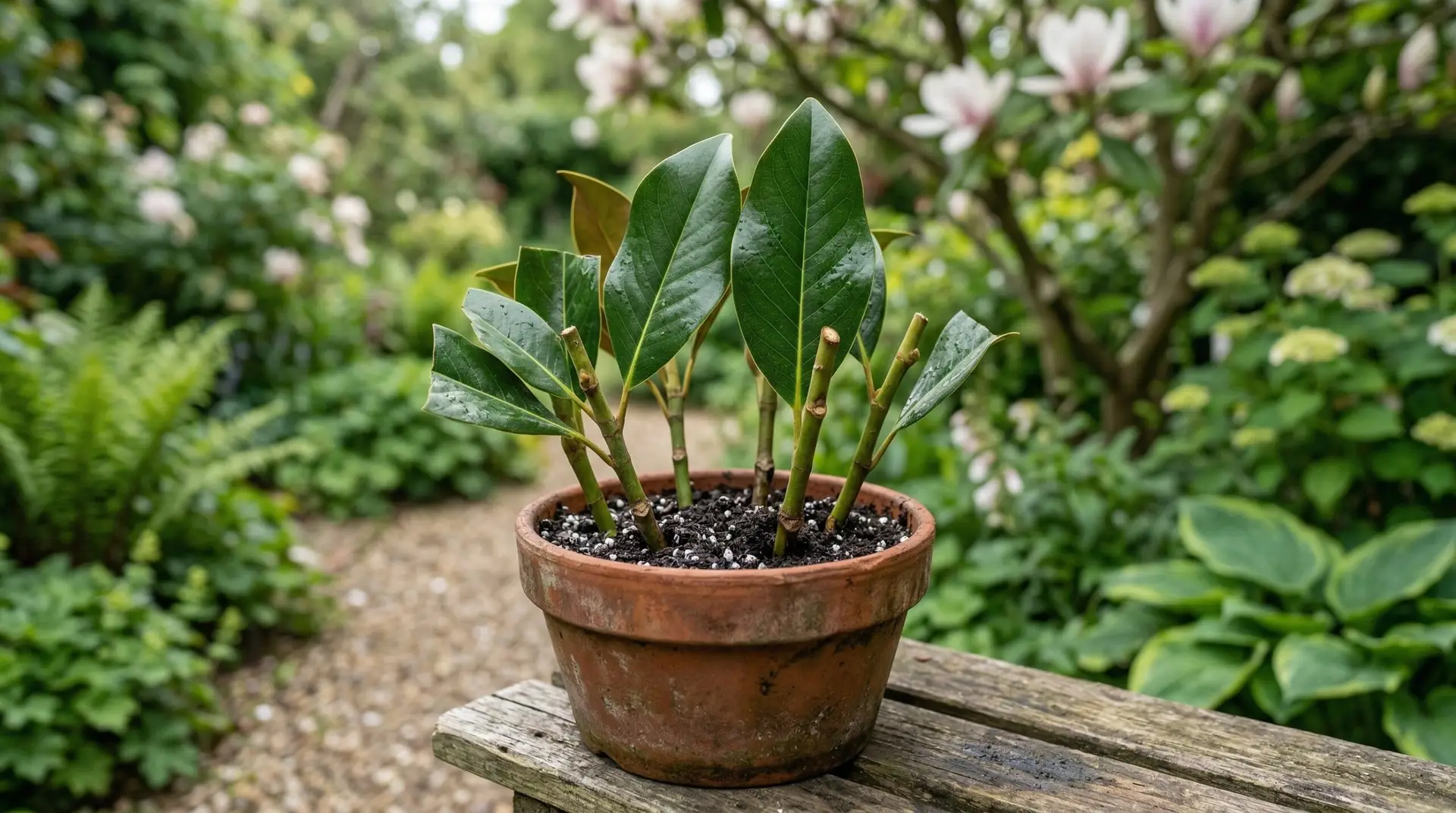
By the time you finish reading this guide, you will understand exactly how a piece of a branch or a single seed transforms into a towering magnolia tree. When you look at a mature blooming tree in your yard, you are looking at decades of growth that started from a single propagation event. Learning magnolia propagation means learning how to manipulate the biology of the plant so it builds new roots instead of just growing more leaves. We are going to walk through how different methods work, from taking cuttings to starting seeds, so you understand the mechanics happening inside the plant tissue. This takes a season or two to get a feel for, and that is completely normal.
Contents 4 sections
Understanding why seeds and cuttings behave differently
Before you take a pair of pruners to your tree, you need to understand the difference between growing a plant from seed and growing it from a piece of the parent plant. When you plant a magnolia from seed, you are creating a completely new genetic individual. Just like human children, the seedling will share traits with its parents but will look and behave somewhat differently. If you have a specific named variety with distinct yellow blooms or a particular growth habit, a seed will not give you an exact copy of that tree. To get an exact replica of your favorite tree, you must use asexual propagation methods like cuttings, layering, or grafting. These methods take a physical piece of the original plant and encourage it to grow its own root system, creating a literal clone. This might seem contradictory to how we usually think about planting, but the reason is that every cell in a branch contains the complete genetic blueprint to become a whole new tree.
Creating new roots with semi-hardwood cuttings
Taking magnolia cuttings requires catching the wood at a very specific stage of development known as semi-hardwood. Think of semi-hardwood as the teenage phase of a branch, where it is no longer soft and floppy green growth, but it has not yet developed a thick, woody bark. You can test this by bending a branch tip in mid-summer. If it bends easily without breaking, it is too soft, but if it snaps completely with a sharp sound, it is too hard. You want the branch to bend and then splinter slightly, which tells you the tissue is mature enough to survive on its own but young enough to generate new roots.
Once you cut a six-inch piece of this semi-hardwood, you immediately face a biological problem because the cutting has leaves that lose water but no roots to drink water. You solve this by removing most of the leaves, dipping the cut end in rooting hormone, and placing it in a highly humid environment. The rooting hormone is a chemical signal telling the stem cells to stop being branch tissue and start becoming root tissue. You must keep the soil warm and the air humid for several months, which is much longer than it takes to root other common garden plants. For example, gardeners who have easily rooted early spring bloomers like forsythia are often surprised by how slowly a magnolia cutting develops.
Using air layering to build roots on the tree
Air layering is a fascinating technique that solves the problem of a cutting drying out before it can grow roots. Instead of cutting a branch off and trying to keep it alive in a pot, you bring the soil up into the tree canopy and force the branch to grow roots while it is still attached to the mother plant. You do this by making a shallow cut around the bark of a healthy branch and packing damp sphagnum moss around the wound, sealing the whole thing in plastic wrap. The reason this works comes down to the plumbing system inside the tree. Water and nutrients travel up from the roots through the inner wood, while the sugars produced by the leaves travel down to the roots through the thin layer just under the bark. By cutting away a ring of bark, you stop the downward flow of sugars. Those sugars pool at the top of the cut, and because they are trapped in a dark, moist ball of moss, the plant uses that concentrated energy to push out new roots right there in mid-air. Once the moss ball is full of roots, you can safely cut the branch off below the new root system and plant it in the ground. While some spreading shrubs like lilac naturally send up new rooted shoots from the ground, magnolias usually have a single trunk, making this aerial rooting method highly effective.
The slow process of growing from seed
If you choose to grow a magnolia from seed, you are signing up for an exercise in extreme patience and biological manipulation. Magnolia seeds are covered in an oily red or orange fleshy coating that prevents the seed from absorbing water and sprouting prematurely. In nature, a bird eats the seed, digests the oily coating, and drops the hard inner seed on the forest floor just as winter begins. You replicate this process by soaking the seeds to soften and scrub away that oily coat, leaving you with a clean, hard black seed. Once clean, the seed still refuses to sprout because it has a built-in survival mechanism called dormancy. The seed needs to experience a long, cold winter to know that it is safe to wake up, otherwise it might sprout in October and freeze to death in January. You provide this artificial winter through a process called stratification, which means packing the seeds in damp sand or peat moss and placing them in your refrigerator for three to four months. When you finally take them out and plant them in warm soil, the seeds interpret the temperature change as spring and will begin to germinate.
The core principle of propagating any woody tree is recognizing that you are working with a living system that responds to specific environmental cues. Whether you are tricking a branch into growing roots in a ball of moss or convincing a seed that it just survived a long winter, you are providing the exact conditions the plant needs to trigger its next stage of life. Grafting, cuttings, layering, and seed starting all require an understanding of how water, hormones, and temperature interact inside the plant tissue. You will likely lose a few cuttings or have seeds that fail to sprout, and that is simply part of learning how to read the responses of the plant. As you practice these techniques, you move away from just following a set of instructions and begin to truly understand the mechanics of how a tree grows.
More About Magnolia
Magnolia in wedding decor and the southern tradition of magnolia bridal flowers
Companion plants for magnolia trees: what to grow and avoid
How to grow magnolia trees for breathtaking spring blooms on bare branches
Small magnolias for compact gardens that fit any yard with room to spare
Southern magnolia grandiflora and growing the iconic evergreen of the American South
Magnolia meaning, from dignity and perseverance to its place in the American South
Magnolia trees in landscape design and placing them for maximum dramatic impact
Why magnolia flower buds freeze in late spring frost and how to protect your tree

Best magnolia varieties from small garden stars to grand southern shade trees
Enjoying our flower guides? Add YourFlowersGuide as a preferred source on Google. It helps more readers find us.
Add to Preferred Sources