What to plant with Shasta daisies
The pairing · pick a flower
All Shasta daisies companions
What not to plant near Shasta daisies
The best companions for Shasta daisies, explained
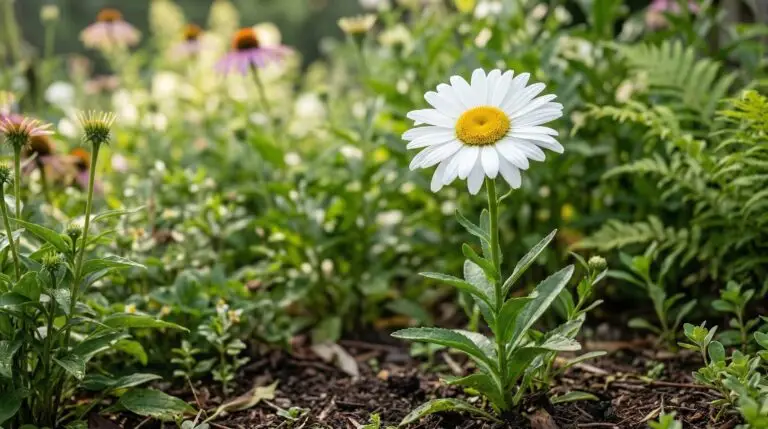
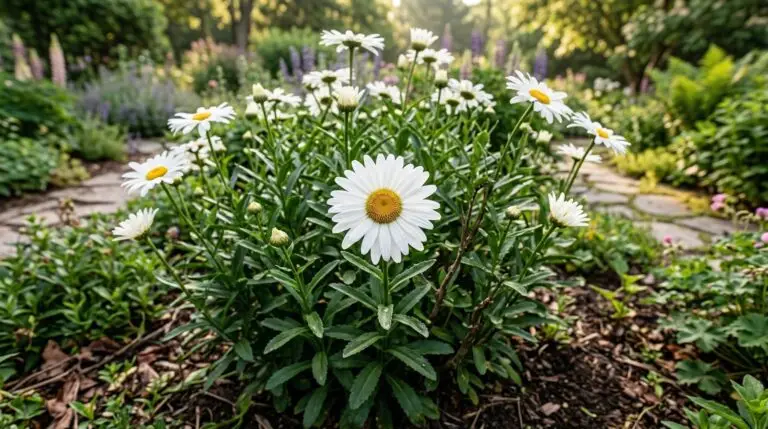
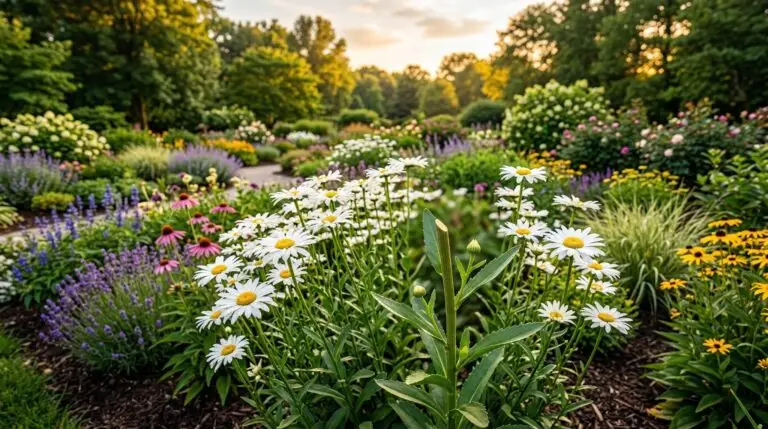
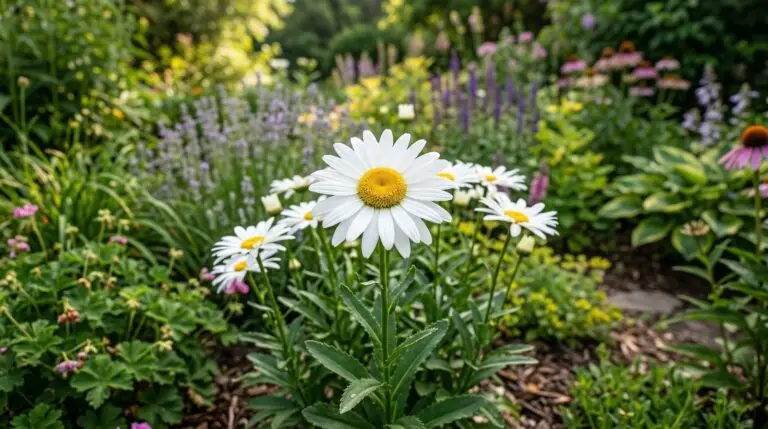
A Shasta daisy is a blank canvas: a flat white face with a yellow center, repeated on wiry stems in a clump that gets bigger every year. That plainness is exactly why the strategy for pairing it is so consistent across gardens that get it right. The companions that work best are the ones that match its lean, full-sun, well-drained ground and then supply the color, height or texture the daisy itself can’t. Lavender is the clearest example: it wants the identical full sun and dry, sharply drained soil Shasta daisy does, and its silvery-purple spikes are the single most common color foil paired with the daisy’s white-and-yellow bloom across gardening guides and extension plant lists alike. Russian sage does similar work at a bigger scale, an airy haze of smoky blue on woody, see-through stems that gives the daisy’s flat form the vertical lift it lacks on its own, peaking late enough in summer to carry color past the daisy’s first flush. Catmint fills the front-of-border role, billowing and spilling in a way that softens the daisy’s stiff, upright stems, and like lavender and Russian sage it shares the same drought-tolerant, full-sun profile once established.
Salvia earns its place for the same shared-conditions reason, but its deep violet-blue spikes are the strongest color contrast on this list, a genuinely useful pairing rather than a decorative afterthought. Coneflower and black-eyed Susan round out the meadow-style anchor group, both wanting the same full sun and well-drained, drought-tolerant ground, both blooming through summer alongside the daisy, and both worth one honest caveat: they are Asteraceae, the same plant family as Shasta daisy itself, so crowding any of them together needs real spacing for airflow rather than a tight, mixed drift (more on that below). Yarrow adds a second kind of value beyond matching conditions and looking good together: its flat flower heads independently draw ladybugs, lacewings and predatory wasps, the same beneficial-insect logic that makes the daisy itself a useful pollinator plant. At ground level, dusty miller and lamb’s ear do quieter foliage work, felted silver leaves that set off the white blooms above them, both genuinely full-sun and drought-tolerant, though this pairing leans more toward a design device than a functional one. For a dedicated cutting bed rather than a border, cosmos, zinnia, dahlia and gladiolus share the daisy’s sun and drainage needs and make reliable cut-flower bed-mates, cosmos in particular prized for the way its ferny foliage plays against the daisy’s rigid stems, both in the ground and in the vase.
What not to plant near Shasta daisies
The most straightforward mismatch is shade. Shasta daisy needs at least six hours of direct sun to bloom well and hold its stems upright, so ferns, hosta, bleeding heart, astilbe and hellebore, all genuine shade plants, are a poor fit next to it: one of the two ends up starved of light or scorched, depending on which side of the mismatch it sits on. The fix is simply separation, sun plants in the sunny run of a border and shade plants in the shaded run, not a compromise spot that shortchanges both. Wet, boggy soil is the same kind of problem from the opposite direction. Shasta daisy’s crown rots in soil that stays wet, especially through winter, so anything grown specifically to sit damp is fighting the daisy’s need for sharp drainage rather than complementing it.
The more daisy-specific caution is about crowding its own plant family. Shasta daisy, coneflower, rudbeckia, aster, zinnia, marigold, dahlia, chrysanthemum and sunflower are all Asteraceae, and they share the same susceptibility to powdery mildew, a fungus that, counterintuitively, doesn’t even need wet leaves to spread: shade and a crowded, poorly ventilated canopy are enough on their own. Several consumer garden lists turn this into a blanket "never plant coneflower or aster near Shasta daisy" rule, and that overstates a real mechanism into an unnecessary ban. The honest version is a spacing rule: give any Asteraceae neighbor real room, 18 to 24 inches or more, and skip the tight, mixed drift of several family members packed into one pocket. A single well-spaced coneflower or rudbeckia next to a Shasta daisy is not a problem; a crowded row of them is. One claim worth actively correcting rather than repeating: a cluster of consumer sites warns against planting Shasta daisy near black walnut trees over juglone toxicity, but Penn State Extension’s own list of juglone-tolerant herbaceous plants names Shasta Daisy (Leucanthemum x superbum) by name, alongside purple coneflower, coral bells and daylily, among plants that tolerate juglone rather than suffer from it. Fennel gets a similar warning on a smaller scale, and fennel’s general reputation for allelopathic chemical release is real, but the confirmed sensitive plants are nightshades, tomato, potato, pepper, eggplant, not Shasta daisy; no daisy-specific research backs the claim, so it stays unconfirmed rather than an actual avoid.
Do they like the same conditions?
The rule that filters this whole list is simple and, compared to a plant like hydrangea or azalea, refreshingly forgiving: full sun and soil on the dry side of well-drained. Shasta daisy wants at least six hours of direct light for sturdy stems and full bloom, tolerates a little afternoon shade in hot climates, and flowers noticeably less in real shade, which is the entire logic behind steering ferns and hosta elsewhere rather than trying to make them work at the daisy’s feet. Water follows the same logic in reverse of what a shade-and-moisture plant would need: the daisy wants even moisture while it establishes, then settles into genuine drought tolerance, and the one thing it does not forgive is a wet root crown, particularly over winter, when soggy soil is the most common way gardeners actually lose the plant.
Soil chemistry is where Shasta daisy is a useful contrast to a flower like azalea or hydrangea, where pH is a real, load-bearing constraint. This plant is not pH-sensitive in any meaningful way: University of Illinois Extension and the RHS both describe it thriving in average garden soil across clay, loam and sand, with no acid or alkaline requirement to chase. That means every companion on this list gets matched on sun and drainage, not on soil chemistry, which is a genuinely simpler rule to apply in the ground than the pH-matching most flower-companion advice has to work around. The one nuance worth stating plainly rather than glossing over: "drought-tolerant" on this list means tolerant once established, not from day one. Every companion named above, lavender, Russian sage, catmint, salvia, yarrow, needs regular watering through its first season the same way the daisy itself does, and it’s only after that first year that the shared dry-soil profile becomes the reliable, low-maintenance match it’s known for.
How to plant them together
Layer the border by height and let the daisy’s own structure do some of the design work. Shasta daisy reads as a mid-height, flat-topped anchor, so tall vertical companions, Russian sage, salvia, lavender, work well planted behind or beside it rather than in front, where they’d hide the daisy’s own bloom. Low, silver-foliaged plants, dusty miller and lamb’s ear, belong at the very front, where their felted leaves set off the white blooms above without competing for the same visual space. Spacing follows the shared-conditions logic from above: 18 to 24 inches is the standard gap for most companions here, tightened to 12 to 15 inches for lower, less spreading plants like salvia or coreopsis, and opened up to 24 to 36 inches for a big, woody subshrub like Russian sage that genuinely needs the room. Any Asteraceae neighbor, coneflower, black-eyed Susan, aster, zinnia, gets the wider end of that range specifically for airflow, not because the plants compete for nutrients in any special way.
The one structural fact that should shape spacing more than any other companion pairing does: Shasta daisy spreads by rhizome into an expanding clump, and the center dies out and needs dividing roughly every two to four years as the plant pushes new growth outward and the old crown goes woody. That means anything planted at the immediate edge of a daisy clump should either tolerate being crowded and occasionally disturbed at division time, or be given enough buffer, closer to 24 inches than 12, that the daisy’s outward growth doesn’t swallow it before the next division. In a dedicated cutting garden, the same sun-and-drainage logic applies but the layout shifts to rows rather than a mixed border: cosmos, zinnia, dahlia and gladiolus all want the daisy’s conditions and make reliable row-mates, with dahlia and gladiolus given the widest spacing of the group since both want dug, dedicated ground for tubers or corms rather than a shared root zone. In containers, the same rules hold at a smaller scale: pair the daisy with a genuinely drought-tolerant, full-sun companion like catmint or a compact salvia, and skip anything that wants consistent moisture, since a pot dries faster and more unevenly than open ground.
Does companion planting actually work for Shasta daisies?
Some of it holds up cleanly, and some of it is closer to a design habit dressed up as horticultural fact, which is worth separating out rather than blurring together. The shared-conditions matches are the strongest claims on this page: lavender, Russian sage, catmint, salvia, coneflower, black-eyed Susan and yarrow all genuinely want the same full sun and well-drained, moderately dry soil Shasta daisy does, verified directly against extension plant guides for each one rather than assumed from a shared reputation for being easy. That overlap is real and it’s why these particular pairings recur across gardening literature instead of just garden blogs repeating each other. Yarrow’s beneficial-insect draw is a second, distinct kind of real benefit, not just a matching bloom shape: its flat flower heads are independently documented to attract ladybugs, lacewings and predatory wasps, the exact kind of pest-predator support that goes beyond simple color-and-texture design.
Where the evidence thins out is anywhere a claim reaches past shared conditions and design into an active health or protective benefit. There’s no meaningful allelopathy case for Shasta daisy the way there is, say, for black walnut against certain sensitive shrubs; no neighboring plant here is chemically protecting or feeding the daisy. The black walnut avoid claim is the clearest example of popular advice running the wrong direction entirely: Penn State’s own juglone-tolerant list names Shasta daisy directly, which makes the "keep it away from walnut" warning a genuine correction rather than a caveat. The fennel-inhibits-daisy claim sits one step behind that, not disproven exactly, but resting on a single weak source with no daisy-specific research behind it, so it stays unconfirmed rather than promoted to a real avoid. The Asteraceae-crowding caution is the most defensible daisy-specific mechanism on this page, and it’s precise: it’s not that coneflower or aster harm Shasta daisy by proximity, it’s that crowding any of them without airflow invites the powdery mildew they’re all prone to, which makes it a spacing rule rather than a pairing ban. That’s the honest verdict: match sun and drainage first, use height and silver foliage to do the design work second, give Asteraceae neighbors real room, and treat anything beyond that, repelling pests, boosting bloom, protecting the plant chemically, as unproven until shown otherwise.
Shasta daisy companion planting FAQ
What can I plant in front of a Shasta daisy?
Low, silver-foliaged plants do the best front-of-border work here. Dusty miller and lamb’s ear both want the same full sun and dry, well-drained soil as the daisy, and their felted grey leaves set off the white blooms above them without competing for attention.
What should you not plant near Shasta daisies?
Real shade plants, ferns, hosta, bleeding heart, astilbe, hellebore, are the clearest mismatch, since the daisy needs six or more hours of direct sun to bloom well. Wet, boggy ground is the second clear avoid, since the daisy’s crown rots in soil that stays consistently damp. Crowding other Asteraceae, coneflower, aster, zinnia, rudbeckia, without airflow space is a real but softer caution, best treated as a spacing rule rather than a ban.
Is it safe to plant Shasta daisy near a black walnut tree?
Yes, on the evidence available. A cluster of consumer garden sites warns against it over juglone toxicity, but Penn State Extension’s own juglone-tolerant plant list names Shasta Daisy (Leucanthemum x superbum) directly among plants that tolerate the compound rather than suffer from it.
Do Shasta daisies attract bees and butterflies?
Yes, the flat, open bloom shape makes pollen and nectar easy to reach for bees, butterflies and hoverflies. Single-flowered cultivars are the better choice for this specifically; double-flowered types like some ‘Real Neat’-style cultivars pack extra petals where pollen and nectar would otherwise be, which measurably reduces pollinator access compared to a single-flowered bloom.
Why does the center of my Shasta daisy clump die out?
This is normal, rhizomatous growth, not disease. The clump spreads outward from the original crown, and the older center goes woody and stops flowering well as new growth pushes to the edges, typically on a two-to-four-year cycle. Dividing the clump in early spring or early fall resets it and keeps the surrounding companions from being crowded out as the daisy expands.
Can I plant coneflower or rudbeckia right next to my Shasta daisy?
Yes, both are genuinely good matches on shared sun and drainage, and it’s one of the most common meadow-style pairings for exactly that reason. The only real caution is spacing: give each clump 18 to 24 inches or more so air moves between them, since all three share the same susceptibility to powdery mildew in crowded, shaded conditions.
Sources
Penn State Extension, Landscaping and Gardening Around Walnuts and Other Juglone Producing Plants · University of Illinois Extension, Shasta Daisy (Leucanthemum x superbum), Hort Answers · UC Statewide IPM Program, Powdery Mildew on Ornamentals · North Carolina Extension Gardener Plant Toolbox, Leucanthemum x superbum (Shasta Daisy) · RHS, Leucanthemum x superbum (Shasta daisy) · Utah State University Extension, How to Grow English Lavender in Your Garden · University of Wisconsin-Madison Extension, Russian Sage · Penn State Extension, Black-Eyed Susan: Beautiful and Beneficial
More About Daisy
Best Shasta daisy varieties from classic Alaska to fluffy double Crazy Daisy
Shasta daisies in containers for bright summer displays on patios and porches
Daisy meaning, from innocence and new beginnings to he loves me, he loves me not
Why Shasta daisies die after a few years and how to keep them going through division
The Luther Burbank story and how he created the Shasta daisy from four wild species
Deadheading Shasta daisies for months of continuous blooming instead of a one-time show
Growing Shasta daisies from seed for the most affordable perennial border
How to grow Shasta daisies for cheerful white and gold flowers all summer long