When planning a winter garden, Southern gardeners face an overwhelming number of camellia cultivars that often look identical in nursery pots. Many comprehensive planting guides attempt to catalog hundreds of available options, resulting in collections that bloom all at once or suffer from overlapping disease issues. A more deliberate approach involves selecting specific plants that create an unbroken sequence of flowers between October and April. By carefully choosing among the best camellia varieties, you can establish a reliable progression of form and color. This requires understanding the distinct roles of the delicate autumn species, the heavy winter classics, and the vigorous spring hybrids. Instead of acquiring plants at random, we will examine a curated sequence that prioritizes weather resistance and distinct floral structures.
Autumn elegance with camellia sasanqua varieties
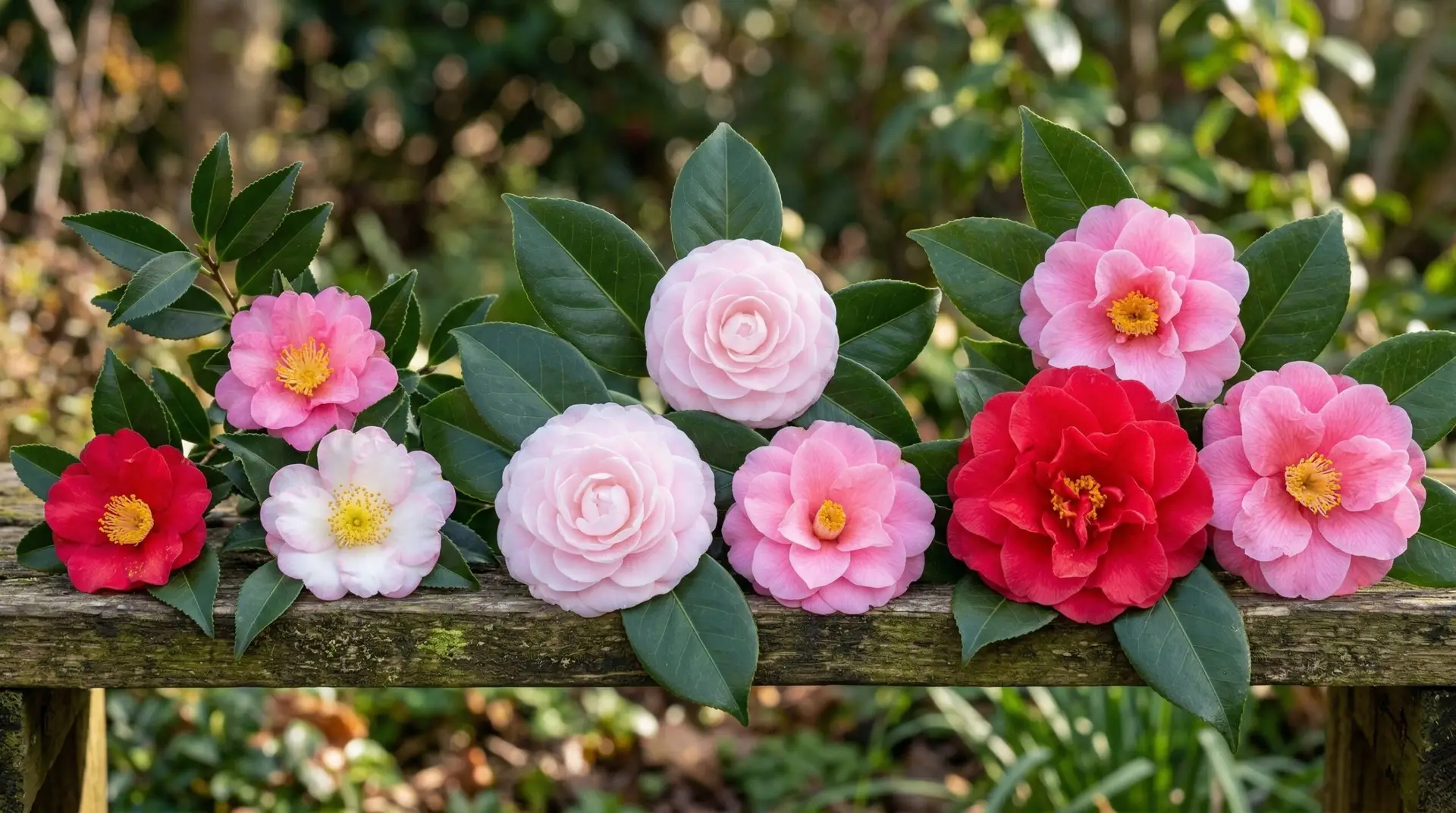
The earliest flowers in the sequence belong to the sasanqua group, which thrives in the cooling days of autumn and tolerates far more direct sun than other types. These shrubs have smaller leaves and a more open, graceful branching habit that works well for espalier or loose hedging. When selecting camellia sasanqua varieties, many gardeners default to the ubiquitous red ‘Yuletide’, but its single form often feels visually thin and drops quickly in heavy rain. A far superior choice for early autumn is ‘Setsugekka’, a vigorous grower that produces large, semi-double white flowers with heavily ruffled edges. The bright golden stamens of ‘Setsugekka’ attract late-season pollinators, and its petals fall cleanly to the ground like snow rather than turning brown on the branch. This self-cleaning trait is essential for maintaining a tidy garden during the messy transition into winter.
For a more saturated color in November, ‘Kanjiro’ provides an exceptional informal double form in a deep cerise pink. The blooms of ‘Kanjiro’ offer more substance than typical single sasanquas, with layered petals that hold up well against early frosts and strong autumn winds. The plant itself grows with an upright, dense habit that provides excellent evergreen structure long after the flowers fade. This dense foliage creates a dark, solid backdrop that pairs beautifully with the bare winter branches of a deciduous Japanese magnolia planted nearby. By relying on ‘Setsugekka’ and ‘Kanjiro’, you establish a strong, weather-resistant foundation for the first half of the blooming season.
Midwinter structure through camellia japonica varieties
As the season turns to deep winter, the sasanquas finish their display and the japonica group takes over the garden. Camellia japonica varieties require protection from harsh afternoon sun and prefer the dappled light of high pine canopies. Their flowers are significantly larger and heavier, often appearing in complex geometric arrangements like formal doubles or dense anemone forms. The challenge with midwinter blooms is their susceptibility to cold damage and petal blight, which turns the heavy flowers into a brown, mushy mess. To avoid this common frustration, I recommend ‘Professor Charles S. Sargent’, an older cultivar with a tightly packed, dark red anemone form. The sheer density of its central petaloids allows it to shed water easily, preventing the rot that plagues looser, cup-shaped varieties during wet Southern winters.
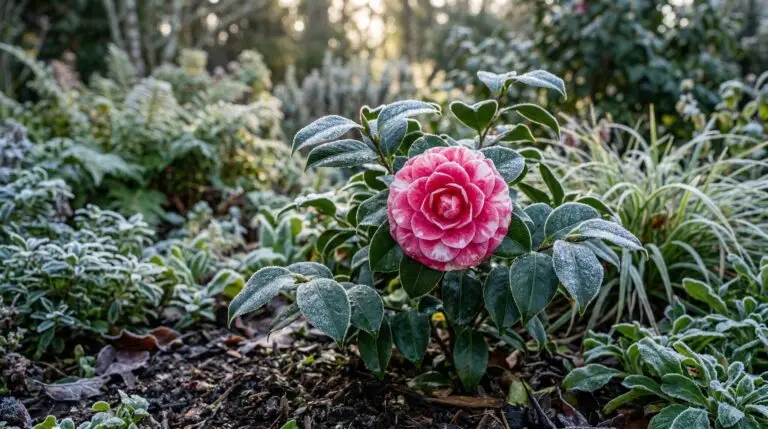
While ‘Professor Charles S. Sargent’ offers rugged durability, a curated collection should also include a specimen of absolute geometric perfection. ‘Pink Perfection’ is a formal double japonica that produces flawless, shell-pink flowers with symmetrical rows of overlapping petals. Many contemporary growers dismiss this historic variety because it has a tendency to drop unopened buds if the soil moisture fluctuates drastically. However, when planted in heavily mulched, consistently moist soil, its floral display remains unmatched in the winter garden. The smooth, flat petals of ‘Pink Perfection’ create a striking visual contrast when positioned near the softer, ruffled blooms of a spring pink azalea that might open just as the camellia finishes. This specific variety demands slightly more attention to watering, but the resulting flawless blooms easily justify the extra care.
Overlooked hybrids for late season resilience
By late February and March, the garden transitions again, and this is where complex hybrid camellias prove their immense value. Breeders often cross japonica plants with other species like saluenensis or reticulata to create shrubs with superior vigor, larger flowers, or extended blooming periods. One of the most consistently overlooked options is the williamsii hybrid ‘Donation’, which produces massive, orchid-pink semi-double flowers. Unlike many late-season japonicas that hold onto their dead blooms, ‘Donation’ drops its spent flowers completely intact. This eliminates the tedious chore of manual deadheading and keeps the shrub looking immaculate as the weather warms up. The plant also blooms profusely even at a young age, covering its branches in color rather than producing just a few isolated flowers at the tips.
Another significant gap in the standard camellia repertoire is the distinct lack of fragrance, a trait that hybridizers have worked for decades to introduce. Most classic varieties offer nothing in the way of scent, relying entirely on their visual appeal to earn a spot in the garden. The hybrid ‘High Fragrance’ solves this problem by delivering a strong, sweet perfume that carries well in the damp, cool air of early spring. It produces pale ivory-pink flowers in a loose peony form, with irregular, wavy petals that give the plant a relaxed, romantic appearance. The scent is remarkably similar to a summer blooming gardenia, adding an entirely new sensory dimension to the late winter garden. Including ‘High Fragrance’ in your collection provides a specific, rare quality that elevates the entire garden experience.
The definitive choice for the southern garden
If a garden only has space for a single specimen, the selection process must prioritize a plant that excels in vigor and bloom size. After evaluating dozens of the best camellia varieties, ‘Kramer’s Supreme’ emerges as the most complete and rewarding option for the Southern climate. This mid-season japonica produces massive, turkey-red flowers in a full peony form, creating a visual weight that commands attention from across the yard. The blooms open reliably even after sudden temperature drops, avoiding the bud damage that frequently ruins more delicate formal doubles. The foliage is exceptionally dark and glossy, providing a dense evergreen screen that looks deliberate and healthy year-round.
Beyond its visual characteristics, ‘Kramer’s Supreme’ offers a mild, spicy fragrance that is entirely unexpected in a pure japonica variety. The plant grows with a strong, upright habit, establishing itself quickly in the yard without the awkward, sparse juvenile phase common to many other cultivars. It resists the typical leaf galls and scale insects better than older, weaker varieties, reducing the need for chemical interventions. ‘Kramer’s Supreme’ is the ideal balance of classic Southern aesthetics and modern garden reliability. It delivers the large, dramatic flowers gardeners expect, backed by a robust constitution that ensures success season after season.
More About Camellia
Common camellia diseases including petal blight and scale and how to treat them
How to prune camellias for shape and size without sacrificing next season’s flowers
Camellia flower meaning in Japanese tea ceremony culture and garden traditions
Growing camellias in containers for patios and northern gardeners who want blooms
How to grow camellias in cold climates with the right varieties and winter protection
Using camellia flowers for floating arrangements and simple winter table decor
Why camellia buds drop before opening and how to prevent bud blast