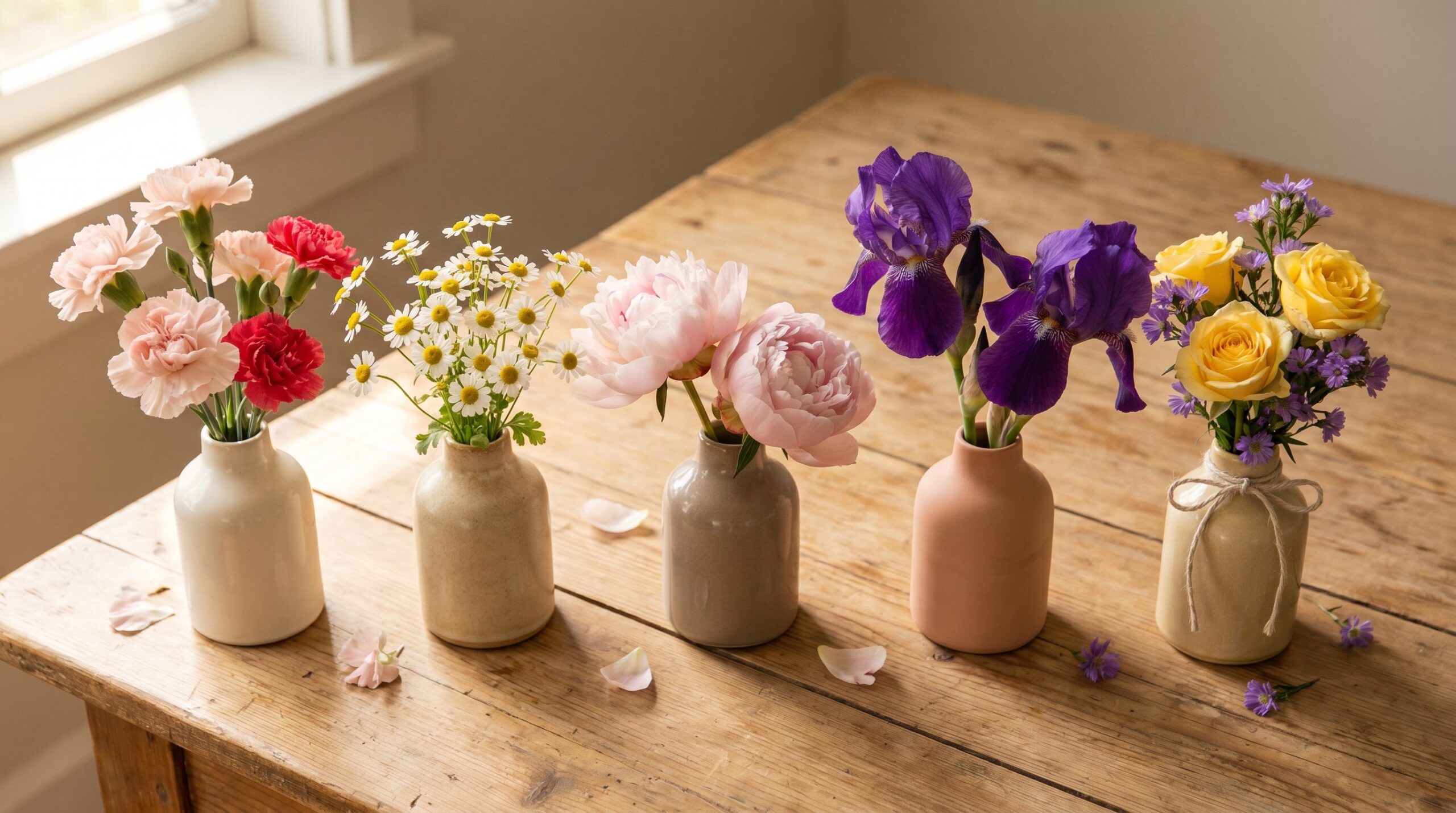
If you searched this a few minutes before you need an answer, here it is straight: year one is carnations, year five is daisies, year twelve is peonies, year twenty-five is irises, and the fiftieth is yellow roses laced with violets. The full table below runs from year one through year seventy-five, with the color that traditionally rides along with each bloom. What most florist blogs won't say out loud is that a good chunk of these years are genuinely contested. The Knot lists sunflowers for year three. Flowericon lists fuchsia. Sendflowers.com backs sunflowers, and so do we, but three named sources landing on two different answers means a real split exists between florist traditions. Nobody selling you a bouquet wants to admit their own list might be the minority view, so underneath the table we did the comparison ourselves: which years every source agrees on, which ones are a genuine coin flip between two florist traditions, and which flower we would actually send.
Find your anniversary flower for any year
The table covers every year a real florist authority bothers to track. Years marked "contested" have a real split between sources, resolved just below. Years with no flower listed are years where none of the lists we checked, The Knot, Flowericon, Interflora UK, FTD, or the retail sites that clone them, offer anything at all, and that gap is its own answer, covered after the table.
| Year | Flower | Color and meaning |
|---|---|---|
| 1 | Carnations | Pink or red; new love, fascination |
| 2 | Cosmos (contested, see below) | Soft pink or white; harmony, a love just taking root |
| 3 | Sunflowers (contested, see below) | Gold; a sturdy, sun-facing foundation |
| 4 | Geraniums, paired with fruit | Red or blue; friendship, plus the fruit-and-flowers gift theme this year traditionally carries |
| 5 | Daisies | White and yellow; fidelity, cheerful and unguarded love |
| 6 | Calla lilies | White for marital bliss, pink for appreciation |
| 7 | Freesias | Pale yellow or lavender; fragrant, quiet trust |
| 8 | Clematis and lilac | Violet and white; devotion that has settled in |
| 9 | Bird of paradise | Orange and blue; joy, a sense of freedom |
| 10 | Daffodils | Yellow; unconditional, decade-tested love |
| 11 | Tulips (contested, see below) | Red or purple; a passionate declaration |
| 12 | Peonies | Blush pink; prosperity, good fortune |
| 13 | Chrysanthemums | Gold or bronze; abundance, devoted loyalty |
| 14 | Dahlias | Deep red or purple; dignity, quiet strength |
| 15 | Roses | Red; deep, established love |
| 16-19 | No flower every source agrees exists (see below) | - |
| 20 | Asters | Lavender; love, wisdom, faith |
| 21-24 | No traditional flower on any list we checked | - |
| 25 | Irises | Purple; hope, wisdom, courage. The silver anniversary |
| 26-29 | No traditional flower on any list we checked | - |
| 30 | Lilies (contested, see below) | White; humility, devotion |
| 31-34 | No traditional flower on any list we checked | - |
| 35 | Coral roses | Coral pink; warmth |
| 36-39 | No traditional flower on any list we checked | - |
| 40 | Gladioli (contested, see below) | Red or white; strength, remembrance |
| 41-44 | No traditional flower on any list we checked | - |
| 45 | Blue irises | Blue; hope for the years still ahead |
| 46-49 | No traditional flower on any list we checked | - |
| 50 | Yellow roses and violets | Gold and purple; faith, everlasting love. The golden anniversary |
| 51-54 | No traditional flower on any list we checked | - |
| 55 | Green tinged calla lilies | White fading to green; the emerald years |
| 56-59 | No traditional flower on any list we checked | - |
| 60 | Orchids, though Interflora UK just says "white flowers" | White or lavender; luxury, endurance. The diamond anniversary |
| 61-75 | No florist authority we could find publishes a flower this far out | - |
Swipe →
The stretch from 16 through 19 deserves its own note, because the sources disagree at a deeper level than which flower fills them. They disagree on whether the years exist at all. The Knot assigns statice to 16, red carnations to 17, and bronze chrysanthemums to 19, while calling 18 open territory: "completely up to you to decide." Flowericon takes the harder line and says none of the four years has a real traditional flower, full stop, defaulting to roses for all of them. Past year 60, the pattern breaks down further. A handful of minor sites will tell you the 65th wants blue delphiniums, the 70th wants chrysanthemums, the 75th wants white roses, but none of that traces back to an actual florist authority. It reads like someone matched a flower to the anniversary's gemstone color after the fact, which is a fine approach if you like it, just not a tradition anyone actually recorded.
Why The Knot, Flowericon and the florists don't agree
The confusion has a real origin, and it is older than any of these websites. According to the anniversary history documented at Beyond Memories, the practice of marking anniversaries with specific materials traces back to medieval Germany, where a husband crowned his wife with a silver wreath on the 25th anniversary and a gold one on the 50th. English etiquette writers formalized a fuller version of that list in the 1860s and 1870s, built around materials that grow more durable as a marriage ages: paper, cotton and leather in the early years, working up through wood and iron toward the precious metals at the milestones. That original list was about gifts and materials. It was never about flowers, and it never covered every single year either, which is exactly why the 1937 American National Retail Jeweler Association stepped in with what's now called the modern list, adding coverage for years 17 through 24 and updating the older suggestions for a mid-century American household. The jewelry trade's fingerprints are on that update, and even histories sympathetic to the tradition admit some of the later years were picked mainly because they suited a jeweler's catalog rather than because any real custom demanded them.
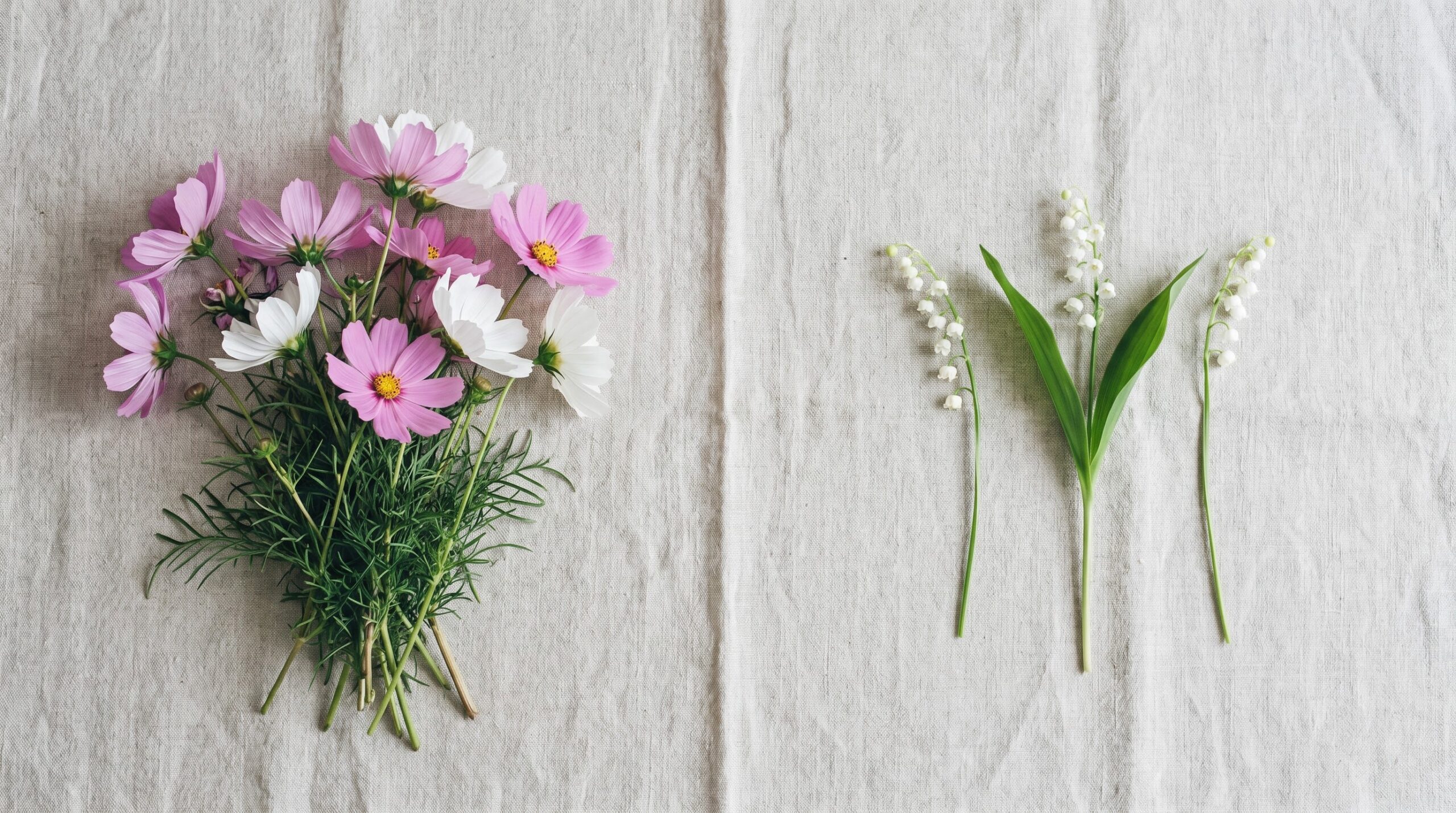
Florists inherited that material list generations later and had to invent flower equivalents for years the Victorians never assigned a bloom to in the first place. Different florists did that inventing independently, at different times, which is the actual root of every disagreement in the table above. Here is where the biggest ones land, source by source.
| Year | The Knot | Flowericon | Other florists checked | Where it lands |
|---|---|---|---|---|
| 2 | Cosmos | Cosmos | Sendflowers.com and several UK florist sites: lily of the valley | Cosmos is the majority pick even among sources that disagree on almost everything else. Lily of the valley is a real, persistent alternative documented across several independent florist sites, worth knowing about even though we would not lead with it |
| 3 | Sunflowers | Fuchsia | Sendflowers.com: sunflowers | Sunflowers, two sources to one, and our pick |
| 8 | Clematis and lilac, listed as two flowers | Clematis or lilac | Wedbuddy.com: lilac and clematis | Agreement in substance. The disagreement is only whether it's one flower or a pair |
| 9 | Poppies and bird of paradise | Bird of paradise | Sendflowers.com: bird of paradise | Bird of paradise is the shared core; The Knot just tacks on a second flower nobody else lists |
| 11 | Morning glories | Tulips | Sendflowers.com: tulips | Tulips, two to one, and the practical reason is below |
| 30 | Lilies | Sweet peas | Sendflowers.com and Interflora UK: lilies | Lilies, a clear majority, and our pick, with one caveat: true lilies are highly toxic to cats (the ASPCA documents this), so worth confirming there isn't one in the house before they arrive |
| 40 | Gladioli | Nasturtiums | Sendflowers.com and Interflora UK: gladioli | Gladioli, a clear majority, and our pick |
| 50 | Yellow roses and violets | Yellow roses and violets | Interflora UK and sendflowers.com: the same pairing | Full agreement. This is the one milestone nobody argues about |
| 60 | Orchids | Not listed | Interflora UK: "white flowers," no specific bloom named | A soft disagreement. Nobody has a confident claim past the diamond anniversary |
Swipe →
A note on the fourth column: FTD runs its own dedicated pages for the 1st, 10th, 25th, 40th and 50th anniversaries, and on the years we could confirm (carnations for one, daffodils for ten, irises for twenty-five, yellow roses and violets for fifty) it lines up with the majority view every time. FTD's exact stance on the contested years above wasn't something we could pull directly during research, so we've left those cells to the sources we could verify rather than guess at a fifth column.
The Knot publishes the fullest single list on the open web, running from year one all the way to sixty with barely a gap, which is likely why it dominates the search results. But a full list built by one commerce editor is still one editor's judgment call, repeated. Interflora UK takes the opposite approach and only commits to the five milestone years, with actual florist input behind the choices rather than an editorial team working alone. Where the two disagree, as they do on year 60, that gap is worth noticing rather than smoothing over.
When your year's flower is out of season or doesn't exist
Three of the contested years have a practical explanation sitting underneath the tradition, and it changes what you should actually order. Morning glories, The Knot's pick for year eleven, close up within hours of being cut and rarely survive being arranged at all, which is almost certainly why the florists who actually sell flowers for a living settled on tulips instead. Nasturtiums, Flowericon's pick for year forty, are an edible flower more at home in a salad than a florist's cooler, and most flower shops simply don't stock them, so gladioli became the version you can actually buy. Lily of the valley, the persistent alternative for year two, is the trickiest of the three: real florists do carry it, but only in spring, only imported, with a vase life measured in days rather than a week, and a price tag well above what its size would suggest. If you can find it in season, it's a genuinely lovely and better story than cosmos. If you're ordering three days before the date in October, cosmos is what will actually arrive looking good.
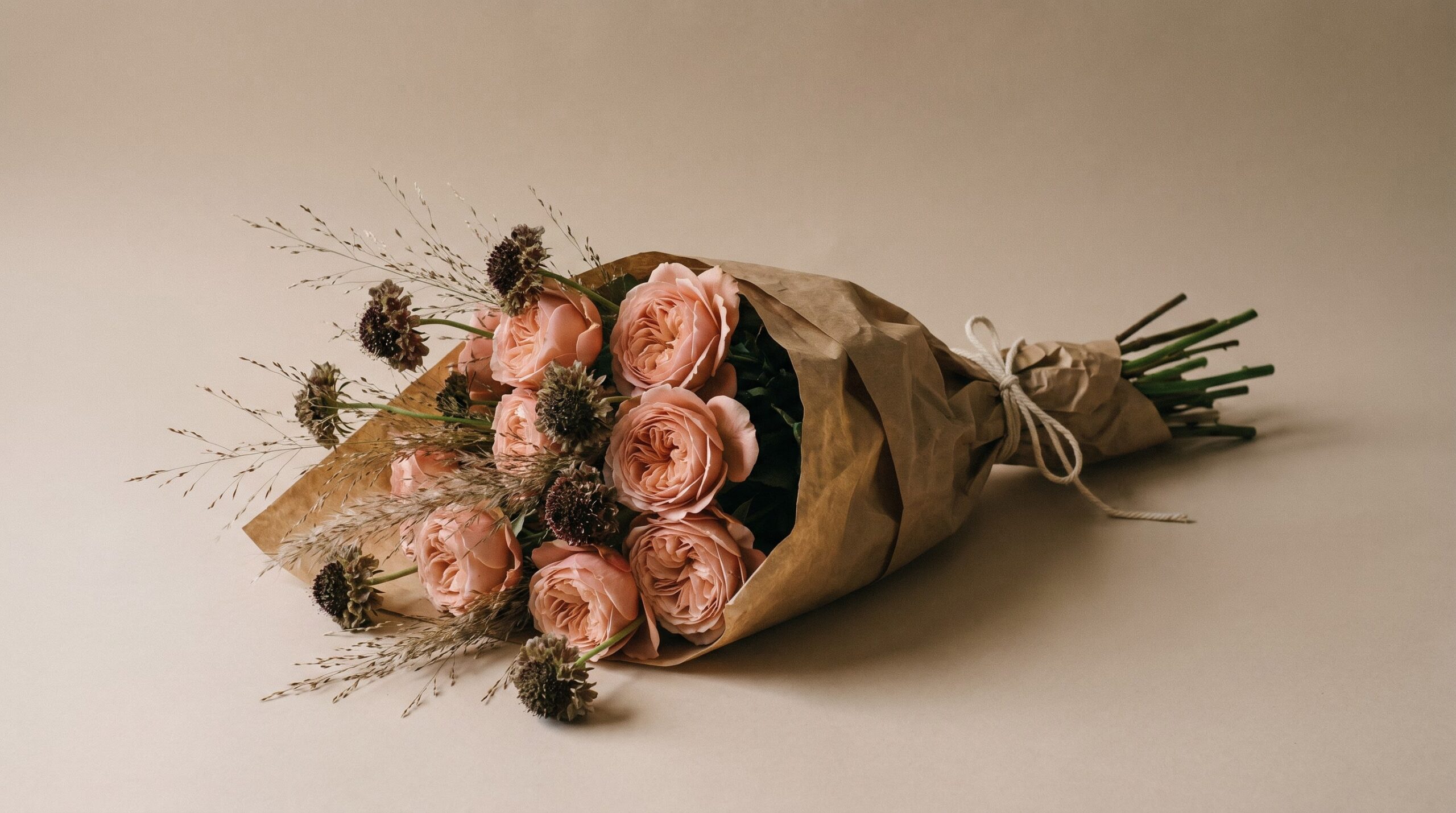
The empty years, 16 through 19, 21 through 24, and every four-year gap after that up through the fifties, don't need a florist's permission to have an answer. Pick by the meaning that fits your marriage this year rather than hunting for an official flower that was never assigned, or lean on that year's traditional gift material for a color cue: silver leans toward white and lavender blooms, wood leans toward warm golds and browns, and let the flower follow. Our guide to what each flower traditionally says is a reasonable place to start if you want the pick to mean something specific rather than just look nice. And whichever way you land, the thing not to do is force a contested or out-of-season flower into the order because a website told you it was official. These lists exist to sell flowers first and preserve tradition a distant second, and treating any one of them as gospel gets you a wilted bouquet and a shipping delay when the sentiment was the whole point.
Making the flower actually land
None of this research started with anyone asking a friend. People who search "anniversary flowers by year" are googling it alone, on a phone, usually with the date closer than they'd like to admit, and one commenter on r/Marriage put the whole behavior in one line: "you have internet access, you can google ideas for what to do for different anniversaries and events." That's the entire audience for this page. Nobody's asking their group chat what year six is. They're typing it into a search bar at eleven at night.
The reader who gets this right early tends to describe the same system, whatever they call it. One user on r/marriageadvice laid his out plainly: "I get my wife: 1 thoughtful modern anniversary gift, 1 traditional anniversary gift, 1 traditional anniversary gemstone (moderately priced...), 1 bouquet of traditional anniversary flowers. Lastly, I incorporate traditional anniversary colors to the bouquet and whole presentation." He called it his racket, and it works precisely because none of the individual pieces need to be expensive. The flower with a single line of explanation, this is the color for year twelve, this is what the daisies mean, does more work than a bigger, unexplained bouquet ever will.
The version that goes wrong tends to go wrong the same way too. One user on r/AskMen admitted he forgot his fifth anniversary until the day itself, ran out and grabbed flowers, a card and some chocolate, and got them handed straight back. His wife told him flatly she didn't want his "pitty flowers" or his "pitty card." He ended up saving the night with an engraved wood cutting board, because the fifth anniversary gift is wood themed, a fact he only learned after the flowers had already failed. That's the exact fear sitting under a lot of these searches: the risk that the bouquet reads as an afterthought rather than something planned, whatever it cost. A named flower with a one-line reason behind it is the cheapest possible insurance against that.
The fourth anniversary carries its own creative problem, since the traditional theme pairs geraniums with fruit, and one r/AskMen thread asked exactly the right question: what's a creative spin on a fruit-and-flower gift a man would actually love giving. A fruit basket built around the geranium's own color, or a bouquet with a few stems of edible flowers and fruit woven through the arrangement, honors the theme without turning into a supermarket cliche. For the full etiquette on timing, delivery and how to hand the bouquet over so it lands, our guide to giving anniversary flowers so they land covers that ground in full. And one boundary worth naming plainly: if the date you're shopping for is the anniversary of a death rather than a wedding, this page is the wrong page, since flowers read very differently on a grief anniversary, and our guide to flowers for the anniversary of a death follows a different set of rules entirely.
The golden anniversary: the fiftieth, done right
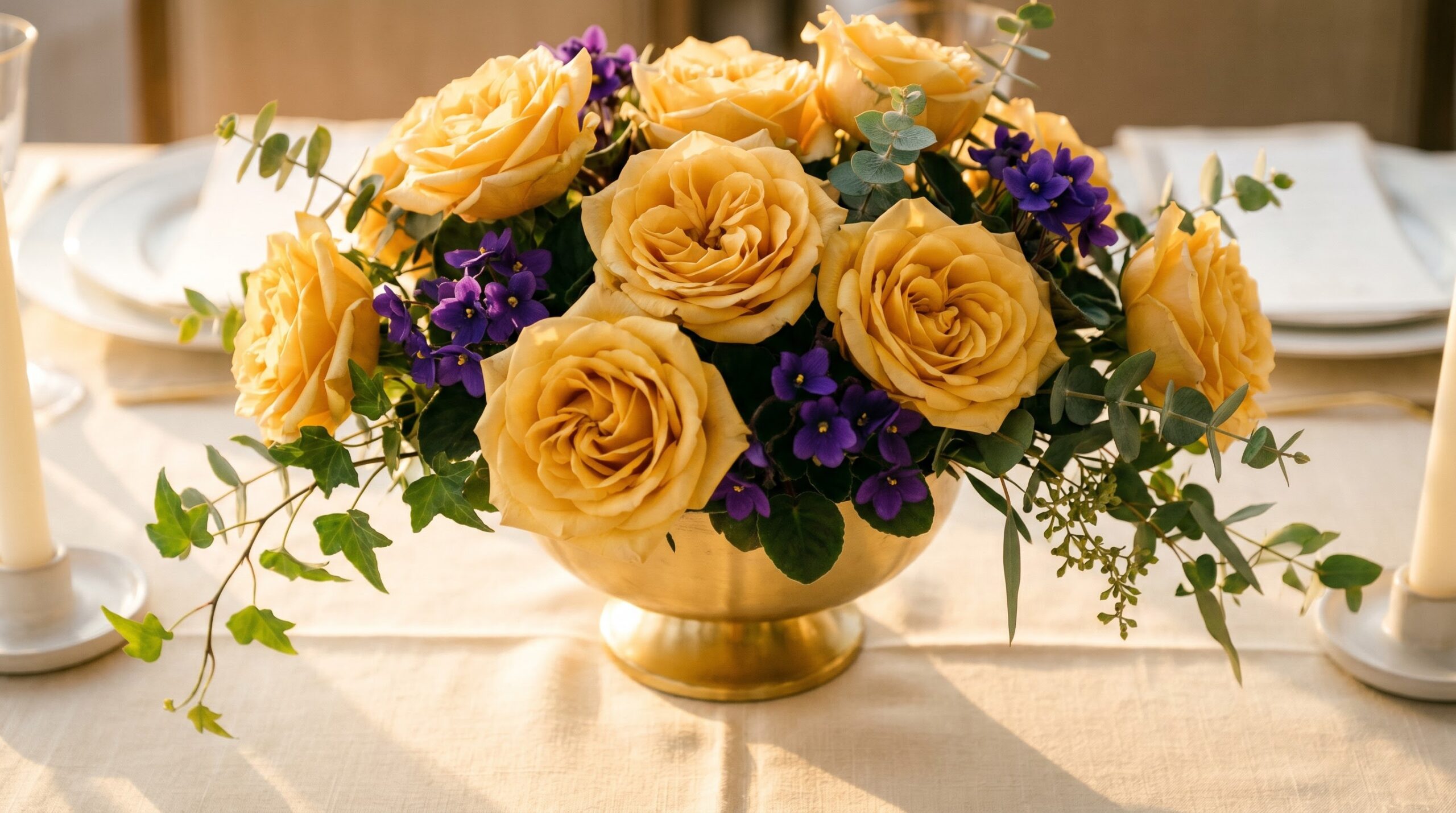
Year fifty is the one entry in the entire table where nobody disagrees, and the shape of the agreement is itself interesting. The Knot, Flowericon, Interflora UK and the retail sites we checked all land on the same pairing, yellow roses and violets, rather than a single flower. Yellow carries the gold the milestone is named for. Violets carry the older, quieter meaning of faithfulness that the gold tends to overshadow. A fiftieth anniversary table or centerpiece built around both, rather than yellow roses alone, tends to read as more considered, and it gives a florist something to actually design around instead of a single monochrome stem count.
The fiftieth is also where the buyer changes. A meaningful share of these searches come from adult children shopping for their parents rather than a spouse shopping for their partner, and the instinct running through that group shows up clearly on r/florists, where one user wrote in about a milestone anniversary coming up for her parents and wanting to surprise them with a bouquet using the same flowers they had at their own wedding. That instinct, matching the original wedding flowers rather than the generic year-fifty pairing, works just as well for a fiftieth as it does for a twenty-fifth, and it tends to mean more to the couple than a bouquet built strictly off a table like this one. If nobody remembers what those original flowers were, yellow roses and violets are a genuinely fine fallback, sourced across every list that bothered to weigh in.
So find your year in the table above, confirm the color and the one line of meaning behind it, and order that. If the flower turns out to be contested between sources, or hard to find this week, reach for the substitute named here rather than whatever a random site insists is official. That's the whole system: a real answer, a reason attached to it, and a backup plan when the tradition runs into a florist's actual inventory.
Enjoying our flower guides? Add YourFlowersGuide as a preferred source on Google. It helps more readers find us.
Add to Preferred Sources