
Hand the flowers over after the ceremony, not during it. If it's the night before commencement and you're standing in the kitchen wondering whether you've already gotten the timing wrong, you haven't: tradition puts a corsage or boutonnière on the graduate before the ceremony begins, and saves the full bouquet for afterward, at the moment the graduate finds their people again outside the auditorium or stadium. That much is settled, and Emily Post's own etiquette guidance backs it up almost word for word. The part nobody warns you about, and the part that actually derails families every graduation season, is whether the venue will even let you carry that bouquet through the door in the first place.
When to actually hand over the flowers
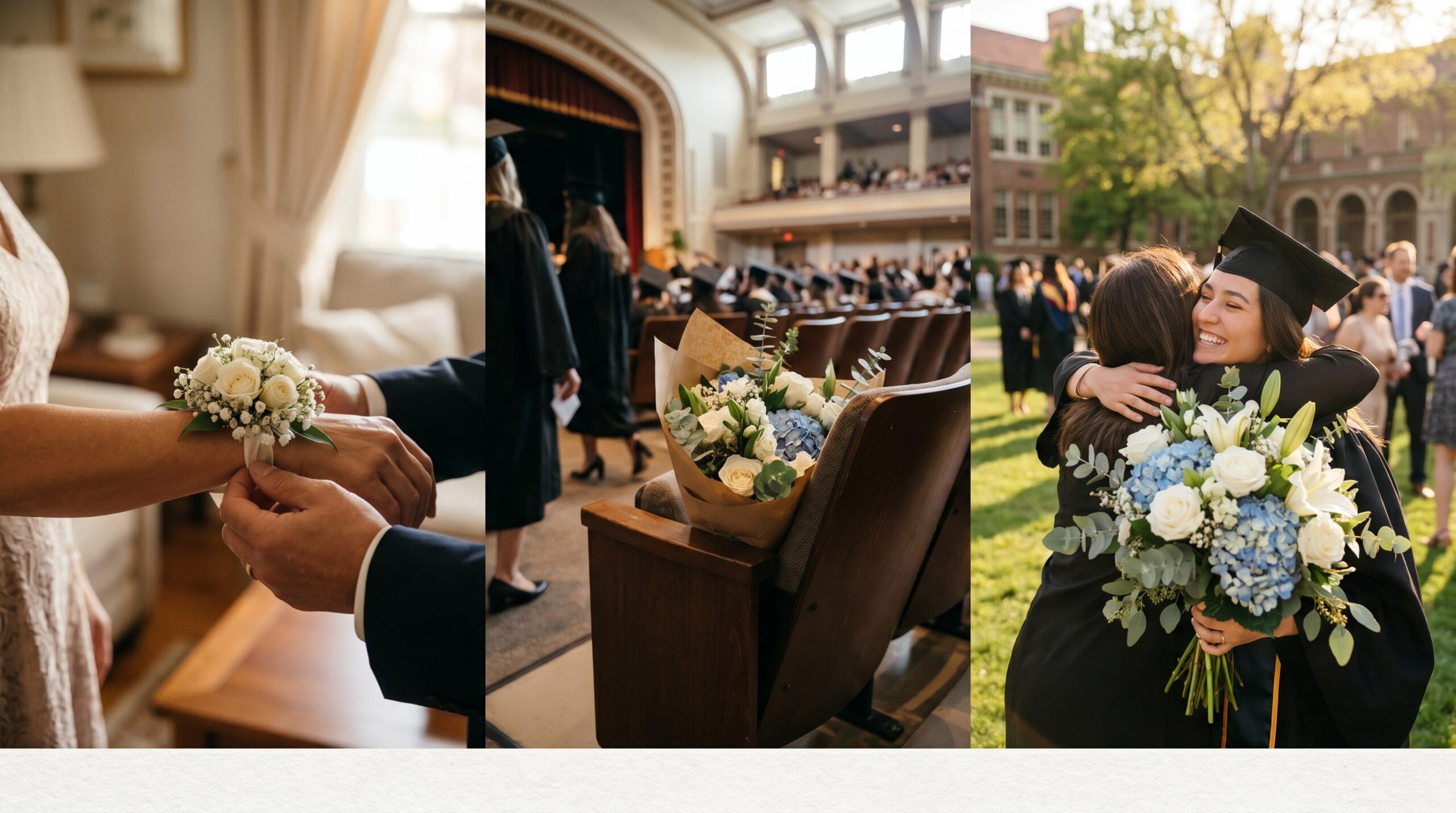
The Emily Post Institute's graduation etiquette guidance settles the order of operations in one line: it's tradition to present the graduate with a corsage or boutonnière prior to the ceremony, or a bouquet of flowers afterwards. A corsage or boutonnière is small enough to wear into the seats, so it goes on before anyone sits down, usually pinned on at home or in a parking lot in the last few minutes before the processional starts. A cut bouquet is a different animal: bulky, awkward to hold through an hour or two of names being called, and not something anyone wants to balance on their lap while trying to spot their graduate crossing the stage. That's why the bouquet waits.

The question that actually shows up in parent forums the night before a ceremony isn't whether to bring flowers, it's what to do with them once you have them. One parent posting to a graduation Facebook group described having already bought 75 roses and only then realizing she had no idea when to actually hand them over, a scramble common enough that a near-identical version of it shows up on Reddit's r/NoStupidQuestions, where someone asked whether they'd be stuck clutching a bouquet through an entire two-hour program. The answer, repeated across several r/AskReddit threads describing how graduations actually run, stays consistent: the graduate sits with their class through the ceremony, walks the stage when their name is called, and only reunites with family and friends afterward, outside the venue, for the round of hugs and photos where gifts change hands. The bouquet changes hands at that reunion, once everyone's back together outside.
If you're giving both a corsage or boutonnière and a full bouquet on the same day, the small piece goes on before the doors open, and the bouquet stays in the car, or with whoever in your group isn't attending, until the ceremony lets out. Don't try to hold both through the seating.
Check your venue's bag policy before you check your outfit
Nobody puts this on a checklist, but it belongs on one: plenty of stadiums and arenas that host graduations run the exact same bag policy they use for a football game or a concert, and they don't carve out an exception for commencement. The clearest documented case is the Alamodome in San Antonio, home to the University of Texas at San Antonio's graduation ceremonies. UT San Antonio's own commencement guest information confirms that a Clear Bag Policy is in force for commencement exactly as it is for any other ticketed Alamodome event, and the venue's posted rules give security the standing right to turn away any item deemed dangerous or unsuitable. Families who've shown up with a full bouquet have reported being stopped at the door and told to leave it behind, because a loose armful of flowers doesn't fit inside a clear bag any better than a purse or a backpack does, and graduation isn't treated as a special case there.

Your venue almost certainly isn't the Alamodome, and its own rules may be looser or stricter. What matters is the pattern behind that one case: a large public venue built for concerts and sports treats a graduation crowd the way it treats every other crowd passing through its doors. Look up your specific stadium, arena, or auditorium's own bag and prohibited-items policy before the day, the same way you'd check one before a concert. Most college and university commencement pages post this under "guest information" or "what to bring," usually a week or two ahead of the ceremony.
| Moment | What's typical | What to check first |
|---|---|---|
| Before the ceremony | A corsage or boutonnière, pinned on and worn into the seats | Nothing, this part is essentially never restricted |
| During the ceremony | No bouquet in hand; leave it in the car or with someone not attending | Whether your venue runs bag checks at all |
| Right after, at the reunion | The full bouquet, handed over for hugs and photos | This is the moment a bouquet actually belongs |
| Before you leave home | Nothing to carry yet | Your venue's own bag and prohibited-items policy |
Swipe →
Leis carry their own separate etiquette and, at some venues, their own floor rules that have nothing to do with a standard bouquet; that's its own set of considerations worth reading if a lei is part of your family's tradition.
How many flowers to actually bring
Size the bouquet to the moment, not to how much affection you're trying to express. A single stem or a small corsage says exactly as much as an oversized arrangement once the photos are taken and everyone's driving home, and a graduate with more than one set of family and friends attending often ends up on the receiving end of far more flowers than any dorm room or apartment has vases for. One parent, describing her daughter's graduation on an advice forum, summed up the aftermath simply: four vases of flowers that were dead within days, and then the actual work of dumping the water, washing the vases, and cleaning up petals and pollen for a week afterward. The practical lesson is to size the bouquet sensibly and check with anyone else in the group who might also be bringing one.
If several friends or family members are all planning to bring something, a group text beforehand solves the problem before it starts. A common workaround among college graduates, especially at larger universities, is for a group of friends to chip in ten dollars or so apiece and buy one nice bouquet together rather than five separate ones that all end up wilting on the same windowsill. It usually costs less per person than a solo bouquet would, too. Which actual flowers or colors to bring, including matching a graduate's school colors, is a separate decision worth its own look before you buy.
Does this change for a kindergarten or elementary graduation?
Yes, and the difference is bigger than most people expect. A kindergarten or elementary school "graduation" is a party rather than a commencement: there's no stage walk in the formal sense, no diploma, no crowd of thousands to navigate. On forums where parents compare notes on exactly this question, the etiquette consensus is blunt: these presents belong at the party itself, handed over whenever feels natural, with none of the timing rules above attached. A small posy, a single flower, or a card is plenty.

High school and college ceremonies are where the rest of this article actually applies, and the venue-ban problem specifically bites hardest at college commencements held in stadiums or arenas rather than a school gymnasium. A high school graduation in a gym rarely runs a clear-bag policy; a university sending thousands of families into a football stadium usually does. If you're not sure which category your ceremony falls into, that's the one fact worth confirming before you decide whether checking a bag policy even applies to you.
Is bringing flowers even expected?
Not as a hard rule. Close family and close friends are the ones who typically show up with something, and plenty of graduates say the flowers are as much for the photos as anything else, a bright prop for the pictures everyone's taking regardless. Nobody is required to bring a bouquet, and a graduate who doesn't get one hasn't been slighted by the people who love them.
A couple of related questions point elsewhere. If the graduate is a guy and you're second-guessing whether flowers are even the right call, that's its own question with its own answer, and this page treats givers and recipients neutrally rather than wading into it. If you're celebrating a different milestone entirely, not a graduation, the wider range of congratulations occasions, from a new job to an engagement, runs on slightly different rules than the ones here.
For the graduation itself, the plan that actually works stays simple. Pin on the corsage or boutonnière before the ceremony if you're giving one. Hold the bouquet back until the reunion afterward, when everyone's together for photos anyway. And before any of that, spend five minutes on your own venue's bag and prohibited-items page, so you're not the one standing at the check-in line with nowhere to put a dozen roses.
Enjoying our flower guides? Add YourFlowersGuide as a preferred source on Google. It helps more readers find us.
Add to Preferred Sources